Article

Determinants and Projections of Minimum Acceptable Diet among Children Aged 6–23 Months: A National and Subnational Inequality Assessment in Bangladesh


by
Md. Shafiur Rahman
1,2,†,
Md. Rocky Khan Chowdhury
3,4,†,
Md. Rashedul Islam
5,
Sarah Krull Abe
6,
Kamal Hossain
7,
Toshiki Iwabuchi
1,2,
Kenji J. Tsuchiya
1,2 and
Stuart Gilmour
8,*
1
Research Centre for Child Mental Development, Hamamatsu University School of Medicine, Hamamatsu 431-3192, Japan
2
United Graduate School of Child Development, Osaka University, Kanazawa University, Hamamatsu University School of Medicine, Chiba University and University of Fukui, Suita 565-0871, Japan
3
Department of Public Health, First Capital University of Bangladesh, Chuadanga 7200, Bangladesh
4
Department of Epidemiology and Preventive Medicine, School of Public Health and Preventive Medicine, Monash University, St. Kilda Road, Melbourne, VIC 3004, Australia
5
Hitotsubashi Institute for Advance Study, Hitotsubashi University, Tokyo 186-8601, Japan
6
Division of Prevention, National Cancer Center Institute for Cancer Control, Tokyo 104-0045, Japan
7
Department of Population Science and Human Resource Development, Rajshahi University, Rajshahi 6204, Bangladesh
8
Division of Biostatistics and Bioinformatics, Graduate School of Public Health, St. Luke’s International University, Akashi-cho, Chuo-ku, Tokyo 104-0044, Japan
*
Author to whom correspondence should be addressed.
These authors contributed equally to this work.
Int. J. Environ. Res. Public Health 2023, 20(3), 2010; https://doi.org/10.3390/ijerph20032010

Submission received: 30 November 2022 / Revised: 15 January 2023 / Accepted: 17 January 2023 / Published: 21 January 2023
(This article belongs to the Special Issue Feature Paper: Advance in Global Health)

Abstract

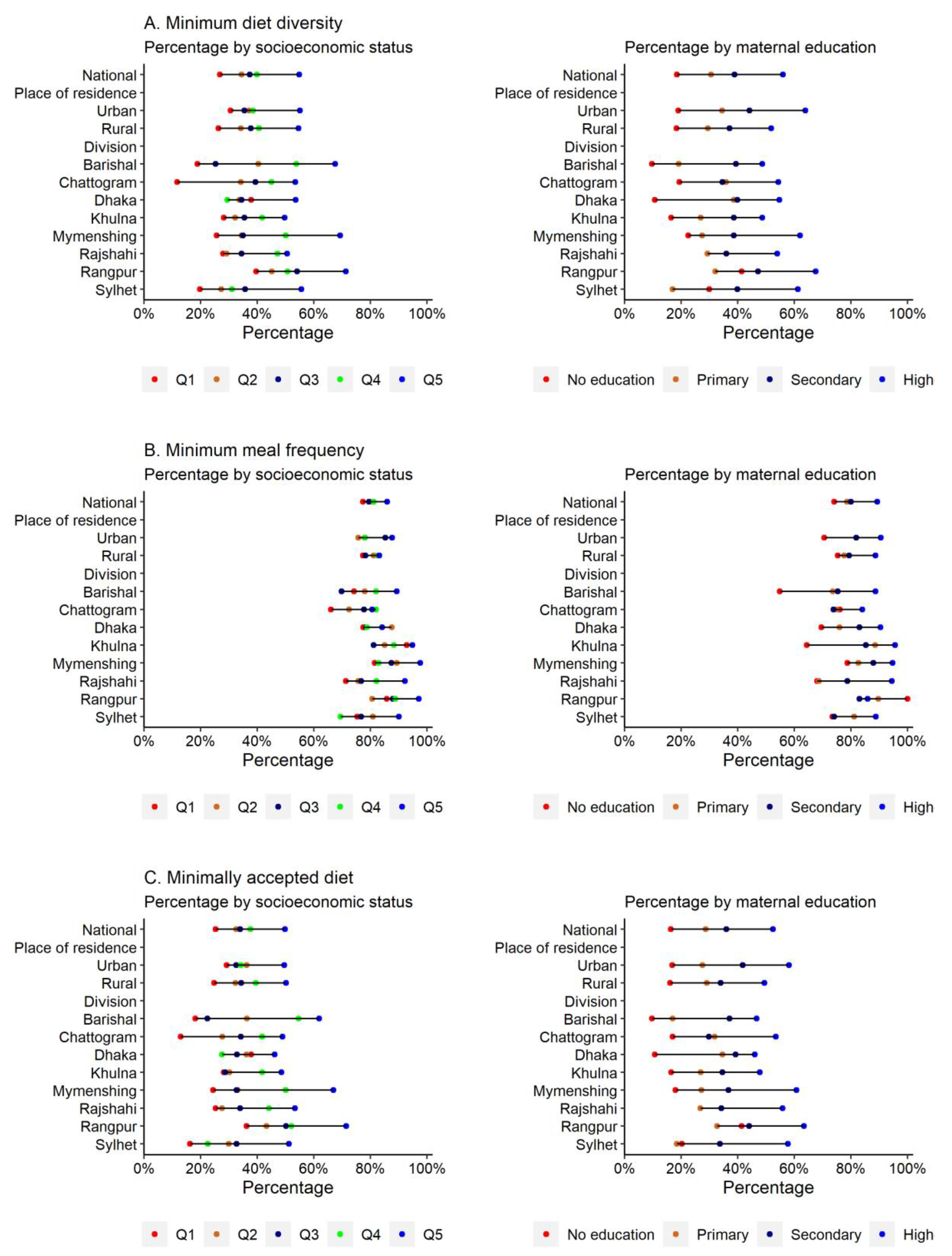
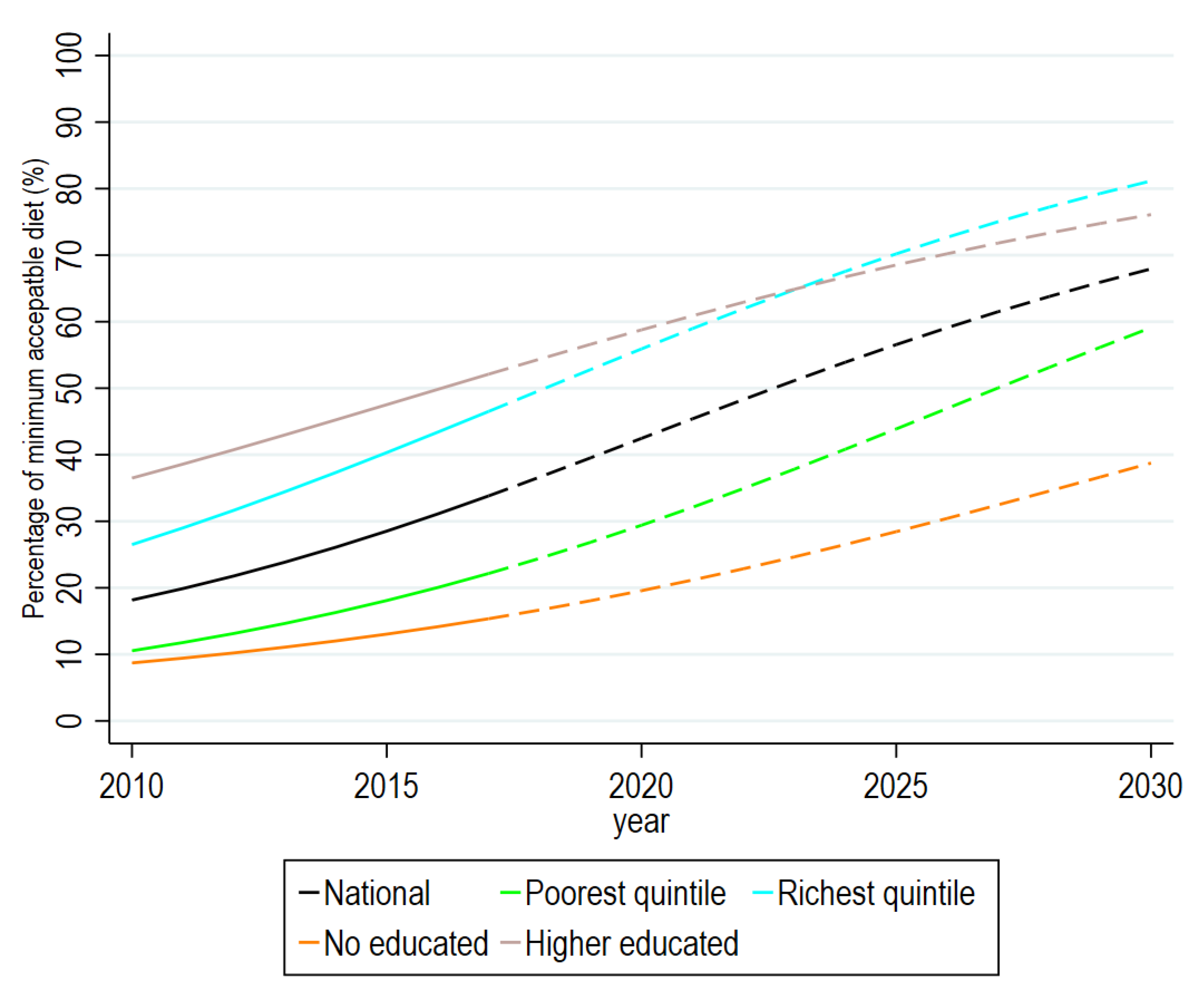
Subnational evidence on the level of inequality in receiving complementary feeding practice among Bangladeshi children is lacking. This study estimated inequality in the minimum acceptable diet (MAD) among Bangladeshi children aged 6–23 months, and identified risk factors for and developed projections of the MAD up to 2030. Data from the Bangladesh Demographic and Health Survey 2017–2018 were used in this cross-sectional study. Regression-based slope (SII) and relative index of inequality (RII) were used to quantify the level of absolute and relative inequality, respectively. A Bayesian logistic regression model was used to identify the potential determinants of a MAD and project prevalence up to 2030. About 38% of children aged 6–23 months received a MAD. The national prevalence of a MAD was 26.0 percentage points higher among children from the richest compared to the poorest households, and 32.1 percentage points higher among children of higher-educated over illiterate mothers. Socioeconomic inequality was found to be the highest in the Chattogram division (SII: 43.9), while education-based inequality was highest in the Sylhet division (SII: 47.7). Maternal employment and the number of ANC visits were also identified as significant determinants of a MAD, and the prevalence of a MAD was projected to increase from 42.5% in 2020 to 67.9% in 2030. Approximately two out of five children received a MAD in Bangladesh and significant socioeconomic and education-based inequalities in the MAD were observed. Subnational variation in socioeconomic and education-based inequalities in the MAD requires further public health attention, and poverty reduction programs need to be strengthened.
Keywords: minimum acceptable diet; meal frequency; diet diversity; socioeconomic inequality; education-based inequality; projection; Bangladesh minimum acceptable diet; meal frequency; diet diversity; socioeconomic inequality; education-based inequality; projection; Bangladesh