Article

Coexistence of Anaemia and Stunting among Children Aged 6–59 Months in Ethiopia: Findings from the Nationally Representative Cross-Sectional Study

by
Biniyam Sahiledengle
1,*,
Lillian Mwanri
2,
Pammla Petrucka
3 and
Kingsley Emwinyore Agho
4
1
Department of Public Health, Madda Walabu University Goba Referral Hospital, Bale-Goba P.O. Box 302, Ethiopia
2
Research Centre for Public Health, Equity and Human Flourishing, Torrens University Australia, Adelaide Campus, Adelaide 5000, Australia
3
College of Nursing, University of Saskatchewan, Saskatoon, SK S7N 5A2, Canada
4
School of Health Sciences, Western Sydney University, Locked Bag 1797, Penrith 2751, Australia
*
Author to whom correspondence should be addressed.
Int. J. Environ. Res. Public Health 2023, 20(13), 6251; https://doi.org/10.3390/ijerph20136251

Submission received: 23 May 2023 / Revised: 19 June 2023 / Accepted: 26 June 2023 / Published: 29 June 2023
(This article belongs to the Section Global Health)

Abstract

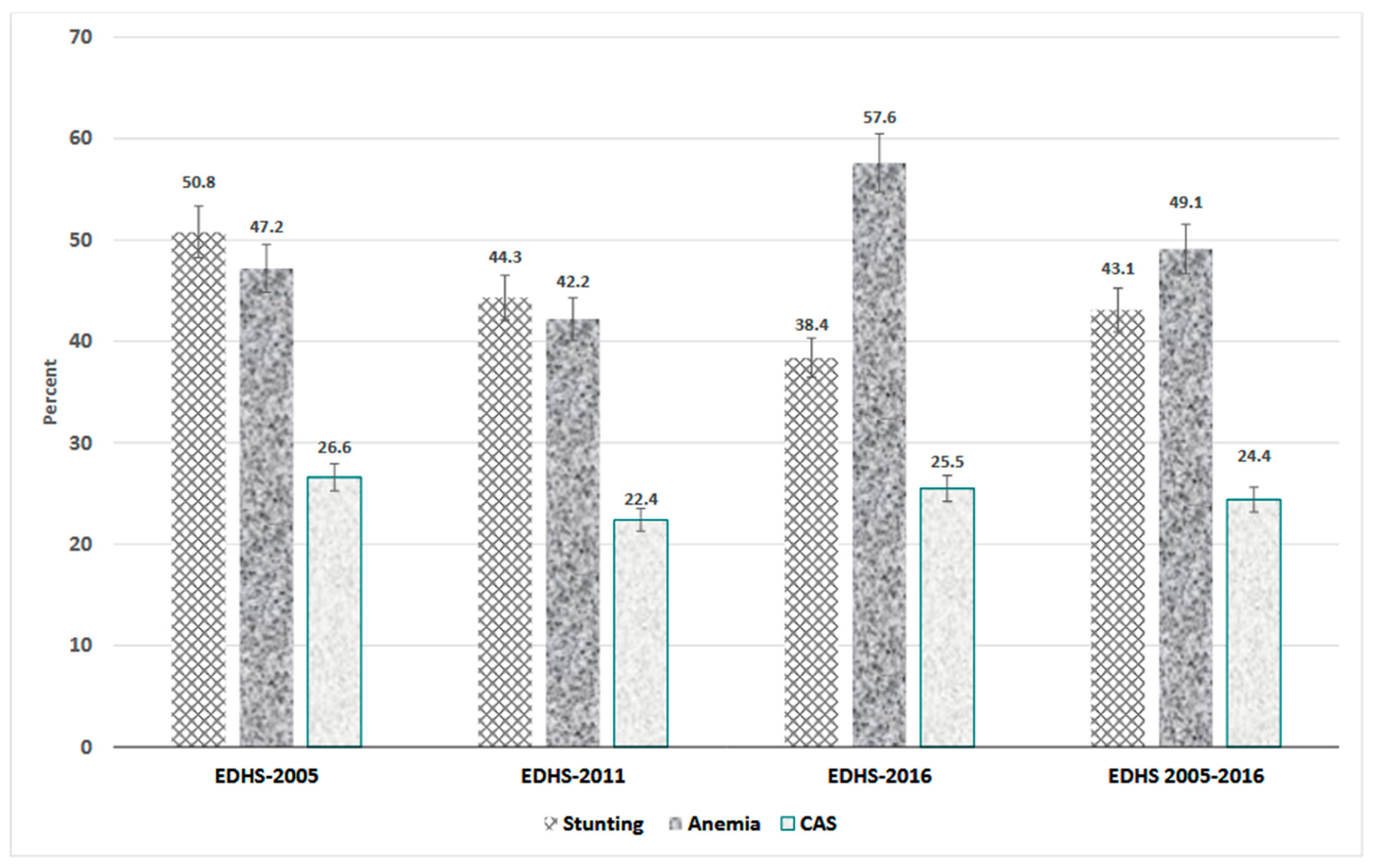
Introduction: Stunting and anaemia, two severe public health problems, affect a significant number of children under the age of five. To date, the burden of and predictive factors for coexisting forms of stunting and anaemia in childhood have not been well documented in Ethiopia, where both the conditions are endemic. The primary aims of the present study were to: (i) determine the prevalence of co-morbid anaemia and stunting (CAS); (ii) and identify factors associated with these co-morbid conditions among children aged 6–59 months in Ethiopia. Methods: The study was based on data from the Ethiopian Demographic and Health Survey (EDHS 2005–2016). The EDHS was a cross-sectional study that used a two-stage stratified cluster sampling technique to select households. A total weighted sample of 21,172 children aged 6–59 months was included in the current study (EDHS-2005 (n = 3898), EDHS-2011 (n = 8943), and EDHS-2016 (n = 8332)). Children with height-for-age z-scores (HAZ) less than −2 SD were classified as stunted. Anaemia status was measured by haemoglobin level with readings below 11.0 g/deciliter (g/dL) categorized as anaemic. A multilevel mixed-effects logistic regression model was used to identify the factors associated with CAS. The findings from the models were reported as adjusted odds ratios (AOR) with 95% confidence intervals (CIs). Results: Almost half of the children were males (51.1%) and the majority were from rural areas (89.2%). The prevalence of CAS was 24.4% [95% CI: (23.8–24.9)]. Multivariate analyses revealed that children aged 12–23 months, 24–35 months, and 36–59 months, and children perceived by their mothers to be smaller than normal at birth had higher odds of CAS. The odds of CAS were significantly higher among children born to anaemic mothers [AOR: 1.25, 95% CI: (1.11–1.41)], mothers with very short stature [AOR: 2.04, 95% CI: (1.44–2.91)], children from households which practiced open defecation [AOR: 1.57, 95% CI: (1.27–1.92)], children born to mothers without education [AOR: 3.66, 95% CI: (1.85–7.22)], and those who reside in rural areas [AOR: 1.41, 95% CI: (1.10, 1.82)]. Male children had 19% lower odds of having CAS compared to female children [AOR: 0.81, 95% CI: (0.73–0.91)]. Children born to mothers who had normal body mass index (BMI) [AOR: 0.82, 95%CI: (0.73–0.92)] reported lower odds of CAS. Conclusions: One in four preschool-age children in Ethiopia had co-morbid anaemia and stunting, which is a significant public health problem. Future interventions to reduce CAS in Ethiopia should target those children perceived to be small at birth, anaemic mothers, and mothers with short stature.
Keywords: stunting; anaemia; concurrent stunting and anaemia; coexisting forms of malnutrition stunting; anaemia; concurrent stunting and anaemia; coexisting forms of malnutrition