Article

Episodic Memory Performance Modifies the Strength of the Age–Brain Structure Relationship
Department of Psychology, Stony Brook University, Stony Brook, NY 11794-2500, USA
*
Author to whom correspondence should be addressed.
Int. J. Environ. Res. Public Health 2022, 19(7), 4364; https://doi.org/10.3390/ijerph19074364

Submission received: 7 February 2022 / Revised: 30 March 2022 / Accepted: 1 April 2022 / Published: 5 April 2022
(This article belongs to the Special Issue Innovations in Healthy Aging)

Abstract

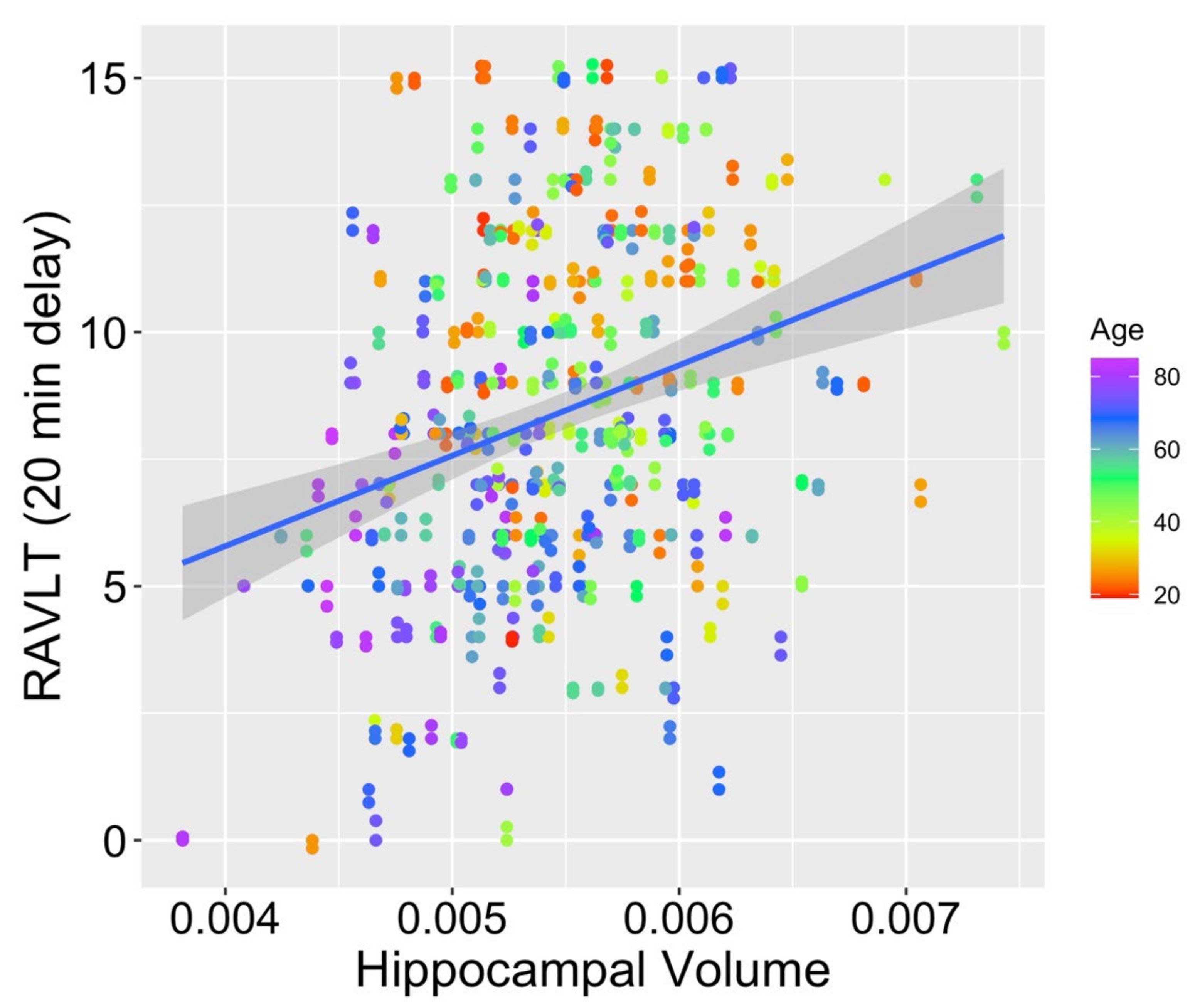
The bivariate relationships between brain structure, age, and episodic memory performance are well understood. Advancing age and poorer episodic memory performance are each associated with smaller brain volumes and lower cortical thickness measures, respectively. Advancing age is also known to be associated with poorer episodic memory task scores on average. However, the simultaneous interrelationship between all three factors—brain structure, age, and episodic memory—is not as well understood. We tested the hypothesis that the preservation of episodic memory function would modify the typical trajectory of age-related brain volume loss in regions known to support episodic memory function using linear mixed models in a large adult lifespan sample. We found that the model allowing for age and episodic memory scores to interact predicted the hippocampal volume better than simpler models. Furthermore, we found that a model including a fixed effect for age and episodic memory scores (but without the inclusion of the interaction term) predicted the cortical volumes marginally better than a simpler model in the prefrontal regions and significantly better in the posterior parietal regions. Finally, we observed that a model containing only a fixed effect for age (e.g., without the inclusion of memory scores) predicted the cortical thickness estimates and regional volume in a non-memory control region. Together, our findings provide support for the idea that the preservation of memory function in late life can buffer against typical patterns of age-related brain volume loss in regions known to support episodic memory.
Keywords: episodic memory; adult lifespan; structural neuroimaging; hippocampal volume; cortical thickness episodic memory; adult lifespan; structural neuroimaging; hippocampal volume; cortical thickness