


The Impact of Four High-Altitude Training Camps on the Aerobic Capacity of a Short Track PyeongChang 2018 Olympian: A Case Study

 ,
,  ,
,  and
and
Abstract
1. Introduction
2. Materials and Methods
2.1. Subject
2.2. Methods and Tools
2.3. Research Procedures
2.4. High-Altitude Training of an Olympic Athlete
- 1
- In macrocycles of general preparation, the main training was based on aerobic training—continuous method (efforts at threshold intensity of AT4) and interval lactic acid training.
- -
- The combination of the two workouts was considered to increase VO2max. The training sessions were performed on a bicycle, measuring work at a specific heart rate (HR). Training was also focused on running or walking in the mountains. Duration of training sessions: 60–120 min.
- -
- Lactic acid training sessions were held two or three times in a microcycle using the interval method. The training consisted of running on the ice or running a certain number of sections on an athletics track in 50″–1′45″ at a speed of 85% with a break between sections 1′–2′. The number of repetitions in a set was 7–10, with 2–3 sets.
- 2
- The training intensity changed to 90% in the second mesocycle. This intensity resulted in better production of lactic acid in the muscles and an increase in the athlete’s blood lactate level. On this basis, the plan includes typical aerobic training conducted on a bicycle and in a running form. They supported faster regeneration of the body after exercise.
- -
- An important assumption at that time was the performance of endurance tests, especially the graded exercise test, which allowed us to determine the athlete’s HR at the metabolic thresholds, enabling better programming of subsequent training sessions and choice of their intensity (LT and AT).
- -
- Complementary training: aerobic training was performed only in specific zones based on the principle of training individualization. For lactic acid tolerance training to be effective and not to lead to overtraining or fatigue after glycogen depletion, aerobic training in specific AT and LT zones was very important, thus leading to improved performance.
- -
- The aerobic training was performed for 4–5 sessions in a given build-up microcycle, and up to 6–7 sessions in the introductory microcycle.
- 3
- Strength training also played an important role in the training plan. It was performed 3 times in the build-up microcycle and twice in the introductory microcycle.
- -
- In the regenerative microcycle, one training session was performed for muscle stimulation. In the preparatory period, strength training was focused on strength endurance and building maximum strength. During the competitive period, strength training was aimed at maintaining maximum strength and building maximum strength. The range of training loads was controlled and adjusted every four weeks.
- 4
- Complementary training was ice speed training, ice skating technique training, and skating tactics training. These training sessions were performed using the individual skating method or in a relay race. Such training sessions were designed to combine main training with support training.
- 5
- In the regenerative microcycle, an important factor was the work with a physiotherapist and complementary training for the athlete.
3. Results
- -
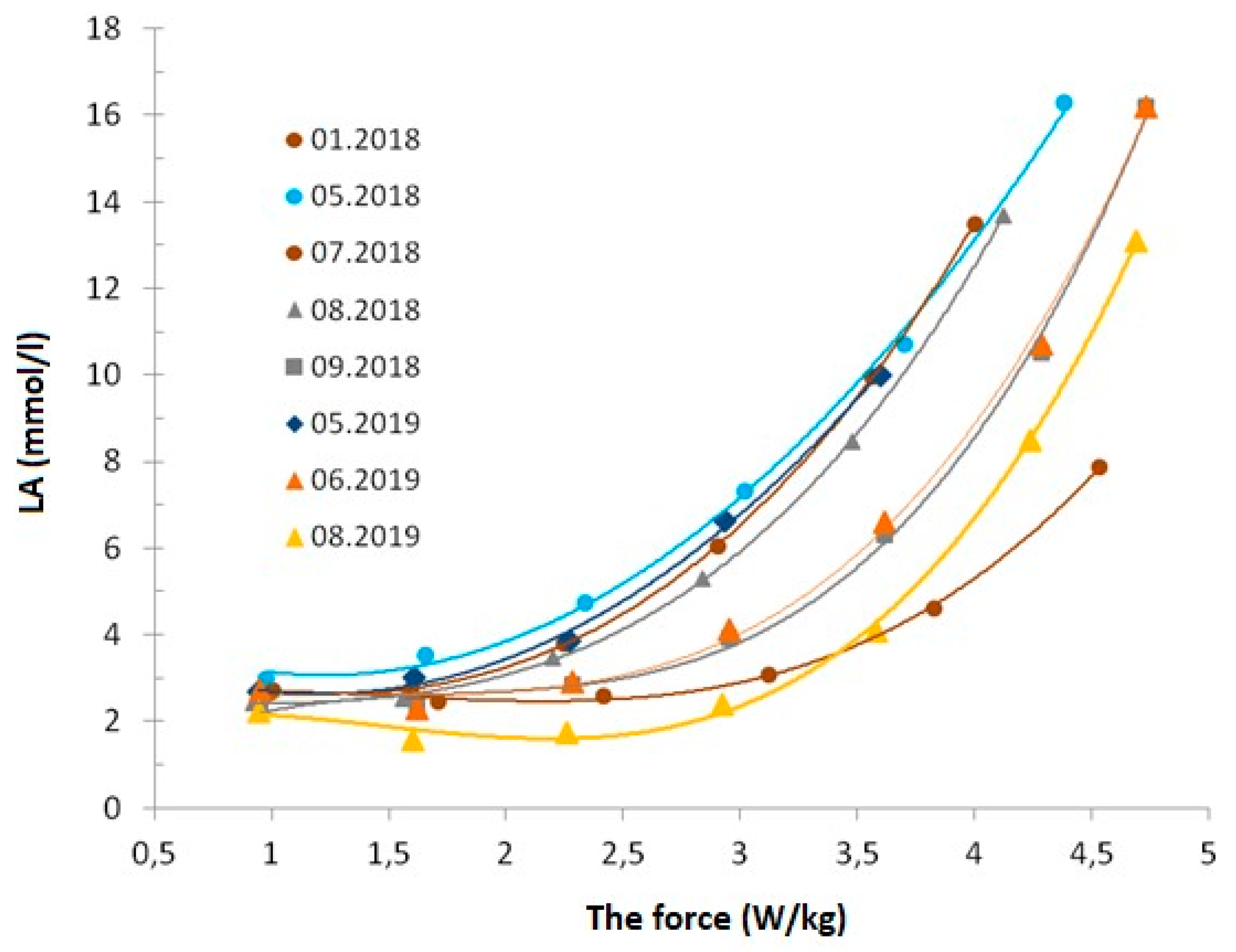
- AT-VO2 (mL/kg/min)—51.3; VO2max (mL/kg/min)—61.0;
- -
- AT-PO (W)—223; POmax (W)—299;
- -
- AT-PO (W/kg)—3.50, POmax (W/kg)—4.69.
4. Discussion
5. Conclusions
- 1
- The use of four altitude camps in two consecutive annual training cycles allowed the athlete to achieve high exercise adaptations and improve the aerobic potential.
- 2
- Significant improvements in physiological parameters were found, some of them reaching the highest levels in the professional skater’s career so far: threshold of anaerobic changes AT-VO2 (mL/kg/min) of 51.3, and VO2max (mL/kg/min) of 61.0.
- 3
- The results of the study show unequivocally the high economy and excellent aerobic potential of the athlete.
Author Contributions
Funding
Institutional Review Board Statement
Informed Consent Statement
Data Availability Statement
Acknowledgments
Conflicts of Interest
References
- Ronikier, A. Fizjologia Wysiłku W Sporcie, Fizjoterapii I Rekreacji; Biblioteka Trenera: Warsaw, Poland, 2008. [Google Scholar]
- Hettinga, F.; Muñoz, M.B.; Hext, A. Speed skating (long-track and short-track). In Sport and Exercise Physiology Testing Guidelines: Volume I–Sport Testing; Routledge: Oxfordshire, UK, 1988. [Google Scholar]
- Pakosz, P.; Lukanova-Jakubowska, A.; Konieczny, M. Pre-Olympic Ice-Skaters Training Versus Muscle Fatigability Assessed by sEMG. Preprints, 2019; preprint. [CrossRef] [Scilit]
- Charaśna-Blachucik, J.; Konieczny, M.; Lukanova-Jakubowska, A.; Wieloch, M. Optimization of the Effort Preparation Process Among the Short Track Female Competitors in a Year Cycle. Cent. Eur. J. Sport Sci. Med. 2015, 12, 109–119. [Google Scholar] [CrossRef] [Scilit]
- Rundell, K.W. Effects of drafting during short-track speed skating. Med. Sci. Sports Exerc. 1996, 28, 765–771. [Google Scholar] [CrossRef] [Scilit] [PubMed]
- Ambroży, T.; Maciejczyk, M.; Klimek, A.T.; Wiecha, S.; Stanula, A.; Snopkowski, P.; Pałka, T.; Jaworski, J.; Ambroży, D.; Rydzik, Ł.; et al. The effects of intermittent hypoxic training on anaerobic and aerobic power in boxers. Int. J. Environ. Res. Public Health 2020, 17, 9361. [Google Scholar] [CrossRef] [Scilit]
- Górski, J. Fizjologia wysiłku i treningu fizycznego. PZWL Wydaw. Lek. 2019, 28, 148. [Google Scholar]
- Faiss, R.; Girard, O.; Millet, G.P. Advancing hypoxic training in team sports: From intermittent hypoxic training to repeated sprint training in hypoxia. Br. J. Sports Med. 2013, 47, i45–i50. [Google Scholar] [CrossRef] [Scilit] [PubMed]
- Truijens, M.J.; Toussaint, H.M.; Dow, J.; Levine, B.D. Effect of high-intensity hypoxic training on sea-level swimming performances. J. Appl. Physiol. 2003, 94, 733–743. [Google Scholar] [CrossRef] [Scilit]
- Levine, B.D. Intermittent Hypoxic Training: Fact and Fancy. High Alt. Med. Biol. 2002, 3, 177–193. [Google Scholar] [CrossRef] [Scilit]
- Connett, R.J.; Honig, C.R.; Gayeski, T.E.; Brooks, G.A. Defining hypoxia: A systems view of VO2, glycolysis, energetics, and intracellular PO2. J. Appl. Physiol. 1990, 68, 833–842. [Google Scholar] [CrossRef] [Scilit]
- Kenney, W.; Wilmore, J.; Costill, D. Physiology of Sport and Exercise; Human Kinetics Publishers: Champaign, IL, USA, 2012. [Google Scholar]
- Łukanowa-Jakubowska, A.; Tataruch, R. Influence of alpine training on the anaerobic capacity of short track players. In The Use of Research in Physical Education and Sport, Part 1; Iskra, R.T.J., Ed.; Opole University of Technology: Opole, Poland, 2008; pp. 95–102. [Google Scholar]
- Millet, G.P.; Faiss, R.; Brocherie, F.; Girard, O. Hypoxic training and team sports: A challenge to traditional methods? Br. J. Sports Med. 2013, 47, i6–i7. [Google Scholar] [CrossRef] [Scilit]
- Sinex, J.A.; Chapman, R.F. Hypoxic training methods for improving endurance exercise performance. J. Sport Health Sci. 2015, 4, 325–332. [Google Scholar] [CrossRef] [Scilit]
- Boraczyński, T. Trening Wysokogórski, Podstawy Teoretyczne, Metodyka, Kontrola Obciążeń; Sport Wyczynowy: Opole, Poland, 1989. [Google Scholar]
- Ambroży, T.; Wieczorek, T.; Mucha, D. Zasady właściwego i bezpiecznego prowadzenia treningu wysokogórskiego jako elementu kształtującego zdolności kondycyjne sportowców. Kult. Bezpieczeństwa. Nauka Prakt. Refleksje 2016, 24, 46–73. [Google Scholar]
- Biggs, N.C.; England, B.S.; Turcotte, N.J.; Cook, M.R.; Williams, A.L. Effects of Simulated Altitude on Maximal Oxygen Uptake and Inspiratory Fitness. Int. J. Exerc. Sci. 2017, 10, 127–136. [Google Scholar] [PubMed]
- Gore, C.J.; Hahn, A.G.; Aughey, R.J.; Martin, D.T.; Ashenden, M.J.; Clark, S.A.; Garnham, A.P.; Roberts, A.D.; Slater, G.J.; Mckenna, M.J. Live high:train low increases muscle buffer capacity and submaximal cycling efficiency. Acta Physiol. Scand. 2001, 173, 275–286. [Google Scholar] [CrossRef] [Scilit] [PubMed]
- Bonne, T.C.; Lundby, C.; Jørgensen, S.; Johansen, L.; Mrgan, M.; Bech, S.R.; Sander, M.; Papoti, M.; Nordsborg, N.B. “Live High–Train High” increases hemoglobin mass in Olympic swimmers. Eur. J. Appl. Physiol. 2014, 114, 1439–1449. [Google Scholar] [CrossRef] [Scilit]
- McLean, B.D.; Gore, C.J.; Kemp, J. Application of ‘Live Low-Train High’ for Enhancing Normoxic Exercise Performance in Team Sport Athletes. Sports Med. 2014, 44, 1275–1287. [Google Scholar] [CrossRef] [Scilit]
- Wilmore, J.; Costill, D. Physiology of Sport and Exercise; Human Kinetics Publishers: Champaign, IL, USA, 2004. [Google Scholar]
- Brooks, G.; Fahey, T.; White, T.P.; Baldwin, K.M. Cardiovascular Dynamics During Exercise, In Exercise Physiology. In Human Bioenergetics and Its Applications; McGraw Hill: Sydney, Australia, 2000. [Google Scholar]
- Conley, M. Bioenergetics of Excercise Training. In Essential of Strength Training and Conditioning; Human Kinetics Publishers: Champaign, IL, USA, 2000. [Google Scholar]
- Garrett, W.; Kirkendall, D. Exercise and Sport Science; Lippincott Williams & Wilkins: Philadelphia, PA, USA, 2000. [Google Scholar]
- Pilch, T.; Bauman, T. Strategie ilościowe w badaniach pedagogicznych. In Zasady Badań Pedagogicznych. Strategie Ilościowe i Jakościowe; Wydawnictwo Akademickie Żak: Warsaw, Poland, 1977; pp. 77–78. [Google Scholar]
- Menting, S.G.P.; Hendry, D.T.; Schiphof-Godart, L.; Elferink-Gemser, M.T.; Hettinga, F.J. Optimal Development of Youth Athletes Toward Elite Athletic Performance: How to Coach Their Motivation, Plan Exercise Training, and Pace the Race. Front. Sports Act. Living 2019, 1, 14. [Google Scholar] [CrossRef] [Scilit]
- Haug, W.B.; Drinkwater, E.J.; Cicero, N.J.; Barthell, J.A.; Chapman, D.W. The Impact of Dry-Land Sprint Start Training on the Short Track Speed Skating Start. J. Strength Cond. Res. 2019, 33, 544–548. [Google Scholar] [CrossRef] [Scilit]
- Kuch, S. Łyżwiarstwo Szybkie. Program Szkolenia Dzieci i Młodzieży; Biblioteka Trenera COS: Warsaw, Poland, 1999. [Google Scholar]
- Macfarlane, D.J.; Wong, P. Validity, reliability and stability of the portable Cortex Metamax 3B gas analysis system. Eur. J. Appl. Physiol. 2012, 112, 2539–2547. [Google Scholar] [CrossRef] [Scilit]
- Lukanova-Jakubowska, A.; Piechota, K.; Ozimek, M.; Borkowski, L.; Klusiewicz, A. Assessment Of Aerobic And Anaerobic Exercise Capacity And Sport Level Of Poland’s Leading Representative In A Short Track In A 4-Year Olympic Cycle. Acta Kinesiol. 2021, 15, 32–41. [Google Scholar] [CrossRef] [Scilit]
- Mcardle, W.D.; Katch, F.I.; Katch, V. Exercise physiology: Energy, nutrition and human performance. Rio Jan. Guanab. Koogan 2002, 580. Available online: https://www.amazon.com/Exercise-Physiology-Nutrition-Energy-Performance/dp/1451191553 (accessed on 21 March 2022).
- Sozański, H.; Śledziewski, D. Obciążenia Treningowe: Dokumentowanie i Opracowywanie Danych: Praca Zbiorowa; Biblioteka Trenera COS: Warsaw, Poland, 1995. [Google Scholar]
- McArdle, W.; Katch, F.; Katch, V. Exercise Physiology Energy, Nutrition and Human Performance; Williams & Williams: Silver Spring, MD, USA, 2007. [Google Scholar]
- Czuba, M.; Waskiewicz, Z.; Zajac, A.; Poprzecki, S.; Cholewa, J.; Roczniok, R. The effects of intermittent hypoxic training on aerobic capacity and endurance performance in cyclists. J. Sports Sci. Med. 2011, 10, 175–183. [Google Scholar] [PubMed]
- Morton, J.P.; Cable, N.T. The effects of intermittent hypoxic training on aerobic and anaerobic performance. Ergonomics 2005, 48, 1535–1546. [Google Scholar] [CrossRef] [Scilit] [PubMed]

| Lp. | Camps Date | Place |
|---|---|---|
| 1. | 27.08–17.09.2018 | Erzurum |
| 2. | 12.05–02.06.2019 | Erzurum |
| 3. | 07.07–28.07.2019 | Erzurum |
| 4. | 01.09–22.09.2019 | Ankara |
| Lp. | Training Measures—Microcycle | Load |
|---|---|---|
| 1 | Strength training - squat with a barbell (main exercise) | 2 × 6—70% max 2 × 4—85% max 2 × 2—90% max 1 × 1—100% max |
| 2 | Power training - barbell jumping - jumping (athletics hurdles, stairs, other platforms) - sprint with various loads, medicine ball throws | 4 × 10 barbell jumps—from half a squat 4 × 6 lunges—from a full squat |
| Period/Numberof Training Microcycles | Test Date | I—Dry Land Training/HR/ | II—Dry Land Training /Number of Training Sessions/ | III—Dry Land Training /Number of Training Sessions/ | IV—Dry Land Training /Number of Training Sessions/ | ||||||||
|---|---|---|---|---|---|---|---|---|---|---|---|---|---|
| LT—Up to 2 mmol | LT-AT—2–4 mmol | AT and Above | LT—Up to 2 mmol | LT-AT 2–4 mmol | AT and Above | Intensity | Intensity | ||||||
| 85% | 90% | 95–100% | 65–80% | 80–95% | 95–100% | ||||||||
| I general 8 microcycles | 29.05.2018 | 140 | 150 | 163 | 41 | 24 | 12 | 7 | 2 | 6 | 24 | 8 | 2 |
| I special 8 microcycles | 23.07.2018 | 150 | 160 | 171–176 | 36 | 18 | 16 | 2 | 4 | 5 | 6 | 12 | 10 |
| II general 8 microcycles | 06.05.2019 | 150 | 160 | 177 | 34 | 18 | 16 | 9 | 4 | 8 | 26 | 12 | 2 |
| II special 8 microcycles | 08.08.2019 | 170 | 180 | 191 | 28 | 18 | 16 | 4 | 6 | 6 | 6 | 12 | 12 |
| p-value | I vs. II p < 0.001 | III vs. IV p = 0.04 | |||||||||||
| Period/Number of Training Microcycles | Test Date | I—Strength Training/Number of Training Sessions | II—Specific Strength/Number of Training Sessions | |||
|---|---|---|---|---|---|---|
| Training Measures | ||||||
| Strength Endurance (Deadlift, Squat, Bench Press, Throw), 12–15 Repetitions 3–4 Sets | Maximum Strength (Deadlift, Squat, Bench Press, Chargé) 2–6 Repetitions 2–4 Sets | Maximum Power (Barbell Jumps, Charges, Plyometric Exercises), 4–6 Repetitions 3–4 Sets | Skating Imitations with Elements of Statics | Specialized Exercises on Belts and Rubbers | ||
| I general 8 microcycles | 29.05.2018 | 22 | 4 | 2 | 24 | 26 |
| I special 8 microcycles | 23.07.2018 | 4 | 16 | 12 | 10 | 12 |
| II general 8 microcycles | 06.05.2019 | 22 | 4 | 2 | 22 | 26 |
| II special 8 microcycles | 08.08.2019 | 4 | 16 | 12 | 12 | 12 |
| Date | LA [mmol/L] | PO [W] | PO [W/kg] | VO2 [L/min] | VO2 [mL/kg/min] | HR [sk/min] | |
|---|---|---|---|---|---|---|---|
| AT4 | 29-05-2018 | 4.0 | 121 | 1.96 | 1.69 | 27.4 | 163 |
| 23-07-2018 | 4.0 | 150 | 2.34 | 2.16 | 33.8 | 171 | |
| 22-08-2018 | 4.0 | 161 | 2.45 | 2.14 | 32.7 | 176 | |
| 21-09-2018 | 4.0 | 188 | 2.98 | 2.70 | 42.8 | 182 | |
| 06-05-2019 | 4.0 | 142 | 2.24 | 2.01 | 31.7 | 177 | |
| 10-06-2019 | 4.0 | 183 | 2.90 | 2.56 | 40.6 | 175 | |
| 08-08-2019 | 4.0 | 223 | 3.50 | 3.27 | 51.3 | 191 | |
| MAX | 29-05-2018 | 16.4 | 270 | 4.43 | 3.26 | 52.9 | 198 |
| 23-07-2018 | 13.5 | 256 | 4.00 | 3.25 | 50.8 | 195 | |
| 22-08-2018 | 15.1 | 284 | 4.34 | 3.35 | 51.1 | 203 | |
| 21-09-2018 | 16.2 | 298 | 4.73 | 3.80 | 60.3 | 206 | |
| 06-05-2019 | 13.8 | 242 | 3.82 | 3.06 | 48.3 | 202 | |
| 10-06-2019 | 16.2 | 298 | 4.73 | 3.83 | 60.7 | 201 | |
| 08-08-2019 | 13.1 | 299 | 4.69 | 3.88 | 61.0 | 208 |
| Effort | PV | Slope (S) | t-Value | p-Value |
|---|---|---|---|---|
| AT4 | HR (b/min) | 1.949 | 2.83 | 0.066 |
| PO (W/kg) | 0.029 | 3.6 | 0.037 | |
| VO2 (mL/kg/min) | 0.411 | 3.6 | 0.037 | |
| MAX | HR | 2.22 | 2.68 | 0.075 |
| PO | 0.049 | 2.71 | 0.073 | |
| VO2 | 0.506 | 2.81 | 0.047 | |
| LA mmol/L | 1.67 | 2.54 | 0.084 |
| Effort | Correlations | r-Value |
|---|---|---|
| AT4 | HR ● PO | 0.802 |
| HR ● VO2 | 0.837 | |
| PO ● VO2 | 0.938 | |
| MAX | HR ● PO | 0.441 |
| HR ● VO2 | 0.420 | |
| PO ● VO2 | 0.924 | |
| LA ● HR | 0.401 | |
| LA ● PO | 0.910 | |
| LA ● VO2 | 0.753 |
Publisher’s Note: MDPI stays neutral with regard to jurisdictional claims in published maps and institutional affiliations. |
© 2022 by the authors. Licensee MDPI, Basel, Switzerland. This article is an open access article distributed under the terms and conditions of the Creative Commons Attribution (CC BY) license (https://creativecommons.org/licenses/by/4.0/).
Share and Cite
Lukanova-Jakubowska, A.; Piechota, K.; Grzywacz, T.; Ambroży, T.; Rydzik, Ł.; Ozimek, M. The Impact of Four High-Altitude Training Camps on the Aerobic Capacity of a Short Track PyeongChang 2018 Olympian: A Case Study. Int. J. Environ. Res. Public Health 2022, 19, 3814. https://doi.org/10.3390/ijerph19073814
Lukanova-Jakubowska A, Piechota K, Grzywacz T, Ambroży T, Rydzik Ł, Ozimek M. The Impact of Four High-Altitude Training Camps on the Aerobic Capacity of a Short Track PyeongChang 2018 Olympian: A Case Study. International Journal of Environmental Research and Public Health. 2022; 19(7):3814. https://doi.org/10.3390/ijerph19073814
Chicago/Turabian StyleLukanova-Jakubowska, Anna, Katarzyna Piechota, Tomasz Grzywacz, Tadeusz Ambroży, Łukasz Rydzik, and Mariusz Ozimek. 2022. "The Impact of Four High-Altitude Training Camps on the Aerobic Capacity of a Short Track PyeongChang 2018 Olympian: A Case Study" International Journal of Environmental Research and Public Health 19, no. 7: 3814. https://doi.org/10.3390/ijerph19073814
APA StyleLukanova-Jakubowska, A., Piechota, K., Grzywacz, T., Ambroży, T., Rydzik, Ł., & Ozimek, M. (2022). The Impact of Four High-Altitude Training Camps on the Aerobic Capacity of a Short Track PyeongChang 2018 Olympian: A Case Study. International Journal of Environmental Research and Public Health, 19(7), 3814. https://doi.org/10.3390/ijerph19073814

