Analysis of Spatial Heterogeneity and Influencing Factors of Ecological Environment Quality in China’s North-South Transitional Zone
Abstract
1. Introduction
2. Materials and Methods
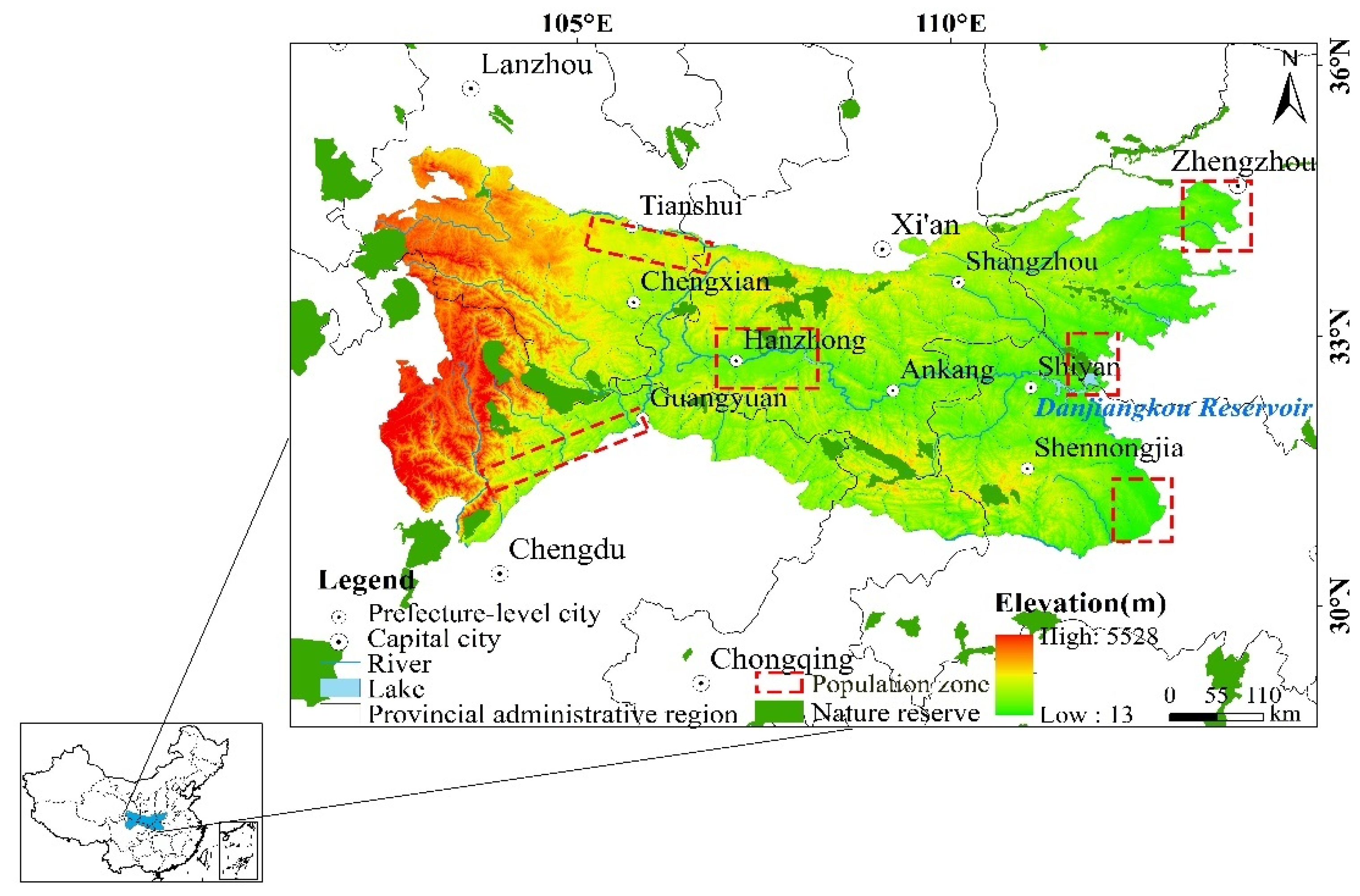
2.1. Study Area
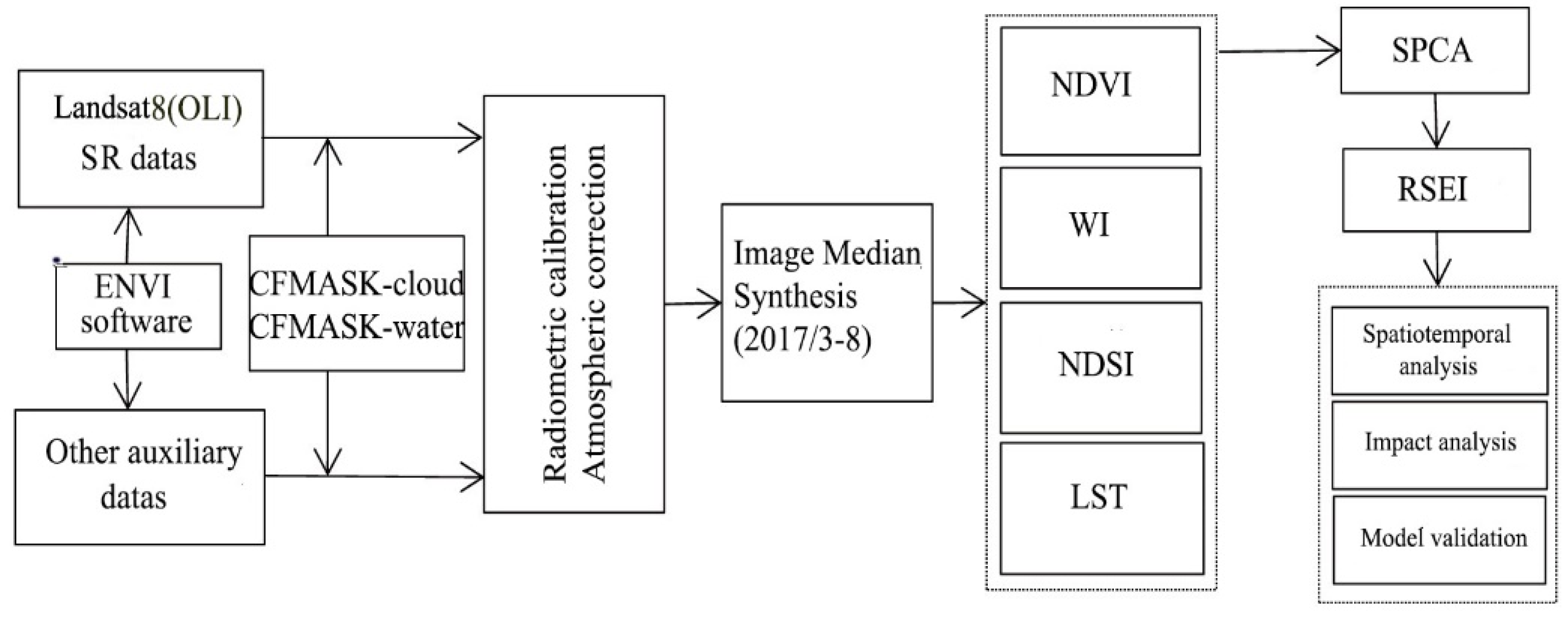
2.2. Data Source and Processing
2.3. Methodology
2.3.1. Selection of Various Index Factors of RSEI
2.3.2. Construction of Comprehensive Index of Ecological Environment Quality Evaluation
2.3.3. Spatial Heterogeneity Analysis Method of Ecological Environment Quality
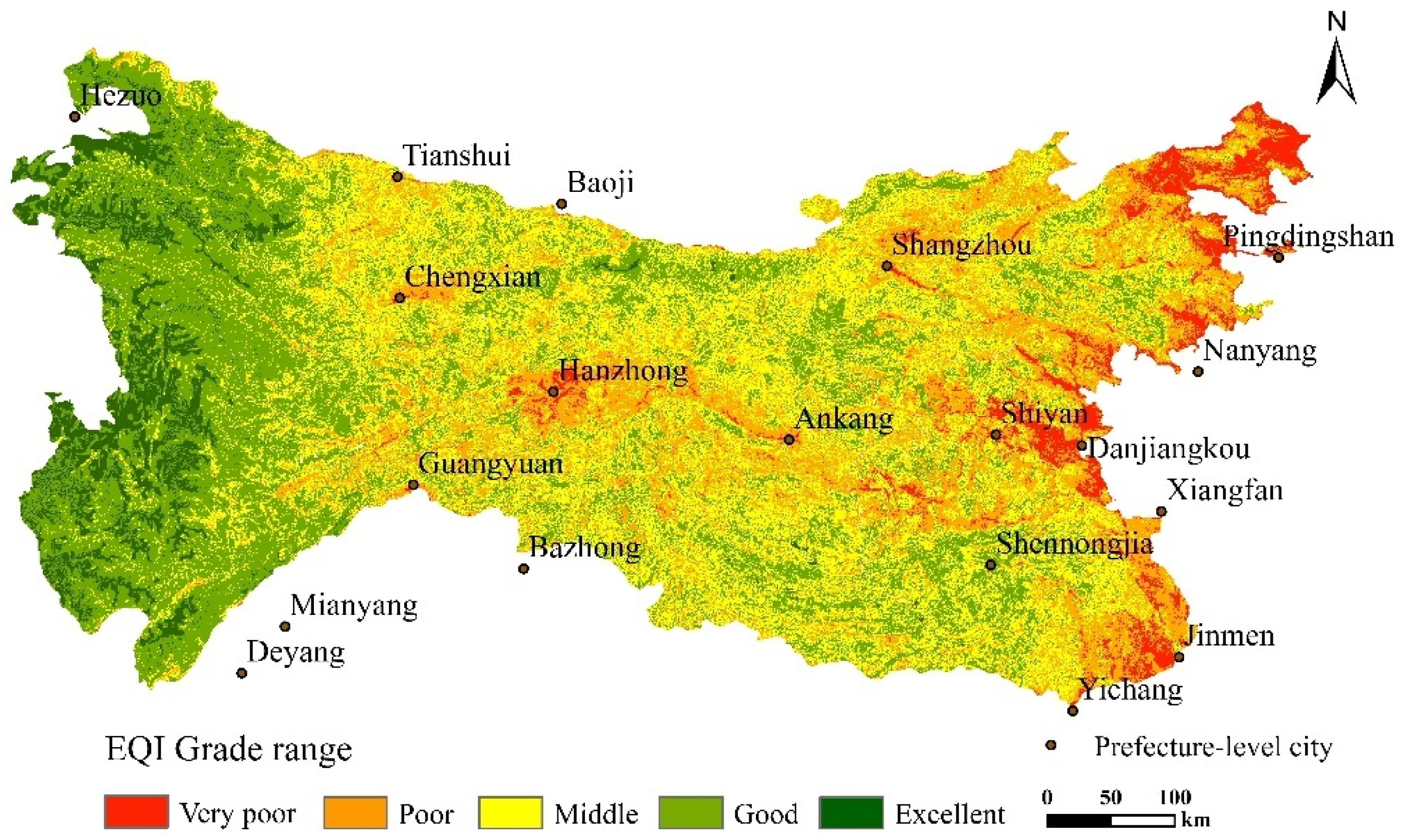
2.3.4. Eco-Environmental Quality Index (EQI) Verification
3. Results
3.1. Principal Component Analysis Results of RSEI Index in Qinling-Daba Mountains
3.2. The Spatial Distribution Characteristics of RSEI in Qinling-Daba Mountain Area
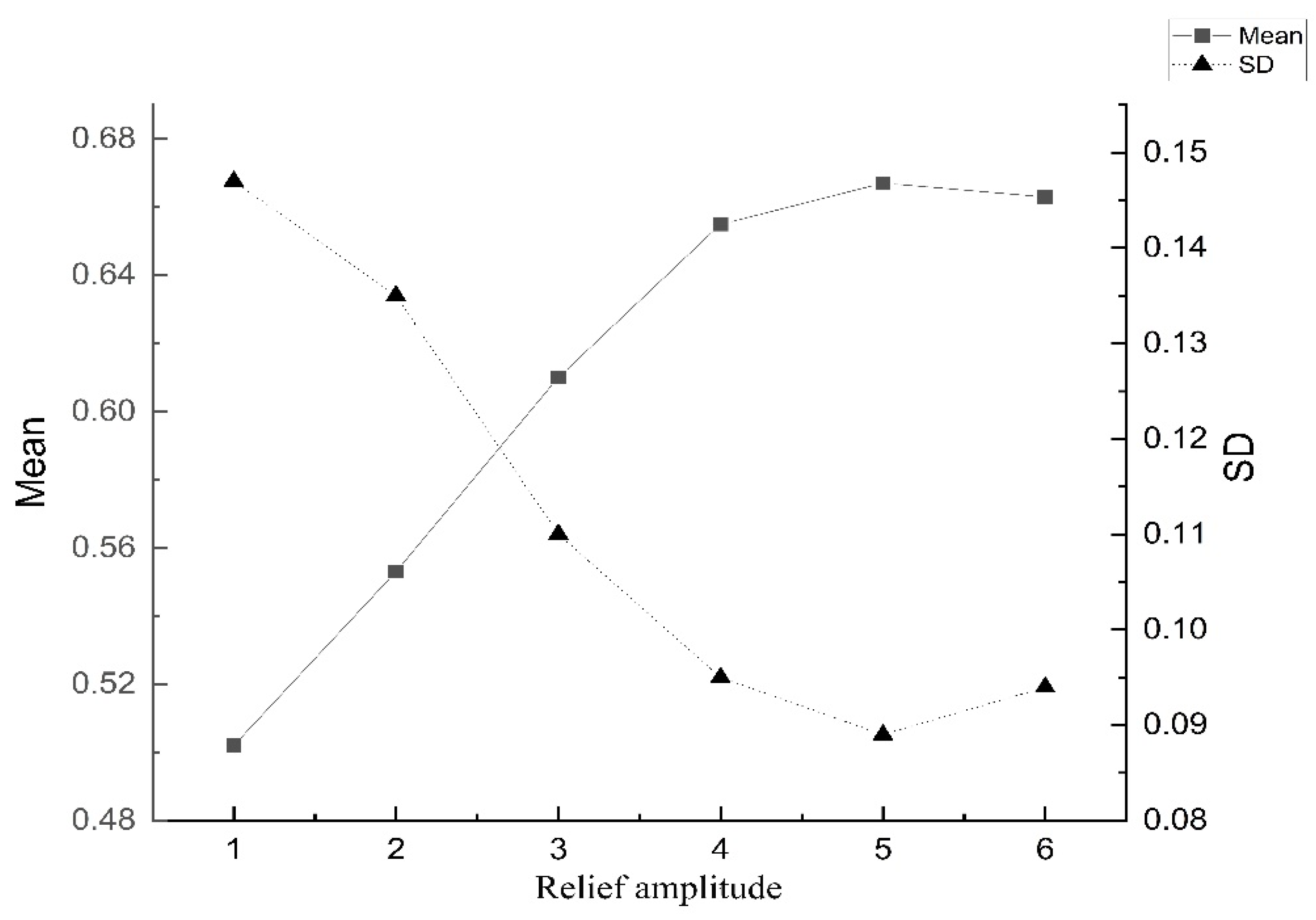
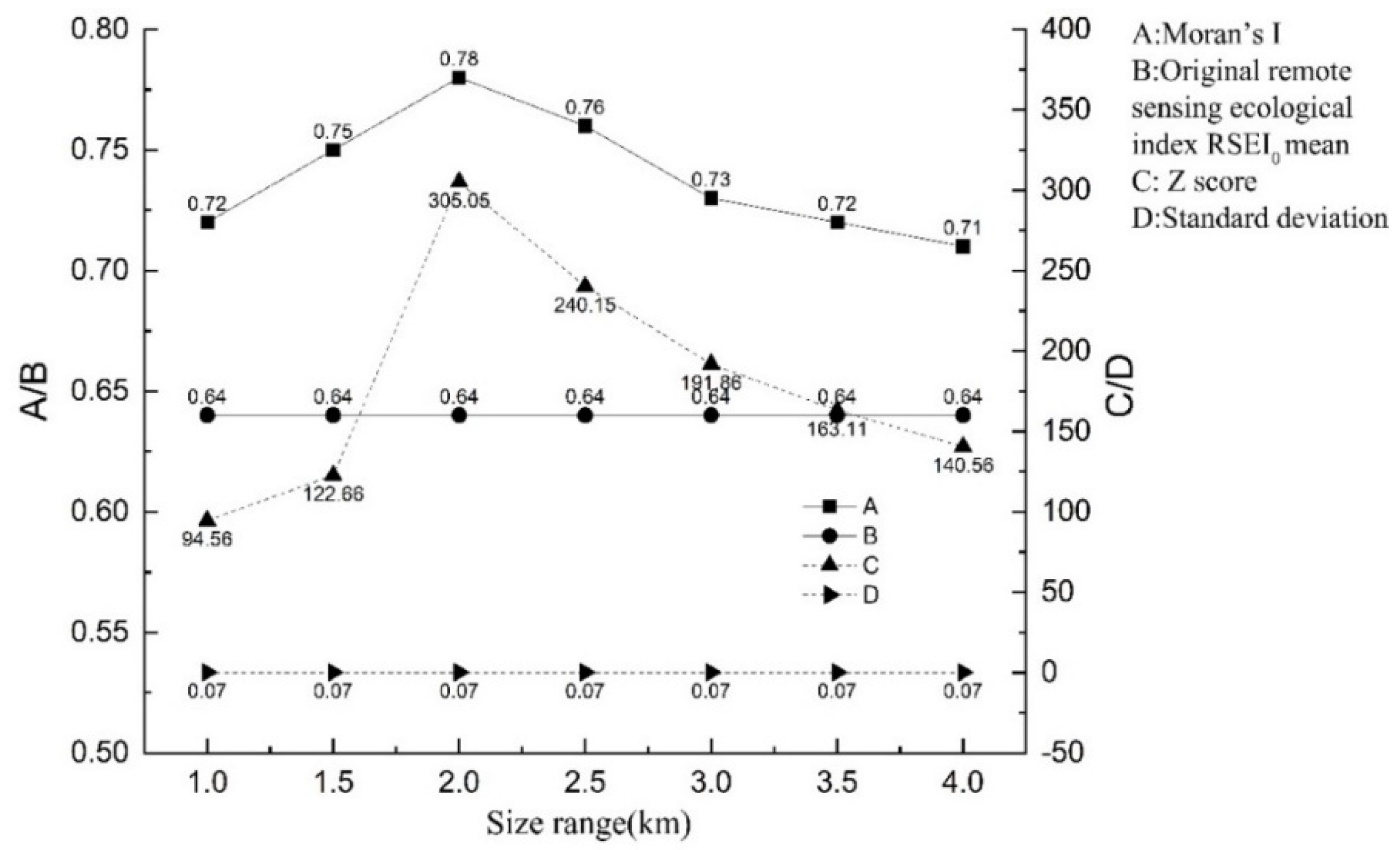
3.3. The Spatial Differentiation Characteristics of RSEI0 under Different Scale Effects
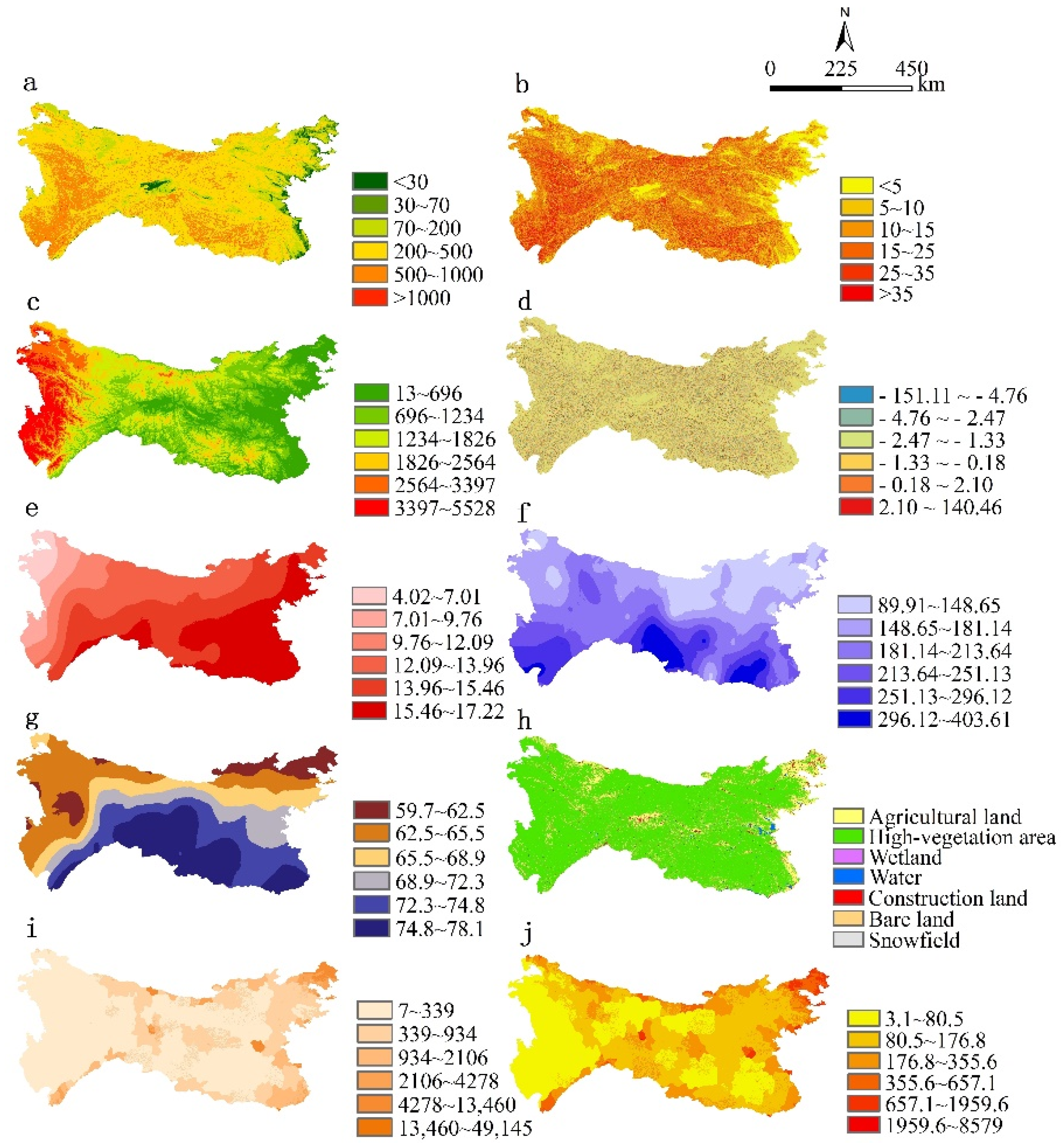
3.4. Factors Influencing Spatial Heterogeneity of RSEI0 in Qinling-Daba Mountains
4. Discussion
4.1. Verification of the Accuracy of the RSEI Comprehensive Method
4.2. The Rationality of the Selection of Indicators
4.3. Comparative Analysis and Suggestions on Influencing Factors
4.4. Shortcomings and Prospects
5. Conclusions
- (1)
- The overall RSEI average value of the Qinling-Daba Mountains reached 0.61, and the ecological environment quality was mostly above the middle level; the greenness contributed the most to the RSEI comprehensive index of the areas, indicating that vegetation coverage plays an important role in the improvement of the ecological environment quality of the areas. Heat has the second-highest contribution to the RSEI index of the area, and it has an inhibitory effect on improving the area’s habitat quality.
- (2)
- The overall distribution of ecological environment quality in the study area in 2017 was quite different, with good and bad being distributed alternately from east to west; the ecological environment quality level decreased from low to high altitude. Low-value areas accounted for a relatively large area in low-altitude land, and high-value areas accounted for a relatively large area in high-altitude areas.
- (3)
- There are scale changes in the spatial clustering of RSEI0. The degree of spatial heterogeneity is the most obvious at a scale of 2 km. The RSEI0 nugget effect is 88%, which is high spatial heterogeneity, mainly affected by structural factors such as slope, relief amplitude, elevation, curvature, annual average temperature, annual average precipitation, annual average relative humidity, the proportion of high-vegetation areas, proportion of construction land area, and average annual population density which have significant effects on the spatial differentiation of RSEI0. Among them, slope and relief amplitude are the main factors affecting the spatial differentiation of the Qinling-Daba Mountains’ ecological environment quality.
Author Contributions
Funding
Institutional Review Board Statement
Informed Consent Statement
Acknowledgments
Conflicts of Interest
References
- Rastorgueff, P.A.; Bellan, S.D.; Bianchi, C.N. An ecosystem-based approach to evaluate the ecological quality of Mediterranean undersea caves. Ecol. Ind. 2015, 54, 137–152. [Google Scholar] [CrossRef] [Scilit]
- Imhoff, M.L.; Zhang, P.; Wolfe, R.E.; Bounoua, L. Remote sensing of the urban heat island effect across biomes in the continental USA. Remote Sens. Environ. 2009, 114, 504–513. [Google Scholar] [CrossRef] [Scilit]
- Zhao, Q.G.; Huang, G.Q.; Ma, Y.Q. Ecological environment and construction of ecological civilization in China. Acta Ecol. Sin. 2016, 36, 6328–6335. [Google Scholar] [CrossRef] [Scilit]
- Colwell, R.K.; Brehm, G.; Cardelús, C.L.; Gilman, A.C.; Longino, J.T. Global warming, elevational range shifts, and lowland biotic attrition in the wet tropics. Science 2008, 322, 258–261. [Google Scholar] [CrossRef] [Scilit]
- Li, T.T.; Ma, C.; Guo, Z.Z. RSEI model based long time series ecological quality assessment and analysis of influencing factors in Helan Mountains. J. Ecol. 2021, 40, 1154–1165. [Google Scholar] [CrossRef]
- Wang, F.T.; Huang, C.S.; Chen, Z.H.; Bao, K. Distribution, ecological risk assessment, and bioavailability of cadmium in soil from Nansha, Pearl River Delta, China. Int. J. Environ. Res. Public Health 2019, 16, 3637. [Google Scholar] [CrossRef] [Scilit] [PubMed]
- Wang, M.X.; Liao, G.K.; Li, Y.L. The relationship between environmental regulation, pollution and corporate environmental responsibility. Int. J. Environ. Res. Public Health 2021, 18, 8018. [Google Scholar] [CrossRef] [Scilit]
- Zhu, L.Q.; Xu, L.M. Study on the impact of global change on terrestrial ecosystem. Areal Res. Develop. 2011, 30, 161–164. [Google Scholar] [CrossRef]
- Wang, Y.H.; Li, J.Y. Evaluation of coupling and coordination between ecological environment quality and economic development level in contiguous destitute areas. J. Appl. Ecol. 2015, 26, 1519–1530. [Google Scholar] [CrossRef]
- Wang, D.S.; Wang, X.L.; Lei, Z.Y. Ecological quality assessment of fuxin based on remote sensing ecological index. Eco. Sci. 2020, 39, 88–94. [Google Scholar] [CrossRef]
- Xu, H.Q. Establishment and application of urban remote sensing ecological index. Acta Ecol. Sin. 2013, 33, 7853–7862. [Google Scholar] [CrossRef]
- Sun, C.J.; Li, X.M.; Zhang, W.Q.; Chen, W.; Wang, J.R. Assessment of ecological security in poverty-stricken areas of Luliang Mountains based on remote sensing information. Environ. Sci. 2019, 39, 5352–5360. [Google Scholar] [CrossRef]
- Ivits, E.; Cherlet, M.; Mehl, W.; Sommer, S. Estimating the ecological status and change of riparian zones in Andalusia assessed by multi-temporal AVHHR datasets. Eco. Ind. 2008, 9, 422–431. [Google Scholar] [CrossRef] [Scilit]
- Jiang, C.L.; Wu, L.; Liu, D.; Wang, S.M. Remote sensing dynamic monitoring of eco-environmental quality in arid desert areas: A case study of Gurbantunggut Desert. J. Appl. Ecol. 2019, 30, 877–883. [Google Scholar] [CrossRef]
- Wen, L.T. Discussion on remote sensing monitoring of agrometeorological disasters. Remote Sens. 2020, 9, 38–41. [Google Scholar] [CrossRef] [Scilit]
- Song, W.; Song, W.; Gu, H.H.; Li, F.P. Progress in the remote sensing monitoring of the ecological environment in mining areas. Int. J. Environ. Res. Public Health. 2020, 17, 1846. [Google Scholar] [CrossRef] [Scilit]
- Ministry of Environmental Protection of the People’s Republic of China. Technical Code for Assessment of Ecological and Environmental Conditions (In Operation); China Environmental Science Publishing House: Beijing, China, 2006.
- Ye, Y.H.; Liang, Y.X.; Shen, Y.Q.; Xie, L.S. Some problems to be discussed in technical standard for assessment of ecological and environmental conditions (trial implementation). Trop. Geo. 2009, 29, 404–406. [Google Scholar] [CrossRef]
- Liu, H.; Che, G.H.; Gao, C.J.; Zhao, Y.J. Change of ecological environment quality and its influencing factors in Hebei Province. Eco. Sci. 2016, 35, 89–97. [Google Scholar] [CrossRef]
- Wang, H.J.; Bi, F.F.; Dong, Z.F. Performance evaluation of ecological compensation policy in Xin Anjiang River Basin based on AHP-fuzzy comprehensive evaluation method. Acta Ecologica Sinica 2020, 40, 7493–7506. [Google Scholar] [CrossRef]
- Xu, H.Q. Remote sensing evaluation index of regional ecological environment change. Environ. Sci. 2013, 33, 889–897. [Google Scholar] [CrossRef]
- Liao, W.H.; Jiang, W.G. Evaluation of the spatiotemporal variations in the eco-environmental quality in China based on the remote sensing ecological index. Remote Sens. 2020, 12, 2462. [Google Scholar] [CrossRef] [Scilit]
- Wang, Y.; Zhao, Y.H.; Wu, J.S. Long-time dynamic monitoring of urban agglomeration ecological quality based on Google Earth Engine Cloud Computing: A case study of Guangdong-HongKong-MacaoGreaterBayArea. Acta Ecol. Sin. 2020, 40, 1–13. [Google Scholar] [CrossRef]
- Zhou, L.M.; Wang, S.H. Remote sensing monitoring and assessment of spatial-temporal change of ecological environment in Hang Jin Banner, Inner Mongolia. J. Appl. Ecol. 2020, 31, 1999–2006. [Google Scholar] [CrossRef] [Scilit]
- Zhu, D.; Chen, T.; Zhen, N.; Niu, R.Q. Monitoring the effects of open-pit mining on the eco-environment using a moving window-based remote sensing ecological index. Environ. Sci. Pollut. Res. Int. 2020, 27, 15716–15728. [Google Scholar] [CrossRef] [Scilit]
- Liu, K.; Ma, N.X.; Xu, Y.L.; Sun, G.N. Protection and construction of ecological environment in Qinling Mountains. Chin. J. Ecol. 2004, 23, 157–160. [Google Scholar] [CrossRef]
- Liu, Y.S.; Ni, S.X.; Jiang, J.J. Comprehensive evaluation of ecological environment quality in southern Shaanxi Mountain. Mt. Res. 1997, 3, 178–182. [Google Scholar]
- Lang, G.D.; Guo, J.L. Study on the ecological environment quality of Taibai Mountain scenic area. J. Northwest Univ. 2001, 5, 431–433. [Google Scholar] [CrossRef]
- Zhang, Y.Q.; Jiang, F.; Ji, M.D.; Jiang, H.S.; Wang, Z.Y. Evaluation of ecological environment at district and county level based on remote sensing index. Arid. Zone Stud. 2020, 37, 1598–1605. [Google Scholar] [CrossRef]
- Zhao, F.; Zhang, B.; Zhu, L.; Yao, Y.; Cui, Y.; Liu, J. Spatial differentiation of vertical band spectral structure in Qinling-Daba Mountains and the problem of warm temperate zone–Subtropical boundary. Acta Geogr. Sin. 2019, 74, 889–901. [Google Scholar] [CrossRef]
- Zhao, F.; Zhang, J.; Liu, S.; Wang, Z.; Wang, L.; Gu, H.; Li, W. NPP and its response to climate change in Qinling-Daba Mountains: A multi-dimensional zonal and warm temperate-subtropical boundary problem. Acta Ecol. Sin. 2021, 41, 1–12. [Google Scholar] [CrossRef] [Scilit]
- Li, Y.H. Research on Multi-Dimensional Changes of Soil Erosion in Qinling-Daba Mountains; Henan University: Kaifeng, China, 2020. [Google Scholar] [CrossRef]
- Liu, J.J.; Pan, Z.W.; Qin, F.; Gu, J.Y.; Zhu, M.Y.; Zhao, F. Land temperature estimation and mass elevation effect analysis of Qinling-Daba Mountains based on MODIS data. Geo. Res. 2020, 39, 735–748. [Google Scholar] [CrossRef]
- Zhao, Y.L.; Zhang, L.J. Study on quantitative assessment method of fragile ecological environment. Prog. Geogr. 1998, 18, 3–5. [Google Scholar] [CrossRef]
- Goward, S.N.; Xue, Y.K.; Czajkowski, K.P. Evaluating land surface moisture conditions from the remotely sensed temperature /vegetation index measurements: An exploration with the simplified simple biosphere model. Remote Sens. Environ. 2002, 79, 225–242. [Google Scholar] [CrossRef] [Scilit]
- Todd, S.W.; Hoffer, R.M. Responses of spectral indices to variations in vegetation cover and soil background. Photogramm. Eng. Remote Sens. 1998, 64, 915–921. [Google Scholar]
- Li, B.L.; Jing, C.P.; Yan, X.Y. Derivation of tassel-cap transformation of Landsat 8 land imager image. Sci. Surv. Mapp. 2016, 41, 102–107. [Google Scholar] [CrossRef]
- Ashutosh, S.; Roy, P.S. Three decades of nationwide forest cover mapping using indian remote sensing satellite data: A success story of monitoring forests for conservation in india. J. Indian Soc. Remote. Sens. 2021, 49, 61–70. [Google Scholar] [CrossRef] [Scilit]
- Xu, H.Q. A new index for delineating built-up land features in satellite imagery. Int. J. Remote Sens. 2008, 29, 4269–4276. [Google Scholar] [CrossRef] [Scilit]
- Nichol, J. Remote sensing of urban heat islands by day and night. Photogramm. Eng. Remote Sens. 2005, 71, 613–622. [Google Scholar] [CrossRef] [Scilit]
- Ding, F.; Xu, H.Q. Land surface temperature inversion algorithm and experimental analysis of TM thermal band image. J. Geo-informa. Sci. 2006, 8, 125–130, 135. [Google Scholar] [CrossRef]
- Chander, G.; Markham, B.L.; Helder, D.L. Summary of current radiometric calibration coefficients for Landsat MSS, TM, ETM+ and EO-1 ALI sensors. Remote Sens. Environ. 2009, 113, 893–903. [Google Scholar] [CrossRef] [Scilit]
- Williams, D. Landsat 7 Science Data Users Handbook; U.S. Geological Survey: Sacramento, CA, USA, 1998. [CrossRef] [Scilit]
- Jimenez-Munoz, J.C.; Cristobal, J.; Sobrino, J.A.; Soria, G.; Ninyerola, M.; Pons, X. Revision of the single-channel algorithm for land surface temperature retrieval from Landsat Thermal-Infrared data. IEEE Trans. Geofence Remote Sens. 2009, 47, 339–349. [Google Scholar] [CrossRef] [Scilit]
- Qi, Y.C.; Dong, Y.S.; Jin, Z.; Peng, Q.; Xiao, S.S.; Ya-ting, H.E. Spatial heterogeneity of soil nutrients and respiration in the decertified grasslands of inner mongolia, China. Pedosphere 2010, 20, 655–665. [Google Scholar] [CrossRef] [Scilit]
- Wang, M.; Wang, J.; Meng, Z.; Cai, X.; Lv, S.; Wang, D.; Wu, Y. Heterogeneity of spatial distribution of Haloxylon ammo dendron population in the eastern margin of Badain Jaran Desert. Acta Ecol. Sin. 2016, 36, 4055–4063. [Google Scholar] [CrossRef] [Scilit]
- Yan, L.; Zhou, G.; Zhang, F.; Sui, X.; Ping, X. Spatial heterogeneity dynamic analysis of vegetation coverage in desert steppe of Inner Mongolia. Acta Ecol. Sin. 2012, 32, 4017–4024. [Google Scholar] [CrossRef] [Scilit]
- Wang, J.F.; Xu, C.D. GEO-DETECTOR: Principles and prospects. Acta Geogr. Sin. 2017, 72, 116–134. [Google Scholar] [CrossRef]
- Fan, C.; Xia, B.C.; Qin, J.Q. A comprehensive evaluation model of county eco-environmental quality based on RS and GIS: Taking Huidong County as an example. Chin. J. Ecol. 2013, 32, 719–725. [Google Scholar] [CrossRef]
- Liu, P.; Ren, C.Y.; Wang, Z.M.; Zhang, B.; Chen, L. Assessment of the eco-environmental quality in the Nanweng River nature reserve, Northeast China by remote sensing. J. Appl. Ecol. 2018, 29, 3347–3356. [Google Scholar] [CrossRef]
- Wang, L.C.; Jiao, L.; Lai, F.B.; Zhang, N.M. Ecological change assessment of Manas Lake Wetland in Xinjiang based on remote sensing ecological index. Acta Ecol. Sin. 2019, 39, 2963–2972. [Google Scholar]
- Wang, Y.; Wang, S.D. Analysis of dynamic change of ecological quality based on RSEI: A case study of Danjiang River (Henan Section). Sci. Soil Water Conserv. 2019, 17, 57–65. [Google Scholar] [CrossRef]
- Gao, W.P.; Alimjiang, k.; Tursunayi, R.; Zhao, M. Spatio-temporal analysis of ecological and environmental benefits in Yizhou District. Arid. Zone Res. 2020, 37, 1057–1067. [Google Scholar] [CrossRef]
- Li, F.L.; Chang, Q.R.; Shen, J.; Liu, J. Dynamic monitoring of ecological environment in some random place somewhere region by remote sensing: A case study of Fuxian County, Shaanxi Province. J. Appl. Ecol. 2015, 26, 3811–3817. [Google Scholar] [CrossRef]
- Liu, T.; Bao, G.D.; Zhai, C.; Yang, J.; Zhang, D.W.; Lv, M.Y. Change of eco-environmental quality and its driving forces in ecologically fragile areas. Jilin For. Sci. Technol. 2020, 49, 18–25. [Google Scholar] [CrossRef]
- Wang, J.; Liu, D.; Ma, J.; Cheng, Y.; Wang, L. Development of a large-scale remote sensing ecological index in arid areas and its application in the Aral Sea Basin. J. Arid Land. 2021, 13, 40–55. [Google Scholar] [CrossRef] [Scilit]
- Li, F.M.; Yin, S.Y.; Yin, T.Y. Study on the spatial-temporal variation of extreme temperature in Qinling-Daba mountains and its adjacent regions from 1960 to 2017. Proc. Natl. Sun Yat-Sen Univ. 2020, 272, 86–98. [Google Scholar] [CrossRef]
- Zhang, B.P.; Yao, Y.H. Mass Elevation Effect Study; China Environmental Science Publishing House: Beijing, China, 2015; pp. 45–93. [Google Scholar]
- Cong, N.; Shen, M.; Yang, W.; Yang, Z.; Zhang, G.; Piao, S. Varying responses of vegetation activity to climate changes on the Tibetan Plateau grassland. Int. J. Biometeorol. 2017, 61, 1433–1444. [Google Scholar] [CrossRef] [Scilit] [PubMed]
- Zhang, B.P. Ten scientific problems in the study of the north-south transition zone in China. Progr. Geogr. 2019, 38, 305–311. [Google Scholar] [CrossRef] [Scilit]
- Yang, J.; Wu, T.; Pan, X.; Du, H.; Li, J.; Men, M.; Chen, Y. Ecological quality assessment of Xiongan New Area based on remote sensing ecological index. J. Appl. Ecol. 2019, 30, 277–284. [Google Scholar] [CrossRef]
- Zhu, Q.; Guo, J.; Guo, X.; Xu, Z.; Ding, H.; Han, Y. Spatial differentiation of eco-environmental quality and its influencing factors in Poyang Lake region. J. Appl. Ecol. 2019, 30, 4108–4116. [Google Scholar] [CrossRef]
- Li, J.; Feng, X.; Yin, J.; Chen, F. Change analysis of spring vegetation green-up date in Qinba Mountains under the support of spatiotemporal data cube. J. Sens. 2020, 3, 1–12. [Google Scholar] [CrossRef] [Scilit]
- Jia, L.; Liu, Y.; Liu, J.; Li, J. Analysis on the causes of poverty in China’s contiguous extreme poverty-stricken areas and its helping needs. Hum. Geogr. 2018, 33, 85–93. [Google Scholar] [CrossRef]
- Ren, Q.R. Coupling analysis of coordinated development of eco-environment and socio-economic system in Gansu Province. J. Ecol. 2021, 41, 2944–2953. [Google Scholar] [CrossRef] [Scilit]
- Zhu, W.; Zhang, J.; Cui, Y.; Zhu, L. Ecosystem carbon storage under different scenarios of land use change in Qihe catchment, China. J. Geogr. Sci. 2020, 30, 1507–1522. [Google Scholar] [CrossRef] [Scilit]
- Zhang, J.; Zhu, W.; Zhu, L.; Cui, Y.; He, S.; Ren, H. Topographical relief characteristics and its impact on population and economy: A case study of the mountainous area in western Henan, China. J. Geo. Sci. 2019, 29, 598–612. [Google Scholar] [CrossRef] [Scilit]
- Yin, H.; Zhang, P.; Dong, Q.; Chen, Q.; Zhu, L. Evaluation on climate comfortable degree for ecotourism along altitude gradient in Qinling-Daba Mountains areas, China. J. Mt. Sci. 2021, 39, 710–721. [Google Scholar] [CrossRef]
- Schmidt, D.N. Determining climate change impacts on ecosystems: The role of palaeontology. Palaeontology 2018, 61, 1–12. [Google Scholar] [CrossRef] [Scilit]
- Wang, L.; Chen, S.; Zhu, W.; Ren, H.; Zhang, L.; Zhu, L. Spatiotemporal variations of extreme precipitation and its potential driving factors in China’s North-South Transition Zone during 1960–2017. Atmos. Res. 2021, 252, 105429. [Google Scholar] [CrossRef] [Scilit]

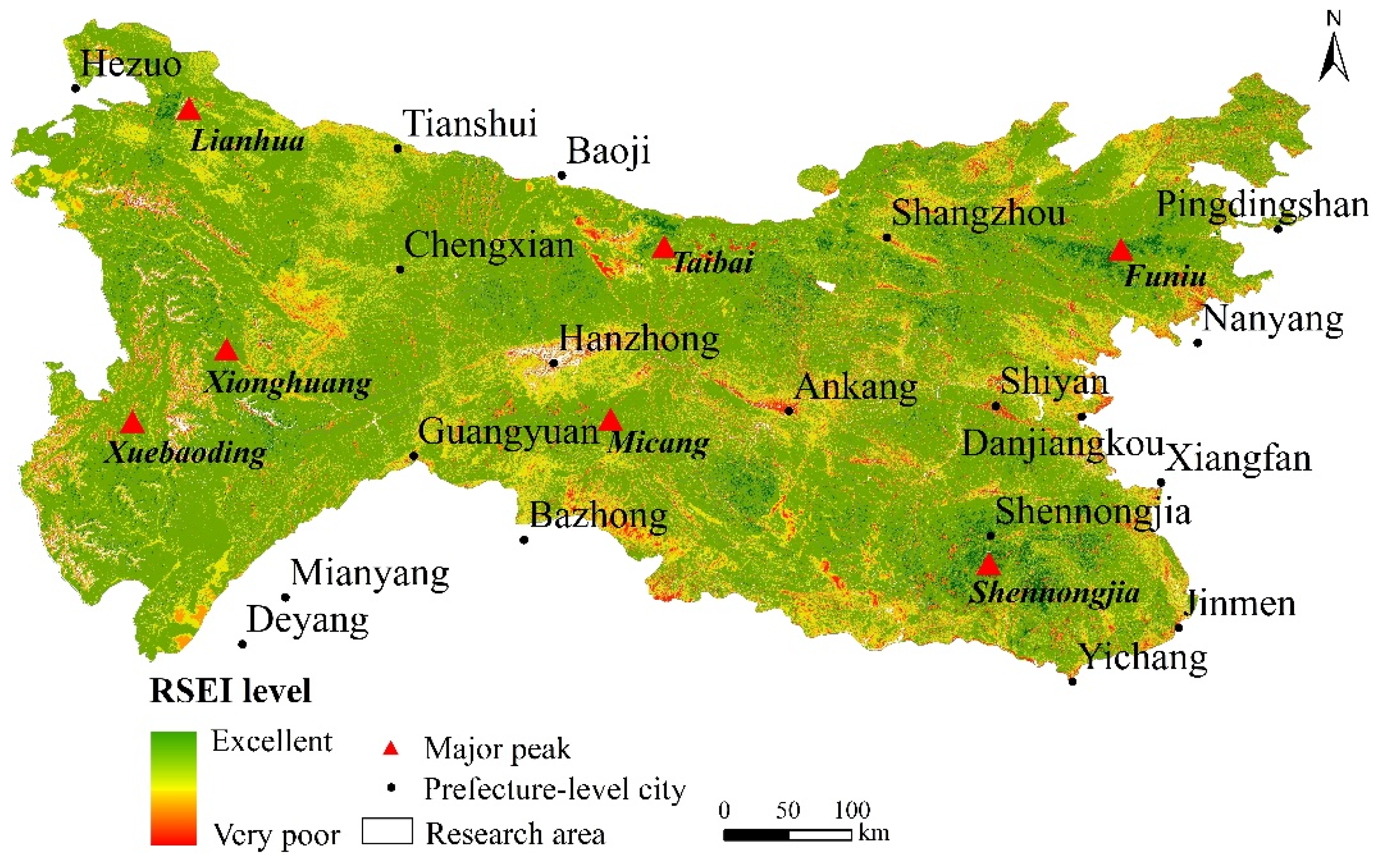


| Index | Calculation Formula |
|---|---|
| Greenness | NDVI = (NR − NIR)/(NR + NIR) |
| Humidity | WI = 0.1511B + 0.1973G + 0.3283NR + 0.3407NIR − 0.7117M1 − 0.4559M2 |
| Bare soil and construction | NDSI = (SI + NDIBI)/2 |
| SI = [(M1 + NR) − (NIR + B)]/[(M2 + NR) + (NIR + B)] | |
| NDIBI = {2M1/(M1 + NIR) [NIR/(NIR + NR) + G/(G + M1)]}/{2M2/(M2 + NIR) + | |
| [NIR/(NIR + NR) + G/(G + M2)]} | |
| Land surface temperature | LST = T/[1 + (λT/ρ) lnε] − 273 |
| T = B2/ln (B1/Ht + 1) | |
| Ht = (Lt − ↑U − V (1 − ε) ↓D)/Vε |
| Index | Mean | Standard Deviation | PC1 | PC2 | PC3 | PC4 | PC1 Load Value |
|---|---|---|---|---|---|---|---|
| NDVI | 0.63 | 0.27 | 0.614 | 0.133 | 0.427 | 0.654 | 0.614 |
| WI | 0.54 | 0.16 | 0.232 | −0.971 | 0.233 | 0.048 | 0.232 |
| NDSI | 0.40 | 0.20 | −0.521 | −0.194 | −0.826 | 0.094 | −0.521 |
| LST | 0.58 | 0.29 | −0.597 | 0.030 | 0.285 | −0.749 | −0.597 |
| Eigenvalues | - | - | 0.193 | 0.023 | 0.005 | 0.004 | - |
| Eigenvalue Contribution rate (%) | - | - | 85.41 | 10.29 | 2.31 | 1.99 | - |
| RSEI | 0.61 | 0.10 | - | - | - | - | - |
| RSEI Level | Area (km2) | Proportion (%) |
|---|---|---|
| Very poor (0~0.2) | 3154.5 | 1.11 |
| Poor (0.2~0.4) | 12,851.15 | 4.54 |
| Middle (0.4~0.6) | 82,487.02 | 29.15 |
| Good (0.6~0.8) | 178,672.98 | 63.14 |
| Excellent (0.8~1.0) | 5832.89 | 2.06 |
| Total | 282,998.54 | 100.00 |
| Model | C0 | C0 + C | C/C0 + C | R-Square | RSS |
|---|---|---|---|---|---|
| Gaussian model | 0.001 | 0.0063 | 83.9 | 0.74 | 2.9 × 10⁻⁷ |
| Linear model | 0.002 | 0.0071 | 71.0 | 0.34 | 1.7 × 10⁻⁷ |
| Exponential model | 0.00076 | 0.0064 | 88.0 | 0.80 | 2.3 × 10⁻⁷ |
| Spherical model | 0.00032 | 0.0060 | 94.9 | 0.74 | 2.9 × 10⁻⁷ |
| Influencing Factor | Analytic Index | Correlation Coefficient | Correlation |
|---|---|---|---|
| Terrain factors | Elevation | 0.52 | + |
| Slope | 0.62 | + | |
| Curvature | 0.10 | + | |
| Relief amplitude | 0.56 | + | |
| Climatic factors | Average annual temperature | 0.25 | − |
| Average annual precipitation | 0.38 | − | |
| Annual average relative humidity | 0.18 | + | |
| Land use type | Proportion of high vegetation area | 0.37 | + |
| Proportion of construction land area | 0.33 | − | |
| Proportion of agricultural land area | 0.09 | − | |
| Socio-economic factors | Annual average GDP | 0.19 | − |
| Population density | 0.22 | − |
| Factor Types | Influencing Factor | Detection Index | (q Value) |
|---|---|---|---|
| Structural factors | Terrain factors | Elevation | 0.528 ** |
| Slope | 0.561 ** | ||
| Curvature | 0.021 ** | ||
| Relief amplitude | 0.653 ** | ||
| Climatic factors | Annual average temperature | 0.256 ** | |
| Annual average precipitation | 0.312 ** | ||
| Annual average relative humidity | 0.230 ** | ||
| Randomness factors | Land use type | Proportion of high vegetation area | 0.282 ** |
| Proportion of construction land area | 0.135 ** | ||
| Proportion of agricultural land area | 0.002 | ||
| Socio-economic factors | Annual average GDP | 0.174 | |
| Population density | 0.214 ** |
Publisher’s Note: MDPI stays neutral with regard to jurisdictional claims in published maps and institutional affiliations. |
© 2022 by the authors. Licensee MDPI, Basel, Switzerland. This article is an open access article distributed under the terms and conditions of the Creative Commons Attribution (CC BY) license (https://creativecommons.org/licenses/by/4.0/).
Share and Cite
Yin, H.; Chen, C.; Dong, Q.; Zhang, P.; Chen, Q.; Zhu, L. Analysis of Spatial Heterogeneity and Influencing Factors of Ecological Environment Quality in China’s North-South Transitional Zone. Int. J. Environ. Res. Public Health 2022, 19, 2236. https://doi.org/10.3390/ijerph19042236
Yin H, Chen C, Dong Q, Zhang P, Chen Q, Zhu L. Analysis of Spatial Heterogeneity and Influencing Factors of Ecological Environment Quality in China’s North-South Transitional Zone. International Journal of Environmental Research and Public Health. 2022; 19(4):2236. https://doi.org/10.3390/ijerph19042236
Chicago/Turabian StyleYin, Haoran, Chaonan Chen, Qingdong Dong, Pingping Zhang, Quantong Chen, and Lianqi Zhu. 2022. "Analysis of Spatial Heterogeneity and Influencing Factors of Ecological Environment Quality in China’s North-South Transitional Zone" International Journal of Environmental Research and Public Health 19, no. 4: 2236. https://doi.org/10.3390/ijerph19042236
APA StyleYin, H., Chen, C., Dong, Q., Zhang, P., Chen, Q., & Zhu, L. (2022). Analysis of Spatial Heterogeneity and Influencing Factors of Ecological Environment Quality in China’s North-South Transitional Zone. International Journal of Environmental Research and Public Health, 19(4), 2236. https://doi.org/10.3390/ijerph19042236