Air Pollution and Cognitive Impairment across the Life Course in Humans: A Systematic Review with Specific Focus on Income Level of Study Area
 , ,
, ,
Abstract
1. Introduction
2. Materials and Methods
2.1. Search Strategy
2.2. Selection Criteria
2.3. Screening Strategy
2.4. Data Extraction and Analysis
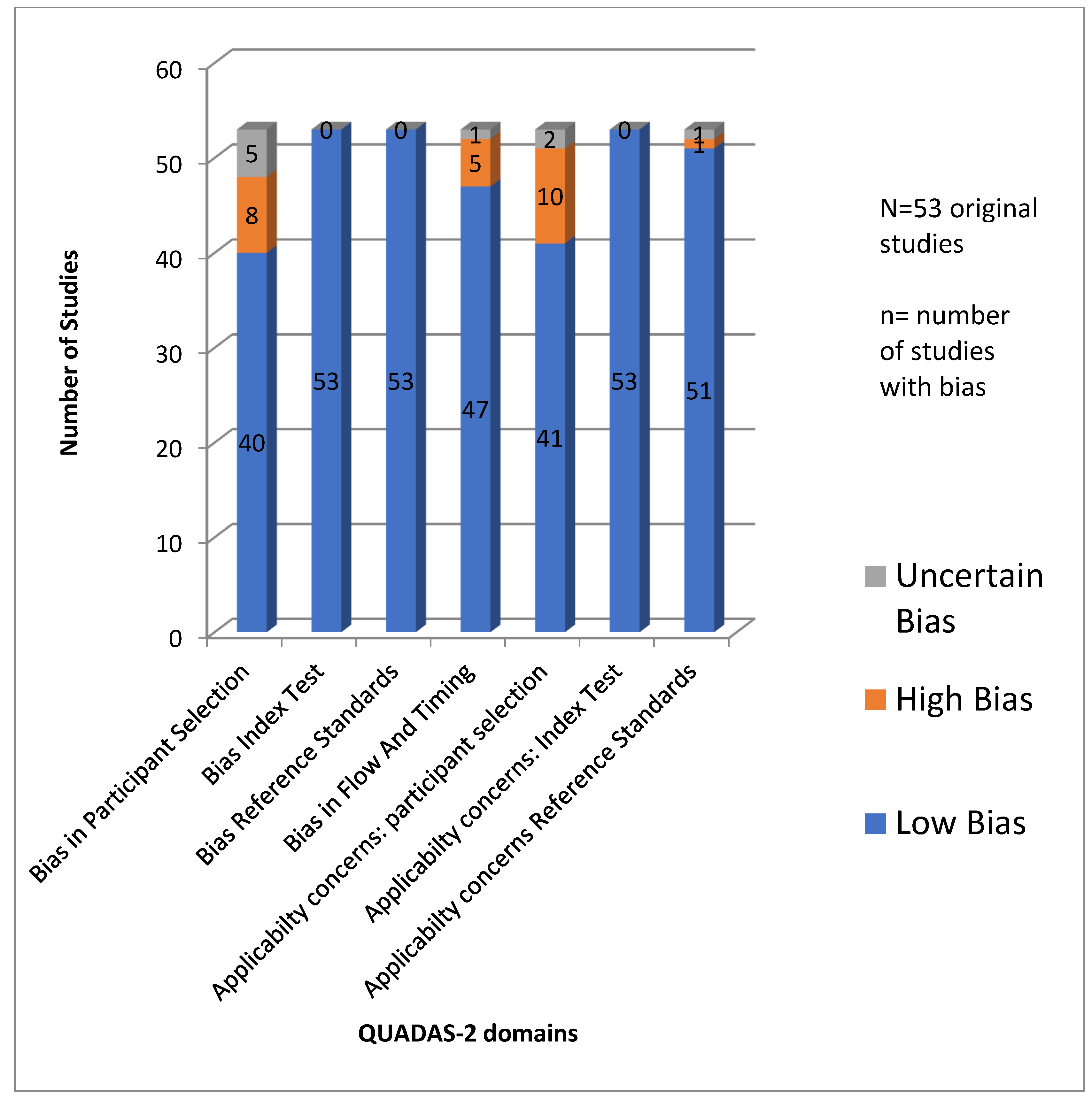
2.5. Quality Assessment
3. Results
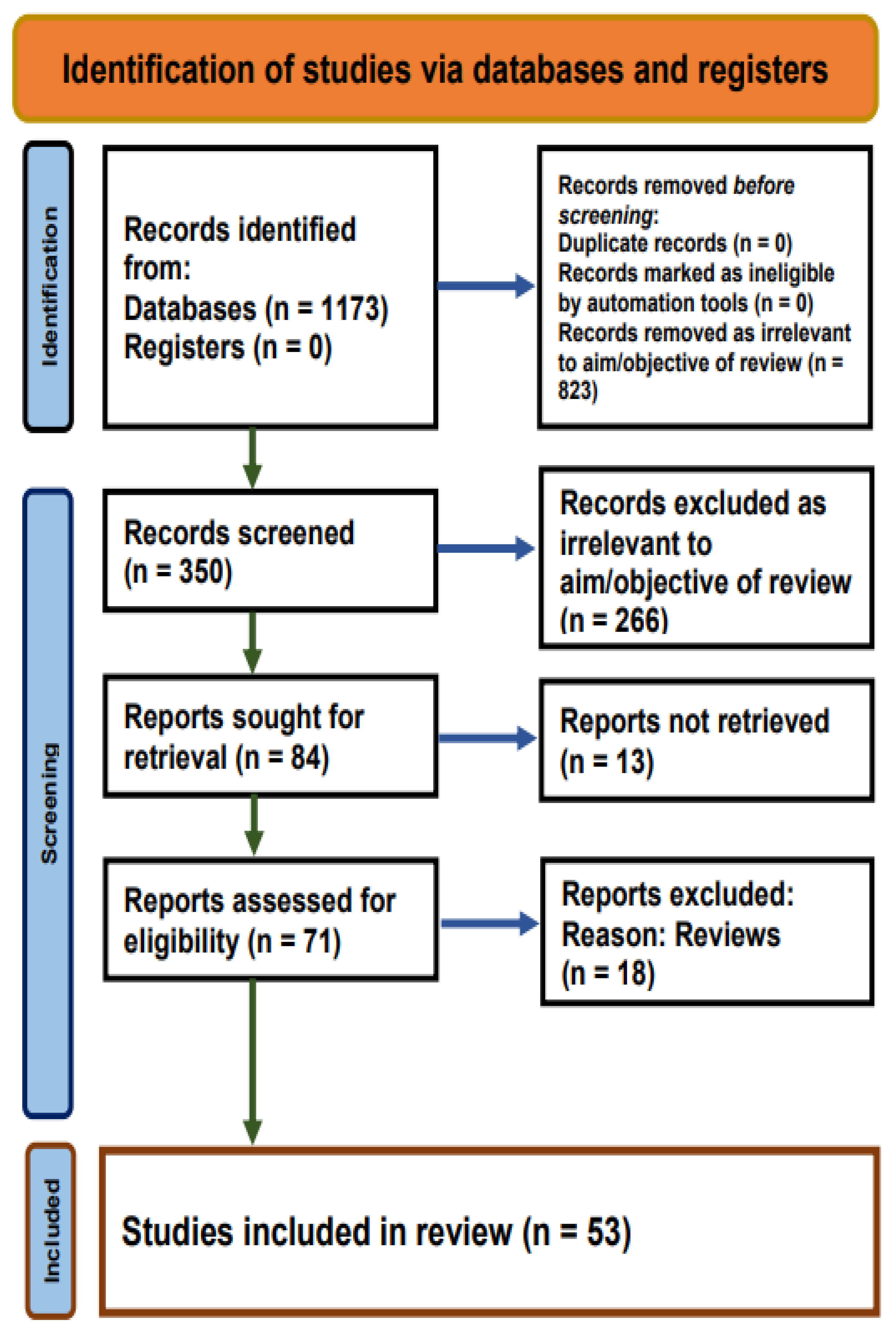
3.1. Original Research Studies Obtained on Screening
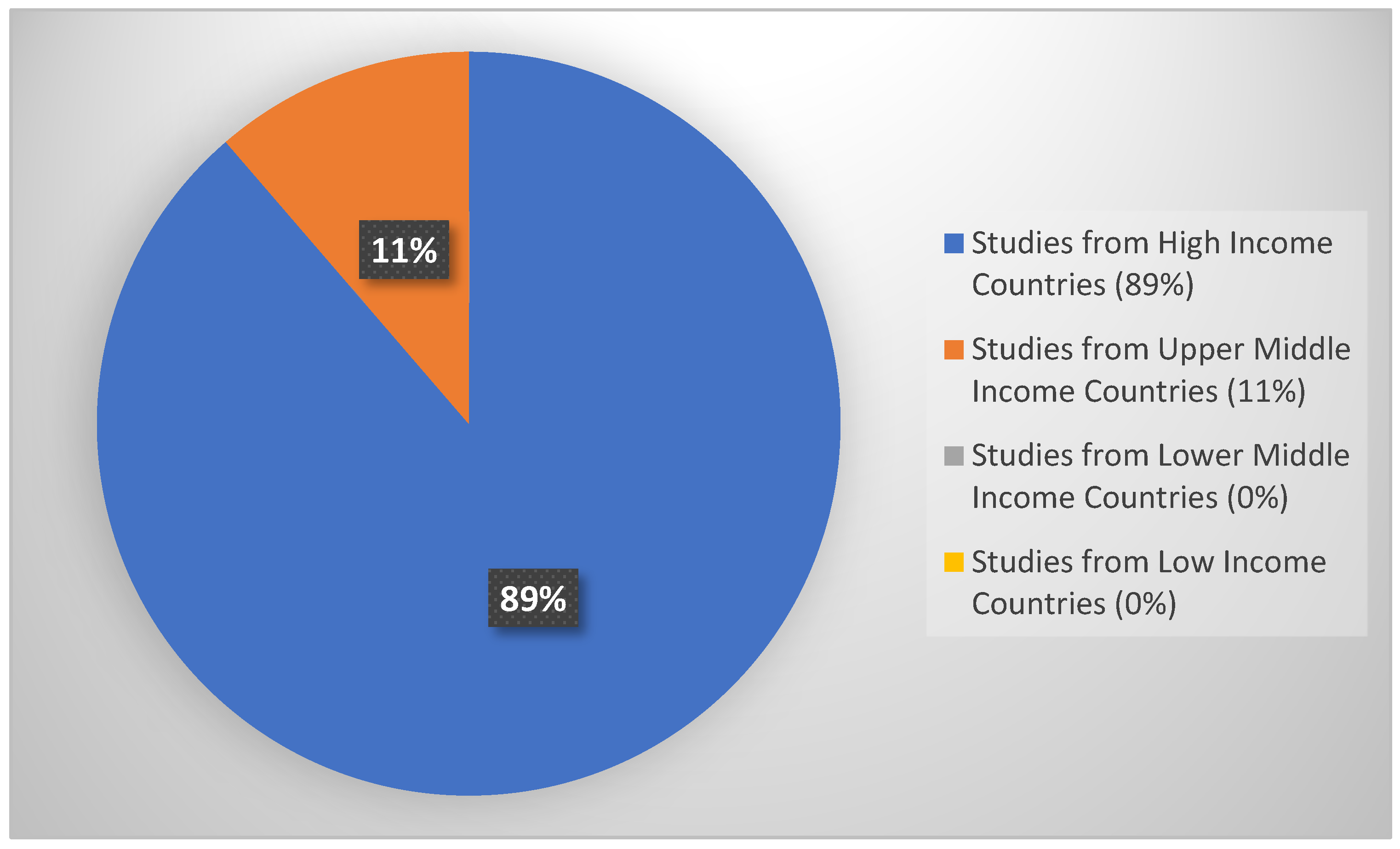
3.2. Income Levels of Sites of Original Studies
3.3. Research from LMICs/LICs
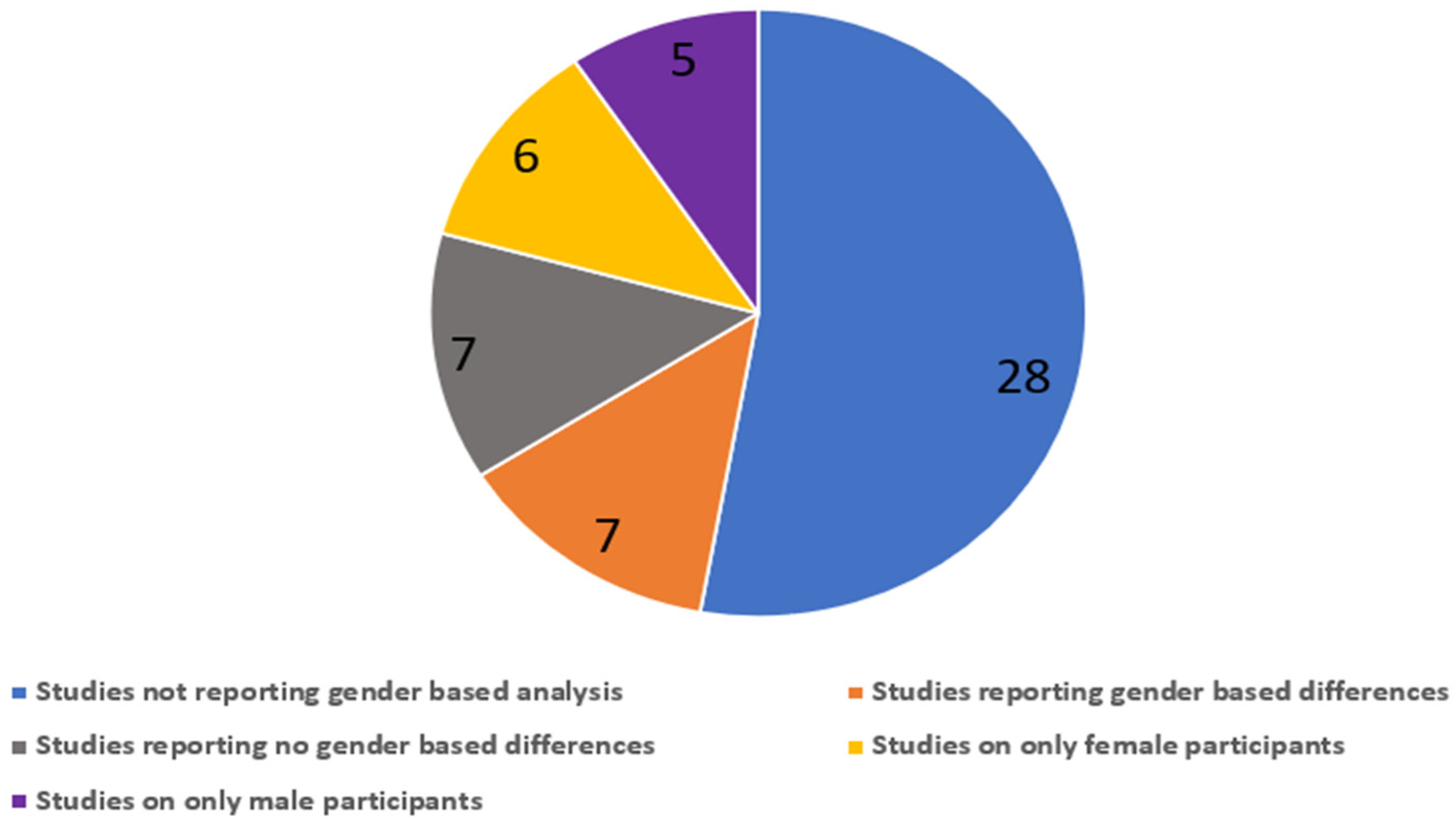
3.4. Gender-Based Analysis
3.5. Analysis Based on Life Course and Income Level of Study Areas
3.5.1. Studies Related to Air Pollution and Cognitive Impairment in Children and Adolescents
Prenatal Exposure Studies
- Multiple Air Pollutants
- 2.
- Traffic-Related Air Pollution (TRAP)
- 3.
- Particulate Matter (PM)
- 4.
- Isophorone
- 5.
- Persistent Organic Pollutants (POPs)
- 6.
- Polyaromatic Hydrocarbons (PAH)
Postnatal Exposure Studies
- Multiple Air Pollutants
- 2.
- Traffic-Related Air Pollution (TRAP)
- 3.
- Persistent Organic Pollutants (POPs)
- 4.
- Isophorone
3.5.2. Studies Related to Air Pollution and Cognitive Impairment in Adults
3.5.3. Studies Related to Air Pollution and Cognitive Dysfunction in the Older Adults
Air and Noise Pollution
Multiple Air Pollutants and TRAP
Particulate Matter (PM)
Polyaromatic Hydrocarbons (PAH)
Contribution of Genetic Factors
4. Discussion
5. Conclusions
Author Contributions
Funding
Acknowledgments
Conflicts of Interest
Abbreviations
Appendix A
Appendix A.1. Protocol for Systematic Review Air Pollution and Cognitive Health across the Life Course with Specific Focus on Income Level of the Study Area
Appendix A.1.1. Research Question
Appendix A.1.2. Aim and Objectives
Appendix A.1.3. Methodology

| Population | Any Age Group Both Genders Participant Level Data or Cohort Level Data |
|---|---|
| Investigated exposure | Air Pollution: single or multiple, cross sectional or cumulative exposure In utero exposure, Circumscribed cross sectional exposure or Lifetime exposure |
| Comparison | Air Pollutant exposed population comparators Gender comparators Income settings comparators |
| Outcome | Cognition and its different domains, neuroimaging markers |
Appendix A.2. Search Strategy
Appendix A.2.1. Databases
Appendix A.2.2. Keywords
Appendix A.2.3. The Study Eligibility
- Articles will be eligible for inclusion in the review if they are full-text articles published in English with no time limit on date of publication;
- Original studies, systematic reviews, and meta-analysis will all be eligible for inclusion;
- The target population could be of any age;
- The study could have been conducted in any country/countries.
- Exclusion criteria:
- The following publications will be excluded: Protocols, Letter to editor, No full text available;
- Grey Literature will be excluded.
Appendix A.3. Selecting the Studies
Appendix A.4. Data Extraction
Appendix A.5. Data Analysis
Appendix A.6. Quality Control
Appendix A.7. Patient, Public or Stakeholder Involvement
Appendix B. Sites of Original Research Studies on Air Pollution and Cognition as Per Income Level of the Country
References
- Forouzanfar, M.H.; Afshin, A.; Alexander, L.T.; Anderson, H.R.; Bhutta, Z.A.; Biryukov, S. Global, regional, and national comparative risk assessment of 79 behavioural, environmental and occupational, and metabolic risks or clusters of risks, 1990–2015: A systematic analysis for the Global Burden of Disease Study 2015. Lancet 2016, 388, 1659–1724. [Google Scholar] [CrossRef] [Scilit]
- Burnett, R.; Chen, H.; Szyszkowicz, M.; Fann, N.; Hubbell, B.; Pope, C.A.; Apte, J.S.; Brauer, M.; Cohen, A.; Weichenthal, S.; et al. Global estimates of mortality associated with long-term exposure to outdoor fine particulate matter. Proc. Natl. Acad. Sci. USA 2018, 115, 9592–9597. [Google Scholar] [CrossRef] [Scilit]
- Vohra, K.; Vodonos, A.; Schwartz, J.; Marais, E.A.; Sulprizio, M.P.; Mickley, L.J. Global mortality from outdoor fine particle pollution generated by fossil fuel combustion: Results from GEOS-Chem. Environ. Res. 2021, 195, 110754. [Google Scholar] [CrossRef] [Scilit]
- Babatola, S.S. Global burden of diseases attributable to air pollution. J. Public Health Afr. 2018, 9, 813. [Google Scholar] [CrossRef] [Scilit]
- Abera, A.; Friberg, J.; Isaxon, C.; Jerrett, M.; Malmqvist, E.; Sjöström, C. Air Quality in Africa: Public Health Implications. Annu. Rev. Public Health 2020, 42, 193–210. [Google Scholar] [CrossRef] [Scilit]
- Ostro, B.; Spadaro, J.V.; Gumy, S.; Mudu, P.; Awe, Y.; Forastiere, F.; Peters, A. Assessing the recent estimates of the global burden of disease for ambient air pollution: Methodological changes and implications for low- and middle-income countries. Environ. Res. 2018, 166, 713–725. [Google Scholar] [CrossRef] [Scilit]
- Guttikunda, S.; Goel, R.; Pant, P. Nature of air pollution, emission sources, and management in the Indian cities. Atmos. Environ. 2014, 95, 501–510. [Google Scholar] [CrossRef] [Scilit]
- Pal, R.; Chowdhury, S.; Dey, S.; Sharma, A.R. 18-Year Ambient PM2.5 Exposure and Night Light Trends in Indian Cities: Vulnerability Assessment. Aerosol Air Qual. Res. 2018, 18, 2332–2342. [Google Scholar] [CrossRef] [Scilit]
- Naidja, L.; Ali-Khodja, H.; Khardi, S. Sources and levels of particulate matter in North African and Sub-Saharan cities: A literature review. Environ. Sci. Pollut. Res. 2018, 25, 12303–12328. [Google Scholar] [CrossRef] [Scilit]
- Ferri, C.P.; Jacob, K.S. Dementia in low-income and middle-income countries: Different realities mandate tailored solutions. PLoS Med. 2017, 14, e1002271. [Google Scholar] [CrossRef] [Scilit] [PubMed]
- Dementia Statistics | Alzheimer’s Disease International (ADI). Available online: https://www.alzint.org/about/dementia-facts-figures/dementia-statistics/ (accessed on 3 August 2021).
- Alvarez-Pedrerol, M.; Rivas, I.; López-Vicente, M.; Suades-González, E.; Donaire-Gonzalez, D.; Cirach, M.; de Castro, M.; Esnaola, M.; Basagaña, X.; Dadvand, P.; et al. Impact of commuting exposure to traffic-related air pollution on cognitive development in children walking to school. Environ. Pollut. 2017, 231, 837–844. [Google Scholar] [CrossRef] [Scilit]
- Calderón-Garcidueñas, L.; Mora-Tiscareño, A.; Ontiveros, E.; Gómez-Garza, G.; Barragán-Mejía, G.; Broadway, J.; Chapman, S.; Valencia-Salazar, G.; Jewells, V.; Maronpot, R.R.; et al. Air pollution, cognitive deficits and brain abnormalities: A pilot study with children and dogs. Brain Cogn. 2008, 68, 117–127. [Google Scholar] [CrossRef] [Scilit] [PubMed]
- Guxens, M.; Lubczyńska, M.J.; Muetzel, R.L.; Dalmau-Bueno, A.; Jaddoe, V.W.; Hoek, G.; van der Lugt, A.; Verhulst, F.C.; White, T.; Brunekreef, B.; et al. Air Pollution Exposure during Fetal Life, Brain Morphology, and Cognitive Function in School-Age Children. Biol. Psychiatry 2018, 84, 295–303. [Google Scholar] [CrossRef] [Scilit]
- Cacciottolo, M.; Wang, X.; Driscoll, I.; Woodward, N.; Saffari, A.; Reyes, J.; Serre, M.L.; Vizuete, W.; Sioutas, C.; Morgan, E.T.; et al. Particulate air pollutants, APOE alleles and their contributions to cognitive impairment in older women and to amyloidogenesis in experimental models. Transl. Psychiatry 2017, 7, e1022. [Google Scholar] [CrossRef] [Scilit]
- Kioumourtzoglou, M.-A.; Schwartz, J.D.; Weisskopf, M.G.; Melly, S.J.; Wang, Y.; Dominici, F.; Zanobetti, A. Long-term PM 2.5 Exposure and Neurological HospitalAdmissions in the Northeastern United States. Environ. Health Perspect. 2016, 124, 23–29. [Google Scholar] [CrossRef] [Scilit]
- Power, M.C.; Adar, S.D.; Yanosky, J.D.; Weuve, J. Exposure to air pollution as a potential contributor to cognitive function, cognitive decline, brain imaging, and dementia: A systematic review of epidemiologic research. NeuroToxicology 2016, 56, 235–253. [Google Scholar] [CrossRef] [Scilit] [PubMed]
- Livingston, G.; Huntley, J.; Sommerlad, A.; Ames, D.; Ballard, C.; Banerjee, S.; Brayne, C.; Burns, A.; Cohen-Mansfield, J.; Cooper, C.; et al. Dementia prevention, intervention, and care: 2020 report of the Lancet Commission. Lancet 2020, 396, 413–446. [Google Scholar] [CrossRef] [Scilit]
- Moher, D.; Liberati, A.; Tetzlaff, J.; Altman, D.G.; Group, P. Preferred reporting items for systematic reviews and meta-analyses: The PRISMA statement. BMJ 2009, 339, b2535. [Google Scholar] [CrossRef] [PubMed]
- World Bank. 2020. Available online: https://blogs.worldbank.org/opendata/new-world-bank-country-classifications-income-level-2020–2021 (accessed on 19 August 2020).
- Whiting, P.F.; Rutjes, A.W.S.; Westwood, M.E.; Mallett, S.; Deeks, J.J.; Reitsma, J.B.; Leeflang, M.M.; Sterne, J.A.; Bossuyt, P.M.; QUADAS-2 Group. QUADAS-2: A Revised Tool for the Quality Assessment of Diagnostic Accuracy Studies. Ann. Intern. Med. 2011, 155, 529–536. [Google Scholar] [CrossRef] [Scilit] [PubMed]
- Lee, M.; Schwartz, J.; Wang, Y.; Dominici, F.; Zanobetti, A. Long-term effect of fine particulate matter on hospitalization with dementia. Environ. Pollut. 2019, 254, 112926. [Google Scholar] [CrossRef] [Scilit] [PubMed]
- Lo, Y.-T.C.; Lu, Y.-C.; Chang, Y.-H.; Kao, S.; Huang, H.-B. Air Pollution Exposure and Cognitive Function in Taiwanese Older Adults: A Repeated Measurement Study. Int. J. Environ. Res. Public Health 2019, 16, 2976. [Google Scholar] [CrossRef] [Scilit] [PubMed]
- Molina-Sotomayor, E.G.O.M.; Pradas de la Fuente, F.; Carozzi Figueroa, G.S.-O.A.; González-Jurado, J.A. Effects of cardiorespiratory exercise on cognition in older women exposed to air pollution. Int. J. Environ. Res. Public Health 2019, 16, 245. [Google Scholar] [CrossRef] [Scilit] [PubMed]
- Andersson, J.; Oudin, A.; Sundström, A.; Forsberg, B.; Adolfsson, R.; Nordin, M. Road traffic noise, air pollution, and risk of dementia–results from the Betula project. Environ. Res. 2018, 166, 334–339. [Google Scholar] [CrossRef] [Scilit]
- Berghuis, S.A.; Van Braeckel, K.N.; Sauer, P.J.; Bos, A.F. Prenatal exposure to persistent organic pollutants and cognition and motor performance in adolescence. Environ. Int. 2018, 121, 13–22. [Google Scholar] [CrossRef] [Scilit]
- Carey, I.M.; Anderson, H.R.; Atkinson, R.W.; Beevers, S.D.; Cook, D.; Strachan, D.P.; Dajnak, D.; Gulliver, J.; Kelly, F.J. Are noise and air pollution related to the incidence of dementia? A cohort study in London, England. BMJ Open 2018, 8, e022404. [Google Scholar] [CrossRef] [Scilit] [PubMed]
- Cullen, B.; Newby, D.; Lee, D.; Lyall, D.M.; Nevado-Holgado, A.J.; Evans, J.J.; Pell, J.P.; Lovestone, S.; Cavanagh, J. Cross-sectional and longitudinal analyses of outdoor air pollution exposure and cognitive function in UK Biobank. Sci. Rep. 2018, 8, 12089. [Google Scholar] [CrossRef] [Scilit]
- Kerin, T.; Volk, H.; Li, W.; Lurmann, F.; Eckel, S.; McConnell, R.; Hertz-Picciotto, I. Association between Air Pollution Exposure, Cognitive and Adaptive Function, and ASD Severity among Children with Autism Spectrum Disorder. J. Autism Dev. Disord. 2017, 48, 137–150. [Google Scholar] [CrossRef] [Scilit]
- Oudin, A.; Segersson, D.; Adolfsson, R.; Forsberg, B. Association between air pollution from residential wood burning and dementia incidence in a longitudinal study in Northern Sweden. PLoS ONE 2018, 13, e0198283. [Google Scholar] [CrossRef] [Scilit]
- Ailshire, J.; Karraker, A.; Clarke, P. Neighborhood social stressors, fine particulate matter air pollution, and cognitive function among older US adults. Soc. Sci. Med. 2017, 172, 56–63. [Google Scholar] [CrossRef] [Scilit]
- Chen, H.; Kwong, J.C.; Copes, R.; Hystad, P.; van Donkelaar, A.; Tu, K.; Brook, J.R.; Goldberg, M.S.; Martin, R.V.; Murray, B.; et al. Exposure to ambient air pollution and the incidence of dementia: A population-based cohort study. Environ. Int. 2017, 108, 271–277. [Google Scholar] [CrossRef] [Scilit]
- Colicino, E.; Wilson, A.; Frisardi, M.C.; Prada, D.; Power, M.C.; Hoxha, M.; Dioni, L.; Spiro, A.; Vokonas, P.S.; Weisskopf, M.G.; et al. Telomere Length, Long-Term Black Carbon Exposure, and Cognitive Function in a Cohort of Older Men: The VA Normative Aging Study. Environ. Health Perspect. 2017, 125, 76–81. [Google Scholar] [CrossRef] [Scilit] [PubMed]
- Forns, J.; Dadvand, P.; Esnaola, M.; Alvarez-Pedrerol, M.; López-Vicente, M.; Garcia-Esteban, R.; Cirach, M.; Basagaña, X.; Guxens, M.; Sunyer, J. Longitudinal association between air pollution exposure at school and cognitive development in school children over a period of 3.5 years. Environ. Res. 2017, 159, 416–421. [Google Scholar] [CrossRef] [Scilit]
- Lett, E.; Stingone, J.A.; Claudio, L. The Combined Influence of Air Pollution and Home Learning Environment on Early Cognitive Skills in Children. Int. J. Environ. Res. Public Health 2017, 14, 1295. [Google Scholar] [CrossRef] [Scilit]
- Oudin, A.; Forsberg, B.; Lind, N.; Nordin, S.; Åström, D.O.; Sundström, A. Is long-term exposure to air pollution associated with episodic memory? A longitudinal study from Northern Sweden. Sci. Rep. 2017, 7, 12789. [Google Scholar] [CrossRef] [Scilit]
- Stingone, J.A.; Pandey, O.P.; Claudio, L.; Pandey, G. Using machine learning to identify air pollution exposure profiles associated with early cognitive skills among U.S. children. Environ. Pollut. 2017, 230, 730–740. [Google Scholar] [CrossRef] [Scilit]
- Sunyer, J.; Suades-González, E.; García-Esteban, R.; Rivas, I.; Pujol, J.; Alvarez-Pedrerol, M. Traffic-related air pollution and attention in primary school children: Short-term association. Epidemiology 2017, 28, 181. [Google Scholar] [CrossRef] [Scilit] [PubMed]
- Tallon, L.A.; Manjourides, J.; Pun, V.C.; Salhi, C.; Suh, H. Cognitive impacts of ambient air pollution in the National Social Health and Aging Project (NSHAP) cohort. Environ. Int. 2017, 104, 102–109. [Google Scholar] [CrossRef] [Scilit]
- Tzivian, L.; Jokisch, M.; Winkler, A.; Weimar, C.; Hennig, F.; Sugiri, D.; Soppa, V.J.; Dragano, N.; Erbel, R.; Jöckel, K.-H.; et al. Associations of long-term exposure to air pollution and road traffic noise with cognitive function—An analysis of effect measure modification. Environ. Int. 2017, 103, 30–38. [Google Scholar] [CrossRef] [Scilit] [PubMed]
- Best, E.A.; Juarez-Colunga, E.; James, K.; Leblanc, W.G.; Serdar, B. Biomarkers of Exposure to Polycyclic Aromatic Hydrocarbons and Cognitive Function among Elderly in the United States (National Health and Nutrition Examination Survey: 2001–2002). PLoS ONE 2016, 11, e0147632. [Google Scholar] [CrossRef] [Scilit]
- Oudin, A.; Forsberg, B.; Adolfsson, A.N.; Lind, N.; Modig, L.; Nordin, M.; Nordin, S.; Adolfsson, R.; Nilsson, L.-G. Traffic-Related Air Pollution and Dementia Incidence in Northern Sweden: A Longitudinal Study. Environ. Health Perspect. 2016, 124, 306–312. [Google Scholar] [CrossRef] [Scilit]
- Porta, D.; Narduzzi, S.; Badaloni, C.; Bucci, S.; Cesaroni, G.; Colelli, V.; Davoli, M.; Sunyer, J.; Zirro, E.; Schwartz, J.; et al. Air pollution and cognitive development at age seven in a prospective Italian birth cohort. Epidemiology 2015, 27, 228–236. [Google Scholar] [CrossRef] [Scilit]
- Tzivian, L.; Dlugaj, M.; Winkler, A.; Hennig, F.; Fuks, K.; Sugiri, D.; Schikowski, T.; Jakobs, H.; Erbel, R.; Jöckel, K.-H.; et al. Long-term air pollution and traffic noise exposures and cognitive function: A cross-sectional analysis of the Heinz Nixdorf Recall study. J. Toxicol. Environ. Health Part A 2016, 79, 1057–1069. [Google Scholar] [CrossRef] [Scilit]
- Tzivian, L.; Dlugaj, M.; Winkler, A.; Weinmayr, G.; Hennig, F.; Fuks, K.B.; Vossoughi, M.; Schikowski, T.; Weimar, C.; Erbel, R.; et al. Long-Term Air Pollution and Traffic Noise Exposures and Mild Cognitive Impairment in Older Adults: A Cross-Sectional Analysis of the Heinz Nixdorf Recall Study. Environ. Health Perspect. 2016, 124, 1361–1368. [Google Scholar] [CrossRef] [Scilit] [PubMed]
- Chen, J.-C.; Wang, X.; ScD, G.A.W.; Serre, M.; Driscoll, I.; Casanova, R.; McArdle, J.J.; Manson, J.E.; Chui, H.C.; Espeland, M.A. Ambient air pollution and neurotoxicity on brain structure: Evidence from women’s health initiative memory study. Ann. Neurol. 2015, 78, 466–476. [Google Scholar] [CrossRef] [Scilit]
- Harris, M.H.; Gold, D.R.; Rifas-Shiman, S.L.; Melly, S.J.; Zanobetti, A.; Coull, B.A.; Schwartz, J.D.; Gryparis, A.; Kloog, I.; Koutrakis, P.; et al. Prenatal and Childhood Traffic-Related Pollution Exposure and Childhood Cognition in the Project Viva Cohort (Massachusetts, USA). Environ. Health Perspect. 2015, 123, 1072–1078. [Google Scholar] [CrossRef] [Scilit]
- Peterson, B.S.; Rauh, V.A.; Bansal, R.; Hao, X.; Toth, Z.; Nati, G.; Walsh, K.; Miller, R.L.; Arias, F.; Semanek, D.; et al. Effects of Prenatal Exposure to Air Pollutants (Polycyclic Aromatic Hydrocarbons) on the Development of Brain White Matter, Cognition, and Behavior in Later Childhood. JAMA Psychiatry 2015, 72, 531–540. [Google Scholar] [CrossRef] [Scilit] [PubMed]
- Schikowski, T.; Vossoughi, M.; Vierkötter, A.; Schulte, T.; Teichert, T.; Sugiri, D.; Fehsel, K.; Tzivian, L.; Bae, I.-S.; Ranft, U.; et al. Association of air pollution with cognitive functions and its modification by APOE gene variants in elderly women. Environ. Res. 2015, 142, 10–16. [Google Scholar] [CrossRef] [Scilit]
- Sunyer, J.; Esnaola, M.; Alvarez-Pedrerol, M.; Forns, J.; Rivas, I.; López-Vicente, M.; Suades-González, E.; Foraster, M.; Garcia-Esteban, R.; Basagaña, X.; et al. Association between Traffic-Related Air Pollution in Schools and Cognitive Development in Primary School Children: A Prospective Cohort Study. PLoS Med. 2015, 12, e1001792. [Google Scholar] [CrossRef] [Scilit]
- Ailshire, J.A.; Clarke, P. Fine Particulate Matter Air Pollution and Cognitive Function among U.S. Older Adults. J. Gerontol. Ser. B 2014, 70, 322–328. [Google Scholar] [CrossRef] [Scilit] [PubMed]
- Jennifer, A.; Ailshire, E.M.C. Fine particulate matter air pollution and cognitive function among older US adults. Am. J. Epidemiol. 2014, 180, 359–366. [Google Scholar]
- Gatto, N.M.; Henderson, V.W.; Hodis, H.N.; John, J.A.S.; Lurmann, F.; Chen, J.-C.; Mack, W.J. Components of air pollution and cognitive function in middle-aged and older adults in Los Angeles. NeuroToxicology 2013, 40, 1–7. [Google Scholar] [CrossRef] [Scilit]
- Guxens, M.; Garcia-Esteban, R.; Giorgis-Allemand, L.; Forns, J.; Badaloni, C.; Ballester, F. Air Pollution during Pregnancy and Childhood Cognitive and Psychomotor Development: Six European Birth Cohorts. Epidemiology 2014, 25, 636–647. [Google Scholar] [CrossRef] [Scilit]
- Tonne, C.; Elbaz, A.; Beevers, S.; Singh-Manoux, A. Traffic-related Air Pollution in Relation to Cognitive Function in Older Adults. Epidemiology 2014, 25, 674–681. [Google Scholar] [CrossRef] [Scilit]
- Loop, M.S.; Kent, S.T.; Al-Hamdan, M.Z.; Crosson, W.L.; Estes, S.M.; Estes, M.G., Jr. Fine particulate matter and incident cognitive impairment in the REasons for Geographic and Racial Differences in Stroke (REGARDS) cohort. PLoS ONE 2013, 8, e75001. [Google Scholar] [CrossRef] [Scilit]
- Power, M.C.; Weisskopf, M.G.; Alexeeff, E.S.; Wright, R.; Coull, A.B.; Spiro, A.; Schwartz, J. Modification by hemochromatosis gene polymorphisms of the association between traffic-related air pollution and cognition in older men: A cohort study. Environ. Health 2013, 12, 16. [Google Scholar] [CrossRef] [Scilit] [PubMed]
- Weuve, J.; Puett, R.C.; Schwartz, J.; Yanosky, J.D.; Laden, F.; Grodstein, F. Exposure to Particulate Air Pollution and Cognitive Decline in Older Women. Arch. Intern. Med. 2012, 172, 219–227. [Google Scholar] [CrossRef] [Scilit] [PubMed]
- Power, M.C.; Weisskopf, M.G.; Alexeeff, S.E.; Coull, B.A.; Spin, A., III; Schwartz, J. Traffic-related air pollution and cognitive function in a cohort of older men. Environ. Health Perspect. 2011, 119, 682. [Google Scholar] [CrossRef] [Scilit] [PubMed]
- Edwards, S.C.; Jedrychowski, W.; Butscher, M.; Camann, D.; Kieltyka, A.; Mroz, E.; Flak, E.; Li, Z.; Wang, S.; Rauh, V.; et al. Prenatal Exposure to Airborne Polycyclic Aromatic Hydrocarbons and Children’s Intelligence at 5 Years of Age in a Prospective Cohort Study in Poland. Environ. Health Perspect. 2010, 118, 1326–1331. [Google Scholar] [CrossRef] [Scilit]
- Freire, C.; Ramos, R.; Puertas, R.; Lopez-Espinosa, M.-J.; Julvez, J.; Aguilera, I.; Cruz, F.; Fernandez, M.-F.; Sunyer, J.; Olea, N. Association of traffic-related air pollution with cognitive development in children. J. Epidemiol. Commun. Health 2009, 64, 223–228. [Google Scholar] [CrossRef] [Scilit]
- Chen, J.-C.; Schwartz, J. Neurobehavioral effects of ambient air pollution on cognitive performance in US adults. NeuroToxicology 2009, 30, 231–239. [Google Scholar] [CrossRef] [Scilit]
- Perera, F.P.; Li, Z.; Whyatt, R.; Hoepner, L.; Wang, S.; Camann, D.; Rauh, V. Prenatal Airborne Polycyclic Aromatic Hydrocarbon Exposure and Child IQ at Age 5 Years. Pediatrics 2009, 124, e195–e202. [Google Scholar] [CrossRef] [Scilit]
- Ranft, U.; Schikowski, T.; Sugiri, D.; Krutmann, J.; Krämer, U. Long-term exposure to traffic-related particulate matter impairs cognitive function in the elderly. Environ. Res. 2009, 109, 1004–1011. [Google Scholar] [CrossRef] [Scilit]
- Lee, D.-H.; Jacobs, D.R.; Porta, M. Association of serum concentrations of persistent organic pollutants with the prevalence of learning disability and attention deficit disorder. J. Epidemiol. Commun. Health 2007, 61, 591–596. [Google Scholar] [CrossRef] [Scilit] [PubMed]
- Saenz, J.L.; Wong, R.; A Ailshire, J. Indoor air pollution and cognitive function among older Mexican adults. J. Epidemiol. Commun. Health 2017, 72, 21–26. [Google Scholar] [CrossRef] [Scilit]
- Zhang, X.; Chen, X.; Zhang, X. The impact of exposure to air pollution on cognitive performance. Proc. Natl. Acad. Sci. USA 2018, 115, 9193–9197. [Google Scholar] [CrossRef] [Scilit]
- Calderón-Garcidueñas, L.; Kavanaugh, M.; Block, M.; D’Angiulli, A.; Delgado-Chávez, R.; Torres-Jardón, R.; González-Maciel, A.; Reynoso-Robles, R.; Osnaya, N.; Villarreal-Calderon, R.; et al. Neuroinflammation, Hyperphosphorylated Tau, Diffuse Amyloid Plaques, and Down-Regulation of the Cellular Prion Protein in Air Pollution Exposed Children and Young Adults. J. Alzheimer Dis. 2012, 28, 93–107. [Google Scholar] [CrossRef] [Scilit] [PubMed]
- Calderón-Garcidueñas, L.; Engle, R.; Mora-Tiscareño, A.; Styner, M.; Gómez-Garza, G.; Zhu, H.; Jewells, V.; Torres-Jardón, R.; Romero, L.; Monroy-Acosta, M.E.; et al. Exposure to severe urban air pollution influences cognitive outcomes, brain volume and systemic inflammation in clinically healthy children. Brain Cogn. 2011, 77, 345–355. [Google Scholar] [CrossRef] [Scilit]
- Wang, J.N.; Wang, Q.; Li, T.T.; Shi, X.M. Association between air pollution and cognitive function in the elderly. Chin. J. Prev. Med. 2017, 51, 364–368. (In Chinese) [Google Scholar]
- Sharma, S.; Chandra, M.; Kota, S.H. Health Effects Associated with PM2.5: A Systematic Review. Curr. Pollut. Rep. 2020, 6, 345–367. [Google Scholar] [CrossRef] [Scilit]
- Dias, A.; Patel, V. Closing the treatment gap for dementia in India. Indian J. Psychiatry 2009, 51, S93–S97. [Google Scholar]
- Prince, M.J. World Alzheimer Report 2015: The Global Impact of Dementia: An Analysis of Prevalence, Incidence, Cost and Trends; Alzheimer’s Disease International: London, UK, 2015. [Google Scholar]
- Shaji, K.S.; Jithu, V.P.; Jyothi, K.S. Indian research on aging and dementia. Indian J. Psychiatry 2010, 52, 148–152. [Google Scholar] [CrossRef] [Scilit]
- Landrigan, P.J.; Fuller, R.; Acosta, N.J.R.; Adeyi, O.; Arnold, R.; Basu, N.; Baldé, A.B.; Bertollini, R.; Bose-O’Reilly, S.; Boufford, J.I.; et al. The Lancet Commission on pollution and health. Lancet 2018, 391, 462–512. [Google Scholar] [CrossRef] [Scilit]
- Shah, A.S.V.; Lee, K.K.; McAllister, D.; Hunter, A.; Nair, H.; Whiteley, W.; Langrish, J.P.; E Newby, D.; Mills, N. Short term exposure to air pollution and stroke: Systematic review and meta-analysis. BMJ 2015, 350, h1295. [Google Scholar] [CrossRef] [Scilit]
- Chen, X. Smog, cognition and real-world decision-making. Int. J. Health Policy Manag. 2019, 8, 76. [Google Scholar] [CrossRef] [Scilit] [PubMed]
- Schraufnagel, D.E.; Balmes, J.R.; Cowl, C.T.; De Matteis, S.; Jung, S.-H.; Mortimer, K. Air pollution and noncommunicable diseases: A review by the Forum of International Respiratory Societies’ Environmental Committee, Part 2: Air pollution and organ systems. Chest 2019, 155, 417–426. [Google Scholar] [CrossRef] [Scilit] [PubMed]
- Block, M.L.; Calderón-Garcidueñas, L. Air pollution: Mechanisms of neuroinflammation and CNS disease. Trends Neurosci. 2009, 32, 506–516. [Google Scholar] [CrossRef] [Scilit] [PubMed]
- Li, J.; Liu, Y.; An, Z.; Li, W.; Zeng, X.; Li, H.; Jiang, J.; Song, J.; Wu, W. Seasonal Variations in PM2.5-induced Oxidative Stress and Up-regulation of Pro-inflammatory Mediators. Aerosol Air Qual. Res. 2020, 20, 679–687. [Google Scholar] [CrossRef] [Scilit]
- Peters, R.; Peters, J.; Booth, A.; Mudway, I. Is air pollution associated with increased risk of cognitive decline? A systematic review. Age Ageing 2015, 44, 755–760. [Google Scholar] [CrossRef] [Scilit] [PubMed]

| Population | Any Age Group Both Genders Participant Level Data or Cohort Level Data |
|---|---|
| Investigated exposure | Air Pollution: single or multiple Cross sectional or Cumulative exposure In utero exposure, Circumscribed cross sectional exposure or Lifetime exposure |
| Comparison | Air Pollutant exposed population comparators Gender comparators Income settings comparators |
| Outcome | Cognition and its different domains, neuroimaging markers |
| S. No. | Study: Author (Year) | Risk of Bias Low: 1, High: 2, Uncertain: 3 | Applicability Concerns Low: 1, High: 2, Uncertain: 3 | |||||
|---|---|---|---|---|---|---|---|---|
| Participant Selection | Index Test | Reference Standards | Flow and Timing | Participant Selection | Index Test | Reference Standards | ||
| A | Studies from High Income Settings | |||||||
| 1 | Lee et al. (2019) [22] | 1 | 1 | 1 | 1 | 1 | 1 | 1 |
| 2 | Lo et al. (2019) [23] | 1 | 1 | 1 | 1 | 1 | 1 | 1 |
| 3 | Molina-Sotomayor et al. (2019) [24] | 2 | 1 | 1 | 2 | 1 | 1 | 1 |
| 4 | Andersson et al. (2018) [25] | 1 | 1 | 1 | 1 | 2 | 1 | 1 |
| 5 | Berghuis et al. (2018) [26] | 2 | 1 | 1 | 1 | 2 | 1 | 1 |
| 6 | Carey et al. (2018) [27] | 1 | 1 | 1 | 1 | 1 | 1 | 1 |
| 7 | Cullen et al. (2018) [28] | 1 | 1 | 1 | 1 | 1 | 1 | 1 |
| 8 | Guxens et al. (2018) [14] | 1 | 1 | 1 | 1 | 1 | 1 | 1 |
| 9 | Kerin et al. (2018) [29] | 2 | 1 | 1 | 1 | 2 | 1 | 1 |
| 10 | Oudin et al. (2018) [30] | 1 | 1 | 1 | 1 | 1 | 1 | 1 |
| 11 | Ailshire et al. (2017) [31] | 3 | 1 | 1 | 1 | 2 | 1 | 1 |
| 12 | Alvarez-Pedrerol (2017) [12] | 1 | 1 | 1 | 1 | 1 | 1 | 1 |
| 13 | Cacciottolo et al. (2017) [15] | 1 | 1 | 1 | 1 | 1 | 1 | 1 |
| 14 | Chen et al. (2017) [32] | 1 | 1 | 1 | 1 | 1 | 1 | 1 |
| 15 | Colicino et al. (2017) [33] | 2 | 1 | 1 | 1 | 2 | 1 | 1 |
| 16 | Forns et al. (2017) [34] | 1 | 1 | 1 | 1 | 1 | 1 | 1 |
| 17 | Lett et al. (2017) [35] | 1 | 1 | 1 | 1 | 1 | 1 | 1 |
| 18 | Oudin et al. (2017) [36] | 1 | 1 | 1 | 1 | 1 | 1 | 1 |
| 19 | Stingone et al. (2017) [37] | 1 | 1 | 1 | 1 | 1 | 1 | 1 |
| 20 | Sunyer et al. (2017) [38] | 1 | 1 | 1 | 1 | 1 | 1 | 1 |
| 21 | Tallon et al. (2017) [39] | 1 | 1 | 1 | 1 | 1 | 1 | 1 |
| 22 | Tzivian et al. (2017) [40] | 1 | 1 | 1 | 1 | 1 | 1 | 1 |
| 23 | Best et al. (2016) [41] | 1 | 1 | 1 | 1 | 1 | 1 | 1 |
| 24 | Oudin et al. (2016) [42] | 1 | 1 | 1 | 1 | 1 | 1 | 1 |
| 25 | Porta et al. (2016) [43] | 3 | 1 | 1 | 1 | 3 | 1 | 1 |
| 26 | Tzivian et al. (2016) [44] | 1 | 1 | 1 | 1 | 1 | 1 | 1 |
| 27 | Tzivian et al. (2016) [45] | 1 | 1 | 1 | 1 | 1 | 1 | 1 |
| 28 | Chen et al. (2015) [46] | 1 | 1 | 1 | 1 | 1 | 1 | 1 |
| 29 | Harris et al. (2015) [46] | 1 | 1 | 1 | 1 | 1 | 1 | 1 |
| 30 | Peterson et al. (2015) [47] | 1 | 1 | 1 | 1 | 1 | 1 | 1 |
| 31 | Schikowski et al. (2015) [48] | 1 | 1 | 1 | 1 | 1 | 1 | 1 |
| 32 | Sunyer et al. (2015) [49] | 1 | 1 | 1 | 1 | 1 | 1 | 1 |
| 33 | Ailshire and Clarke (2014) [50] | 3 | 1 | 1 | 3 | 2 | 1 | 1 |
| 34 | Ailshire and Crimmins (2014) [51] | 1 | 1 | 1 | 1 | 1 | 1 | 1 |
| 35 | Gatto et al. (2014) [52] | 1 | 1 | 1 | 1 | 1 | 1 | 1 |
| 36 | Guxens et al. (2014) [53] | 1 | 1 | 1 | 1 | 1 | 1 | 1 |
| 37 | Tonne et al. (2014) [54] | 1 | 1 | 1 | 1 | 1 | 1 | 1 |
| 38 | Loop et al. (2013) [55] | 1 | 1 | 1 | 1 | 1 | 1 | 1 |
| 39 | Power et al. (2013) [56] | 1 | 1 | 1 | 1 | 1 | 1 | 1 |
| 40 | Weuve et al. (2012) [57] | 1 | 1 | 1 | 1 | 1 | 1 | 1 |
| 41 | Power et al. (2011) [58] | 1 | 1 | 1 | 1 | 1 | 1 | 1 |
| 42 | Edwards et al. (2010) [59] | 1 | 1 | 1 | 1 | 1 | 1 | 1 |
| 43 | Freire et al. (2010) [60] | 3 | 1 | 1 | 1 | 2 | 1 | 1 |
| 44 | Chen and Schwartz (2009) [61] | 1 | 1 | 1 | 1 | 1 | 1 | 1 |
| 45 | Perera et al. (2009) [62] | 1 | 1 | 1 | 1 | 1 | 1 | 1 |
| 46 | Ranft et al. (2009) [63] | 3 | 1 | 1 | 1 | 1 | 1 | 1 |
| 47 | Lee et al. (2007) [64] | 1 | 1 | 1 | 1 | 1 | 1 | 1 |
| B | Studies from Upper Middle Income Settings | |||||||
| 1 | Saenz et al. (2018) [65] | 1 | 1 | 1 | 1 | 1 | 1 | 1 |
| 2 | Zhang et al. (2018) [66] | 1 | 1 | 1 | 1 | 1 | 1 | 1 |
| 3 | Calderón-Garcidueñas et al. (2016) [67] | 2 | 1 | 1 | 2 | 3 | 1 | 3 |
| 4 | Calderón-Garcidueñas et al. (2012) [68] | 2 | 1 | 1 | 2 | 2 | 1 | 1 |
| 5 | Calderón-Garcidueñas et al. (2011) [69] | 2 | 1 | 1 | 2 | 2 | 1 | 2 |
| 6 | Calderón-Garcidueñas et al. (2008) [13] | 2 | 1 | 1 | 2 | 2 | 1 | 1 |
| S. No. | Author (Year) | Study Site | Study Population | Exposure Studied | Outcome Variable Studied | Cognitive Impact |
|---|---|---|---|---|---|---|
| A | Studies from High Income Settings | |||||
| 1 | Lee et al. (2019) [22] | South-eastern part of the United States | 94 million follow-up records from fee-for-service Medicare records for 13 million Medicare beneficiaries of fee for service (FFS) residing in the southeastern United States (U.S.) from 2000 to 2013. | Spatially and temporally continuous PM2.5 exposure data | Hospitalization rates for dementia | Long-term exposure to a high PM2.5 levels associated with increased hospitalization with dementia per 1 μg/m3 increase in annual PM2.5, with higher risk for vascular dementia. Did not report analysis stratified by sex |
| 2 | Lo et al. (2019) [23] | Taiwan | 2241 community-dwelling, free-living elderly population with mean age at the time of recruitment 73.62 years; M:F = 57.5:42.5) followed from 1996 to 2007 | PM10 Ozone | Short Portable Mental Status Questionnaire | Long-term exposure to PM10 and O3 associated with cognitive impairment with greater impact of the joint effect of exposure to PM10 and O3 Did not report analysis stratified by sex |
| 3 | Molina-Sotomayor et al. (2019) [24] | Chile | 181 older women, patients of the “La Estrella” Health Center of the Pudahuel commune, Metropolitan Region of Santiago de Chile, and patients of the Senior Centers of Viña del Mar City-Chile | Average PM10 PM2.5 NO2 SO2 Ozone Concentrati-on between 2012–2014 Cardio-respiratory Aerobic exercise indicators: Maximum oxygen uptake (VO2max), estimated by the Six-Minute Walk Test (6mWT); heart rate (HR); and oxygen saturation (SpO2). | Mini Mental State Examination (MMSE) | Significant differences (p < 0.05) between the Active Group residing in relatively less polluted areas versus sedentary group residing in more polluted areas on all the MMSE dimensions except “Registration”, and in all the physiological variables (VO2max, SpO2, HR). Aerobic exercise may be a protective factor adverse cognitive effects of air pollution have on cognition probably due to improvement in the mechanisms of oxygen transport. |
| 4 | Andersson et al. (2018) [25] | Umea, Sweden | Data of 1721 participants aged 55–85 years at baseline (Male: Female = 985:736 of Betula project, a longitudinal study of health and ageing aged 55–85 years at baseline | Estimates of annual mean levels of nitrogen oxides (NOx) at the participants’ residential address using a land-use regression model. Modelled data for road traffic noise levels at the participants’ residential address | Dementia incidence | 302 of 1721 participants at baseline, 302 developed dementia during the follow up period. Residing in the two highest quartiles of NOx exposure was associated with an increased risk of dementia which was not modified by adjusting for noise. Did not report analysis stratified by sex |
| 5 | Berghuis et al. (2018) [26] | Nether-lands | 101 children aged 13–15 years (M:F 55:46) participating in Development at Adolescence and Chemical Exposure (DACE)-study a follow-up of two Dutch birth cohorts. | Maternal pregnancy serum levels of PCB-153 and three OH-PCBs, 9 PCBs, 5 polybrominated diphenyl ethers (PBDEs), dichloroethene (DDE), pentachlorophenol (PCP) and hexabroomcyclododecane (HBCDD) in different parts of the cohort Maternal smoking and alcohol use | Wechsler Intelligence Scale for Children, third edition, Dutch version (WISC-III-NL) Dutch version of the Rey’s Auditory Verbal Learning Test (AVLT) Movement Assessment Battery for Children (Movement-ABC) | Significant association between PCB-183 and lower total intelligence, HBCDD with lower performance intelligence and PBDEs with lower verbal memory Positive trends between OH-PCBs and verbal intelligence, and a negative trend between BDE-153 and fine motor skills was observed Several OH-PCBs associated with more optimal sustained attention and balance CONTD ON NEXT PAGE Boys had poorer outcomes on fine motor skills and better outcomes on ball skills with positive trend was seen between 4-OH-PCB-107 and fine motor skills In girls, Prenatal DDE levels were associated with (sub)clinical motor performance |
| 6 | Carey et al. (2018) [27] | London, UK | Retrospective cohort of 130,978 adults aged 50–79 years | Average annual concentrations of NO2, PM2.5, ozone (O3), traffic intensity, distance from major road and night-time noise levels | Clinical diagnosis of Dementia | Positive exposure-response relationship between dementia and all measures of air pollution except O3. Did not report gender based findings |
| 7 | Cullen et al. (2018) [28] | UK | 86,759 middle- to older-aged adults from the UK Biobank | Cumulative impact of outdoor air pollution exposure (PM10, PM2.5, NO2, NOx) | Cognitive function including reasoning test, pairs matching test, reaction time, prospective memory, visuospatial memory, numeric memory | Weak association between air pollutant exposure and cognitive performance at baseline (dose-dependent lower reaction time, higher error rate on a visuospatial memory test and lower numeric memory scores) with no such association at 2.8 years follow-up. Did not report analysis stratified by sex |
| 8 | Guxens et al. (2018) [14] | Nether-lands | Data from population-based birth cohorts—GENERATION R (The Netherlands) (2002–2006) that recruited mother infant dyads including 8879 pregnant women and 1932 children born between April 2002 and January 2006 were taken of which 783 children between ages of 6–10 years participated in MRI sub-study | Prenatal exposure to air pollutants such as (NO2, NOx) in all regions and PM (PM2.5, PM10 and PM coarse) and PM2.5 absorbance in a subgroup using land-use regression models for the period 2008 to 2011 and then modelled for air pollutant profile for the exact pregnancy periods using background monitoring sites. | MRI Brain Cognitive and psycho-motor development | Air pollution exposure was not associated with global brain volumes Higher prenatal PM exposure per 5 μg/m3 had a dose-dependent thinning of cortex increase in several brain regions of both hemispheres (e.g., cerebral cortex of the precuneus in Right hemisphere). Reduced cerebral cortex in precuneus and rostral middle frontal regions partially mediated the association between PM exposure and impaired inhibitory control. Did not report analysis stratified by sex |
| 9 | Kerin et al. (2018) [29] | California, USA | 327 children with Autism Spectrum Disorder (ASD) from the Childhood Autism Risks from Genetics and the Environment study | Exposure to NO2, PM2.5 and PM10, ozone, and near-roadway air pollution in each trimester of pregnancy and first year of life. | Mullen Scales of Early Learning (MSEL), the Vineland Adaptive Behavior Scales (VABS), and the Autism Diagnostic Observation Schedule calibrated severity score. | ASD severity not associated with any air pollutant exposure. Prenatal and First year exposure to NO2 associated with impaired cognitive performance, adaptive functioning and behavioral indices but not severity of ASD 3rd Trimester PM10 exposure was paradoxically associated with improved behavioral performance Did not report analysis stratified by sex |
| 10 | Oudin et al. (2018) [30] | Umea, Norhern Sweden | 1806 participants from Betula project from Umeå, Northern Sweden enrolled between (1993–1995) and followed upto 2010 | Modelled levels of source-specific residential fine PM exposure to wood stoves or wood boilers and traffic | Validated data on dementia diagnosis | Increased dose-dependent risk for incident dementia (Vascular Dementia and Alzheimer’s Disease) with local residential wood burning and traffic exhaust Did not report analysis stratified by sex |
| 11 | Ailshire et al. (2017) [31] | USA | 779 U.S. adults age ≥ 55 years from the 2001/2002 wave of the Americans’ Changing Lives study | Annual average PM2.5 concentration in 2001 in the area of residence by linking respondents with EPA air monitoring data using census tract identifiers. Exposure to neighborhood social stressors using perceptions of disorder and decay including subjective evaluations of neighborhood upkeep, presence of deteriorating/abandoned buildings, trash, and empty lots. | Error rate on Short Portable Mental Status Questionnaire (SPMSQ). | Association between higher rates of cognitive errors with high concentrations of PM2.5 which was stronger in high stress neighborhoods indicating towards a possible role of social stressors and environmental hazards No statistically significant gender based differences found |
| 12 | Alvarez-Pedrerol (2017) [12] | Barcelona, Spain | 1234 children aged 7–10 years from 39 schools who commuted to school by foot | TRAP exposure (Average PM2.5, Black Carbon (BC) and NO2 concentrations) for the shortest walking route to school | Working Memory (the three-back numbers test) and inattentiveness (hit reaction time standard error of the Attention Network Test) | PM2.5 and Black Carbon were associated with a reduction in the growth of working memory with no significant association of working memory with NO2 Associations of TRAP concentrations (BC and PM2.5) and working memory were stronger for males than females |
| 13 | Cacciottolo et al. (2017) [15] | USA | 3647 women aged 65 to 79 years from Women’s Health Initiative Memory Study (WHIMS) | PM2.5 | Global cognitive decline and all-cause dementia APOE ɛ4/4 status | Residence in places with high PM2.5 was associated with an increased risk for global cognitive decline and all-cause dementia by 81% and 92% respectively, with risk exacerbated by APOE ɛ4/4 allele status |
| 14 | Chen et al. (2017) [32] | Ontario, Canada | All Ontario residents who were 55–85 years old on 1 April 2001, Canadian-born, and free of physician-diagnosed dementia who were followed up to 2013 | Long-term average residential exposure to Air Pollutants including PM2.5, NOs and ozone | Dementia incidence | Every interquartile-range increase in exposure to M2.5 and NO2 even at low levels of air pollution associated with higher incidence of dementia No statistically significant gender based differences |
| 15 | Colicino et al. (2017) [33] | USA | 428 older men in the Veterans Affairs (VA) Normative Aging Study | Black carbon | MMSE Score Telomere length C Reactive Protein | Black Carbon associated with lower cognition. Each doubling in BC level associated with 1.57 (95% CI: 1.20, 2.05) times higher odds of low MMSE scores in individuals with longer blood Telomere length (OR = 3.23; 95% CI: 1.37, 7.59; p = 0.04 for BC-by-TL-interaction). |
| 16 | Forns et al. (2017) [34] | Barcelona, Spain | 1439 of 2897 children recruited from 39 schools across Barcelona who participated in the BREATHE project 2012/2013 | Composite exposure to indoor and outdoor levels of various TRAPs such as elemental carbon (EC), nitrogen dioxide (NO2), PM2.5 and ultrafine particles (UFP) at school | Working Memory | Slower development of working memory in children over 3.5 years period associated with higher schools based exposure to air pollution Did not report analysis stratified by sex |
| 17 | Lett et al. (2017) [35] | USA | Sub population of Early Childhood Longitudinal Study, Birth Cohort (n = 4050) | Isophorone exposure using 2002 National Air Toxics Assessment levels Home learning environment assessed with a modified Home Observation for Measurement of the Environment (HOME) Inventory | Standardized math assessment scores as a measure of early cognitive skills. | High isophorone levels (>0.49 ng/m3) and low HOME score were associated low math scale score. Decrement in math scale score was more than the additive effect of each exposure especially in male children. |
| 18 | Oudin et al. (2017) [36] | Umeå, Northern Sweden | 1469 participants aged 60 to 85 years from Betula project followed up every five years from 1988 to 2010 | Cumulative annual residential mean of NOx (marker of long-term exposure to TRAP) | Episodic memory | No association between long-term exposure to air pollution especially TRAP and episodic memory. Did not report analysis stratified by sex |
| 19 | Stingone et al. (2017) [37] | USA | 6900 children enrolled in the Early Childhood Longitudinal Study Birth Cohort | Residential concentrations of 104 ambient air toxins (including trichloroethylene, isophorone) from the National Air Toxics Assessment (2002) at age 9 months as per ZIP codes | Mathematics Tasks score | High isophorone levels (>0.49 ng/m3) were associated with low mathematics task scores in urban and highly populated urban areas Did not report analysis stratified by sex |
| 20 | Sunyer et al. (2017) [38] | Spain | 2687 school children from 265 classrooms in 39 schools across Barcelona, Spain over one year from January 2012 to March 2013 | Ambient TRAP exposure with daily levels of nitrogen dioxide (NO2) and elemental carbon (EC) in PM2.5 measured from PM2.5 filters at a fixed air quality background monitoring station and in schools. | Computerized child Attention Network test (ANT) | TRAP was associated with attentional impairment Daily ambient levels of NO2 and PM2.5 contributed to an estimated equivalent to a 1.1 month delay in age appropriate improvement in response speed as part of natural developmental trajectory. Boys had worse cognitive performance on Hit Reaction Time with incremental increase of both Elemental Carbon and NO2 |
| 21 | Tallon et al. (2017) [39] | USA | 3377 participants aged 57 to 85 years (from Wave 2, August 2010 to May 2011 in National Social Life, Health, and Aging Project (NSHAP) cohort study | PM2.5 exposure (estimated using GIS-based spatio-temporal models) and nitrogen dioxide (NO2) exposures (obtained from EPA monitors). | Chicago Cognitive Function Measure (CCFM) | High PM2.5 exposures associated with decrease in Chicago Cognitive Function Measure scores equivalent to aging by 1.6 years for PM2.5 and 1.9 years for NO2 exposure. Cognitive impact of PM2.5 was modified by stroke, anxiety, stress and mediated by depression.Cognitive impact of NO2 were mediated by stress with effect modification by impaired activities of daily living. Did not report analysis stratified by sex |
| 22 | Tzivian et al. (2017) [40] | Bochum, Essen, and Mülhei, Germany | Heinz Nixdorf Recall population based cohort study with 4086 participants | Land use regression was used to assess long-term residential concentrations for size-fractioned PM and nitrogen oxides. Assessment of road traffic noise | Cognitive assessment using five neuropsychological subtests and an additively calculated global cognitive score | Association of air pollutants with cognitive dysfunction was amplified by higher noise exposure at high levels of exposure. Did not report analysis stratified by sex |
| 23 | Best et al. (2016) [41] | USA | (n = 454; age ≥ 60 years from the 2001–2002 National Health and Nutrition Examination Survey). | Urinary 1-hydroxypyrene (indicator of PAH exposure) | Digit Symbol Substitution Test (DSST) | Dose-dependent 1% increase in urinary 1-hydroxypyrene associated with 1.8% poorer performance on DSST |
| 24 | Oudin et al. (2016) [42] | Sweden | 1469 persons aged 60 to 85 years at inclusion in the Betula project and followed up to 22 years, five years apart between 1988 and 2010 | Exposure to traffic-related air pollution | Dementia incidence | Participants in the group with the highest exposure to TRAP more likely to be diagnosed with dementia. Did not report analysis stratified by sex |
| 25 | Porta et al. (2016) [43] | Rome, Italy | 474 children from a birth cohort of 719 newborns enrolled in 2003–2004 as part of the GASPII project evaluated at the age of 7 years | Air pollutants (NO2, PMcoarse, PM2.5, PM2.5 absorbance) during pregnancy and at birth Maternal smoking | IQ assessed with Wechsler Intelligence Scale for Children-III | Traffic intensity in a 100 m buffer around home and an incremental 10 μg/m3 higher exposure of NO2 exposure in intra-uterine period was associated reduced verbal IQ and verbal comprehension IQ. Other pollutants also showed negative associations with much larger confidence intervals. Did not report analysis stratified by sex |
| 26 | Tzivian et al. (2016) [44] | Bochum, Essen, and Mülhei, Germany | Heinz Nixdorf Recall population based cohort study with 4086 participants aged 50–80 years old | Land use regression was used to assess long-term residential concentrations for size-fractioned PM and nitrogen oxides. Assessment of road traffic noise | Cognitive assessment using five neuropsychological subtests and an additively calculated global cognitive score (GCS) | Long-term exposures to AP and traffic noise are negatively correlated with four subtests including memory and executive functions and GCS in dose-dependent relationship independent of noise exposure e.g., an interquartile range rise in PM2.5 correlated with verbal fluency, labyrinth test, and immediate and delayed verbal recall. Did not report analysis stratified by sex |
| 27 | Tzivian et al. (2016) [45] | Vide supra | Vide supra | Vide supra | Diagnosis of Mild Cognitive Impairment based on five neuropsychological tests (Vide supra) and subjective memory complaint | Positive dose-dependent association between long-term PM2.5 exposure and mild cognitive impairment, mainly amnesic subtype (aMCI) Did not report analysis stratified by sex |
| 28 | Chen et al. (2015) [46] | USA | 1403 community-dwelling older women aged 65–80 years without enrolled in the Women’s Health Initiative Memory Study (WHIMS), 1996–1998 | Cumulative PM2.5 exposure in 1999–2006 Based on given residential histories and air monitoring data | MRI Brain | Greater PM2.5 exposures associated with significantly smaller white matter (WM) volumes in frontal and temporal lobes and corpus callosum (equivalent to 1–2 years of brain ageing), but not of gray matter or hippocampus |
| 29 | Harris et al. (2015) [47] | Eastern Massachusetts, USA | 1109 mother-child pairs in Project Viva, a prospective birth cohort study in eastern Massachusetts (USA) | Prenatal and childhood exposure to TRAPs including black carbon (BC) and PM2.5 assessed by distance of residence from roadways and traffic density | Verbal and nonverbal intelligence, visual motor abilities, and visual memory assessed at mean age of 8 years | Children with a residence less than 50 m away from major highway had lower nonverbal IQ and lower verbal IQ and visual-motor abilities Equivocal findings for cross-sectional associations with major roadway proximity, prenatal and childhood exposure to traffic density and PM2.5, third-trimester and childhood BC exposures Did not report analysis stratified by sex |
| 30 | Peterson et al. (2015) [48] | New York, USA | 40 children aged 7 to 9 years born to any of the 665 urban Latina (Dominican) or African American women women 18–35 years old who were not cigarette smokers or users of other tobacco products or illicit drugs, with initial prenatal care by the 20th week of pregnancy, and who were free of diabetes mellitus, hypertension, and known human immunodeficiency virus recruited between 1998 and 2006 through the local prenatal care clinics who had completed survey and who had a full range of prenatal PAH exposure levels; no or very low prenatal exposure to environmental tobacco smoke (classified by maternal report validated by cotinine levels of less than 15 µg/L in umbilical cord blood) and low chlorpyrifos exposure (below 4.39 pg/g) 20 children were randomly selected from above the median PAH level group and 20 from below the median PAH level group | Prenatal airborne PAH exposure by the sum of 8 Nonvolatile PAH: benzo[a]anthracene, chrysene/iso-chrysene, benzo[b]fluoranthene, benzo[k]fluoranthene, benzo[a]pyrene, indeno[1,2,3c,d]pyrene, dibenzo[a,h]anthracene, and benzo[g,h,i]perylene. measured with personal air monitoring of the mothers over a 48-h period in the third trimester of pregnancy but assumed to be index exposure for the entire gestation Prenatal PAH exposures validated against concurrent 2-week monitoring of residential air samples in the final trimester of pregnancy Postnatal PAH exposure by spot urine sample at age of 5 years for 9 metabolites (1-Hydroxynaphthalene, 2 Hydroxynaphthalene, 2-Hydroxyfluorene, 3-Hydroxyfluorene, 9-Hydroxyfluorene, 1 Hydroxyphenanthrene, 2-Hydroxyphenanthrene, 3-Hydroxyphenanthrene, and 4 Hydroxyphenanthren.) | CBCL WISC-IV MRI Brain | A dose-response inverse relationship between prenatal PAH exposure and reductions of the white matter surface in most of the frontal, superior temporal, and parietal lobes, as well as the entire rostrocaudal extent of the mesial surface, in the left but not the right hemisphere of the brain and reduced white matter in later childhood associated with slower information processing speed during intelligence testing and more severe externalizing behavioral problems such as ADHD and Conduct disorder. Postnatal PAH exposure correlated with white matter surface measures in bilateral dorsal prefrontal cortex bilaterally independent of prenatal PAH exposure Stronger inverse associations of prenatal PAH exposure with white matter surface measures in girls as compared to boys |
| 31 | Schiko-wski et al. (2015) [49] | Ruhr Area and Borken, Germany | 4874 women from the SALIA cohort (aged 55 years at baseline) enrolled between 1985 and 1994 and followed up in 2006 (n = 2116) and 2008 (n = 834) of which complete information available (n = 789) | Particulate matter (PM) size fractions and nitrogen oxides (NOx) Traffic load | CERAD-Plus test Apolipoprotein E (ApoE) alleles | Air pollution was inversely related to visuospatial abilities on cognitive assessment with significant adverse association of traffic load in carriers of ApoE ɛ4 risk alleles. |
| 32 | Sunyer et al. (2015) [50] | Barcelona, Spain | 2715 children aged 7 to 10 years from 39 schools in Barcelona | Chronic traffic air pollution [elemental carbon [(EC), nitrogen dioxide (NO2), and ultrafine particle number (UFP; 10–700 nm)] measured twice during 1-wk campaigns both in the courtyard (outdoor) and inside the classroom (indoor) | n-back and the attentional network tests | Detrimental associations between Traffic related air pollution and cognitive performance were stronger in boys than in girls |
| 33 | Ailshire and Clarke (2014) | USA [51] | Cross sectional data of 780 non-Hispanic black and white men and women aged ≥ 55 years from the 2001/2002 Americans’ Changing Lives Study | PM2.5 using PA air monitoring data linked to respondents using census tract identifiers. | Tests of working memory and orientation | Exposure to high PM2.5 concentrations associated with 1.5 times greater error rate Male gender was associated with more cognitive errors |
| 34 | Ailshire and Crimmins (2014) [52] | USA | 13,996 men and women aged 50 years or older from the 2004 HRS survey | Residence in areas with higher PM2.5 concentrations | Cognitive Function | Living in areas with higher PM2.5 concentrations was associated with worse cognitive function especially episodic memory No statistically significant gender based differences |
| 35 | Gatto et al. (2014) [53] | Los Angeles Basin, USA | 1496 individuals (mean age of 60.5 years) | Air pollutants [O3, PM2.5 and nitrogen dioxide (NO2)] | Six domains of cognitive function and global cognition | Increased exposure to PM2.5 associated with lower verbal learning Exposure to NO2 > 20 ppb associated with lower logical memory Exposure to O3 above 49 ppb associated with lower executive function No air pollutant significantly associated with global cognition. No statistically significant gender based differences |
| 36 | Guxens et al. (2014) [54] | Europe (Netherlands, Germany, France, Italy, Greece, Spain) | Mother-, infant pairs recruited between 1997 to 2008 yielding a total sample of 9482 children from 6 European population-based birth cohorts—GENERATION R (The Netherlands), DUISBURG (Germany), EDEN (France), GASPII (Italy), RHEA (Greece), and INMA (Spain) | Prenatal exposure to air pollutants such as (NO2, NOx) in all regions and PM (PM2.5, PM10 and PMcoarse) and PM2.5 absorbance in a subgroup using land-use regression models for the period 2008 to 2011 and then modelled for air pollutant profile for the exact pregnancy periods using background monitoring sites. | Assessment for cognitive and psychomotor development at 1 and 6 years of age. | Prenatal air pollution exposure during pregnancy, particularly NO2, was associated with dose-dependent reduction in psychomotor development but not cognitive development. Did not report analysis stratified by sex |
| 37 | Tonne et al. (2014) [55] | London, UK | 2867 white men retired from work (mean age 66 years) from Whitehall II cohort | Particulate matter from traffic exhaust | Alice Heim 4-I test, 20-word free-recall test, semantic and phonemic verbal fluency | Higher PM2.5 of 1.1 μg/m3 was negatively associated with reasoning and memory but not verbal fluency and significant 5-year decline in standardized memory score. |
| 38 | Loop et al. (2013) [56] | USA | 20,150 men and women enrolled in the REasons for Geographic And Racial Differences1 in Stroke (REGARDS) cohort | Satellite-derived estimate of PM2.5 concentration map | Cognition | No consistent increase in odds of cognitive impairment with every 10 µg/m3 increase in PM2.5 concentration. No statistically significant gender based differences |
| 39 | Power et al. (2013) [57] | USA | 628 men (mean age of 70 years) from the VA Normative Aging Study | TRAP exposure on cognitive function. | HFE C282Y variant (hemochromatosis gene polymorphisms) Cognitive function | Older adults lacking HFE C282Y variant had greater adverse cognitive impact of TRAP exposure |
| 40 | Weuve et al. (2012) [58] | USA | 19,409 US women aged 70 to 81 years from Nurses’ Health Study Cognitive Cohort | Long-term exposure to higher levels of both PM2.5–10 and PM2.5 | Cognition | Dose-dependent association between Long-term exposure to higher levels of both PM2.5–10 and PM2.5 and significantly faster cognitive decline at 2 years. Every 10 μg/m3 increment in long-term (2 years) exposure to PM2.5–10 and PM2.5 cognitively equivalent to aging by approximately 2 years. |
| 41 | Power et al. (2011) [59] | USA | 680 men (mean ± SD, 71 ± 7 years of age) from the U.S. Department of Veterans Affairs Normative Aging Study | Traffic-related air pollution including Black carbon (BC) exposure | Mini Mental Status Examination (MMSE) | Significant association between Black carbon (BC) exposure and lower MMSE score |
| 42 | Edwards et al. (2010) [60] | Krakow Poland | 214 offspring of a cohort of pregnant, healthy, nonsmoking women of Krakow, Poland, between 2001 and 2006 | Maternal 48-hr personal air monitoring to estimate foetal Polyaromatic Hydrocarbon air pollutant exposure and PAH estimation from maternal blood sample and/or a cord blood sample at the time of delivery | Raven’s Coloured Progressive Matrices (RCPM) at 5 years of age | Higher (above the median of 17.96 ng/m3) prenatal exposure to airborne PAHs associated with decreased scores on RCPM corresponding to an estimated average decrease of 3.8 IQ points. Did not report gender-based differences |
| 43 | Freire et al. (2010) [61] | Spain | 210 boys from a population-based birth cohort from southern Spain | NO2 | Cognitive development | No significant association between NO2 and cognitive development |
| 44 | Chen and Schwartz (2009) [62] | USA | 1764 adult participants (aged 37.5 ± 10.9 years) of the Third National Health and Nutrition Examination Survey in 1988–1991 | Geocoded Residential Ambient annual PM10 and ozone | Neurobehavioral Evaluation System-2 (NES2) data (including a simple reaction time test [SRTT] measuring motor response speed to a visual stimulus; a symbol-digit substitution test [SDST] for coding ability; and a serial-digit learning test [SDLT] for attention and short-term memory | Consistent associations between ozone and not PM10 and reduced performance on symbol-digit substitution test and a serial-digit learning test but not in simple reaction time test. Each 10-ppb increase in annual ozone was associated with equivalent to 3.5 and 5.3 years of aging-related decline in cognitive performance. Did not report analysis stratified by sex |
| 45 | Perera et al. (2009) [63] | New York, USA | 249 Children born to nonsmoking black or Dominican-American women residing in New York City who had undergone prenatal ambient personal PAH monitoring | PAH exposure | Wechsler Preschool and Primary Scale of Intelligence-Revised (WPPSI-R) | High Prenatal Polyaromatic Hydrocarbons (PAH) levels (above the median of 2.26 ng/m3) inversely associated with full-scale IQ and verbal IQ with a decrement of 4.31 to 4.67 points of IQ at age of 5 years. Did not report analysis stratified by sex |
| 46 | Ranft et al. (2009) [64] | Germany | 399 women aged 68–79 years | Traffic-related fine PM | Mild Cognitive Impairment (MCI) | Exposure to traffic-related fine PM consistent and significant risk factor for MCI |
| 47 | Lee et al. (2007) [65] | USA | 278 children aged 12–15 years included in the National Health and Nutrition Examination Survey 1999–2000 | POPs such as 3,3’,4,4’,5-pentachlorobiphenyl, 1,2,3,4,6,7,8-heptachlorodibenzo-p-dioxin (HPCDD), 1,2,3,4,6,7,8,9-octachlorodibenzo-p-dioxin (OCDD), 1,2,3,4,6,7,8-heptachlorodibenzofuran (HPCDF), beta-hexachlorocyclohexane, p,p’-dichlorodiphenyltrichloroethane, and trans-nonachlor. | Prevalence rates of learning disability (LD) and attention deficit hyperactivity disorder (ADHD), both of which are characterized by cognitive impairment | Direct association between POPs and LD/ADHD. No statistically significant gender based differences found |
| B | Stduies from Upper and Middle Income Settings | |||||
| 1 | Saenz et al. (2018) [66] | Mexico | 13,023 Mexican adults over age 50 participating in 2012 Wave of the Mexican Health and Aging Study | Indoor air pollution (Use of wood or coal as primary cooking fuel) | Verbal learning, verbal recall, attention, orientation and verbal fluency | Exposure to indoor air pollution associated with poorer cognitive performance Did not report analysis stratified by sex |
| 2 | Zhang et al. (2018) [67] | China | 25,486 individual respondents over age 10 in 2010 and 2014, from China Family Panel Studies (CFPS) | Cumulative and transitory exposures to air pollution | Verbal and Math tests | Adverse cognitive impact of air pollution on performance in verbal and math tests with greater deficits on verbal tasks as people aged. Significantly worse verbal tests performance in males on verbal tasks with short-term and cumulative air pollution exposure |
| 3 | Calderón-Garcidueñas et al. (2012) [68] | Mexico | 30 children (20 from Southwest Mexico City (SWMC) and 10 from Polotitlan) | High pollution versus low pollution areas | Frontal tau hyperphosphorylation with pre-tangle material amyloid-beta diffuse plaques | Nearly 40% of highly exposed children and young adults had frontal tau hyperphosphorylation with pre-tangle material and 51% had amyloid-beta diffuse plaques compared versus 0% of controls living in low pollution areas. Did not report analysis stratified by sex |
| 5 | Calderón-Garcidueñas et al. (2011) [69] | Mexico | 20 children from Mexico City (Mean age = 7.1 years, SD = 0.69) and 10 children from Polotitlán (Mean age = 6.8 years, SD = 0.66) | High pollution Areas versus Low pollution areas | MRI Brain Wechsler Intelligence Scale for Children-Revised (WISC-R) Inflammatory markers interleukin 12, cytokines and chemokines | Complex modulation of cytokines and chemokines influences children’s central nervous system structural and volumetric responses and cognitive correlates resulting from environmental pollution exposures Did not report analysis stratified by sex Exposure high pollution associated with low white matter volumes especially in the right parietal and bilateral temporal areas irrespective of white matter abnormalities as well as progressive deficits on WISC-R Vocabulary and Digit Span subtests |
| 5 | Calderón-Garcidueñas et al. (2011) [69] (Continued) | White matter hyperintensities associated with evidence of inflammation, immunoregulation, and tissue remodeling on MRI. Children without white matter hyperintensities had raised levels of interleukin 12, pro-inflammatory cytokines, and low levels of neuroprotective cytokines and chemokines. Did not report analysis stratified by sex | ||||
| 6 | Calderón-Garcidueñas et al. (2008) [13] | Mexico | 55 Children (mean age: 9.2 years) from Mexico City with high air pollution and 18 children (mean age: 10.5 years) from Polotitlán with low air pollution | Air Quality | Psychometric testing MRI Brain | Residence in high air pollution area associated with deficits in a combination of fluid and crystallized cognition tasks, high rates of prefrontal white matter hyperintense lesions Did not report analysis stratified by sex |
Publisher’s Note: MDPI stays neutral with regard to jurisdictional claims in published maps and institutional affiliations. |
© 2022 by the authors. Licensee MDPI, Basel, Switzerland. This article is an open access article distributed under the terms and conditions of the Creative Commons Attribution (CC BY) license (https://creativecommons.org/licenses/by/4.0/).
Share and Cite
Chandra, M.; Rai, C.B.; Kumari, N.; Sandhu, V.K.; Chandra, K.; Krishna, M.; Kota, S.H.; Anand, K.S.; Oudin, A. Air Pollution and Cognitive Impairment across the Life Course in Humans: A Systematic Review with Specific Focus on Income Level of Study Area. Int. J. Environ. Res. Public Health 2022, 19, 1405. https://doi.org/10.3390/ijerph19031405
Chandra M, Rai CB, Kumari N, Sandhu VK, Chandra K, Krishna M, Kota SH, Anand KS, Oudin A. Air Pollution and Cognitive Impairment across the Life Course in Humans: A Systematic Review with Specific Focus on Income Level of Study Area. International Journal of Environmental Research and Public Health. 2022; 19(3):1405. https://doi.org/10.3390/ijerph19031405
Chicago/Turabian StyleChandra, Mina, Chandra Bhushan Rai, Neelam Kumari, Vipindeep Kaur Sandhu, Kalpana Chandra, Murali Krishna, Sri Harsha Kota, Kuljeet Singh Anand, and Anna Oudin. 2022. "Air Pollution and Cognitive Impairment across the Life Course in Humans: A Systematic Review with Specific Focus on Income Level of Study Area" International Journal of Environmental Research and Public Health 19, no. 3: 1405. https://doi.org/10.3390/ijerph19031405
APA StyleChandra, M., Rai, C. B., Kumari, N., Sandhu, V. K., Chandra, K., Krishna, M., Kota, S. H., Anand, K. S., & Oudin, A. (2022). Air Pollution and Cognitive Impairment across the Life Course in Humans: A Systematic Review with Specific Focus on Income Level of Study Area. International Journal of Environmental Research and Public Health, 19(3), 1405. https://doi.org/10.3390/ijerph19031405