Article

Inhibition and Calendar Age Explain Variance in Game Performance of Youth Soccer Athletes

by
Florian Heilmann
1,*,
Rainer Wollny
2 and
Franziska Lautenbach
2,3
1
Movement Science Lab, Institute of Sport Science, Martin-Luther University Halle-Wittenberg, 06120 Halle (Saale), Germany
2
Sport Psychology, Institute of Sport Science, Humboldt-Universität zu Berlin, 10115 Berlin, Germany
3
Institute of Sport Psychology and Sport Pedagogy, Leipzig University, 04109 Leipzig, Germany
*
Author to whom correspondence should be addressed.
Int. J. Environ. Res. Public Health 2022, 19(3), 1138; https://doi.org/10.3390/ijerph19031138

Submission received: 13 December 2021 / Revised: 16 January 2022 / Accepted: 18 January 2022 / Published: 20 January 2022
(This article belongs to the Special Issue Effects of Physical Activity on Cognitive Function in Young People)

Abstract

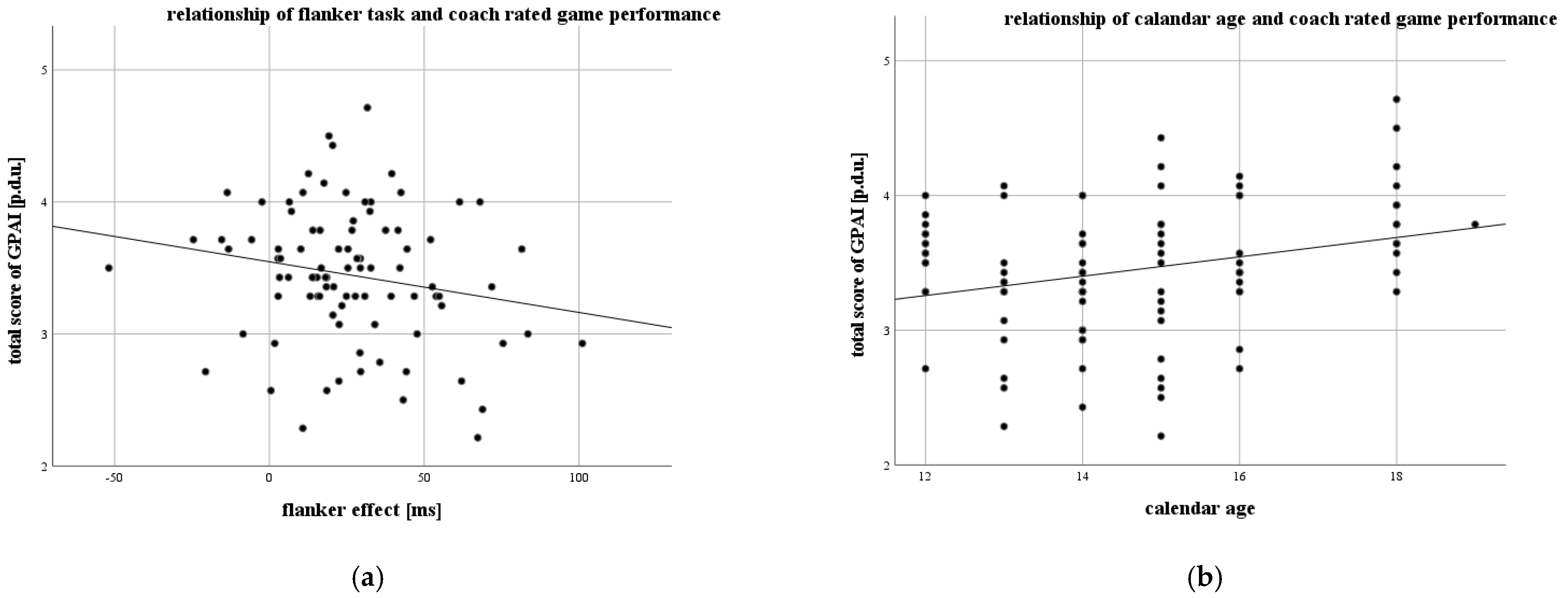
The assessment of core executive functions (EFs; i.e., inhibition, working memory, cognitive flexibility) has often been presented as a diagnostic tool for evaluating cognitive functions in recent publications. For example, EFs are essential in soccer because players must quickly adapt, change strategies, and inhibit responses in rapidly changing game situations. Previous research has shown relations between (subjectively rated) game performance and the EFs of soccer players. Nevertheless, the previous studies’ samples were heterogeneous in their performance level (experts vs. amateurs), and the ratings were rather unsystematic (no validated rating protocol). Therefore, the current study aimed to predict soccer players’ game performance (i.e., systematically rated by coaches) with the help of EF performance. Therefore, we assessed the game performance (small-sided game, Game Performance Assessment Instrument [GPAI]) and EFs (inhibition: flanker task; working memory: 3-back task; cognitive flexibility: number-letter task) of 94 male soccer players (12–19 years old) from Germany’s highest competitive level. Multiple regression model results indicate that inhibition (i.e., flanker effect) and calendar age explain ~18% of players’ game performance variance. Results have to be interpreted with regard to the age-dependency of game performance and EFs. In conclusion, even though the results are based on a cross-sectional study, it appears that calendar age needs to be considered when assessing EFs.
Keywords: executive functions; game performance; cognitive skill transfer; talent identification; soccer; cognition executive functions; game performance; cognitive skill transfer; talent identification; soccer; cognition