Article

Fiscal Decentralization, Green Technology Innovation, and Regional Air Pollution in China: An Investigation from the Perspective of Intergovernmental Competition

1
School of Economics and Management, China University of Mining and Technology, Xuzhou 221116, China
2
Think Tank of Carbon Neutral and Energy Strategy, China University of Mining and Technology, Xuzhou 221116, China
3
School of Public Policy and Management, China University of Mining and Technology, Xuzhou 221116, China
4
School of Safety Engineering, China University of Mining and Technology, Xuzhou 221116, China
*
Authors to whom correspondence should be addressed.
Int. J. Environ. Res. Public Health 2022, 19(14), 8456; https://doi.org/10.3390/ijerph19148456

Submission received: 19 June 2022 / Revised: 7 July 2022 / Accepted: 8 July 2022 / Published: 11 July 2022
(This article belongs to the Special Issue Low-Carbon Development and Carbon Reduction)

Abstract

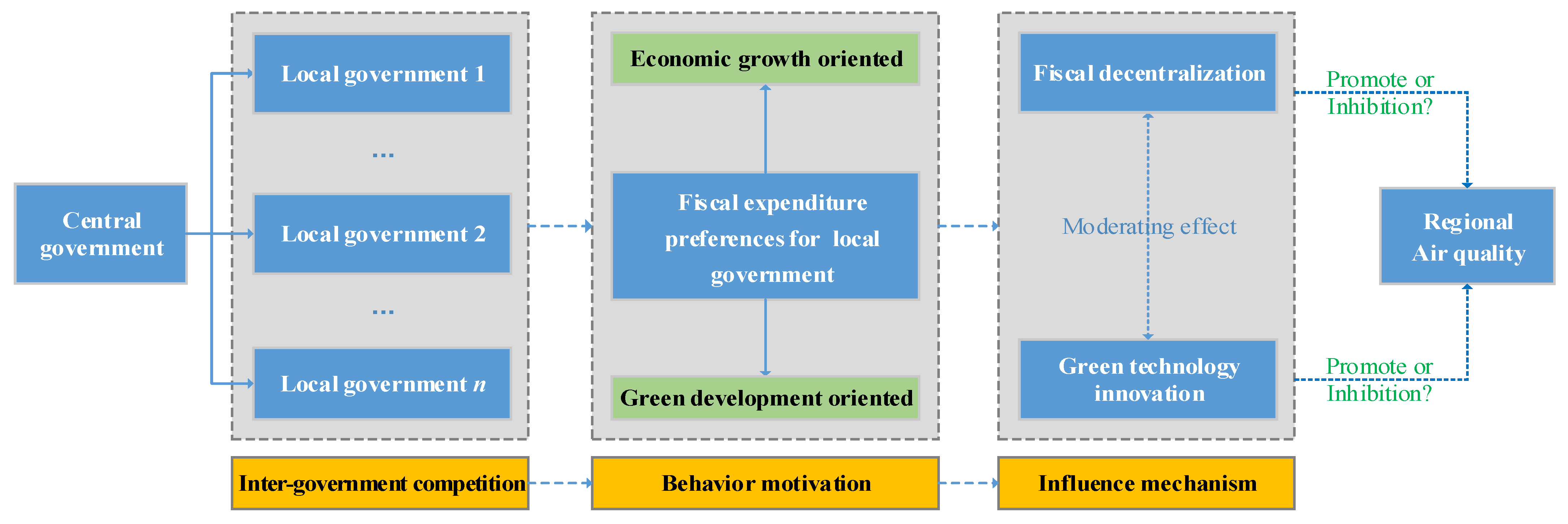
Fiscal decentralization (FD), as an institutional arrangement for the fiscal division between central and local governments, gives local governments the enthusiasm and autonomy to provide public products and services. With the dominance of environmental governance, how local governments can avoid intergovernmental “race to the bottom” issues through green technology innovation (GTI) is a matter of regional green development and continuous improvement of atmospheric environmental quality. Based on a sample of 30 provinces in China from 2003 to 2018, this paper uses the spatial Durbin model (SDM) to examine the relationship between FD, GTI, and regional air pollution and explores their spatial spillover effect and regional heterogeneity from the perspective of intergovernmental competition. The results indicate that the FD and GTI in various provinces had significant and regionally differentiated inhibitory effects on local air pollution. In Western China, due to the regional competition among local governments in terms of economic development, economic development-oriented fiscal expenditures crowd out environmental governance-oriented fiscal expenditures, which has led to the consequence that FD can intensify local air pollution and has a positive spillover effect, but the demonstration effect of green technological innovation can well moderate the effect of FD on air pollution. FD in the eastern region has played a positive role in promoting regional air quality improvement. However, its green technological innovation has not played a positive role in reducing emissions, and it plays a significant negative regulatory role in the emission reduction effect led by FD. Finally, the article puts forward policy recommendations in terms of a fiscal decentralization system, green technological innovation, and performance evaluation mechanism.
Keywords: air pollution; fiscal decentralization; green technology innovation; spatial Durbin model air pollution; fiscal decentralization; green technology innovation; spatial Durbin model