


Does Technological Innovation Curb O3 Pollution? Evidence from Three Major Regions in China
Abstract
1. Introduction
2. Materials and Methods
2.1. Theoretical Model and Methodology
2.1.1. The STIRPAT Model
2.1.2. Methodology
2.2. Study Area and Data Description
3. Results
3.1. Spatial Autocorrelation Test
3.2. Estimation Results
3.2.1. Selection of the Specific Model
3.2.2. Regression Results
3.2.3. Direct Effect and Indirect Effect
3.3. Model Validation
4. Discussion
4.1. Technology Innovation
4.2. Other Influencing Factors
4.2.1. The BTH Region
4.2.2. The YRD Region
4.2.3. The FW Region
5. Conclusions
- The positive superposition of O3 pollution in time and space dimensions indicates that it is urgent to carry out regional control and joint prevention efforts to limit regional O3 pollution. In particular, key regions should actively carry out intra- and inter-regional synergistic cooperation and implement joint actions in key pollution source monitoring, mobile monitoring, legislative enforcement, quantitative standards, etc., to strictly implement O3 pollution regulation and pollution management.
- The direct and indirect effects of technological innovation on ozone pollution vary considerably between regions. In particular, in the YRD and FW regions, on the one hand, they should promote green environmental protection technologies, accelerate the elimination of energy-consuming and polluting production technologies, and encourage international corporations to help cities with lower technological innovation. On the other hand, they should pay more attention to improving O3 pollution control technologies and equipment, including controlling the sources of pollution and end-of-treatment.
- As for other factors on ozone pollution, the BTH region should strengthen the management of motor vehicles and promote a green transportation system throughout the whole area while strengthening the upgrading of industrial structure, especially in the cities of Hebei Province. The YRD region should improve its energy use efficiency and reduce its energy use intensity. The FW region, because of its abundant energy resources, mostly coal, has an industrial structure dominated by secondary industries and high energy use intensity, which has exacerbated the degree of ozone pollution. Therefore, efforts should focus on the upgrading of industrial structure and energy use to promote the formation of green industries and energy use.
Author Contributions
Funding
Institutional Review Board Statement
Informed Consent Statement
Data Availability Statement
Conflicts of Interest
References
- Li, K.; Jacob, D.J.; Liao, H.; Shen, L.; Zhang, Q.; Bates, K.H. Anthropogenic drivers of 2013–2017 trends in summer surface ozone in China. Proc. Natl. Acad. Sci. USA 2019, 116, 422–427. [Google Scholar] [CrossRef] [Scilit] [PubMed]
- Lefohn, A.S.; Malley, C.S.; Smith, L.; Wells, B.; Hazucha, M.; Simon, H.; Naik, V.; Mills, G.; Schultz, M.G.; Paoletti, E.; et al. Tropospheric ozone assessment report: Global ozone metrics for climate change, human health, and crop/ecosystem research. Elementa: Sci. Anthr. 2018, 6, 1. [Google Scholar] [CrossRef] [Scilit] [PubMed]
- Mills, G.; Pleijel, H.; Malley, C.S.; Sinha, B.; Cooper, O.R.; Schultz, M.G.; Neufeld, H.S.; Simpson, D.; Sharps, K.; Feng, Z.; et al. Tropospheric Ozone Assessment Report: Present-day tropospheric ozone distribution and trends relevant to vegetation. Elem. Sci. Anthr. 2018, 6, 302. [Google Scholar] [CrossRef] [Scilit]
- Lu, X.; Zhang, L.; Wang, X.; Gao, M.; Li, K.; Zhang, Y.; Yue, X.; Zhang, Y. Rapid Increases in Warm-Season Surface Ozone and Resulting Health Impact in China Since 2013. Environ. Sci. Technol. Lett. 2020, 7, 240–247. [Google Scholar] [CrossRef] [Scilit]
- Lu, X.; Hong, J.; Zhang, L.; Cooper, O.R.; Schultz, M.G.; Xu, X.; Wang, T.; Gao, M.; Zhao, Y.; Zhang, Y. Severe Surface Ozone Pollution in China: A Global Perspective. Environ. Sci. Technol. Lett. 2018, 5, 487–494. [Google Scholar] [CrossRef] [Scilit]
- Wang, T.; Xue, L.; Brimblecombe, P.; Lam, Y.F.; Li, L.; Zhang, L. Ozone pollution in China: A review of concentrations, meteorological influences, chemical precursors, and effects. Sci. Total Environ. 2016, 575, 1582–1596. [Google Scholar] [CrossRef] [Scilit]
- Edwards, P.M.; Brown, S.S.; Roberts, J.M.; Ahmadov, R.; Banta, R.M.; Degouw, J.A.; Dubé, W.P.; Field, R.A.; Flynn, J.H.; Gilman, J.B.; et al. High winter ozone pollution from carbonyl photolysis in an oil and gas basin. Nature 2014, 514, 351–354. [Google Scholar] [CrossRef] [Scilit]
- McDonald, B.C.; de Gouw, J.A.; Gilman, J.B.; Jathar, S.H.; Akherati, A.; Cappa, C.D.; Jimenez, J.L.; Lee-Taylor, J.; Hayes, P.L.; McKeen, S.A.; et al. Volatile chemical products emerging as largest petrochemical source of urban organic emissions. Science 2018, 359, 760–764. [Google Scholar] [CrossRef] [Scilit]
- Avnery, S.; Mauzerall, D.; Liu, J.; Horowitz, L. Global crop yield reductions due to surface ozone exposure: 2. Year 2030 potential crop production losses and economic damage under two scenarios of O3 pollution. Atmos. Environ. 2011, 45, 2297–2309. [Google Scholar] [CrossRef] [Scilit]
- Xue, L.K.; Wang, T.; Gao, J.; Ding, A.J.; Zhou, X.H.; Blake, D.R.; Wang, X.F.; Saunders, S.M.; Fan, S.J.; Zuo, H.C.; et al. Ground-level ozone in four Chinese cities: Precursors, regional transport and heterogeneous processes. Atmos. Chem. Phys. 2014, 14, 13175–13188. [Google Scholar] [CrossRef] [Scilit]
- Monks, P.S.; Archibald, A.T.; Colette, A.; Cooper, O.; Coyle, M.; Derwent, R.; Fowler, D.; Granier, C.; Law, K.S.; Mills, G.E.; et al. Tropospheric ozone and its precursors from the urban to the global scale from air quality to short-lived climate forcer. Atmos. Chem. Phys. 2015, 15, 8889–8973. [Google Scholar] [CrossRef] [Scilit]
- Gao, Y.; Zhang, M. Sensitivity analysis of surface ozone to emission controls in Beijing and its neighboring area during the 2008 Olympic Games. J. Environ. Sci. 2012, 24, 50–61. [Google Scholar] [CrossRef] [Scilit]
- Liu, Y.; Wang, T. Worsening urban ozone pollution in China from 2013 to 2017—Part 1: The complex and varying roles of meteorology. Atmos. Chem. Phys. 2020, 20, 6305–6321. [Google Scholar] [CrossRef] [Scilit]
- Juráň, S.; Grace, J.; Urban, O. Temporal Changes in Ozone Concentrations and Their Impact on Vegetation. Atmosphere 2021, 12, 82. [Google Scholar] [CrossRef] [Scilit]
- Wang, Y.; Gao, W.; Wang, S.; Song, T.; Gong, Z.; Ji, D.; Wang, L.; Liu, Z.; Tang, G.; Huo, Y.; et al. Contrasting trends of PM2.5 and surface-ozone concentrations in China from 2013 to 2017. Natl. Sci. Rev. 2020, 7, 1331–1339. [Google Scholar] [CrossRef] [Scilit]
- Zhang, L.; Wang, T.; Zhang, Q.; Zheng, J.; Xu, Z.; Lv, M. Potential sources of nitrous acid (HONO) and their impacts on ozone: A WRF-Chem study in a polluted subtropical region. J. Geophys. Res. Atmos. 2016, 121, 3645–3662. [Google Scholar] [CrossRef] [Scilit]
- Lu, X.; Zhang, L.; Chen, Y.; Zhou, M.; Zheng, B.; Li, K.; Liu, Y.; Lin, J.; Fu, T.-M.; Zhang, Q. Exploring 2016–2017 surface ozone pollution over China: Source contributions and meteorological influences. Atmos. Chem. Phys. 2019, 19, 8339–8361. [Google Scholar] [CrossRef] [Scilit]
- Feng, Z.; De Marco, A.; Anav, A.; Gualtieri, M.; Sicard, P.; Tian, H.; Fornasier, F.; Tao, F.; Guo, A.; Paoletti, E. Economic losses due to ozone impacts on human health, forest productivity and crop yield across China. Environ. Int. 2019, 131, 104966. [Google Scholar] [CrossRef] [Scilit]
- Omri, A.; Hadj, T.B. Foreign investment and air pollution: Good governance and technological innovation matter? Environ. Res. 2020, 185, 109469. [Google Scholar] [CrossRef] [Scilit]
- Ali, W.; Abdullah, A.; Khan, M.A. The dynamic linkage between technological innovation and CO2 emissions in Malaysia: An autoregressive distributed lagged bound approach. Int. J. Energy Econ. Policy 2016, 6, 389–400. [Google Scholar]
- Wang, X.T.; Luo, Y. Has technological innovation capability addressed environmental pollution from the dual perspective of FDI quantity and quality? Evidence from China. J. Clean. Prod. 2020, 258, 120941. [Google Scholar] [CrossRef] [Scilit]
- Chen, H.; Hou, J. Research on the Threshold Effect of R&D, FDI and Domestic Innovation Capability: Based on the Regional Heterogeneity of Intellectual Property Protection. Manag. Rev. 2017, 6, 85–95. [Google Scholar]
- Chen, Y.; Lee, C.-C. Does technological innovation reduce CO2 emissions? Cross-country evidence. J. Clean. Prod. 2020, 263, 121550. [Google Scholar] [CrossRef] [Scilit]
- Grossman, G.; Krueger, A. Economic-growth and the environment. Q. J. Econ. 1995, 110, 353–377. [Google Scholar] [CrossRef] [Scilit]
- Diao, X.; Zeng, S.; Tam, C.M.; Tam, V.W. EKC analysis for studying economic growth and environmental quality: A case study in China. J. Clean. Prod. 2009, 17, 541–548. [Google Scholar] [CrossRef] [Scilit]
- Stokey, N.L. Are There Limits to growth? Int. Econ. Rev. 1998, 39, 1–31. [Google Scholar] [CrossRef] [Scilit]
- Yang, L.; Li, Z. Technology advance and the carbon dioxide emission in China—Empirical research based on the rebound effect. Energy Policy 2017, 101, 150–161. [Google Scholar] [CrossRef] [Scilit]
- Xiaoli, Z.; Yue, Z.; Saixing, Z.; Sufang, Z. Corporate behavior and competitiveness: Impact of environmental regulation on Chinese firms. J. Clean. Prod. 2015, 86, 311–322. [Google Scholar]
- Yu, Y.; Du, Y. Impact of technological innovation on CO2 emissions and emissions trend prediction on ‘New Normal’ economy in China. Atmos. Pollut. Res. 2018, 10, 152–161. [Google Scholar] [CrossRef] [Scilit]
- Santra, S. The effect of technological innovation on production-based energy and CO2 emission productivity: Evidence from BRICS countries. Afr. J. Sci. Technol. Innov. Dev. 2017, 9, 503–512. [Google Scholar] [CrossRef] [Scilit]
- Khattak, S.I.; Ahmad, M.; Khan, Z.U.; Khan, A. Exploring the impact of innovation, renewable energy consumption, and income on CO2 emissions: New evidence from the BRICS economies. Environ. Sci. Pollut. Res. 2020, 27, 13866–13881. [Google Scholar] [CrossRef] [Scilit] [PubMed]
- Smulders, S.A.; Bretschger, L. Explaining environmental Kuznets curves: How pollution induces policy and new technology. Soc. Sci. Electron. Publ. 2000, 95 Pt 1, 1–28. [Google Scholar] [CrossRef] [Scilit]
- Dinda, S.; Coondoo, D.; Pal, M. Air quality and economic growth: An empirical study. Ecol. Econ. 2000, 34, 409–423. [Google Scholar] [CrossRef] [Scilit]
- Cheng, C.; Ren, X.; Wang, Z. The impact of renewable energy and innovation on carbon emission: An empirical analysis for OECD countries. Energy Procedia 2019, 158, 3506–3512. [Google Scholar] [CrossRef] [Scilit]
- Weina, D.; Gilli, M.; Mazzanti, M.; Nicolli, F. Green inventions and greenhouse gas emission dynamics: A close examination of provincial Italian data. Environ. Econ. Policy Stud. 2016, 18, 247–263. [Google Scholar] [CrossRef] [Scilit]
- Samargandi, N. Sector value addition, technology and CO2 emissions in Saudi Arabia. Renew. Sustain. Energy Rev. 2017, 78, 868–877. [Google Scholar] [CrossRef] [Scilit]
- Balin, B.E.; Akan, D.M. EKC hypothesis and the effect of innovation: A panel data analysis. Bus. Econom. Finance 2015, 4, 81–91. [Google Scholar] [CrossRef] [Scilit]
- Wang, Z.; Wang, C. Spatial Analysis of China’s R&D Investment’s Impact on Environmental Pollution. Chin. J. Manag. 2016, 11, 1710–1717. [Google Scholar]
- Hao, Y.; Wu, Y.; Wu, H.; Ren, S. How do FDI and technical innovation affect environmental quality? Evidence from China. Environ. Sci. Pollut. Res. 2019, 27, 7835–7850. [Google Scholar] [CrossRef] [Scilit]
- Costantini, V.; Crespi, F.; Marin, G.; Paglialunga, E. Eco-innovation, sustainable supply chains and environmental performance in European industries. Clean. Prod. 2017, 155, 141–154. [Google Scholar] [CrossRef] [Scilit]
- Ahmed, A.; Uddin, G.S.; Sohag, K. Biomass energy, technological progress and the environmental Kuznets curve: Evidence from selected European countries. Biomass-Bioenergy 2016, 90, 202–208. [Google Scholar] [CrossRef] [Scilit]
- Rho, S.; Moon, I. Innovation and spillovers in China: Spatial econometric approach. Seoul J. Econ. 2014, 27, 149–170. [Google Scholar]
- Cho, J.H.; Sohn, S.Y. A novel decomposition analysis of green patent applications for the evaluation of R&D efforts to reduce CO2 emissions from fossil fuel energy consumption. J. Clean. Prod. 2018, 193, 290–299. [Google Scholar] [CrossRef] [Scilit]
- Khan, Z.; Ali, M.; Kirikkaleli, D.; Wahab, S.; Jiao, Z. The impact of technological innovation and public-private partnership in-vestment on sustainable environment in China: Consumption-based carbon emissions analysis. Sustain. Dev. 2020, 28, 1317–1330. [Google Scholar] [CrossRef] [Scilit]
- Wang, S.; Wang, J.; Fang, C.; Li, S. Estimating the impacts of urban form on CO2 emission efficiency in the Pearl River Delta, China. Cities 2018, 85, 117–129. [Google Scholar] [CrossRef] [Scilit]
- Yuan, Q.; Qi, B.; Hu, D.; Wang, J.; Zhang, J.; Yang, H.; Zhang, S.; Liu, L.; Xu, L.; Li, W. Spatiotemporal variations and reduction of air pollutants during the COVID-19 pandemic in a megacity of Yangtze River Delta in China. Sci. Total Environ. 2020, 751, 141820. [Google Scholar] [CrossRef] [Scilit] [PubMed]
- Ding, A.J.; Fu, C.B.; Yang, X.Q.; Sun, J.N.; Zheng, L.F.; Xie, Y.N.; Herrmann, E.; Nie, W.; Petäjä, T.; Kerminen, V.-M.; et al. Ozone and fine particle in the western Yangtze River Delta: An overview of 1 yr data at the SORPES station. Atmos. Chem. Phys. 2013, 13, 5813–5830. [Google Scholar] [CrossRef] [Scilit]
- Dietz, T.; Rosa, E.A. Effects of population and affluence on CO2 emissions. Proc. Natl. Acad. Sci. USA 1997, 94, 175–179. [Google Scholar] [CrossRef] [Scilit]
- Gu, G.; Wang, Z. Research on global carbon abatement driven by R&D investment in the context of INDCs. Energy 2018, 148, 662–675. [Google Scholar] [CrossRef] [Scilit]
- Ibrahiem, D.M. Do technological innovations and financial development improve environmental quality in Egypt? Environ. Sci. Pollut. Res. 2020, 27, 10869–10881. [Google Scholar] [CrossRef] [Scilit]
- Churchill, S.A.; Inekwe, J.; Smyth, R.; Zhang, X. R&D intensity and carbon emissions in the G7: 1870–2014. Energy Econ. 2018, 80, 30–37. [Google Scholar] [CrossRef] [Scilit]
- An, H.; Razzaq, A.; Haseeb, M.; Mihardjo, L.W. The role of technology innovation and people’s connectivity in testing en-vironmental Kuznets curve and pollution heaven hypotheses across the Belt and Road host countries: New evidence from Method of Moments Quantile Regression. Environ. Sci. Pollut. Res. 2021, 28, 5254–5270. [Google Scholar] [CrossRef] [Scilit] [PubMed]
- Ali, W.; Rahman, I.U.; Zahid, M.; Khan, M.A.; Kumail, T. Do technology and structural changes favour environment in Ma-laysia: An ARDL-based evidence for environmental Kuznets curve. Environ. Dev. Sustain. 2020, 29, 7927–7950. [Google Scholar] [CrossRef] [Scilit]
- Moran, P.A.P. Notes on Continuous Stochastic Phenomena. Biometrika 1950, 37, 17. [Google Scholar] [CrossRef] [Scilit]
- Elhorst, J.P. Dynamic spatial panels: Models, methods, and inferences. J. Geogr. Syst. 2011, 14, 5–28. [Google Scholar] [CrossRef] [Scilit]
- Lesage, J.P.; Kelley, P. Spatial lags and spatial errors revisited: Some monte carlo evidence. In Spatial and Spatiotemporal Econometrics; Emerald Group Publishing Limited: Bingley, UK, 2004; pp. 75–98. [Google Scholar] [CrossRef] [Scilit]
- Anselin, L. Lagrange Multiplier Test Diagnostics for Spatial Dependence and Spatial Heterogeneity. Geogr. Anal. 1988, 20, 1–17. [Google Scholar] [CrossRef] [Scilit]
- Wang, Y.; Kang, L.; Wu, X.; Xiao, Y. Estimating the environmental Kuznets curve for ecological footprint at the global level: A spatial econometric approach. Ecol. Indic. 2013, 34, 15–21. [Google Scholar] [CrossRef] [Scilit]
- Baltagi, B.; Li, N. Testing for linear and log-linear models against box-cox alternatives with spatial lag dependence. In Spatial and Spatiotemporal Econometrics; Emerald Group Publishing Limited: Bingley, UK, 2004; pp. 35–74. [Google Scholar] [CrossRef] [Scilit]
- People’s Republic of China Ministry of Ecology Environment. Available online: https://www.mee.gov.cn/hjzl/sthjzk/zghjzkgb/202006/P020200602509464172096.pdf (accessed on 15 September 2021).
- Fernandez, Y.F.; L’opez, M.F.; Blanco, B.O. Innovation for sustainability: The impact of R&D spending on CO2 emissions. Clean. Prod. 2018, 172, 3459–3467. [Google Scholar]
- Ullah, S.; Ozturk, I.; Majeed, M.T.; Ahmad, W. Do technological innovations have symmetric or asymmetric effects on environmental quality? Evidence from Pakistan. J. Clean. Prod. 2021, 316, 128239. [Google Scholar] [CrossRef] [Scilit]
- Kathuria, V. Does Environmental Governance Matter for Foreign Direct Investment? Testing the Pollution Haven Hypothesis for Indian States. Asian Dev. Rev. 2018, 35, 81–107. [Google Scholar] [CrossRef] [Scilit]
- Silva, R.A.; Adelman, Z.; Fry, M.; West, J.J. The Impact of Individual Anthropogenic Emissions Sectors on the Global Burden of Human Mortality due to Ambient Air Pollution. Environ. Health Perspect. 2016, 124, 1776–1784. [Google Scholar] [CrossRef] [Scilit] [PubMed]
- Anenberg, S.; Miller, J.; Minjares, R.; Du, L.; Henze, D.K.; Lacey, F.; Malley, C.S.; Emberson, L.; Franco, V.; Klimont, Z.; et al. Impacts and mitigation of excess diesel-related NOx emissions in 11 major vehicle markets. Nature 2017, 545, 467–471. [Google Scholar] [CrossRef] [Scilit]
- Unger, N.; Bond, T.C.; Wang, J.S.; Koch, D.M.; Menon, S.; Shindell, D.T.; Bauer, S. Attribution of climate forcing to economic sectors. Proc. Natl. Acad. Sci. USA 2010, 107, 3382–3387. [Google Scholar] [CrossRef] [Scilit] [PubMed]
- Radmehr, R.; Henneberry, S.R.; Shayanmehr, S. Renewable Energy Consumption, CO2 Emissions, and Economic Growth Nexus: A Simultaneity Spatial Modeling Analysis of EU Countries. Struct. Chang. Econ. Dyn. 2021, 57, 13–27. [Google Scholar] [CrossRef] [Scilit]
- Adewuyi, A.O.; Awodumi, O.B. Environmental pollution, energy import, and economic growth: Evidence of sustainable growth in South Africa and Nigeria. Environ. Sci. Pollut. Res. 2020, 28, 14434–14468. [Google Scholar] [CrossRef] [Scilit]
- Eskeland, G.S.; Harrison, A.E. Moving to greener pastures? Multinationals and the pollution haven hypothesis. J. Dev. Econ. 2003, 70, 149–170. [Google Scholar] [CrossRef] [Scilit]
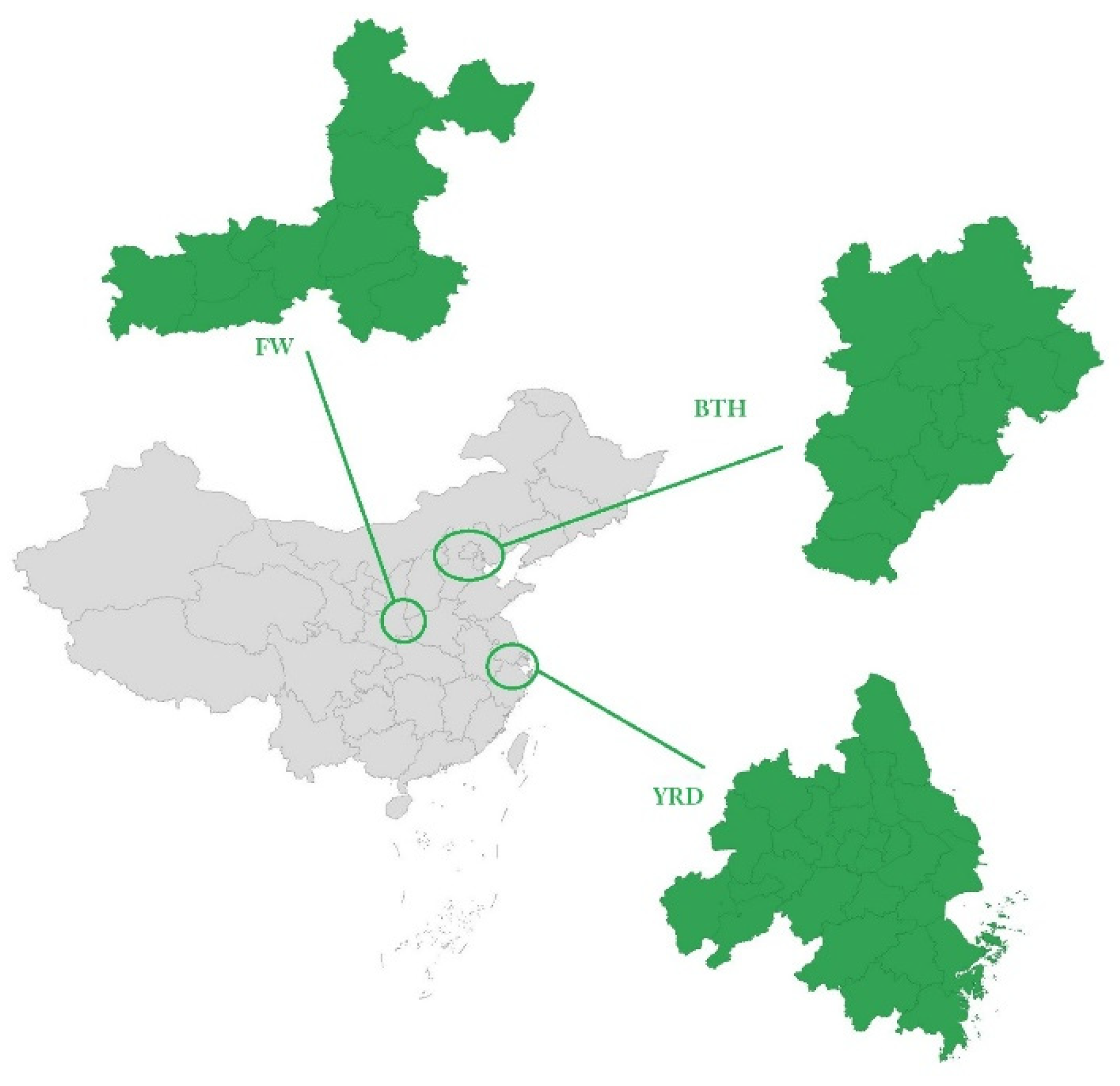

| Region | City Name |
|---|---|
| BTH | Beijing, Tianjin, Shijiazhuang, Tangshan, Qinhuangdao, Handan, Xingtai, Baoding, Zhangjiakou, Chengde, Cangzhou, Langfang, Hengshui |
| YRD | Shanghai, Nanjing, Wuxi, Changzhou, Suzhou, Nantong, Yancheng, Yangzhou, Zhenjiang, Taizhou 1, Hangzhou, Ningbo, Jiaxing, Huzhou, Shaoxing, Jinhua, Zhoushan, Taizhou 1, Hefei, Wuhu, Maanshan, Tongling, Anqing, Chuzhou, Chizhou, Xuancheng |
| FW | Jinzhong, Yuncheng, Linfen, Lvliang, Luoyang, Sanmenxia, Xi’an, Tongchuan, Baoji, Xianyang, Weinan |
| Region | Position | GDP Share of the Country (%) | Population Share of the Country (%) | Number of Patents Granted (Million) | Ratio of the Three Industries | Number of Cars (Million) | FDI Share of the Country (%) | Energy Consumption Share of the Country (%) |
|---|---|---|---|---|---|---|---|---|
| BTH | Located in the North China Plain | 8.6 | 8.1 | 24.55 | 4.5: 28.7: 66.8 | 2707.81 | 20.56 | 9.6, of which coal accounted for 67.9 |
| YRD | Located in the lower reaches of the Yangtze River in East China | 23.94 | 16.7 | 67.9 | 3.97: 40.66: 55.37 | 4131.42 | 49.86 | 17%, of which coal accounted for 55.4% |
| FW | Located in west-central China, in the middle reaches of the Yellow River | 2.88 | 3.68 | 4.59 | 8.11: 40.36: 51.54 | 929.81 | 8.07 | 2.93%, of which coal accounted for 80% |
| Region | Variable | Unit | Mean | Std. dev | Min | Max |
|---|---|---|---|---|---|---|
| BTH | O3 | 97.1766 | 10.4500 | 65 | 113.5 | |
| tech | -- | 14,308.45 | 29,244.58 | 300 | 13,1716 | |
| energy | 0.0980 | 0.1024 | 0.0152 | 0.6761 | ||
| agdp | 55,960.36 | 31,666.73 | 22,758 | 164,220 | ||
| car | -- | 181.8881 | 137.2016 | 51.56 | 636.5 | |
| ind | % | 41.1321 | 10.7247 | 8.5 | 62.1 | |
| pop | 606.7331 | 313.0762 | 61.9616 | 1324 | ||
| fdi | yuan | 262,370.4 | 519,982.3 | 1047 | 2,432,909 | |
| YRD | O3 | 94.4653 | 15.3034 | 36 | 115 | |
| tech | -- | 20,903.1 | 19,415.71 | 1040 | 100,587 | |
| energy | 0.0538 | 0.0250 | 0.0124 | 0.1153 | ||
| agdp | 92,849.81 | 35,715.66 | 28,808 | 180,044 | ||
| car | -- | 130.126 | 94.9818 | 8.73 | 442.55 | |
| ind | % | 47.2482 | 6.6954 | 26.99 | 68.27 | |
| pop | 790.3617 | 677.264 | 171.8062 | 3830 | ||
| fdi | yuan | 258,718.2 | 353,974.1 | 7792 | 1,904,800 | |
| FW | O3 | 89.4681 | 15.0859 | 58.75 | 118.6667 | |
| tech | -- | 3458.439 | 8278.139 | 117 | 38,279 | |
| energy | 0.0673 | 0.0536 | 0.0069 | 0.2247 | ||
| agdp | 44,500.66 | 16,658.41 | 22,304 | 92,256 | ||
| car | -- | 66.1168 | 69.0366 | 6.9349 | 343.0559 | |
| ind | % | 47.3930 | 9.2123 | 32.84 | 70.04 | |
| pop | 348.3166 | 191.5584 | 180.7995 | 863.2962 | ||
| fdi | yuan | 87,823.59 | 156,464.5 | 1 | 665,666 |
| Year | BTH | YRD | FW |
|---|---|---|---|
| 2014 | −0.097 | 0.513 *** | 0.209 |
| 2015 | −0.091 | 0.586 *** | 0.469 *** |
| 2016 | −0.100 | 0.285 *** | 0.235 ** |
| 2017 | 0.191 | 0.038 | −0.021 |
| 2018 | 0.480 *** | 0.106 | −0.002 |
| 2019 | 0.440 *** | 0.135 | 0.425 ** |
| Test | BTH | YRD | FW | |
|---|---|---|---|---|
| LM-lag | 3.386 ** | 28.027 *** | 15.685 *** | |
| Robust LM-lag | 11.119 *** | 11.704 *** | 2.843 * | |
| LM-error | 0.105 | 16.534 *** | 14.143 *** | |
| Robust LM-error | 7.838 *** | 0.211 | 1.301 | |
| Hausman test | 275.73 *** | 70.98 *** | 5.00 | |
| LR test | SDM/SLM | chi2 = 27.17 *** | chi2 = 11.36 | chi2 = 21.02 ** |
| SDM/SEM | chi2 = 29.61 *** | chi2 = 25.98 *** | chi2 = 21.01 ** | |
| Wald test | SDM/SLM | chi2 = 50.77 *** | chi2 = 40.06 *** | chi2 = 43.15 *** |
| SDM/SEM | chi2 = 70.61 *** | chi2 = 49.15 *** | chi2 = 35.34 *** | |
| LR test | ind/both | chi2 = 17.17 * | chi2 = 19.32 ** | chi2 = 40.89 *** |
| time/both | chi2 = 44.82 *** | chi2 = 104.80 *** | chi2 = 41.62 *** | |
| Variable | BTH | YRD | FW |
|---|---|---|---|
| L.lnO3 | 0.593 *** | 0.514 *** | 0.217 |
| (4.565) | (5.996) | (1.366) | |
| lntech | −1.001 *** | 0.525 *** | 0.041 |
| (−5.159) | (2.660) | (0.304) | |
| lntech2 | 0.057 *** | −0.020 ** | −0.003 |
| (4.900) | (−2.230) | (−0.199) | |
| lnenergy | 0.016 | 0.007 | 0.054 ** |
| (1.279) | (0.441) | (2.189) | |
| lnagdp | 0.255 * | −0.207 * | 0.104 |
| (1.882) | (−1.795) | (0.342) | |
| lncar | 0.245 | −0.114 * | 0.783 *** |
| (1.544) | (−1.904) | (2.831) | |
| ind | −0.008 ** | 0.003 | −0.004 |
| (−2.491) | (0.854) | (−0.026) | |
| lnpop | 0.002 | 0.534 | −1.831 ** |
| (0.049) | (1.575) | (−2.559) | |
| lnfdi | 0.032 *** | −0.016 | −0.027 *** |
| (2.730) | (−0.658) | (−5.231) | |
| W.lntech | 0.394 | −1.568 ** | 0.186 |
| (0.678) | (−2.062) | (0.393) | |
| W.lntech2 | −0.032 | 0.069 ** | −0.017 |
| (−0.955) | (2.264) | (−0.521) | |
| W.lnenergy | −0.002 | 0.010 | 0.116 ** |
| (−0.075) | (0.330) | (2.328) | |
| W.lnagdp | −0.035 | −0.079 | −1.340 *** |
| (−0.320) | (−0.409) | (−2.756) | |
| W.lncar | 0.527 *** | 0.058 | −0.148 |
| (4.043) | (0.461) | (−0.361) | |
| W.ind | 0.015 *** | −0.006 | 0.786 ** |
| (5.021) | (−0.860) | (2.484) | |
| W.lnpop | 0.168 | −1.114 | −0.471 |
| (0.979) | (−1.065) | (−0.473) | |
| W.lnfdi | −0.016 | 0.019 | −0.036 ** |
| (−0.712) | (0.281) | (−2.433) | |
| rho | 0.303 ** | 0.491 *** | 0.259 ** |
| (2.543) | (8.418) | (2.572) | |
| sigma2_e | 0.002 *** | 0.006 *** | 0.003 *** |
| (6.323) | (2.756) | (4.908) | |
| R2 | 0.7645 | 0.6593 | 0.8406 |
| Variable | BTH | YRD | FW | |
|---|---|---|---|---|
| SR_Direct | lntech | −0.970 *** | 0.315 * | 0.074 |
| (−5.096) | (1.812) | (0.577) | ||
| lntech2 | 0.054 *** | −0.011 | −0.003 | |
| (2.612) | (−1.347) | (−0.108) | ||
| lnenergy | 0.017 | 0.009 | 0.065 ** | |
| (1.008) | (0.503) | (2.030) | ||
| lnagdp | 0.273 * | −0.238 ** | −0.020 | |
| (1.930) | (−2.128) | (−0.058) | ||
| lncar | 0.308 * | −0.114 ** | 0.815 *** | |
| (1.828) | (−2.028) | (3.002) | ||
| ind | −0.007 | 0.003 | 0.073 | |
| (−1.119) | (0.722) | (0.496) | ||
| lnpop | 0.020 | 0.409 | −1.991 *** | |
| (0.447) | (1.087) | (−2.927) | ||
| lnfdi | 0.032 | −0.013 | −0.031 ** | |
| (1.563) | (−0.404) | (−2.002) | ||
| SR_Indirect | lntech | 0.135 | −2.491 * | 0.329 |
| (0.173) | (−1.897) | (0.536) | ||
| lntech2 | −0.021 | 0.112 ** | −0.030 | |
| (−0.455) | (2.148) | (−0.670) | ||
| lnenergy | 0.002 | 0.022 | 0.157 ** | |
| (0.075) | (0.364) | (2.574) | ||
| lnagdp | 0.087 | −0.347 | −1.691 ** | |
| (0.606) | (−0.971) | (−2.344) | ||
| lncar | 0.828 *** | −0.019 | 0.097 | |
| (3.456) | (−0.089) | (0.185) | ||
| ind | 0.017 ** | −0.007 | 1.013 ** | |
| (2.476) | (−0.584) | (2.479) | ||
| lnpop | 0.228 | −1.450 | −1.308 | |
| (1.005) | (−0.812) | (−0.929) | ||
| lnfdi | −0.007 | 0.024 | −0.058 ** | |
| (−0.223) | (0.185) | (−2.207) | ||
| LR_Direct | lntech | −2.463 *** | −0.847 | 0.116 |
| (−4.985) | (−0.016) | (0.642) | ||
| lntech2 | 0.140 *** | 0.050 | −0.006 | |
| (2.632) | (0.023) | (−0.154) | ||
| lnenergy | 0.041 | −0.003 | 0.089 ** | |
| (0.957) | (−0.002) | (2.133) | ||
| lnagdp | 0.659 * | −0.804 | −0.087 | |
| (1.892) | (−0.049) | (−0.179) | ||
| lncar | 0.602 | −0.392 | 1.061 *** | |
| (1.450) | (−0.094) | (2.990) | ||
| ind | −0.020 | 0.005 | 0.132 | |
| (−1.236) | (0.024) | (0.658) | ||
| lnpop | −0.008 | −0.211 | −2.634 *** | |
| (−0.072) | (−0.005) | (−2.938) | ||
| lnfdi | 0.081 | 0.033 | −0.042 ** | |
| (1.587) | (0.010) | (−2.011) | ||
| LR_Indirect | lntech | 1.047 | −3.021 | 0.516 |
| (0.679) | (−0.006) | (0.549) | ||
| lntech2 | −0.083 | 0.324 | −0.047 | |
| (−0.907) | (0.014) | (−0.663) | ||
| lnenergy | −0.010 | 0.057 | 0.226 *** | |
| (−0.161) | (0.002) | (2.658) | ||
| lnagdp | −0.025 | −6.107 | −2.385 ** | |
| (−0.073) | (−0.033) | (−2.153) | ||
| lncar | 1.330 ** | 1.655 | 0.276 | |
| (2.210) | (0.027) | (0.351) | ||
| ind | 0.039 ** | −0.168 | 1.445 ** | |
| (2.232) | (−0.086) | (2.305) | ||
| lnpop | 0.406 | −31.882 | −2.197 | |
| (0.944) | (−0.035) | (−0.971) | ||
| lnfdi | −0.039 | −1.222 | −0.086 ** | |
| (−0.600) | (−0.017) | (−1.979) |
| Variable | BTH | YRD | FW |
|---|---|---|---|
| L.lnO3 | 0.549 *** | 0.453 *** | 0.093 |
| (5.825) | (13.675) | (0.601) | |
| lnltech | −0.531 *** | 0.548 ** | 0.053 |
| (−2.809) | (2.531) | (0.360) | |
| lnltech2 | 0.038 *** | −0.023 ** | −0.003 |
| (3.129) | (−2.029) | (−0.359) | |
| lnenergy | 0.019 | 0.015 | 0.052 ** |
| (1.499) | (0.612) | (2.223) | |
| lnagdp | 0.100 | −0.188 ** | 0.268 * |
| (1.000) | (−1.990) | (1.810) | |
| lncar | −0.055 | −0.031 | 0.654 *** |
| (−0.343) | (−0.431) | (2.788) | |
| ind | −0.007 ** | 0.002 | 0.001 |
| (−2.073) | (0.556) | (0.285) | |
| lnpop | 0.031 | 0.452 | −1.646 ** |
| (0.988) | (1.083) | (−2.359) | |
| lnfdi | 0.011 | 0.020 | −0.023 *** |
| (0.764) | (0.515) | (−4.023) | |
| rho | 0.300 *** | 0.404 *** | 0.037 |
| (2.620) | (4.044) | (0.239) | |
| sigma2_e | 0.003 *** | 0.005 *** | 0.003 *** |
| (7.249) | (2.957) | (6.288) |
| Variable | BTH | YRD | FW |
|---|---|---|---|
| L.lnO3 | 0.540 *** | 0.603 *** | 0.187 |
| (6.423) | (15.307) | (1.407) | |
| lntech | −0.899 *** | 0.229 ** | 0.115 |
| (−5.941) | (2.498) | (0.490) | |
| lntech2 | 0.049 *** | −0.006 * | −0.012 |
| (4.728) | (−1.827) | (−0.795) | |
| lnenergy | 0.006 | −0.008 | 0.039 |
| (0.648) | (−0.459) | (1.382) | |
| lnagdp | 0.246 * | −0.316 *** | 0.015 |
| (1.820) | (−4.065) | (0.063) | |
| lncar | 0.491*** | −0.090 | 0.736 * |
| (3.449) | (−1.389) | (1.848) | |
| ind | −0.003 | 0.005 * | −0.003 |
| (−1.254) | (1.735) | (−0.799) | |
| lnpop | 0.107 ** | 0.521 | −1.781 *** |
| (2.503) | (1.244) | (−3.136) | |
| lnfdi | 0.047 *** | −0.032 * | −0.036 *** |
| (3.762) | (−1.665) | (−4.355) |
Publisher’s Note: MDPI stays neutral with regard to jurisdictional claims in published maps and institutional affiliations. |
© 2022 by the authors. Licensee MDPI, Basel, Switzerland. This article is an open access article distributed under the terms and conditions of the Creative Commons Attribution (CC BY) license (https://creativecommons.org/licenses/by/4.0/).
Share and Cite
Wang, W.-j.; Liu, Y.-n.; Ying, X.-r. Does Technological Innovation Curb O3 Pollution? Evidence from Three Major Regions in China. Int. J. Environ. Res. Public Health 2022, 19, 7743. https://doi.org/10.3390/ijerph19137743
Wang W-j, Liu Y-n, Ying X-r. Does Technological Innovation Curb O3 Pollution? Evidence from Three Major Regions in China. International Journal of Environmental Research and Public Health. 2022; 19(13):7743. https://doi.org/10.3390/ijerph19137743
Chicago/Turabian StyleWang, Wen-jun, Yan-ni Liu, and Xin-ru Ying. 2022. "Does Technological Innovation Curb O3 Pollution? Evidence from Three Major Regions in China" International Journal of Environmental Research and Public Health 19, no. 13: 7743. https://doi.org/10.3390/ijerph19137743
APA StyleWang, W.-j., Liu, Y.-n., & Ying, X.-r. (2022). Does Technological Innovation Curb O3 Pollution? Evidence from Three Major Regions in China. International Journal of Environmental Research and Public Health, 19(13), 7743. https://doi.org/10.3390/ijerph19137743

