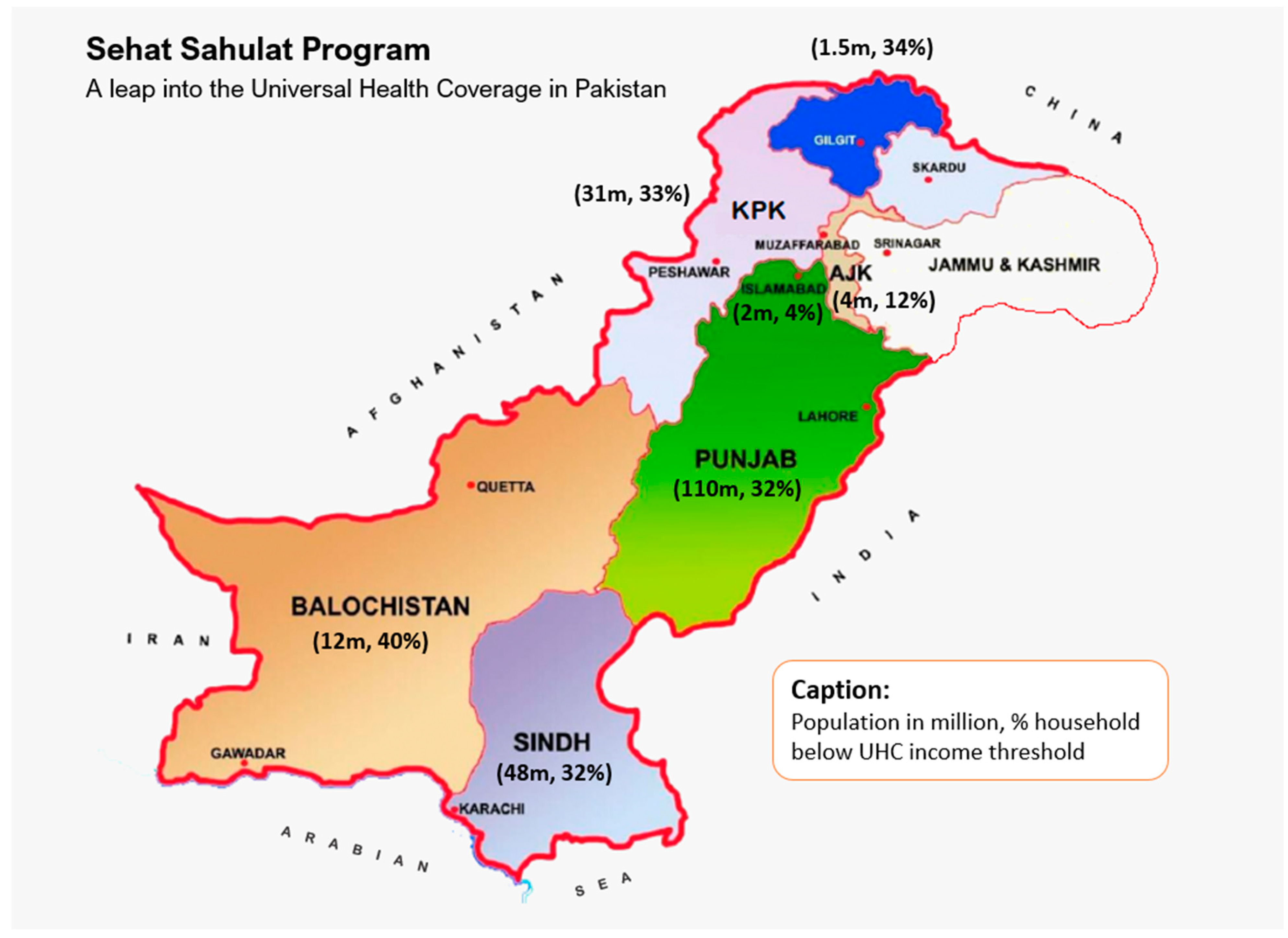
“Sehat Sahulat Program”: A Leap into the Universal Health Coverage in Pakistan




Abstract
Share and Cite
Hasan, S.S.; Mustafa, Z.U.; Kow, C.S.; Merchant, H.A. “Sehat Sahulat Program”: A Leap into the Universal Health Coverage in Pakistan. Int. J. Environ. Res. Public Health 2022, 19, 6998. https://doi.org/10.3390/ijerph19126998
Hasan SS, Mustafa ZU, Kow CS, Merchant HA. “Sehat Sahulat Program”: A Leap into the Universal Health Coverage in Pakistan. International Journal of Environmental Research and Public Health. 2022; 19(12):6998. https://doi.org/10.3390/ijerph19126998
Chicago/Turabian StyleHasan, Syed Shahzad, Zia Ul Mustafa, Chia Siang Kow, and Hamid A. Merchant. 2022. "“Sehat Sahulat Program”: A Leap into the Universal Health Coverage in Pakistan" International Journal of Environmental Research and Public Health 19, no. 12: 6998. https://doi.org/10.3390/ijerph19126998
APA StyleHasan, S. S., Mustafa, Z. U., Kow, C. S., & Merchant, H. A. (2022). “Sehat Sahulat Program”: A Leap into the Universal Health Coverage in Pakistan. International Journal of Environmental Research and Public Health, 19(12), 6998. https://doi.org/10.3390/ijerph19126998