


Has China’s New Round of Collective Forest Reforms Reduced Forest Fragmentation? A Case Study of the Beijing–Tianjin–Hebei Region

Abstract
1. Introduction
- In terms of social effects, most studies have concluded that NRCFT enhances the stability of property rights in forestland [43,44,45] and reduced the occurrence of forest rights disputes [46,47,48]. NRCFT has also promoted the transfer of forest rights and given rise to forestry cooperative organizations [49,50,51], which stabilized the basic rural management system [52].
- In terms of economic effects, several scholars have affirmed the income-generating effects of NRCFT on rural households from the perspective of property rights theory [53]. Some research confirmed that NRCFT has increased the nonfarm employment and income of rural households by optimizing the allocation of rural labor [54,55]. However, from the perspective of economies of scale, NRCFT led to higher land tenure fragmentation, which reduces the scale effect of forestry operations and thus affects forestry output [56,57,58].
- At the level of ecological effects of NRCFT, effective property rights arrangements are considered one of the prerequisites for forest restoration [59,60]. Clear property rights can “internalize” the externalities of public goods and avoid the phenomenon of “tragedy of the commons” [61,62]. NRCFT provides farmers with more integrated and secure forestland rights [63,64], which reduced deforestation, and encouraged them to protect forests [65,66]. At the same time, the stability of property rights also promotes farmers’ forestland transfer behavior, which increases the rural population in the non-farm sector. This eases rural dependence on forests for livelihoods and reduces the rate of deforestation. However, some scholars have denied the role of NRCFT on forest resource conservation, arguing that the short-sighted behavior of foresters may exacerbate deforestation [67,68]. Meanwhile, the planting of large areas of fast-growing forests by large forestry contractors in pursuit of economic interests [69], the crude management model exacerbated forest degradation [70].
- Economic factors. Economic growth is considered to be the main driver of forest fragmentation [84,85]. Economic growth is accompanied by the input of land elements, which reveal the original value of land assets [86]. Meanwhile, the change of land function demanded by land operators causes land use transformation, leads to deforestation, and causes changes in forest spatial patterns [87].
- Policy factors. National policies determine the degree of natural resource protection [88]. Ecological construction projects implemented in China, such as the Three Norths Shelter Forest System Project, the Natural Forest Conservation Program, and the Grain for Green Program (GGP) have curbed the process of forest fragmentation [89]. Local governments, as the principal part of environmental governance, can prevent forest fragmentation by influencing the main behavior of land users and regulating regional land use patterns [90]. However, if local government departments are inefficient in management, poor interdepartmental coordination may lead to forest fragmentation [91].
- Demographic factors. Population increase is a potential driver of deforestation [92]. Rapid population growth can lead to increased demand for transportation, building, and farmland, which increases the exploitation of forestland [93,94], resulting in forest fragmentation. In addition to this, population migration during urbanization reduces the rural dependence on forests for livelihood. From another perspective, population migration causes a sharp decline in the rural labor force, which leads to the crude management of forest land and may trigger forest degradation.
2. Data and Methods
2.1. Data Sources
2.2. Forest Fragmentation Measurement Method
2.2.1. Data Pre-Processing
2.2.2. Remote Sensing Interpretation
- Calculation of classification. Compute ROI Separability is used to calculate sample separability. After the samples are checked, the support vector machine (SVM) is used to classify Landsat images. SVM is a supervised classification algorithm that draws hyperplanes in n-dimensional space to differentiate samples. Before SVM classification, use the linear normalization to normalize the digital number in all spectral bands, which places the attribute numeric values on the same scale and prevents attributes of large original scales from biasing the solution. To use an SVM classifier, have to choose a kernel. which is a function that transforms the input data to a high-dimensional space, so that the data is separable and the problem can be solved in the new space. In ENVI, it has four types of kernels: linear, polynomial, RBF (Radial Basis Function), and sigmoid. This work chooses the linear kernel to perform the classification as it has higher efficiency than others. Then the image elements are judged one by one and output the classification result.
- Correction of classification results. The training samples of the woodland are sampled by extracting the woodland part of each period. Then the second classification is performed by the neural network algorithm to obtain the corrected woodland distribution data.
- Accuracy evaluation. Firstly, the validation points in the decoded area were randomly and uniformly selected to plot a confusion matrix, and the kappa coefficient was calculated to evaluate the classification accuracy [95]. Finally, the overall classification accuracy of images was calculated to be above 80%, and the kappa coefficient was above 0.7. Among them, the user accuracy of woodland ranged from 81.83% to 99.92%, indicating that 81.83% to 99.92% of the image elements classified as woodland were woodland, and the data availability was good.
2.2.3. Calculation of Forest Fragmentation Indicators
- Landscape Shape Index (LSI)
- Patch Density (PD)
- Edge Density (ED)
2.3. Variable Selection
- Economic growth. The change in land use type brought about by economic growth has a significant effect on forest fragmentation. Based on existing studies and choose per capita disposable income as a proxy variable for economic growth [96];
- Grain for Green Program (GGP). GGP significantly increases the forest cover in China and helps to reduce forest fragmentation, so the implementation of GGP is added to the model as a control variable;
- Urbanization. From the land-use dimension, the urbanization process is the continuous transformation of large-scale forestry land into construction land [97], this causes a large reduction of forest area. Therefore, control for the effect of the urbanization rate on forest fragmentation;
- Rural energy consumption transformation. The transition of rural energy from fuelwood to electricity may significantly avoid deforestation behavior, thus reducing the probability of forest fragmentation. This paper uses rural per capita electricity consumption as a proxy variable for rural energy consumption transition;
- Intensive land use. The increase in intensive arable land use improves the output per unit of land and also relieves pressure on forests. Therefore, crop sown area per capita is added to the model as a proxy variable for the intensive land use to control its effect on forest fragmentation;
- Demographic factors. The increase in demand for food and fuel brought about by population growth leads to predatory deforestation. Therefore, in this paper, population density is used as a proxy variable for demographic factors.
- Transportation infrastructure construction. Transportation infrastructure construction may occupy or destroy forestland, and the road grid may exacerbate forest fragmentation. In this paper, the number of road miles per capita is used as a proxy variable for transportation infrastructure construction.
2.4. Model Construction
3. Results
3.1. Descriptive Statistics of the Variables
3.2. Empirical Results
3.3. Robustness Test
4. Discussion
4.1. Principal Findings
4.2. Strengths and Limitations
4.3. Implications
5. Conclusions
Author Contributions
Funding
Institutional Review Board Statement
Informed Consent Statement
Data Availability Statement
Acknowledgments
Conflicts of Interest
Abbreviations
| NRTFP | New wave of Reform of Collective Forestland Tenure |
| GGP | Grain for Green |
| IR | Infrared Region |
| LSI | Landscape Shape Index |
| PD | Patch Density |
| ED | Edge Density |
| VIF | Variance Inflation Factor |
References
- Beckerman, W. Economic Growth and the Environment: Whose Growth? Whose Environment? World Dev. 1992, 20, 481–496. [Google Scholar] [CrossRef] [Scilit]
- Adams, W.M.; Aveling, R.; Brockington, D.; Dickson, B.; Elliott, J.; Hutton, J.; Roe, D.; Vira, B.; Wolmer, W. Biodiversity Conservation and the Eradication of Poverty. Science 2004, 306, 1146–1149. [Google Scholar] [CrossRef] [Scilit] [PubMed]
- Zhang, K.; Wen, Z. Review and Challenges of Policies of Environmental Protection and Sustainable Development in China. J. Environ. Manag. 2008, 88, 1249–1261. [Google Scholar] [CrossRef] [Scilit] [PubMed]
- Cheng, H.; Dong, S.; Li, F.; Yang, Y.; Li, Y.; Li, Z. A Circular Economy System for Breaking the Development Dilemma of ‘Ecological Fragility–Economic Poverty’ Vicious Circle: A CEEPS-SD Analysis. J. Clean. Prod. 2019, 212, 381–392. [Google Scholar] [CrossRef] [Scilit]
- Nathaniel, S.; Anyanwu, O.; Shah, M. Renewable Energy, Urbanization, and Ecological Footprint in the Middle East and North Africa Region. Environ. Sci. Pollut. Res. 2020, 27, 14601–14613. [Google Scholar] [CrossRef] [Scilit]
- Rudel, T.K.; Defries, R.; Asner, G.P.; Laurance, W.F. Changing Drivers of Deforestation and New Opportunities for Conservation. Conserv. Biol. 2009, 23, 1396–1405. [Google Scholar] [CrossRef] [Scilit]
- Zhao, K.; Zhang, A.L.; Li, P. Driving Forces of Urban Construction Land Expansion: An Empirical Analysis Based on Panel Data of Provinces. J. Nat. Resour. 2011, 26, 1323–1332. [Google Scholar] [CrossRef]
- Song, X.P.; Hansen, M.C.; Stehman, S.V.; Potapov, P.V.; Tyukavina, A.; Vermote, E.F.; Townshend, J.R. Global Land Change from 1982 to 2016. Nature 2018, 560, 639–643. [Google Scholar] [CrossRef] [Scilit]
- Li, W.; Zinda, J.A.; Zhang, Z. Does the “Returning Farmland to Forest Program” Drive Community-Level Changes in Landscape Patterns in China? Forests 2019, 10, 933. [Google Scholar] [CrossRef] [Scilit]
- Abbas, S.; Nichol, J.E.; Zhang, J.; Fischer, G.A.; Wong, M.S.; Irteza, S.M. Spatial and Environmental Constraints on Natural Forest Regeneration in the Degraded Landscape of Hong Kong. Sci. Total Environ. 2021, 752, 141760. [Google Scholar] [CrossRef] [Scilit]
- Ajanaku, B.A.; Collins, A.R. Economic Growth and Deforestation in African Countries: Is the Environmental Kuznets Curve Hypothesis Applicable? For. Policy Econ. 2021, 129, 102488. [Google Scholar] [CrossRef] [Scilit]
- Harper, G.J.; Steininger, M.K.; Tucker, C.J.; Juhn, D.; Hawkins, F. Fifty Years of Deforestation and Forest Fragmentation in Madagascar. Environ. Conserv. 2007, 34, 325–333. [Google Scholar] [CrossRef] [Scilit]
- Rahman, M.F.; Islam, K. Effectiveness of protected areas in reducing deforestation and forest fragmentation in Bangladesh. J. Environ. Manag. 2021, 280, 111711. [Google Scholar] [CrossRef] [Scilit] [PubMed]
- Murcia, C. Edge Effects in Fragmented Forests: Implications for Conservation. Trends Ecol. Evol. 1995, 10, 58–62. [Google Scholar] [CrossRef] [Scilit]
- Chazdon, R.L. Beyond Deforestation: Restoring Forests and Ecosystem Services on Degraded Lands. Science 2008, 320, 1458–1460. [Google Scholar] [CrossRef] [Scilit]
- Hernando, A.; Velázquez, J.; Valbuena, R.; Legrand, M.; García-Abril, A. Influence of the Resolution of Forest Cover Maps in Evaluating Fragmentation and Connectivity to Assess Habitat Conservation Status. Ecol. Indic. 2017, 79, 295–302. [Google Scholar] [CrossRef] [Scilit]
- Hargreaves, A. Lasting Signature of Forest Fragmentation. Science 2019, 366, 1196–1197. [Google Scholar] [CrossRef] [Scilit]
- Fischer, R.; Taubert, F.; Müller, M.S.; Groeneveld, J.; Lehmann, S.; Wiegand, T.; Huth, A. Accelerated Forest Fragmentation Leads to Critical Increase in Tropical Forest Edge Area. Sci. Adv. 2021, 7, eabg7012. [Google Scholar] [CrossRef] [Scilit]
- Rong, H.; Li, M.S.; Shen, W.J. Assessment of Forest Fragmentation Driven by the Intensive Urbanization—A Case Study of Yuhang District. J. Northwest For. Univ. 2012, 27, 173–178. [Google Scholar] [CrossRef]
- Wilkinson, D.A.; Marshall, J.C.; French, N.P.; Hayman, D.T.S. Habitat Fragmentation, Biodiversity Loss and the Risk of Novel Infectious Disease Emergence. J. R. Soc. Interface. 2018, 15, 20180403. [Google Scholar] [CrossRef] [Scilit]
- Fahrig, L.; Arroyo-Rodríguez, V.; Bennett, J.R.; Boucher-Lalonde, V.; Cazetta, E.; Currie, D.J.; Eigenbrod, F.; Ford, A.T.; Harrison, S.P.; Jaeger, J.A.G.; et al. Is Habitat Fragmentation Bad for Biodiversity? Biol. Conserv. 2019, 230, 179–186. [Google Scholar] [CrossRef] [Scilit]
- Liu, J.; Coomes, D.A.; Gibson, L.; Hu, G.; Liu, J.; Luo, Y.; Wu, C.; Yu, M. Forest Fragmentation in China and Its Effect on Biodiversity. Biol. Rev. 2019, 94, 1636–1657. [Google Scholar] [CrossRef] [Scilit] [PubMed]
- Shen, C.; Shi, N.; Fu, S.; Ye, W.; Ma, L.; Guan, D. Decline in Aboveground Biomass due to Fragmentation in Subtropical Forests of China. Forests 2021, 12, 617. [Google Scholar] [CrossRef] [Scilit]
- Ribot, J.C.; Lund, J.F.; Treue, T. Democratic Decentralization in Sub-Saharan Africa: Its Contribution to Forest Management, Livelihoods, and Enfranchisement. Envir. Conserv. 2010, 37, 35–44. [Google Scholar] [CrossRef] [Scilit]
- Long, H.X.; Fu, Y.M.; Liu, J.L. Historical Change and Trend of Global Forest Governance. For. Econ. 2016, 38, 3–7, 42. [Google Scholar] [CrossRef]
- Liu, J.L.; Dong, J.Y.; Long, H.X.; Xu, T.Y.; Putzel, L. Private vs. Community Management Responses to De-Collectivization: Illustrative Cases from China. Int. J. Commons 2020, 14, 445–464. [Google Scholar] [CrossRef] [Scilit]
- Wong, S.W.; Tang, B.; Liu, J.L.; Liang, M.; Ho, W.K.O. From “Decentralization of Governance” to “Governance of Decentralization”: Reassessing Income Inequality in Periurban China. Env. Plan A 2021, 53, 1473–1489. [Google Scholar] [CrossRef] [Scilit]
- Kumar, K.; Singh, N.M.; Kerr, J.M. Decentralisation and Democratic Forest Reforms in India: Moving to a Rights-Based Approach. For. Policy Econ. 2015, 51, 1–8. [Google Scholar] [CrossRef] [Scilit]
- Gelo, D.; Muchapondwa, E.; Koch, S.F. Decentralization, Market Integration and Efficiency-Equity Trade-Offs: Evidence from Joint Forest Management in Ethiopian Villages. J. For. Econ. 2016, 22, 1–23. [Google Scholar] [CrossRef] [Scilit]
- Xu, T.Y.; Zhang, X.X.; Agrawal, A.; Liu, J.L. Decentralizing While Centralizing: An Explanation of China’s Collective Forestry Reform since the 1980s. For. Policy Econ. 2020, 119, 102268. [Google Scholar] [CrossRef] [Scilit]
- Liu, P.; Ravenscroft, N. Collective Action in China’s Recent Collective Forestry Property Rights Reform. Land Use Policy 2016, 59, 402–411. [Google Scholar] [CrossRef] [Scilit]
- Hyde, W.F. The Experience of China’s Forest Reforms: What They Mean for China and What They Suggest for the World. For. Policy Econ. 2019, 98, 1–7. [Google Scholar] [CrossRef] [Scilit]
- Long, H.X.; Wil, D.J.; Zhang, Y.W.; Liu, J.L. Institutional Choices between Private Management and User Group Management during Forest Devolution: A Case Study of Forest Allocation in China. For. Policy Econ. 2021, 132, 102586. [Google Scholar] [CrossRef] [Scilit]
- Liu, D. Tenure and Management of Non-State Forests in China since 1950: A Historical Review. Environ. Hist. 2001, 6, 239–263. [Google Scholar] [CrossRef] [Scilit]
- Yang, Y.; Li, H.; Liu, Z.; Hatab, A.A.; Ha, J. Effect of Forestland Tenure Security on Rural Household Forest Management and Protection in Southern China. Glob. Ecol. Conserv. 2020, 22, e00952. [Google Scholar] [CrossRef] [Scilit]
- Yin, R.; Xu, J. A Welfare Measurement of China’s Rural Forestry Reform during the 1980s. World Dev. 2002, 30, 1755–1767. [Google Scholar] [CrossRef] [Scilit]
- Delang, C.O.; Wang, W. Chinese Forest Policies in the Age of Decentralisation (1978–1997). Int. Forest. Rev. 2012, 14, 13–26. [Google Scholar] [CrossRef] [Scilit]
- Wendland, K.J.; Lewis, D.J.; Alix-Garcia, J. The Effect of Decentralized Governance on Timber Extraction in European Russia. Env. Resour. Econ 2014, 57, 19–40. [Google Scholar] [CrossRef] [Scilit]
- Xing, G.C.; Zeng, X.G. Research on Forest Rights Reform and Foresters’ Environmental Behavior Incentives. Rural Econ. 2015, 9, 39–45. [Google Scholar]
- Wei, J.; He, H. Incentive Contract or Tenure Reform? Understanding the Transition of Forest Resources Management in China. China Agric. Econ. Rev. 2016, 8, 112–128. [Google Scholar] [CrossRef] [Scilit]
- He, W.; Wang, Y.; Jiang, M. A review on the collective forestland tenure reform and changes in forest resources. Resour. Sci. 2019, 41, 2083–2093. [Google Scholar] [CrossRef] [Scilit]
- Yu, J.; Wei, Y.; Fang, W.; Liu, Z.; Zhang, Y.; Lan, J. New Round of Collective Forest Rights Reform, Forestland Transfer and Household Production Efficiency. Land 2021, 10, 988. [Google Scholar] [CrossRef] [Scilit]
- Yi, Y.; Köhlin, G.; Xu, J. Property Rights, Tenure Security and Forest Investment Incentives: Evidence from China’s Collective Forest Tenure Reform. Envir. Dev. Econ. 2014, 19, 48–73. [Google Scholar] [CrossRef] [Scilit]
- Liu, C.; Liu, H.; Wang, S. Has China’s New Round of Collective Forest Reforms Caused an Increase in the Use of Productive Forest Inputs? Land Use Policy 2017, 64, 492–510. [Google Scholar] [CrossRef] [Scilit]
- Ren, Y.; Kuuluvainen, J.; Yang, L.; Yao, S.; Xue, C.; Toppinen, A. Property Rights, Village Political System, and Forestry Investment: Evidence from China’s Collective Forest Tenure Reform. Forests 2018, 9, 541. [Google Scholar] [CrossRef] [Scilit]
- Zhu, D. The Practice and Reconstruction of Village Communal Ownership: An Analytical Framework for Collective Forest Tenure Disputes in China. Soc. Sci. China 2014, 35, 46–64. [Google Scholar] [CrossRef] [Scilit]
- Hou, J.; Yin, R.; Wu, W. Intensifying Forest Management in China: What Does It Mean, Why, and How? For. Policy Econ. 2019, 98, 82–89. [Google Scholar] [CrossRef] [Scilit]
- Wen, Y.P.; Dong, J.Y.; Liu, W.P.; Liu, J.L. Property Strength and the Farmers’ Involvement in the Forest Rights’ Dispute—Data from Fujian Province. J. Agrotech. Econ. 2020, 55–65. [Google Scholar] [CrossRef]
- Brasselle, A.S.; Gaspart, F.; Platteau, J.P. Land Tenure Security and Investment Incentives: Puzzling Evidence from Burkina Faso. J. Dev. Econ. 2002, 67, 373–418. [Google Scholar] [CrossRef] [Scilit]
- Deininger, K.; Zegarra, E.; Lavadenz, I. Determinants and Impacts of Rural Land Market Activity: Evidence from Nicaragua. World Dev. 2003, 31, 1385–1404. [Google Scholar] [CrossRef] [Scilit]
- He, J.; Kebede, B.; Martin, A.; Gross-Camp, N. Privatization or Communalization: A Multi-Level Analysis of Changes in Forest Property Regimes in China. Ecol. Econ. 2020, 174, 106629. [Google Scholar] [CrossRef] [Scilit]
- He, A.H.; Zheng, L.W.; Mao, F.; Kong, X.Z. The Effect of Collective Forest Right System Reform on the Stability of Rural Basic Management System. J. Nanjing Agric. Univ. (Soc. Sci. Ed.) 2011, 11, 22–30. [Google Scholar] [CrossRef]
- Huang, W. Forest Condition Change, Tenure Reform, and Government-Funded Eco-Environmental Programs in Northeast China. For. Policy Econ. 2019, 98, 67–74. [Google Scholar] [CrossRef] [Scilit]
- Li, Y.; Jiang, C.Q.; Yan, C. Analysis of the Effect of Forest Rights System Reform in Collective Forest Areas and Farmers’ Willingness in Jiangxi Province: An Example of Yongfeng, Shangcai and Longgui Villages in Jiangxi Province. Chin. Rural Econ. 2007, 54–61. [Google Scholar]
- He, W.J.; Zhao, Q.Y.; Zhang, H.X. Income-increasing Effect of the Collective Forest Tenure Reform: Mechanism Discussions and Empirical Evidences. Chin. Rural Econ. 2021, 46–67. Available online: hfiiz60aabc7d15084b00s5np0x6cxuwww6bkn.fcya.libproxy.ruc.edu.cn/kcms/detail/detail.aspx?FileName=ZNJJ202103003&DbName=CJFQ2021 (accessed on 1 January 2022).
- Wang, D.J. Japan’s Private Forest Cooperative Practices and Experience. World For. Res. 2009, 22, 1–5. [Google Scholar] [CrossRef]
- Liu, X.Q.; Xu, J.T.; Wang, L.Q. Empirical Analysis on Influences of Collective Forest Tenure Reform on Farmers’ Income. J. Beijing For. Univ. (Soc. Sci.) 2011, 10, 69–75. [Google Scholar] [CrossRef]
- Zhu, Z.; Xu, Z.; Shen, Y.; Huang, C. How Forestland Size Affects Household Profits from Timber Harvests: A Case-Study in China’s Southern Collective Forest Area. Land Use Policy 2020, 97, 103380. [Google Scholar] [CrossRef] [Scilit]
- Nelson, G.C.; Harris, V.; Stone, S.W. Deforestation, Land Use, and Property Rights: Empirical Evidence from Darien, Panama. Land Econ. 2001, 77, 187. [Google Scholar] [CrossRef] [Scilit]
- Price, M.F. Navigating Social–Ecological Systems: Building Resilience for Complexity and Change. Biol. Conserv. 2004, 119, 581. [Google Scholar] [CrossRef] [Scilit]
- Stavins, R.N. The Problem of the Commons: Still Unsettled after 100 Years. Am. Econ. Rev. 2011, 101, 81–108. [Google Scholar] [CrossRef] [Scilit]
- Isaksen, E.T.; Richter, A. Tragedy, Property Rights, and the Commons: Investigating the Causal Relationship from Institutions to Ecosystem Collapse. J. Assoc. Environ. Resour. Econ. 2019, 6, 741–781. [Google Scholar] [CrossRef] [Scilit]
- Xie, L.; Berck, P.; Xu, J. The Effect on Forestation of the Collective Forest Tenure Reform in China. China Econ. Rev. 2016, 38, 116–129. [Google Scholar] [CrossRef] [Scilit]
- Yang, Y.; Li, H.; Cheng, L.; Ning, Y. Effect of Land Property Rights on Forest Resources in Southern China. Land 2021, 10, 392. [Google Scholar] [CrossRef] [Scilit]
- Yin, R.S.; Yao, S.B.; Hu, X.X. Deliberating How to Resolve the Major Challenges Facing China’s Forest Tenure Reform and Institutional Change. Int. Forest. Rev. 2013, 15, 534–543. [Google Scholar] [CrossRef] [Scilit]
- Chankrajang, T. State-Community Property-Rights Sharing in Forests and Its Contributions to Environmental Outcomes: Evidence from Thailand’s Community Forestry. J. Dev. Econ. 2019, 138, 261–273. [Google Scholar] [CrossRef] [Scilit]
- Démurger, S.; Yang, W. Economic Changes and Afforestation Incentives in Rural China. Envir. Dev. Econ. 2006, 11, 629–649. [Google Scholar] [CrossRef] [Scilit]
- Qin, P.; Xu, J. Forest Land Rights, Tenure Types, and Farmers’ Investment Incentives in China: An Empirical Study of Fujian Province. China Ag Econ. Rev. 2013, 5, 154–170. [Google Scholar] [CrossRef] [Scilit]
- Li, Y.; Gao, L. Efficiency Evaluation on the Provincial Practice Guangdong Model of the Reform of Collective Forest Right System Basing on the Structure-Conduct-Performance Analytical Framework. Issues Agric. Econ. 2012, 88–94. [Google Scholar]
- Hou, Y.L. The Impact of Forest Tenure Reform on Forest Ecosystem: A Case in Fujian Province. Reform 2015, 86–94. [Google Scholar]
- Gao, J. Detecting Spatially Non-Stationary and Scale-Dependent Relationships between Urban Landscape Fragmentation and Related Factors Using Geographically Weighted Regression. Appl. Geogr. 2011, 31, 292–302. [Google Scholar] [CrossRef] [Scilit]
- Parent, J.R. Validating Landsat-Based Landscape Metrics with Fine-Grained Land Cover Data. Ecol. Indic. 2016, 60, 668–677. [Google Scholar] [CrossRef] [Scilit]
- Xue, D.P.; Xue, J.; Dai, H.; Sun, H.W.; Liu, Y. Analysis of spatial and temporal pattern changes and driving factors of Hotan Oasis. J. Desert Res. 2021, 41, 59–69. [Google Scholar]
- Riitters, K.; Wickham, J.D.; O’Neill, R.; Jones, K.B.; Smith, E. Global-Scale Patterns of Forest Fragmentation. Conserv. Ecol. 2000, 4, 3. [Google Scholar] [CrossRef] [Scilit]
- Shen, W.J.; Xu, T.; Li, M.S. Spatio-temporal changes in forest fragmentation, disturbance patterns over the three giant forested regions of China. J. Nanjing For. Univ. (Nat. Sci. Ed.) 2013, 37, 75–79. [Google Scholar] [CrossRef]
- Long, J.A.; Nelson, T.A.; Wulder, M.A. Characterizing Forest Fragmentation: Distinguishing Change in Composition from Configuration. Appl. Geogr. 2010, 30, 426–435. [Google Scholar] [CrossRef] [Scilit]
- Tang, J.; Bu, K.; Yang, J.; Zhang, S.; Chang, L. Multitemporal Analysis of Forest Fragmentation in the Upstream Region of the Nenjiang River Basin, Northeast China. Ecol. Indic. 2012, 23, 597–607. [Google Scholar] [CrossRef] [Scilit]
- Dutta, S.; Dutta, I.; Das, A.; Guchhait, S.K. Quantification and Mapping of Fragmented Forest Landscape in Dry Deciduous Forest of Burdwan Forest Division, West Bengal, India. Trees For. People 2020, 2, 100012. [Google Scholar] [CrossRef] [Scilit]
- Rodríguez, Y.A.; Pérez, Y.P.; Roa, L.V.; Jiménez-Rodríguez, C.; Granda-Rodríguez, H.D.; De Luque-Villa, M. Spatio-Temporal Analysis of Forest Fragmentation in Río Botello Catchment at Facatativá (Colombia). Planning 2020, 15, 1169–1178. [Google Scholar] [CrossRef] [Scilit]
- Butler, B.J.; Swenson, J.J.; Alig, R.J. Forest Fragmentation in the Pacific Northwest: Quantification and Correlations. For. Ecol. Manag. 2004, 189, 363–373. [Google Scholar] [CrossRef] [Scilit]
- Shirvani, Z.; Abdi, O.; Buchroithner, M.F. A New Analysis Approach for Long-term Variations of Forest Loss, Fragmentation, and Degradation Resulting from Road-network Expansion Using Landsat Time-series and Object-based Image Analysis. Land Degrad. Dev. 2020, 31, 1462–1481. [Google Scholar] [CrossRef] [Scilit]
- Shrestha, M.K.; York, A.M.; Boone, C.G.; Zhang, S. Land Fragmentation Due to Rapid Urbanization in the Phoenix Metropolitan Area: Analyzing the Spatiotemporal Patterns and Drivers. Appl. Geogr. 2012, 32, 522–531. [Google Scholar] [CrossRef] [Scilit]
- Liu, Y.; Feng, Y.; Zhao, Z.; Zhang, Q.; Su, S. Socioeconomic Drivers of Forest Loss and Fragmentation: A Comparison between Different Land Use Planning Schemes and Policy Implications. Land Use Policy 2016, 54, 58–68. [Google Scholar] [CrossRef] [Scilit]
- Gong, C.; Yu, S.; Joesting, H.; Chen, J. Determining Socioeconomic Drivers of Urban Forest Fragmentation with Historical Remote Sensing Images. Landsc. Urban Plan. 2013, 117, 57–65. [Google Scholar] [CrossRef] [Scilit]
- Su, S.; Hu, Y.; Luo, F.; Mai, G.; Wang, Y. Farmland Fragmentation due to Anthropogenic Activity in Rapidly Developing Region. Agric. Syst. 2014, 131, 87–93. [Google Scholar] [CrossRef] [Scilit]
- Ma, L.J.; Cheng, J.M.; Cheng, J. Analysis of the Influencing Factors for Recessive Transformation of Land Use. China Land Sci. 2019, 33, 81–90. [Google Scholar] [CrossRef]
- Barbier, E.B.; Delacote, P.; Wolfersberger, J. The Economic Analysis of the Forest Transition: A Review. J. For. Econ. 2017, 27, 10–17. [Google Scholar] [CrossRef] [Scilit]
- Orach, K.; Duit, A.; Schlüter, M. Sustainable Natural Resource Governance under Interest Group Competition in Policy-Making. Nat. Hum. Behav. 2020, 4, 898–909. [Google Scholar] [CrossRef] [Scilit]
- Huang, C.; Huang, X.; Peng, C.; Zhou, Z.; Teng, M.; Wang, P. Land Use/Cover Change in the Three Gorges Reservoir Area, China: Reconciling the Land Use Conflicts between Development and Protection. CATENA 2019, 175, 388–399. [Google Scholar] [CrossRef] [Scilit]
- Li, L.; Gou, M.; Wang, N.; La, L.; Liu, C. Do Ecological Restoration Programs Reduce Forest Fragmentation? Case Study of the Three Gorges Reservoir Area, China. Ecol. Eng. 2021, 172, 106410. [Google Scholar] [CrossRef] [Scilit]
- Wang, L.H.; Kong, Y.; Zheng, H.Y. Empirical Study on the Impact of Forest Ownership Structure on Forest Harvest. China Popul. Resour. Environ. 2013, 23, 404–407. [Google Scholar]
- Khuc, Q.V.; Tran, B.Q.; Meyfroidt, P.; Paschke, M.W. Drivers of Deforestation and Forest Degradation in Vietnam: An Exploratory Analysis at the National Level. For. Policy Econ. 2018, 90, 128–141. [Google Scholar] [CrossRef] [Scilit]
- Nelson, G.C.; Bennett, E.; Berhe, A.A.; Cassman, K.; DeFries, R.; Dietz, T.; Dobermann, A.; Dobson, A.; Janetos, A.; Levy, M.; et al. Anthropogenic Drivers of Ecosystem Change: An Overview. Ecol. Soc. 2006, 11, 29. [Google Scholar] [CrossRef] [Scilit]
- Hosonuma, N.; Herold, M.; De Sy, V.; De Fries, R.S.; Brockhaus, M.; Verchot, L.; Angelsen, A.; Romijn, E. An Assessment of Deforestation and Forest Degradation Drivers in Developing Countries. Environ. Res. Lett. 2012, 7, 044009. [Google Scholar] [CrossRef] [Scilit]
- Foody, G.M. Status of Land Cover Classification Accuracy Assessment. Remote Sens. Environ. 2002, 80, 185–201. [Google Scholar] [CrossRef] [Scilit]
- Ma, Y.; Chen, Y.L. Financial Leverage, Leverage Volatility and Economic Growth. Econ. Res. J. 2017, 52, 31–45. [Google Scholar]
- Gao, Y.L.; Wang, Z.G. Does Urbanization Increase the Pressure of Cultivated Land? Evidence Based on Interprovincial Panel Data in China. Chin. Rural Econ. 2020, 65–85. Available online: http://hfiiz60aabc7d15084b00s5np0x6cxuwww6bkn.fcya.libproxy.ruc.edu.cn/kcms/detail/detail.aspx?FileName=ZNJJ202009004&DbName=CJFQ2020 (accessed on 20 December 2021).
- Wright, G.D.; Andersson, K.P.; Gibson, C.C.; Evans, T.P. Decentralization Can Help Reduce Deforestation When User Groups Engage with Local Government. Proc. Natl. Acad. Sci. USA 2016, 113, 14958–14963. [Google Scholar] [CrossRef] [Scilit]
- Vélez, M.A.; Robalino, J.; Cardenas, J.C.; Paz, A.; Pacay, E. Is Collective Titling Enough to Protect Forests? Evidence from Afro-Descendant Communities in the Colombian Pacific Region. World Dev. 2020, 128, 104837. [Google Scholar] [CrossRef] [Scilit]
- Li, L.C.; Deng, D.D.; Zhang, D.W.; Yang, W.T. Analysis on Socio-economic Determinants of Forest Fragmentation in Beijing-Tianjin-Hebei Region. For. Econ. 2021, 43, 5–16. [Google Scholar] [CrossRef]
- DeFries, R.; Pandey, D. Urbanization, the Energy Ladder and Forest Transitions in India’s Emerging Economy. Land Use Policy 2010, 27, 130–138. [Google Scholar] [CrossRef] [Scilit]
- Li, G.Z.; Niu, S.; Liu, Z.; Yang, Z. Evaluation on the Eco-Economic Benefits of Rural Energy Construction and Sloping Land Conversion to Forest Program. In Proceedings of the 2007 IEEE International Geoscience and Remote Sensing Symposium, Barcelona, Spain, 23–27 July 2007; IEEE: Barcelona, Spain, 2007; pp. 2177–2180. [Google Scholar]
- Zhang, W.J.; Ou, M.H.; Wang, W.M. Study on Cultivated Land Preservation Performance of Land Use Control System and Its Regional Differences in China. China Land Sci. 2008, 22, 8–13. [Google Scholar] [CrossRef]
- Wang, W.M. A rational analysis of the implementation of land use control and its benefits. China Land Sci. 1999, 13, 10–13. [Google Scholar]

| Band | Phenomena Revealed |
|---|---|
| 0.45–0.52 µm (visible blue) | Identify water bodies, soil, and vegetation |
| 0.52–0.60 µm (visible green) | Measure the peak reflection of green light from vegetation |
| 0.63–0.69 µm (visible red) | Detect chlorophyll absorption and identify vegetation types |
| 0.76–0.90 µm (near IR 1) | Identify vegetation type and biomass, as well as water and soil moisture |
| 1.55–1.75 µm (mid IR) | Identify the water content of soil and vegetation |
| 10.40–12.50 µm (thermal IR) | Identify the degree of plant stress, soil moisture, and to measure surface heat |
| 2.08–2.35 µm (mid IR) | Distinguish mineral and rock types |
| Variables | Indicators | 2000 | 2010 | 2018 |
|---|---|---|---|---|
| Mean (st.) | Mean (st.) | Mean (st.) | ||
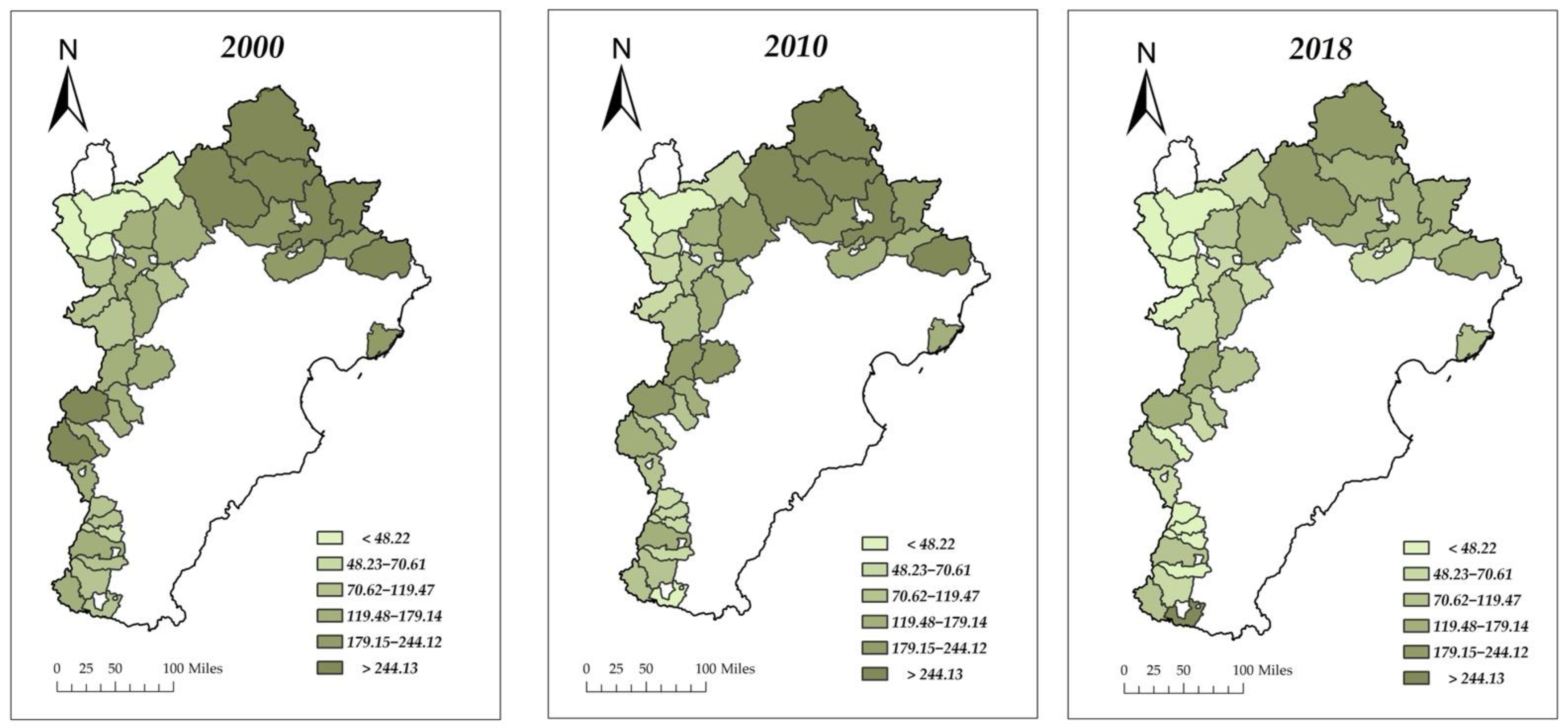
| LSI | Forest fragmentation | 155.50 (84.19) | 157.99 (85.90) | 119.13 (59.17) |
| INC | Per capita disposable income (104 CNY) | 0.18 (0.07) | 0.43 (0.15) | 1.11 (0.26) |
| GGP | Implementation of GGP (%) | 0.342 (0.48) | 1 (0.00) | 1 (0.00) |
| URBAN | Urbanization rate | 6.02 (6.54) | 13.38 (3.73) | 16.27 (9.46) |
| ELE | Rural electricity (kWh/per) | 150.4 (108.49) | 558.41 (681.54) | 620.71 (709.58) |
| FARM | Crop sown area (m2) | 1553.649 (1173.84) | 1189.87 (627.20) | 1038.23 (798.36) |
| POPDEN | Population density (people/ha) | 186.12 (137.07) | 200.74 (143.99) | 198.21 (138.78) |
| ROAD | Road mileage (m/per) | 2.24 (1.42) | 4.37 (1.778) | 5.2 (1.86) |
| Variables | VIF | 1/VIF |
|---|---|---|
| TREAT | 2.460 | 0.407 |
| INC | 2.350 | 0.425 |
| ROAD | 2.230 | 0.448 |
| POPDEN | 1.910 | 0.522 |
| GGP | 1.400 | 0.713 |
| URBANI | 1.390 | 0.719 |
| FARM | 1.270 | 0.789 |
| ELE | 1.190 | 0.838 |
| Variables | Model 1 | Model 2 | Model 3 | Model 4 | Model 5 | Model 6 | Model 7 | Model 8 |
|---|---|---|---|---|---|---|---|---|
| LSI | LSI | LSI | LSI | LSI | LSI | LSI | LSI | |
| TREAT | −0.230 *** | −0.711 *** | −0.419 * | −0.448 ** | −0.489 ** | −0.497 ** | −0.541 ** | −0.546 ** |
| (−0.063) | (−0.242) | (−0.221) | (−0.219) | (−0.221) | (−0.22) | (−0.221) | (−0.221) | |
| INC | 1.058 ** | 1.058 ** | 0.927 * | 1.078 ** | 1.110 ** | 1.194 ** | 1.223 ** | |
| (−0.511) | (−0.511) | (−0.491) | (−0.521) | (−0.524) | (−0.543) | (−0.546) | ||
| INC2 | −0.399 ** | −0.399 ** | −0.325 * | −0.381 ** | −0.395 ** | −0.425 ** | −0.430 ** | |
| (−0.176) | (−0.176) | (−0.163) | (−0.177) | (−0.180) | (−0.188) | (−0.19) | ||
| GGP | −0.292 *** | −0.324 *** | −0.318 *** | −0.336 *** | −0.344 *** | −0.333 *** | ||
| (−0.053) | (−0.060) | (−0.060) | (−0.060) | (−0.069) | (−0.072) | |||
| URBAN | 0.894 *** | 0.859 *** | 0.675 * | 0.674 | 0.72 | |||
| (−0.323) | (−0.308) | (−0.400) | (−0.403) | (−0.437) | ||||
| ELE | −0.692 ** | −0.655 * | −0.672 * | −0.665 * | ||||
| (−0.340) | (−0.328) | (−0.333) | (−0.330) | |||||
| FARM | −0.678 | −0.657 | −0.675 | |||||
| (−0.943) | (−0.943) | (−0.964) | ||||||
| POPDEN | 0.604 | 0.446 | ||||||
| (−1.252) | (−1.332) | |||||||
| ROAD | −4.985 | |||||||
| (−7.459) | ||||||||
| Constant | 4.865 *** | 4.693 *** | 4.693 *** | 4.660 *** | 4.648 *** | 4.758 *** | 4.630 *** | 4.677 *** |
| (−0.032) | (−0.101) | (−0.101) | (−0.092) | (−0.093) | (−0.171) | (−0.307) | (−0.328) | |
| Observations | 190 | 190 | 190 | 190 | 190 | 190 | 190 | 190 |
| Number of id | 38 | 38 | 38 | 38 | 38 | 38 | 38 | 38 |
| R-squared | 0.370 | 0.385 | 0.385 | 0.407 | 0.415 | 0.417 | 0.418 | 0.418 |
| Variables | Model 9 | Model 10 | Model 11 | Model 12 | Model 13 | Model 14 |
|---|---|---|---|---|---|---|
| PD | PD | PD | ED | ED | ED | |
| TREAT | −0.720 *** | −0.991 ** | −0.757 * | −12.370 *** | −37.150 ** | −25.310 ** |
| (−0.097) | (−0.374) | (−0.388) | (−3.799) | (−14.740) | (−12.270) | |
| INC | 1.221 | 1.482 | 54.780 * | 63.280 ** | ||
| (−0.813) | (−0.935) | (−28.130) | (−26.430) | |||
| INC2 | −0.672 ** | −0.721 ** | −20.960 ** | −22.300 ** | ||
| (−0.328) | (−0.35) | (−9.873) | (−9.348) | |||
| GGP | −0.412 *** | −24.460 *** | ||||
| (−0.138) | (−5.184) | |||||
| URBAN | 1.202 | 44.530 | ||||
| (−1.244) | (−28.080) | |||||
| ELE | −1.574 ** | −8.193 | ||||
| (−0.737) | (−21.430) | |||||
| FARM | −0.351 | −43.980 | ||||
| (−2.020) | (−34.790) | |||||
| POPDEN | −0.194 | 72.610 | ||||
| (−2.688) | (−60.110) | |||||
| ROAD | −10.750 | −243.200 | ||||
| (−15.240) | (−709.500) | |||||
| Constant | 1.696 *** | 1.502 *** | 1.547 ** | 65.630 *** | 56.940 *** | 47.470 *** |
| (−0.0476) | (−0.154) | (−0.69) | (−2.484) | (−5.662) | (−12.610) | |
| Observations | 190 | 188 | 188 | 190 | 188 | 188 |
| Number of id | 38 | 38 | 38 | 38 | 38 | 38 |
| R-squared | 0.394 | 0.405 | 0.427 | 0.389 | 0.406 | 0.449 |
Publisher’s Note: MDPI stays neutral with regard to jurisdictional claims in published maps and institutional affiliations. |
© 2022 by the authors. Licensee MDPI, Basel, Switzerland. This article is an open access article distributed under the terms and conditions of the Creative Commons Attribution (CC BY) license (https://creativecommons.org/licenses/by/4.0/).
Share and Cite
Zhu, S.; Liu, J.; Xu, H.; Li, L.; Yang, W. Has China’s New Round of Collective Forest Reforms Reduced Forest Fragmentation? A Case Study of the Beijing–Tianjin–Hebei Region. Int. J. Environ. Res. Public Health 2022, 19, 6183. https://doi.org/10.3390/ijerph19106183
Zhu S, Liu J, Xu H, Li L, Yang W. Has China’s New Round of Collective Forest Reforms Reduced Forest Fragmentation? A Case Study of the Beijing–Tianjin–Hebei Region. International Journal of Environmental Research and Public Health. 2022; 19(10):6183. https://doi.org/10.3390/ijerph19106183
Chicago/Turabian StyleZhu, Shuning, Jinlong Liu, Hao Xu, Lingchao Li, and Wentao Yang. 2022. "Has China’s New Round of Collective Forest Reforms Reduced Forest Fragmentation? A Case Study of the Beijing–Tianjin–Hebei Region" International Journal of Environmental Research and Public Health 19, no. 10: 6183. https://doi.org/10.3390/ijerph19106183
APA StyleZhu, S., Liu, J., Xu, H., Li, L., & Yang, W. (2022). Has China’s New Round of Collective Forest Reforms Reduced Forest Fragmentation? A Case Study of the Beijing–Tianjin–Hebei Region. International Journal of Environmental Research and Public Health, 19(10), 6183. https://doi.org/10.3390/ijerph19106183

