Article

A Spatial Survival Model for Risk Factors of Under-Five Child Mortality in Kenya
by
Kilemi Daniel
*,†,
Nelson Owuor Onyango
and
Rachel Jelagat Sarguta
School of Mathematics, University of Nairobi, Nairobi 30197, Kenya
*
Author to whom correspondence should be addressed.
These authors contributed equally to this work.
Int. J. Environ. Res. Public Health 2022, 19(1), 399; https://doi.org/10.3390/ijerph19010399

Submission received: 13 March 2021 / Revised: 27 May 2021 / Accepted: 28 May 2021 / Published: 30 December 2021

Abstract

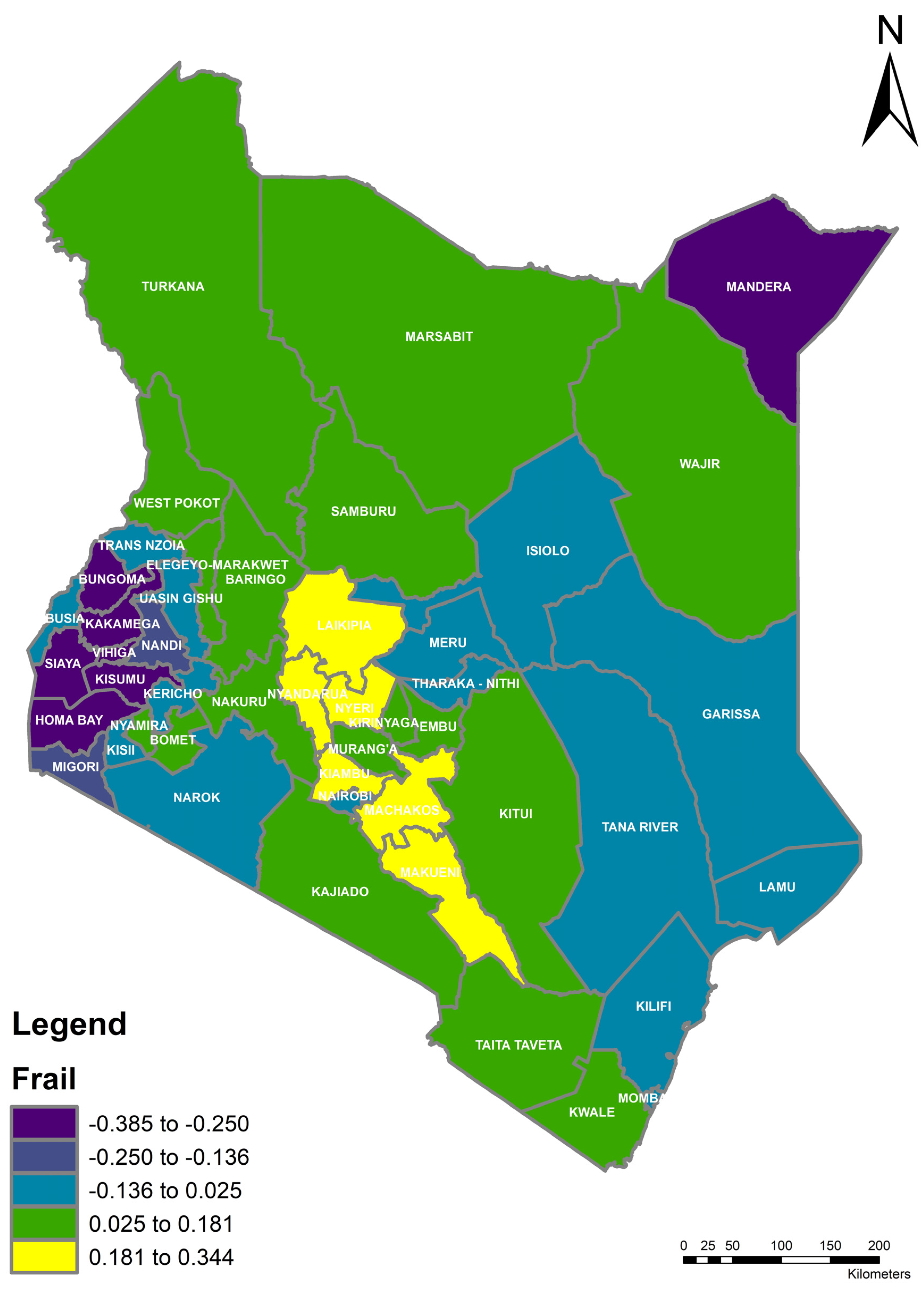
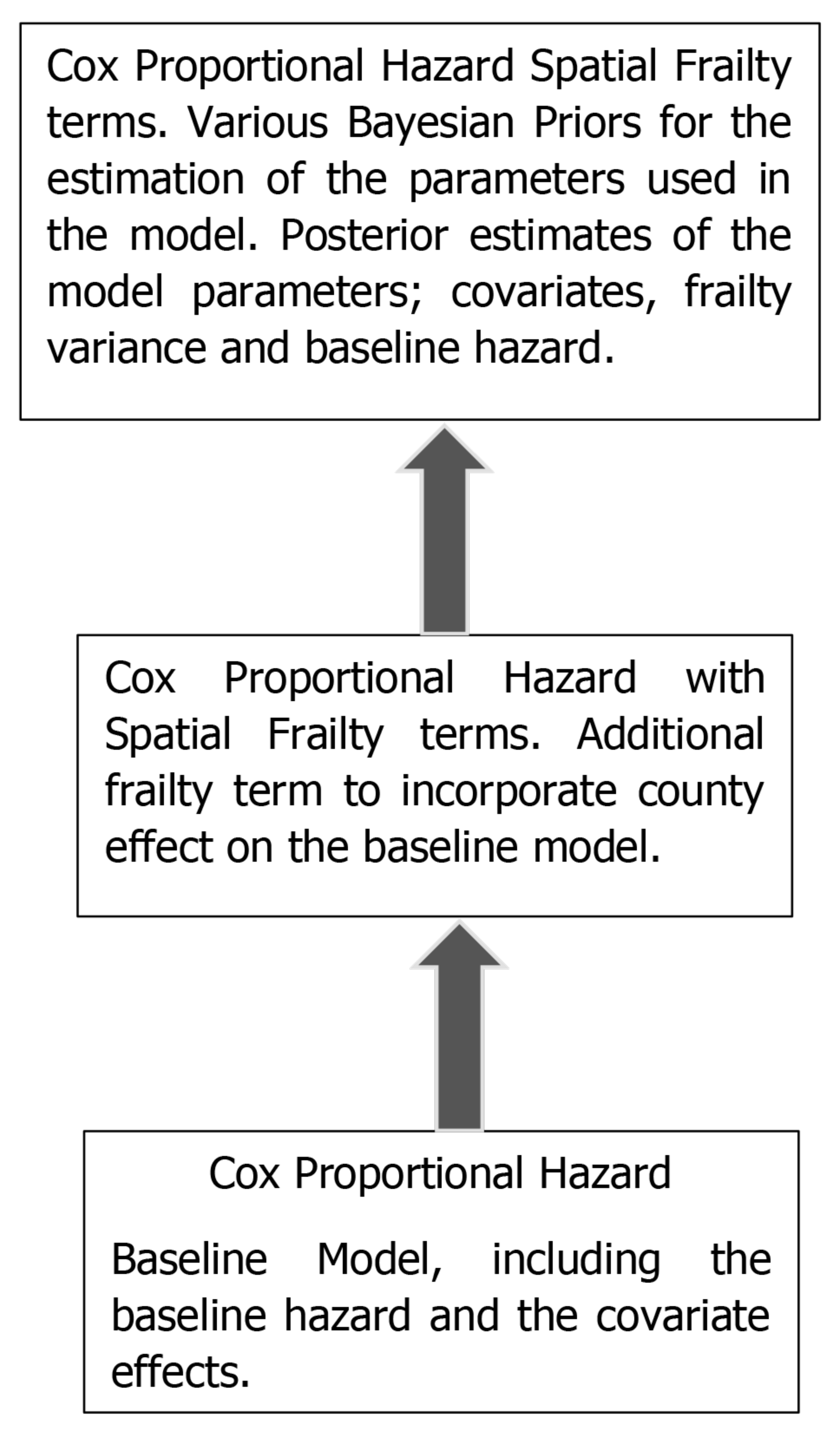
Child mortality is high in Sub-Saharan Africa compared to other regions in the world. In Kenya, the risk of mortality is assumed to vary from county to county due to diversity in socio-economic and even climatic factors. Recently, the country was split into 47 different administrative regions called counties, and health care was delegated to those county governments, further aggravating the spatial differences in health care from county to county. The goal of this study is to evaluate the effects of spatial variation in under-five mortality in Kenya. Data from the Kenya Demographic Health Survey (KDHS-2014) consisting the newly introduced counties was used to analyze this risk. Using a spatial Cox Proportional Hazard model, an Intrinsic Conditional Autoregressive Model (ICAR) was fitted to account for the spatial variation among the counties in the country while the Cox model was used to model the risk factors associated with the time to death of a child. Inference regarding the risk factors and the spatial variation was made in a Bayesian setup based on the Markov Chain Monte Carlo (MCMC) technique to provide posterior estimates. The paper indicate the spatial disparities that exist in the country regarding child mortality in Kenya. The specific counties have mortality rates that are county-specific, although neighboring counties have similar hazards for death of a child. Counties in the central Kenya region were shown to have the highest hazard of death, while those from the western region had the lowest hazard of death. Demographic factors such as the sex of the child and sex of the household head, as well as social economic factors, such as the level of education, accounted for the most variation when spatial differences were factored in. The spatial Cox proportional hazard frailty model performed better compared to the non-spatial non-frailty model. These findings can help the country to plan health care interventions at a subnational level and guide social and health policies by ensuring that counties with a higher risk of Under Five Child Mortality (U5CM) are considered differently from counties experiencing a lower risk of death.
Keywords: under five child mortality; kenya dhs; spatial survival models; bayesian survival applications under five child mortality; kenya dhs; spatial survival models; bayesian survival applications