Article

Facing the Coronavirus Pandemic: An Integrated Continuing Education Program in Taiwan
1
Department of Pediatrics, Taipei City Hospital Zhongxiao Branch, Taipei 115, Taiwan
2
Department of Health and Welfare, University of Taipei, Taipei 100, Taiwan
3
Department of Education and Research, Taipei City Hospital, Taipei 106, Taiwan
4
Institute of Public Health, National Yang Ming Chiao Tung University, Taipei 112, Taiwan
5
Department of Neurosurgery, Taipei City Hospital, Taipei 103, Taiwan
6
Superintendent Office, Taipei City Hospital, Taipei 103, Taiwan
7
Department of Surgery, National Taiwan University Hospital, Taipei 100, Taiwan
8
Department of Family Medicine, Taipei City Hospital Yangming Branch, Taipei 111, Taiwan
*
Author to whom correspondence should be addressed.
Int. J. Environ. Res. Public Health 2021, 18(5), 2417; https://doi.org/10.3390/ijerph18052417

Submission received: 17 January 2021 / Revised: 11 February 2021 / Accepted: 25 February 2021 / Published: 2 March 2021
(This article belongs to the Special Issue COVID-19 Pandemics: Impact on Health Care and Health Care Professions)

Abstract

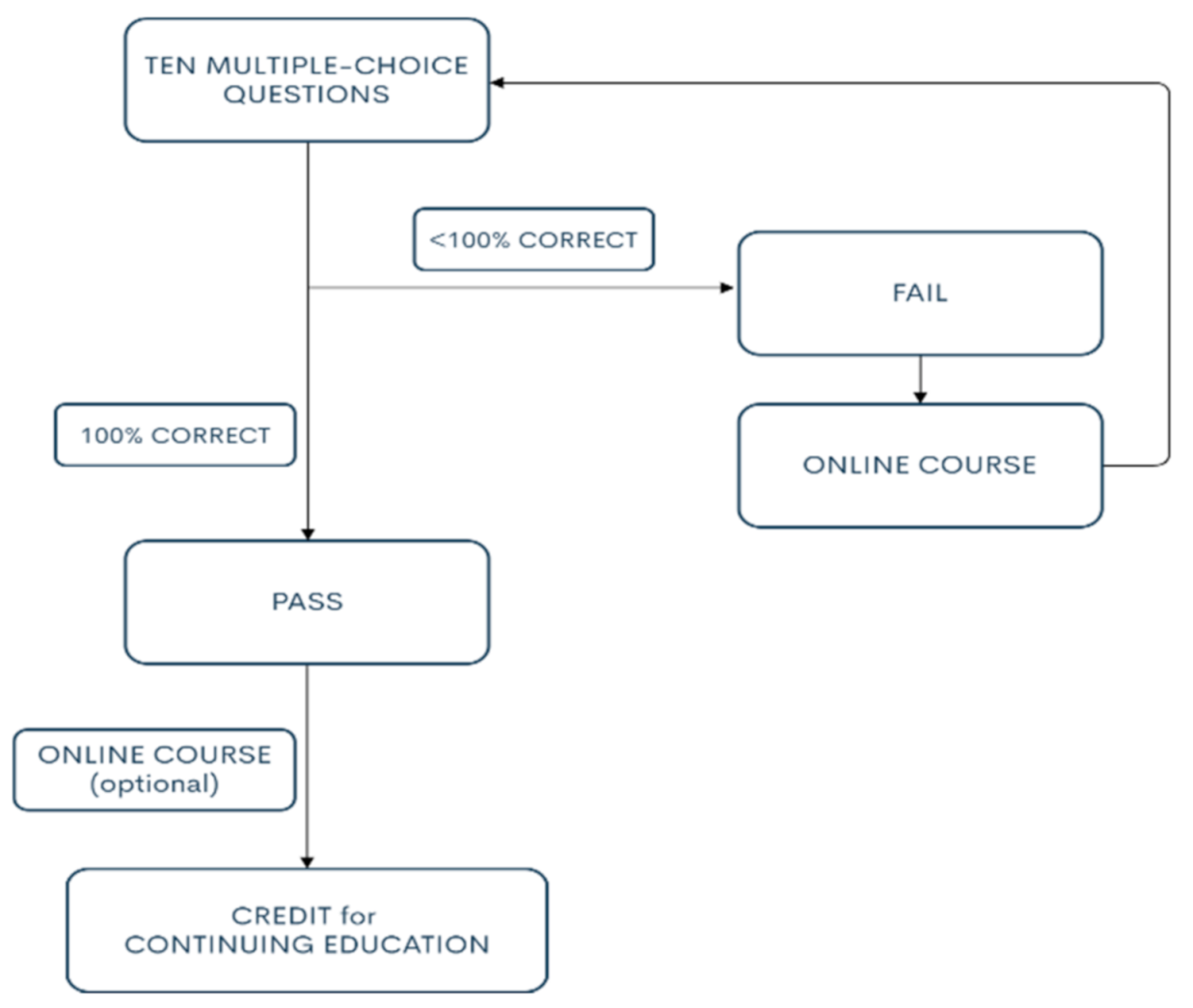
This study aimed to identify knowledge gaps regarding coronavirus disease 2019 (COVID-19) and develop an integrated educational program for healthcare workers. First, we designed and validated ten multiple-choice questions to identify knowledge gaps among healthcare workers. Within one month of the online test and curriculum offering, 5533 staff had completed the test, with a completion rate of 84.97%. There were 2618 healthcare workers who answered the pre-test 100% correctly. Those who did not answer the pre-test 100% correctly took multiple tests after learning through the online teaching materials. Eventually, 5214 staff passed the test (pre-test or post-test with 100% correct answers). The result showed that all staff had a low correct rate for personal protective equipment (PPE) use recommendations. The Infection Control Center conducted training sessions for hospital staff on how to wear protective clothing. Information on the selection and use of PPE for infection prevention was provided, and participants were allowed time to practice and familiarize themselves with the correct way to wear PPE. Moreover, the Department of Education and Research continued updating the online learning materials based on the most important updated peer-reviewed published articles. The attending teaching physicians helped to search, translate, and take notes on articles in the local language (traditional Chinese) for other colleagues to read easily. We expect to increase learning opportunities for healthcare workers, even during uncertain times such as the current coronavirus pandemic through (1) the hospital-wide course announcements, (2) the continuous placement of test questions and learning files on the digital learning platform, (3) the placement of journal highlights in cloud folders, and (4) the use of the digital learning platform on mobile phones accessible outside the hospital.
Keywords: integrated continuing education model; continuing education; COVID-19; healthcare workers; health knowledge; knowledge gaps; online learning; local language integrated continuing education model; continuing education; COVID-19; healthcare workers; health knowledge; knowledge gaps; online learning; local language