

A Community Audit of 300 “Drop-Out” Instances in Children Undergoing Ponseti Clubfoot Care in Bangladesh—What Do the Parents Say?



Abstract
1. Introduction
- To identify the factors preventing completion of clubfoot treatment at six months of the treatment course;
- To encourage the parents with children requiring further clubfoot care to access treatment.
2. Materials and Methods
- A non-clinical questionnaire; (Supplementary Material 1);
- The hypothesis underpinning this investigation was that drop-out from treatment can be ameliorated and that factors potentiating drop-out are modifiable. The null hypothesis was that factors inducing drop-out will not be identified or able to be ameliorated to avert drop-out.
Audit Data Management
3. Results
4. Discussion
5. Conclusions
Supplementary Materials
Author Contributions
Funding
Institutional Review Board Statement
Informed Consent Statement
Data Availability Statement
Acknowledgments
Conflicts of Interest
References
- Owen, R.M.; Capper, B.; Lavy, C. Clubfoot treatment in 2015: A global perspective. BMJ Glob. Health 2018, 3, e000852. [Google Scholar] [CrossRef] [Scilit] [PubMed]
- Carroll, N.C. Clubfoot in the twentieth century: Where we were and where we may be going in the twenty-first century. J. Pediatric Orthop. Part B Eur. Pediatric Orthop. Soc. Pedietric Orthop. Soc. North Am. 2012, 21, 1–6. [Google Scholar] [CrossRef] [Scilit] [PubMed]
- Morcuende, J. Congenital idiopathic clubfoot: Prevention of late deformity and disability by conservative treatment with the Ponseti technique. Pediatric Ann. 2006, 35, 128–136. [Google Scholar] [CrossRef] [Scilit]
- Evans, A.M.; Chowdhury, M.M.H.; Kabir, M.H.; Rahman, M.F. Walk for life—The National Clubfoot Project of Bangladesh: The four-year outcomes of 150 congenital clubfoot cases following Ponseti method. J. Foot Ankle Res. 2016, 9, 42. [Google Scholar] [CrossRef] [Scilit]
- Ansar, A.; Rahman, A.E.; Romero, L.; Haider, M.R.; Rahman, M.M.; Moinuddin, M.; Siddique, M.A.B.; Mamun, M.A.; Mazumder, T.; Pirani, S.P.; et al. Systematic review and meta-analysis of global birth prevalence of clubfoot: A study protocol. BMJ Open 2018, 8, e019246. [Google Scholar] [CrossRef] [Scilit]
- Owen, R.M.; Penny, J.N.; Mayo, A.; Morcuende, J.; Lavy, C.B.D. A collaborative public health approach to clubfoot intervention in 10 low-income and middle-income countries: 2-year outcomes and lessons learnt. J. Pediatric Orthop. Part B Eur. Pediatric Orthop. Soc. Pedietric Orthop. Soc. North Am. 2012, 21, 361–365. [Google Scholar] [CrossRef] [Scilit] [PubMed]
- Owen, R.M.; Kembhavi, G. A critical review of interventions for clubfoot in low and middle-income countries. J. Pediatric Orthop. 2012, 21, 59–67. [Google Scholar] [CrossRef] [Scilit]
- Evans, A.; Chowdhury, M.; Karimi, L.; Rouf, A.; Uddin, S.; Haque, O. Factors Affecting Parents to ‘Drop-Out’ from Ponseti Method and Children’s Clubfoot Relapse. Orthop. Res. Online J. 2020. [Google Scholar] [CrossRef] [Scilit]
- Evans, A.M.; Thanh, D.V. A Review of the Ponseti Method and Development of an Infant Clubfoot Program in Vietnam. J. Am. Podiatr. Med. Assoc. 2009, 99, 306–316. [Google Scholar] [CrossRef] [Scilit]
- Haque, M. Barriers Facing by Parents During Clubfoot Treatment of Children with Clubfoot Deformity. MOJ Orthop. Rheumatol. 2014, 1, 1–5. [Google Scholar] [CrossRef] [Scilit]
- Bhaskar, A.; Patni, P. Classification of relapse pattern in clubfoot treated with Ponseti technique. Indian J. Orthop. 2013, 47, 370–376. [Google Scholar] [CrossRef] [Scilit] [PubMed]
- Harmer, L.; Rhatigan, J. Clubfoot Care in Low-Income and Middle-Income Countries: From Clinical Innovation to a Public Health Program. World J. Surg. 2013, 38, 839–848. [Google Scholar] [CrossRef] [Scilit] [PubMed]
- Cosma, D.; Vasilescu, D. Comparative results of the conservative treatment in clubfoot by two different protocols. J. Pediatric Orthop. B 2007, 16, 317–321. [Google Scholar] [CrossRef] [Scilit] [PubMed]
- Hussain, H.; Burfat, A.M.; Samad, L.; Jawed, F.; Chinoy, M.A.; Khan, M.A. Cost-Effectiveness of the Ponseti Method for Treatment of Clubfoot in Pakistan. World J. Surg. 2014, 38, 2217–2222. [Google Scholar] [CrossRef] [Scilit] [PubMed]
- Bridgens, J.; Kiely, N. Current management of clubfoot (congenital talipes equinovarus). BMJ 2010, 340, c355. [Google Scholar] [CrossRef] [Scilit]
- McElroy, T.; Konde-Lule, J.; Neema, S.; Gitta, S.; Care, U.S.C. Understanding the barriers to clubfoot treatment adherence in Uganda: A rapid ethnographic study. Disabil. Rehabil. 2007, 29, 845–855. [Google Scholar] [CrossRef] [Scilit]
- Boardman, A.; Jayawardena, A.; Oprescu, F.; Cook, T.; Morcuende, J.A. The Ponseti method in Latin America: Initial impact and barriers to its diffusion and implementation. Iowa Orthop. J. 2011, 31, 30–35. [Google Scholar]
- Mejabi, J.O.; Esan, O.; Adegbehingbe, O.O.; Asuquo, J.E.; Akinyoola, A.L. A prospective cohort study on comparison of early outcome of classical Ponseti and modified Ponseti post tenotomy in clubfoot management. Ann. Med. Surg. 2017, 24, 34–37. [Google Scholar] [CrossRef] [Scilit]
- Evans, A.; Chowdhury, M.; Rana, S.; Rahman, S.; Mahboob, A.H. “Fast cast” and “needle Tenotomy” protocols with the Ponseti method to improve clubfoot management in Bangladesh. J. Foot Ankle Res. 2017, 10, 49. [Google Scholar] [CrossRef] [Scilit]
- Mehtani, A.; Prakash, J.; Vijay, V.; Kumar, N.; Sinha, A. Modified Ponseti technique for management of neglected clubfeet. J. Pediatric Orthop. Part B Eur. Pediatric Orthop. Soc. Pedietric Orthop. Soc. N. Am. 2018, 27, 61–66. [Google Scholar] [CrossRef] [Scilit]
- Shabtai, L.; Segev, E.; Yavor, A.; Wientroub, S.; Hemo, Y. Prolonged use of foot abduction brace reduces the rate of surgery in Ponseti-treated idiopathic club feet. J. Child. Orthop. 2015, 9, 177–182. [Google Scholar] [CrossRef] [Scilit] [PubMed]
- Zhao, D.; Li, H.; Zhao, L.; Liu, J.; Wu, Z.; Jin, F. Results of clubfoot management using the Ponseti method: Do the details matter? A systematic review. Clin. Orthop. Relat. Res. 2014, 472, 1329–1336. [Google Scholar] [CrossRef] [Scilit] [PubMed]
- Ponseti, I.V.; Zhivkov, M.; Davis, N.; Sinclair, M.; Dobbs, M.B.; Morcuende, J.A. Treatment of the complex idiopathic clubfoot. Clin. Orthop. Relat. Res. 2006, 451, 171–176. [Google Scholar] [CrossRef] [Scilit] [PubMed]
- Van Bosse, H.J.P. Ponseti treatment for clubfeet: An international perspective. Curr. Opin. Pediatrics 2011, 23, 41–45. [Google Scholar] [CrossRef] [Scilit]
- Ford-Powell, V.A.; Barker, S.; Khan, M.S.I.; Evans, A.M.; Deitz, F.R. The bangladesh clubfoot project: The first 5000 feet. J. Pediatric Orthop. 2013, 33, e40–e44. [Google Scholar] [CrossRef] [Scilit]
- Perveen, R.; Evans, A.M.; Ford-Powell, V.; Dietz, F.R.; Barker, S.; Wade, P.; Khan, S.I. The Bangladesh clubfoot project: Audit of 2-year outcomes of Ponseti treatment in 400 children. J. Pediatric Orthop. 2014, 34, 720–725. [Google Scholar] [CrossRef] [Scilit]
- Boehm, S.; Limpaphayom, N.; Alaee, F.; Sinclair, M.F.; Dobbs, M.B. Early results of the Ponseti method for the treatment of clubfoot in distal arthrogryposis. J. Bone Jt. Surg. Am. Vol. 2008, 90, 1501–1507. [Google Scholar] [CrossRef] [Scilit]
- Zhao, D.; Liu, J.; Zhao, L.; Wu, Z. Relapse of Clubfoot after Treatment with the Ponseti Method and the Function of the Foot Abduction Orthosis. Clin. Orthop. Surg. 2014, 6, 245–248. [Google Scholar] [CrossRef] [Scilit]
- Evans, A.M.; Perveen, R.; Ford-Powell, V.A.; Barker, S. The Bangla clubfoot tool: A repeatability study. J. Foot Ankle Res. 2014, 7, 27. [Google Scholar] [CrossRef] [Scilit]
- Utrilla-Rodríguez, E.; Munuera-Martínez, P.V.; Albornoz-Cabello, M. Treatment of clubfoot with the modified Copenhagen method: A 10-year follow-up. Prosthet. Orthot. Int. 2017, 12, 309364617741777. [Google Scholar] [CrossRef] [Scilit]
- Collinson, J.M.; Lindström, N.O.; Neves, C.; Wallace, K.; Meharg, C.; Charles, R.H.; Ross, Z.K.; Fraser, A.M.; Mbogo, I.; Oras, K.; et al. The developmental and genetic basis of “clubfoot” in the peroneal muscular atrophy mutant mouse. Development (Cambridge, England). Development 2018, 145, 160093. [Google Scholar] [CrossRef] [Scilit] [PubMed]
- Basit, S.; Khoshhal, K.I. Genetics of clubfoot; recent progress and future perspectives. Eur. J. Med. Genet. 2018, 61, 107–113. [Google Scholar] [CrossRef] [Scilit] [PubMed]
- Dobbs, M.B.; Gurnett, C.A. Genetics of clubfoot. J. Pediatric Orthop. B 2012, 21, 7–9. [Google Scholar] [CrossRef] [Scilit] [PubMed]
- Ponseti, I.V.; Campos, J. The classic: Observations on pathogenesis and treatment of congenital clubfoot. Clin. Orthop. Relat. Res. 2009, 467, 1124–1132. [Google Scholar] [CrossRef] [Scilit] [PubMed]
- Zionts, L.E.; Frost, N.; Kim, R.; Ebramzadeh, E.; Sangiorgio, S.N. Treatment of idiopathic clubfoot: Experience with the Mitchell-Ponseti brace. J. Pediatric Orthop. 2012, 32, 706–713. [Google Scholar] [CrossRef] [Scilit] [PubMed]
- Haque, M. Pattern of Clubfoot Deformity and Adherence to Ponseti Treatment among Children with Clubfoot Deformity. MOJ Orthop. Rheumatol. 2015, 2, 1–5. [Google Scholar] [CrossRef] [Scilit]
- Göksan, S.B.; Bilgili, F.; Eren, İ.; Bursalı, A.; Koç, E. Factors affecting adherence with foot abduction orthosis following Ponseti method. Acta Orthop. Traumatol. Turc. 2015, 49, 620–626. [Google Scholar] [CrossRef] [Scilit]
- Kessler, J.I. A new flexible brace used in the Ponseti treatment of talipes equinovarus. J. Pediatric Orthop. Part B Eur. Pediatric Orthop. Soc. Pedietric Orthop. Soc. N. Am. 2008, 17, 247–250. [Google Scholar] [CrossRef] [Scilit]
- Smythe, T.; Mudariki, D.; Kuper, H.; Lavy, C.; Foster, A. Assessment of success of the Ponseti method of clubfoot management in sub-Saharan Africa: A systematic review. BMC Musculoskelet. Disord. 2017, 18, 453. [Google Scholar] [CrossRef] [Scilit]
- Desai, L.; Oprescu, F.; DiMeo, A.; Morcuende, J.A. Bracing in the treatment of children with clubfoot: Past, present, and future. Iowa Orthop. J. 2010, 30, 15–23. [Google Scholar]
- Garg, S.; Porter, K. Improved bracing compliance in children with clubfeet using a dynamic orthosis. J. Child. Orthop. 2009, 3, 271–276. [Google Scholar] [CrossRef] [Scilit] [PubMed]
- Drew, S.; Gooberman-Hill, R.; Lavy, C. What factors impact on the implementation of clubfoot treatment services in low and middle-income countries? A narrative synthesis of existing qualitative studies. BMC Musculoskelet. Disord. 2018, 19, 72. [Google Scholar] [CrossRef] [Scilit] [PubMed]
- Alam, Z.; Haque, M.M.; Bhuiyan, M.R.; Islam, M.S.; Haque, M.; Islam, A.M.; Pradhania, M.S. Assessing Knowledge on Clubfoot Among Parents Having Children with Clubfoot Deformity. Chattagram Maa O Shishu Hosp. Med. Coll. J. 2015, 14, 42–46. [Google Scholar] [CrossRef] [Scilit]
- Ramahenina, H.; O’Connor, R.J.; Chamberlain, M.A. Problems encountered by parents of infants with clubfoot treated by the Ponseti method in Madagascar: A study to inform better practice. J. Rehabil. Med. 2016, 48, 481. [Google Scholar] [CrossRef] [Scilit]
- Nogueira, M.P.; Farcetta, M.; Fox, M.H.; Miller, K.K.; Pereira, T.S.; Morcuende, J.A. Treatment of congenital clubfoot with the Ponseti method: The parents’ perspective. J. Pediatric Orthop. Part B Eur. Pediatric Orthop. Soc. Pedietric Orthop. Soc. N. Am. 2013, 22, 583–588. [Google Scholar] [CrossRef] [Scilit] [PubMed]
- Malagelada, F.; Mayet, S.; Firth, G.; Ramachandran, M. The impact of the Ponseti treatment method on parents and caregivers of children with clubfoot: A comparison of two urban populations in Europe and Africa. J. Child. Orthop. 2016, 10, 101–107. [Google Scholar] [CrossRef] [Scilit]
- Ponseti, I.V. Relapsing clubfoot: Causes, prevention, and treatment. Iowa Orthop. J. 2002, 22, 55–56. [Google Scholar]
- Alves, C. Bracing in clubfoot: Do we know enough? J. Child. Orthop. 2019, 13, 258–264. [Google Scholar] [CrossRef] [Scilit]
- Mang’oli, P.; Theuri, J.; Kollmann, T.; MacDonald, N.E. Ponseti clubfoot management: Experience with the Steenbeek foot abduction brace. Paediatrics Child Health 2014, 19, 513–514. [Google Scholar] [CrossRef] [Scilit]
- Hemo, Y.; Segev, E.; Yavor, A.; Ovadia, D.; Wientroub, S.; Hayek, S. The influence of brace type on the success rate of the Ponseti treatment protocol for idiopathic clubfoot. J. Child. Orthop. 2010, 5, 115–119. [Google Scholar] [CrossRef] [Scilit]
- Dobbs, M.B.; Frick, S.L.; Mosca, V.S.; Raney, E.; VanBosse, H.J.; Lerman, J.A.; Talwalkar, V.R.; Steger-May, K.; Gurnett, C.A. Design and descriptive data of the randomized Clubfoot Foot Abduction Brace Length of Treatment Study (FAB24). J Pediatric Orthop. B 2017, 26, 101–107. [Google Scholar] [CrossRef] [Scilit] [PubMed]
- Richards, B.S.; Faulks, S.; Rathjen, K.E.; Karol, L.A.; Johnston, C.E.; Jones, S.A. A Comparison of Two Nonoperative Methods of Idiopathic Clubfoot Correction: The Ponseti Method and the French Functional (Physiotherapy) Method. J. Bone Jt. Surg. Am. Vol. 2008, 90, 2313–2321. [Google Scholar] [CrossRef] [Scilit] [PubMed]
- Chaweerat, R.; Kaewpornsawan, K.; Wongsiridej, P.; Payakkaraung, S.; Sinnoi, S.; Meesamanpong, S. The effectiveness of parent manipulation on newborns with postural clubfoot: A randomized controlled trial. J. Med Assoc. Thail. Chotmaihet Thangphaet 2014, 9, S68–S72. [Google Scholar]
- Gray, K.; Burns, J.; Little, D.; Bellemore, M.; Gibbons, P. Is tibialis anterior tendon transfer effective for recurrent clubfoot? Clin. Orthop. Relat. Res. 2014, 472, 750–758. [Google Scholar] [CrossRef] [Scilit] [PubMed]
- Zionts, L.E.; Jew, M.H.; Bauer, K.L.; Ebramzadeh, E.; Sangiorgio, S.N. How Many Patients Who Have a Clubfoot Treated Using the Ponseti Method are Likely to Undergo a Tendon Transfer? J. Pediatric Orthop. 2016, 38, 382–387. [Google Scholar] [CrossRef] [Scilit] [PubMed]
- Kilger, R.; Knupp, M.; Hintermann, B. Peroneus Longus to Peroneus Brevis Tendon Transfer. Tech. Foot Ankle Surg. 2009, 8, 146–149. [Google Scholar] [CrossRef] [Scilit]
- Shaheen, S.; Jaiballa, H.; Pirani, S. Interobserver reliability in Pirani clubfoot severity scoring between a paediatric orthopaedic surgeon and a physiotherapy assistant. J. Pediatric Orthop. Part B Eur. Pediatric Orthop. Soc. Pedietric Orthop. Soc. N. Am. 2012, 21, 366–368. [Google Scholar] [CrossRef] [Scilit]
- Gao, R.; Tomlinson, M.; Walker, C. Correlation of Pirani and Dimeglio Scores with Number of Ponseti Casts Required for Clubfoot Correction. J. Pediatric Orthop. 2014, 34, 639–642. [Google Scholar] [CrossRef] [Scilit]
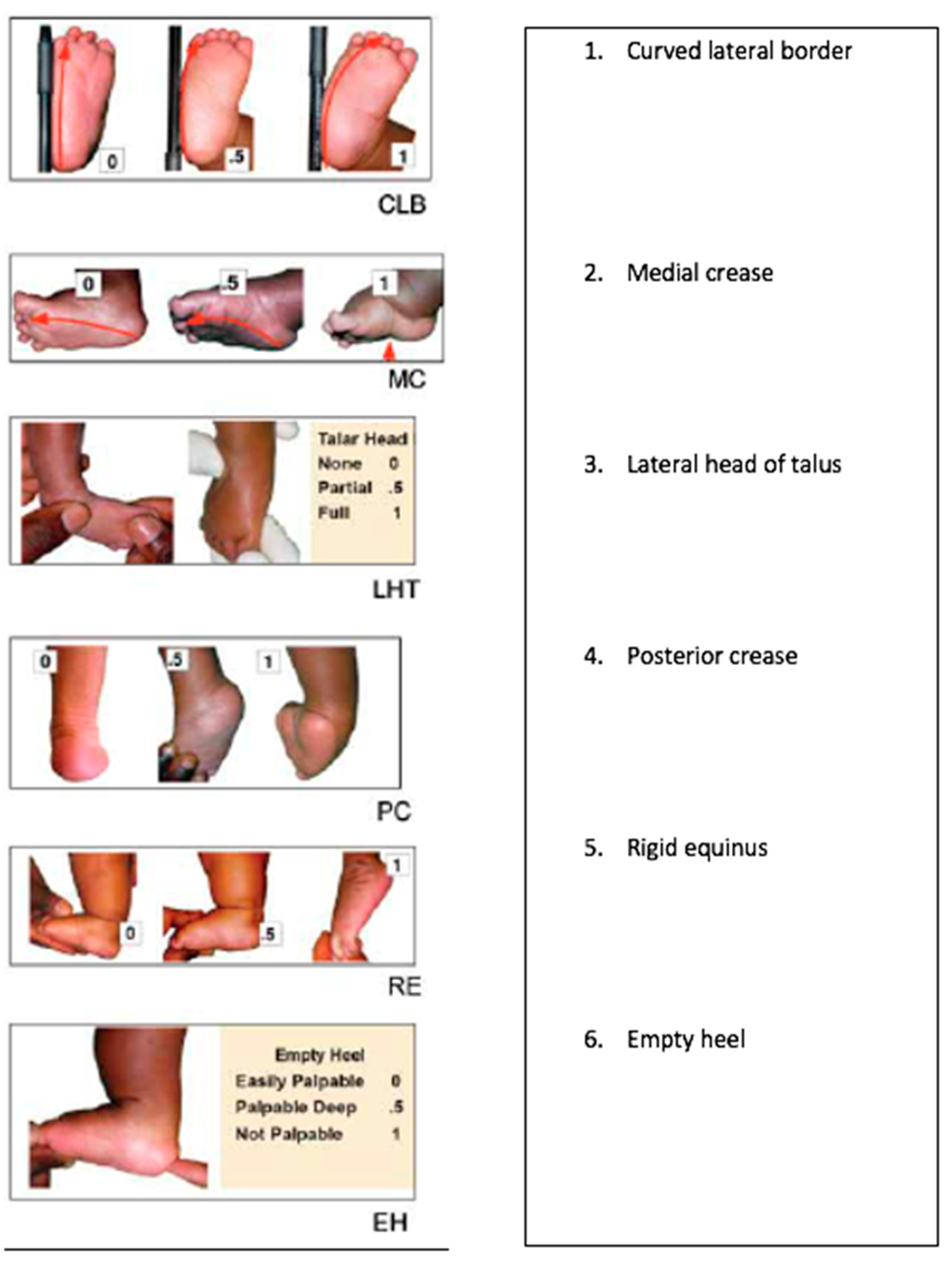
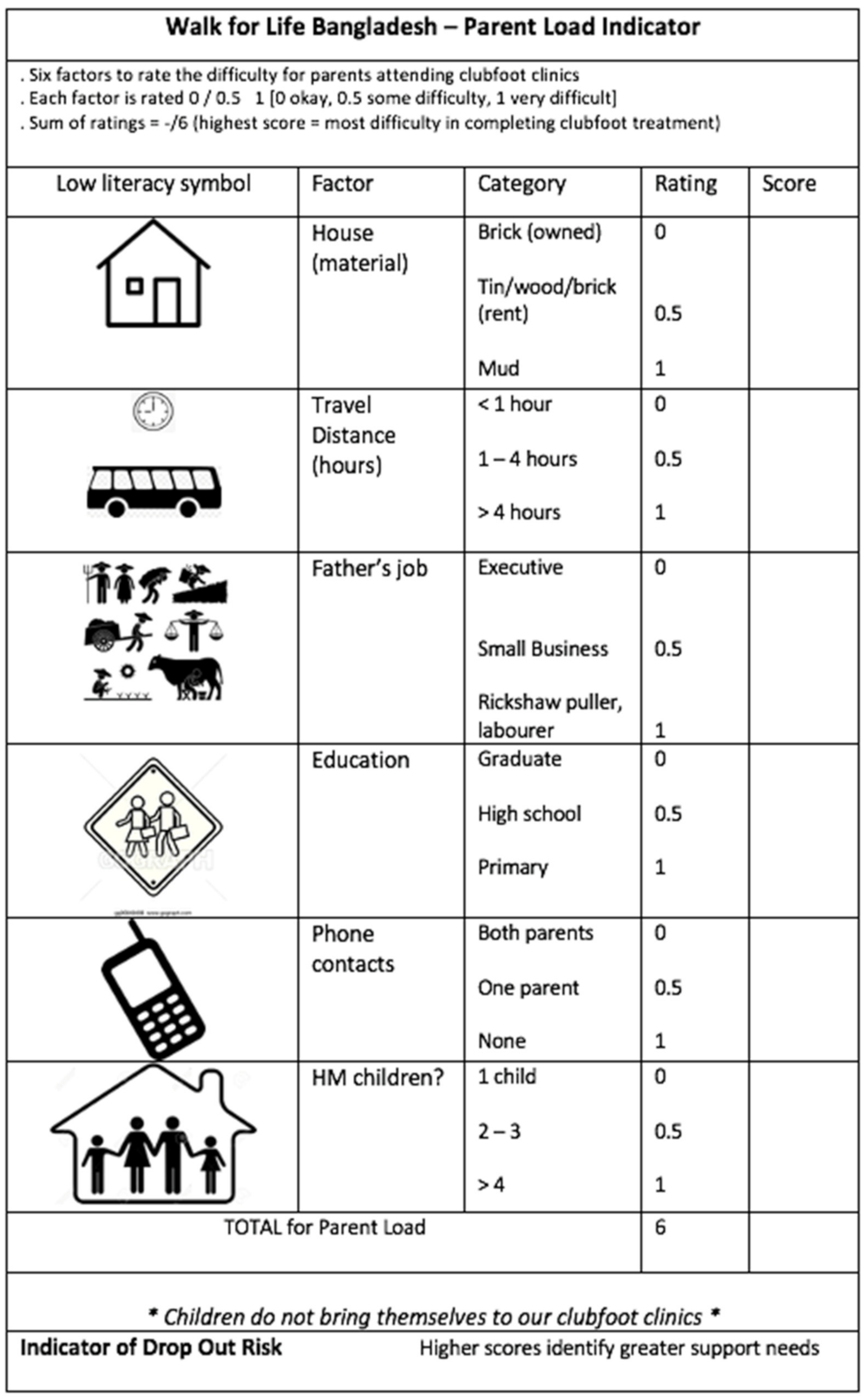

| Sample | 309 |
|---|---|
| Time since drop-out | 6 months |
| Male Female | 208 (67.3%) 101 (32.7%) |
| Age (years) Mean Range | 5.2 (SD 1.97) 0.7–11 |
| Housing materials Brick Tin Wood Mud | 74 199 22 18 |
| Previous Study | Current Study | % Difference Current vs. Previous Samples | |
|---|---|---|---|
| Drop-out Sample | 72 | 309 | |
| Treatment stage of drop-out Casts PAT/casts Brace Follow-up | 0 0 72 (100%) 0 | 17 (5.5%) 10 (3.2%) 95 (30.7%) 187 (60.5%) | −5.5% −3.2% 69% −60.5% |
| Reasons for drop-out Family issues Finances Difficulty with brace Problems with treatment Long term, many visits Bad staff Fear of tenotomy Cannot find clinic Child ill Too far to travel Lack understanding child seemed ok forgot appointment | 22 (30.6%) 5 (69.4%) 30 (41.6%) 11 | 86 (27.8%) 22 (7.1%) 24 (7.7%) 28 3 2 6 14 54 23 26 16 | −2.7% −30.3% −71.4% |
| Treatment phase found difficult None Casts PAT/casts Brace | 50 (69.4%) 10 (13.8%) 2 (2.7%) 5 (6.9%) | 68 (22.0%) 43 (13.9%) 74 (23.9%) 116 (37.5%) | 47.4% −0.1% −21.2% −30.6% |
| Functional Level of Children (n = 309) | |||||
|---|---|---|---|---|---|
| Test | Single leg standing | Squatting | Weakness | Pain | |
| Yes | 201 | 179 | 107 | 66 | |
| No | 108 | 130 | 202 | 243 | |
| Parent ratings (n = 309) | Support needed | Type of support needed | |||
| Not satisfactory | 69 | Yes | 94 | Financial | 48 |
| Satisfactory | 32 | No | 215 | Repeat Treatment | 12 |
| Average | 42 | Transport | 35 | ||
| Good | 95 | None | 38 | ||
| Very Good | 71 | ||||
| Clinic reviews, n = 283 (91% sample) Resume FAB Re-cast, then resume FAB OK, discharged Relapse deformity | 49.8% 5.3% 27.9% 25/283 (9%) | ||||
Publisher’s Note: MDPI stays neutral with regard to jurisdictional claims in published maps and institutional affiliations. |
© 2021 by the authors. Licensee MDPI, Basel, Switzerland. This article is an open access article distributed under the terms and conditions of the Creative Commons Attribution (CC BY) license (http://creativecommons.org/licenses/by/4.0/).
Share and Cite
Evans, A.M.; Chowdhury, M.; Khan, S. A Community Audit of 300 “Drop-Out” Instances in Children Undergoing Ponseti Clubfoot Care in Bangladesh—What Do the Parents Say? Int. J. Environ. Res. Public Health 2021, 18, 993. https://doi.org/10.3390/ijerph18030993
Evans AM, Chowdhury M, Khan S. A Community Audit of 300 “Drop-Out” Instances in Children Undergoing Ponseti Clubfoot Care in Bangladesh—What Do the Parents Say? International Journal of Environmental Research and Public Health. 2021; 18(3):993. https://doi.org/10.3390/ijerph18030993
Chicago/Turabian StyleEvans, Angela Margaret, Mamun Chowdhury, and Sharif Khan. 2021. "A Community Audit of 300 “Drop-Out” Instances in Children Undergoing Ponseti Clubfoot Care in Bangladesh—What Do the Parents Say?" International Journal of Environmental Research and Public Health 18, no. 3: 993. https://doi.org/10.3390/ijerph18030993
APA StyleEvans, A. M., Chowdhury, M., & Khan, S. (2021). A Community Audit of 300 “Drop-Out” Instances in Children Undergoing Ponseti Clubfoot Care in Bangladesh—What Do the Parents Say? International Journal of Environmental Research and Public Health, 18(3), 993. https://doi.org/10.3390/ijerph18030993

