Current States and Future Trends in Safety Research of Construction Personnel: A Quantitative Analysis Based on Social Network Approach


Abstract
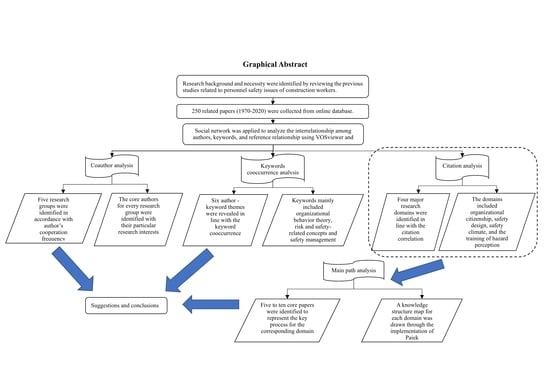
Share and Cite
Meng, X.; Chan, A.H.S. Current States and Future Trends in Safety Research of Construction Personnel: A Quantitative Analysis Based on Social Network Approach. Int. J. Environ. Res. Public Health 2021, 18, 883. https://doi.org/10.3390/ijerph18030883
Meng X, Chan AHS. Current States and Future Trends in Safety Research of Construction Personnel: A Quantitative Analysis Based on Social Network Approach. International Journal of Environmental Research and Public Health. 2021; 18(3):883. https://doi.org/10.3390/ijerph18030883
Chicago/Turabian StyleMeng, Xiangcheng, and Alan H. S. Chan. 2021. "Current States and Future Trends in Safety Research of Construction Personnel: A Quantitative Analysis Based on Social Network Approach" International Journal of Environmental Research and Public Health 18, no. 3: 883. https://doi.org/10.3390/ijerph18030883
APA StyleMeng, X., & Chan, A. H. S. (2021). Current States and Future Trends in Safety Research of Construction Personnel: A Quantitative Analysis Based on Social Network Approach. International Journal of Environmental Research and Public Health, 18(3), 883. https://doi.org/10.3390/ijerph18030883