

Epidemiologic Methods to Estimate Insufficient Sleep in the US Population

 ,
, 
Abstract
1. Background
2. Methods
2.1. Study Population
2.2. Statistical Analysis
3. Results
4. Discussion
5. Conclusions
Author Contributions
Funding
Conflicts of Interest
References
- Bin, Y.S.; Marshall, N.S.; Glozier, N. Secular trends in adult sleep duration: A systematic review. Sleep Med. Rev. 2012, 16, 223–230. [Google Scholar] [CrossRef] [PubMed]
- Jean-Louis, G.; Grandner, M.A.; Youngstedt, S.D.; Williams, N.J.; Zizi, F.; Sarpong, D.F.; Ogedegbe, G.G. Differential increase in prevalence estimates of inadequate sleep among black and white Americans. BMC Public Health 2015, 15, 1185. [Google Scholar] [CrossRef] [PubMed]
- Williams, N.J.; Grandner, M.A.; Wallace, D.M.; Cuffee, Y.; Airhihenbuwa, C.; Okuyemi, K.; Ogedegbe, G.; Jean-Louis, G. Social and behavioral predictors of insufficient sleep among African Americans and Caucasians. Sleep Med. 2016, 18, 103–107. [Google Scholar] [CrossRef] [PubMed]
- Liu, Y.; Croft, J.B.; Wheaton, A.G.; Perry, G.S.; Chapman, D.P.; Strine, T.W.; McKnight-Eily, L.R.; Presley-Cantrell, L. Association between perceived insufficient sleep, frequent mental distress, obesity and chronic diseases among US adults, 2009 behavioral risk factor surveillance system. BMC Public Health 2013, 13, 84. [Google Scholar] [CrossRef] [PubMed]
- Centers for Disease Control and Prevention (CDC). Sleep and Sleep Disorders: Data and Statistics. 2014. Available online: https://www.cdc.gov/sleep/data_statistics.html (accessed on 18 May 2020).
- McNutt, L.A.; Wu, C.; Xue, X.; Hafner, J.P. Estimating the relative risk in cohort studies and clinical trials of common outcomes. Am. J. Epidemiol. 2003, 157, 940–943. [Google Scholar] [CrossRef] [PubMed]
- Zou, G. A modified poisson regression approach to prospective studies with binary data. Am. J. Epidemiol. 2004, 159, 702–706. [Google Scholar] [CrossRef] [PubMed]
- Barros, A.J.D.; Hirakata, V.N. Alternatives for logistic regression in cross-sectional studies: An empirical comparison of models that directly estimate the prevalence ratio. BMC Med. Res. Methodol. 2003, 3, 21. [Google Scholar] [CrossRef] [PubMed]
- Thompson, M.L.; Myers, J.E.; Kriebel, D. Prevalence odds ratio or prevalence ratio in the analysis of cross sectional data: What is to be done? Occup. Environ. Med. 1998, 55, 272–277. [Google Scholar] [CrossRef] [PubMed]
- Martinez, B.A.F.; Leotti, V.B.; Silva, G.G.E.; Nunes, L.N.; Machado, G.; Corbellini, L.G. Odds Ratio or Prevalence Ratio? An Overview of Reported Statistical Methods and Appropriateness of Interpretations in Cross-sectional Studies with Dichotomous Outcomes in Veterinary Medicine. Front. Vet. Sci. 2017, 4, 193. [Google Scholar] [CrossRef] [PubMed]
- Lee, J.; Chia, K.S. Estimation of prevalence rate ratios for cross sectional data: An example in occupational epidemiology. Br. J. Ind. Med. 1993, 50, 861–862. [Google Scholar] [CrossRef] [PubMed]
- Behrens, T.; Taeger, D.; Wellmann, J.; Keil, U. Different methods to calculate effect estimates in cross-sectional studies. A comparison between prevalence odds ratio and prevalence ratio. Methods Inf. Med. 2004, 43, 505–509. [Google Scholar] [PubMed]
- Zhang, J.; Yu, K.F. What’s the relative risk? A method of correcting the odds ratio in cohort studies of common outcomes. JAMA 1998, 280, 1690–1691. [Google Scholar] [CrossRef] [PubMed]
- Dupont, W.D. Statistical Modeling for Biomedical Researchers: A Simple Introduction to the Analysis of Complex Data, 2nd ed.; Cambridge University Press: Cambridge, UK, 2009. [Google Scholar]
- Centers for Disease Control and the National Center for Health Statistics; U.S. Department of Health & Human Services. About the National Health and Nutrition Examination Survey. 2017. Available online: https://www.cdc.gov/nchs/nhanes/about_nhanes.htm (accessed on 9 June 2020).
- Kripke, D.F.; Garfinkel, L.; Wingard, D.L.; Klauber, M.R.; Marler, M.R. Mortality associated with sleep duration and insomnia. Arch. Gen. Psychiatry 2002, 59, 131–136. [Google Scholar] [CrossRef] [PubMed]
- Tamakoshi, A.; Ohno, Y. Self-reported sleep duration as a predictor of all-cause mortality: Results from the JACC study, Japan. Sleep 2004, 27, 51–54. [Google Scholar] [PubMed]
- National Heart, Lung, and Blood Institute. Your Guide To Healthy Sleep. 2012. Available online: https://www.nhlbi.nih.gov/health-topics/all-publications-and-resources/your-guide-healthy-sleep (accessed on 9 June 2020).
- RCoreTeam. R: A Language and Environment for Statistical Computing; R Foundation for Statistical Computing: Vienna, Austria, 2019. [Google Scholar]
- Davies, H.T.; Crombie, I.K.; Tavakoli, M. When can odds ratios mislead? BMJ 1998, 316, 989–991. [Google Scholar] [CrossRef] [PubMed]

| Non-Hispanic Black | Non-Hispanic White | p-Value c | |
|---|---|---|---|
| Participants (n) | 4888 | 10,176 | |
| Female Sex | 51.82% | 50.38% | 0.001 |
| Education | 0.001 | ||
| Less than 9th grade | 5.05% | 4.05% | |
| 9–11th grade | 18.04% | 12.02% | |
| High school or equivalent | 26.58% | 23.96% | |
| Some college or associate degree | 33.14% | 31.88% | |
| College graduate or above | 17.18% | 28.10% | |
| Total household income | 0.001 | ||
| $0 to $44,999 | 58.74% | 49.38% | |
| $45,000 to $99,999 | 29.93% | 29.48% | |
| $100,000 and over | 11.33% | 21.14% | |
| Sleep disorders | 25.43% | 32.44% | 0.001 |
| Diabetes | 16.57% | 10.56% | 0.001 |
| Age (mean, SD) | 48.37 (16.97) | 51.69 (18.54) | 0.001 |
| BMI (mean, SD) a | 30.52 (7.84) | 28.78 (6.76) | 0.001 |
| Underweight | 17.40 (0.90) | 17.44 (0.91) | 0.323 |
| Normal | 22.46 (1.71) | 22.42 (1.69) | 0.819 |
| Overweight | 33.32 (6.99) | 31.77 (5.98) | 0.001 |
| SBP (mean, SD) b | 127.34 (19.53) | 123.25 (17.83) | 0.001 |
| SBP < 120 mm Hg | 110.02 (6.91) | 109.40 (7.37) | 0.005 |
| SBP ≥ 120 mm Hg | 138.90 (16.44) | 136.03 (14.87) | 0.001 |
| Sleep duration (mean, SD) | 6.69 (1.65) | 7.11 (1.42) | 0.001 |
| Non-Hispanic Black: n (%) | Non-Hispanic White: n (%) | Total Population: n (%) | |||||||
|---|---|---|---|---|---|---|---|---|---|
| <6 h | 6–8 h | >8 h | <6 h | 6–8 h | >8 h | <6 h | 6–8 h | >8 h | |
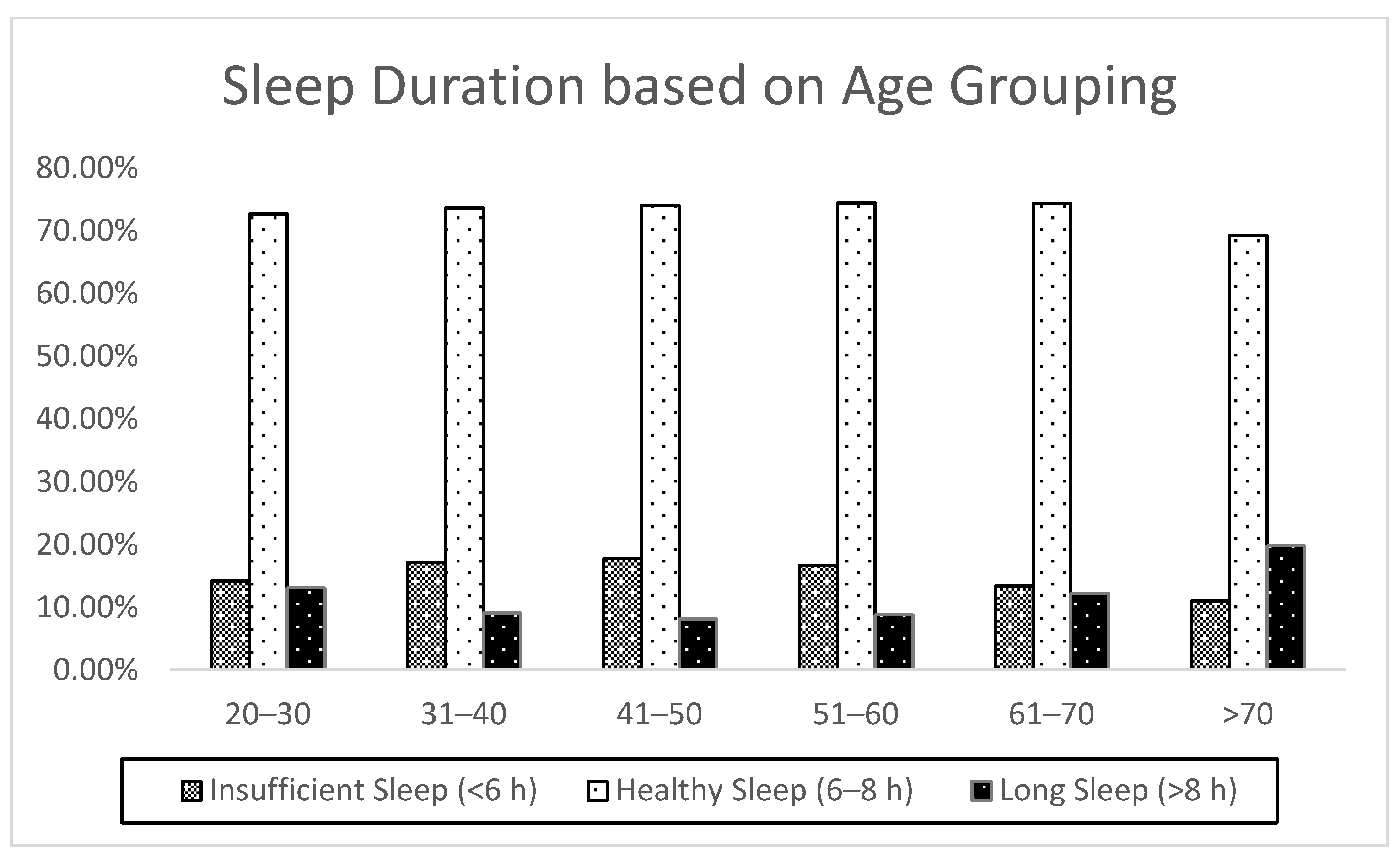
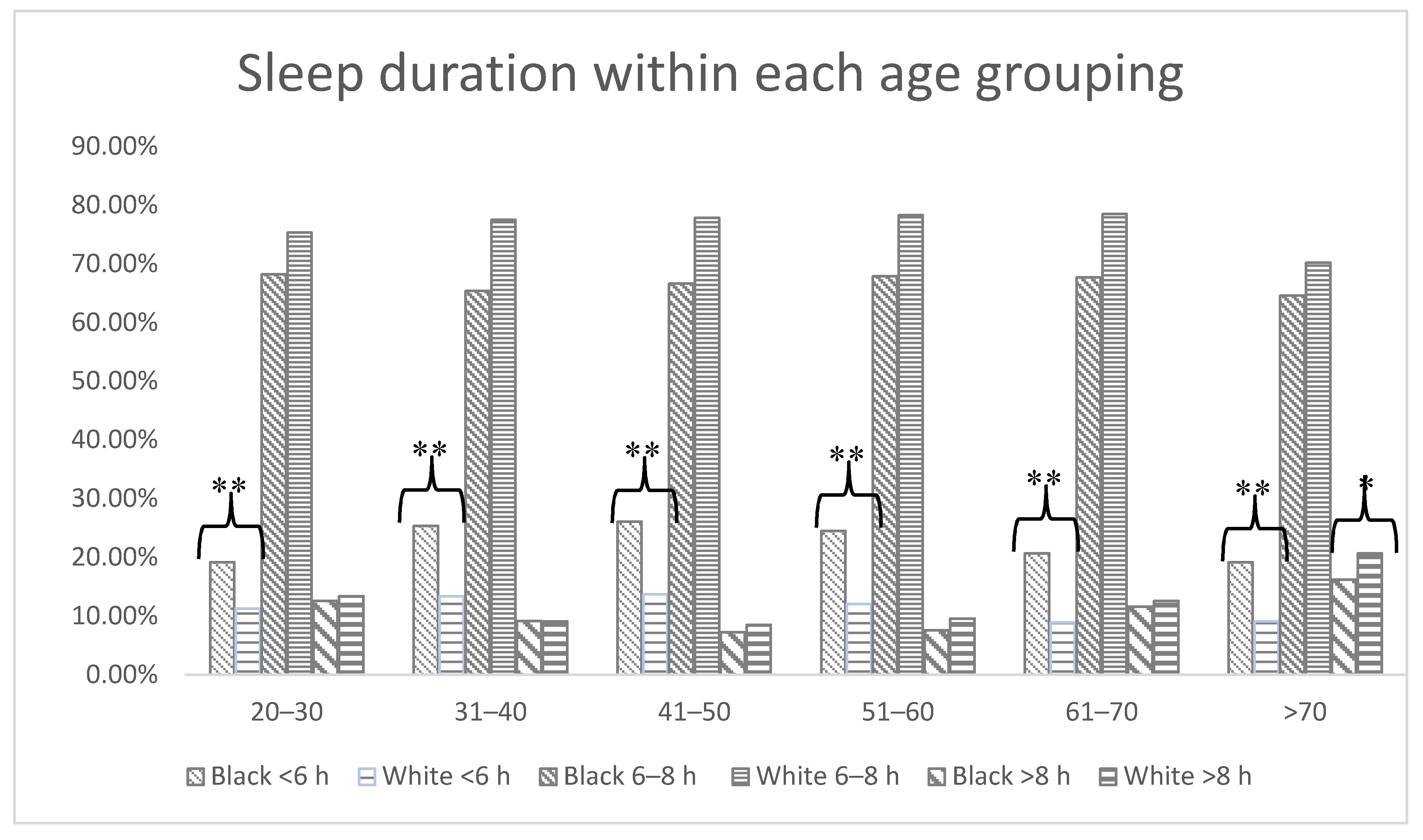
| 20–30 | 185 (19.2) | 656 (68.2) | 121 (12.6) | 186 (11.3) | 1243 (75.3) | 221 (13.4) | 371 (14.2) | 1899 (72.7) | 342 (13.1) |
| 31–40 | 202 (25.4) | 519 (65.4) | 73 (9.2) | 226 (13.4) | 1310 (77.5) | 154 (9.1) | 428 (17.2) | 1829 (73.7) | 227 (9.1) |
| 41–50 | 215 (26.1) | 548 (66.6) | 60 (7.3) | 229 (13.7) | 1306 (77.8) | 142 (8.5) | 444 (17.8) | 1854 (74.1) | 202 (8.1) |
| 51–60 | 223 (24.5) | 618 (67.9) | 69 (7.6) | 185 (12.1) | 1195 (78.3) | 146 (9.6) | 408 (16.7) | 1813 (74.5) | 215 (8.8) |
| 61–70 | 181 (20.7) | 592 (67.7) | 101 (11.6) | 126 (8.9) | 1105 (78.5) | 178 (12.6) | 307 (13.4) | 1697 (74.4) | 279 (12.2) |
| >70 | 101 (19.2) | 339 (64.6) | 85 (16.2) | 202 (9.1) | 1562 (70.2) | 460 (20.7) | 303 (11.0) | 1901 (69.2) | 545 (19.8) |
| Age Grouping | N | Logistic Regression | Modified Poisson Regression | ||
|---|---|---|---|---|---|
| Estimated Risk Ratio 1 (95% CI) | p-Value 2 | Estimated Risk Ratio 1 (95% CI) | p-Value 2 | ||
| 20–30 | 2612 | 2.12 (1.59, 2.84) | 0.01 | 1.86 (1.49, 2.32) | 0.01 |
| 31–40 | 2484 | 2.18 (1.65, 2.87) | 0.01 | 1.84 (1.49, 2.26) | 0.01 |
| 41–50 | 2500 | 2.59 (1.92, 3.50) | 0.01 | 2.06 (1.70, 2.50) | 0.01 |
| 51–60 | 2436 | 2.36 (1.71, 3.25) | 0.01 | 1.94 (1.57, 2.41) | 0.01 |
| 61–70 | 2283 | 2.34 (1.57, 3.48) | 0.01 | 1.95 (1.49, 2.56) | 0.01 |
| >70 | 2749 | 2.45 (1.65, 3.63) | 0.01 | 2.12 (1.64, 2.73) | 0.01 |
Publisher’s Note: MDPI stays neutral with regard to jurisdictional claims in published maps and institutional affiliations. |
© 2020 by the authors. Licensee MDPI, Basel, Switzerland. This article is an open access article distributed under the terms and conditions of the Creative Commons Attribution (CC BY) license (http://creativecommons.org/licenses/by/4.0/).
Share and Cite
Jean-Louis, G.; Turner, A.D.; Seixas, A.; Jin, P.; Rosenthal, D.M.; Liu, M.; Avirappattu, G. Epidemiologic Methods to Estimate Insufficient Sleep in the US Population. Int. J. Environ. Res. Public Health 2020, 17, 9337. https://doi.org/10.3390/ijerph17249337
Jean-Louis G, Turner AD, Seixas A, Jin P, Rosenthal DM, Liu M, Avirappattu G. Epidemiologic Methods to Estimate Insufficient Sleep in the US Population. International Journal of Environmental Research and Public Health. 2020; 17(24):9337. https://doi.org/10.3390/ijerph17249337
Chicago/Turabian StyleJean-Louis, Girardin, Arlener D. Turner, Azizi Seixas, Peng Jin, Diana M. Rosenthal, Mengling Liu, and George Avirappattu. 2020. "Epidemiologic Methods to Estimate Insufficient Sleep in the US Population" International Journal of Environmental Research and Public Health 17, no. 24: 9337. https://doi.org/10.3390/ijerph17249337
APA StyleJean-Louis, G., Turner, A. D., Seixas, A., Jin, P., Rosenthal, D. M., Liu, M., & Avirappattu, G. (2020). Epidemiologic Methods to Estimate Insufficient Sleep in the US Population. International Journal of Environmental Research and Public Health, 17(24), 9337. https://doi.org/10.3390/ijerph17249337

