

Same Involvement, Different Reasons: How Personality Factors and Organizations Contribute to Heavy Work Investment



Abstract
1. Introduction
2. Theoretical Background
2.1. Individual Antecedents of HWI
2.2. Situational Antecedents of HWI
3. Materials and Methods
3.1. Procedure and Participants
3.2. Measures
3.3. Strategy of Analysis
4. Results
4.1. Descriptive Results
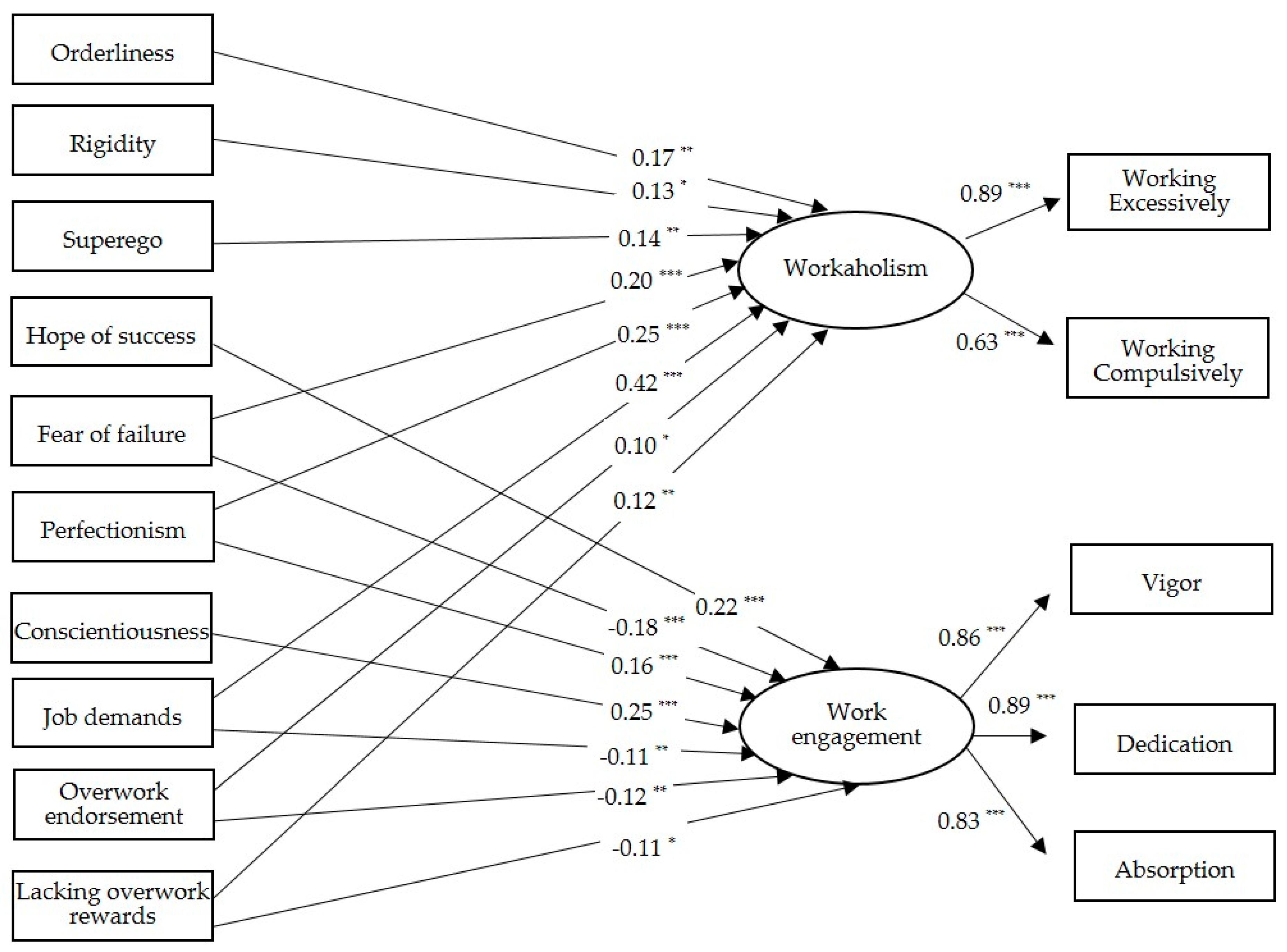
4.2. Model Testing
5. Discussion
5.1. Study Limitations and Recommendations for Future Research
5.2. Practical Implications
6. Conclusions
Author Contributions
Funding
Conflicts of Interest
References
- Di Stefano, G.; Gaudiino, M. Workaholism and work engagement: How are they similar? How are they different? A systematic review and meta-analysis. Eur. J. Work Organ. Psychol. 2019, 28, 329–347. [Google Scholar] [CrossRef] [Scilit]
- Schaufeli, W.B. Heavy work investment, personality and organizational climate. J. Manag. Psychol. 2016, 31, 1057–1073. [Google Scholar] [CrossRef] [Scilit]
- Bakker, A.B.; Schaufeli, W.B. Work Engagement. Wiley Encycl. Manag. 2015, 1–5. [Google Scholar] [CrossRef] [Scilit]
- Clark, M.A.; Michel, J.S.; Zhdanova, L.; Pui, S.Y.; Baltes, B.B. All work and no play? A meta-analytic examination of the correlates and outcomes of workaholism. J. Manag. 2016, 42, 1836–1873. [Google Scholar] [CrossRef] [Scilit]
- Mazzetti, G.; Schaufeli, W.B.; Guglielmi, D. Are workaholism and work engagement in the eye of the beholder? A multirater perspective on different forms of working hard. Eur. J. Psychol. Assess. 2016, 34, 30–40. [Google Scholar] [CrossRef] [Scilit]
- van Beek, I.; Taris, T.W.; Schaufeli, W.B. Workaholic and work engaged employees: Dead ringers or worlds apart? J. Occup. Health Psychol. 2011, 16, 468–482. [Google Scholar] [CrossRef] [Scilit] [PubMed]
- Schaufeli, W.B.; Salanova, M. Burnout, boredom and engagement at the workplace. In People at Work: An Introduction to Contemporary Work Psychology; Peeters, M., de Jonge, J., Taris, T., Eds.; Wiley-Blackwell: Chichester, UK, 2014; pp. 293–320. ISBN 978-1-119-94552-9. [Google Scholar]
- van Beek, I.; Hu, Q.; Schaufeli, W.B.; Taris, T.W.; Schreurs, B.H.J. For fun, love, or money: What drives workaholic, engaged, and burned-out employees at work? Appl. Psychol. 2012, 61, 30–55. [Google Scholar] [CrossRef] [Scilit]
- Borst, R.T.; Kruyen, P.M.; Lako, C.J.; de Vries, M.S. The attitudinal, behavioral, and performance outcomes of work engagement: A comparative meta-analysis across the public, semipublic, and private sector. Rev. Public Pers. Adm. 2020, 23, 133–153. [Google Scholar] [CrossRef] [Scilit]
- Robledo, E.; Zappalà, S.; Topa, G. Job crafting as a mediator between work engagement and well-being outcomes: A time-lagged study. Int. J. Environ. Res. Public Health 2019, 16, 1376. [Google Scholar] [CrossRef] [Scilit]
- Choi, Y. The differences between work engagement and workaholism, and organizational outcomes: An integrative model. J. Soc. Behav. Pers. 2013, 41, 1655–1665. [Google Scholar] [CrossRef] [Scilit]
- Sussman, S. Workaholism: A Review. J. Addict. Res. Ther. 2012, 6, 4120. [Google Scholar] [CrossRef] [PubMed]
- Clark, M.A.; Lelchook, A.M.; Taylor, M.L. Beyond the Big Five: How narcissism, perfectionism, and dispositional affect relate to workaholism. Pers. Individ. Dif. 2010, 48, 786–791. [Google Scholar] [CrossRef] [Scilit]
- Mazzetti, G.; Schaufeli, W.B.; Guglielmi, D. Are workaholics born or made? Relations of workaholism with person characteristics and overwork climate. Int. J. Stress Manag. 2014, 21, 227–254. [Google Scholar] [CrossRef] [Scilit]
- Liang, Y.W.; Chu, C.M. Personality traits and personal and organizational inducements: Antecedents of workaholism. Soc. Behav. Pers. 2009, 37, 645–660. [Google Scholar] [CrossRef] [Scilit]
- Ng, T.W.H.; Sorensen, K.L.; Feldman, D.C. Dimensions, antecedents, and consequences of workaholism: A conceptual integration and extension. J. Organ. Behav. 2007, 28, 111–136. [Google Scholar] [CrossRef] [Scilit]
- American Psychiatric Association. Diagnostic and Statistical Manual of Mental Disorders, 5th ed.; American Psychiatric Publishing: Arlington, VA, USA, 2013; ISBN 978-0-89042-554-1. [Google Scholar]
- Andreassen, C.S.; Griffiths, M.D.; Sinha, R.; Hetland, J.; Pallesen, S. The relationships between workaholism and symptoms of psychiatric disorders: A large-scale cross-sectional study. PLoS ONE 2016, 11, e0152978. [Google Scholar] [CrossRef] [Scilit]
- Mike, A.; King, H.; Oltmanns, T.F.; Jackson, J.J. Obsessive, compulsive, and conscientious? The relationship between OCPD and personality traits. J. Pers. 2018, 86, 952–972. [Google Scholar] [CrossRef] [Scilit] [PubMed]
- van Hiel, A.; Onraet, E.; Crowson, H.M.; Roets, A. The relationship between right-wing attitudes and cognitive style: A comparison of self-report and behavioural measures of rigidity and intolerance of ambiguity. Eur. J. Pers. 2016, 30, 523–531. [Google Scholar] [CrossRef] [Scilit]
- Wheaton, M.G.; Pinto, A. The role of experiential avoidance in obsessive-compulsive personality disorder traits. Pers. Disord. Theory Res. Treat. 2017, 8, 383–388. [Google Scholar] [CrossRef] [Scilit] [PubMed]
- Houlfort, N.; Philippe, F.L.; Vallerand, R.J.; Ménard, J. On passion and heavy work investment: Personal and organizational outcomes. J. Manag. Psychol. 2014, 29, 25–45. [Google Scholar] [CrossRef] [Scilit]
- Vallerand, R.J.; Blanchard, C.; Mageau, G.A.; Koestner, R.; Ratelle, C.; Léonard, M.; Gagné, M.; Marsolais, J. Les passions de l’âme: On obsessive and harmonious passion. J. Pers. Soc. Psychol. 2003, 85, 756–767. [Google Scholar] [CrossRef] [Scilit] [PubMed]
- Newstrom, J.W. Organizational Behavior: Human Behavior at Work; McGraw-Hill: New York, NY, USA, 2015; ISBN 978-0078112829. [Google Scholar]
- Pang, J.S. The Achievement Motive: A review of theory and assessment of n achievement, hope of success, and fear of failure. In Implicit Motives; Schultheiss, O., Brunstein, J., Eds.; Oxford University Press: New York, NY, USA, 2010; Volume 1, pp. 30–71. ISBN 9780199776955. [Google Scholar]
- Karim, R.; Chaudhri, P. Behavioral addictions: An overview. J. Psychoact. Drugs. 2012, 44, 5–17. [Google Scholar] [CrossRef] [Scilit] [PubMed]
- Taris, T.W.; van Beek, I.; Schaufeli, W.B. The motivational make-up of workaholism and work engagement: A longitudinal study on need satisfaction, motivation, and heavy work investment. Front. Psychol. 2020, 11, 1419. [Google Scholar] [CrossRef] [Scilit] [PubMed]
- Shepherd, D.A.; Patzelt, H.; Wolfe, M. Moving forward from project failure: Negative emotions, affective commitment, and learning from the experience. Acad. Manag. J. 2011, 54, 1229–1259. [Google Scholar] [CrossRef] [Scilit]
- Bakker, A.B.; Petrou, P.; Op den Kamp, E.M.; Tims, M. Proactive Vitality Management, Work Engagement, and Creativity: The Role of Goal Orientation. Appl. Psychol. 2020, 69, 351–378. [Google Scholar] [CrossRef] [Scilit]
- Akkermans, J.; Tims, M. Crafting your Career: How career competencies relate to career success via job crafting. Appl. Psychol. 2017, 66, 168–195. [Google Scholar] [CrossRef] [Scilit]
- Brunstein, J.C.; Heckhausen, H. Achievement motivation. In Motivation and Action, 3rd ed.; Heckhausen, H., Ed.; Springer: Cham, Switzerland, 2018; pp. 221–304. ISBN 9783319650944. [Google Scholar]
- Frost, R.O.; Marten, P.; Lahart, C.; Rosenblate, R. The dimensions of perfectionism. Cognit. Ther. Res. 1990, 14, 449–468. [Google Scholar] [CrossRef] [Scilit]
- Dunkley, D.M.; Grilo, C.M. Self-criticism, low self-esteem, depressive symptoms, and over-evaluation of shape and weight in binge eating disorder patients. Behav. Res. Ther. 2007, 45, 139–149. [Google Scholar] [CrossRef] [Scilit]
- Spence, J.T.; Robbins, A.S. Workaholism: Definition, measurement, and preliminary results. J. Pers. Assess. 1992, 58, 160–178. [Google Scholar] [CrossRef] [Scilit]
- Falco, A.; Dal Corso, L.; Girardi, D.; De Carlo, A.; Barbieri, B.; Boatto, T.; Schaufeli, W.B. Why is perfectionism a risk factor for workaholism? The mediating role of irrational beliefs at work. Test. Psychom. Methodol. Appl. Psychol. 2017, 24, 583–600. [Google Scholar]
- Childs, J.H.; Stoeber, J. Self-oriented, other-oriented, and socially prescribed perfectionism in employees: Relationships with burnout and engagement. J. Workplace Behav. Health 2010, 25, 269–281. [Google Scholar] [CrossRef] [Scilit]
- Ozbilir, T.; Day, A.; Catano, V.M. Perfectionism at work: An investigation of adaptive and maladaptive perfectionism in the workplace among Canadian and Turkish employees. Appl. Psychol. 2015, 64, 252–280. [Google Scholar] [CrossRef] [Scilit]
- Stoeber, J.; Davis, C.R.; Townley, J. Perfectionism and workaholism in employees: The role of work motivation. Pers. Individ. Dif. 2013, 55, 733–738. [Google Scholar] [CrossRef] [Scilit]
- Stoeber, J.; Gaudreau, P. The advantages of partialling perfectionistic strivings and perfectionistic concerns: Critical issues and recommendations. Pers. Individ. Dif. 2017, 104, 379–386. [Google Scholar] [CrossRef] [Scilit]
- Carter, N.T.; Guan, L.; Maples, J.L.; Williamson, R.L.; Miller, J.D. The downsides of extreme conscientiousness for psychological well-being: The role of obsessive-compulsive tendencies. J. Pers. 2016, 84, 510–522. [Google Scholar] [CrossRef] [Scilit]
- Scheepers, R.A.; Arah, O.A.; Heineman, M.J.; Lombarts, K.M.J.M.H. How personality traits affect clinician-supervisors’ work engagement and subsequently their teaching performance in residency training. Med. Teach. 2016, 38, 1105–1111. [Google Scholar] [CrossRef] [Scilit]
- James, L.R.; Choi, C.C.; Ko, C.-H.E.; McNeil, P.K.; Minton, M.K.; Wright, M.A.; Kim, K.-I. Organizational and psychological climate: A review of theory and research. Eur. J. Work Organ. Psychol. 2008, 17, 5–32. [Google Scholar] [CrossRef] [Scilit]
- Mazzetti, G.; Schaufeli, W.B.; Guglielmi, D.; Depolo, M. Overwork climate scale: Psychometric properties and relationships with working hard. J. Manag. Psychol. 2016, 31, 880–896. [Google Scholar] [CrossRef] [Scilit]
- Karasek, R. Job Content Questionnaire and User’s Guide; Department of Work Environment, University of Massachusetts: Lowell, MA, USA, 1985. [Google Scholar]
- An, Y.; Sun, X.; Wang, K.; Shi, H.; Liu, Z.; Zhu, Y.; Luo, F. Core self-evaluations associated with workaholism: The mediating role of perceived job demands. Pers. Rev. 2020. [Google Scholar] [CrossRef] [Scilit]
- Molino, M.; Bakker, A.B.; Ghislieri, C. The role of workaholism in the job demands-resources model. Anxiety Stress Coping 2016, 29, 400–414. [Google Scholar] [CrossRef] [Scilit]
- Breevaart, K.; Bakker, A.B. Daily job demands and employee work engagement: The role of daily transformational leadership behavior. J. Occup. Health Psychol. 2018, 23, 338. [Google Scholar] [CrossRef] [Scilit] [PubMed]
- World Medical Association. World Medical Association Declaration of Helsinki. Ethical principles for medical research involving human subjects. Bull. World Health Org. 2008, 79, 373–374. [Google Scholar]
- Schaufeli, W.B.; Bakker, A.B.; Salanova, M. The measurement of work engagement with a short questionnaire: A cross-national study. Educ. Psychol. Meas. 2006, 66, 701–716. [Google Scholar] [CrossRef] [Scilit]
- Schaufeli, W.B.; Shimazu, A.; Taris, T.W. Being driven to work excessively hard: The evaluation of a two-factor measure of Workaholism in the Netherlands and Japan. Cross Cult. Res. 2009, 43, 320–348. [Google Scholar] [CrossRef] [Scilit]
- Mudrack, P.E. Job involvement, obsessive-compulsive personality traits, and workaholic behavioral tendencies. J. Organ. Chang. Manag. 2004, 17, 490–508. [Google Scholar] [CrossRef] [Scilit]
- Lang, J.W.B.; Fries, S. A revised 10-item version of the achievement motives scale: Psychometric properties in German-speaking samples. Eur. J. Psychol. Assess. 2006, 22, 216–224. [Google Scholar] [CrossRef] [Scilit]
- van Emmerik, I.J.H.; Jawahar, I.M.; Stone, T.H. The relationship between personality and discretionary helping behaviors. Psychol. Rep. 2004, 95, 355–365. [Google Scholar] [CrossRef] [Scilit]
- Mowen, J.C. The 3M Model of Motivation and Personality: Theory and Empirical Applications to Consumer Behavior; Kluwer Academic Press: Norwell, MA, USA, 2000; ISBN 0792385438. [Google Scholar]
- Arbuckle, J.L. IBM SPSS Amos 21 User’s Guide; Amos Development Corporation: Crawfordville, FL, USA, 2012. [Google Scholar]
- Byrne, B.M. Structural Equation Modeling with AMOS, 2nd ed.; Routledge: New York, NY, USA, 2010; ISBN 978-0805863734. [Google Scholar]
- Schaufeli, W.B.; Taris, T.W.; Van Rhenen, W. Workaholism, burnout, and work engagement: Three of a kind or three different kinds of employee well-being? Appl. Psychol. 2008, 57, 173–203. [Google Scholar] [CrossRef] [Scilit]
- Cortina, J.M. What is coefficient alpha? An examination of theory and applications. J. Appl. Psychol. 1993, 78, 98. [Google Scholar] [CrossRef]
- Erkmen, T.; Cerik, S.; Bozkurt, S.; Ozarslan, E. The development of Spence and Robbins Workaholism Scale with its validity and reliability measurement. Int. J. Bus. Manag. 2010, 2, 89–95. [Google Scholar]
- Atroszko, P.A.; Demetrovics, Z.; Griffiths, M.D. Work addiction, obsessive-compulsive personality disorder, burnout, and global burden of disease: Implications from the ICD-11. Int. J. Environ. Res. Public Health 2020, 17, 660. [Google Scholar] [CrossRef] [Scilit] [PubMed]
- Lesener, T.; Gusy, B.; Jochmann, A.; Wolter, C. The drivers of work engagement: A meta-analytic review of longitudinal evidence. Work Stress 2020, 34, 259–278. [Google Scholar] [CrossRef] [Scilit]
- Burke, R.J. Workaholism in organizations: The role of personal beliefs and fears. Anxiety Stress Coping 2000, 13, 53–64. [Google Scholar] [CrossRef] [Scilit]
- Aziz, S.; Vitiello, K. Managing workaholism. In Flourishing in Life, Work and Careers; Burke, R.J., Page, K.M., Cooper, C.L., Eds.; Edward Elgar Publishing: Northampton, MA, USA, 2015; ISBN 978-1783474097. [Google Scholar]
- Falco, A.; Piccirelli, A.; Girardi, D.; Di Sipio, A.; De Carlo, N.A. “The best or nothing”: The mediating role of workaholism in the relationship between perfectionism and burnout. Test. Psychom. Methodol. Appl. Psychol. 2014, 21. [Google Scholar] [CrossRef] [Scilit]
- Kim, N.; Kang, Y.J.; Choi, J.; Sohn, Y.W. The crossover effects of supervisors’ workaholism on subordinates’ turnover intention: The mediating role of two types of job demands and emotional exhaustion. Int. J. Environ. Res. Public Health 2020, 17, 7742. [Google Scholar] [CrossRef] [Scilit]
- Burke, R.J.; Matthiesen, S.B.; Pallesen, S. Personality correlates of workaholism. Pers. Individ. Dif. 2006, 40, 1223–1233. [Google Scholar] [CrossRef] [Scilit]
- Robinson, B.E. Chained to the Desk: A Guidebook for Workaholics, Their Partners and Children, and the Clinicians Who Treat Them, 3rd ed.; New York University Press: New York, NY, USA, 2013; ISBN 978-0814789230. [Google Scholar]
- Tziner, A.; Tanami, M. Examining the links between attachment, perfectionism, and job motivation potential with job engagement and workaholism. Rev. Psicol. Trab. Organ. 2013, 29, 65–74. [Google Scholar] [CrossRef] [Scilit]
- Stoeber, J.; Damian, L.E. Perfectionism in employees: Work engagement, workaholism, and burnout. In Perfectionism, Health, and Well-Being; Sirois, F.M., Molnar, D.S., Eds.; Springer: Cham, Switzerland, 2016; pp. 265–283. ISBN 978-3-319-18582-8. [Google Scholar]
- Akhtar, R.; Boustani, L.; Tsivrikos, D.; Chamorro-Premuzic, T. The engageable personality: Personality and trait EI as predictors of work engagement. Pers. Individ. Dif. 2015, 73, 44–49. [Google Scholar] [CrossRef] [Scilit]
- Bakker, A.B.; Demerouti, E.; Lieke, L. Work engagement, performance, and active learning: The role of conscientiousness. J. Vocat. Behav. 2012, 80, 555–564. [Google Scholar] [CrossRef] [Scilit]
- Balducci, C.; Avanzi, L.; Fraccaroli, F. The individual “costs” of workaholism: An analysis based on multisource and prospective data. J. Manag. 2018, 44, 2961–2986. [Google Scholar] [CrossRef] [Scilit]
- Schaufeli, W.B.; Taris, T.W. A critical review of the Job Demands-Resources model: Implications for improving work and health. In Bridging Occupational, Organizational and Public Health: A Transdisciplinary Approach; Bauer, G.F., Hämmig, O., Eds.; Springer: Dordrecht, NL, USA, 2014; pp. 43–68. ISBN 9789400756403. [Google Scholar]
- Taris, T.W. Models in work and health research: The JDC(S), ERI and JD-R frameworks. In Research Handbook on Work and Well-Being; Burke, R.J., Page, K.M., Eds.; Edward Elgar: Cheltenham, UK, 2017; pp. 77–98. ISBN 9781785363269. [Google Scholar]
- Parker, C.P.; Baltes, B.B.; Young, S.A.; Huff, J.W.; Altmann, R.A.; Lacost, H.A.; Roberts, J.E. Relationships between psychological climate perceptions and work outcomes: A meta-analytic review. J. Organ. Behav. 2003, 24, 389–416. [Google Scholar] [CrossRef] [Scilit]
- Lievens, F. Assessing personality–situation interplay in personnel selection: Toward more integration into personality research. Eur. J. Pers. 2017, 31, 424–440. [Google Scholar] [CrossRef] [Scilit]
- Schneider, B.; González-Romá, V.; Ostroff, C.; West, M.A. Organizational climate and culture: Reflections on the history of the constructs in the journal of applied psychology. J. Appl. Psychol. 2017, 102, 468. [Google Scholar] [CrossRef] [Scilit] [PubMed]
- O’Reilly, C.A.; Caldwell, D.F.; Chatman, J.A.; Doerr, B. The promise and problems of organizational culture: CEO personality, culture, and firm performance. Gr. Organ. Manag. 2014, 39, 595–625. [Google Scholar] [CrossRef] [Scilit]
- Guglielmi, D.; Mazzetti, G.; Villano, P.; Topa Cantisano, G. The impact of perceived effort-reward imbalance on workplace bullying: Also a matter of organizational identification. Psychol. Heal. Med. 2018, 23, 511–516. [Google Scholar] [CrossRef] [Scilit] [PubMed]
- Keller, A.C.; Spurk, D.; Baumeler, F.; Hirschi, A. Competitive climate and workaholism: Negative sides of future orientation and calling. Pers. Individ. Dif. 2016, 96, 122–126. [Google Scholar] [CrossRef] [Scilit]
- Hakanen, J.J.; Peeters, M.C.W.; Schaufeli, W.B. Different types of employee well-being across time and their relationships with job crafting. J. Occup. Health Psychol. 2018, 23, 289. [Google Scholar] [CrossRef] [Scilit]
- Trenado, C.; Leal, N.P.; Ruge, D. Considering the Role of Neurodidactics in Medical Education as Inspired by Learning Studies and Music Education. PsyArXiv 2020. [Google Scholar] [CrossRef] [Scilit]
- Wood, J.; Oh, J.; Park, J.; Kim, W. The relationship between work engagement and work-life balance in organizations: A review of the empirical research. Hum. Resour. Dev. Rev. 2020, 19, 240–262. [Google Scholar] [CrossRef] [Scilit]

| Variable | R | |||||||||||||
|---|---|---|---|---|---|---|---|---|---|---|---|---|---|---|
| M | SD | 1 | 2 | 3 | 4 | 5 | 6 | 7 | 8 | 9 | 10 | 11 | 12 | |
| 1. Workaholism | 2.43 | 0.53 | (0.81) | |||||||||||
| 2. Work Engagement | 5.62 | 0.90 | −0.15 ** | (0.92) | ||||||||||
| 3. Orderliness | 5.58 | 0.97 | 0.13 ** | 0.19 *** | (0.82) | |||||||||
| 4. Rigidity | 4.56 | 1.10 | 0.08 | −0.01 | 0.37 *** | (0.77) | ||||||||
| 5. Superego | 5.62 | 0.88 | 0.22 *** | 0.17 *** | 0.47 *** | 0.48 *** | (0.73) | |||||||
| 6. Hope for Success | 3.63 | 0.45 | 0.07 | 0.31 *** | 0.25 *** | −0.02 | 0.25 *** | (0.86) | ||||||
| 7. Fear of Failure | 2.41 | 0.78 | 0.19 *** | −0.21 *** | −0.07 | 0.29 *** | 0.03 | −0.14 ** | (0.89) | |||||
| 8. Perfectionism | 3.41 | 0.59 | 0.32 *** | 0.20 *** | 0.09 * | −0.05 | 0.16 *** | 0.22 *** | −0.08 | (0.71) | ||||
| 9. Conscientiousness | 5.56 | 1.13 | 0.02 | 0.27 *** | 0.68 *** | 0.27 *** | 0.34 *** | 0.16 *** | −0.04 | 0.03 | (0.88) | |||
| 10. Job Demands | 2.70 | 0.48 | 0.39 *** | −0.13 ** | −0.07 | 0.04 | 0.10 * | −0.06 | 0.08 | 0.15 ** | −0.07 | (0.78) | ||
| 11. Overwork Endorsement | 2.20 | 0.81 | 0.25 *** | −0.16 *** | −0.03 | 0.09 * | 0.07 | −0.03 | 0.02 | 0.16 *** | −0.09 * | 0.31 *** | (0.79) | |
| 12. Lacking overwork rewards | 3.47 | 0.98 | 0.19 *** | −0.14 ** | 0.04 | 0.09 * | 0.02 | 0.02 | 0.02 | 0.04 | 0.32 *** | 0.13 ** | 0.33 *** | (0.71) |
Publisher’s Note: MDPI stays neutral with regard to jurisdictional claims in published maps and institutional affiliations. |
© 2020 by the authors. Licensee MDPI, Basel, Switzerland. This article is an open access article distributed under the terms and conditions of the Creative Commons Attribution (CC BY) license (http://creativecommons.org/licenses/by/4.0/).
Share and Cite
Mazzetti, G.; Guglielmi, D.; Schaufeli, W.B. Same Involvement, Different Reasons: How Personality Factors and Organizations Contribute to Heavy Work Investment. Int. J. Environ. Res. Public Health 2020, 17, 8550. https://doi.org/10.3390/ijerph17228550
Mazzetti G, Guglielmi D, Schaufeli WB. Same Involvement, Different Reasons: How Personality Factors and Organizations Contribute to Heavy Work Investment. International Journal of Environmental Research and Public Health. 2020; 17(22):8550. https://doi.org/10.3390/ijerph17228550
Chicago/Turabian StyleMazzetti, Greta, Dina Guglielmi, and Wilmar B. Schaufeli. 2020. "Same Involvement, Different Reasons: How Personality Factors and Organizations Contribute to Heavy Work Investment" International Journal of Environmental Research and Public Health 17, no. 22: 8550. https://doi.org/10.3390/ijerph17228550
APA StyleMazzetti, G., Guglielmi, D., & Schaufeli, W. B. (2020). Same Involvement, Different Reasons: How Personality Factors and Organizations Contribute to Heavy Work Investment. International Journal of Environmental Research and Public Health, 17(22), 8550. https://doi.org/10.3390/ijerph17228550

