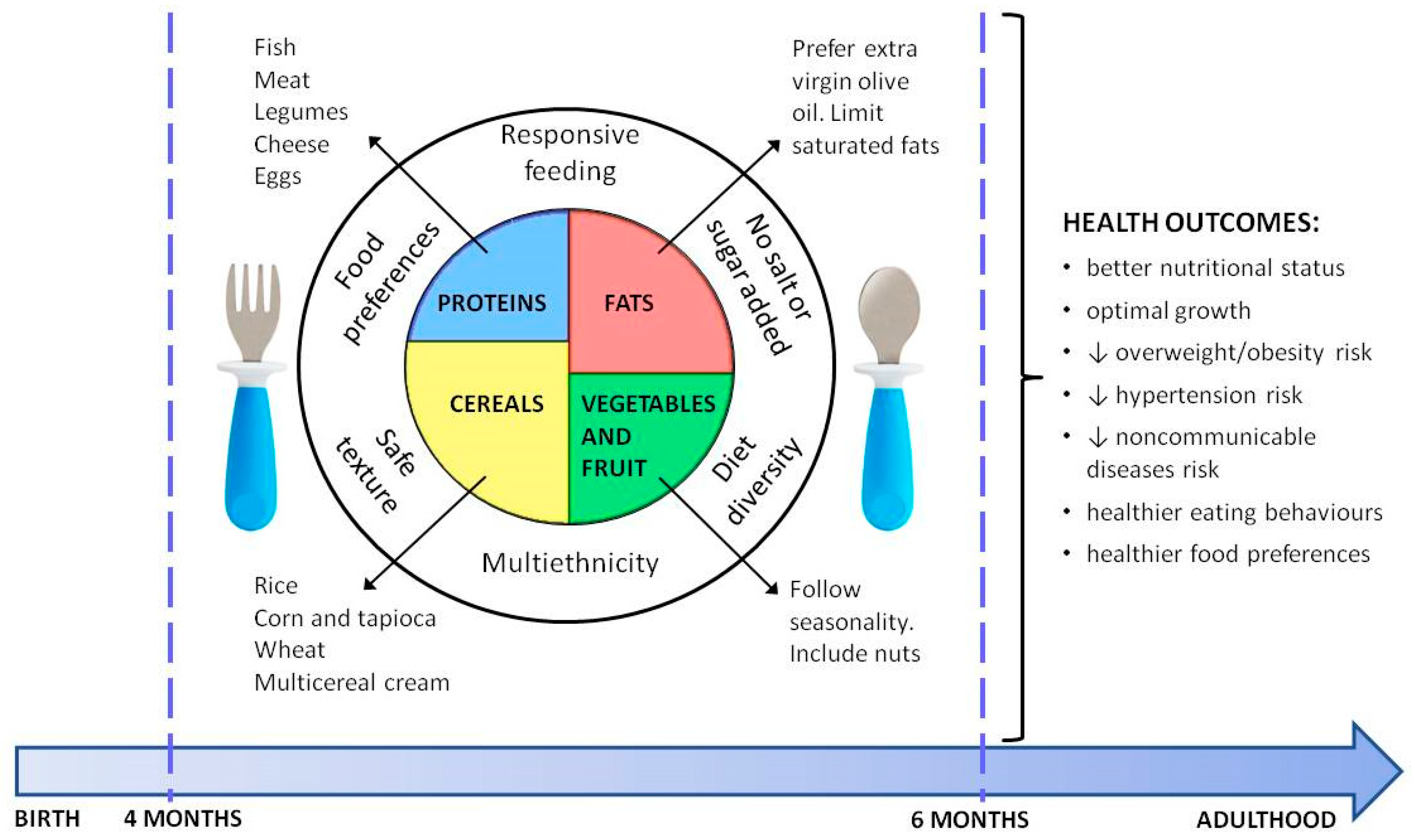
Complementary Feeding: Pitfalls for Health Outcomes

 , ,
, ,  and
and 
Abstract
Share and Cite
D’Auria, E.; Borsani, B.; Pendezza, E.; Bosetti, A.; Paradiso, L.; Zuccotti, G.V.; Verduci, E. Complementary Feeding: Pitfalls for Health Outcomes. Int. J. Environ. Res. Public Health 2020, 17, 7931. https://doi.org/10.3390/ijerph17217931
D’Auria E, Borsani B, Pendezza E, Bosetti A, Paradiso L, Zuccotti GV, Verduci E. Complementary Feeding: Pitfalls for Health Outcomes. International Journal of Environmental Research and Public Health. 2020; 17(21):7931. https://doi.org/10.3390/ijerph17217931
Chicago/Turabian StyleD’Auria, Enza, Barbara Borsani, Erica Pendezza, Alessandra Bosetti, Laura Paradiso, Gian Vincenzo Zuccotti, and Elvira Verduci. 2020. "Complementary Feeding: Pitfalls for Health Outcomes" International Journal of Environmental Research and Public Health 17, no. 21: 7931. https://doi.org/10.3390/ijerph17217931
APA StyleD’Auria, E., Borsani, B., Pendezza, E., Bosetti, A., Paradiso, L., Zuccotti, G. V., & Verduci, E. (2020). Complementary Feeding: Pitfalls for Health Outcomes. International Journal of Environmental Research and Public Health, 17(21), 7931. https://doi.org/10.3390/ijerph17217931