Evaluation of a Suicide Prevention Program for the Energy Sector




Abstract
1. Introduction
2. Materials and Methods
2.1. Participants and Procedure
2.2. Survey Materials
2.3. Data Analysis
3. Results
4. Discussion
5. Conclusions
Author Contributions
Funding
Acknowledgments
Conflicts of Interest
References
- Andersen, K.; Hawgood, J.; Klieve, H.; Kõlves, K.; De Leo, D. Suicide in selected occupations in Queensland: Evidence from the State suicide register. Aust. N. Z. J. Psychiatry 2010, 44, 243–249. [Google Scholar] [CrossRef] [PubMed]
- Milner, A.; Spittal, M.J.; Pirkis, J.; Lamontagne, A.D. Suicide by Occupation: Systematic Review and Meta-Analysis. Br. J. Psychiatry 2013, 203, 409–416. [Google Scholar] [CrossRef] [PubMed]
- Milner, A.; Niven, H.; LaMontagne, A. Suicide by occupational skill level in the Australian construction industry: Data from 2001 to 2010. Aust. N. Z. J. Public Health 2014, 38, 281–285. [Google Scholar] [CrossRef] [PubMed]
- Roberts, E.; Jaremin, B.; Lloyd, K. High-Risk Occupations for Suicide. Psychol. Med. 2013, 43, 1231–1240. [Google Scholar] [CrossRef] [PubMed]
- Windsor-Shellard, B.; Gunnell, D. Occupation-Specific Suicide Risk in England: 2011–2015. Brit. J. Psychiatry 2019, 215, 594–599. [Google Scholar] [CrossRef]
- Gullestrup, J.; Lequertier, B.; Martin, G. MATES in Construction: Impact of a Multimodal, Community-Based Program for Suicide Prevention in the Construction Industry. Int. J. Environ. Res. Public Health 2011, 8, 4180–4196. [Google Scholar] [CrossRef]
- King, T.L.; Gullestrup, J.; Batterham, P.J.; Kelly, B.; Lockwood, C.; Lingard, H.; Harvey, S.B.; LaMontagne, A.D.; Milner, A. Shifting Beliefs about Suicide: Pre-Post Evaluation of the Effectiveness of a Program for Workers in the Construction Industry. Int. J. Environ. Res. Public Health 2018, 15, 2106. [Google Scholar] [CrossRef]
- Doran, C.M.; Ling, R.; Gullestrup, J.; Swannell, S.; Milner, A. The impact of suicide prevention strategy on reducing the economic cost of suicide in the New South Wales construction industry. Crisis 2016, 37, 121–129. [Google Scholar] [CrossRef]
- Heller, T.S.; Hawgood, J.L.; De Leo, D.D. Correlates of Suicide in Building Industry Workers. Arch. Suicide Res. 2007, 11, 105–117. [Google Scholar] [CrossRef]
- Kamardeen, I.; Loosemore, M. Suicide in the construction industry: A cross-sectional analysis. In RICS COBRA 2016-The Construction, Building and Real Estate Research Conference of the Royal Institution of Chartered Surveyors; Royal Institution of Chartered Surveyors: London, UK, 2016. [Google Scholar]
- Milner, A.; Maheen, H.; Currier, D.; LaMontagne, A.D. Male suicide among construction workers in Australia: A qualitative analysis of the major stressors precipitating death. BMC Public Health 2017, 17, 584. [Google Scholar] [CrossRef]
- Milner, A.; Kavanagh, A.; King, T.; Currier, D. The influence of masculine norms and occupational factors on mental health: Evidence from the baseline of the Australian Longitudinal Study on male health. Am. J. Men’s Health 2018, 12, 696–705. [Google Scholar] [CrossRef] [PubMed]
- Ross, V.; Caton, N.; Gullestrup, J.; Kõlves, K. Understanding the Barriers and Pathways to Male Help-Seeking and Help-Offering: A Mixed Methods Study of the Impact of the Mates in Construction Program. Int. J. Environ. Res. Public Health 2019, 16, 2979. [Google Scholar] [CrossRef] [PubMed]
- Milner, A.; Page, K.; Spencer-Thomas, S.; LaMontagne, A.D. Workplace suicide prevention: A systematic review of published and unpublished activities. Health Promot. Int. 2015, 30, 29–37. [Google Scholar] [CrossRef] [PubMed]
- Klingelschmidt, J.; Milner, A.; Khireddine-Medouni, I.; Witt, K.; Alexopoulos, E.C.; Toivanen, S.; LaMontagne, A.D.; Chastang, J.F.; Niedhammer, I. Suicide among agricultural, forestry and fishery workers: A systematic literature review and meta-analysis. Scand. J. Work. Environ. Health 2018, 44, 3–5. [Google Scholar] [CrossRef] [PubMed]
- Tynan, R.J.; James, C.; Considine, R.; Skehan, J.; Gullestrup, J.; Lewin, T.J.; Wiggers, J.; Kelly, B.J. Feasibility and acceptability of strategies to address mental health and mental ill-health in the Australian coal mining industry. Int. J. Ment. Health Syst. 2018, 12, 66. [Google Scholar] [CrossRef]
- Sayers, E.; Rich, J.; Rahman, M.M.; Kelly, B.; James, C. Does help seeking behavior change over time following a workplace mental health intervention in the coal mining industry? J. Occup. Environ. Med. 2019, 61, 282–290. [Google Scholar] [CrossRef]
- Doran, C.; Adams, M.L.; Meurk, C.; Wittenhagen, L.; Heffernan, E. An evaluation of MATES in Construction Queensland Case Management; Central Queensland University: Brisbane, Australia, 2019. [Google Scholar]
- King, T.L.; Batterham, P.J.; Lingard, H.; Gullestrup, J.; Lockwood, C.; Harvey, S.B.; Kelly, B.; LaMontagne, A.D.; Milner, A. Are young men getting the message? Age differences in suicide prevention literacy among male construction workers. Int. J. Environ. Res. Public Health 2019, 16, 475. [Google Scholar] [CrossRef] [PubMed]
- Ross, V.; Caton, N.; Gullestrup, J.; Kõlves, K. A longitudinal assessment of two suicide prevention training programs for the construction industry. Int. J. Environ. Res. Public Health 2020, 17, 803. [Google Scholar] [CrossRef] [PubMed]
- Wilson, C.J.; Deane, F.P.; Ciarrochi, J.V.; Rickwood, D. Measuring help-seeking intentions: Properties of the General Help Seeking Questionnaire. Can. J. Couns. 2005, 39, 15–28. [Google Scholar]
- Van Wijngaarden, E.; Savitz, D.A.; Kleckner, R.C.; Cai, J.; Loomis, D. Exposure to electromagnetic fields and suicide among electric utility workers: A nested case-control study. Occup. Environ. Med. 2000, 57, 258–263. [Google Scholar] [CrossRef]
- Howard, G.S.; Dailey, P.R. Response-shift bias: A source of contamination of self-report measures. J. Appl. Psychol. 1979, 64, 144. [Google Scholar] [CrossRef]
- Drennan, J.; Hyde, A. Controlling response shift bias: The use of the retrospective pre-test design in the evaluation of a master’s programme. Assess. Eval. High. Educ. 2008, 33, 699–709. [Google Scholar] [CrossRef]
- Woertman, W.; de Hoop, E.; Moerbeek, M.; Zuidema, S.U.; Gerritsen, D.L.; Teerenstra, S. Stepped wedge designs could reduce the required sample size in cluster randomized trials. J. Clin. Epidemiol. 2013, 66, 752–758. [Google Scholar] [CrossRef] [PubMed]


| Item | Pre | Post | |||||
|---|---|---|---|---|---|---|---|
| Suicide literacy | M1 | SE | M1 | SE | β | t | p |
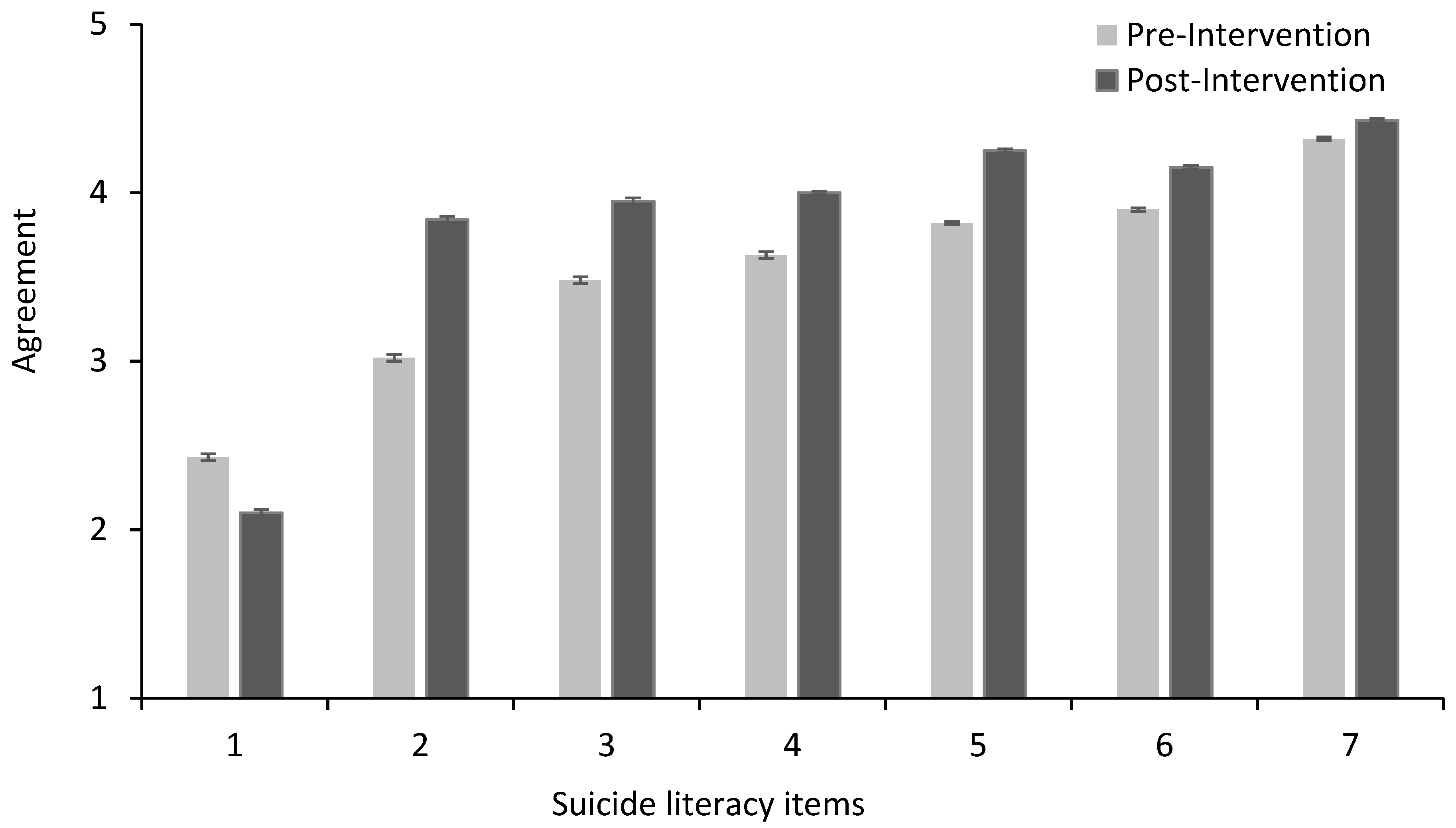
| “Asking a workmate if they are having suicidal thoughts can increase his/her risk of suicide” | 2.43 | 0.02 | 2.10 | 0.02 | −0.19 | −24.29 | <0.001 |
| “People considering suicide often send out warning signs or invitations” | 3.02 | 0.02 | 3.84 | 0.02 | 0.39 | 47.86 | <0.001 |
| “Suicide is a serious problem in the energy industry” | 3.48 | 0.02 | 3.95 | 0.02 | 0.30 | 40.33 | <0.001 |
| “If I was struggling with mental health issues, I would be willing to ask for help” | 3.63 | 0.02 | 4.00 | 0.01 | 0.23 | 31.34 | <0.001 |
| “If I was struggling with mental health issues, I would know who I would talk to, in order to get help” | 3.82 | 0.01 | 4.25 | 0.01 | 0.30 | 34.46 | <0.001 |
| “I would notice if a workmate was having a tough time and ask how he/she was doing” | 3.90 | 0.01 | 4.15 | 0.01 | 0.20 | 22.87 | <0.001 |
| “If I knew a workmate was struggling then I would be willing to offer help” | 4.32 | 0.01 | 4.43 | 0.01 | 0.10 | 12.98 | <0.001 |
| Well-being | |||||||
| “So far today, the best way to describe how I’m feeling emotionally/mentally is…” | 3.82 | 0.01 | 3.86 | 0.01 | 0.02 | 5.95 | <0.001 |
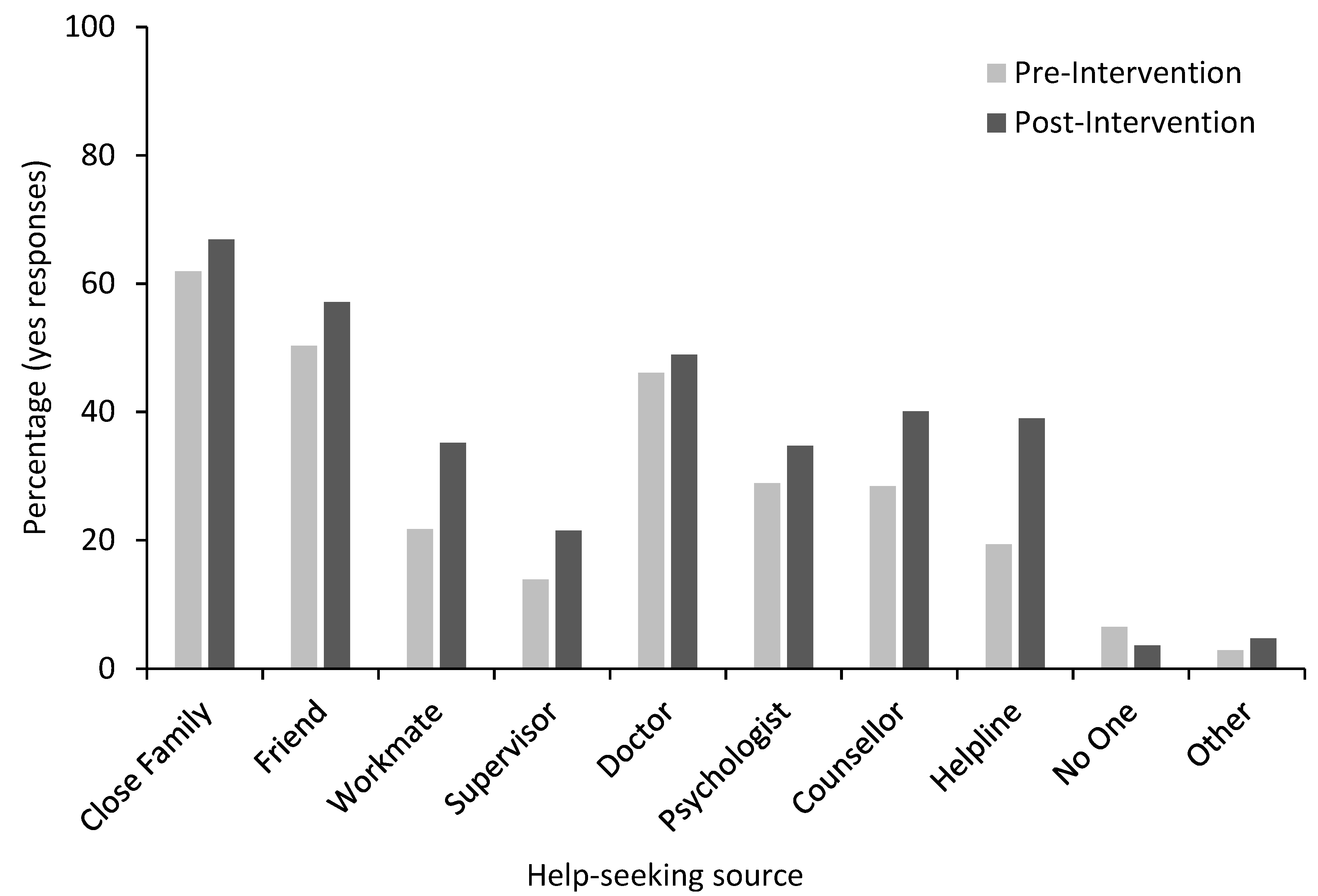
| Help-seeking source (yes responses) | N | % | N | % | OR2 | t | p |
| Close family | 3027 | 61.94 | 3269 | 66.89 | 1.27 | 4.84 | <0.001 |
| Friend | 2458 | 50.30 | 2791 | 57.11 | 1.36 | 6.34 | <0.001 |
| Workmate | 1059 | 21.67 | 1718 | 35.15 | 2.01 | 13.44 | <0.001 |
| A supervisor | 678 | 13.87 | 1051 | 21.51 | 1.74 | 9.24 | <0.001 |
| My doctor | 2253 | 46.10 | 2388 | 48.86 | 1.13 | 2.44 | 0.01 |
| Psychologist | 1414 | 28.93 | 1697 | 34.72 | 1.33 | 5.62 | <0.001 |
| Counsellor | 1389 | 28.42 | 1960 | 40.11 | 1.72 | 10.89 | <0.001 |
| A helpline | 947 | 19.38 | 1907 | 39.02 | 2.74 | 18.76 | <0.001 |
| No one | 317 | 6.49 | 174 | 3.56 | 0.56 | −5.05 | <0.001 |
| Other | 140 | 2.86 | 228 | 4.67 | 2.01 | 5.33 | <0.001 |
| Item | Died by Suicide 1 | Suicide Attempt 2 | Suicidal Thoughts 3 | Age | Gender | |||||
|---|---|---|---|---|---|---|---|---|---|---|
| Suicide literacy | β | p | β | p | β | p | β | p | β | p |
| “Asking a workmate if they are having suicidal thoughts can increase his/her risk of suicide” | 0.03 | 0.09 | −0.05 | 0.001 | 0.03 | 0.052 | 0.04 | 0.001 | 0.11 | <0.001 |
| “People considering suicide often send out warning signs or invitations” | −0.05 | <0.001 | 0.01 | 0.59 | 0.00 | 0.78 | 0.01 | 0.26 | 0.05 | <0.001 |
| “Suicide is a serious problem in the energy industry” | 0.01 | 0.64 | 0.08 | <0.001 | 0.01 | 0.56 | −0.05 | <0.001 | −0.03 | 0.06 |
| “If I was struggling with mental health issues, I would be willing to ask for help” | 0.00 | 0.90 | −0.01 | 0.39 | −0.08 | <0.001 | 0.00 | 0.92 | −0.11 | <0.001 |
| “If I was struggling with mental health issues, I would know who I would talk to, in order to get help” | 0.00 | 0.94 | 0.00 | 0.90 | −0.05 | <0.001 | −0.04 | <0.001 | −0.11 | <0.001 |
| “I would notice if a workmate was having a tough time and ask how he/she was doing” | 0.00 | 0.94 | 0.04 | 0.005 | 0.01 | 0.65 | −0.05 | <0.001 | −0.17 | <0.001 |
| “If I knew a workmate was struggling then I would be willing to offer help” | 0.03 | 0.08 | 0.06 | <0.001 | −0.02 | 0.10 | −0.10 | <0.001 | −0.17 | <0.001 |
| Well-being | ||||||||||
| “So far today, the best way to describe how I’m feeling emotionally/mentally is…” | 0.00 | 0.84 | −0.06 | <0.001 | −0.17 | <0.001 | −0.04 | 0.002 | −0.01 | 0.44 |
| Help-seeking source | 4OR | p | 4OR | p | 4OR | p | 4OR | p | 4OR | p |
| Close family | 0.98 | 0.32 | 1.00 | 0.96 | 0.79 | <0.001 | 0.97 | <0.001 | 0.94 | 0.33 |
| Friend | 1.01 | 0.69 | 1.05 | <0.001 | 0.80 | <0.001 | 0.96 | <0.001 | 0.58 | <0.001 |
| Workmate | 1.00 | 0.84 | 1.03 | 0.046 | 0.96 | 0.35 | 0.99 | <0.001 | 1.08 | 0.20 |
| A supervisor | 0.97 | 0.13 | 1.05 | 0.01 | 1.04 | 0.40 | 1.00 | 0.17 | 0.82 | 0.004 |
| My doctor | 1.00 | 0.84 | 1.03 | 0.02 | 1.01 | 0.82 | 1.02 | <0.001 | 0.47 | <0.001 |
| Psychologist | 0.99 | 0.71 | 1.06 | <0.001 | 1.11 | 0.01 | 0.99 | <0.001 | 0.55 | <0.001 |
| Counsellor | 0.98 | 0.11 | 1.05 | <0.001 | 1.02 | 0.56 | 1.01 | <0.001 | 0.75 | <0.001 |
| A helpline | 0.99 | 0.48 | 0.99 | 0.73 | 0.99 | 0.90 | 0.99 | 0.02 | 0.91 | 0.12 |
| No one | 1.03 | 0.35 | 1.07 | 0.07 | 1.51 | <0.001 | 1.01 | 0.11 | 1.23 | 0.14 |
| Other | 1.02 | 0.57 | 1.15 | <0.001 | 1.13 | 0.14 | 0.99 | 0.27 | 1.02 | 0.90 |
| Item | Died by Suicide 1 | Suicide Atempt 2 | Suicidal Thoughts 3 | Age | Gender | |||||
|---|---|---|---|---|---|---|---|---|---|---|
| Suicide awareness | t | p | t | p | t | p | t | p | t | p |
| “Asking a workmate if they are having suicidal thoughts can increase his/her risk of suicide” | 2.10 | 0.04 | −0.20 | 0.98 | −0.64 | 0.53 | 2.10 | 0.04 | −0.86 | 0.39 |
| “People considering suicide often send out warning signs or invitations” | 0.61 | 0.54 | −0.70 | 0.49 | 0.37 | 0.71 | −2.31 | 0.02 | −6.81 | <0.001 |
| “Suicide is a serious problem in the energy industry” | −0.87 | 0.38 | −3.42 | 0.001 | −1.49 | 0.14 | −0.12 | 0.82 | −3.70 | <0.001 |
| “If I was struggling with mental health issues, I would be willing to ask for help” | −1.30 | 0.19 | 0.79 | 0.43 | −0.35 | 0.73 | −1.59 | 0.11 | −0.02 | 0.98 |
| “If I was struggling with mental health issues, I would know who I would talk to, in order to get help” | −1.21 | 0.23 | −0.48 | 0.63 | 0.69 | 0.49 | −0.24 | 0.81 | 2.51 | 0.01 |
| “I would notice if a workmate was having a tough time and ask how he/she was doing” | −0.73 | 0.46 | 0.98 | 0.33 | 1.02 | 0.31 | 2.95 | 0.003 | −0.16 | 0.87 |
| “If I knew a workmate was struggling then I would be willing to offer help” | −1.12 | 0.26 | −0.93 | 0.35 | 0.44 | 0.66 | 0.04 | 0.97 | 1.05 | 0.29 |
| Well-being | ||||||||||
| “So far today, the best way to describe how I’m feeling emotionally/mentally is…” | −0.50 | 0.62 | −0.76 | 0.45 | 1.01 | 0.31 | 1.65 | 0.10 | −0.34 | 0.75 |
| Help-seeking source | ||||||||||
| Close family | −0.39 | 0.70 | 0.47 | 0.64 | 0.36 | 0.72 | 0.94 | 0.34 | 0.14 | 0.88 |
| Friend | 0.22 | 0.82 | −0.12 | 0.90 | −0.09 | 0.93 | 0.35 | 0.72 | 0.19 | 0.85 |
| Workmate | −1.28 | 0.20 | −0.03 | 0.97 | −0.74 | 0.45 | 0.56 | 0.58 | 0.22 | 0.83 |
| A supervisor | −0.28 | 0.77 | −0.59 | 0.55 | −1.13 | 0.26 | −0.29 | 0.77 | 0.29 | 0.77 |
| My doctor | −1.32 | 0.19 | −0.20 | 0.84 | 0.15 | 0.87 | −0.06 | 0.94 | −0.41 | 0.68 |
| Psychologist | −0.11 | 0.91 | −0.15 | 0.87 | −0.86 | 0.39 | 0.45 | 0.65 | −1.01 | 0.31 |
| Counsellor | 0.40 | 0.71 | −0.32 | 0.74 | 0.84 | 0.40 | 0.84 | 0.40 | 0.19 | 0.85 |
| A helpline | −0.07 | 0.94 | −0.77 | 0.44 | −1.46 | 0.15 | −1.14 | 0.26 | 1.40 | 0.16 |
| No one | 0.17 | 0.86 | −0.32 | 0.75 | 1.00 | 0.31 | −0.28 | 0.78 | 1.27 | 0.20 |
| Other | 1.10 | 0.27 | −0.68 | 0.49 | −1.09 | 0.27 | −0.46 | 0.64 | −0.45 | 0.65 |
© 2020 by the authors. Licensee MDPI, Basel, Switzerland. This article is an open access article distributed under the terms and conditions of the Creative Commons Attribution (CC BY) license (http://creativecommons.org/licenses/by/4.0/).
Share and Cite
Ross, V.; Caton, N.; Mathieu, S.; Gullestrup, J.; Kõlves, K. Evaluation of a Suicide Prevention Program for the Energy Sector. Int. J. Environ. Res. Public Health 2020, 17, 6418. https://doi.org/10.3390/ijerph17176418
Ross V, Caton N, Mathieu S, Gullestrup J, Kõlves K. Evaluation of a Suicide Prevention Program for the Energy Sector. International Journal of Environmental Research and Public Health. 2020; 17(17):6418. https://doi.org/10.3390/ijerph17176418
Chicago/Turabian StyleRoss, Victoria, Neil Caton, Sharna Mathieu, Jorgen Gullestrup, and Kairi Kõlves. 2020. "Evaluation of a Suicide Prevention Program for the Energy Sector" International Journal of Environmental Research and Public Health 17, no. 17: 6418. https://doi.org/10.3390/ijerph17176418
APA StyleRoss, V., Caton, N., Mathieu, S., Gullestrup, J., & Kõlves, K. (2020). Evaluation of a Suicide Prevention Program for the Energy Sector. International Journal of Environmental Research and Public Health, 17(17), 6418. https://doi.org/10.3390/ijerph17176418