

Providing Sports Venues on Mainland China: Implications for Promoting Leisure-Time Physical Activity and National Fitness Policies


Abstract
1. Introduction
2. Methods
2.1. Data and Subjects
2.2. Analysis
3. Results
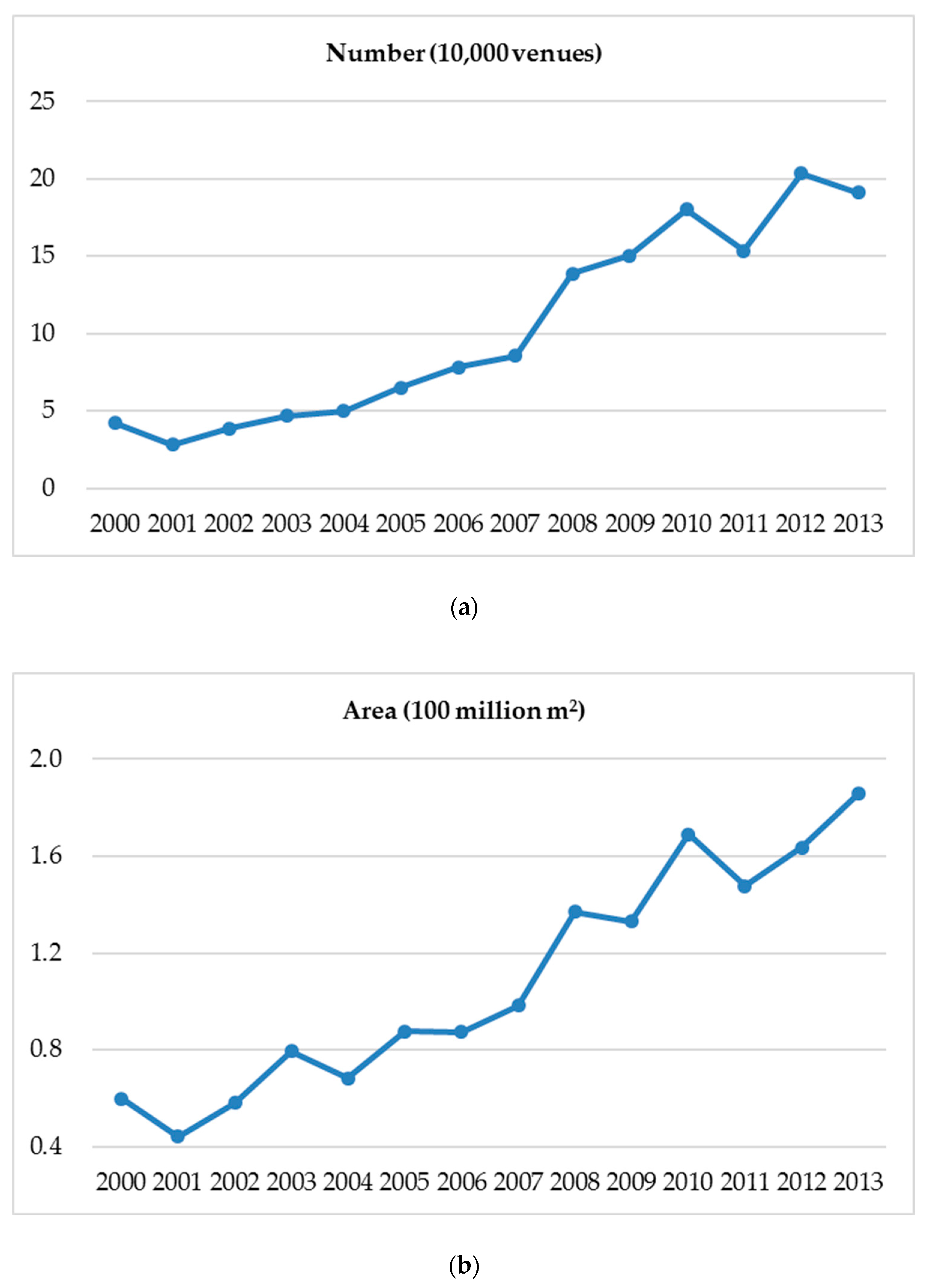
3.1. Trends in Number and Area of Sports Venues
3.2. Sports Venues in Different Networks, Their Opening Status and Weekly Visits
3.3. Types of Sports Venues with Full-Time Access Status
3.4. Sports Venues in Urban Parks
3.5. Sports Venues in Urban and Rural Areas
4. Discussion
5. Conclusions
Author Contributions
Funding
Acknowledgments
Conflicts of Interest
References
- Guthold, R.; Stevens, G.A.; Riley, L.M.; Bull, F.C. Worldwide trends in insufficient physical activity from 2001 to 2016: A pooled analysis of 358 population-based surveys with 1.9 million participants. Lancet Glob. Health 2018, 6, e1077–e1086. [Google Scholar] [CrossRef]
- Bray, F.; Ferlay, J.; Soerjomataram, I.; Siegel, R.L.; Torre, L.A.; Jemal, A. Global cancer statistics 2018: GLOBOCAN estimates of incidence and mortality worldwide for 36 cancers in 185 countries. CA Cancer J. Clin. 2018, 68, 394–424. [Google Scholar] [CrossRef]
- IDF Diabetes Atlas, 8th ed.; International Diabetes Federation: Brussels, Belgium; Available online: http://www.diabetesatlas.org (accessed on 20 September 2019).
- State Council’s Opinions on Implementing Healthy China Action. Available online: http://www.gov.cn/zhengce/content/2019-07/15/content_5409492.htm (accessed on 20 September 2019).
- Zhang, J.; Chaaban, J. The economic cost of physical inactivity in China. Prev. Med. 2013, 56, 75–78. [Google Scholar] [CrossRef] [PubMed]
- Ng, S.W.; Howard, A.G.; Wang, H.J.; Su, C.; Zhang, B. The physical activity transition among adults in China: 1991–2011. Obes. Rev. 2014, 15, 27–36. [Google Scholar] [CrossRef] [PubMed]
- Jiang, B.; Liang, S.; Peng, Z.R.; Cong, H.; Levy, M.; Cheng, Q.; Wang, T.; Remais, J.V. Transport and public health in China: The road to a healthy future. Lancet 2017, 390, 1781–1791. [Google Scholar] [CrossRef]
- Wang, L.; Ning, P.; Yin, P.; Cheng, P.; Schwebel, D.C.; Liu, J.; Wu, Y.; Liu, Y.; Qi, J.; Zeng, X.; et al. Road traffic mortality in China: Analysis of national surveillance data from 2006 to 2016. Lancet Public Health 2019, 4, e245–e255. [Google Scholar] [CrossRef]
- Bedimo-Rung, A.L.; Mowen, A.J.; Cohen, D.A. The significance of parks to physical activity and public health: A conceptual model. Am. J. Prev. Med. 2005, 28, 159–168. [Google Scholar] [CrossRef] [PubMed]
- Rachel Morgan. Importance of Leisure & Recreation for Health. Available online: https://healthfully.com/importance-of-leisure-recreation-for-health-7692320.html (accessed on 7 July 2020).
- Raza, W.; Krachler, B.; Forsberg, B.; Sommar, J.N. Health benefits of leisure time and commuting physical activity: A meta-analysis of effects on morbidity. J. Transp. Health 2020, 18, 100873. [Google Scholar] [CrossRef]
- Ng, S.W.; Popkin, B.M. Time use and physical activity: A shift away from movement across the globe. Obes. Rev. 2012, 13, 659–680. [Google Scholar] [CrossRef]
- General Administration of Sport of China. Available online: http://www.sport.gov.cn/n16/n1077/n1422/7300210.html (accessed on 14 September 2019).
- Gao, W.; Cao, K. Increasing public access to sports venues to promote physical activity among older adults in China. J. Aging Phys. Activ. 2018, 26, 169–170. [Google Scholar] [CrossRef]
- Guo, M.; Liu, C.; Liu, M.; Wang, J. The process and enlightenment of the development of sports facilities in China. J. Beijing Sport Univ. 2009, 32, 12–16. [Google Scholar]
- Wu, S.; Luo, Y.; Qiu, X.; Bao, M. Building a healthy China by enhancing physical activity: Priorities, challenges, and strategies. J. Sport Health Sci. 2017, 6, 125–126. [Google Scholar] [CrossRef] [PubMed][Green Version]
- Department of Sports Economy, General Administration of Sport of China. The Data Compilation of the Sixth National Sports Venues Census. Available online: http://www.sport.gov.cn/pucha/index.html (accessed on 12 August 2018).
- Heart Rate Guidelines for Adults and Children. Available online: https://www.ncsf.org/enew/articles/articles-heartrateguidelines.aspx (accessed on 11 July 2020).
- Li, G.; Sun, Q. The empirical study of the development of the sports ground since the 21st century: Based on the Fifth and Sixth National Sports Ground Survey data statistical analysis. J. Xi’an Phys. Educ. Univ. 2016, 33, 164–171. [Google Scholar]
- Chen, Z. Research on Public Sports Services in Japan. In Annual Report on Development of Public Sports Services in China (2013); Dai, J., Ed.; Social Sciences Academic Press: Beijing, China, 2013. [Google Scholar]
- Han, H.; Zheng, J. Logic, connotation and value of “People-centered Sports Development Outlook” based on study of General Secretary Xi Jinping’s speeches on sports. J. Wuhan I. Phys. Educ. 2018, 52, 5–11. [Google Scholar]
- China Focus: Square-dance Basketball Battle Causes Furor. Available online: http://www.xinhuanet.com//english/2017–06/07/c_136347068.htm (accessed on 12 November 2019).
- Chinese Teenagers’ Addiction to Internet Gaming Can Possibly Be Related to the Low Area Per Capita of Sports Venues in the Country. Available online: http://edu.people.com.cn/n/2014/0915/c1053-25664967.html (accessed on 2 October 2019).
- Fast-Walker Killed after Taxi Strikes Group in E China. Available online: http://en.people.cn/n3/2017/0712/c90882–9240647.html (accessed on 2 December 2019).
- Booth, M.; Okely, A. Promoting physical activity among children and adolescents: The strengths and limitations of school-based approaches. Health Promot. J. Austr. 2005, 16, 52–54. [Google Scholar] [CrossRef] [PubMed]
- Kanters, M.A.; Bocarro, J.N.; Moore, R.; Floyd, M.F.; Carlton, T.A. Afterschool shared use of public school facilities for physical activity in North Carolina. Prev. Med. 2014, 69, 44–48. [Google Scholar] [CrossRef] [PubMed]
- Sallis, J.F.; Cervero, R.B.; Ascher, W.; Henderson, K.A.; Kraft, M.K.; Kerr, J. An ecological approach to creating active living communities. Annu. Rev. Public Health 2006, 27, 297–322. [Google Scholar] [CrossRef] [PubMed]
- Xu, P. Optimization Design Research of Primary and Secondary Schools’ Gymnasium and Surrounding Facilities under Open Policy. Master’s Thesis, Dalian University of Technology, Dalian, China, 2017. [Google Scholar]
- Lei, Y. Study on the Risks and Risk Response Measures of the Public Opening Stadiums in Shanghai Primary and Middle Schools. Master’s Thesis, Shanghai University of Sport, Shanghai, China, 2017. [Google Scholar]
- Jin, Y.; Wang, W.; Wu, X. The policies of opening to the public of school sports facilities in China based on the text analysis of policies. J. Jilin Sport Univ. 2018, 34, 83–89. [Google Scholar]
- Wang, C. The investigation of the Changchun City national fitness path. J. Jilin I. Architect. Civil Eng. 2013, 30, 111–114. Available online: http://en.cnki.com.cn/Article_en/CJFDTotal-JLJZ201302032.htm (accessed on 16 November 2019).
- Yang, C. An Investigation on the Setting and Using of Comprehensive Fitness Equipment in Changchun. Master’s Thesis, Jilin University, Changchun, China, 2010. [Google Scholar]
- Cai, L. The Status Research of the National Fitness Path Configuration in the Urban Districts of Harbin. Master’s Thesis, Harbin Normal University, Harbin, China, 2015. [Google Scholar]
- Li, G. Investigation and Countermeasure Research on the Current Situation of the Big Class Break Sports Activities in the Primary School of Dalian City. Master’s Thesis, Liaoning Normal University, Dalian, China, 2016. [Google Scholar]
- Lin, L.; Qiu, G. Present and future of urban exercise trails in Fujian Province. J. Xiamen Univ. Technol. 2016, 24, 105–110. [Google Scholar]
- Multi-department Notice on Issuing the “Implementation Plan for the Million-kilometer Walking Trail Project”. Available online: http://www.gov.cn/xinwen/2018-03/16/content_5274663.htm (accessed on 2 December 2019).
- Chen, S. Planning and Construction of Fitness Trails in Suzhou. In Proceedings of the 2017 China Urban Transportation Planning Conference, Shanghai, China, 7–9 July 2017. [Google Scholar]
- McKenzie, T.L.; Cohen, D.A.; Sehgal, A.; Williamson, S.; Golinelli, D. System for Observing Play and Recreation in Communities (SOPARC): Reliability and feasibility measures. J. Phys. Act. Health 2006, 3, 208–222. [Google Scholar] [CrossRef] [PubMed]
- Wang, K.; Liu, J. The spatiotemporal trend of city parks in Mainland China between 1981 and 2014: Implications for the promotion of leisure time physical activity and planning. Int. J. Environ. Res. Public Health 2017, 14, 1150. [Google Scholar] [CrossRef] [PubMed]
- National Recreation and Park Association. NRPA Americans’ Engagement with Parks Survey. Available online: https://www.nrpa.org/globalassets/research/engagement-survey-report.pdf (accessed on 12 December 2019).
- Zhang, M.; Wang, K.; Liu, J. Analysis and enlightenment of the classification system of American urban parks for physical activity needs. Planners 2018, 34, 148–154. [Google Scholar]
- Tu, H.; Liao, X.; Schuller, K.; Cook, A.; Fan, S.; Lan, G.; Lu, Y.; Yuan, Z.; Moore, J.B.; Maddock, J.E. Insights from an observational assessment of park-based physical activity in Nanchang, China. Prev. Med. Rep. 2015, 2, 930–934. [Google Scholar] [CrossRef] [PubMed]
- China Urban Research Report, 2017 Q3. Available online: http://huiyan.baidu.com/reports/2017Q3.html (accessed on 12 December 2019).
- Xu, J.; Gao, C.; Lee, J.K.; Zhao, J. PM2.5: A barrier to fitness and health promotion in China. J. Sport Health Sci. 2017, 6, 292. [Google Scholar] [CrossRef]
- Qin, F.; Yang, Y.; Wang, S.T.; Dong, Y.N.; Xu, M.X.; Wang, Z.W.; Zhao, J.X. Exercise and air pollutants exposure: A systematic review and meta-analysis. Life Sci. 2019, 218, 153–164. [Google Scholar] [CrossRef]
- Huang, Y.; Su, T.; Wang, L.; Wang, N.; Xue, Y.; Dai, W.; Lee, S.C.; Cao, J.; Ho, S.S. Evaluation and characterization of volatile air toxics indoors in a heavy polluted city of northwestern China in wintertime. Sci. Total Environ. 2019, 662, 470–480. [Google Scholar] [CrossRef]
- National Health Commission of the People’s Republic of China. Status Report on Nutrition and Chronic Diseases of Chinese Residents 2015; People’s Medical Publishing House: Beijing, China, 2015.
- Why is it difficult and expensive for large and medium city residents to exercise? Venue opening is not enough. Available online: http://www.chinanews.com/sh/2018/05-08/8508308.shtml (accessed on 3 December 2019).

| Number Ratio (%) | Area Ratio (%) | Full-Time Access | Part-Time Access | Membership | |
|---|---|---|---|---|---|
| Sports network | 1.43 | 4.77 | 15,656 | 4868 | 3798 |
| Education network | 38.98 | 53.01 | 56,135 | 153,072 | 451,314 |
| Others | 59.59 | 42.22 | 774,050 | 76,333 | 107,184 |
| Total | 100 | 100 | 845,841 | 234,273 | 562,296 |
| Number (10,000 Venues) | Ratio | Full-Time Access | |
|---|---|---|---|
| Basketball court | 59.64 | 36.31% | 47.60% |
| Fitness station | 36.81 | 22.41% | 91.37% |
| Table tennis court | 14.57 | 8.87% | 47.04% |
| Small-area sports court | 8.91 | 5.42% | 7.79% |
| Table tennis room | 4.87 | 2.97% | 34.78% |
| Total | 124.80 | 75.98% |
| Area (100 Million m2) | Ratio | Full-Time Access | |
|---|---|---|---|
| Small-area sports court | 4.42 | 22.68% | 7.79% |
| Basketball court | 3.58 | 18.34% | 47.60% |
| Ground track field | 1.69 | 8.67% | 12.42% |
| Stadium | 1.05 | 5.39% | 7.02% |
| Urban fitness trail | 0.59 | 3.03% | 96.68% |
| Total | 11.33 | 58.13% |
| Urban Area | Rural Area | |||
|---|---|---|---|---|
| Number | Area | Number | Area | |
| Indoor venues | 12.87 | 0.54 | 2.73 | 0.05 |
| Outdoor venues | 83.40 | 12.83 | 65.24 | 6.07 |
| Total | 96.27 | 13.37 | 67.97 | 6.12 |
| Indoor venues | 12.87 | 0.54 | 2.73 | 0.05 |
| Outdoor venues | 83.40 | 12.83 | 65.24 | 6.07 |
| Total | 96.27 | 13.37 | 67.97 | 6.12 |
© 2020 by the authors. Licensee MDPI, Basel, Switzerland. This article is an open access article distributed under the terms and conditions of the Creative Commons Attribution (CC BY) license (http://creativecommons.org/licenses/by/4.0/).
Share and Cite
Wang, K.; Wang, X. Providing Sports Venues on Mainland China: Implications for Promoting Leisure-Time Physical Activity and National Fitness Policies. Int. J. Environ. Res. Public Health 2020, 17, 5136. https://doi.org/10.3390/ijerph17145136
Wang K, Wang X. Providing Sports Venues on Mainland China: Implications for Promoting Leisure-Time Physical Activity and National Fitness Policies. International Journal of Environmental Research and Public Health. 2020; 17(14):5136. https://doi.org/10.3390/ijerph17145136
Chicago/Turabian StyleWang, Kai, and Xuhui Wang. 2020. "Providing Sports Venues on Mainland China: Implications for Promoting Leisure-Time Physical Activity and National Fitness Policies" International Journal of Environmental Research and Public Health 17, no. 14: 5136. https://doi.org/10.3390/ijerph17145136
APA StyleWang, K., & Wang, X. (2020). Providing Sports Venues on Mainland China: Implications for Promoting Leisure-Time Physical Activity and National Fitness Policies. International Journal of Environmental Research and Public Health, 17(14), 5136. https://doi.org/10.3390/ijerph17145136

