

Next Article in Journal
Analysis of Necessary Support in the 2011 Great East Japan Earthquake Disaster Area
Next Article in Special Issue
How to Estimate Optimal Malaria Readiness Indicators at Health-District Level: Findings from the Burkina Faso Service Availability and Readiness Assessment (SARA) Data
Previous Article in Journal
Moving Evidence into Practice by Advanced Practice Nurses in Hospitalization Wards. Protocol for a Multicentre Quasi-Experimental Study in Three Hospitals in Spain
Previous Article in Special Issue
Malaria Case Fatality Rate among Children under Five in Burkina Faso: An Assessment of the Spatiotemporal Trends Following the Implementation of Control Programs
Article

Statistical Modelling of the Effects of Weather Factors on Malaria Occurrence in Abuja, Nigeria


1
Institute for Mathematical Research, Universiti Putra Malaysia, Serdang 43400, Selangor, Malaysia
2
Department of Statistics, University of Abuja, Abuja PMB 117, Nigeria
3
Department of Biology, Faculty of Science, Universiti Putra Malaysia, Serdang 43400, Selangor, Malaysia
4
Department of Biostatistics, School of Public Health, Kermanshah University of Medical Sciences, Kermanshah 6715847141, Iran
*
Author to whom correspondence should be addressed.
Int. J. Environ. Res. Public Health 2020, 17(10), 3474; https://doi.org/10.3390/ijerph17103474

Received: 21 January 2020 / Revised: 16 March 2020 / Accepted: 17 March 2020 / Published: 16 May 2020
(This article belongs to the Special Issue Geo-Epidemiology of Malaria)
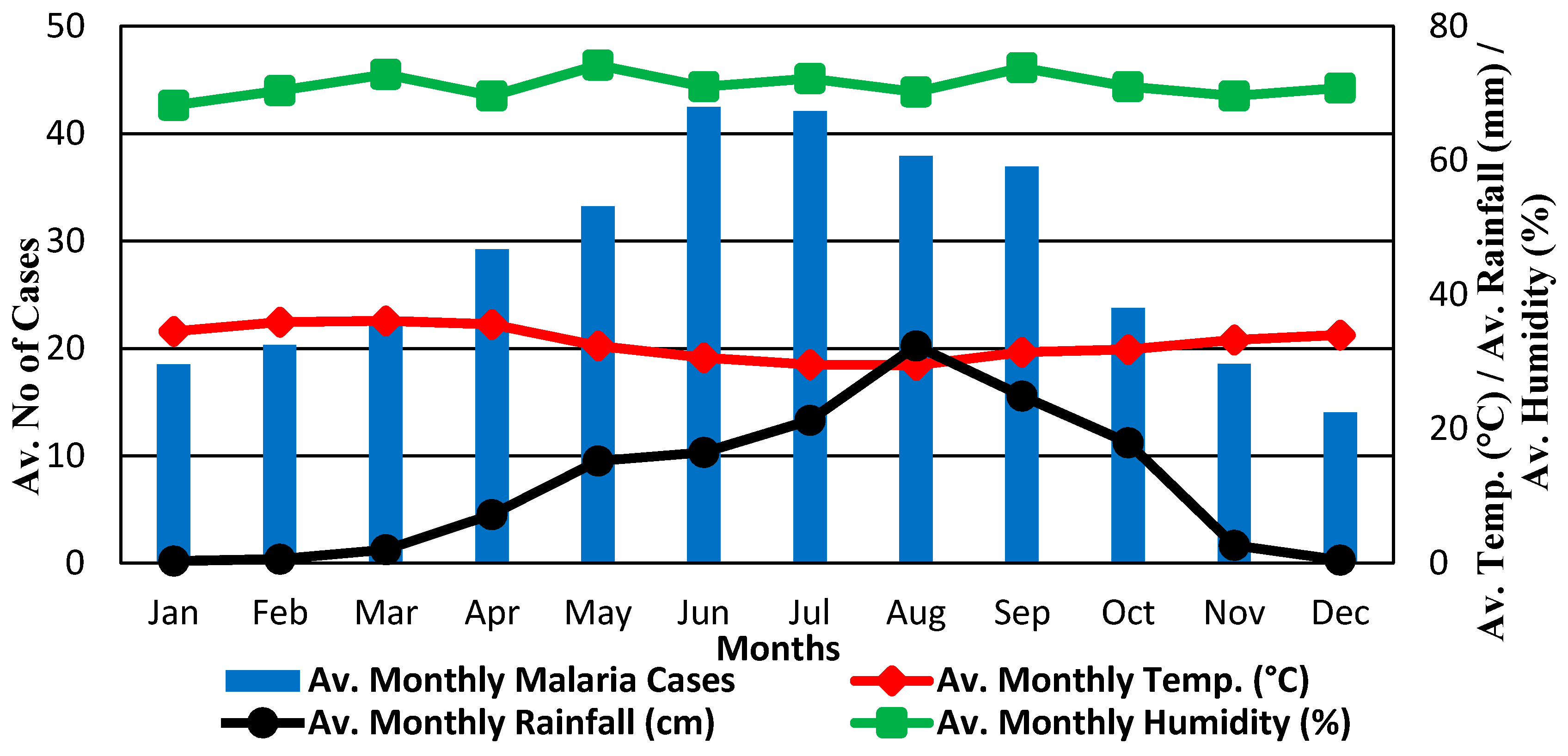
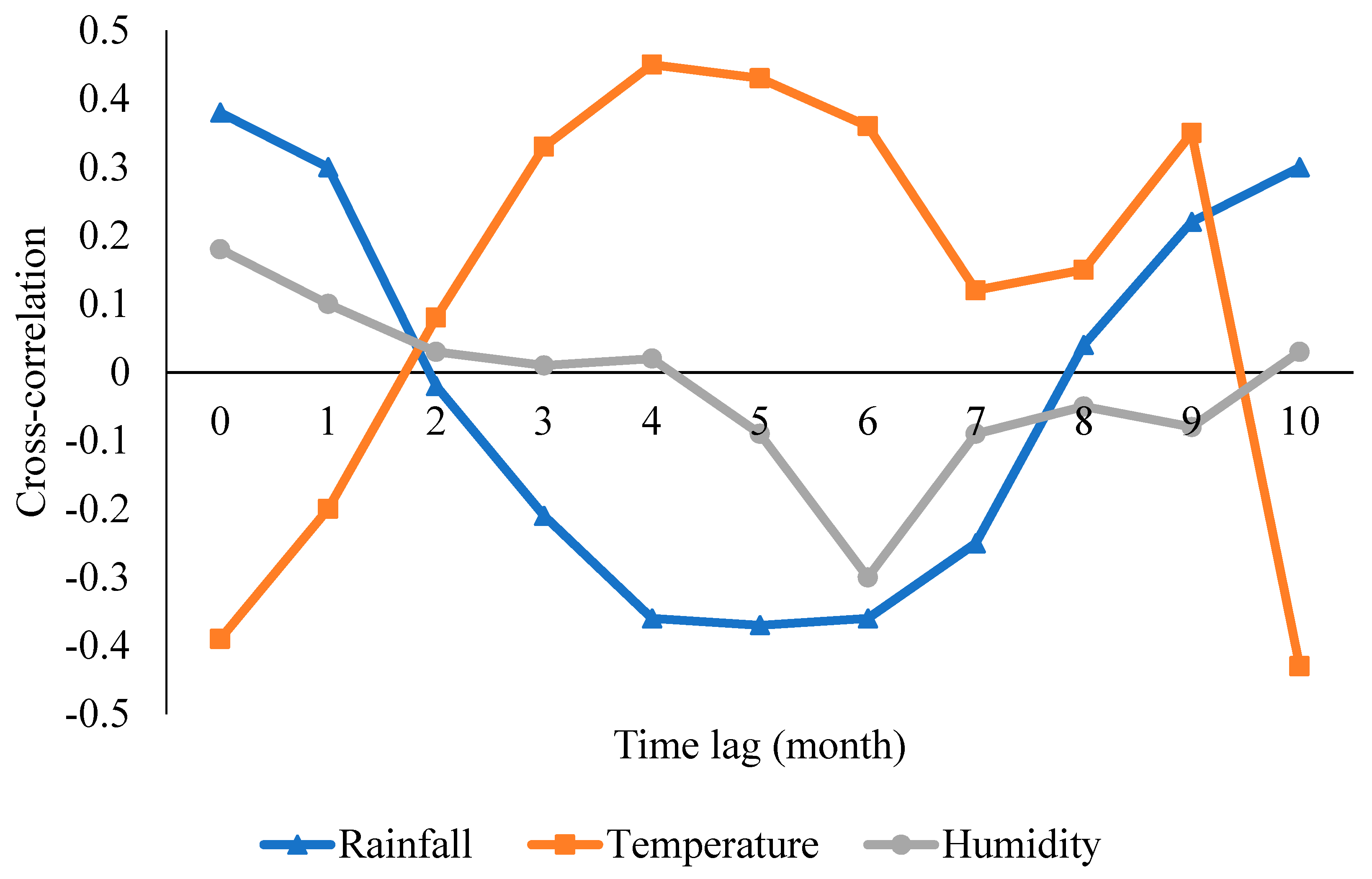
Background: despite the increase in malaria control and elimination efforts, weather patterns and ecological factors continue to serve as important drivers of malaria transmission dynamics. This study examined the statistical relationship between weather variables and malaria incidence in Abuja, Nigeria. Methodology/Principal Findings: monthly data on malaria incidence and weather variables were collected in Abuja from the year 2000 to 2013. The analysis of count outcomes was based on generalized linear models, while Pearson correlation analysis was undertaken at the bivariate level. The results showed more malaria incidence in the months with the highest rainfall recorded (June–August). Based on the negative binomial model, every unit increase in humidity corresponds to about 1.010 (95% confidence interval (CI), 1.005–1.015) times increase in malaria cases while the odds of having malaria decreases by 5.8% for every extra unit increase in temperature: 0.942 (95% CI, 0.928–0.956). At lag 1 month, there was a significant positive effect of rainfall on malaria incidence while at lag 4, temperature and humidity had significant influences. Conclusions: malaria remains a widespread infectious disease among the local subjects in the study area. Relative humidity was identified as one of the factors that influence a malaria epidemic at lag 0 while the biggest significant influence of temperature was observed at lag 4. Therefore, emphasis should be given to vector control activities and to create public health awareness on the proper usage of intervention measures such as indoor residual sprays to reduce the epidemic especially during peak periods with suitable weather conditions. View Full-Text
Keywords: negative binomial models; weather variables; malaria; Nigeria negative binomial models; weather variables; malaria; Nigeria
Show Figures

Figure 1

MDPI and ACS Style

Segun, O.E.; Shohaimi, S.; Nallapan, M.; Lamidi-Sarumoh, A.A.; Salari, N. Statistical Modelling of the Effects of Weather Factors on Malaria Occurrence in Abuja, Nigeria. Int. J. Environ. Res. Public Health 2020, 17, 3474. https://doi.org/10.3390/ijerph17103474

AMA Style

Segun OE, Shohaimi S, Nallapan M, Lamidi-Sarumoh AA, Salari N. Statistical Modelling of the Effects of Weather Factors on Malaria Occurrence in Abuja, Nigeria. International Journal of Environmental Research and Public Health. 2020; 17(10):3474. https://doi.org/10.3390/ijerph17103474
Chicago/Turabian Style

Segun, Oguntade E., Shamarina Shohaimi, Meenakshii Nallapan, Alaba A. Lamidi-Sarumoh, and Nader Salari. 2020. "Statistical Modelling of the Effects of Weather Factors on Malaria Occurrence in Abuja, Nigeria" International Journal of Environmental Research and Public Health 17, no. 10: 3474. https://doi.org/10.3390/ijerph17103474
Find Other Styles
Note that from the first issue of 2016, MDPI journals use article numbers instead of page numbers. See further details here.

Article Access Map by Country/Region

1
Back to TopTop