Article

Association between Actual and Perceived Motor Competence in School Children


by
Jaime Carcamo-Oyarzun
1,*,
Isaac Estevan
2 and
Christian Herrmann
3
1
Department of Physical Education, Faculty of Education, Social Science & Humanities, Universidad de La Frontera, 4811230 Temuco, Chile
2
Activitat Física i Promoció de la Salut (AFIPS) Research Group. Department of Teaching of Music, Visual and Corporal Expression, University of Valencia, 46022 Valencia, Spain
3
Didactics Exercise and Sport, Zurich University of Teacher Education, CH-8032 Zurich, Switzerland
*
Author to whom correspondence should be addressed.
Int. J. Environ. Res. Public Health 2020, 17(10), 3408; https://doi.org/10.3390/ijerph17103408

Submission received: 17 April 2020 / Revised: 1 May 2020 / Accepted: 9 May 2020 / Published: 14 May 2020

Abstract

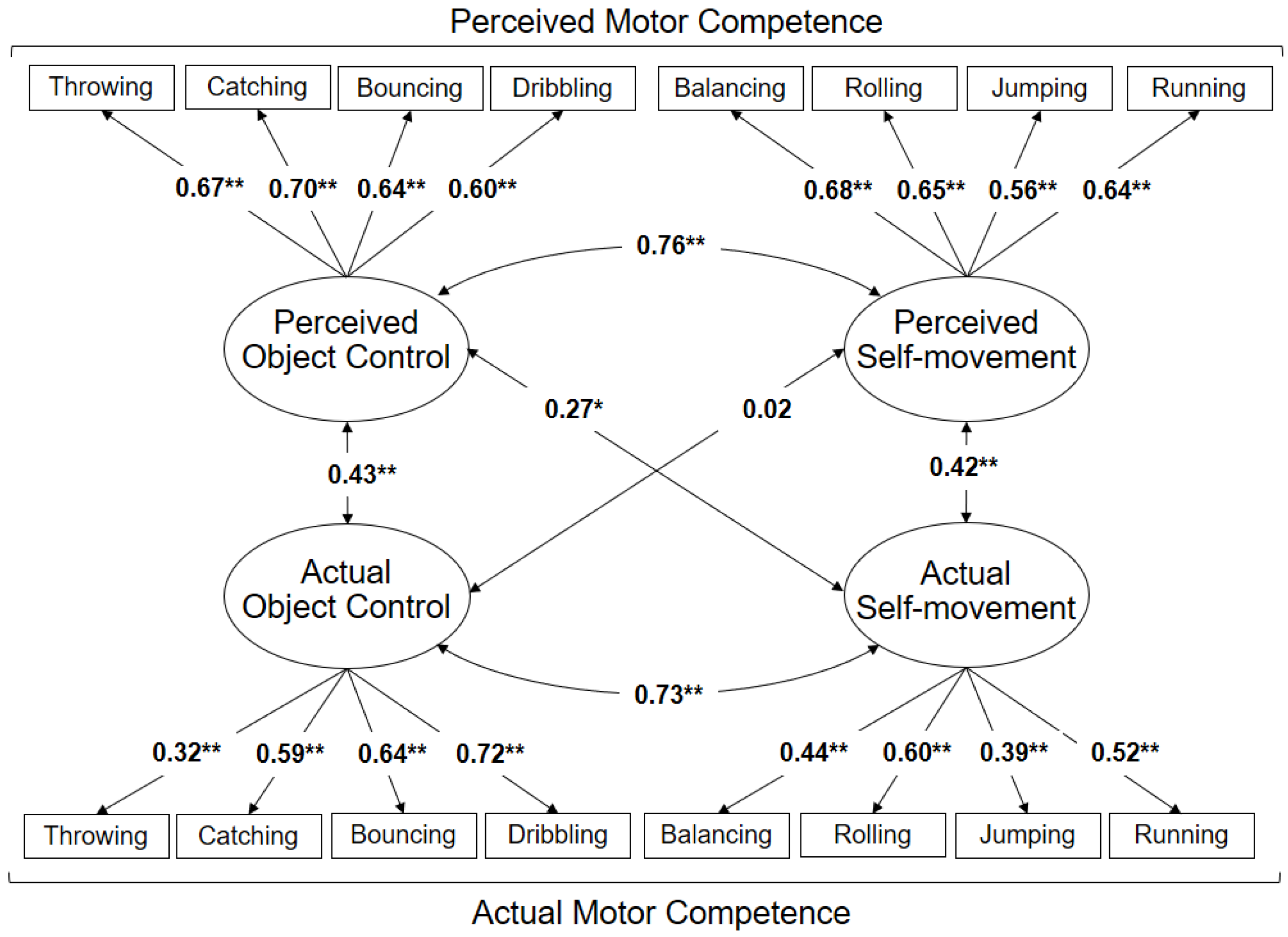
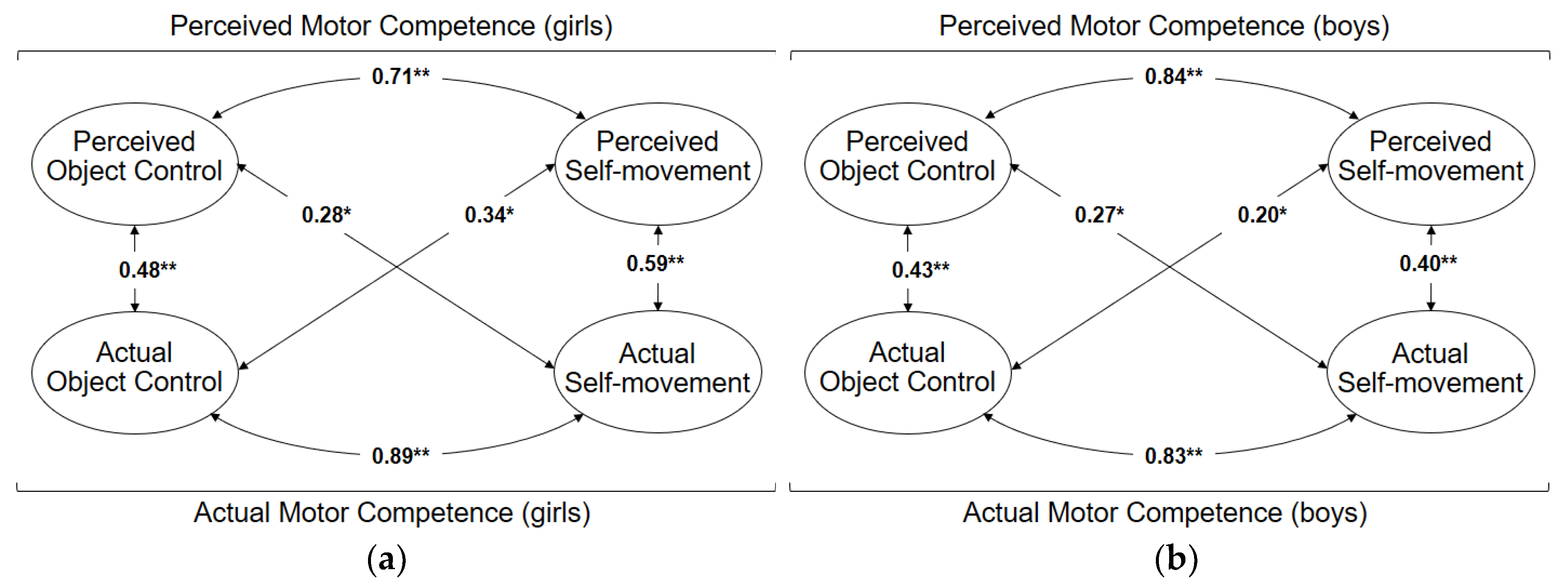
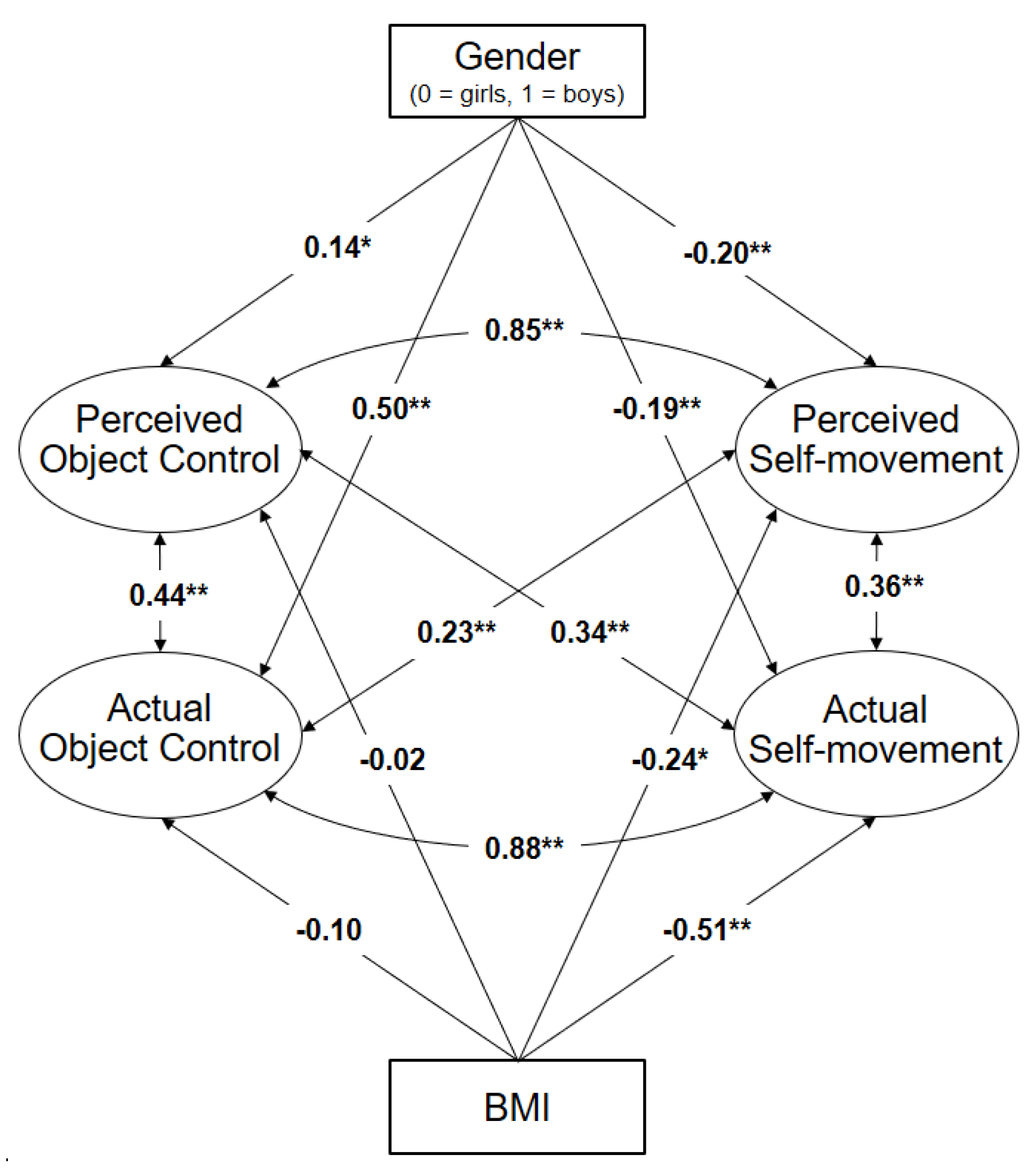
(1) Background: The association between actual and perceived motor competence (MC) is one of the underlying mechanisms that influence the practice of physical activity. This study mainly aimed to analyze the structure and correlations between actual and perceived MC in schoolchildren and to compare actual and perceived MC between girls and boys. (2) Methods: A total of 467 fifth and sixth graders (43.9% girls, M = 11.26, SD = 0.70) participated. Actual and perceived MC were assessed. To examine the proposed four factor models, structural equation models (factor analyses, latent correlations, invariance testing for gender) were conducted. Student t-test for independent samples was used to compare boys and girls. (3) Results: Proposed models achieved acceptable fit values with moderate correlation between the factors according to the type of MC in actual and perceived MC. Invariant factor structure in boys and girls was revealed. Boys performed and perceived themselves higher in object control than girls; whereas girls showed higher actual and perceived self-movement than boys. (4) Conclusions: The association between actual and perceived MC exists both globally and separately by gender, despite the differences between boys and girls. It is important to consider the role of gender and type of MC in the development of motor competencies, as well as in the strengthening of the children’s sense of competence.
Keywords: motor development; fundamental movement skills; self-perception; gender motor development; fundamental movement skills; self-perception; gender