Adsorption Thermodynamics and Dynamics of Three Typical Dyes onto Bio-adsorbent Spent Substrate of Pleurotus eryngii

Abstract
1. Introduction
2. Materials and Methods
2.1. Preparation of Bio-Adsorbent
2.2. Preparation of Dye Solution
2.3. Batch Bio-Adsorption Procedure
2.4. Determination of Concentration of Dyes
2.5. Removal Efficiency by Adsorption and Equilibrium Adsorption Quantity
2.6. Assays by Fourier Transform Infrared Spectroscopy (FTIR)
2.7. Adsorption Thermodynamics and Dynamics Model
2.7.1. Adsorption Isotherm Model
2.7.2. Adsorption Thermodynamics
2.7.3. Adsorption Kinetics
3. Results
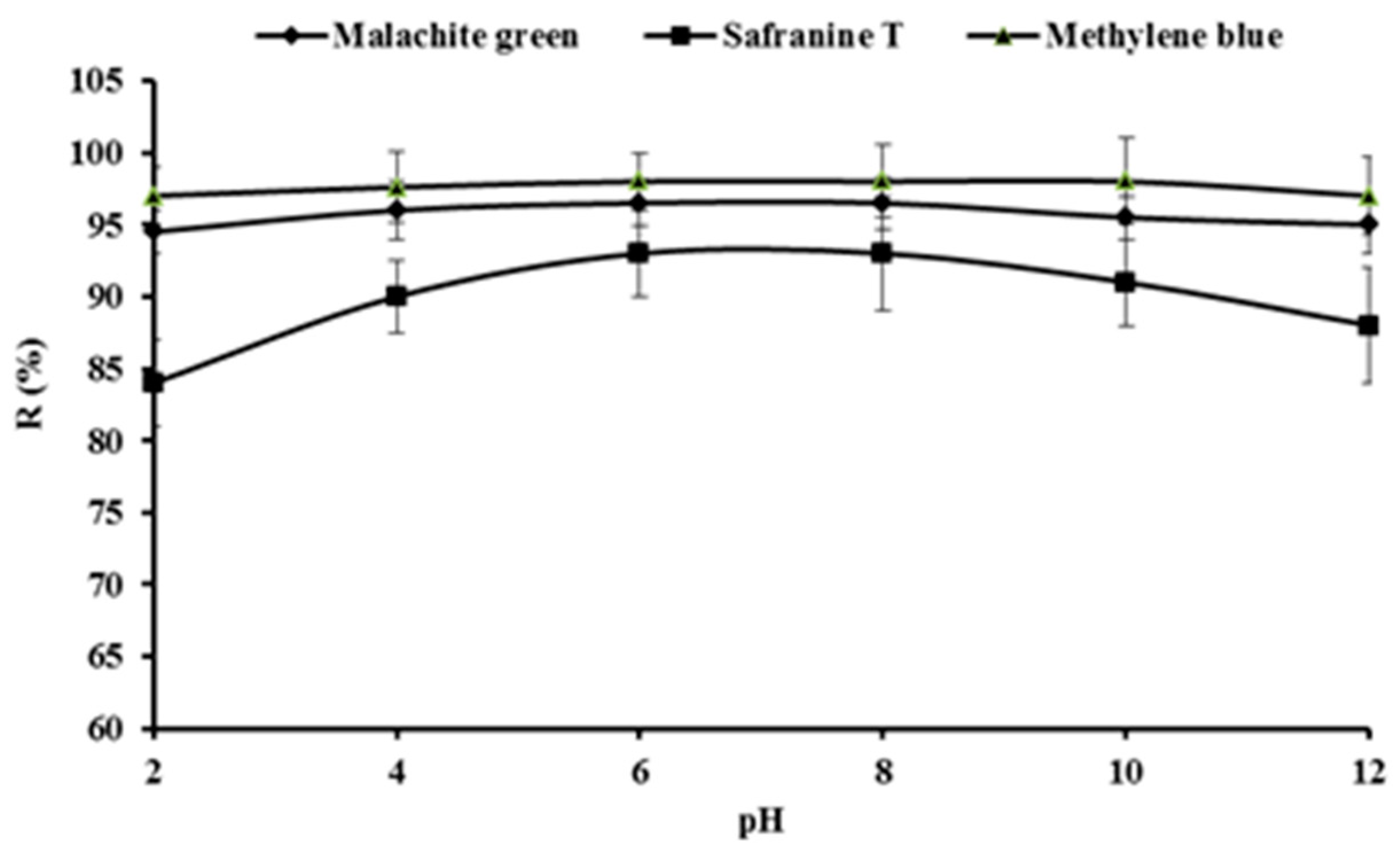
3.1. Effect of pH on Dyes Adsorption
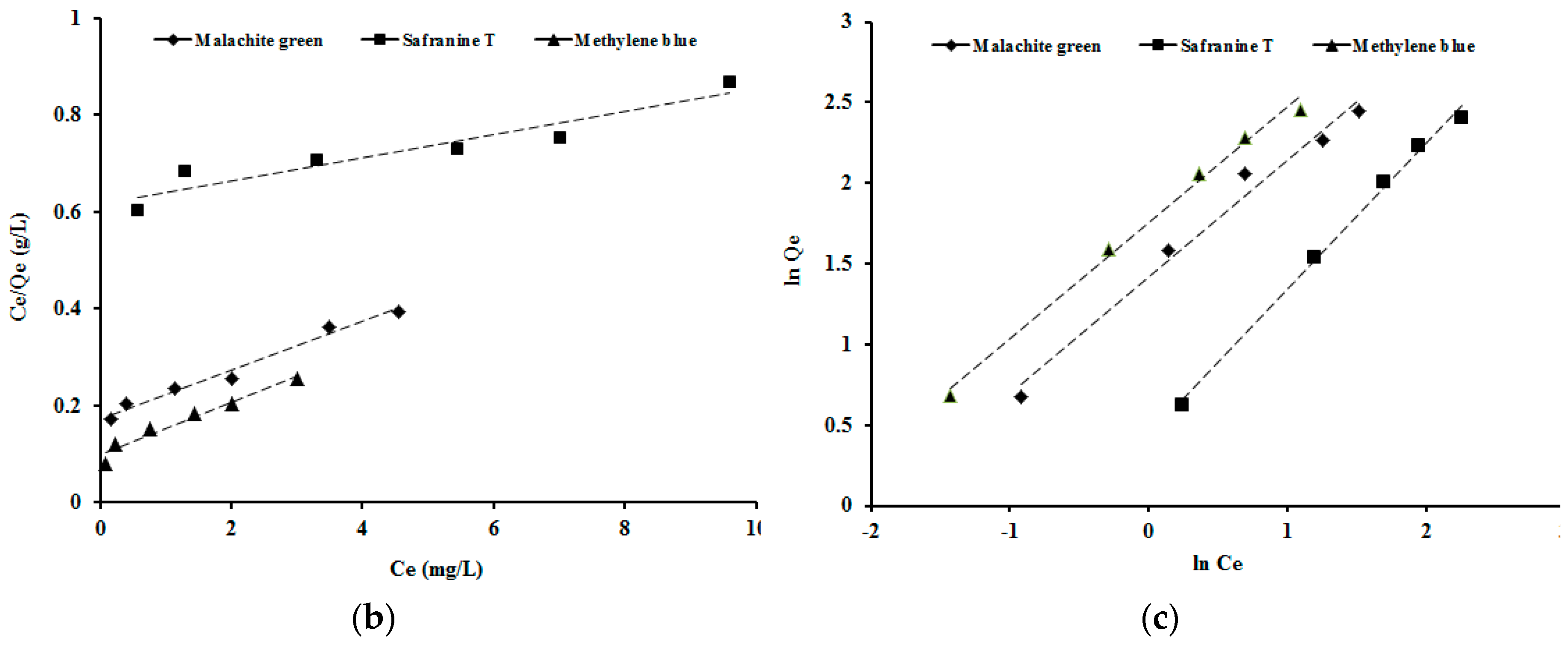
3.2. Adsorption Isotherm
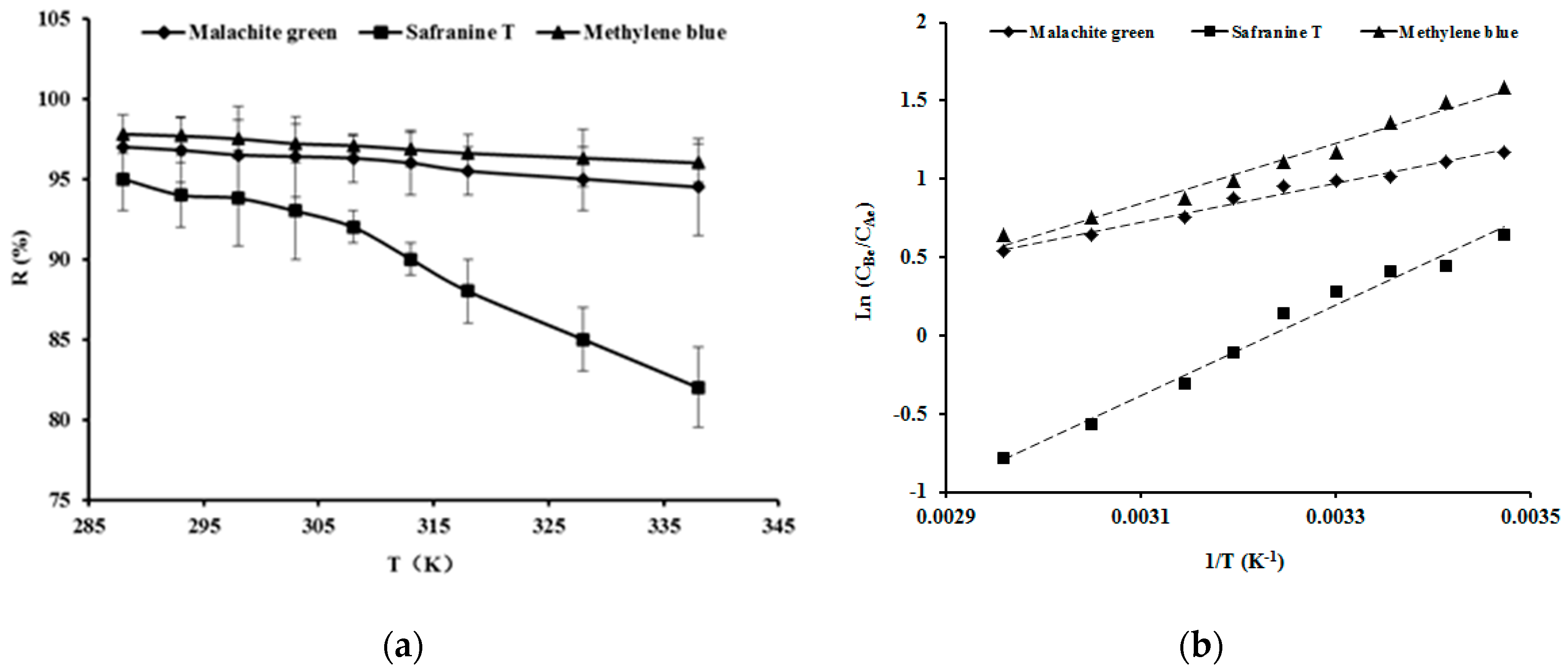
3.3. Adsorption Thermodynamics
3.4. Adsorption Kinetics
4. Conclusions
Author Contributions
Funding
Acknowledgments
Conflicts of Interest
References
- Dos Santos, R.F.; Ramlow, H.; Dolzan, N.; Machado, R.A.F.; de Aguiar, C.R.L.; Marangoni, C. Influence of different textile fibers on characterization of dyeing wastewater and final effluent. Environ. Monit. Assess. 2018. [Google Scholar] [CrossRef] [PubMed]
- Akhtar, M.F.; Ashraf, M.; Javeed, A.; Anjum, A.A.; Sharif, A.; Saleem, A.; Akhtar, B.; Khan, A.M.; Altaf, I. Toxicity appraisal of untreated dyeing industry wastewater based on chemical characterization and short term bioassays. Bull. Environ. Contam. Tox. 2016, 96, 502–507. [Google Scholar] [CrossRef] [PubMed]
- Liang, J.; Ning, X.A.; Kong, M.; Liu, D.; Wang, G.; Cai, H.; Sun, J.; Zhang, Y.; Lu, X.; Yuan, Y. Elimination and ecotoxicity evaluation of phthalic acid esters from textile-dyeing wastewater. Environ. Pollut. 2017, 231, 115–122. [Google Scholar] [CrossRef] [PubMed]
- Kim, H.L.; Cho, J.B.; Park, Y.J.; Cho, I.H. Treatment and toxicity reduction of textile dyeing wastewater using the electrocoagulation-electroflotation process. J. Environ. Sci. Heal. A 2016, 51, 661–668. [Google Scholar] [CrossRef] [PubMed]
- Chequer, F.M.; Lizier, T.M.; de Felicio, R.; Zanoni, M.V.; Debonsi, H.M.; Lopes, N.P.; de Oliveira, D.P. The azo dye Disperse Red 13 and its oxidation and reduction products showed mutagenic potential. Toxicol. In Vitro 2015, 29, 1906–1915. [Google Scholar] [CrossRef] [PubMed]
- Maeda, C.H.; Araki, C.A.; Moretti, A.L.; de Barros, M.; Arroyo, P.A. Adsorption and desorption cycles of reactive blue BF-5G dye in a bone char fixed-bed column. Environ. Sci. Pollut. Res. 2018. [Google Scholar] [CrossRef] [PubMed]
- Naushad, M.; ALOthman, Z.A.; Awual, M.R.; Alfadul, S.M.; Ahamad, T. Adsorption of rose Bengal dye from aqueous solution by amberlite Ira-938 resin: Kinetics, isotherms, and thermodynamic studies. Desalin. Water Treat. 2016, 57, 13527–13533. [Google Scholar] [CrossRef]
- Sharma, G.; Naushad, M.; Kumar, A.; Rana, S.; Sharma, S.; Bhatnagar, A.; Stadler, F.J.; Ghfar, A.A.; Khan, M.R. Efficient removal of coomassie brilliant blue R-250 dye using starch/poly(alginic acid-cl-acrylamide) nanohydrogel. Process Saf. Environ. 2017, 109, 301–310. [Google Scholar] [CrossRef]
- Khaled, A.; El Nemr, A.; El-Sikaily, A.; Abdelwahab, O. Removal of direct N Blue-106 from artificial textile dye effluent using activated carbon from orange peel: Adsorption isotherm and kinetic studies. J. Hazard. Mater. 2009, 165, 100–110. [Google Scholar] [CrossRef] [PubMed]
- Suganya, S.; Senthil Kumar, P.; Saravanan, A.; Sundar Rajan, P.; Ravikumar, C. Computation of adsorption parameters for the removal of dye from wastewater by microwave assisted sawdust: Theoretical and experimental analysis. Environ. Toxicol. Pharmacol. 2017, 50, 45–57. [Google Scholar]
- Khan, A.; Afzal, S.; Mustafa, H.; Qumreen, M. Data article for adsorption of chemically activated fullers earth and rice husk for removal of dri-marine reactive red dye. Data Brief 2018, 21, 189–200. [Google Scholar] [CrossRef] [PubMed]
- Wu, J.; Zhang, T.; Chen, C.; Feng, L.; Su, X.; Zhou, L.; Chen, Y.; Xia, A.; Wang, X. Spent substrate of Ganodorma lucidum as a new bio-adsorbent for adsorption of three typical dyes. Bioresour. Technol. 2018, 266, 134–138. [Google Scholar] [CrossRef] [PubMed]
- Xing, Z.; Zhao, X. Mushroom production in China: The illegal use of fluorescent whitening agents (FWAs) and related outbreaks. In Global Safety of Fresh Produce; Woodhead Publishing Limited: Sawston, Cambridge, UK, 2014; pp. 401–408. [Google Scholar]
- Herrero-Hernandez, E.; Andrades, M.S.; Marin-Benito, J.M.; Sanchez-Martin, M.J.; Rodriguez-Cruz, M.S. Field-scale dissipation of tebuconazole in a vineyard soil amended with spent mushroom substrate and its potential environmental impact. Ecotox. Environ. Saf. 2011, 74, 1480–1488. [Google Scholar] [CrossRef] [PubMed]
- Li, S.; Li, D.; Li, J.; Li, Y.; Li, G.; Zang, B.; Li, Y. Effect of spent mushroom substrate as a bulking agent on gaseous emissions and compost quality during pig manure composting. Environ. Sci. Pollut. Res. Int. 2018, 25, 12398–12406. [Google Scholar] [CrossRef] [PubMed]
- Economou, C.N.; Diamantopoulou, P.A.; Philippoussis, A.N. Valorization of spent oyster mushroom substrate and laccase recovery through successive solid state cultivation of Pleurotus, Ganoderma, and Lentinula strains. Appl. Microbiol. Biot. 2017, 101, 5213–5222. [Google Scholar] [CrossRef] [PubMed]
- Correa, R.C.; da Silva, B.P.; Castoldi, R.; Kato, C.G.; de Sa-Nakanishi, A.B.; Peralta, R.A.; de Souza, C.G.; Bracht, A.; Peralta, R.M. Spent mushroom substrate of Pleurotus pulmonarius: A source of easily hydrolyzable lignocellulose. Folia Microbiol. 2016, 61, 439–448. [Google Scholar] [CrossRef] [PubMed]
- Tay, C.C.; Liew, H.H.; Redzwan, G.; Yong, S.K.; Surif, S.; Abdul-Talib, S. Pleurotus ostreatus spent mushroom compost as green biosorbent for nickel (II) biosorption. Water Sci. Technol. 2011, 64, 2425–2432. [Google Scholar] [CrossRef] [PubMed]
- Jiang, Y.; Hao, R.; Yang, S. Equilibrium and kinetic studies on biosorption of Pb(II) by common edible macrofungi: A comparative study. Can. J. Microbiol. 2016, 62, 329–337. [Google Scholar] [CrossRef] [PubMed]
- Sewu, D.D.; Boakye, P.; Jung, H.; Woo, S.H. Synergistic dye adsorption by biochar from co-pyrolysis of spent mushroom substrate and Saccharina japonica. Bioresour. Technol. 2017, 244, 1142–1149. [Google Scholar] [CrossRef] [PubMed]
- He, P.; Li, F.; Huang, L.; Xue, D.; Liu, W.; Xu, C. Chemical characterization and antioxidant activity of polysaccharide extract from spent mushroom substrate of Pleurotus eryngii. J. Taiwan Inst. Chem. E 2016, 69, 48–53. [Google Scholar] [CrossRef]
- Islam, M.S.; McPhedran, K.N.; Messele, S.A.; Liu, Y.; Gamal El-Din, M. Isotherm and kinetic studies on adsorption of oil sands process-affected water organic compounds using granular activated carbon. Chemosphere 2018, 202, 716–725. [Google Scholar] [CrossRef] [PubMed]
- AL-Othman, Z.A.; Ali, R.; Naushad, M. Hexavalent chromium removal from aqueous medium by activated carbon prepared from peanut shell: Adsorption kinetics, equilibrium and thermodynamic studies. Chem. Eng. J. 2012, 184, 238–247. [Google Scholar] [CrossRef]
- Borsarelli, C.D.; Bertolotti, S.G.; Previtali, C.M. Thermodynamic changes in the photoinduced proton-transfer reaction of the triplet state of safranine-T. Photochem. Photobiol. Sci. 2002, 1, 574–580. [Google Scholar] [CrossRef] [PubMed]
- Dhodapkar, R.; Rao, N.N.; Pande, S.P.; Nandy, T.; Devotta, S. Adsorption of cationic dyes on Jalshakti®, super absorbent polymer and photocatalytic regeneration of the adsorbent. React. Funct. Polym. 2007, 67, 540–548. [Google Scholar] [CrossRef]
- Alqadami, A.A.; Naushad, M.; Alothman, Z.A.; Ahamad, T. Adsorptive performance of MOF nanocomposite for methylene blue and malachite green dyes: Kinetics, isotherm and mechanism. J. Environ. Manag. 2018, 223, 29–36. [Google Scholar] [CrossRef] [PubMed]
- Albadarin, A.B.; Collins, M.N.; Naushad, M.; Shirazian, S.; Walker, G.; Mangwandi, C. Activated lignin-chitosan extruded blends for efficient adsorption of methylene blue. Chem. Eng. J. 2017, 307, 264–272. [Google Scholar] [CrossRef]
- Daneshvar, E.; Vazirzadeh, A.; Niazi, A.; Kousha, M.; Naushad, M.; Bhatnagar, A. Desorption of Methylene blue dye from brown macroalga: Effects of operating parameters, isotherm study and kinetic modeling. J. Clean. Prod. 2017, 152, 443–453. [Google Scholar] [CrossRef]
- Naushad, M.; Ahamad, T.; Al-Maswari, B.M.; Alqadami, A.A.; Alshehri, S.M. Nickel ferrite bearing nitrogen-doped mesoporous carbon as efficient adsorbent for the removal of highly toxic metal ion from aqueous medium. Chem. Eng. J. 2017, 330, 1351–1360. [Google Scholar] [CrossRef]
- Naushad, M. Surfactant assisted nano-composite cation exchanger: Development, characterization and applications for the removal of toxic Pb2+ from aqueous medium. Chem. Eng. J. 2014, 235, 100–108. [Google Scholar] [CrossRef]




| Dye | Qm (mg/g) | KL (L/mg) | R2 |
|---|---|---|---|
| Malachite green | 19.23 | 0.3071 | 0.986 |
| Safranine T | 42.02 | 0.0386 | 0.897 |
| Methylene blue | 18.45 | 0.5503 | 0.957 |
| Dye | n | KF (mg/g) (L/mg)1/n | R2 | n * | KF * (mg/g) (L/mg)1/n | R2 * | Ref. |
|---|---|---|---|---|---|---|---|
| Malachite green | 1.38 | 4.12 | 0.981 | 1.58 | 8.30 | 0.980 | [25] |
| 2.18 | 26.27 | 0.980 | [26] | ||||
| Safranine T | 1.11 | 1.55 | 0.995 | 1.28 | 15.50 | 0.990 | [25] |
| Methylene blue | 1.39 | 5.77 | 0.993 | 2.08 | 58.90 | 0.980 | [25] |
| 2.04 | 19.31 | 0.983 | [26] | ||||
| 2.47 | 7.02 | 0.978 | [27] | ||||
| 1.05 | 1.13 | 0.999 | [28] |
| Dye | R2 | ||
|---|---|---|---|
| Malachite green | −10.35 | −26.1 | 0.984 |
| Safranine T | −23.99 | −77.5 | 0.983 |
| Methylene blue | −16.00 | −42.6 | 0.981 |
| Dye | First Order Kinetic Model | Second Order Kinetic Model | |||
|---|---|---|---|---|---|
| k1 (1/min) | R2 | Qe (mg/g) | k2 (g/mg)·(1/min) | R2 | |
| Malachite green | 0.0891 | 0.609 | 9.662 | 0.595 | ≈1 |
| Safranine T | 0.0849 | 0.652 | 9.389 | 0.259 | ≈1 |
| Methylene blue | 0.0948 | 0.725 | 9.823 | 0.503 | ≈1 |
© 2019 by the authors. Licensee MDPI, Basel, Switzerland. This article is an open access article distributed under the terms and conditions of the Creative Commons Attribution (CC BY) license (http://creativecommons.org/licenses/by/4.0/).
Share and Cite
Wu, J.; Xia, A.; Chen, C.; Feng, L.; Su, X.; Wang, X. Adsorption Thermodynamics and Dynamics of Three Typical Dyes onto Bio-adsorbent Spent Substrate of Pleurotus eryngii. Int. J. Environ. Res. Public Health 2019, 16, 679. https://doi.org/10.3390/ijerph16050679
Wu J, Xia A, Chen C, Feng L, Su X, Wang X. Adsorption Thermodynamics and Dynamics of Three Typical Dyes onto Bio-adsorbent Spent Substrate of Pleurotus eryngii. International Journal of Environmental Research and Public Health. 2019; 16(5):679. https://doi.org/10.3390/ijerph16050679
Chicago/Turabian StyleWu, Jianguo, Aiqiang Xia, Chunyan Chen, Liuying Feng, Xiaohui Su, and Xinfeng Wang. 2019. "Adsorption Thermodynamics and Dynamics of Three Typical Dyes onto Bio-adsorbent Spent Substrate of Pleurotus eryngii" International Journal of Environmental Research and Public Health 16, no. 5: 679. https://doi.org/10.3390/ijerph16050679
APA StyleWu, J., Xia, A., Chen, C., Feng, L., Su, X., & Wang, X. (2019). Adsorption Thermodynamics and Dynamics of Three Typical Dyes onto Bio-adsorbent Spent Substrate of Pleurotus eryngii. International Journal of Environmental Research and Public Health, 16(5), 679. https://doi.org/10.3390/ijerph16050679