Examining the Effect of the Environment and Commuting Flow from/to Epidemic Areas on the Spread of Dengue Fever

 ,
, 
Abstract
1. Introduction
- Question 1:Do commuting flows from/to epidemic areas impact DF distribution?
- Question 2:If the answer to the first question is a YES, does the impact vary in space?
- Question 3:If the answer to the second question is a YES, can the spatial variation be explained by the environment of epidemic areas that commuters commuted from/to?
2. Materials and Methods
2.1. Study Area and Data Collection
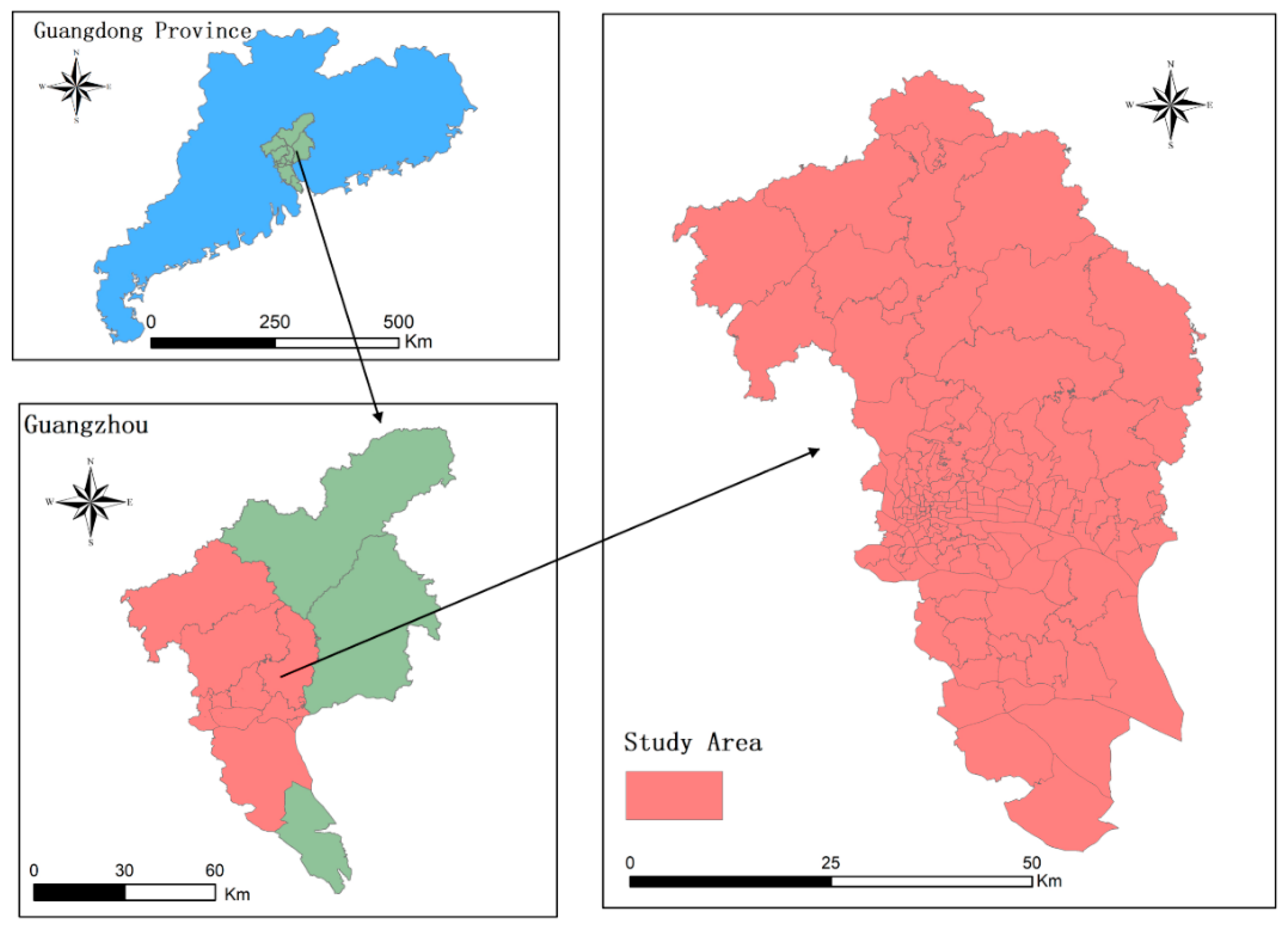
2.1.1. Study Area
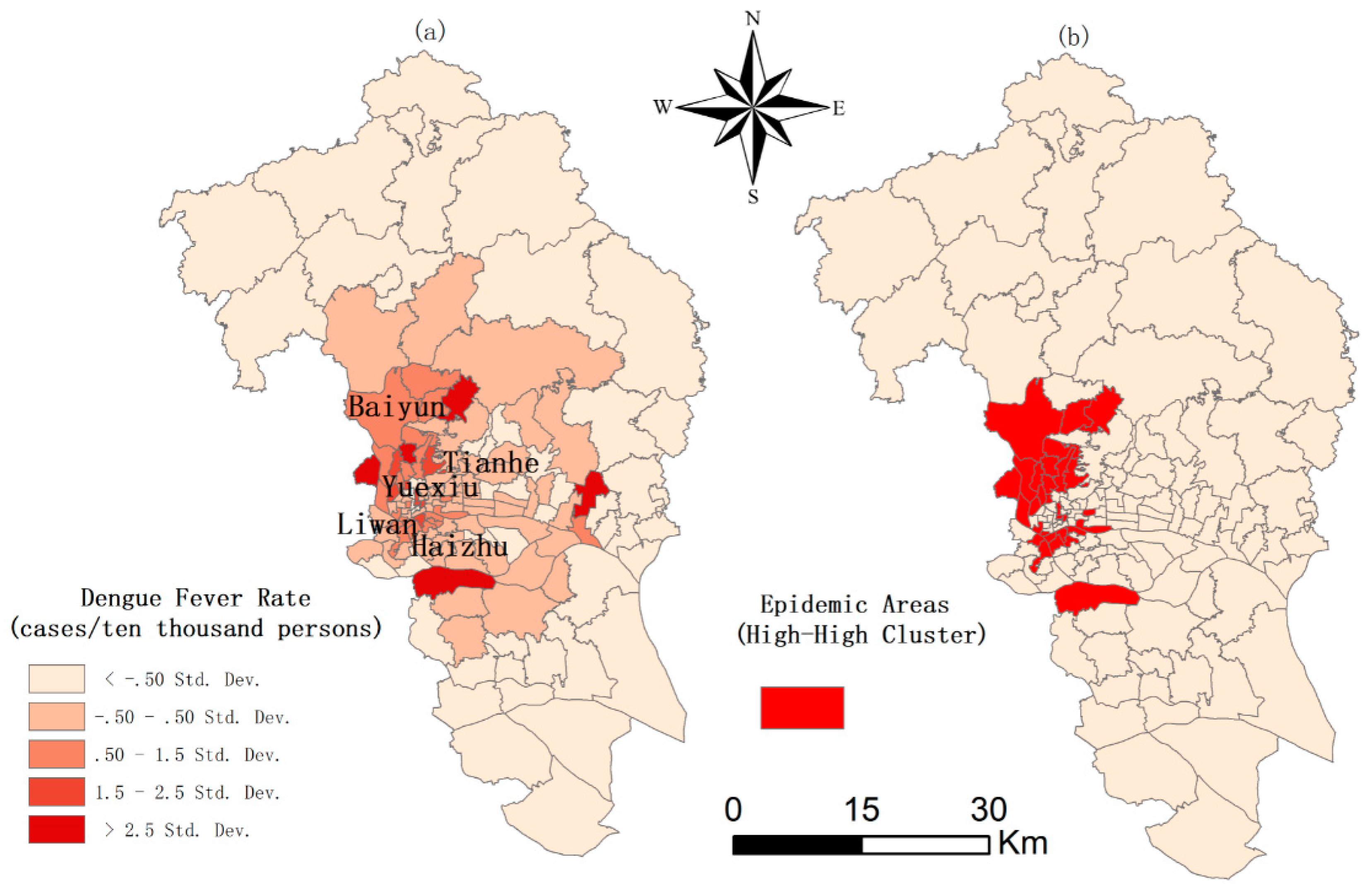
2.1.2. DF Outbreak in the Study Area
2.1.3. Commuting Flow with Mobile Phone Data
2.1.4. Environment Indicators
2.2. Spatial Autocorrelation Analysis
2.3. Geographically Weighted Poisson Regression (GWPR)
3. Results
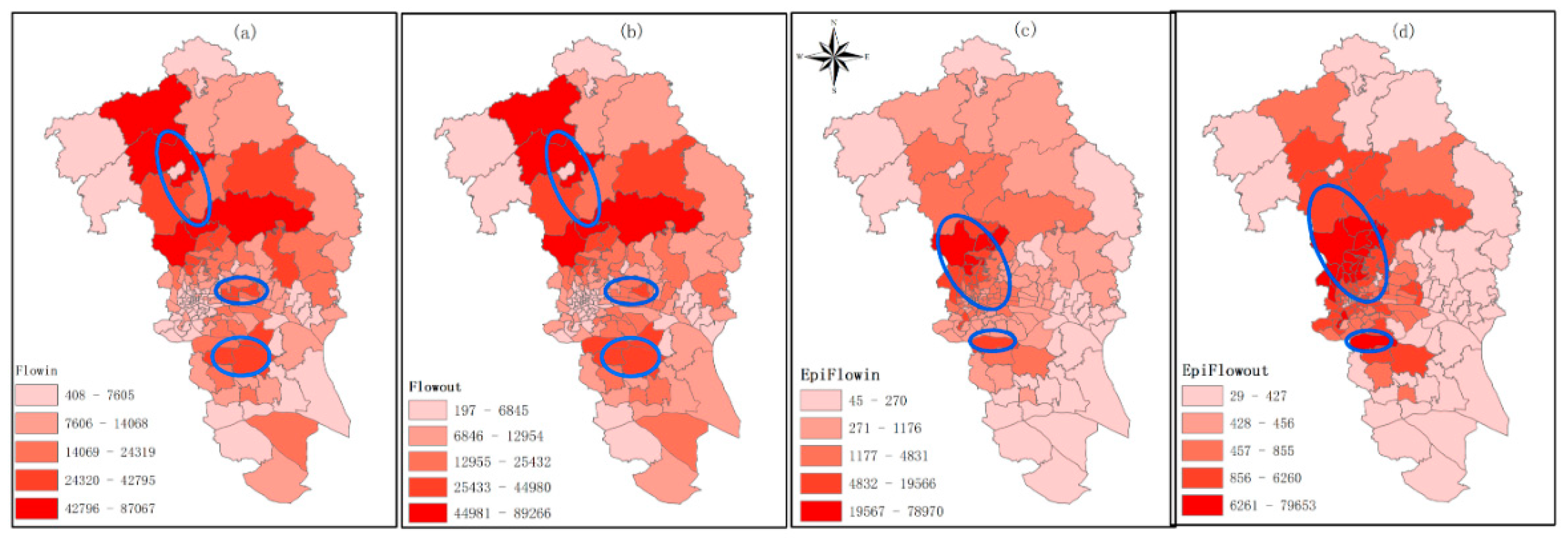
3.1. Exploratory Analysis
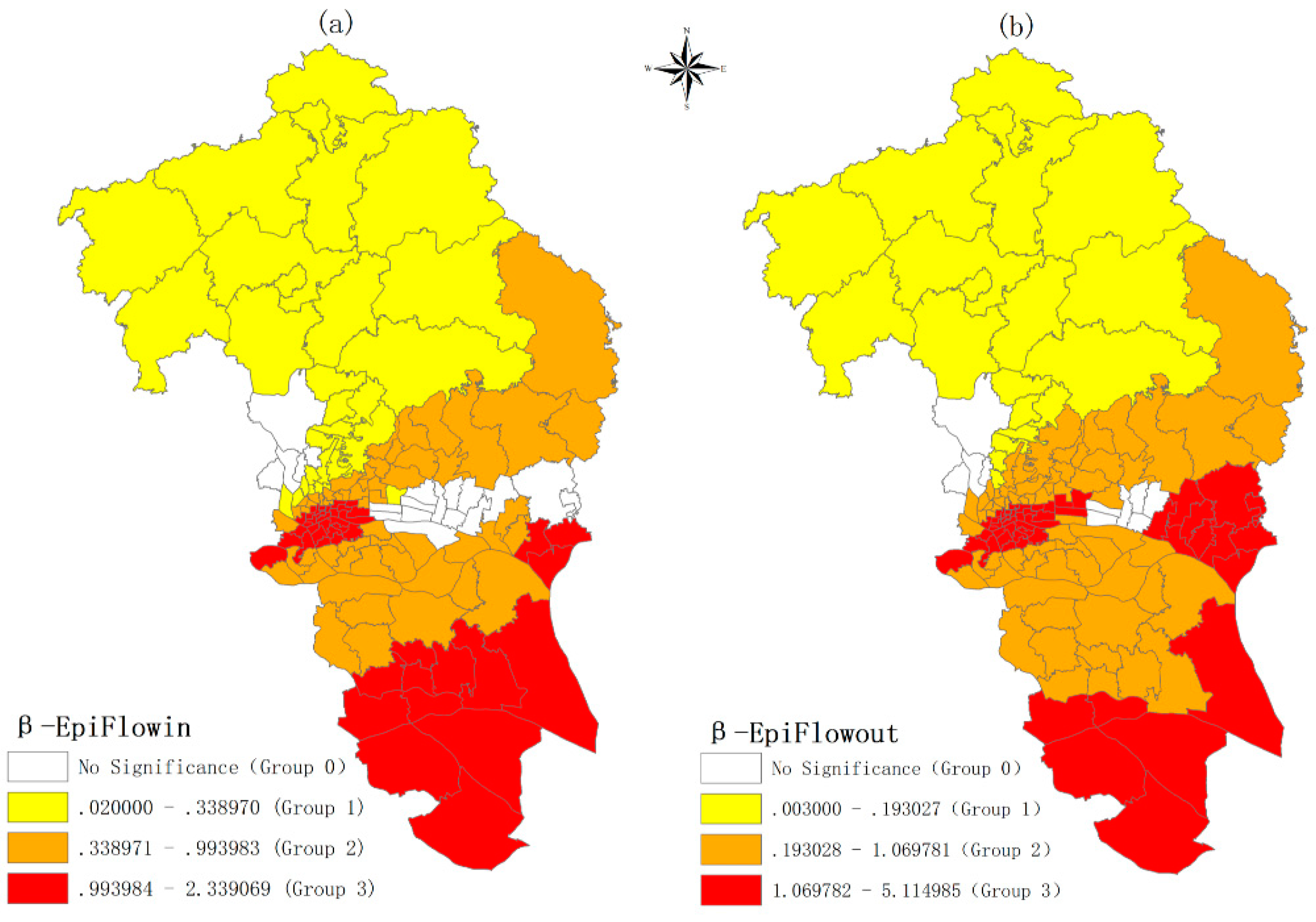
3.2. GWPR Results
3.3. ANOVA Results
4. Discussion
5. Conclusions
Author Contributions
Funding
Acknowledgments
Conflicts of Interest
References
- Gubler, D.J.; Clark, G.G. Dengue/dengue hemorrhagic fever: The emergence of a global health problem. Emerg. Infect. Dis. 1995, 1, 55. [Google Scholar] [CrossRef] [PubMed]
- World Health Organization. Global Strategy for Dengue Prevention and Control 2012–2020; WHO: Geneva, Switzerland, 2012. [Google Scholar]
- Bhatt, S.; Gething, P.W.; Brady, O.J.; Messina, J.P.; Farlow, A.W.; Moyes, C.L.; Drake, J.M.; Brownstein, J.S.; Hoen, A.G.; Sankoh, O. The global distribution and burden of dengue. Nature 2013, 496, 504. [Google Scholar] [CrossRef] [PubMed]
- Castro, M.C.; Wilson, M.E.; Bloom, D.E. Disease and economic burdens of dengue. Lancet Infect. Dis. 2017, 17, e70–e78. [Google Scholar] [CrossRef]
- Pang, T.; Mak, T.K.; Gubler, D.J. Prevention and control of dengue-the light at the end of the tunnel. Lancet Infect. Dis. 2017, 17, e79–e87. [Google Scholar] [CrossRef]
- Katzelnick, L.C.; Coloma, J.; Harris, E. Dengue: Knowledge gaps, unmet needs, and research priorities. Lancet Infect. Dis. 2017, 17, e88–e100. [Google Scholar] [CrossRef]
- Hsueh, Y.-H.; Lee, J.; Beltz, L. Spatio-temporal patterns of dengue fever cases in Kaoshiung City, Taiwan, 2003–2008. Appl. Geogr. 2012, 34, 587–594. [Google Scholar] [CrossRef]
- Khormi, H.M.; Kumar, L. Modeling dengue fever risk based on socioeconomic parameters, nationality and age groups: GIS and remote sensing based case study. Sci. Total Environ. 2011, 409, 4713–4719. [Google Scholar] [CrossRef]
- Delmelle, E.; Hagenlocher, M.; Kienberger, S.; Casas, I. A spatial model of socioeconomic and environmental determinants of dengue fever in Cali, Colombia. Acta Trop. 2016, 164, 169. [Google Scholar] [CrossRef]
- Cao, Z.; Liu, T.; Li, X.; Wang, J.; Lin, H.; Chen, L.; Wu, Z.; Ma, W. Individual and interactive effects of socio-ecological factors on dengue fever at fine spatial scale: A geographical detector-based analysis. Int. J. Environ. Res. Public Health 2017, 14, 795. [Google Scholar] [CrossRef]
- Qi, X.; Wang, Y.; Li, Y.; Meng, Y.; Chen, Q.; Ma, J.; Gao, G.F. The Effects of Socioeconomic and Environmental Factors on the Incidence of Dengue Fever in the Pearl River Delta, China, 2013. PLoS Negl. Trop. Dis. 2015, 9, e0004159. [Google Scholar] [CrossRef]
- Ren, H.; Zheng, L.; Li, Q.; Yuan, W.; Lu, L. Exploring Determinants of Spatial Variations in the Dengue Fever Epidemic Using Geographically Weighted Regression Model: A Case Study in the Joint Guangzhou-Foshan Area, China, 2014. Int. J. Environ. Res. Public Health 2017, 14, 1518. [Google Scholar] [CrossRef] [PubMed]
- Huang, C.-C.; Tam, T.; Chern, Y.-R.; Lung, S.-C.; Chen, N.-T.; Wu, C.-D. Spatial Clustering of Dengue Fever Incidence and Its Association with Surrounding Greenness. Int. J. Environ. Res. Public Health 2018, 15, 1869. [Google Scholar] [CrossRef] [PubMed]
- Chen, Y.; Zhao, Z.; Li, Z.; Li, W.; Li, Z.; Guo, R.; Yuan, Z. Spatiotemporal Transmission Patterns and Determinants of Dengue Fever: A Case Study of Guangzhou, China. Int. J. Environ. Res. Public Health 2019, 16, 2486. [Google Scholar] [CrossRef] [PubMed]
- Yue, Y.; Liu, Q. Exploring Epidemiological Characteristics of Domestic Imported Dengue Fever in Mainland China, 2014–2018. Int. J. Environ. Res. Public Health 2019, 16, 3901. [Google Scholar] [CrossRef] [PubMed]
- Zhu, G.; Liu, T.; Xiao, J.; Zhang, B.; Song, T.; Zhang, Y.; Lin, L.; Peng, Z.; Deng, A.; Ma, W.; et al. Effects of human mobility, temperature and mosquito control on the spatiotemporal transmission of dengue. Sci. Total Environ. 2019, 651, 969–978. [Google Scholar] [CrossRef]
- Rajarethinam, J.; Ong, J.; Lim, S.-H.; Tay, Y.-H.; Bounliphone, W.; Chong, C.-S.; Yap, G.; Ng, L.-C. Using Human Movement Data to Identify Potential Areas of Zika Transmission: Case Study of the Largest Zika Cluster in Singapore. Int. J. Environ. Res. Public Health 2019, 16, 808. [Google Scholar] [CrossRef]
- Wen, T.; Lin, M.; Fang, C. Population Movement and Vector-Borne Disease Transmission: Differentiating Spatial–Temporal Diffusion Patterns of Commuting and Noncommuting Dengue Cases. Ann. Assoc. Am. Geogr. 2012, 102, 1026–1037. [Google Scholar] [CrossRef]
- Stoddard, S.T.; Morrison, A.C.; Vazquezprokopec, G.M.; Paz, S.V.; Kochel, T.J.; Kitron, U.; Elder, J.P.; Scott, T.W. The role of human movement in the transmission of vector-borne pathogens. PLoS Negl. Trop. Dis. 2009, 3, e481. [Google Scholar] [CrossRef]
- Teurlai, M.; Huy, R.; Cazelles, B.; Duboz, R.; Baehr, C.; Vong, S. Can human movements explain heterogeneous propagation of dengue fever in Cambodia? PLoS Negl. Trop. Dis. 2012, 6, e1957. [Google Scholar] [CrossRef]
- Stoddard, S.T.; Forshey, B.M.; Morrison, A.C.; Paz-Soldan, V.A.; Vazquez-Prokopec, G.M.; Astete, H.; Reiner, R.C.; Vilcarromero, S.; Elder, J.P.; Halsey, E.S. House-to-house human movement drives dengue virus transmission. Proc. Natl. Acad. Sci. USA 2013, 110, 994–999. [Google Scholar] [CrossRef]
- Zhu, G.; Xiao, J.; Zhang, B.; Liu, T.; Lin, H.; Li, X.; Song, T.; Zhang, Y.; Ma, W.; Hao, Y. The spatiotemporal transmission of dengue and its driving mechanism: A case study on the 2014 dengue outbreak in Guangdong, China. Sci. Total Environ. 2018, 622–623, 252–259. [Google Scholar] [CrossRef] [PubMed]
- Adams, B.; Kapan, D.D. Man bites mosquito: Understanding the contribution of human movement to vector-borne disease dynamics. PLoS ONE 2009, 4, e6763. [Google Scholar] [CrossRef] [PubMed]
- Bengtsson, L.; Gaudart, J.; Lu, X.; Moore, S.; Wetter, E.; Sallah, K.; Rebaudet, S.; Piarroux, R. Using mobile phone data to predict the spatial spread of cholera. Sci. Rep. 2015, 5, 8923. [Google Scholar] [CrossRef] [PubMed]
- Wesolowski, A.; Eagle, N.; Tatem, A.J.; Smith, D.L.; Noor, A.M.; Snow, R.W.; Buckee, C.O. Quantifying the impact of human mobility on malaria. Science 2012, 338, 267–270. [Google Scholar] [CrossRef] [PubMed]
- Weber, J.; Kwan, M.P. Mobility and Travel Activity Patterns; Elsevier Inc.: Amsterdam, The Netherlands, 2015; pp. 636–639. [Google Scholar]
- Chapin, F.S. Human Activity Patterns in the City: Things People do in Time and in Space; Wiley-Interscience: Hoboken, NJ, USA, 1974; Volume 13. [Google Scholar]
- Golledge, R.G. Spatial Behavior: A Geographic Perspective; Guilford Press: New York, NY, USA, 1997. [Google Scholar]
- Chai, Y.; Zhang, X.; Sun, D. A study on life circle planning based on space time behavioural analysis: A case study of Beijing. Urban Planning Forum. 2015, 3, 61–69. [Google Scholar]
- Yuan, J.-D.; Sun, Z.-J.; Zhang, N.; Zhao, Z. Reconstruction of Urban Region System in China Based on Daily Life Circle. Sci. Geogr. Sin. 2005, 1, 17–22. [Google Scholar]
- Zuopeng, X.; Yanwei, C.; Yan, Z. Overseas Life Circle Planning And Practice. Planners 2014, 10, 89–95. [Google Scholar]
- Zhou, S.; Liu, Y.-L. The situation and transition of jobs-housing relocation in Guangzhou, China. Acta Geogr. Sin. 2010, 65, 191–201. [Google Scholar]
- Zhou, S.; Yan, X. The Impact of Commuters’ Travel Pattern on Urban Structure: A Case Study in Some Typical Communities in Guangzhou. Acta Geogr. Sin. 2006, 61, 179–189. [Google Scholar]
- Zhilin, L.; Maojun, W. Job accessibility and its impacts on commuting time of urban residents in Beijing: From a spatial mismatch perspective. Acta Geogr. Sin. 2011, 66, 457–467. [Google Scholar]
- Wesolowski, A.; Qureshi, T.; Boni, M.F.; Sundsøy, P.R.; Johansson, M.A.; Rasheed, S.B.; Engø-Monsen, K.; Buckee, C.O.; Singer, B.H. Impact of human mobility on the emergence of dengue epidemics in Pakistan. Proc. Natl. Acad. Sci. USA 2015, 112, 11887–11892. [Google Scholar] [CrossRef] [PubMed]
- Bengtsson, L.; Lu, X.; Thorson, A.; Garfield, R.; Von Schreeb, J. Improved response to disasters and outbreaks by tracking population movements with mobile phone network data: A post-earthquake geospatial study in Haiti. PLoS Med. 2011, 8, e1001083. [Google Scholar] [CrossRef] [PubMed]
- Mao, L.; Yin, L.; Song, X.; Mei, S. Mapping intra-urban transmission risk of dengue fever with big hourly cellphone data. Acta Trop. 2016, 162, 188–195. [Google Scholar] [CrossRef] [PubMed]
- Wen, T.-H.; Tsai, C.-T. Evaluating the role of disease importation in the spatiotemporal transmission of indigenous dengue outbreak. Appl. Geogr. 2016, 76, 137–146. [Google Scholar] [CrossRef]
- Chuang, T.W.; Ng, K.C.; Nguyen, T.L.; Chaves, L.F. Epidemiological characteristics and space-time analysis of the 2015 dengue outbreak in the metropolitan region of Tainan city, Taiwan. Int. J. Environ. Res. Public Health 2018, 15, 396. [Google Scholar] [CrossRef] [PubMed]
- Teurlai, M.; Menkès, C.E.; Cavarero, V.; Degallier, N.; Descloux, E.; Grangeon, J.P.; Guillaumot, L.; Libourel, T.; Lucio, P.S.; Mathieu-Daudé, F.; et al. Socio-economic and Climate Factors Associated with Dengue Fever Spatial Heterogeneity: A Worked Example in New Caledonia. PLoS Negl. Trop. Dis. 2015, 9. [Google Scholar] [CrossRef] [PubMed]
- Zellweger, R.M.; Cano, J.; Mangeas, M.; Taglioni, F.; Mercier, A.; Despinoy, M.; Menkès, C.E.; Dupont-Rouzeyrol, M.; Nikolay, B.; Teurlai, M. Socioeconomic and environmental determinants of dengue transmission in an urban setting: An ecological study in Nouméa, New Caledonia. PLoS Negl. Trop. Dis. 2017, 11. [Google Scholar] [CrossRef]
- Xiao, J.-P.; He, J.-F.; Deng, A.-P.; Lin, H.-L.; Song, T.; Peng, Z.-Q.; Wu, X.-C.; Liu, T.; Li, Z.-H.; Rutherford, S. Characterizing a large outbreak of dengue fever in Guangdong Province, China. Infect. Dis. Poverty 2016, 5, 44. [Google Scholar] [CrossRef]
- Dengue: Guidelines for Diagnosis, Treatment, Prevention and Control: New Edition; World Health Organization: Geneva, Switzerland, 2009; p. 990.
- Chong, S.C.; Teoh, W.M.Y.; Qi, Y. Comparing customer satisfaction with China mobile and China telecom services: An empirical study. J. Dev. Areas 2015, 49, 247–262. [Google Scholar] [CrossRef]
- Song, G.; Bernasco, W.; Liu, L.; Xiao, L.; Zhou, S.; Liao, W. Crime Feeds on Legal Activities: Daily Mobility Flows Help to Explain Thieves’ Target Location Choices. J. Quant. Criminol. 2019, 35, 831–854. [Google Scholar] [CrossRef]
- Lin, C.H.; Wen, T.H. Using Geographically Weighted Regression (GWR) to Explore Spatial Varying Relationships of Immature Mosquitoes and Human Densities with the Incidence of Dengue. Int. J. Environ. Res. Public Health 2011, 8, 2798–2815. [Google Scholar] [CrossRef] [PubMed]
- Tian, H.; Huang, S.; Zhou, S.; Bi, P.; Yang, Z.; Li, X.; Chen, L.; Cazelles, B.; Yang, J.; Luo, L.; et al. Surface water areas significantly impacted 2014 dengue outbreaks in Guangzhou, China. Environ. Res. 2016, 150, 299–305. [Google Scholar] [CrossRef] [PubMed]
- Anselin, L. Local indicators of spatial association—LISA. Geogr. Anal. 1995, 27, 93–115. [Google Scholar] [CrossRef]
- Brunsdon, C.; Fotheringham, A.S.; Charlton, M.E. Geographically weighted regression: A method for exploring spatial nonstationarity. Geogr. Anal. 1996, 28, 281–298. [Google Scholar] [CrossRef]
- Fotheringham, A.S.; Brunsdon, C.; Charlton, M. Geographically Weighted Regression: The Analysis of Spatially Varying Relationships; John Wiley & Sons: Hoboken, NJ, USA, 2003. [Google Scholar]
- Fotheringham, A.S.; Charlton, M.E.; Brunsdon, C. Geographically weighted regression: A natural evolution of the expansion method for spatial data analysis. Environ. Plan. A 1998, 30, 1905–1927. [Google Scholar] [CrossRef]
- Chan, T.-C.; Chiang, P.-H.; Su, M.-D.; Wang, H.-W.; Liu, M.S.-Y. Geographic disparity in chronic obstructive pulmonary disease (COPD) mortality rates among the Taiwan population. PLoS ONE 2014, 9, e98170. [Google Scholar] [CrossRef] [PubMed]
- Goovaerts, P.; Xiao, H.; Adunlin, G.; Ali, A.; Tan, F.; Gwede, C.K.; Huang, Y. Geographically-weighted regression analysis of percentage of late-stage prostate cancer diagnosis in Florida. Appl. Geogr. 2015, 62, 191–200. [Google Scholar] [CrossRef]
- Soljak, M.; Samarasundera, E.; Indulkar, T.; Walford, H.; Majeed, A. Variations in cardiovascular disease under-diagnosis in England: National cross-sectional spatial analysis. BMC Cardiovasc. Disord. 2011, 11, 12. [Google Scholar] [CrossRef]
- Lovett, A.; Flowerdew, R. Analysis of count data using Poisson regression. Prof. Geogr. 1989, 41, 190–198. [Google Scholar] [CrossRef]
- Nakaya, T.; Fotheringham, A.S.; Brunsdon, C.; Charlton, M. Geographically weighted Poisson regression for disease association mapping. Stat. Med. 2005, 24, 2695–2717. [Google Scholar] [CrossRef]
- Huang, C.-Y.; Wen, T.-H.; Fu, Y.-H.; Tsai, Y.-S. EpiRank: Modeling Bidirectional Disease Spread in Asymmetric Commuting Networks. Sci. Rep. 2019, 9, 5415. [Google Scholar] [CrossRef] [PubMed]
- Prem, K.; Lau, M.S.Y.; Tam, C.C.; Ho, M.Z.J.; Ng, L.C.; Cook, A.R. Inferring who-infected-whom-where in the 2016 Zika outbreak in Singapore-A spatio-temporal model. J. R. Soc. Interface 2019, 16. [Google Scholar] [CrossRef] [PubMed]




| Categories | Variables | Description |
|---|---|---|
| Commuting Flow | Daily commuting flow | |
| FlowIn | The total numbers of commuters from other Jiedaos | |
| FlowOut | The total numbers of commuters to other Jiedaos | |
| EpiFlowIn | The total numbers of commuters from epidemic Jiedaos | |
| EpiFlowOut | The total numbers of commuters to epidemic Jiedaos | |
| Local environment | Jiedao’s local environment | |
| Local_popdens | Jiedao’s population density | |
| Local_rioldhous | Jiedao’s proportion of old houses (built before the 1990s) | |
| Local_NDVI | Jiedao’s normalized difference vegetation index | |
| Local_riowater | Jiedao’s proportion of water areas | |
| Epidemic environment | The environment of the epidemic Jiedaos that interact with this local place through commuters | |
| Epi_env_from | The environment of the epidemic Jiedaos from which commuters came (or “come-from” epidemic Jiedaos) | |
| Epi_popdens_from | The population density of the “come-from” epidemic Jiedaos | |
| Epi_rioldhous_from | The proportion of old houses of the “come-from” epidemic Jiedaos | |
| Epi_NDVI_from | The normalized difference vegetation index of the “come-from” epidemic Jiedaos | |
| Epi_riowater_from | The proportion of water areas of the “come-from” epidemic Jiedaos | |
| Epi_env_to | The environment of epidemic Jiedaos to which commuters traveled (or “go-to” epidemic Jiedaos) | |
| Epi_popdens_to | The population density of the “go-to” epidemic Jiedaos | |
| Epi_rioldhous_to | The proportion of old houses of the “go-to” epidemic Jiedaos | |
| Epi_NDVI_to | The normalized difference vegetation index of the “go-to” epidemic Jiedaos | |
| Epi_riowater_to | The proportion of water areas of the “go-to” epidemic Jiedaos |
| Categories | Variable | Min | Max | Mean | Std |
|---|---|---|---|---|---|
| Dependent variable | DF cases | 0 | 1445 | 255 | 258 |
| Independent variables | FlowIn | 408 | 87,067 | 13,391 | 13,535 |
| FlowOut | 197 | 89,266 | 13,391 | 14,293 | |
| EpiFlowIn | 45 | 78,970 | 3038 | 8198 | |
| EpiFlowOut | 29 | 79,653 | 2867 | 8398 | |
| Control variables | local_popdens (10,000 people/km2) | 0.01 | 8.43 | 1.96 | 2.09 |
| local_rioldhous (%) | 0.71 | 80.19 | 29.20 | 21.48 | |
| local_NDVI | 0.036 | 0.284 | 0.123 | 0.556 | |
| local_riowater (%) | 0.00 | 46.25 | 6.79 | 8.83 |
| Models | Variables | Percent Deviance Explained | AIC |
|---|---|---|---|
| Model 1 | Four control variables | 0.6702 | 7781.21 |
| Model 2 | Four control variables, FlowIn | 0.7028 | 7029.15 |
| Model 3 | Four control variables, FlowOut | 0.7091 | 6881.03 |
| Model 4 | Four control variables, EpiFlowIn | 0.7437 | 6066.15 |
| Model 5 | Four control variables, EpiFlowOut | 0.7523 | 5864.58 |
| Models | Variable | Mean | Median | Min | Max | Std |
|---|---|---|---|---|---|---|
| Model 4 | Pop_density | 0.0695 | 0.0336 | −0.7449 | 1.1678 | 0.3648 |
| Rio_oldhouse | 0.0727 | 0.1905 | −1.4327 | 0.5583 | 0.3500 | |
| NDVI | −0.0807 | −0.1155 | −0.6141 | 0.5604 | 0.1978 | |
| Rio_water | 0.0925 | 0.0724 | −0.2849 | 1.4412 | 0.2249 | |
| EpiFlowin | 0.6479 | 0.7273 | −0.3482 | 2.3390 | 0.5005 | |
| Model 5 | Pop_density | 0.0564 | 0.0361 | −0.7548 | 1.1754 | 0.3696 |
| Rio_oldhouse | 0.1027 | 0.2267 | −1.4238 | 0.5921 | 0.3540 | |
| NDVI | −0.0838 | −0.0944 | −0.6153 | 0.5648 | 0.2001 | |
| Rio_water | 0.0828 | 0.0553 | −0.2789 | 1.4033 | 0.2218 | |
| EpiFlowout | 0.9775 | 0.8430 | −0.0385 | 5.1149 | 0.8904 |
| Group | β-EpiFlowIn | Epi_popdens_from | Epi_rioldhous_from | Epi_NDVI_from | Epi_riowater_from |
|---|---|---|---|---|---|
| 0 | No significance | 1.6965 * | 18.1868 * | 0.0993 * | 7.8068 * |
| 1 | 0.144 | 1.6510 * | 18.9830 * | 0.1053 * | 4.8462 * |
| 2 | 0.7083 | 1.8057 * | 23.1628 * | 0.0975 * | 8.7734 * |
| 3 | 1.2198 | 2.3743 | 32.655 | 0.0885 | 10.728 |
| Group | β-EpiFlowout | Epi_popdens_to | Epi_rioldhous_to | Epi_NDVI_to | Epi_riowater_to |
|---|---|---|---|---|---|
| 0 | Nosignificance | 1.9231 * | 7.7114 * | 0.0973 * | 7.8192 |
| 1 | 0.0606 | 1.6194 * | 22.3415 * | 0.1037 * | 3.6239 * |
| 2 | 0.7232 | 2.1908 * | 27.0545 * | 0.0947 * | 8.4258 |
| 3 | 1.8289 | 2.7388 | 39.1045 | 0.0866 | 10.3737 |
© 2019 by the authors. Licensee MDPI, Basel, Switzerland. This article is an open access article distributed under the terms and conditions of the Creative Commons Attribution (CC BY) license (http://creativecommons.org/licenses/by/4.0/).
Share and Cite
Zhou, S.; Zhou, S.; Liu, L.; Zhang, M.; Kang, M.; Xiao, J.; Song, T. Examining the Effect of the Environment and Commuting Flow from/to Epidemic Areas on the Spread of Dengue Fever. Int. J. Environ. Res. Public Health 2019, 16, 5013. https://doi.org/10.3390/ijerph16245013
Zhou S, Zhou S, Liu L, Zhang M, Kang M, Xiao J, Song T. Examining the Effect of the Environment and Commuting Flow from/to Epidemic Areas on the Spread of Dengue Fever. International Journal of Environmental Research and Public Health. 2019; 16(24):5013. https://doi.org/10.3390/ijerph16245013
Chicago/Turabian StyleZhou, Shuli, Suhong Zhou, Lin Liu, Meng Zhang, Min Kang, Jianpeng Xiao, and Tie Song. 2019. "Examining the Effect of the Environment and Commuting Flow from/to Epidemic Areas on the Spread of Dengue Fever" International Journal of Environmental Research and Public Health 16, no. 24: 5013. https://doi.org/10.3390/ijerph16245013
APA StyleZhou, S., Zhou, S., Liu, L., Zhang, M., Kang, M., Xiao, J., & Song, T. (2019). Examining the Effect of the Environment and Commuting Flow from/to Epidemic Areas on the Spread of Dengue Fever. International Journal of Environmental Research and Public Health, 16(24), 5013. https://doi.org/10.3390/ijerph16245013