

Intensive Livestock Farming and Residential Health: Experts’ Views

Abstract
1. Introduction
2. Materials and Methods
2.1. Design
2.2. Sample Expert Selection
2.3. Procedure
2.4. Coding
3. Results
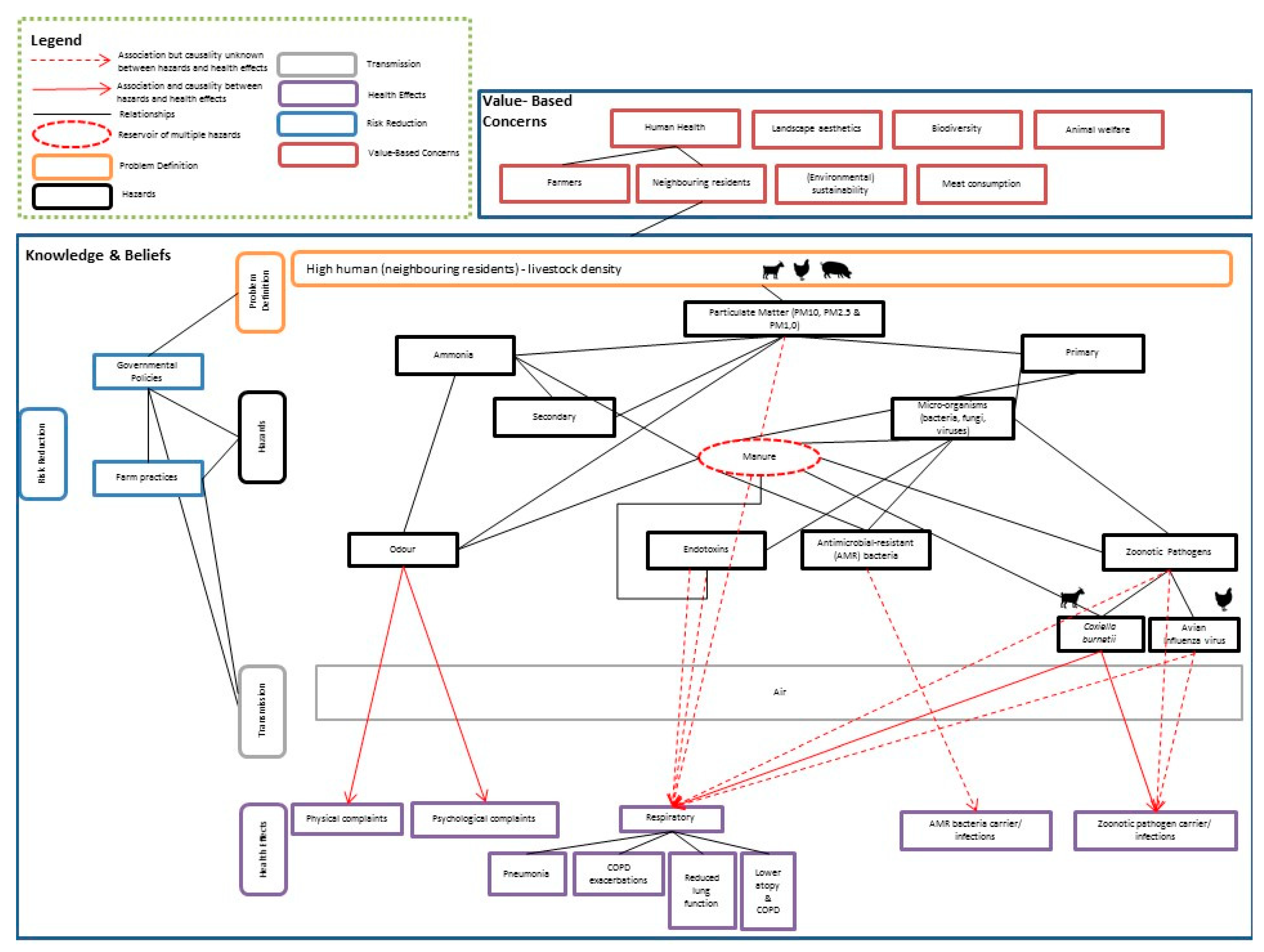
3.1. Problem Definition
3.2. Human Health Hazards
3.3. Transmission
3.4. Health Effects
3.4.1. Physical and Psychological Complaints Related to Odour
“I think that people in the area experience this [odour] as the biggest problem but that this [particulate matter] is probably the biggest problem … When it comes to the impact on public health … I think that people do not get sick of smell and annoyance, probably stress.”(Expert 3)
“You won’t get sick from smell. It will affect you mentally but not physically. It is also very annoying but it is not deadly.”(Expert 17)
“I smell something so apparently that air spreads over my house and over my garden. I smell it and people have also become ill. What else is in it? I think that is what worries people.”(Expert 16)
3.4.2. Respiratory Effects
“I think that it is a major problem in the Netherlands at all levels: traffic but also with livestock farming. Yet we do not know how large the contribution of livestock farming is to particulate matter. Nonetheless, particulate matter causes a lot of illness and deaths, that is clear.”(Expert 13)
3.4.3. Antimicrobial Resistant Bacteria Carrier/Infections
3.4.4. Zoonotic Pathogen Carrier/Infections
3.5. Risk Reduction
3.6. Broader Expert Concerns
“Zoonoses can also come from one animal and there is of course a lot of debate at this moment about poultry where you sometimes have to deal with bird flu, where the risks of small-scale poultry farms may be greater than for very large intensive farms. These often have better biosecurity compared to smaller farms.”(Expert 1)
“If you look purely at the health technical aspects and the animal welfare aspects, they are better off in the current livestock farming systems than in the old livestock farming systems.”(Expert 10)
“Sustainability, the environment, the manure fraud and every time in the news that we produce far too much manure and have far too many animals. The landscape, the nature, the lapwings [type of bird] that are killed by mowing machines, the predatory birds and the insects that are scarcely there, and bird species that are dying out.”(Expert 5)
“The countryside is not becoming more beautiful. Livestock farming is no longer a small farmer with some animals with a landscape function, but it is increasingly becoming an industry and it is becoming a problem to fit in the landscape. And at some point you can ask why for God’s sake it has to take place in the countryside if it is not land-bound.”(Expert 7)
“… I forgot about animal suffering. Perhaps we should be neater and friendlier… I do not mind that animals are raised for consumption but it has to be done in a decent way.”(Expert 2)
“There are certainly sustainable and animal welfare friendly large-scale farms. Perhaps especially large-scale farms as it provides economic opportunities to generate a number of conditions in barns in terms of improved air quality, animal welfare and sustainability. You often have to make large investments.”(Expert 12)
“Those small farmers do not have air filtering system… therefore the entire business management is much more moderate than the rest, but people get a more romantic image of that. A small peasant farmer in the landscape is more attractive and more fun but whether it is efficient and healthy is very much the question.“(Expert 13)
“But now in the Netherlands we have 54 million animals, 4 times as much as the number of inhabitants that is of course completely unmanageable. There is a misbalance.”(Expert 17)
“It is very crazy that on such a small area we have millions of pigs, millions of cows, have to import food to feed the system and then have to throw all of that manure on our own land. So there is over-fertilization, there is also eutrophication resulting in manure in surface water. This leads to all kinds of problems in ditches and rivers etc. and we have been able to manage it to a certain extent, but it is a huge burden from the livestock industry, which is not sustainable in the long-run.”(Expert 7)
“… the interests between animal welfare, environmentally friendly, cost price, food safety; those are interests that all demand a different solution… yet we all want it to be safe for the environment, food is safe, welfare of animals is guaranteed and that a farmer can earn a living.”(Expert 18)
“I have not reached the point that I do not eat meat at all but somewhere you are part of the problem, so you are also part of the solution.”(Expert 18)
4. Discussion
4.1. Strengths and Limitations
4.2. Implications for Future Research
5. Conclusions
Supplementary Materials
Author Contributions
Funding
Acknowledgments
Conflicts of Interest
References
- CBS. Agriculture; Crops, Animals and Land Use by Region [In Dutch: Landbouw; Gewassen, Dieren en Grondgebruik Naar Regio]. 2018. Available online: https://opendata.cbs.nl/statline/#/CBS/nl/dataset/80780ned/table?dl=1525B (accessed on 17 April 2019).
- Smit, L.A.; Heederik, D. Impacts of intensive livestock production on human health in densely populated regions. GeoHealth 2017, 1, 272–277. [Google Scholar] [CrossRef] [Scilit]
- Vanhonacker, F.; Verbeke, W.; van Poucke, E.; Buijs, S.; Tuyttens, F.A. Societal concern related to stocking density, pen size and group size in farm animal production. Livestock Sci. 2009, 123, 16–22. [Google Scholar] [CrossRef] [Scilit]
- Borlée, F. Respiratory Health Effects of Livestock Farm Emissions in Neighbouring Residents; Utrecht University: Utrecht, The Netherlands, 2018. [Google Scholar]
- Maassen, K.; Smit, L.; Wouters, I.; van Duijkeren, E.; Janse, I.; Hagenaars, T.; Heederik, D. Veehouderij en Gezondheid Omwonenden; RIVM Rapport; Rijksinstituut voor Volksgezondheid en Milieu RIVM: Utrecht, The Netherlands, 2016. [Google Scholar]
- Hagenaars, T.; Hoeksma, P.; de Roda Husman, A.M.; Swart, A.; Wouters, I.M. Livestock Farming and Neighbouring Residents’ Health (Additional Studies): Analysis of Health Effects, risk Factors and Emission of Bio-Aerosols; [In Dutch: Veehouderij en Gezondheid Omwonenden (Aanvullende Studies): Analyse van Gezondheidseffecten, Risicofactoren en Uitstoot van Bio-aerosolen]; RIVM Rapport; Rijksinstituut voor Volksgezondheid en Milieu RIVM: Utrecht, The Netherlands, 2017. [Google Scholar]
- Health Council of The Netherlands. Health Risks around Livestock Farms: Follow-up Advice [In Dutch: Gezondheidsrisico’s Rond Veehouderijen: Vervolgadvies]; Health Council of The Netherlands: The Hague, The Netherlands, 2018. [Google Scholar]
- IJzermans, C.J.; Smit, L.A.M.; Heederik, D.J.J.; Hagenaars, T.J.; Baliatsas, C.; Dückers, M.; Petie, R. Livestock Farming and Health of Local Residents III: Pneumonia in the Vicinity of Goat and Poultry Farms; Updating Data from General Practices 2014–2016; [In Dutch: Veehouderij en gezondheid Omwonenden III: Longontsteking in de Nabijheid van geiten-En Pluimveehouderijen; Actualisering van Gegevens uit Huisartspraktijken 2014–2016]; Nivel: Utrecht, The Netherlands, 2018. [Google Scholar]
- Kraaij-Dirkzwager, M.; van der Ree, J.; Lebret, E. Rapid Assessment of Stakeholder Concerns about Public Health. An Introduction to a Fast and Inexpensive Approach Applied on Health Concerns about Intensive Animal Production Systems. Int. J. Environ. Res. Public Health 2017, 14, 1534. [Google Scholar] [CrossRef] [Scilit] [PubMed]
- Renn, O. Stakeholder and public involvement in risk governance. Int. J. Disaster Risk Sci. 2015, 6, 8–20. [Google Scholar] [CrossRef] [Scilit]
- Alford, J.; Head, B.W. Wicked and less wicked problems: A typology and a contingency framework. Policy Soc. 2017, 36, 397–413. [Google Scholar] [CrossRef] [Scilit]
- Rittel, H.W.; Webber, M.M. Dilemmas in a general theory of planning. Policy Sci. 1973, 4, 155–169. [Google Scholar] [CrossRef] [Scilit]
- Batie, S.S. Wicked Problems and Applied Economics; Oxford University Press: Oxford, UK, 2008. [Google Scholar]
- Knowledge Platform for Livestock Farming and Human Health. Social Dialogue [In Dutch: Maatschappelijk Dialoog]. Available online: https://www.kennisplatformveehouderij.nl/sites/default/files/2018-04/Kennisbericht_Maatschappelijke%2520dialoog%2520DEF.pdf (accessed on 1 November 2018).
- Batie, S.S.; Schweikhardt, D.B. Societal concerns as wicked problems: the case of trade liberalisation. In Policy Responses to Societal Concerns in Food and Agriculture Proceedings of an OECD Workshop; OECD: Paris, France, 2010. [Google Scholar]
- Head, B.W. Wicked Problems in Public Policy. Public Policy 2008, 3, 101. [Google Scholar]
- Head, B.W.; Alford, J. Wicked problems: Implications for public policy and management. Administr. Soc. 2015, 47, 711–739. [Google Scholar] [CrossRef] [Scilit]
- Morgan, M.G.; Fischhoff, B.; Bostrom, A.; Atman, C.J. Risk Communication: A Mental Models Approach; Cambridge University Press: Cambridge, UK, 2002. [Google Scholar]
- Lowe, T.D.; Lorenzoni, I. Danger is all around: Eliciting expert perceptions for managing climate change through a mental models approach. Glob. Environ. Chang. 2007, 17, 131–146. [Google Scholar] [CrossRef] [Scilit]
- Statement 201207317/1/R3, Dutch Council of State. The Hague, Netherlands, 17 July 2013.
- Heederik, D.J.J.; Opstal-van Winden, A.J.W.; Smit, L.A.M.; Wouters, I.M.; Hooiveld, M.; IJzermans, C.J.; van Rotterdam, B. Possible Effects of Intensive livestock Farming on the Health of Local Residents: Research into Potential Exposure and Health Problems; [In Dutch: Mogelijke Effecten van Intensieve-Veehouderij op de Gezondheid van Omwonenden: Onderzoek Naar Potentiële Blootstelling en Gezondheidsproblemen]; NIVEL: Utrecht, The Netherlands, 2011. [Google Scholar]
- Gies, E.; Van Os, J.; Hermans, T.; Loohuis, R.O. Megafarms in the Picture; [In Dutch: Megastallen in Beeld]; Alterra: Wageningen, The Netherlands, 2007. [Google Scholar]
- Alders, H.; de Groot, M. From Mega to Better. Reporting the Social Dialogue on Scale Enlargement and Future of Livestock Farming; [In Dutch: Van mega naar beter. Rapportage van de Maatschappelijke Dialoog over Schaalgrootte en Toekomst van de Veehouderij]; Ministerie van Economische Zaken, Landbouw en Innovatie: Haag, The Netherlands, 2011. [Google Scholar]
- Bos, A.P.; Grin, J.; Spoelstra, S.F.; Koerkamp, P.G. Dimensies van Groei in de Veehouderij = Dimensions of Growth in Livestock Production; Wageningen UR Livestock Research: Wageningen, The Netherlands, 2010. [Google Scholar]
- Dungan, R. Board-invited review: Fate and transport of bioaerosols associated with livestock operations and manures. J. Anim. Sci. 2010, 88, 3693–3706. [Google Scholar] [CrossRef] [Scilit]
- Casey, J.A.; Kim, B.F.; Larsen, J.; Price, L.B.; Nachman, K. Industrial food animal production and community health. Curr. Environ. Health Rep. 2015, 2, 259–271. [Google Scholar] [CrossRef] [Scilit]
- Douglas, P.; Robertson, S.; Gay, R.; Hansell, A.L.; Gant, T.W. A systematic review of the public health risks of bioaerosols from intensive farming. Int. J. Hygiene Environ. Health 2018, 221, 134–173. [Google Scholar] [CrossRef] [Scilit]
- O’Connor, A.M.; Auvermann, B.W.; Dzikamunhenga, R.S.; Glanville, J.M.; Higgins, J.P.; Kirychuk, S.P.; Von Essen, S.G. Updated systematic review: Associations between proximity to animal feeding operations and health of individuals in nearby communities. Syst. Rev. 2017, 6, 86. [Google Scholar]
- O’Connor, A.M.; Auvermann, B.; Bickett-Weddle, D.; Kirkhorn, S.; Sargeant, J.M.; Ramirez, A.; Von Essen, S.G. The association between proximity to animal feeding operations and community health: A systematic review. PLoS ONE 2010, 5, e9530. [Google Scholar] [CrossRef] [Scilit]
- Wing, S.; Wolf, S. Intensive livestock operations, health, and quality of life among eastern North. Carolina residents. Environ. Health Perspectiv. 2000, 108, 233–238. [Google Scholar] [CrossRef]
- Schiffman, S.S.; Miller, E.A.S.; Suggs, M.S.; Graham, B.G. The effect of environmental odors emanating from commercial swine operations on the mood of nearby residents. Brain Res. Bull. 1995, 37, 369–375. [Google Scholar] [CrossRef] [Scilit]
- Horton, R.A.; Wing, S.; Marshall, S.W.; Brownley, K.A. Malodor as a trigger of stress and negative mood in neighbors of industrial hog operations. Am. J. Public Health 2009, 99, S610–S615. [Google Scholar] [CrossRef] [Scilit]
- Tajik, M.; Muhammad, N.; Lowman, A.; Thu, K.; Wing, S.; Grant, G. Impact of odor from industrial hog operations on daily living activities. N. Solut. J. Environ. Occ. Health Policy 2008, 18, 193–205. [Google Scholar] [CrossRef] [Scilit]
- Radon, K.; Peters, A.; Praml, G.; Ehrenstein, V.; Schulze, A.; Hehl, O.; Nowak, D. Livestock odours and quality of life of neighbouring residents. Ann. Agric. Environ. Med. 2004, 11, 59–62. [Google Scholar]
- Hooiveld, M.; van Dijk, C.E.; van der Sman-de Beer, F.; Smit, L.A.; Vogelaar, M.; Wouters, I.M.; Yzermans, C.J. Odour annoyance in the neighbourhood of livestock farming–perceived health and health care seeking behaviour. Ann. Agric. Environ. Med. 2015, 22, 55–61. [Google Scholar] [CrossRef] [Scilit]
- Smit, P.H. Goat Stop in Most Provinces for Fear of Health Risks; [In Dutch: Geitenstop in Meeste Provincies uit Angst Voor Gezondheidsrisico’s]. Available online: https://www.volkskrant.nl/nieuws-achtergrond/geitenstop-in-meeste-provincies-uit-angst-voor-gezondheidsrisico-s~b2f44cdd/ (accessed on 27 September 2019).
- Geelen, L.; Boers, D.; Brunekreef, B.; Wouters, I. Odor Nuisance from Livestock Farming Examined Further: More Nuisance than Guideline Wgv suggeste; [In Dutch: Geurhinder van Veehouderij Nader Onderzocht: Meer Hinder dan Handreiking Wgv doet Vermoeden]; Bureau Gezondheid, Milieu & Veiligheid GGD’en Brabant/Zeeland en Institute for Risk Assessment Sciences, Universiteit Utrecht: Tilburg, The Netherlands, 2015; Volume 23. [Google Scholar]
- MARAN. Monitoring of Antimicrobial Resistance and Antibiotic Usafe in Animals in The Netherlands in 2017; Ministry of Economic Affairs: Haag, The Netherlands, 2018. [Google Scholar]
- Melse, R.; Nijeboer, G.; Ogink, N. Evaluation of Odour Removal by air Filters at Stables; Part. 1: Exploratory Research into the Functioning of Combined air Filters and Differences between Odour Laboratories; [In Dutch: Evaluatie Geurverwijdering Door Luchtwassystemen bij Stallen; Deel 1: Oriënterend Onderzoek naar Werking Gecombineerde Luchtwassers en Verschillen Tussen Geurlaboratoria]; Wageningen Livestock Research: Wageningen, The Netherlands, 2018. [Google Scholar]
- Melse, R.; Nijeboer, G.; Ogink, N. Evaluation of Odour Removal by air Filters at Stables; Part. 2: Sample Efficiency air Filters in Practice; [In Dutch: Evaluatie Geurverwijdering Door Luchtwassystemen bij Stallen; Deel 2: Steekproef Rendement Luchtwassers in de Praktijk]; Wageningen Livestock Research: Wageningen, The Netherlands, 2018. [Google Scholar]
- Carey, J.M.; Burgman, M.A. Linguistic uncertainty in qualitative risk analysis and how to minimize it. Ann. N.Y. Acad. Sci. 2008, 1128, 13–17. [Google Scholar] [CrossRef] [Scilit]
- Schiffman, S.S.; Walker, J.M.; Dalton, P.; Lorig, T.S.; Raymer, J.H.; Shusterman, D.; Williams, C.M. Potential health effects of odor from animal operations, wastewater treatment, and recycling of byproducts. J. Agromed. 2000, 7, 7–81. [Google Scholar] [CrossRef] [Scilit]
- Radon, K.; Schulze, A.; Ehrenstein, V.; van Strien, R.T.; Praml, G.; Nowak, D. Environmental exposure to confined animal feeding operations and respiratory health of neighboring residents. Epidemiology 2007, 18, 300–308. [Google Scholar] [CrossRef] [Scilit]
- Sigurdarson, S.T.; Kline, J.N. School proximity to concentrated animal feeding operations and prevalence of asthma in students. Chest 2006, 129, 1486–1491. [Google Scholar] [CrossRef] [Scilit]
- Rasmussen, S.; Casey, J.; Bandeen-Roche, K.; Schwartz, B. Proximity to industrial food animal production and asthma exacerbations in Pennsylvania, 2005–2012. Int. J. Environ. Res. Public Health 2017, 14, 362. [Google Scholar] [CrossRef] [Scilit]
- Lunenburg, F.C. Communication: The process, barriers, and improving effectiveness. Schooling 2010, 1, 1–10. [Google Scholar]
- Van Eeten, M.J. Dialogues of the deaf’on science in policy controversies. Sci. Public Policy 1999, 26, 185–192. [Google Scholar] [CrossRef] [Scilit]
- World Health Organization. Constitution of the World Health Organization; WHO: Geneva, Switzerland, 1946. [Google Scholar]
- Smeets, M.; Fast, T. Dose Effect Relation Odor, Effects of Odor; [In Dutch: Dosis Effect Relatie Geur, Effecten van Geur]; Opdekamp adviesgroep, Universiteit Utrecht, Fast advies: Haag, The Netherlands, 2006. [Google Scholar]
- Dietz, T.; Fitzgerald, A.; Shwom, R. Environmental values. Ann. Rev. Environ. Resour. 2005, 30, 335–372. [Google Scholar] [CrossRef] [Scilit]
- Verhue, D.; Vieira, V.; Koenen, B.; Van Kalmthout, R. Opinions About Megafarms. A Study into the Social Support for Mega Stables and the Views on This; [In Dutch: Opvattingen over Megastallen. Een Onderzoek naar het Maatschappelijk Draagvlak voor Megastallen en de Opvattingen Hierover]; Verhue: Amsterdam, The Netherlands, 2011. [Google Scholar]
- Blanes-Vidal, V.; Suh, H.; Nadimi, E.S.; Løfstrøm, P.; Ellermann, T.; Andersen, H.V.; Schwartz, J. Residential exposure to outdoor air pollution from livestock operations and perceived annoyance among citizens. Environ. Int. 2012, 40, 44–50. [Google Scholar] [CrossRef] [Scilit]
- Biesheuvel, P.J.; Groothuijse, F.; Jeurissen, E.; Melse, R.W.; van Poll, R. Smell: Combi air Washers, Pig Farms and Odor Nuisance; [In Dutch: Geur Bekennen: Combi-Luchtwassers, Varkenshouderijen en Geurhinder]; Overlegorgaan Fysieke Leefomgeving: Haag, The Netherlands, 2019. [Google Scholar]
- Swierstra, T.; Molder, H. Risk and soft impacts. In Handbook of risk theory: Epistemology, Decision Theory, Ethics, and Social Implications of Risk; Springer: Berlin, Germany, 2012; pp. 1049–1066. [Google Scholar]
- Aarts, N. The Art of Dialogue; Wageningen University: Wageningen, The Netherlands, 2015. [Google Scholar]
- Frewer, L. The public and effective risk communication. Toxicol. Lett. 2004, 149, 391–397. [Google Scholar] [CrossRef] [Scilit]

| Gender | n |
|---|---|
| Men | 12 |
| Women | 8 |
| Background | |
| Public health, | 5 |
| Veterinary sciences, | 5 |
| Other: engineering, toxicology, molecular biology, | 5 |
| Social sciences | 5 |
© 2019 by the authors. Licensee MDPI, Basel, Switzerland. This article is an open access article distributed under the terms and conditions of the Creative Commons Attribution (CC BY) license (http://creativecommons.org/licenses/by/4.0/).
Share and Cite
Eijrond, V.; Claassen, L.; van der Giessen, J.; Timmermans, D. Intensive Livestock Farming and Residential Health: Experts’ Views. Int. J. Environ. Res. Public Health 2019, 16, 3625. https://doi.org/10.3390/ijerph16193625
Eijrond V, Claassen L, van der Giessen J, Timmermans D. Intensive Livestock Farming and Residential Health: Experts’ Views. International Journal of Environmental Research and Public Health. 2019; 16(19):3625. https://doi.org/10.3390/ijerph16193625
Chicago/Turabian StyleEijrond, Valérie, Liesbeth Claassen, Joke van der Giessen, and Danielle Timmermans. 2019. "Intensive Livestock Farming and Residential Health: Experts’ Views" International Journal of Environmental Research and Public Health 16, no. 19: 3625. https://doi.org/10.3390/ijerph16193625
APA StyleEijrond, V., Claassen, L., van der Giessen, J., & Timmermans, D. (2019). Intensive Livestock Farming and Residential Health: Experts’ Views. International Journal of Environmental Research and Public Health, 16(19), 3625. https://doi.org/10.3390/ijerph16193625

