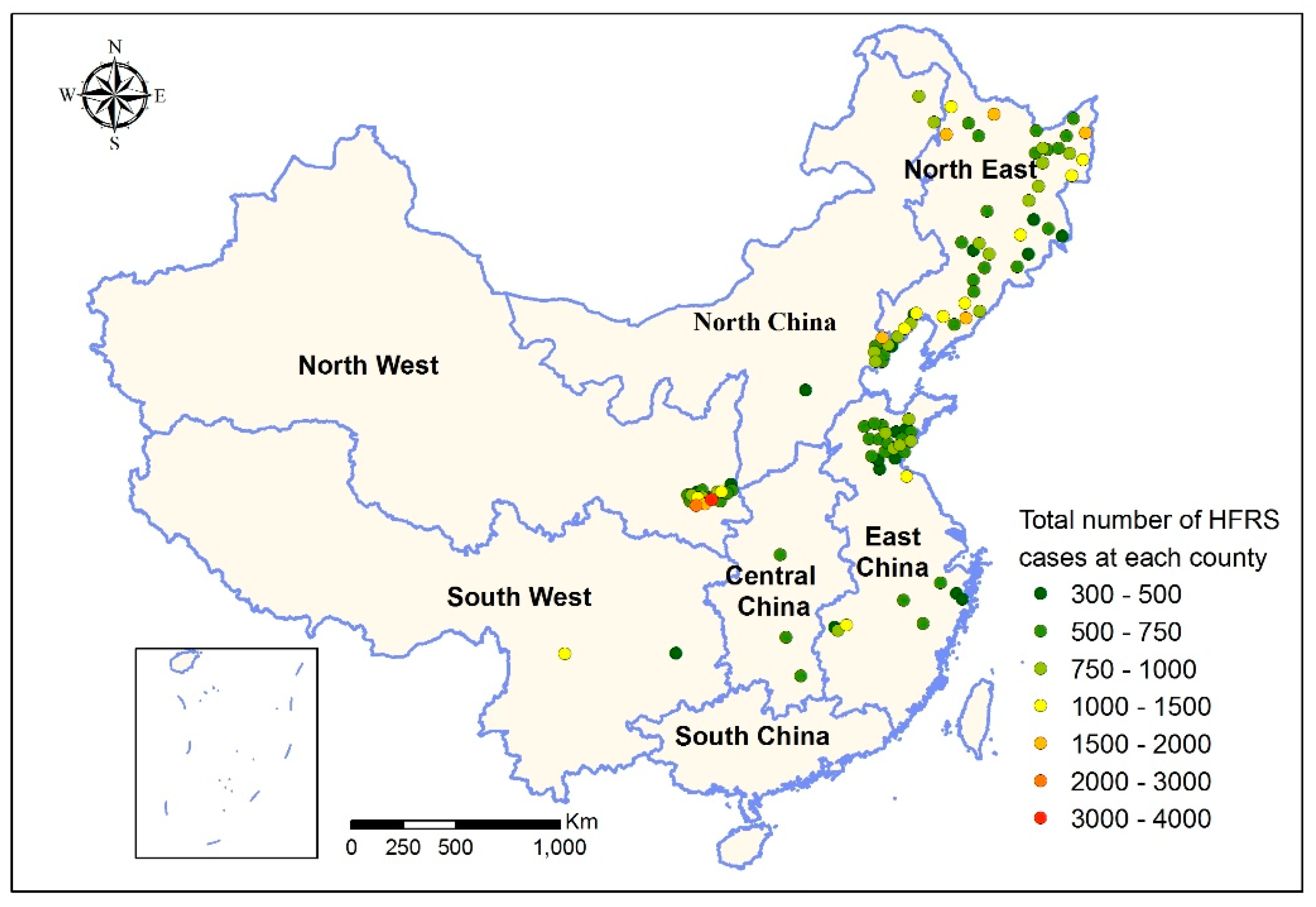
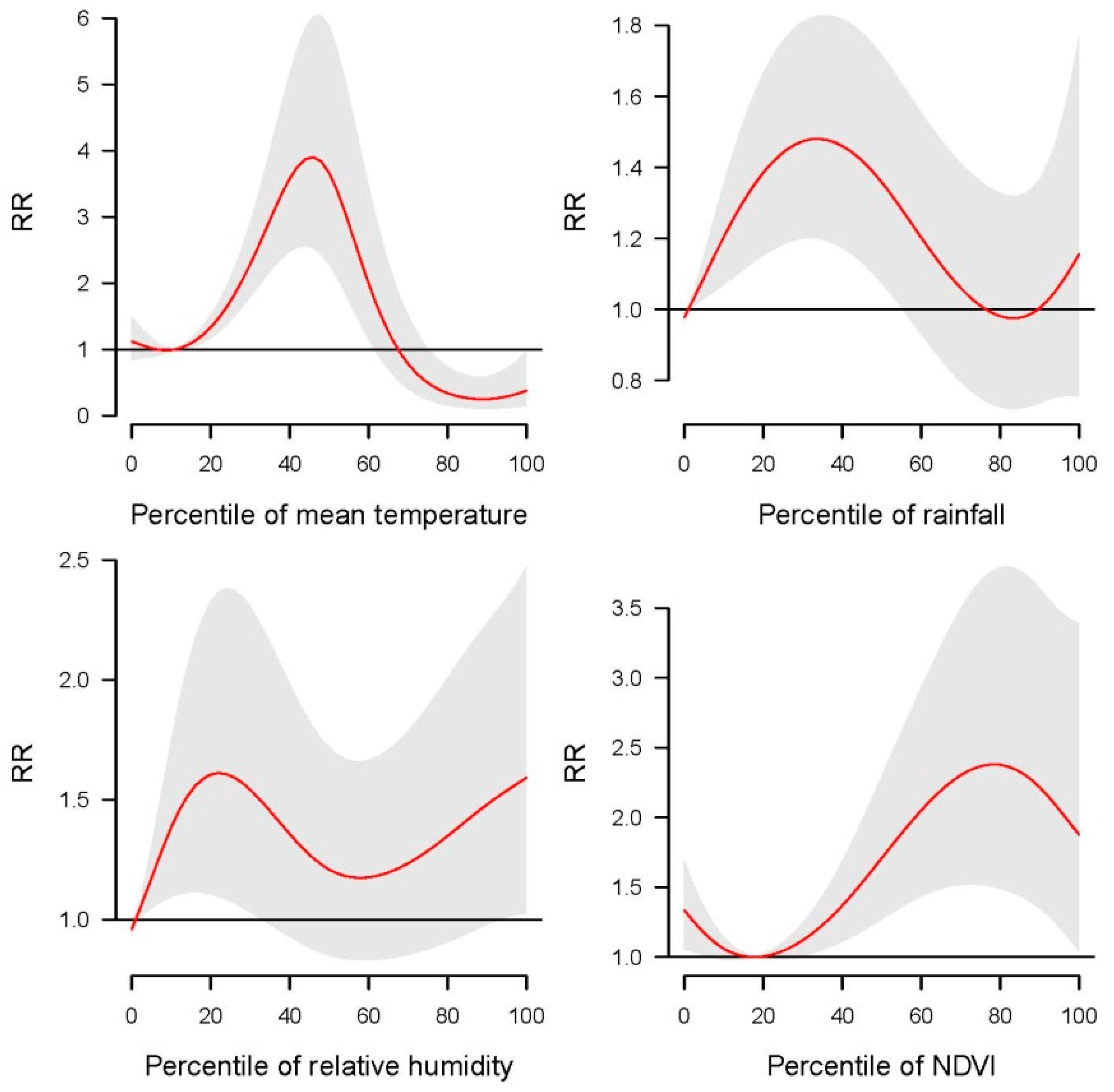
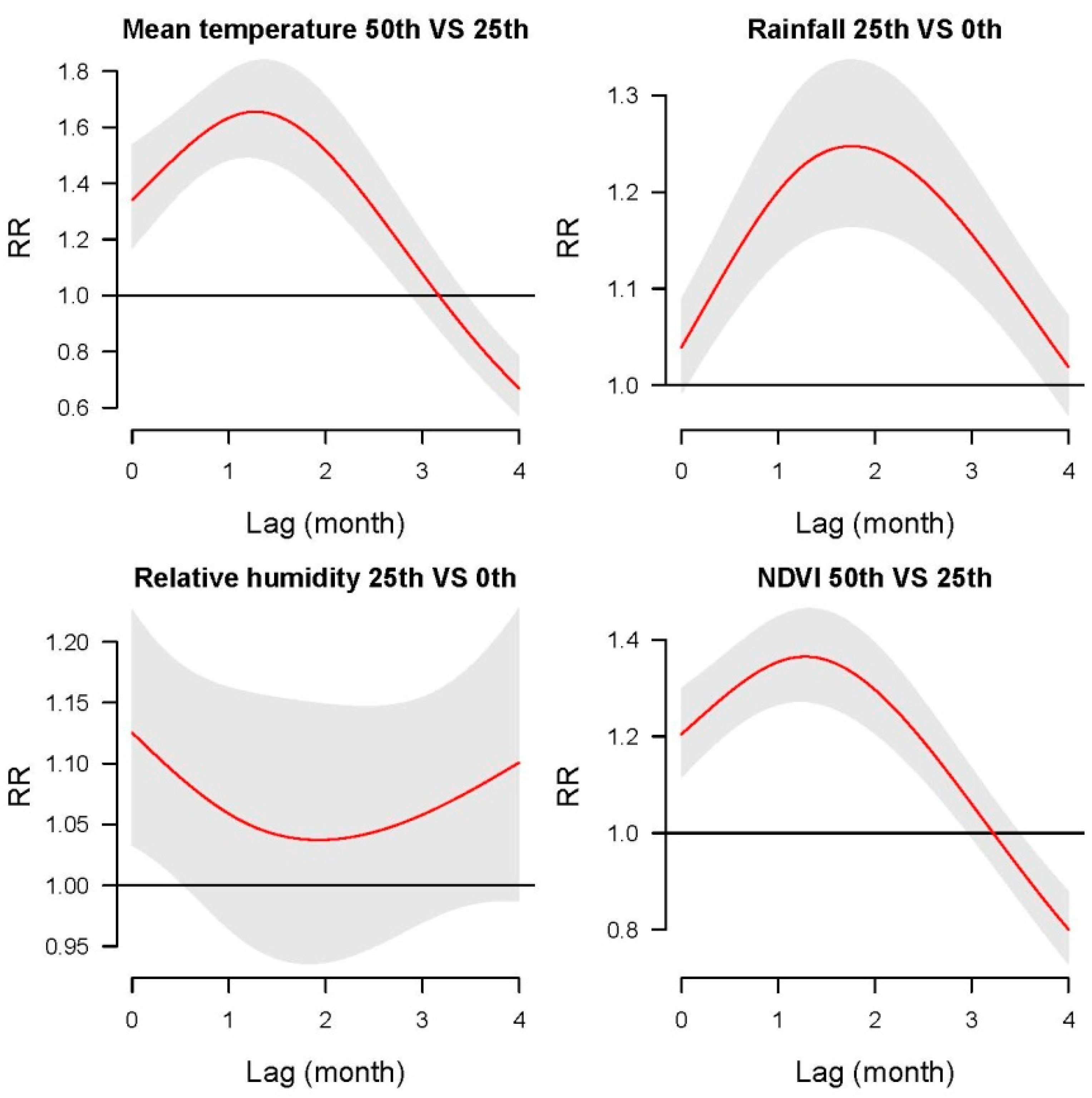
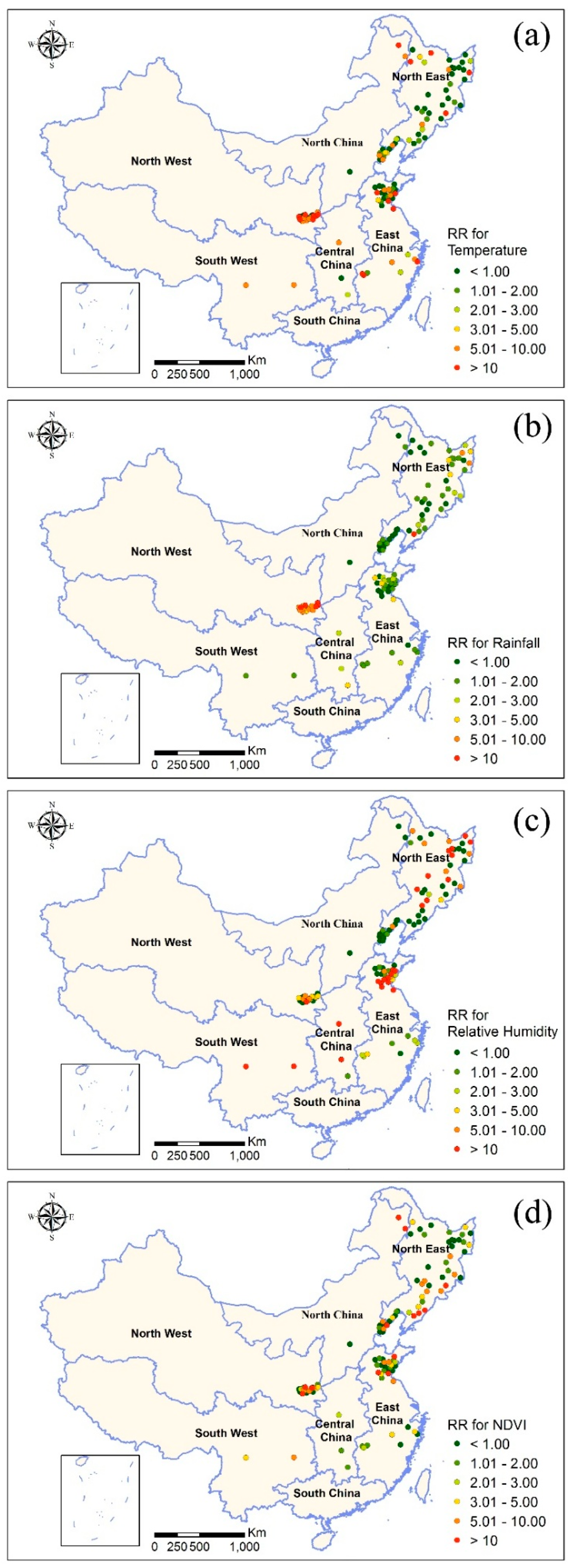
The Impacts of Climatic Factors and Vegetation on Hemorrhagic Fever with Renal Syndrome Transmission in China: A Study of 109 Counties

 ,
, 


Abstract
1. Introduction
2. Materials and Methods
2.1. Data Collection
2.2. Statistical Analysis
2.2.1. First Stage Analysis
2.2.2. Second Stage Analysis
2.2.3. Sensitivity Analysis
3. Results
4. Discussion
5. Conclusions
Supplementary Materials
Author Contributions
Funding
Conflicts of Interest
References
- Fang, L.; Yan, L.; Liang, S.; de Vlas, S.J.; Feng, D.; Han, X.; Zhao, W.; Xu, B.; Bian, L.; Yang, H. Spatial analysis of hemorrhagic fever with renal syndrome in China. BMC Infect. Dis. 2006, 6, 77. [Google Scholar] [CrossRef] [Scilit] [PubMed]
- Zou, L.-X.; Chen, M.-J.; Sun, L. Haemorrhagic fever with renal syndrome: Literature review and distribution analysis in China. Int. J. Infect. Dis. 2016, 43, 95–100. [Google Scholar] [CrossRef] [Scilit] [PubMed]
- Zhang, Y.-Z.; Zou, Y.; Fu, Z.F.; Plyusnin, A. Hantavirus infections in humans and animals, China. Emerg. Infect. Dis. 2010, 16, 1195–1203. [Google Scholar] [CrossRef] [Scilit]
- Chinikar, S.; Javadi, A.A.; Hajiannia, A.; Ataei, B.; Jalali, T.; Khakifirouz, S.; Nowotny, N.; Schmidt-Chanasit, J.; Shahhosseini, N. First Evidence of Hantavirus in Central Iran as an Emerging Viral Disease. Adv. Infect. Dis. 2014, 4, 173–177. [Google Scholar] [CrossRef]
- Zhang, W.-Y.; Guo, W.-D.; Fang, L.-Q.; Li, C.-P.; Bi, P.; Glass, G.E.; Jiang, J.-F.; Sun, S.-H.; Qian, Q.; Liu, W. Climate variability and hemorrhagic fever with renal syndrome transmission in Northeastern China. Environ. Health Perspect. 2010, 118, 915–920. [Google Scholar] [CrossRef] [Scilit] [PubMed]
- Liu, J.; Xue, F.; Wang, J.; Liu, Q. Association of haemorrhagic fever with renal syndrome and weather factors in Junan County, China: A case-crossover study. Epidemiol. Infect. 2013, 141, 697–705. [Google Scholar] [CrossRef] [Scilit] [PubMed]
- Krautkrämer, E.; Zeier, M.; Plyusnin, A. Hantavirus infection: An emerging infectious disease causing acute renal failure. Kidney Int. 2013, 83, 23–27. [Google Scholar] [CrossRef] [Scilit]
- Ma, C.; Wang, Z.; Li, S.; Xing, Y.; Wu, R.; Wei, J.; Nawaz, M.; Tian, H.; Xu, B.; Wang, J. Analysis of an outbreak of hemorrhagic fever with renal syndrome in college students in Xi’an, China. Viruses 2014, 6, 507–515. [Google Scholar] [CrossRef] [Scilit]
- Puca, E.; Pilaca, A.; Pipero, P.; Kalo, T.; Stroni, G.; Qyra, E.; Puca, E.Y.; Kraja, D. A short review of hemorrhagic fever with renal syndrome and it’s extrarenal complications. J. Microbiol. Infect. Dis. 2014, 4, 54–57. [Google Scholar] [CrossRef] [Scilit]
- Gubler, D.J.; Reiter, P.; Ebi, K.L.; Yap, W.; Nasci, R.; Patz, J.A. Climate variability and change in the United States: Potential impacts on vector-and rodent-borne diseases. Environ. Health Perspect. 2001, 109, 223–233. [Google Scholar]
- Liu, H.-N.; Gao, L.-D.; Chowell, G.; Hu, S.-X.; Lin, X.-L.; Li, X.-J.; Ma, G.-H.; Huang, R.; Yang, H.-S.; Tian, H. Time-specific ecologic niche models forecast the risk of hemorrhagic fever with renal syndrome in Dongting Lake district, China, 2005–2010. PLoS ONE 2014, 9, e106839. [Google Scholar] [CrossRef] [Scilit]
- Parmenter, R.R.; Yadav, E.P.; Parmenter, C.A.; Ettestad, P.; Gage, K.L. Incidence of plague associated with increased winter-spring precipitation in New Mexico. Am. J. Trop. Med. Hyg. 1999, 61, 814–821. [Google Scholar] [CrossRef] [Scilit]
- Stenseth, N.C.; Mysterud, A.; Ottersen, G.; Hurrell, J.W.; Chan, K.-S.; Lima, M. Ecological effects of climate fluctuations. Science 2002, 297, 1292–1296. [Google Scholar] [CrossRef] [Scilit]
- White, T. The role of food, weather and climate in limiting the abundance of animals. Biol. Rev. 2008, 83, 227–248. [Google Scholar] [CrossRef] [Scilit]
- Xiao, H.; Tian, H.-Y.; Cazelles, B.; Li, X.-J.; Tong, S.-L.; Gao, L.-D.; Qin, J.-X.; Lin, X.-L.; Liu, H.-N.; Zhang, X.-X. Atmospheric moisture variability and transmission of hemorrhagic fever with renal syndrome in Changsha City, Mainland China, 1991–2010. PLoS Negl. Trop. Dis. 2013, 7, e2260. [Google Scholar] [CrossRef] [Scilit]
- Li, C.-P.; Cui, Z.; Li, S.-L.; Magalhaes, R.J.S.; Wang, B.-L.; Zhang, C.; Sun, H.-L.; Li, C.-Y.; Huang, L.-Y.; Ma, J. Association between hemorrhagic fever with renal syndrome epidemic and climate factors in Heilongjiang Province, China. Am. J. Trop. Med. Hyg. 2013, 89, 1006–1012. [Google Scholar] [CrossRef] [Scilit]
- Bennett, S.G.; Webb, J.P., Jr.; Madon, M.B.; Childs, J.E.; Ksiazek, T.G.; Torrez-Martinez, N.; Hjelle, B. Hantavirus (Bunyaviridae) infections in rodents from Orange and San Diego counties, California. Am. J. Trop. Med. Hyg. 1999, 60, 75–84. [Google Scholar] [CrossRef] [Scilit]
- Gasparrini, A.; Armstrong, B.; Kenward, M.G. Distributed lag non-linear models. Stat. Med. 2010, 29, 2224–2234. [Google Scholar] [CrossRef] [Scilit]
- Guo, Y.; Gasparrini, A.; Armstrong, B.; Li, S.; Tawatsupa, B.; Tobias, A.; Lavigne, E.; Coelho, M.d.S.Z.S.; Leone, M.; Pan, X. Global variation in the effects of ambient temperature on mortality: A systematic evaluation. Epidemiology 2014, 25, 781–789. [Google Scholar] [CrossRef] [Scilit]
- Gasparrini, A.; Armstrong, B. Reducing and meta-analysing estimates from distributed lag non-linear models. BMC Med Res. Methodol. 2013, 13, 1. [Google Scholar] [CrossRef] [Scilit]
- Gasparrini, A. Modeling exposure–lag–response associations with distributed lag non-linear models. Stat. Med. 2014, 33, 881–899. [Google Scholar] [CrossRef] [Scilit]
- Gasparrini, A.; Armstrong, B.; Kenward, M. Multivariate meta-analysis for non-linear and other multi-parameter associations. Stat. Med. 2012, 31, 3821–3839. [Google Scholar] [CrossRef] [Scilit]
- Gasparrini, A. Distributed lag linear and non-linear models in R: The package dlnm. J. Stat. Softw. 2011, 43, 1–20. [Google Scholar] [CrossRef] [Scilit]
- Phung, D.; Guo, Y.; Nguyen, H.T.; Rutherford, S.; Baum, S.; Chu, C. High temperature and risk of hospitalizations, and effect modifying potential of socio-economic conditions: A multi-province study in the tropical Mekong Delta Region. Environ. Int. 2016, 92, 77–86. [Google Scholar] [CrossRef] [Scilit]
- Chen, G.; Zhang, W.; Li, S.; Zhang, Y.; Williams, G.; Huxley, R.; Ren, H.; Cao, W.; Guo, Y. The impact of ambient fine particles on influenza transmission and the modification effects of temperature in China: A multi-city study. Environ. Int. 2017, 98, 82–88. [Google Scholar] [CrossRef] [Scilit]
- Xiao, X.; Gasparrini, A.; Huang, J.; Liao, Q.; Liu, F.; Yin, F.; Yu, H.; Li, X. The exposure-response relationship between temperature and childhood hand, foot and mouth disease: A multicity study from mainland China. Environ. Int. 2017, 100, 102–109. [Google Scholar] [CrossRef] [Scilit]
- Zhao, Q.; Zhang, Y.; Zhang, W.; Li, S.; Chen, G.; Wu, Y.; Qiu, C.; Ying, K.; Tang, H.; Huang, J.-A. Ambient temperature and emergency department visits: Time-series analysis in 12 Chinese cities. Environ. Pollut. 2017, 224, 310–316. [Google Scholar] [CrossRef] [Scilit]
- Xiao, H.; Gao, L.; Li, X.; Lin, X.; Dai, X.; Zhu, P.; Chen, B.; Zhang, X.; Zhao, J.; Tian, H. Environmental variability and the transmission of haemorrhagic fever with renal syndrome in Changsha, People’s Republic of China. Epidemiol. Infect. 2013, 141, 1867–1875. [Google Scholar] [CrossRef] [Scilit]
- Tian, H.; Yu, P.; Cazelles, B.; Xu, L.; Tan, H.; Yang, J.; Huang, S.; Xu, B.; Cai, J.; Ma, C.; et al. Interannual cycles of Hantaan virus outbreaks at the human–animal interface in Central China are controlled by temperature and rainfall. Proc. Natl. Acad. Sci. USA 2017, 114, 8041–8046. [Google Scholar] [CrossRef] [Scilit]
- He, J.; Christakos, G.; Wu, J.; Cazelles, B.; Qian, Q.; Mu, D.; Wang, Y.; Yin, W.; Zhang, W. Spatiotemporal variation of the association between climate dynamics and HFRS outbreaks in Eastern China during 2005–2016 and its geographic determinants. PLoS Negl. Trop. Dis. 2018, 12, e0006554. [Google Scholar] [CrossRef] [Scilit]
- He, J.; He, J.; Han, Z.; Teng, Y.; Zhang, W.; Yin, W. Environmental Determinants of Hemorrhagic Fever with Renal Syndrome in High-Risk Counties in China: A Time Series Analysis (2002–2012). Am. J. Trop. Med. Hyg. 2018, 99, 1262–1268. [Google Scholar] [CrossRef] [Scilit]
- Wei, L.; Qian, Q.; Wang, Z.-Q.; Glass, G.E.; Song, S.-X.; Zhang, W.-Y.; Li, X.-J.; Yang, H.; Wang, X.-J.; Fang, L.-Q. Using geographic information system-based ecologic niche models to forecast the risk of hantavirus infection in Shandong Province, China. Am. J. Trop. Med. Hyg. 2011, 84, 497–503. [Google Scholar] [CrossRef] [Scilit]
- Ari, T.B.; Neerinckx, S.; Gage, K.L.; Kreppel, K.; Laudisoit, A.; Leirs, H.; Stenseth, N.C. Plague and climate: Scales matter. PLoS Pathog. 2011, 7, e1002160. [Google Scholar]
- Lima, M.; Marquet, P.A.; Jaksic, F.M. El Nino events, precipitation patterns, and rodent outbreaks are statistically associated in semiarid Chile. Ecography 1999, 22, 213–218. [Google Scholar] [CrossRef] [Scilit]
- Leirs, H.; Verhagen, R.; Verheyen, W.; Mwanjabe, P.; Mbise, T. Forecasting rodent outbreaks in Africa: An ecological basis for Mastomys control in Tanzania. J. Appl. Ecol. 1996, 33, 937–943. [Google Scholar] [CrossRef] [Scilit]
- Hardestam, J.; Simon, M.; Hedlund, K.; Vaheri, A.; Klingström, J.; Lundkvist, Å. Ex Vivo stability of the rodent-borne Hantaan virus in comparison to that of arthropod-borne members of the Bunyaviridae family. Appl. Environ. Microbiol. 2007, 73, 2547–2551. [Google Scholar] [CrossRef] [Scilit]
- Yan, L.; Fang, L.-Q.; Huang, H.-G.; Zhang, L.-Q.; Feng, D.; Zhao, W.-J.; Zhang, W.-Y.; Li, X.-W.; Cao, W.-C. Landscape elements and Hantaan virus–related hemorrhagic fever with renal syndrome, People’s Republic of China. Emerg. Infect. Dis. 2007, 13, 1301–1306. [Google Scholar] [CrossRef] [Scilit]
- He, J.; Christakos, G.; Zhang, W.; Wang, Y. A Space-Time Study of Hemorrhagic Fever with Renal Syndrome (HFRS) and Its Climatic Associations in Heilongjiang Province, China. Front. Appl. Math. Stat. 2017, 3. [Google Scholar] [CrossRef] [Scilit]
- Bi, P.; Tong, S.; Donald, K.; Parton, K.; Ni, J. Climatic, reservoir and occupational variables and the transmission of haemorrhagic fever with renal syndrome in China. Int. J. Epidemiol. 2002, 31, 189–193. [Google Scholar] [CrossRef] [Scilit]
- Mills, J.N.; Corneli, A.; Young, J.C.; Garrison, L.E.; Khan, A.S.; Ksiazek, T.G.; Centers for Disease Control and Prevention. Hantavirus Pulmonary Syndrome-United States: Updated Recommendations for Risk Reduction; Morbidity and Mortality Weekly Report Recommendations and Reports; U.S. Department of Health and Human Services: Atlanta, GA, USA, 2002; Volume 51.
- Lin, H.; Zhang, Z.; Lu, L.; Li, X.; Liu, Q. Meteorological factors are associated with hemorrhagic fever with renal syndrome in Jiaonan County, China, 2006–2011. Int. J. Biometeorol. 2014, 58, 1031–1037. [Google Scholar] [CrossRef] [Scilit]
- Joshi, Y.P.; Kim, E.-H.; Cheong, H.-K. The influence of climatic factors on the development of hemorrhagic fever with renal syndrome and leptospirosis during the peak season in Korea: An ecologic study. BMC Infect. Dis. 2017, 17, 406. [Google Scholar] [CrossRef] [Scilit]


© 2019 by the authors. Licensee MDPI, Basel, Switzerland. This article is an open access article distributed under the terms and conditions of the Creative Commons Attribution (CC BY) license (http://creativecommons.org/licenses/by/4.0/).
Share and Cite
He, J.; Wang, Y.; Mu, D.; Xu, Z.; Qian, Q.; Chen, G.; Wen, L.; Yin, W.; Li, S.; Zhang, W.; et al. The Impacts of Climatic Factors and Vegetation on Hemorrhagic Fever with Renal Syndrome Transmission in China: A Study of 109 Counties. Int. J. Environ. Res. Public Health 2019, 16, 3434. https://doi.org/10.3390/ijerph16183434
He J, Wang Y, Mu D, Xu Z, Qian Q, Chen G, Wen L, Yin W, Li S, Zhang W, et al. The Impacts of Climatic Factors and Vegetation on Hemorrhagic Fever with Renal Syndrome Transmission in China: A Study of 109 Counties. International Journal of Environmental Research and Public Health. 2019; 16(18):3434. https://doi.org/10.3390/ijerph16183434
Chicago/Turabian StyleHe, Junyu, Yong Wang, Di Mu, Zhiwei Xu, Quan Qian, Gongbo Chen, Liang Wen, Wenwu Yin, Shanshan Li, Wenyi Zhang, and et al. 2019. "The Impacts of Climatic Factors and Vegetation on Hemorrhagic Fever with Renal Syndrome Transmission in China: A Study of 109 Counties" International Journal of Environmental Research and Public Health 16, no. 18: 3434. https://doi.org/10.3390/ijerph16183434
APA StyleHe, J., Wang, Y., Mu, D., Xu, Z., Qian, Q., Chen, G., Wen, L., Yin, W., Li, S., Zhang, W., & Guo, Y. (2019). The Impacts of Climatic Factors and Vegetation on Hemorrhagic Fever with Renal Syndrome Transmission in China: A Study of 109 Counties. International Journal of Environmental Research and Public Health, 16(18), 3434. https://doi.org/10.3390/ijerph16183434