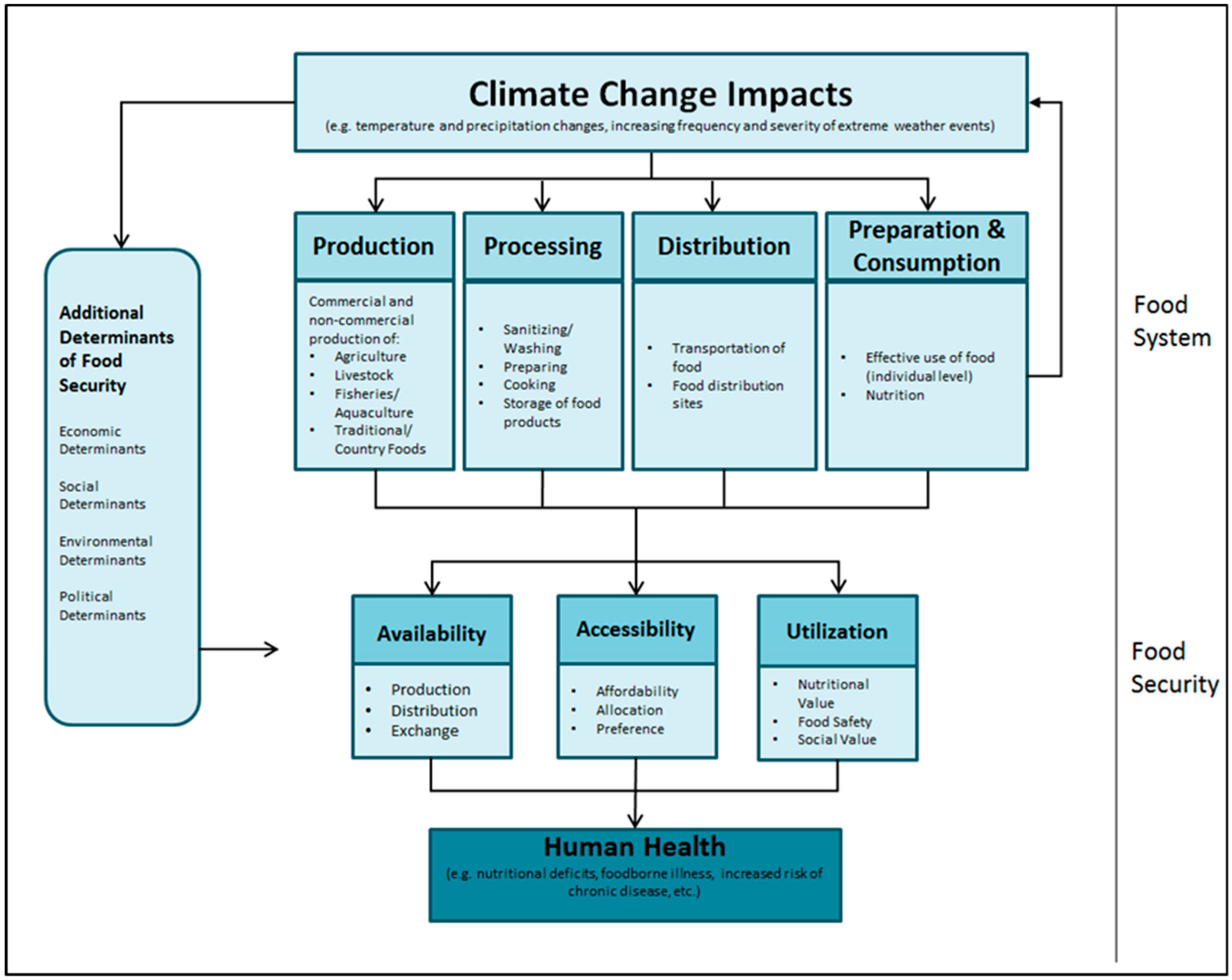
The Climate Change, Food Security and Human Health Nexus in Canada: A Framework to Protect Population Health


Abstract
1. Introduction
2. Background: Food Security in Canada
3. Methods
4. Results
4.1. The Climate Change, Food Security, and Human Health Nexus Framework
4.2. Food Production
4.3. Food Processing
4.4. Food Distribution
4.5. Food Preparation and Consumption
5. Discussion
6. Conclusions
Author Contributions
Funding
Acknowledgments
Conflicts of Interest
References
- Robine, J.M.; Cheung, S.L.; Le Roy, S.; Van Oyen, H.; Griffiths, C.; Michel, J.P.; Herrmann, F.R. Death toll exceeded 70,000 in Europe during the summer of 2003. C. R. Biol. 2008, 331, 171–178. [Google Scholar] [CrossRef] [PubMed]
- Sahni, V.; Scott, A.N.; Beliveau, M.; Varughese, M.; Dover, D.C.; Talbot, J. Public health surveillance response following the southern Alberta floods, 2013. Can. J. Public Health 2016, 107, 142–148. [Google Scholar] [CrossRef] [PubMed]
- Government of Canada. Surveillance of Lyme Disease. Available online: https://www.canada.ca/en/public-health/services/diseases/lyme-disease/surveillance-lyme-disease.html (accessed on 15 March 2019).
- Berry, P.; Clarke, K.; Fleury, M.; Parker, S. Human health. In Canada in a Changing Climate: Sector Perspectives on Impacts and Adaptation; Lemmen, D., Warren, F., Eds.; Government of Canada: Ottawa, ON, Canada, 2014; pp. 101–130. ISBN 978-1-100-24143-2. [Google Scholar]
- Health Canada. Human Health in a Changing Climate: A Canadian Assessment of Vulnerabilities and Adaptive Capacity; Health Canada: Ottawa, ON, Canada, 2008; ISBN 978-0-662-48365-6. [Google Scholar]
- Lake, I.R.; Hooper, L.; Abdelhamid, A.; Bentham, G.; Boxall, A.B.A.; Draper, A.; Fairweather-Tait, S.; Hulme, M.; Hunter, P.R.; Nichols, G.; et al. Climate change and food security: Health impacts in developed countries. Environ. Health Perspect. 2012, 120, 1520–1526. [Google Scholar] [CrossRef]
- Edwards, F.; Dixon, J.; Friel, S.; Hall, G.; Larsen, K.; Lockie, S.; Wood, B.; Lawrence, M.; Hanigan, I.; Hogan, A.; et al. Climate change adaptation at the intersection of food and health. Asia Pac. J. Public Health 2011, 23, 91S–104S. [Google Scholar] [CrossRef] [PubMed]
- Porter, J.R.; Xie, L.; Challinor, A.J.; Cochrane, K.; Howden, S.M.; Iqbal, M.M.; Lobell, D.B.; Travasso, M.I. Food security and food production systems. In Climate Change 2014: Impacts, Adaptation, and Vulnerability. Part A: Global and Sectoral Aspects. Contribution of Working Group II to the Fifth Assessment Report of the Intergovernmental Panel on Climate Change; Field, B.C., Barros, V.R., Dokken, D.J., Mach, K.J., Mastrandrea, M.D., Bilir, T.E., Chatterjee, M., Ebi, K.L., Estrada, Y.O., Genova, R.C., et al., Eds.; Cambridge University Press: Cambridge, UK, 2014; pp. 485–533. ISBN 978-1-107-64165-5. [Google Scholar]
- Watts, N.; Amann, M.; Ayeb-Karlsson, S.; Belesova, K.; Bouley, T.; Boykoff, M.; Byass, P.; Cai, W.; Campbell-Lendrum, D.; Chambers, J.; et al. The lancet countdown on health and climate change: From 25 years of inaction to a global transformation for public health. Lancet 2018, 391, 581–630. [Google Scholar] [CrossRef]
- WHO. Quantitative Risk Assessment of the Effects of Climate Change on Selected Causes of Death, 2030s and 2050s; World Health Organization: Geneva, Switzerland, 2014; ISBN 9789241507691. [Google Scholar]
- Sanchez Martinez, G.; Berry, P. The Adaptation Health Gap: A Global Overview. In The Adaptation Gap Report; United Nations Environment Programme: Nairobi, Kenya, 2018; ISBN 978-92-807-3728-8. [Google Scholar]
- FAO; IFAD; UNICEF; WFP; WH. The State of Food Security and Nutrition in the World: Building Resilience for Peace and Food Security; Food and Agriculture Organization of the United Nations: Rome, Italy, 2017; ISBN 978-92-5-109888-2. [Google Scholar]
- FSIN. Global Report on Food Crises 2017. Food Security Information Network: 2017. Available online: https://documents.wfp.org/stellent/groups/public/documents/ena/wfp291271.pdf?_ga=2.252302985.1615901461.1563215260-866744782.1563215260 (accessed on 25 June 2017).
- CCA. Aboriginal Food Security in Northern Canada: An Assessment of the State of Knowledge; Council of Canadian Academies: Ottawa, ON, Canada, 2014; ISBN 978-1-926558-74-5. [Google Scholar]
- Ford, J.D. Vulnerability of Inuit food systems to food insecurity as a consequence of climate change: A case study from Igloolik, Nunavut. Reg. Environ. Chang. 2009, 9, 83–100. [Google Scholar] [CrossRef]
- Centre for Indigenous Environmental Resources. (2006): Climate Change Impacts on Ice, Winter Roads, Access Trails, and Manitoba First Nations Study. Available online: http://www.yourcier.org/climate-change-impacts-on-ice-winter-roads-access-trails-and-manitoba-first-nations-2006.html (accessed on 10 April 2018).
- McMichael, A.; Woodward, A.; Muir, C. Climate Change and the Health of Nations: Famines, Fevers and the Fate of Populations; Oxford University Press: New York, NY, USA, 2017; ISBN 9780190262952. [Google Scholar]
- FAO. An Introduction to the Basic Concepts of Food Security. EC-FAO Food Security Programme: 2008. Available online: http://www.fao.org/3/al936e/al936e00.pdf (accessed on 13 July 2017).
- Ericksen, P.J. Conceptualizing food systems for global environmental change research. Glob. Environ. Chang. 2008, 18, 234–245. [Google Scholar] [CrossRef]
- Aberman, N.; Tirado, C. Impacts of climate change on food utilization. In Global Environmental Change: Handbook of Global Environmental Pollution; Freedman, B., Ed.; Springer: Dordrecht, The Netherlands, 2014; Volume 1, pp. 717–724. ISBN 978-94-007-5784-4. [Google Scholar]
- Tuomisto, H.L.; Scheelbeek, P.; Chalabi, Z.; Green, R.; Smith, R.D.; Haines, A.; Dangour, A.D. Effects of environmental change on population nutrition and health: A comprehensive framework with a focus on fruits and vegetables. Wellcome Open Res. 2017, 2, 21–49. [Google Scholar] [CrossRef] [PubMed]
- James, S.W.; Friel, S. An integrated approach to identifying and characterising resilient urban food systems to promote population health in a changing climate. Public Health Nutr. 2015, 18, 2498–2508. [Google Scholar] [CrossRef] [PubMed]
- FAO. Rome Declaration on World Food Security and World Food Summit Plan of Action. In Proceedings of the World Food Summit, Rome, Italy, 13–17 November 1996. [Google Scholar]
- Ingram, J. A food systems approach to researching food security and its interactions with global environmental change. Food Secur. 2011, 3, 417–431. [Google Scholar] [CrossRef]
- Burke, M.; Lobell, D. Climate effects on food security: An overview. In Climate Change and Food Security: Adapting Agriculture to a Warming World; Lobell, D., Burke, M., Eds.; Springer Science & Business Media: Berlin, Germany, 2010; Volume 37, pp. 13–30. ISBN 978-90-481-2953-9. [Google Scholar]
- Gregory, P.J.; Ingram, J.S.I.; Brklacich, M. Climate change and food security. Philos. Trans. R. Soc. B Biol. Sci. 2005, 360, 2139–2148. [Google Scholar] [CrossRef] [PubMed]
- Tarasuk, V.; Mitchell, A.; Dachner, N. Household Food Insecurity in Canada, 2012; Research to Identify Policy Options to Reduce Food Insecurity (PROOF): Toronto, ON, Canada, 2014. [Google Scholar]
- Jessiman-Perreault, G.; McIntyre, L. The household food insecurity gradient and potential reductions in adverse population mental health outcomes in Canadian adults. SSM Popul. Health 2017, 3, 464–472. [Google Scholar] [CrossRef] [PubMed]
- Li, N.; Dachner, N.; Tarasuk, V.; Zhang, R.; Kurrein, M.; Harris, T.; Gustin, S.; Rasal, D. Priority Health Equity Indicators for British Columbia: Household Food Insecurity Indicator Report; Provincial Health Services Authority and PROOF: Vancouver, BC, Canada, 2016; Available online: https://proof.utoronto.ca/wp-content/uploads/2016/08/1186-PHS-Priority-health-equity-indicators-WEB.pdf (accessed on 5 December 2018).
- Friel, S. Climate Change and the People’s Health; Krieger, N., Ed.; Oxford University Press: New York, NY, USA, 2019; ISBN 9780190492731. [Google Scholar]
- Bacon, S.L.; Campbell, N.R.C.; Raine, K.D.; Tsuyuki, R.T.; Khan, N.A.; Arango, M.; Kaczorowski, J. Canada’s new Healthy Eating Startegy: Implications for health care professionals and call to action. J. Coll. Fam. Physicians Can. 2019, 65, 393–398. [Google Scholar]
- Lieffers, J.R.L.; Ekwaru, J.P.; Ohinmaa, A.; Veugelers, P.J. The economic burden of not meeting food recommendations in Canada: The cost of doing nothing. PLoS ONE 2018, 13. [Google Scholar] [CrossRef] [PubMed]
- Institute for Health Metrics and Evaluation. Global Burden of Disease Arrow Diagram; Institute for Health Metrics and Evaluation: Seattle, WA, USA, 2016. [Google Scholar]
- Tarasuk, V.; Cheng, J.; de Oliveira, C.; Dachner, N.; Gundersen, C.; Kurdyak, P. Association between household food insecurity and annual health care costs. CMAJ 2015, 187, E429–E436. [Google Scholar] [CrossRef]
- UNEP. The Adaptation Gap Report 2018; United Nations Environment Programme: Nairobi, Kenya, 2018. [Google Scholar]
- AAFC. Impact of Climate Change on Canadian Agriculture. Available online: http://www.agr.gc.ca/eng/science-and-innovation/agricultural-practices/agriculture-and-climate/future-outlook/impact-of-climate-change-on-canadian-agriculture/?id=1329321987305 (accessed on 25 August 2017).
- Gornall, J.; Betts, R.; Burke, E.; Clark, R.; Camp, J.; Willett, K.; Wiltshire, A. Implications of climate change for agricultural productivity in the early twenty-first century. Philos. Trans. R. Soc. B Biol. Sci. 2010, 365, 2973–2989. [Google Scholar] [CrossRef] [PubMed]
- Campbell, I.D.; Durant, D.G.; Hunter, K.L.; Hyatt, K.D. Food production. In Canada in a Changing Climate: Sector Perspectives on Impacts and Adaptation; Warren, F.J., Lemmen, D.S., Eds.; Government of Canada: Ottawa, ON, Canada, 2014; pp. 99–134. ISBN 978-1-100-24143-2. [Google Scholar]
- Fanzo, J.; Davis, C.; McLaren, R.; Choufani, J. The effect of climate change across food systems: Implications for nutrition outcomes. Glob. Food Secur. 2018, 18, 12–19. [Google Scholar] [CrossRef]
- Ziska, L.; Crimmins, A.; Auclair, A.; DeGrasse, S.; Garofalo, J.F.; Khan, A.S.; Loladze, I.; Perez de Leon, A.A.; Showler, A.; Thurston, J.; et al. Food safety, nutrition, and distribution. In The Impacts of Climate Change on Human Health in the United States: A Scientific Assessment; U.S. Global Change Research Program: Washington, DC, USA, 2016; p. 189. ISBN 978-0-16-093241-0. [Google Scholar]
- Wong, J.; Schuchard, R. Adapting to Climate Change: A Guide for the Food, Beverage and Agriculture Industry. Business for Social Responsibility: 2011. Available online: https://www.bsr.org/reports/BSR_Climate_Adaptation_Issue_Brief_Food_Bev_Ag2.pdf (accessed on 5 July 2018).
- Palko, K.; Lemmen, D. Climate Risks and Adaptation Practices for the Canadian Transportation Sector; Government of Canada: Ottawa, ON, Canada, 2017; ISBN 978-0-660-07680-5.
- Biehl, E.; Buzogany, S.; Huang, A.; Chodur, G.; Neff, R. Baltimore Food System Resilience Advisory Report; Johns Hopkins Centre for A Livable Future and Baltimore Office of Sustainability: Baltimore, MD, USA, 2017. [Google Scholar]
- Springmann, M.; Mason-D’Croz, D.; Robinson, S.; Garnett, T.; Godfray, H.C.J.; Gollin, D.; Rayner, M.; Ballon, P.; Scarborough, P. Global and regional health effects of future food production under climate change: A modelling study. Lancet 2016, 387, 1937–1946. [Google Scholar] [CrossRef]
- Kuhnlein, H.V.; Receveur, O. Local cultural animal food contributes high levels of nutrients for arctic Canadian indigenous adults and children. J. Nutr. 2007, 137, 1110–1114. [Google Scholar] [CrossRef]
- Beaumier, M.C.; Ford, J.D. Food insecurity among Inuit women exacerbated by socioeconomic stresses and climate change. Can J. Public Health 2010, 101, 196–201. [Google Scholar]
- Easterling, W.E.; Aggarwal, P.K.; Batima, P.; Brander, K.M.; Erda, L.; Howden, S.M.; Morton, J.; Pingali, P.; Soussana, J.F.; Tubiell, F.; et al. Food, fibre and forest products. In Climate Change 2007: Impacts, Adaptation and Vulnerability. Contribution of Working Group II to the Fourth Assessment Report of the Intergovernmental Panel on Climate Change; Parry, M.L., Canziani, O.F., Palutikof, J.P., van der Linden, P.J., Hanson, C.E., Eds.; Cambridge University Press: Cambridge, UK, 2007; ISBN 978 0521 70597-4. [Google Scholar]
- Butler, C.D. Food and water and climate change. In Global Environmental Change; Freedman, B., Ed.; Springer Science & Business Media: Dordrecht, The Netherlands, 2014. [Google Scholar] [CrossRef]
- Sauchyn, D.; Kulshreshtha, S. Prairies. In From Impacts to Adaptation: Canada in a Changing Climate 2007; Lemmen, D., Warren, F.J., Lacroix, J., Bush, E., Eds.; Government of Canada: Ottawa, ON, Canada, 2008; ISBN 987-0-662-05176-3. [Google Scholar]
- Strzepek, K.; Boehlert, B. Competition for water for the food system. Phil. Trans. R. Soc. B Biol. Sci. 2010, 365, 2927–2940. [Google Scholar] [CrossRef] [PubMed]
- Rahel, F.J.; Olden, J.D. Assessing the Effects of Climate Change on Aquatic Invasive Species. Conserv. Biol. 2008, 22, 521–533. [Google Scholar] [CrossRef] [PubMed]
- Jaykus, L.; Woolridge, M.; Michael Frank, J.; Miraglia, M.; McQuatters-Gollop, A.; Tirado, C.; Clarke, R.; Friel, M. Climate Change: Implications for Food Safety; Food and Agriculture Organization of the United Nations: Rome, Italy, 2008. [Google Scholar]
- Kim, Y.S.; Park, K.H.; Chun, H.S.; Choi, C.; Bahk, G.J. Correlations between climatic conditions and foodborne disease. Food Res. Int. 2015, 68, 24–30. [Google Scholar] [CrossRef]
- Levison, M.; Whelan, M.; Butler, A. A Changing Climate: Addressing Health Impacts and Vulnerabilities due to Climate Change within Simcoe Muskoka. Simcoe-Muskoka District Health Unit: 2017. Available online: http://www.simcoemuskokahealth.org/docs/default-source/topic-environment/smdhu-vulnerability-assessment-2017-finale1e3e25f97be6bc38c2dff0000a8dfd8.pdf?sfvrsn=0 (accessed on 13 May 2019).
- Tirado, M.C.; Clarke, R.; Jaykus, L.A.; McQuatters-Gollop, A.; Frank, J.M. Climate change and food safety: A review. Food Res. Int. 2010, 43, 1745–1765. [Google Scholar] [CrossRef]
- Myers, S.S.; Smith, M.R.; Guth, S.; Golden, C.D.; Vaitla, B.; Mueller, N.D.; Dangour, A.D.; Huybers, P. Climate change and global food systems: Potential impacts on food security and undernutrition. Annu. Rev. Public Health 2017, 38, 259–277. [Google Scholar] [CrossRef] [PubMed]
- Myers, S.S.; Zanobetti, A.; Kloog, I.; Huybers, P.; Leakey, A.D.B.; Bloom, A.J.; Carlisle, E.; Dietterich, L.H.; Fitzgerald, G.; Hasegawa, T.; et al. Increasing CO2 threatens human nutrition. Nature 2014, 510, 139–142. [Google Scholar] [CrossRef] [PubMed]
- Nelson, M.; Zak, K.; Davine, T.; Pau, S. Climate Change and Food Systems Research: Current Trends and Future Directions. Geogr. Compass 2016, 10, 414–428. [Google Scholar] [CrossRef]
- O’Riordan, J.; Karlsen, E.; Sandford, B.; Newman, L. Summary Report: Climate Change Adaptation and Canada’s Crops and Food Supply; Simon Fraser University (ACT): Vancouver, BC, Canada, 2013. [Google Scholar]
- Pachauri, R.K.; Allen, M.R.; Barros, V.R.; Broome, J.; Cramer, W.; Christ, R.; Church, J.A.; Clarke, L.; Dahe, Q.; Dasgupta, P. IPCC 2014: Climate Change 2014: Synthesis Report. In Contribution of Working Groups I, II and III to the Fifth Assessment Report of the Intergovernmental Panel on Climate Change; IPCC: Geneva, Switzerland, 2014; Available online: https://www.ipcc.ch/site/assets/uploads/2018/02/SYR_AR5_FINAL_full.pdf (accessed on 13 May 2019).
- Ford, J.D.; Smit, B.; Wandel, J.; Allurut, M.; Shappa, K.; Ittusarjuat, H.; Qrunnut, K. Climate change in the arctic: Current and future vulnerability in two Inuit communities in Canada. Geogr. J. 2008, 174, 45–62. [Google Scholar] [CrossRef]
- Power, E.M. Conceptualizing food security for aboriginal people in Canada. Can. J. Public Health 2008, 99, 95–97. [Google Scholar] [PubMed]
- Berry, P.; Enright, P.M.; Shumake-Guillemot, J.; Prats, E.V.; Campbell-Lendrum, D. Assessing Health Vulnerabilities and Adaptation to Climate Change: A Review of International Progress. Int. J. Environ. Res. Public Health 2018, 15, 2626. [Google Scholar] [CrossRef] [PubMed]
- World Health Organization. Vulnerability and Adaptation Assessment in Practice: An Evaluation; World Health Organization: Geneva, Switzerland, 2018. [Google Scholar]
- Riedel, D. Human health and well-being. In Climate Change Impacts and Adaptation: A Canadian Perspective; Lemmen, D.S., Warren, F.J., Eds.; Natural Resources Canada: Ottawa, ON, Canada, 2004; ISBN 0-662-68019-7. [Google Scholar]
- Duncan, K.; Guidotti, T.; Cheng, W.; Naidoo, K.; Gibson, G.; Kalkstein, L.; Sheridan, S.; Waltner-Toews, D.; MacEachern, S.; Last, J. Chapter 11: Health Sector. In Canada Country Study: Climate Impacts and Adaptation: National Sectoral Volume; Koshida, G., Avis, W., Eds.; Environment Canada: Ottawa, ON, Canada, 1998. [Google Scholar]
- Berry, P.; Paterson, J.; Buse, C. Assessment of Vulnerability to the Health Impacts of Climate Change in Middlesex-London. 2014. Available online: https://www.healthunit.com/climate-change (accessed on 13 May 2019).
- Zeuli, K.; Nijhuis, A.; Macfarlane, R.; Ridsdale, T. The impact of climate change on the food system in Toronto. Int. J. Environ. Res. Public Health 2018, 15, 2344. [Google Scholar] [CrossRef] [PubMed]
- Smith, B.A.; Ruthman, T.; Sparling, E.; Auld, H.; Comer, N.; Young, I.; Lammerding, A.M.; Fazil, A. A risk modeling framework to evaluate the impacts of climate change and adaptation on food and water safety. Food Res. Int. 2014, 68, 78–85. [Google Scholar] [CrossRef]
- Fillion, M.; Laird, B.; Douglas, V.; Van Pelt, L.; Archie, D.; Chan, H.M. Development of a strategic plan for food security and safety in the Inuvialuit Settlement Region, Canada. Int. J. Circumpolar Health 2014, 73, 25091. [Google Scholar] [CrossRef] [PubMed]
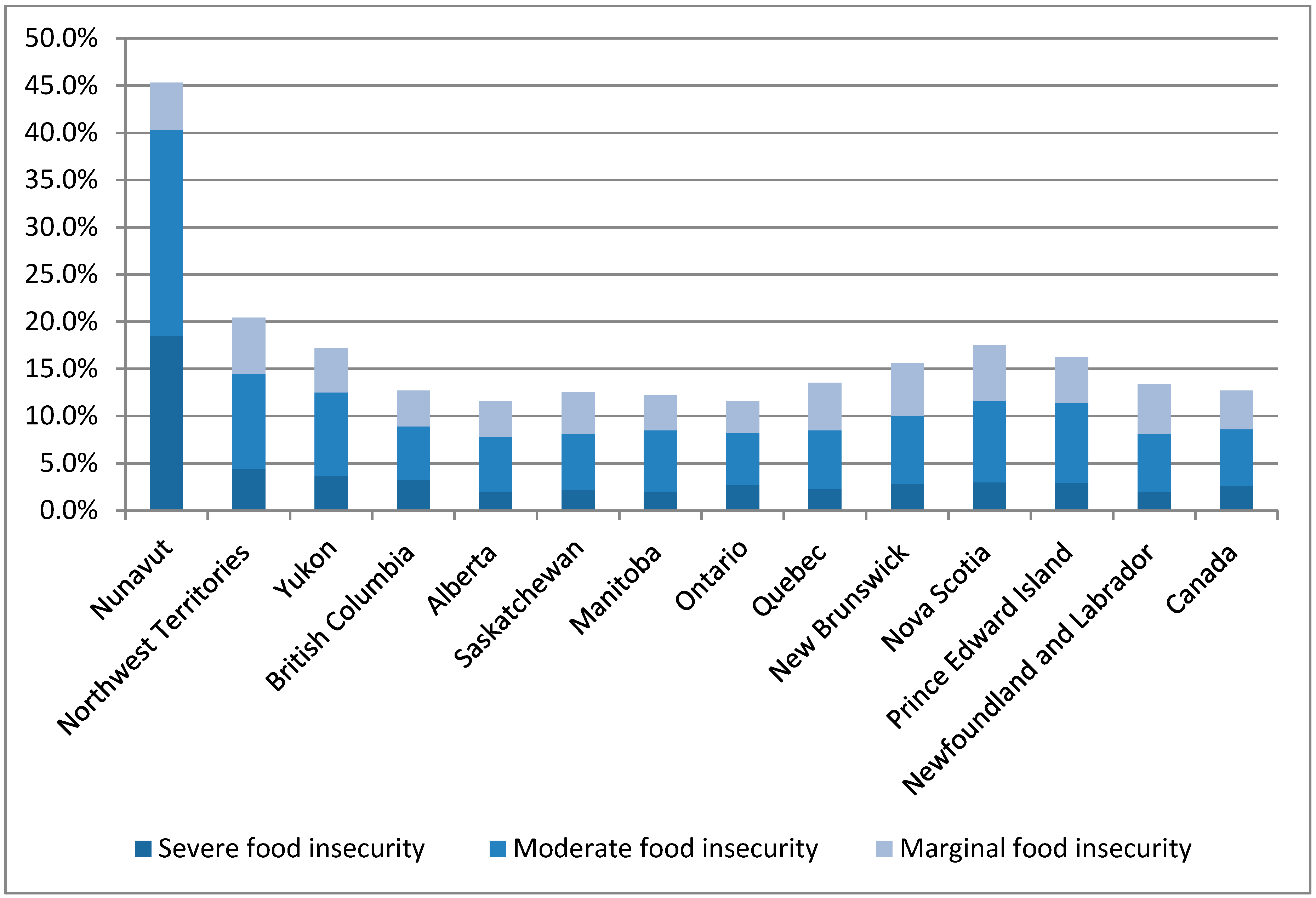


| Health Outcome Category | Health and Social Challenges Related to Food Insecurity |
|---|---|
| Birth Outcomes and Maternal Health | Negative health impacts on both the mother and baby due to inadequate nutrition during pregnancy Increased risk of birth defects Impacts on infant feeding behaviors and sustainability of breastfeeding |
| Child Development | Poorer general health among food insecure children Impacts on growth and development in early life Poorer academic outcomes and social skills compared to children who do not experience food insecurity Iron deficiency anemia linked to the subsequent development of a variety of chronic conditions, including asthma and depression |
| Health Status and Chronic Disease | Impacts on the quality and quantity of women’s food intake due to lower incomes Higher levels of poor or fair self-rated health, diabetes, heart disease, high blood pressure, food allergies and mental health outcomes Barriers to chronic disease management, increasing the likelihood of adverse outcomes |
| Mental Health and Emotional Well-being | Impacts on social and mental well-being that can increase the likelihood of depression, distress and social isolation Child hunger leading to depression and suicidal symptoms in adolescence and early adulthood |
| Economic costs | Increased health care costs associated with food insecurity In Ontario, the annual healthcare costs were 23% higher for adults in marginally food insecure households, 49% higher for those in moderately food insecure households and 121% higher for those in severely food insecure households 1 [34] Increased probability that adults will become high-cost users of health care |
| Food System Component | Climate Vulnerability |
|---|---|
| Production | Increasing temperature extremes and variability, and changes in precipitation patterns and extreme weather events can cause damage to agricultural crops, reduce productivity, and decrease yield [37,38,39,47,48] |
| In the Prairies, groundwater quality and quantity may be reduced as summer rainfall decreases, which can increase irrigation needs for agricultural crops [49] | |
| Water resources will face increasing demand and competition from other users (i.e., oil and gas industry) [49] as well as domestic demand [50], causing further impacts on water availability | |
| Sea level rise could cause inundation of agricultural lands in coastal regions, damaging crops, and creating unsuitable conditions for agricultural production and result in salt water intrusion of aquifers, reducing the quality of irrigation water [38] | |
| Increasing temperatures and changes in precipitation patterns may create more favorable conditions for pests, invasive species and plant diseases [36,37,48] | |
| Rising temperatures and increased concentrations of atmospheric CO2 may decrease the effectiveness of some herbicides used for pest control [8] | |
| Increasing ozone pollution, a by-product of fossil fuel combustion, can inhibit photosynthesis in plants, reducing the quality and productivity of the crop [37,48] | |
| Temperature extremes can adversely impact livestock health and decrease productivity [48] | |
| Extreme weather events may reduce land available for livestock pasture and foraging [36] | |
| The distribution and productivity of natural and farmed fish will change as ocean and freshwater temperatures and ocean acidification increase [8,38] | |
| Rising temperatures may create favorable conditions for aquatic disease and invasive species [51] | |
| Increasing temperatures and changing precipitation patterns are changing the quality and distribution of populations of traditionally harvested species in Canada (i.e., Caribou) [14] | |
| Processing | Increasing temperatures and extreme temperature events may increase the risk of food spoilage or contamination while in storage at processing facilities [40] |
| Traditional food storage and preparation practices may be at risk, for example, permafrost melt may have implications for the stability and safety of traditional in-ground freezers used by Indigenous communities in the Canadian North [14] | |
| Reduced or variable water availability may challenge food processing operations, which require significant amounts of potable water [38] | |
| The physical infrastructure of processing facilities may be damaged by extreme weather events (i.e., flooding) which can disrupt operations [40] | |
| Extreme weather events may cause disruption to energy supplies, labor availability and technological infrastructure critical to processing operations [40] | |
| Availability, quality, and the cost of raw materials and inputs may be variable as a result of climate change impacts in the food production sector, from both international and domestic sources [7,41] | |
| Distribution | Extreme weather events can cause damage and disruption to transportation infrastructure including road, rail, marine, and air transport infrastructure as well as urban and public transportation systems [42] |
| Temperature extremes, permafrost melt, changes in precipitation patterns, and freeze-thaw cycles can compromise the integrity of road, rail, marine, and air transport infrastructure [42] | |
| Extreme weather events can cause physical damage to distribution facilities (i.e., grocery stores and food banks) and also disrupt energy supplies, labor availability, and technological infrastructure critical for distribution site operations [40,41] | |
| Preparation and Consumption | Increasing temperatures, changes in precipitation patterns, and extreme weather events can create favorable conditions for the transmission, survival, and growth of many common foodborne pathogens [40,52,53] |
| Increasing temperatures may result in a rise of activities where food preparation and consumption occurs outdoors (i.e., barbeques, picnics), potentially increasing the risk of exposure to foodborne illness [40,54] | |
| Extreme weather events may facilitate chemical contamination at food production sites (i.e., contaminated flood waters inundating agricultural crops) [40] | |
| An increase in ocean temperature and changes in salinity may increase the risk of pathogens that are known to contaminate seafood (i.e., Vibrio) [40,52,55] | |
| In the Canadian North, climate change may allow for the emergence of new pathogens, viruses, and parasites that affect wildlife harvested as part of traditional and country food systems [14] | |
| A changing climate may increase the need for the use of pesticides which can lead to increased pesticide residues in the food supply [6] | |
| Increasing concentrations of atmospheric CO2 can alter the nutritional content of some agricultural crops, with studies indicating decreased concentration of protein, iron, zinc, and key minerals [8,40,56,57] |
| Primary Elements of Food Security | Critical Dimensions |
|---|---|
| Food availability | Production: how much and which types of food are available |
| Distribution: how food is made available (physically moved), in what form, when, and to whom | |
| Exchange: how much of the available food is obtained through exchange mechanisms such as barter, trade, purchases, or loans | |
| Food accessibility | Affordability: the purchasing power of households or communities relative to the price of food |
| Allocation: the economic, social, and political mechanisms governing when, where, and how food can be accessed by consumers | |
| Preference: social, religious, or cultural norms and values that influence consumer demand for certain types of food | |
| Food utilization | Nutritional value: how much of the daily requirements of calories, vitamins, protein, and micronutrients are provided by the food people consume |
| Social value: the social, religious, and cultural functions and benefits food provides | |
| Food safety: toxic contamination introduced during producing, processing, and packaging, distribution or marketing food; and foodborne diseases |
© 2019 by the authors. Licensee MDPI, Basel, Switzerland. This article is an open access article distributed under the terms and conditions of the Creative Commons Attribution (CC BY) license (http://creativecommons.org/licenses/by/4.0/).
Share and Cite
Schnitter, R.; Berry, P. The Climate Change, Food Security and Human Health Nexus in Canada: A Framework to Protect Population Health. Int. J. Environ. Res. Public Health 2019, 16, 2531. https://doi.org/10.3390/ijerph16142531
Schnitter R, Berry P. The Climate Change, Food Security and Human Health Nexus in Canada: A Framework to Protect Population Health. International Journal of Environmental Research and Public Health. 2019; 16(14):2531. https://doi.org/10.3390/ijerph16142531
Chicago/Turabian StyleSchnitter, Rebekka, and Peter Berry. 2019. "The Climate Change, Food Security and Human Health Nexus in Canada: A Framework to Protect Population Health" International Journal of Environmental Research and Public Health 16, no. 14: 2531. https://doi.org/10.3390/ijerph16142531
APA StyleSchnitter, R., & Berry, P. (2019). The Climate Change, Food Security and Human Health Nexus in Canada: A Framework to Protect Population Health. International Journal of Environmental Research and Public Health, 16(14), 2531. https://doi.org/10.3390/ijerph16142531