

Processing Technology Selection for Municipal Sewage Treatment Based on a Multi-Objective Decision Model under Uncertainty


Abstract
1. Introduction
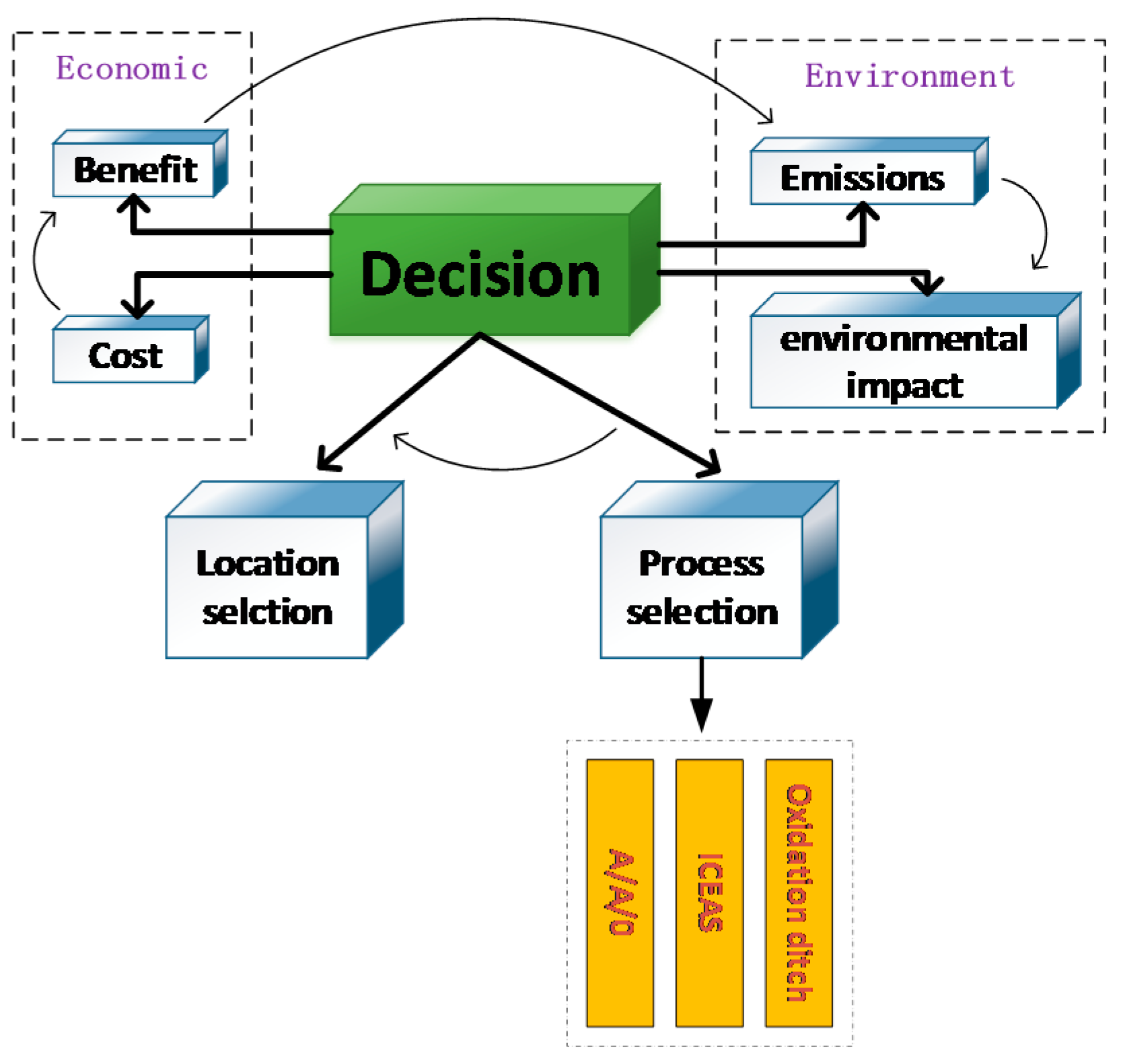
- By combining multiple factors influencing the construction of sewage treatment plants, this study considers the trade-offs between environmental protection and economic benefit.
- A general model of multi-objective decision-making under uncertainty conditions is proposed for optimizing the problem of municipal sewage treatment plant construction.
2. Description of Multi-Objective Decision Model Building
2.1. Key Problem Statement
2.1.1. Principal Factors
2.1.2. Environmental Impacts and Economic Benefits
2.1.3. Uncertainty Problem
2.2. Question Assumption
- All construction schemes are aligned with the overall land utilization planning, urban master planning, special planning of a sewage treatment, as well as such regulations as relevant laws, specifications, and procedures.
- Due to the constraints of factors such as the floor space, the paper assumes that in terms of decision-making, the number of sewage treatment plants to be built is less than N.
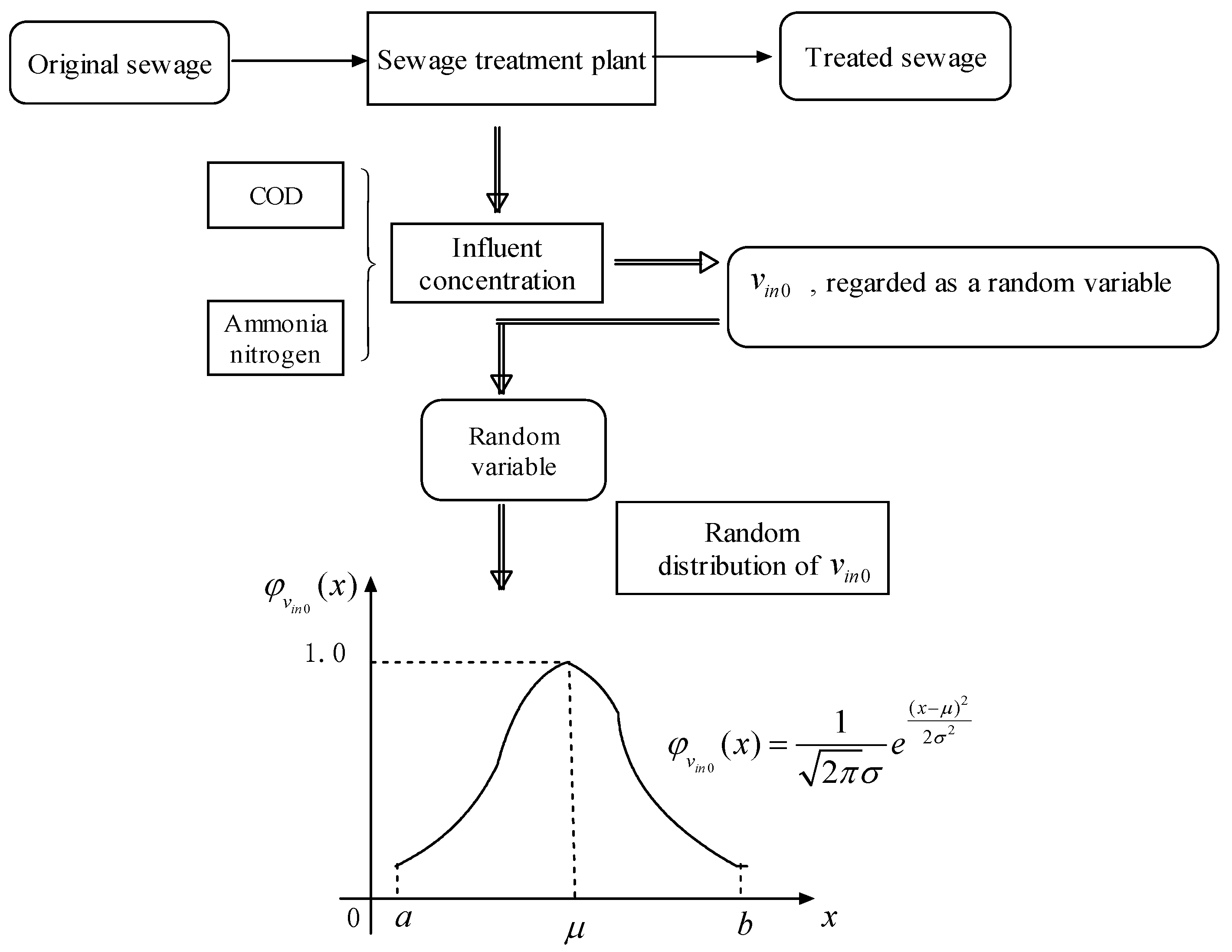
- It is assumed that the distributions of the main sewage source at the construction site of a treatment plant is determined and assumed that the influent concentrations are the same.
- Apart from the infrastructure investments affected by the design treatment capacity and efficiency, the construction and investment costs of a sewage treatment plant also include the purchase and installation costs of different pieces of treatment equipment required by different processes.
- The management and operation costs mainly consist of, for instance, pipeline maintenance, energy consumption, and equipment repair, which is different from sewage treatment engineering.
2.3. Modeling
2.3.1. Objective Function
2.3.2. Constraints
- Pollutant processing capacity. The pollutant processing capacity of a sewage treatment plant should not be less than the sewage quantity, and the actual processing capacity should be more than 60% of the design capacity. In other words:
- Construction investment limitation. Before constructing a sewage treatment plant, the planning department sets a certain total investment; in other words, the construction investment funds should not exceed the upper limit of the total investment. It can be written as:where M is the prescribed investment limit.
- Emissions standards. According to the total pollutant control target, after completion of a sewage treatment plant, effluent must meet certain standards; in other words, the main pollutant content should be less than the standard content. It can be written as:where WCOD and represent COD and ammonia nitrogen emissions control standards of that region, respectively.
- Effluent concentration limitation. To meet discharge standards, effluent concentration should be less than the upper limit of the stated standard. That is:where and denote the stated upper limits of wastewater COD and ammonia nitrogen concentration, respectively. Pollutant discharge standards are generally divided into three types: Primary standard A (COD, 50 mg/L; NH3-N, 8 mg/L), Primary standard B (COD, 60 mg/L, NH3-N, 15 mg/L) and secondary standard (COD, 100 mg/L; NH3-N, 25 mg/L).
- Pollutant treatment rate limitation. The pollutant treatment rate should be more than the lowest limit:where is the stated lower limit of the pollutant treatment rate.
- Plant quantity limitation. The number of sewage treatment plants to be constructed should not exceed a certain limit:
- Processing technology selection limitation. Each wastewater treatment plant can only choose to use one kind of disposal process:
3. Application Research
3.1. Schemes for Site Selection
- Scheme I:
- A sewage plant can be built on a mountain slope with a gradient of 40°. Hence, the land requires leveling; thus, the capital cost of earthwork is evaluated as 190 thousand USD.
- Scheme II:
- A sewage plant can be built on a river bank with a floodwall, which is used for resolving a flood issue. Due to the reinforced concrete structure of the floodwall, a total of 4800 m3 of reinforced concrete is needed. Calculating the comprehensive cost of the reinforced concrete at 63.49 USD/m3, the required investment is 304.76 thousand USD.
- Scheme III:
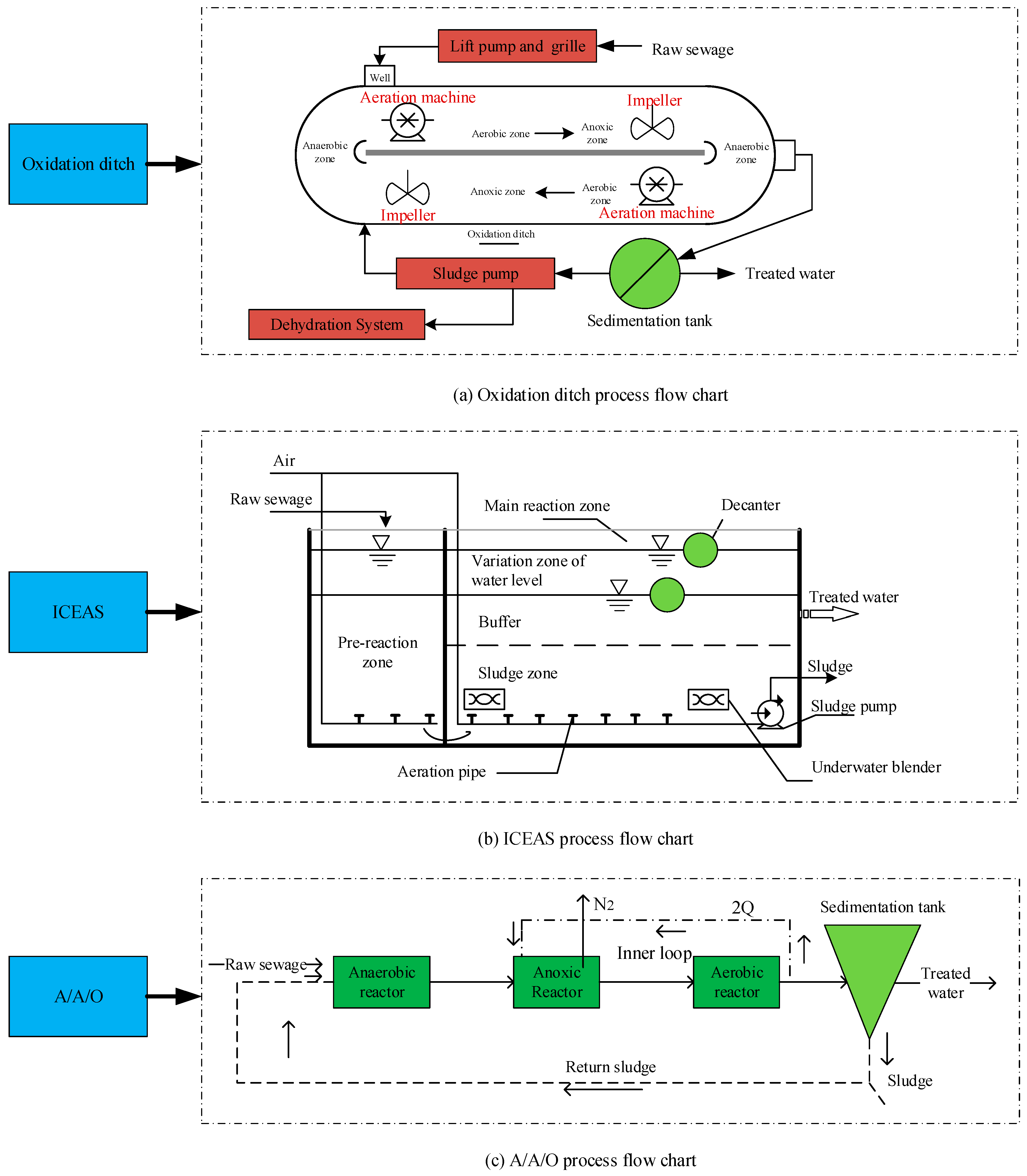
- A sewage plant can be built on a river bank without a floodwall. In this situation, the processing equipment needs to be adjusted. It is worth noting that this scheme adopts an ICEAS process (an improved SBR technique). Adopting this process can completely avoid the flood control drawbacks of the aeration equipment. Before the flood, we need only to move the ordinary movable elements without worrying about the key equipment in the sewage plant.
3.2. Influent and Effluent
3.3. Processing Technology
3.4. Total Costs and Solution Procedure
3.5. Result Analysis
4. Conclusions
- This paper introduced the sewage treatment plant construction program’s related issues, specifically describing the existing problems of the sewage treatment plant construction and combining an actual analysis of the sewage treatment plant construction factors. This process identified the key link (the sewage treatment process) in the construction of a sewage treatment plant.
- Using the framework of uncertainty, random variables were used to characterize COD and ammonia nitrogen, which reduced information losses or distortions while relieving the decision makers’ burden.
- With the construction of a sewage treatment plant in a suburb of Chengdu as an example, this paper empirically tested the general multi-objective decision model for sewage treatment plant construction. The results verified the applicability and effectiveness of the proposed model and provided decision makers with technical support for the optimization of a sewage treatment plant construction plan.
Acknowledgments
Author Contributions
Conflicts of Interest
Nomenclature
| The sewage treatment process | |
| The sites of sewage treatment plant | |
| The sewage treatment capacity | |
| Influent concentrations (COD and ammonia nitrogen) | |
| Effluent concentrations (COD and ammonia nitrogen) | |
| The main distributions of sewage source around the treatment plant | |
| The sewage volumes of each sewage source | |
| Investment costs of the plant construction | |
| The cost of off-site pipe network | |
| The length of the pipeline | |
| The costs of land expropriation and household demolition compensation | |
| The occupied area of the sewage treatment plant | |
| The reuse rates of reclaimed water | |
| The economic benefits per unit reclaimed water | |
| The management operation cost | |
| The score value of the optional site for the decision makers |
Appendix A

| Procedure: The GA Algorithm for the Sewage Treatment Selection |
|---|
| Input: Initial data and GA parameters |
| Output: Best solutions and objective values |
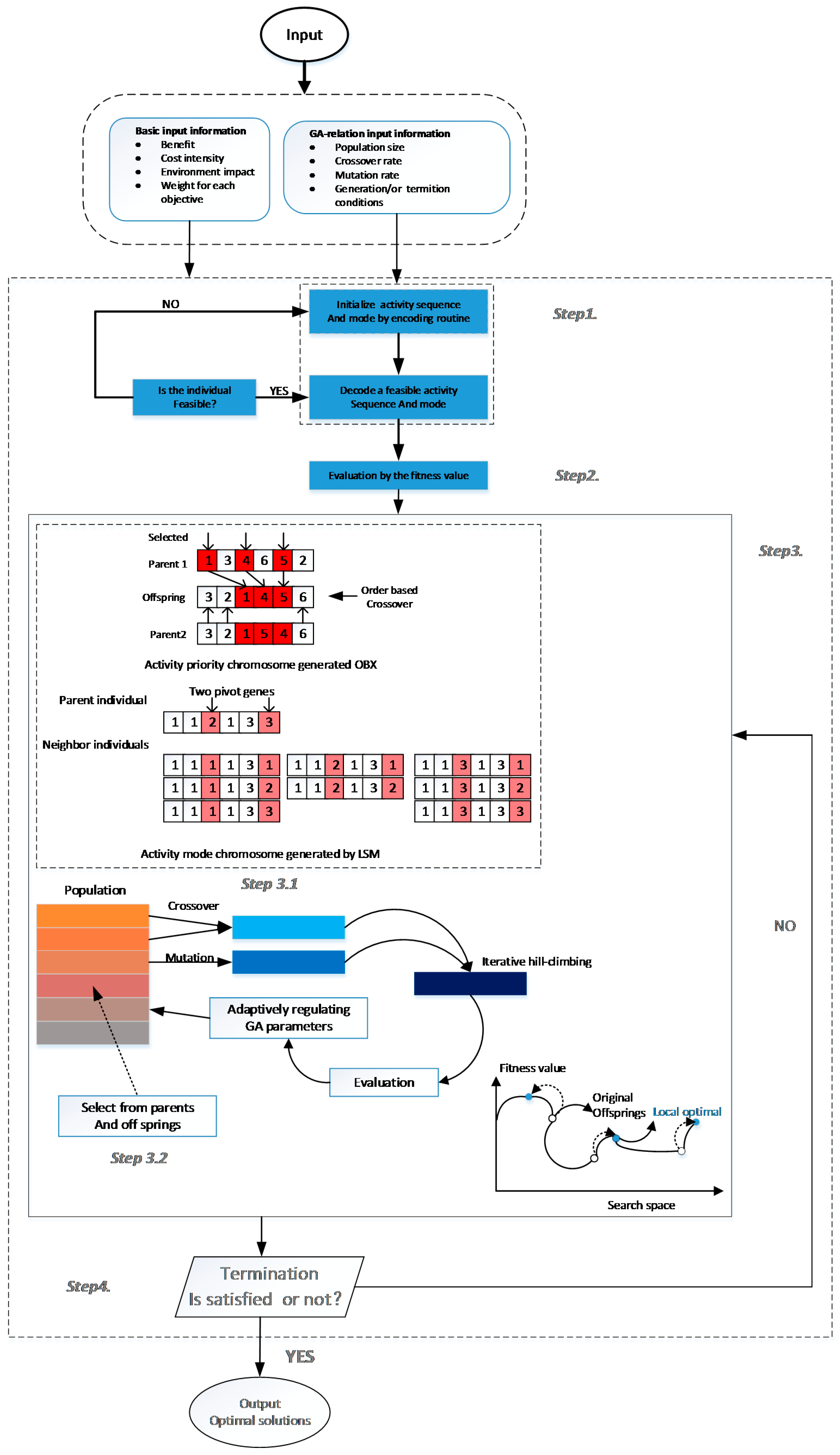
| Step 1. Initialization. Encode the decision variables and randomly generate an initial population; |
| Step 2. Evaluation. Decode a feasible activity sequence and calculate the fitness function; |
| Step 3. Upgrade. Select the best set of solution from the current generation population and offspring populations; |
| Step 3.1 Offspring generation. Fulfill crossover and mutation * and produce offspring solutions; |
| Step 3.2 Evolution. Compare the value of newly obtained individual fitness function with those contained in the previous set. Replace the solutions with the new solutions if their value is higher; |
| Step 4 Stopping criterion. The algorithm ends when a maximal number of generations is reached, and the best solution, together with the corresponding objective functions, are given as output. |
References
- Oakley, S.M.; Gold, A.J.; Oczkowski, A.J. Nitrogen control through decentralized wastewater treatment: Process performance and alternative management strategies. Ecol. Eng. 2010, 36, 1520–1531. [Google Scholar] [CrossRef] [Scilit]
- Xu, J.; Xu, Y.; Wang, H.M.; Guo, C.S.; Qiu, H.Y.; He, Y.; Zhang, Y.; Li, X.C.; Meng, W. Occurrence of antibiotics and antibiotic resistance genes in a sewage treatment plant and its effluent-receiving river. Chemosphere 2015, 119, 1379–1385. [Google Scholar] [CrossRef] [Scilit] [PubMed]
- Belhaj, D.; Athmouni, K.; Jerbi, B.; Kallel, M.; Ayadi, H.; Zhou, L. Estrogenic compounds in Tunisian urban sewage treatment plant: Occurrence, removal and ecotoxicological impact of sewage discharge and sludge disposal. Ecotoxicology 2016, 25, 1–9. [Google Scholar] [CrossRef] [Scilit] [PubMed]
- Pan, C.G.; Liu, Y.S.; Ying, G.G. Perfluoroalkyl substances (PFASs) in wastewater treatment plants and drinking water treatment plants: Removal efficiency and exposure risk. Water Res. 2016, 106, 562–570. [Google Scholar] [CrossRef] [Scilit] [PubMed]
- Gros, M.; Blum, K.M.; Jernstedt, H.; Renman, G.; Rodríguez-Mozaz, S.; Haglund, P.; Andersson, P.L.; Wiberg, K.; Ahrens, L. Screening and prioritization of micropollutants in wastewaters from on-site sewage treatment facilities. J. Hazard. Mater. 2017, 328, 37–45. [Google Scholar] [CrossRef] [Scilit] [PubMed]
- Smith, B.R. Re-thinking wastewater landscapes: Combining innovative strategies to address tomorrow’s urban wastewater treatment challenges. Water Sci. Technol. 2009, 60, 1465–1473. [Google Scholar] [CrossRef] [Scilit] [PubMed]
- Libralato, G.; Ghirardini, A.; Avezzù, F. To centralise or to decentralise: An overview of the most recent trends in wastewater treatment management. J. Environ. Manag. 2012, 94, 61–68. [Google Scholar] [CrossRef] [Scilit] [PubMed]
- Murray, A.; Ray, I. Wastewater for agriculture: A reuse-oriented planning model and its application in Peri-Urban China. Water Res. 2010, 44, 1667–1679. [Google Scholar] [CrossRef] [Scilit] [PubMed]
- Cai, Q.Y.; Mo, C.H.; Wu, Q.T.; Zeng, Q.Y.; Katsoyiannis, A. Occurrence of organic contaminants in sewage sludges from eleven wastewater treatment plants, China. Chemosphere 2007, 68, 1751–1762. [Google Scholar] [CrossRef] [Scilit] [PubMed]
- Kelessidis, A.; Stasinakis, A.S. Comparative study of the methods used for treatment and final disposal of sewage sludge in European countries. Waste Manag. 2012, 32, 1186–1195. [Google Scholar] [CrossRef] [Scilit] [PubMed]
- Gleick, P.H.; Palaniappan, M.; Morikawa, M.; Morrison, J. The world’s water 2008~2009: The biennial report on freshwater resources. Environ. Conserv. 2009, 36, 171–175. [Google Scholar]
- Shen, W.Q. Study on Ammonia nitrogen in municipal sewage adopted by actived coal-serial kaolin. J. Anhui Agric. Sci. 2010, 38, 10845–10847. [Google Scholar]
- Hernández-Sancho, F.; Sala-Garrido, R. Technical efficiency and cost analysis in wastewater treatment processes: A DEA approach. Desalination 2009, 249, 230–234. [Google Scholar] [CrossRef] [Scilit]
- Rizzoa, L.; Manaiab, C.; Merlinc, C.; Schwartzd, T.; Dagote, C.; Ployf, M.C.; Michaelg, I.; Fatta-Kassinosg, D. Urban wastewater treatment plants as hotspots for antibiotic resistant bacteria and genes spread into the environment: A review. Sci. Total Environ. 2013, 447, 345–360. [Google Scholar] [CrossRef] [Scilit] [PubMed]
- Ostoich, M.; Serena, F.; Tomiato, L. Environmental controls for wastewater treatment plants: Hierarchical planning, integrated approach, and functionality assessment. J. Integr. Environ. Sci. 2010, 7, 251–270. [Google Scholar] [CrossRef] [Scilit]
- Bhatnagar, A.; Sillanpää, M. Utilization of agro-industrial and municipal waste materials as potential adsorbents for water treatment. Chem. Eng. J. 2010, 157, 277–296. [Google Scholar] [CrossRef] [Scilit]
- Kartal, B.; Kuenen, J.G.; Loosdrecht, M.C.M.V. Sewage treatment with anammox. Science 2010, 328, 702–703. [Google Scholar] [CrossRef] [Scilit] [PubMed]
- Plakas, K.V.; Karabelas, A.J. Removal of pesticides from water by NF and RO Membranes—A review. Desalination 2012, 287, 255–265. [Google Scholar] [CrossRef] [Scilit]
- Xu, P.; Zeng, G.M.; Huang, D.L.; Feng, C.L.; Hu, S.; Zhao, M.H.; Lai, C.; Wei, Z.; Huang, C.; Xie, G.X.; et al. Use of iron oxide nanomaterials in wastewater treatment: A review. Sci. Total Environ. 2012, 424, 1–10. [Google Scholar] [CrossRef] [Scilit] [PubMed]
- Fu, F.L.; Dionysios, D.; Liu, H. The use of zero-valent iron for groundwater remediation and wastewater treatment: A review. J. Hazard. Mater. 2014, 267, 194–205. [Google Scholar] [CrossRef] [Scilit] [PubMed]
- Garnier, J.; Brion, N.; Callens, J.; Passy, P. Modeling historical changes in nutrient delivery and water quality of the Zenne River (1790s–2010): The role of land use, waterscape and urban wastewater management. J. Mar. Syst. 2013, 128, 62–76. [Google Scholar] [CrossRef] [Scilit]
- Molinos-Senante, M.; Garrido-Baserba, M.; Reif, R.; Hernández-Sancho, F.; Poch, M. Assessment of wastewater treatment plant design for small communities: Environmental and economic aspects. Sci. Total Environ. 2012, 42, 11–18. [Google Scholar] [CrossRef] [Scilit] [PubMed]
- Cornel, P.; Schaum, C. Phosphorus recovery from wastewater: Needs, technologies and costs. Water Sci. Technol. 2009, 59, 1069–1076. [Google Scholar] [CrossRef] [Scilit] [PubMed]
- Bresler, S.E. Policy recommendations for reducing reactive nitrogen from wastewater treatment in the great bay estuary, NH. Environ. Sci. Policy 2012, 19, 69–77. [Google Scholar] [CrossRef] [Scilit]
- Dodane, P.H.; Mbéguéré, M.; Sow, O.; Strande, L. Capital and operating costs of full-scale fecal sludge management and wastewater treatment systems in Dakar, Senegal. Environ. Sci. Technol. 2012, 46, 3705–3711. [Google Scholar] [CrossRef] [Scilit] [PubMed]
- Ostace, G.S.; Cristea, V.M.; Agachi, P.Ş. Cost reduction of the wastewater treatment plant operation by MPC based on modified ASM1 with two-step nitrification/denitrification model. Comput. Chem. Eng. 2011, 35, 2469–2479. [Google Scholar] [CrossRef] [Scilit]
- Molinos-Senante, M.; Hernández-Sancho, F.; Sala-Garrido, R. Economic feasibility study for wastewater treatment: A cost-benefit analysis. Sci. Total Environ. 2010, 408, 4396–4402. [Google Scholar] [CrossRef] [Scilit] [PubMed]
- Hernandez-Sancho, F.; Molinos-Senante, M.; Sala-Garrido, R. Cost modelling for wastewater treatment processes. Desalination 2011, 268, 1–5. [Google Scholar] [CrossRef] [Scilit]
- Mojahed, S.; Aghazadeh, F. Major factors influencing productivity of water and wastewater treatment plant construction: Evidence from the deep south USA. Int. J. Proj. Manag. 2008, 26, 195–202. [Google Scholar] [CrossRef] [Scilit]
- Renou, S.; Thomas, J.S.; Aoustin, E.; Pons, M.N. Influence of impact assessment methods in wastewater treatment LCA. J. Clean. Prod. 2008, 16, 1098–1105. [Google Scholar] [CrossRef] [Scilit]
- Hong, J.L.; Hong, J.M.; Otaki, M.; Jolliet, O. Environmental and economic life cycle assessment for sewage sludge treatment processes in Japan. Waste Manag. 2009, 29, 696–703. [Google Scholar] [CrossRef] [Scilit] [PubMed]
- Robinson, K.G.; Robinso, C.H.; Raup, L.A.; Markum, T.R. Public attitudes and risk perception toward land application of biosolids within the south-eastern United States. J. Environ. Manag. 2012, 98, 29–36. [Google Scholar] [CrossRef] [Scilit] [PubMed]
- Jung, W.; Koo, B.; Han, S.H. A multi-objective linear programming framework for evaluating the financial viability of supplementary facilities in build-transfer-lease projects in Korea. KSCE J. Civ. Eng. 2012, 16, 29–37. [Google Scholar] [CrossRef] [Scilit]
- Di, Z. Using GIS-Based Multi-Criteria Analysis for Optimal Site Selection for a Sewage Treatment Plant; University Library in Gävle: Gävle, Sweden, 2015. [Google Scholar]
- Baxter, G.; Sommerville, I. Socio-technical systems: From design methods to systems engineering. Interact. Comput. 2011, 23, 4–17. [Google Scholar] [CrossRef] [Scilit]
- Anthony, M.; Mathieu, S.; Corinne, C. Comparison of sludge characteristics and performance of a submerged membrane bioreactor and an activated sludge process at high solids retention time. Water Res. 2006, 40, 2405–2415. [Google Scholar]
- Lv, Y. The Typical City Secondary Sewage Plant Cost Models and the Optimization Design; Kunming University of Science: Kunming, China, 2009. [Google Scholar]
| Cost Items | Scheme I | Scheme II | Scheme III |
|---|---|---|---|
| Occupied land (10,000 m2) | 2.4 | 4.6 | 3.5 |
| Land expropriation cost (10,000 USD) | 28.57 | 38.10 | 34.92 |
| Demolition cost (10,000 USD) | 14.29 | 23.81 | 20.63 |
| Initial capital cost (10,000 USD) | 50.79 | 47.62 | 57.14 |
| Sewage pipeline construction cost (10,000 USD) | 15.87 | 31.75 | 23.81 |
| Sewage pump station construction cost (10,000 USD) | 23.81 | 7.94 | 15.87 |
| pipeline maintenance cost (10,000 USD) | 0.63 | 0.95 | 0.63 |
| Pump station operation cost (10,000 USD) | 4.13 | 2.86 | 3.81 |
| Other operation cost (10,000 USD) | 2.54 | 1.59 | 1.90 |
| Double circuit return pipe installation cost (10,000 USD) | 19.05 | 15.87 | 14.29 |
| Item | pH | COD | NH3-N |
|---|---|---|---|
| Influent quality (mg/L) | 6–9 | 252 | 35 |
| Effluent quality (mg/L) | 6–9 | 60 | 15 |
| Process rate (%) | — | 76 | 57 |
| Treatment Process | Oxidation Ditch | ICEAS * | A/A/O |
|---|---|---|---|
| Same structures | Coarse screen wells and pumping station, fine screen and grit chamber, blower room, sludge tank, dewatering room, instruments and center control room | ||
| Different structures | Oxidation ditch biological reaction tank, return sludge pump room | ICEAS reaction tank | A/A/O biological reaction tank, secondary sedimentation tank, return sludge pump room |
| Treatment Process | Oxidation Ditch | ICEAS | A/A/O |
|---|---|---|---|
| Equipment | Surface aerator, rotating disc aerator, underwater agitator, submersible axial pump | Micro porous aeration device, plug-flow agitator, water decanter, ICEAS submersible sewage pump | Underwater agitator, underwater propeller, aerator, rotating door, submersible sewage pump, mud scraper, electric hoist, excess sludge pump |
| Treatment Process | Oxidation Ditch | ICEAS | A/A/O |
|---|---|---|---|
| Initial Investment Cost | |||
| Treatment Process | Oxidation Ditch | ICEAS | A/A/O |
|---|---|---|---|
| Operation cost |
| 0.7 | 0.1 | 0.1 | 0.1 | 0.42 | 0.22 | 0.15 | 0.01 | x3 = 1 | y32 = 1 | 3.7 | 35.63 | 2.39 |
| 0.4 | 0.4 | 0.1 | 0.1 | 0.46 | 0.29 | 0.14 | 0.01 | x1 = 1 | y11 = 1 | 4.2 | 29.58 | 2.31 |
| 0.4 | 0.1 | 0.4 | 0.1 | 0.42 | 0.21 | 0.12 | 0.01 | x3 = 1 | y32 = 1 | 3.9 | 27.39 | 2.44 |
| 0.3 | 0.1 | 0.2 | 0.4 | 0.43 | 0.22 | 0.14 | 0.01 | x3 = 1 | y32 = 1 | 3.7 | 33.22 | 2.31 |
© 2018 by the authors. Licensee MDPI, Basel, Switzerland. This article is an open access article distributed under the terms and conditions of the Creative Commons Attribution (CC BY) license (http://creativecommons.org/licenses/by/4.0/).
Share and Cite
Chen, X.; Xu, Z.; Yao, L.; Ma, N. Processing Technology Selection for Municipal Sewage Treatment Based on a Multi-Objective Decision Model under Uncertainty. Int. J. Environ. Res. Public Health 2018, 15, 448. https://doi.org/10.3390/ijerph15030448
Chen X, Xu Z, Yao L, Ma N. Processing Technology Selection for Municipal Sewage Treatment Based on a Multi-Objective Decision Model under Uncertainty. International Journal of Environmental Research and Public Health. 2018; 15(3):448. https://doi.org/10.3390/ijerph15030448
Chicago/Turabian StyleChen, Xudong, Zhongwen Xu, Liming Yao, and Ning Ma. 2018. "Processing Technology Selection for Municipal Sewage Treatment Based on a Multi-Objective Decision Model under Uncertainty" International Journal of Environmental Research and Public Health 15, no. 3: 448. https://doi.org/10.3390/ijerph15030448
APA StyleChen, X., Xu, Z., Yao, L., & Ma, N. (2018). Processing Technology Selection for Municipal Sewage Treatment Based on a Multi-Objective Decision Model under Uncertainty. International Journal of Environmental Research and Public Health, 15(3), 448. https://doi.org/10.3390/ijerph15030448

