


Estimating Temperature-Mortality Exposure-Response Relationships and Optimum Ambient Temperature at the Multi-City Level of China

Abstract
:1. Introduction
2. Materials and Methods
2.1. Data Sources
2.2. Statistical Analysis
3. Results
3.1. Descriptive Analysis
3.2. Acute Effects of Ambient Temperature on Daily Mortality
3.3. Lagged Effects of Temperature on Non-Accidental Mortality
3.4. Optimum Temperature
4. Discussion
5. Conclusions
Acknowledgments
Author Contributions
Conflicts of Interest
References
- Watts, N.; Adger, W.N.; Agnolucci, P.; Blackstock, J.; Byass, P.; Cai, W.; Chaytor, S.; Colbourn, T.; Collins, M.; Cooper, A.; et al. Health and climate change: Policy response to protect public health. Lancet 2015, 386, 1861–1914. [Google Scholar] [CrossRef]
- Kalkstein, L.S. Saving lives during extreme weather in summer. BMJ 2000, 321, 650–651. [Google Scholar] [CrossRef] [PubMed]
- Medina-Ramón, M.; Zanobetti, A.; Cavanagh, D.P.; Schwartz, J. Extreme temperatures and mortality: Assessing effect modification by personal characteristics and specific cause of death in a multi-city case-only analysis. Environ. Health Perspect. 2006, 114, 1331–1336. [Google Scholar] [CrossRef] [PubMed]
- Patz, J.A.; Campbell-Lendrum, D.; Holloway, T.; Foley, J.A. Impact of regional climate change on human health. Nature 2005, 438, 310–317. [Google Scholar] [CrossRef] [PubMed]
- Rooney, C.; McMichael, A.J.; Kovats, R.S.; Coleman, M.P. Excess mortality in England and Wales, and in Greater London, during the 1995 heatwave. J. Epidemiol. Community Health 1998, 52, 482–486. [Google Scholar] [CrossRef] [PubMed]
- Vandentorren, S.; Suzan, F.; Medina, S.; Pascal, M.; Maulpoix, A.; Cohen, J.C.; Ledrans, M. Mortality in 13 French cities during the August 2003 heat wave. Am. J. Public Health 2004, 94, 1518–1520. [Google Scholar] [CrossRef] [PubMed]
- Gao, J.; Sun, Y.; Liu, Q.; Zhou, M.; Lu, Y.; Li, L. Impact of extreme high temperature on mortality and regional level definition of heat wave: A multi-city study in China. Sci. Total Environ. 2015, 505, 535–544. [Google Scholar] [CrossRef] [PubMed]
- Gasparrini, A.; Armstrong, B.; Kenward, M.G. Distributed lag non-linear models. Stat. Med. 2010, 29, 2224–2234. [Google Scholar] [CrossRef] [PubMed]
- Basu, R.; Feng, W.Y.; Ostro, B.D. Characterizing temperature and mortality in nine California counties. Epidemiology 2008, 19, 138–145. [Google Scholar] [CrossRef] [PubMed]
- Braga, A.L.; Zanobetti, A.; Schwartz, J. The effect of weather on respiratory and cardiovascular deaths in 12 U.S. cities. Environ. Health Perspect. 2002, 110, 859–863. [Google Scholar] [CrossRef] [PubMed]
- Breitner, S.; Wolf, K.; Devlin, R.B.; Diaz-Sanchez, D.; Peters, A.; Schneider, A. Short-term effects of air temperature on mortality and effect modification by air pollution in three cities of Bavaria, Germany: A time-series analysis. Sci. Total Environ. 2014, 6, 49–61. [Google Scholar] [CrossRef] [PubMed]
- Patz, J.A.; Engelberg, D.; Last, J. The effects of changing weather on public health. Annu. Rev. Public Health 2010, 21, 271–307. [Google Scholar] [CrossRef] [PubMed]
- Chen, K.; Bi, J.; Chen, J.; Chen, X.; Huang, L.; Zhou, L. Influence of heat wave definitions to the added effect of heat waves on daily mortality in Nanjing, China. Sci. Total Environ. 2015, 2, 18–25. [Google Scholar] [CrossRef] [PubMed]
- Kan, H.; London, S.J.; Chen, H.; Song, G.; Chen, G.; Jiang, L.; Zhao, N.; Zhang, Y.; Chen, B. Diurnal temperature range and daily mortality in Shanghai, China. Environ. Res. 2007, 103, 424–431. [Google Scholar] [CrossRef] [PubMed]
- Wang, C.; Chen, R.; Kuang, X.; Duan, X.; Kan, H. Temperature and daily mortality in Suzhou, China: A time series analysis. Sci. Total Environ. 2014, 466, 985–990. [Google Scholar] [CrossRef] [PubMed]
- Ma, W.; Chen, R.; Kan, H. Temperature-related mortality in 17 large Chinese cities: how heat and cold affect mortality in China. Environ. Res. 2014, 134, 127–133. [Google Scholar] [CrossRef] [PubMed]
- Zhou, X.; Zhao, A.; Meng, X.; Chen, R.; Kuang, X.; Duan, X.; Kan, H. Acute effects of diurnal temperature range on mortality in 8 Chinese cities. Sci. Total Environ. 2014, 493, 92–97. [Google Scholar] [CrossRef] [PubMed]
- Ma, W.; Wang, L.; Lin, H.; Liu, T.; Zhang, Y.; Rutheford, S.; Luo, Y.; Zeng, W.; Zhang, Y.; Wang, X.; et al. The temperature-mortality relationship in China: An analysis from 66 Chinese communities. Environ. Res. 2015, 137, 72–77. [Google Scholar] [CrossRef] [PubMed]
- Hastie, T.; Tibshirani, R. Generalized additive models for medical research. Stat. Methods Med. Res. 1995, 4, 187–196. [Google Scholar] [CrossRef] [PubMed]
- Zhang, Z.; Wang, J.; Chen, L.; Chen, X.; Sun, G.; Zhong, N.; Kan, H.; Lu, W. Impact of haze and air pollution-related hazards on hospital admissions in Guangzhou, China. Environ. Sci. Pollut. Res. Int. 2014, 21, 4236–4244. [Google Scholar] [CrossRef] [PubMed]
- Brumback, B.A.; Ryan, L.M.; Schwartz, J.D.; Neas, L.M.; Stark, P.C.; Burge, H.A. Transitional regression models, with application to environmental time series. J. Am. Stat. Assoc. 2000, 95, 16–27. [Google Scholar] [CrossRef]
- Chen, R.; Li, Y.; Ma, Y.; Pan, G.; Zeng, G.; Xu, X.; Chen, B.; Kan, H. Coarse particles and mortality in three Chinese cities: The China Air Pollution and Health Effects Study (CAPES). Sci. Total Environ. 2011, 409, 4934–4938. [Google Scholar] [CrossRef] [PubMed]
- Kan, H.; Chen, R.; Tong, S. Ambient air pollution, climate change, and population health in China. Environ. Int. 2012, 42, 10–19. [Google Scholar] [CrossRef] [PubMed]
- Goodman, P.G.; Dockery, D.W.; Clancy, L. Cause-specific mortality and the extended effects of particulate pollution and temperature exposure. Environ. Health Perspect. 2004, 112, 179–185. [Google Scholar] [CrossRef] [PubMed]
- Metzger, K.B.; Ito, K.; Matte, T.D. Summer heat and mortality in New York City: How hot is too hot? Environ. Health Perspect. 2010, 118, 80–86. [Google Scholar] [CrossRef] [PubMed]
- Barnett, A.G.; Tong, S.; Clements, A. What measure of temperature is the best predictor of mortality? Environ. Res. 2010, 110, 604–611. [Google Scholar] [CrossRef] [PubMed]
- Schwartz, J. Who is sensitive to extremes of temperature: A case-only analysis. Epidemiology 2005, 16, 67–72. [Google Scholar] [CrossRef] [PubMed]
- Keatinge, W.R.; Donaldson, G.C.; Cordioli, E.; Martinelli, M.; Kunst, A.E.; Mackenbach, J.P.; Nayha, S.; Vuori, L. Heat related mortality in warm and cold regions of Europe: Observational study. BMJ 2000, 321, 670–673. [Google Scholar] [CrossRef] [PubMed]
- Cheng, Y.; Kan, H. Effect of the interaction between outdoor air pollution and extreme temperature on daily mortality in Shanghai, China. J. Epidemiol. 2012, 22, 28–36. [Google Scholar] [CrossRef] [PubMed]
- Lin, Y.; Wang, Y.; Lin, P.; Li, M.; Ho, T. Relationships between cold-temperature indices and all causes and cardiopulmonary morbidity and mortality in a subtropical island. Sci. Total Environ. 2013, 461, 627–635. [Google Scholar] [CrossRef] [PubMed]
- Wu, W.; Xiao, Y.; Li, G.; Zeng, W.; Lin, H.; Rutherford, S.; Xu, Y.; Luo, Y.; Xu, X.; Chu, C.; et al. Temperature-mortality relationship in four subtropical Chinese cities: A time-series study using a distributed lag non-linear model. Sci. Total Environ. 2013, 449, 355–362. [Google Scholar] [CrossRef] [PubMed]
- Medina-Ramón, M.; Schwartz, J. Temperature, temperature extremes, and mortality: A study of acclimatisation and effect modification in 50 US cities. J. Occup. Environ. Med. 2007, 64, 827–833. [Google Scholar] [CrossRef] [PubMed]
- Iñiguez, C.; Ballester, F.; Ferrandiz, J.; Pérez-Hoyos, S.; Sáez, M.; López, A. Relation between temperature and mortality in thirteen Spanish cities. Int. J. Environ. Res. Public Health 2010, 7, 3196–3210. [Google Scholar] [CrossRef] [PubMed]
- Huang, Z.; Lin, H.; Liu, Y.; Zhou, M.; Liu, T.; Xiao, J.; Zeng, W.; Li, X.; Zhang, Y.; Ebi, K.L.; et al. Individual-level and community-level effect modifiers of the temperature-mortality relationship in 66 Chinese communities. BMJ Open 2015, 5, e009172. [Google Scholar] [CrossRef] [PubMed]
- Schwartz, J. The distributed lag between air pollution and daily deaths. Epidemiology 2000, 11, 320–326. [Google Scholar] [CrossRef] [PubMed]
- Baccini, M.; Biggeri, A.; Accetta, G.; Kosatsky, T.; Katsouyanni, K.; Analitis, A.; Anderson, H.R.; Bisanti, L.; Dlppoliti, D.; Danova, J.; et al. Heat effects on mortality in 15 European cities. Epidemiology 2008, 19, 711–719. [Google Scholar] [CrossRef] [PubMed]
- Yu, W.; Guo, Y.; Ye, X.; Wang, X.; Huang, C.; Pan, X.; Tong, S. The effect of various temperature indicators on different mortality categories in a subtropical city of Brisbane, Australia. Sci. Total Environ. 2011, 409, 3431–3437. [Google Scholar] [CrossRef] [PubMed]
- Bouchama, A.; Knochel, J.P. Heat stroke. N. Engl. J. Med. 2002, 346, 1978–1988. [Google Scholar] [CrossRef] [PubMed]
- Modesti, P.A. Season, temperature and blood pressure: A complex interaction. Eur. J. Intern. Med. 2013, 24, 604–607. [Google Scholar] [CrossRef] [PubMed]
- Blagojevic, D.P.; Grubor-Lajsic, G.N.; Spasic, M.B. Cold defence responses: The role of oxidative stress. Front. Biosci. (Sch. Ed.) 2011, 3, 416–427. [Google Scholar] [CrossRef]
- Keatinge, W. The effects of subcutaneous fat and of previous exposure to cold on the body temperature, peripheral blood flow and metabolic rate of men in cold water. J. Physiol. 1960, 153, 166–178. [Google Scholar] [CrossRef] [PubMed]
- Keatinge, W. The effect of repeated daily exposure to cold and of improved physical fitness on the metabolic and vascular response to cold air. J. Physiol. 1961, 157, 209–220. [Google Scholar] [CrossRef] [PubMed]
- Keatinge, W.; Coleshaw, S.; Cotter, F.; Mattock, M.; Murphy, M.; Chelliah, R. Increases in platelet and red cell counts, blood viscosity, and arterial pressure during mild surface cooling: Factors in mortality from coronary and cerebral thrombosis in winter. BMJ 1984, 289, 1405–1408. [Google Scholar] [CrossRef] [PubMed]
- Hajat, S.; Kovats, R.S.; Atkinson, R.W.; Haines, A. Impact of hot temperatures on death in London: A time series approach. J. Epidemiol. Community Health 2002, 56, 367–372. [Google Scholar] [CrossRef] [PubMed]
- Mackenbach, J.P.; Looman, C.W.; Kunst, A.E. Air pollution, lagged effects of temperature, and mortality: The Netherlands 1979–1987. J. Epidemiol. Community Health 1993, 47, 121–126. [Google Scholar] [CrossRef] [PubMed]
- Ballester, F.; Corella, D.; Perez-Hoyos, S.; Saez, M.; Hervas, A. Mortality as a function of temperature: A study in Valencia, Spain, 1991–1993. Int. J. Epidemiol. 1997, 26, 551–561. [Google Scholar] [CrossRef] [PubMed]
- Modesti, P.A. The hazard of rounding Cape Horn: Is it changing? Heart 2014, 100, 1489–1490. [Google Scholar] [CrossRef] [PubMed]
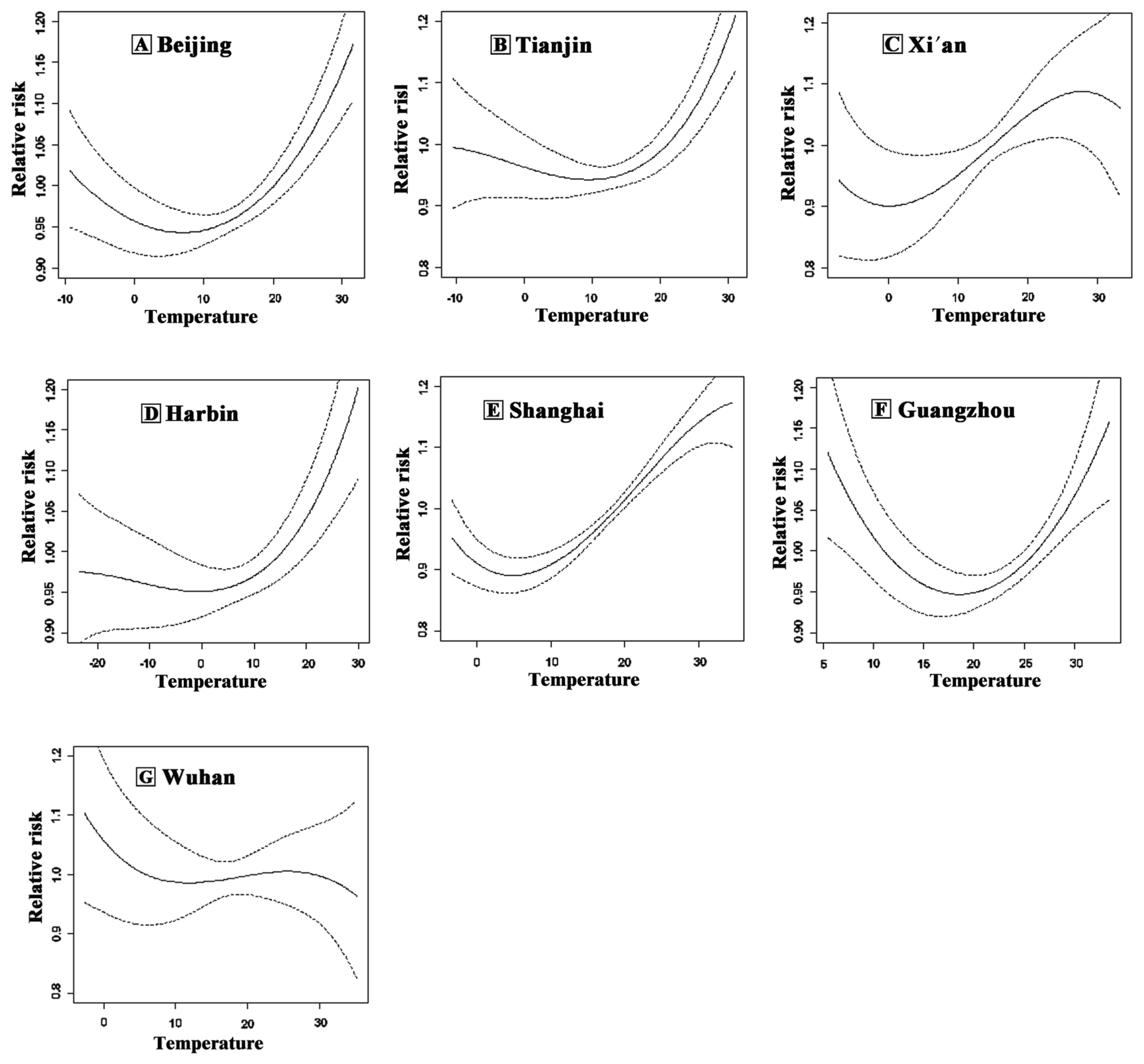
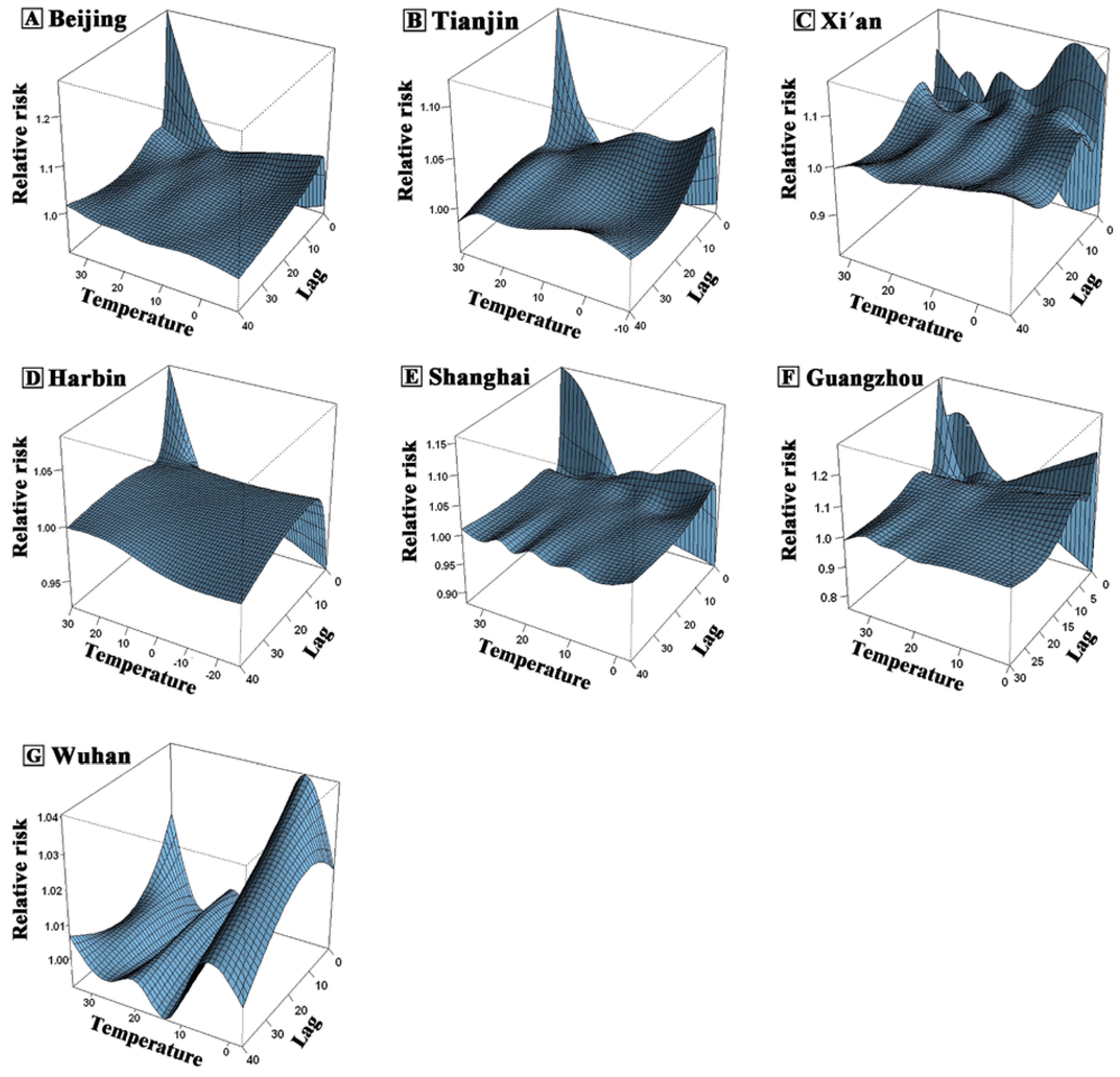
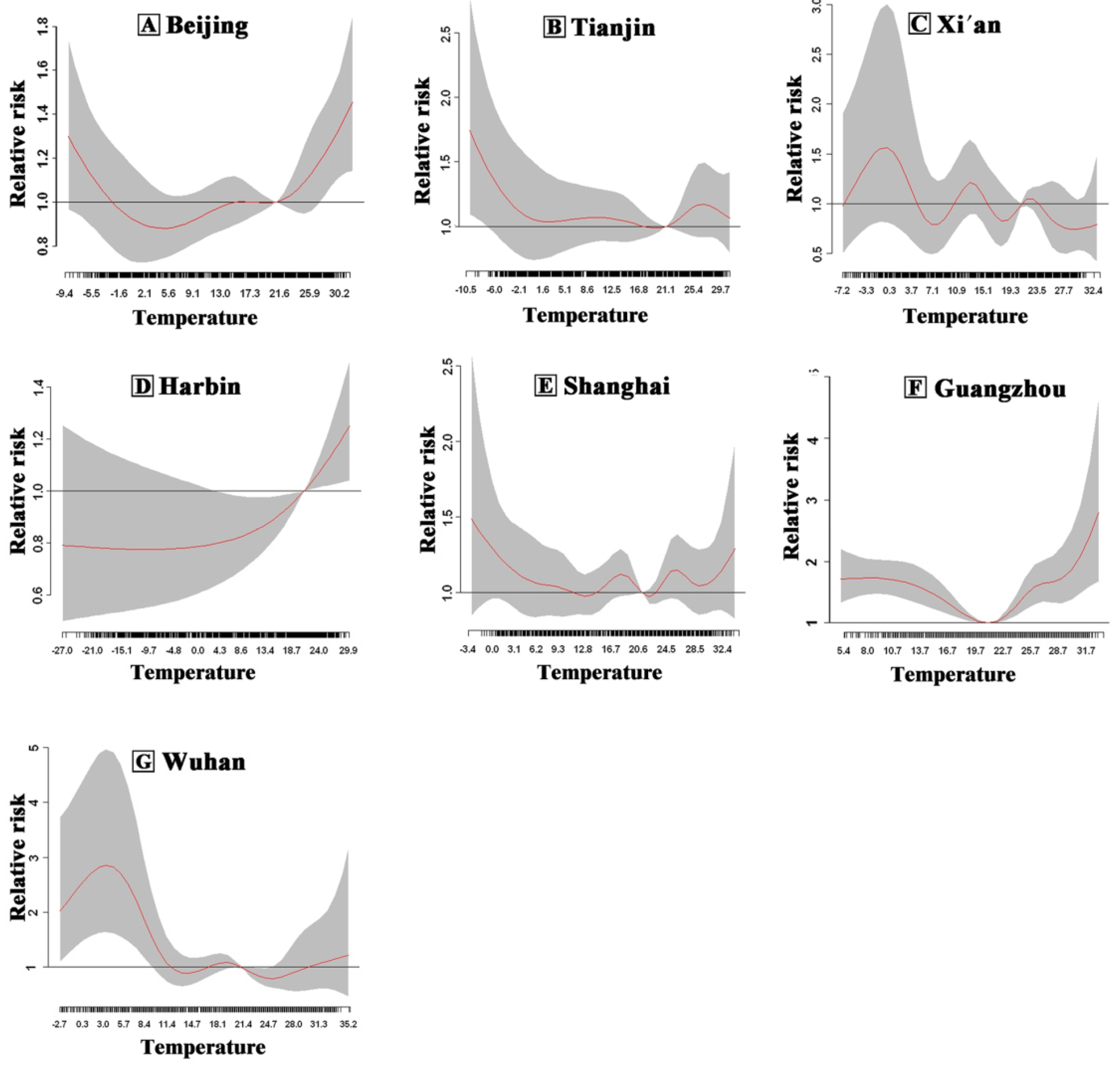
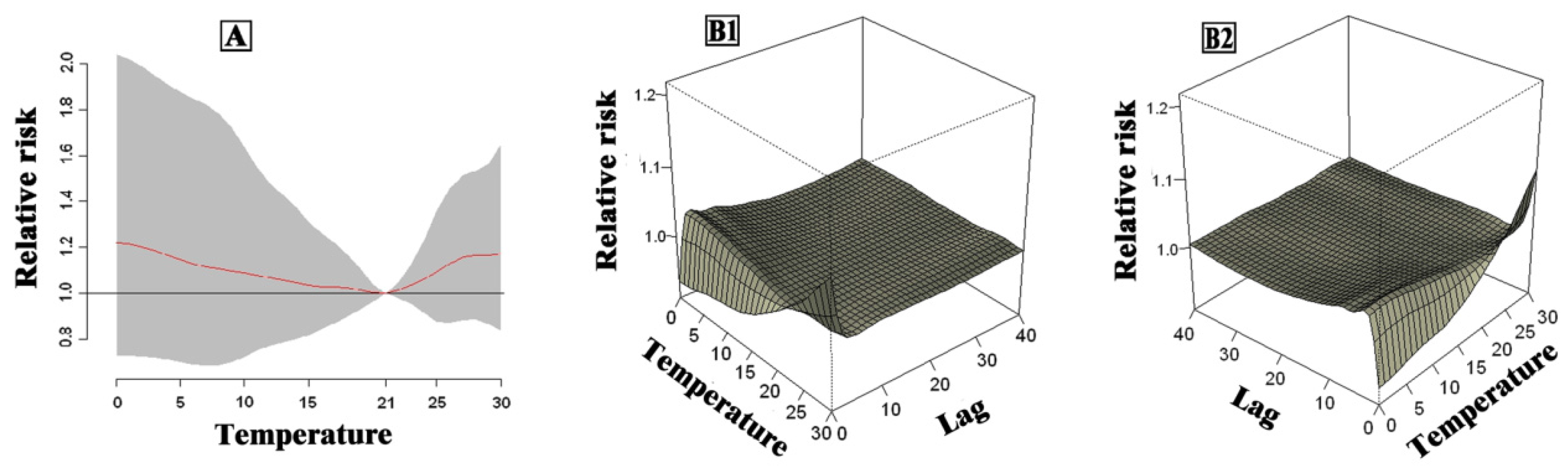

| City | Number of Districts | Name of Districts | Population (× 104) |
|---|---|---|---|
| Beijing | 14 | Dongcheng, Xicheng, Chaoyang, Fengtai, Shijingshan, Haidian, Mentougou, Fangshan, Tongzhou, Shunyi, Changping, Daxing, Huairou, Pinggu | 1620.60 |
| Tianjin | 11 | Hedong, Hexi, Heping, Nankai, Hebei, Hongqiao, Dagang, Tanggu, Dongli, Beichen, Hangu | 724.11 |
| Xi'an | 6 | Xincheng, Beilin, Lianhu, Baqiao, Weiyang, Yanta | 450.57 |
| Harbin | 6 | Daoli, Nangang, Daowai, Pingfang, Songbei, Xiangfang | 354.67 |
| Shanghai | 10 | Huangpu, Luwan, Xuhui, Changning, Jingan, Putuo, Zhabei, Hongkou, Yangpu, Pudongxin | 958.07 |
| Guangzhou | 8 | Liwan, Yuexiu, Haizhu, Tianhe , Baiyun, Huangpu, Fanyu, Huadu | 845.01 |
| Wuhan | 8 | Jiangan, Jianghan, Qiaokou, Hanyang, Wuchang, Qingshan, Hongshan, Dongxihu | 600.70 |
| Total | 63 | 5553.73 |
| City | Variables | Min. | P(25) | Median | P(75) | Max. | Mean ± SD |
|---|---|---|---|---|---|---|---|
| Beijing | temperature(°C) | −9.4 | 3.0 | 15.1 | 24.1 | 31.6 | 13.6 ± 10.9 |
| humidity (%) | 11 | 36 | 53 | 69 | 97 | 52.5 ± 20.2 | |
| PM10 | 7 | 72 | 116 | 160 | 600 | 130.7 ± 81.9 | |
| mortality | 107 | 152 | 171 | 193 | 260 | 175 ± 28 | |
| Tianjin | temperature(°C) | −10.5 | 2.6 | 14.6 | 23.9 | 31 | 13.3 ± 11.2 |
| humidity (%) | 15 | 45 | 60 | 73 | 95 | 58.3 ± 18.3 | |
| PM10 | 13 | 58 | 80 | 118 | 503 | 93.9 ± 55.4 | |
| mortality | 56 | 90 | 100 | 113 | 175 | 101 ± 17 | |
| Xi'an | temperature(°C) | −2.7 | 9.8 | 19.4 | 26.1 | 35.3 | 18.0 ± 9.4 |
| humidity (%) | 21 | 61 | 70 | 79 | 97 | 69.6 ± 13.0 | |
| PM10 | 18 | 72 | 106 | 144 | 567 | 112.9 ± 54.4 | |
| mortality | 7 | 20 | 27 | 34 | 63 | 28 ± 10 | |
| Harbin | temperature(°C) | −27 | −7.4 | 8.6 | 19.7 | 29.9 | 6.1 ± 14.4 |
| humidity (%) | 17 | 51 | 63 | 72 | 96 | 61.1 ± 15.7 | |
| PM10 | 12.6 | 62 | 84 | 124 | 600 | 99.6 ± 62.2 | |
| mortality | 40 | 76 | 87 | 99 | 138 | 88 ± 16 | |
| Shanghai | temperature(°C) | −3.4 | 9.8 | 18.7 | 25.2 | 34.6 | 17.6 ± 8.9 |
| humidity (%) | 30 | 62 | 71 | 79 | 95 | 69.7 ± 12.1 | |
| PM10 | 12 | 48 | 73 | 106 | 600 | 84.0 ± 52.5 | |
| mortality | 70 | 96 | 106 | 119 | 167 | 108 ± 17 | |
| Guangzhou | temperature(°C) | 5.4 | 18.3 | 24.6 | 27.8 | 33.5 | 22.8 ± 6.3 |
| humidity (%) | 25 | 63 | 71 | 81 | 94 | 70.6 ± 13.3 | |
| PM10 | 7 | 43 | 63 | 92 | 297 | 72.8 ± 41.4 | |
| mortality | 17 | 37 | 51 | 61 | 106 | 51 ± 16 | |
| Wuhan | temperature(°C) | −7.2 | 5.8 | 15.5 | 23 | 33.3 | 14.4 ± 9.7 |
| humidity (%) | 19 | 52 | 66 | 78 | 100 | 64.9 ± 17 | |
| PM10 | 29 | 82 | 114 | 144 | 556 | 121.3 ± 55.2 | |
| mortality | 1 | 12 | 17 | 22 | 49 | 18 ± 7 |
| City | Temperature | Excess Risk (%) |
|---|---|---|
| Beijing | high (>21 °C) | 0.36 (0.11, 0.62) * |
| low (<21 °C) | 0.25 (0.00, 0.51) | |
| Tianjin | high (>21 °C) | 0.43 (0.08, 0.78) * |
| low (<21 °C) | 0.28 (−0.09, 0.65) | |
| Xi'an | high (>21 °C) | 0.45 (−0.10, 1.00) |
| low (<21 °C) | 0.43 (−0.15, 1.03) | |
| Harbin | high (>21 °C) | 0.23 (−0.05, 0.51) |
| low (<21 °C) | 0.14 (−0.13, 0.42) | |
| Shanghai | high (>21 °C) | 0.75 (0.52, 0.98) * |
| low (<21 °C) | 0.58 (0.33, 0.82) * | |
| Guangzhou | high (>21 °C) | −0.03 (−0.45, 0.38) |
| low (<21 °C) | −0.17 (−0.67, 0.32) | |
| Wuhan | high (>21 °C) | −0.16 (−0.76, 0.45) |
| low (<21 °C) | −0.5 (−1.16, 0.15) | |
| Overall | high (>21 °C) | 0.33 (0.11, 0.56) * |
| low (<21 °C) | 0.21 (−0.05, 0.48) |
© 2016 by the authors; licensee MDPI, Basel, Switzerland. This article is an open access article distributed under the terms and conditions of the Creative Commons by Attribution (CC-BY) license (http://creativecommons.org/licenses/by/4.0/).
Share and Cite
Zeng, Q.; Li, G.; Cui, Y.; Jiang, G.; Pan, X. Estimating Temperature-Mortality Exposure-Response Relationships and Optimum Ambient Temperature at the Multi-City Level of China. Int. J. Environ. Res. Public Health 2016, 13, 279. https://doi.org/10.3390/ijerph13030279
Zeng Q, Li G, Cui Y, Jiang G, Pan X. Estimating Temperature-Mortality Exposure-Response Relationships and Optimum Ambient Temperature at the Multi-City Level of China. International Journal of Environmental Research and Public Health. 2016; 13(3):279. https://doi.org/10.3390/ijerph13030279
Chicago/Turabian StyleZeng, Qiang, Guoxing Li, Yushan Cui, Guohong Jiang, and Xiaochuan Pan. 2016. "Estimating Temperature-Mortality Exposure-Response Relationships and Optimum Ambient Temperature at the Multi-City Level of China" International Journal of Environmental Research and Public Health 13, no. 3: 279. https://doi.org/10.3390/ijerph13030279
APA StyleZeng, Q., Li, G., Cui, Y., Jiang, G., & Pan, X. (2016). Estimating Temperature-Mortality Exposure-Response Relationships and Optimum Ambient Temperature at the Multi-City Level of China. International Journal of Environmental Research and Public Health, 13(3), 279. https://doi.org/10.3390/ijerph13030279

