1. Introduction
The deep sea, where oceanic water depths exceed 1000 m, occupies 95% of the ocean’s volume and represents the largest and most unexplored biome of Earth’s biosphere [
1,
2]. Deep-sea fungi exhibit remarkable adaptability and metabolic activity under extreme environmental conditions such as high hydrostatic pressure, low temperature, high salinity, and lack of light and oxygen, thereby yielding a wealth of marine natural products, which play a crucial role in biotechnology, species communication adaptation, and pharmaceutical applications [
2,
3,
4]. Marine cold seeps, as typical chemolithotrophic ecosystems, are characterized by methane-rich fluid emissions and unique sulfur redox reactions [
5,
6]. Therefore, deep-sea cold-seep-derived fungi have developed a unique metabolic mechanism and physiological process during their evolution, representing one of the most promising new sources for producing important diverse or untapped medicinal lead compounds [
4,
7,
8,
9,
10]. Moreover, secondary metabolites isolated from cold-seep environments in recent years have demonstrated significant biological activity. Among many other classes of natural products, anthraquinones are one class possessing broad bioactivity, exhibiting antibacterial [
11], anti-inflammatory [
12], and antitumor properties [
13].
Therefore, to uncover more novel bioactive secondary metabolites from deep-sea cold-seep-derived fungi, we have pursued continuous chemical investigation. As a result, a fungal strain of
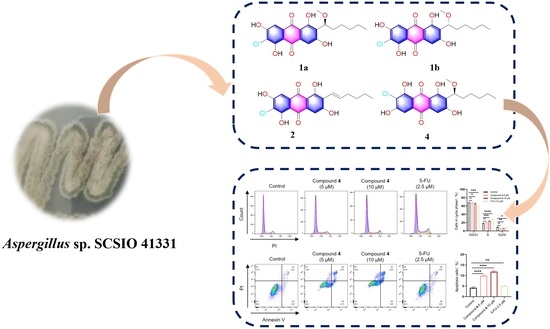
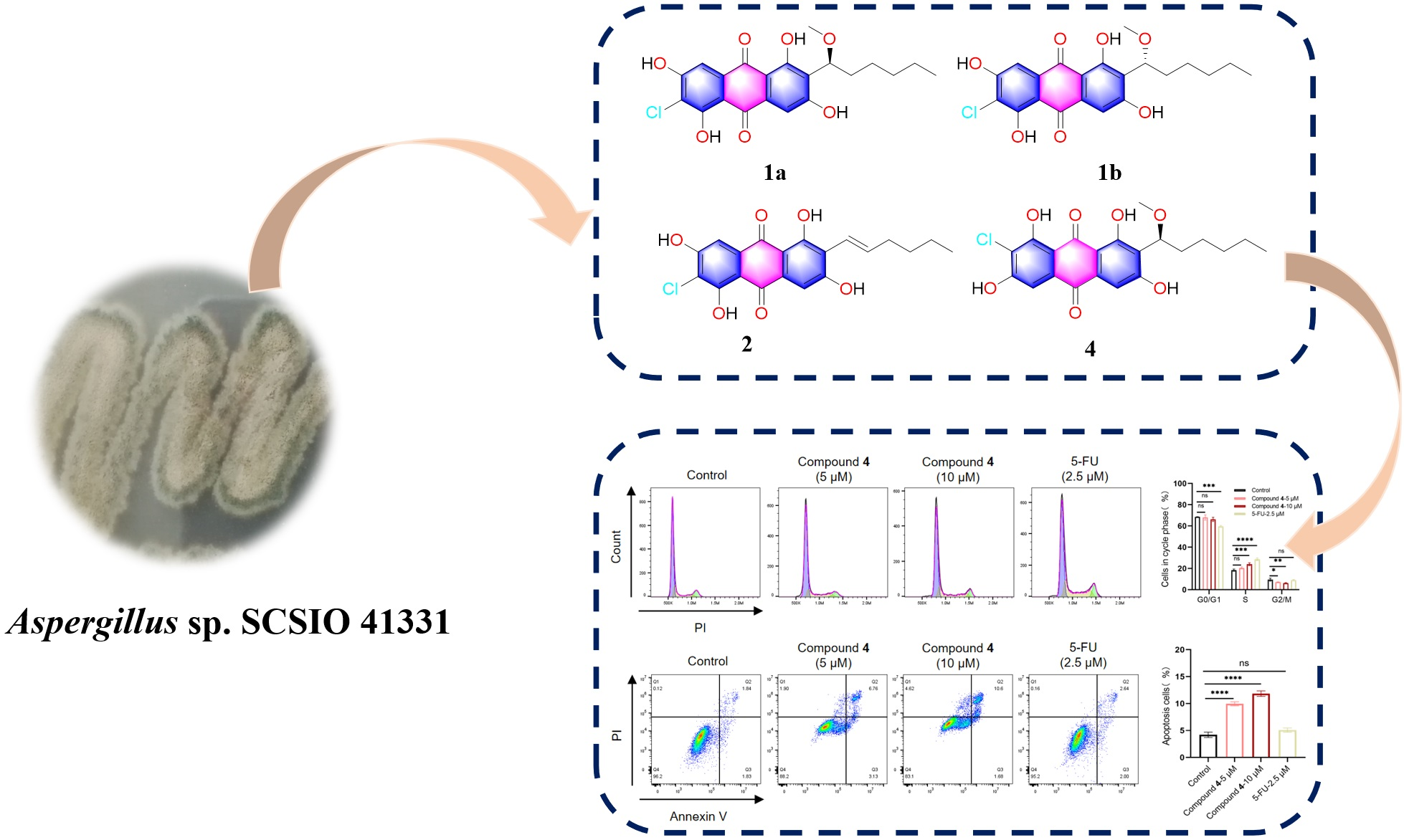
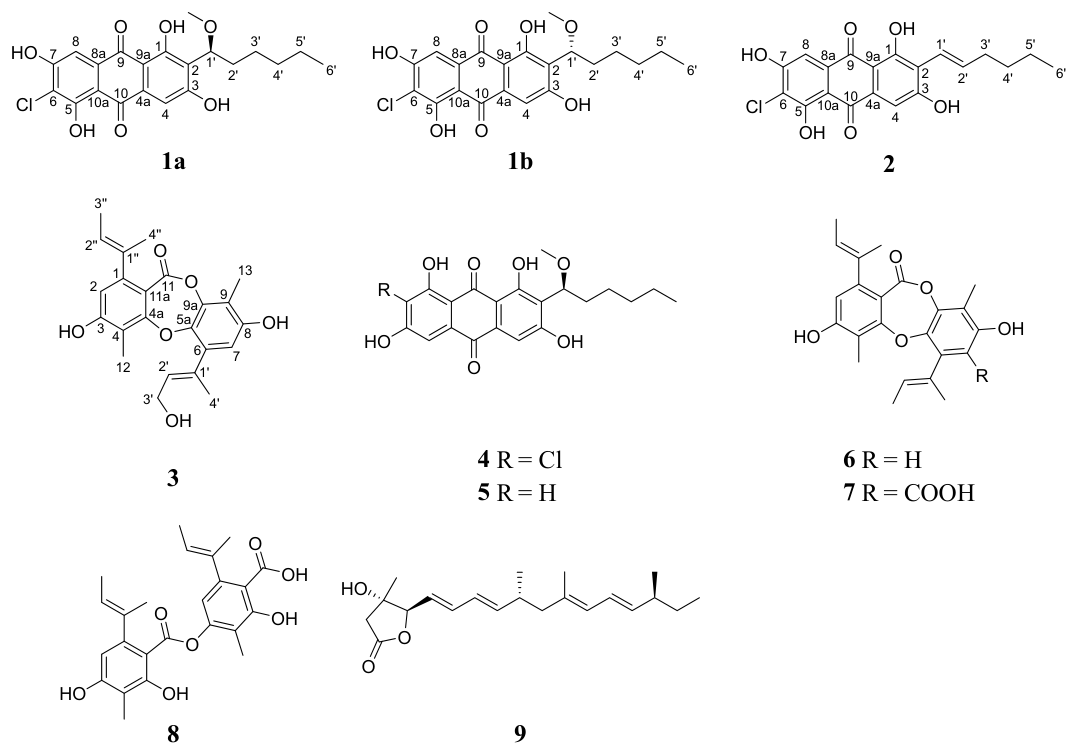
Aspergillus sp. collected from deep-sea sediment in the cold-seep area of the South China Sea caught our attention, from which we isolated and identified two unprecedented anthraquinones, (±)-1′-
O-methyl-6-chloroaverantin (
1a and
1b) and 6-chloroaverythrin (
2), one new diphenyl ether derivative, 1-((
E)-but-2-en-2-yl)-3,8-dihydroxy-6-((
E)-4-hydroxybut-2-en-2-yl)-4,9-dimethyl-11
H-dibenzo[b,e][1,4]dioxepin-11-one (
3), along with six known compounds, 1′-
O-methyl-7-chloroaverantin (
4) [
14], 1′-
O-methylaverantin (
5) [
14], folipastatin (
6) [
15], 7-carboxyfolipastatin (
7) [
16], agonodepside B (
8) [
17], and trichonafurin A (
9) [
18] (
Figure 1). This paper performs the isolation and structural elucidation of new compounds
1–
3, along with the biological evaluation of the isolated compounds.
2. Results and Discussion
Compound
1 was obtained as an orange powder. The molecular formula of
1 was determined to be C
21H
21ClO
7 due to the HRESIMS ion peaks at
m/
z 419.0921 [M − H]
− (calc. for C
21H
20ClO
7, 419.0903), indicating 11 degrees of unsaturation. The UV spectrum of
1 exhibited a characteristic absorption peak of the anthraquinone moiety at λ
max of 290 nm, which was beneficial for UV-guided separation. The
1H NMR (
Table 1) and HSQC spectra of
1 showed 15 sp
3-hybridized protons and 2 sp
2-hybridized protons. The
13C NMR spectrum indicated the presence of 21 carbons, namely, 2 carbonyls (
δC 183.2, C-9/10), 10 aromatic quaternary carbons, 3 methines carbons (including 1 oxygen-bearing carbon at
δC 75.1 and 2 aromatic carbons at 115.9 and 109.0), 4 methylene carbons, 1 methoxy carbon, and 1 methyl carbon (
δC 14.1, C-6′).
The UV−Vis and
1H and
13C NMR data of
1 were compared with those of the known compound 1′-
O-methyl-7-chloroaverantin (
4) isolated from
Aspergillus sp., revealing highly similar data and an identical molecular formula. The primary distinction comprised the change of the chemical shifts of the
13C NMR signal at the C-8 (from
δC 108.3 in
4 to
δC 115.9 in
1) and of the adjacent C-10a and C-8a signals, indicating a change in the substituent position on the benzene ring. The position of H-8 on the benzene ring in
1 was confirmed by the key HMBC correlations between H-8 and C-10a, C-6, and C-9. Moreover, the
13C NMR signal of C-9 shifted downfield to the same chemical shift as that of C-10, indicating that C-9 and C-10 underwent nearly identical deshielding effects from adjacent substituents. Moreover, the 1,5-dihydroxy anthraquinone moiety exhibited a nearly symmetrical structure, resulting in chemical shifts of the
13C NMR signals at positions C-10a and C-8a that were opposite to those observed in the known compound
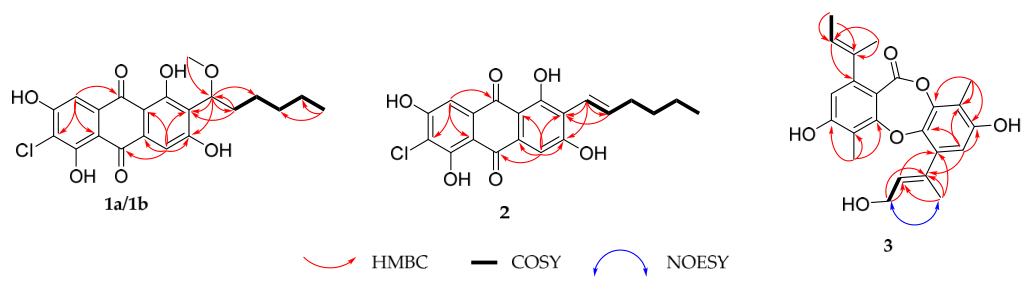
4. Additionally, the HMBC correlations of H-4/C-2/C-3/C-4a/C-9a/C-10; H-1′/C-2 and H-2′/C-2 determined the connection between C-1′ and C-2 in the side chain and the positions of the remaining carbons on the benzene ring (
Figure 2). Concurrently, the HMBC correlation between the oxygen methyl proton attached to C-1′ confirmed the presence of the oxygen methyl group. Therefore, compound
1 was described as 1′-
O-methyl-6-chloroaverantin.
Due to the baseline ECD curve and the barely measurable specific rotation value, compound
1 was presumed to be a racemate. Subsequently,
1 was separated using a chiral column, yielding (+)-
1 and (−)-
1, respectively (
Figure S8). Furthermore, the dichroism calculations (CD) spectrum of the absolute configuration at the C-1′ stereogenic center of compound
1a, as well as its negative optical rotation values (
−52.5 (
c 0.24, MeOH)), were consistent with those of (1′
S)-1′-
O-Methyl-7-chloroaverantin (compound
3 in [
14]), thereby confirming that compound
1a possessed the same
S-configuration, and compound
1b possessed the
R-configuration. Moreover, through the time-dependent density functional theory (TDDFT) calculations at the B3LYP/6-311G(d,p) level in Gaussian 09, the average calculated specific optical rotation values obtained for (1′
R)-
1 and (1′
S)-
1 were +345.3 and −376.0, respectively, which matched the experimental values of (+)-
1b (
+60.0 (
c 0.23, MeOH)) and (−)-
1a (
−52.5 (
c 0.24, MeOH)). Therefore, the absolute configurations of (+)-
1b and (−)-
1a were (1′
R)-
1 and (1′
S)-
1, respectively.
Compound 2 was obtained as a purple powder. The molecular formula of 2 was determined to be C20H17ClO6 due to the HRESIMS ion peaks at m/z 387.0649 [M − H]− (calc. for C20H16ClO6, 387.0641). The structures of compounds 2 and 1 were highly similar based on the 1H and 13C NMR spectroscopic data. By comparing the 1H and 13C NMR data of 1 and 2, it was found that the main difference was the variation in side-chain structure. The C-1′ at δC 119.3 and C-2′ at δC 136.4 were connected by a double bond to form two sp2-methine groups in 2, whereas C-1′ was connected to one methoxy group and one sp3-methylene group in 1. The COSY correlations from H-1′ to H-2′; H-2′/H-3′; H-3′/H-4′; H-4′/H-5′ and H-5′/H-6′ and the HMBC correlations of H-1′ with C-2 confirmed the position of the side chain and the correlation between C-1′ and C-2. Additionally, the H-1′ signal at 6.61 and the H-2′ signal at 6.88 exhibited a large coupling constant (16.0 Hz), suggesting that H-1′/H-2′ adopt a trans-configuration. Furthermore, in the HMBC spectrum, the correlations of H-8/C-10a/C-6/C-9 and H-4/C-2/C-3/C-4a/C-9a/C-10 confirmed that compound 2 possessed the same anthraquinone structure as that of compound 1. Therefore, compound 2 was established as 6-chloroaverythrin.
Compound 3 was obtained as a light yellow powder. The molecular formula of 3 was determined to be C23H24O6 due to the HRESIMS ion peaks at m/z 395.1500 [M − H]− (calc. for C23H23O6, 395.1500), indicating 12 degrees of unsaturation. Since deviations were observed in the chemical shift signals of H-2 and some hydrogen atoms in the high-field region when analyzing the 2D-NMR spectrum, it was inferred that the DMSO-d6 solvent effect might be responsible. Subsequently, acetone-d6 was used as the solvent to eliminate the solvent effect. The 1H NMR spectrum recorded in acetone-d6 exhibited two aromatic protons at δH 6.63 (s, H-2) and 6.53 (s, H-7); five methyl protons at δH 2.17 (s, H-12), 2.19 (s, H-13), 2.08 (d, J = 1.2 Hz, H-4′), 1.67 (dd, J = 6.7, 1.3 Hz, H-3″) and 1.87 (t, J = 1.3 Hz, H-4″); one methylene proton at δH 4.31(d, J = 6.2 Hz, H-3′); and two olefinic methine protons at δH 5.64 (td, J = 6.0, 1.5 Hz, H-2′) and 5.38 (m, H-2″). The 13C NMR spectrum indicated the presence of 23 carbons, namely, 1 carbonyl, 12 quaternary carbons (including 10 aromatic quaternary carbons), 4 methine carbons, 1 hydroxymethyl group carbon, and 5 methyl carbons.
Based on the 1H and 13C NMR data, compound 3 was essentially identical to compound 6, indicating that compound 3 was a depsidone, and they shared the same skeletal structure. Their notable distinction was the alteration of the chemical shifts at the C-3′ (from δC 14.1 in 6 to δC 59.4 in 3) and the distinct deshielded shifted resonance of C-2′ (from δC 125.1 in 6 to δC 132.4 in 3). Specifically, this referred to the replacement of the methyl group at the C-3′ position with a hydroxymethyl group. Further HMBC correlations from the methyl proton at C-12 to C-3/C-4/C-4a and the hydroxymethyl group at C-3′ to C-1′/C-2′ confirmed the presence of the methyl and hydroxymethyl group.
Since the positions at C-1 and C-2 in compound
3 can easily be interchanged, while still satisfying the observed HMBC correlation, in order to further confirm the relative configuration of compound
3, the gauge invariant atomic orbital (GIAO) method at the B3LYP/6-31G(d,p)/PCM(acetone-
d6) was adopted to calculate the
13C NMR data of the two possible isomers of compound
3 (
Tables S1 and S2). The experimental
13C NMR data of
3 match well with those for the isomer
3a (DP4+ probability: 100%) (
Figures S27 and S28). Thus, the planar structure of compound
3 was determined. Furthermore, the relative configuration of compound
3 was determined by NOESY experiments and NMR data. The NOESY spectrum revealed the correlations from H
2-3′ to H
3-4′, indicating that the double bond between H-3′ and H-4′ adopted the
E-configuration. Moreover, the chemical shifts of C-4″ at
δC 17.7 and C-4′ at
δC 18.4 were consistent with the
13C NMR data of the known compounds 7-chlorofolipastatin [
15] and folipastatin [
15], confirming the
E-configuration of the double bond at H-3″/H-4″. Therefore, compound
3 was established as 1-((
E)-but-2-en-2-yl)-3,8-dihydroxy-6-((
E)-4-hydroxybut-2-en-2-yl)-4,9-dimethyl-11
H-dibenzo[b,e][1,4]dioxepin-11-one.
Anthraquinones have a parent structure consisting of three fused rings and two carbonyl groups which are typically substituted with hydroxyl, hydroxymethyl, methyl, methoxy, and carboxyl groups, and they exhibit a wide range of pharmacological activities, such as anti-neurodegenerative and anti-hepatopathic effects, anticancer and anti-inflammatory activities, etc. [
19]. Because chloride/chlorine is the dominant element in the ocean, there are far more chlorinated compounds than brominated compounds [
20]. Exogenous addition of NaBr is usually required to produce bromoanthraquinone, whereas the addition of NaI does not yield iodoanthraquinone [
21]. Currently, most anthraquinone compounds are halogen-substituted at the C-7 position (compounds
4 and
5). In contrast, compounds
1 and
2 are chlorinated at the C-6 position, indicating that C-6 substitution in the anthraquinone skeleton represents a structurally novel feature.
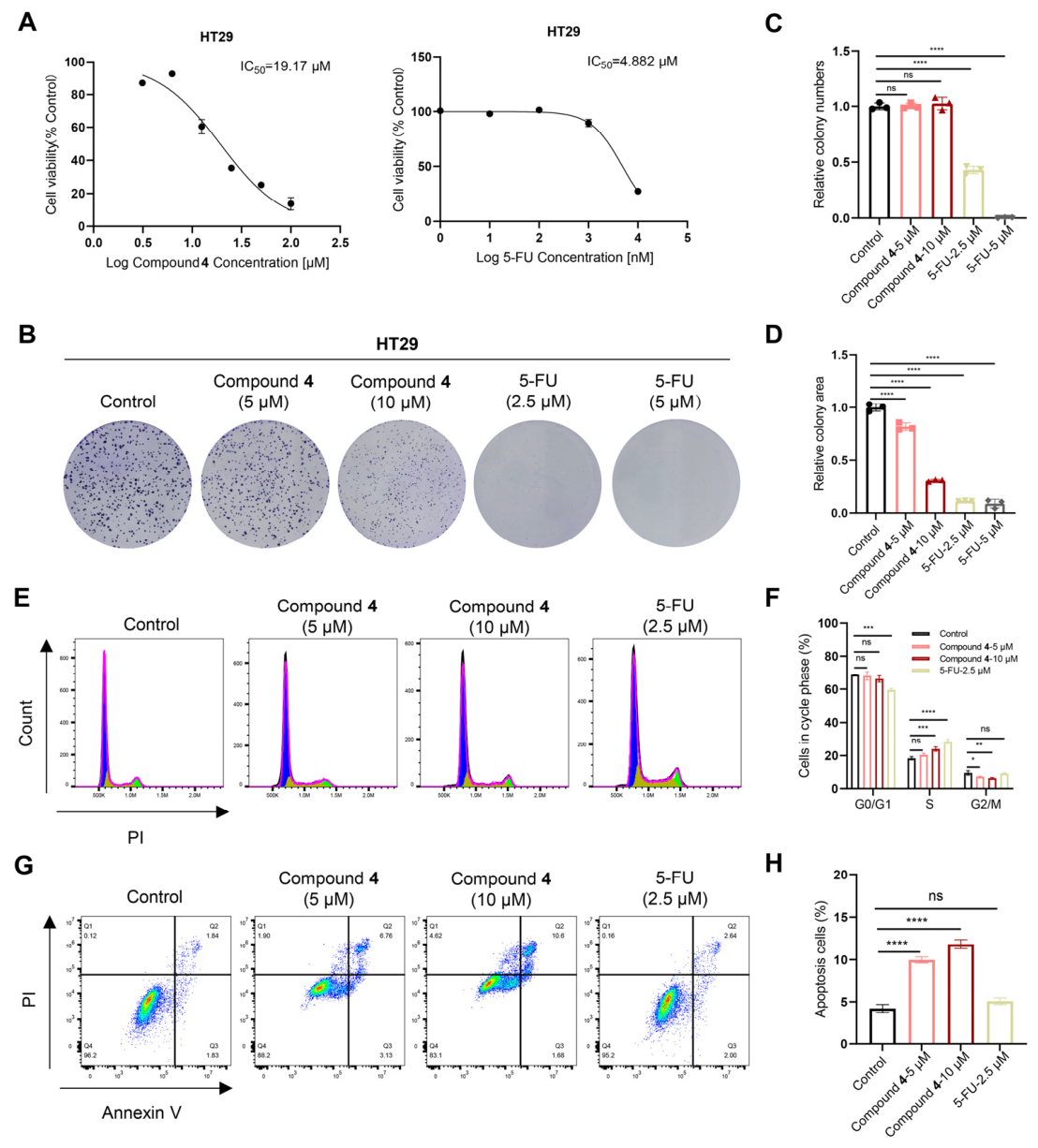
All isolated compounds were evaluated for antitumor activity against a panel of human cancer cell lines. Among them, all compounds exhibited IC
50 values above 50 µM, except for compound
4, which displayed moderate inhibitory activity against colon cancer cells, with an IC
50 value of 19.17 µM (
Figure 3A). As a preliminary evaluation of cytotoxicity in non-tumor-derived cells, compound
4 was tested in 293T cells and showed an IC
50 value of 27.73 μM, while the positive control 5-FU exhibited a high level of cytotoxicity with an IC
50 value of 5.84 μM (
Figure S29). To evaluate the long-term antiproliferative effect of
4, colony formation assays were performed in HT29 cells. Compound
4 at 5 and 10 μM significantly reduced relative colony area without markedly affecting colony number, indicating impaired colony expansion (
Figure 3B–D). As expected, the positive control 5-FU strongly suppressed colony formation, reducing both colony number and colony area (
Figure 3B–D). To explore the potential biological basis underlying the reduced colony expansion, cell-cycle distribution and apoptosis were further examined. Cell-cycle analysis showed that compound
4 caused a modest alteration in cell-cycle distribution, mainly characterized by a slight increase in the S-phase population at 10 μM. In contrast, 5-FU induced a more pronounced S-phase accumulation (
Figure 3E,F). Annexin V/PI staining showed that compound
4 significantly increased the proportion of apoptotic cells in HT29 cells in a concentration-dependent manner (
Figure 3G,H). Compared with the control group, compound
4 at 5 and 10 μM significantly increased total apoptotic cells in HT29 cells in a concentration-dependent manner, whereas 5-FU at 2.5 μM showed only a modest effect in this assay (
Figure 3G,H). Collectively, these results indicate that compound
4 exhibits moderate antiproliferative activity against HT29 cells and suppresses colony expansion. The reduced colony growth induced by compound
4 may be mainly linked to apoptosis-associated cell death, while cell-cycle alterations appear to play a limited or minor role.
3. Materials and Methods
3.1. General Experimental Procedures
Optical rotations were obtained using an Anton MCP-500 polarimeter (Anton Paar, Austria). HRESIMS data were recorded on a Bruker maXis Q-TOF mass spectrometer (Bruker, Fallanden, Switzerland). NMR spectra were recorded using a Bruker AV 500 MHz or AVANCE iii HD 700 MHz NMR spectrometer (Bruker, Falländen, Switzerland) with TMS as the internal standard. Chemical shifts were denoted by δ values in the 1H and 13C spectra, with the coupling constant denoted by J values. The UV and CD spectra were recorded on a Shimadzu UV-2600 PC spectrometer (Shimadzu, Kyoto, Japan) and a Chirascan circular dichroism spectrometer (Applied Photophysics, Surrey, UK), respectively. HPLC was undertaken on Agilent 1260 and Hitachi Primaide devices equipped with YMC ODS SERIES (YMC-Pack ODS-A, YMC Co., Ltd. (Kyoto, Japan)., 250 × 10 mm I.D., S-5 μm, 12 nm), a NanoChrom column (ChromCore 120 C18, NanoChrom Technologies Co., Ltd. (Suzhou, China), 250 × 10 mm I.D., S-5 μm), and a chiral column (CHIRALPAK IC, DAICEL (Shanghai, China), 4.6 mm Ø × 250 mmL, S-5 μm). Column chromatography (CC) was performed on silica gel (200–300 mesh, Jiangyou Silica Gel Development Co., Yantai, China), Sephadex LH-20 (40–70 μm, Amersham Pharmacia Biotech AB (Sweden, Uppsala) and Combi Flash (Irregular C18, 40–63 μm, Santai Tech (Changzhou, China). The TLC plates with silica gel GF254 (0.4–0.5 mm, Qingdao Marine Chemical Factory, Qingdao, China) were applied for analysis and preparative TLC.
3.2. Fungal Material
The fungal strain Aspergillus sp. was isolated from a cold-seep-sediment fungus, which was collected from the South China Sea (depth 1138 m) in July 2020. It was identified by Associate Professor Xiao-Yong Zhang, College of Marine Science, South China Agricultural University, as Aspergillus sp. and named as Aspergillus sp. SCSIO 41331 (accession no. LC105691). A voucher specimen has been preserved in the Laboratory of Tropical Marine Bio-Resources and Ecology, South China Sea Institute of Oceanology, Chinese Academy of Sciences, Guangzhou, China.
3.3. Extraction and Isolation
The Aspergillus sp. strain was inoculated onto agar plates and incubated at 25 °C for 7 days. The seed culture was prepared by inoculating spores of strain SCSIO 41331 into three 500 mL flasks, each containing 150 mL of seed medium (malt extract: 15 g, sea salt: 2.5 g, distilled water: 1 L), and incubated at 25 °C on a 180 r min−1 rotating shaker for 3 days. The seed culture was then transferred into 1 L × 60 conical flasks with solid rice medium (each flask contained 150 g of rice, 3 g of sea salt, and 150 mL of naturally sourced water), and the large-scale fermentation of the strain was carried out at 25 °C for 30 days. The total rice culture was crushed and extracted with EtOAc five times to yield 71.5 g of crude gum.
3.4. Purification
The crude material (71.5 g) was separated by silica gel column chromatography (CC) using petroleum ether (PE), ethyl acetate (EA), and methanol mixtures (90:10:0–0:0:100, v/v) and divided into nine fractions (Fr.1–9), based on TLC characteristics. Fr.3 was similarly separated on the Sephadex LH-20 column eluting with H2O/MeOH (0–100%), yielding nine subfractions (Fr.3-1–3-9). Fr.3-8 was purified by semi-preparative HPLC eluting with 86% MeOH/H2O with 0.04% FA to obtain 2 (2.29 mg, tR 49.6 min). Fr.3–4 was further separated into seven subfractions (Fr.3-4-1–3-4-7) through Sephadex LH-20 column eluting with H2O/MeOH (0–100%). Fr.3-4-5 was further purified by semi-preparative HPLC eluting with 59% MeOH/H2O to obtain 3 (1.43 mg, tR 25.4 min). Fr.3–5 was purified by semi-preparative HPLC eluting with 68% MeOH/H2O with 0.04% FA to obtain 6 (21.66 mg, tR 27.7 min) and 7 (6.2 mg, tR 36.8 min). Fr.3–7 was purified by semi-preparative HPLC eluting with 70% MeCN/H2O with 0.04% FA to obtain 9 (1.58 mg, tR 28.5 min). Fr.4 was further separated into six subfractions (Fr.4-1−4-6) through Sephadex LH-20 column eluting with H2O/MeOH (0–100%). Fr.4-4 underwent semi-preparative HPLC purification using an ODS column to obtain three subfractions (Fr.4-4-1–Fr.4-4-3), eluting with 75% MeCN/H2O with 0.04% formic acid (FA). Fr.4-4-1 was further purified by semi-preparative HPLC eluting with 86% MeOH/ H2O with 0.04% FA to obtain 1 (1.82 mg, tR 32.3 min) and another subfraction (Fr.4-4–1-1). Compound 1 was further separated into 1a (0.24 mg, tR 51.3 min) and 1b (0.23 mg, tR 46.8 min) by semi-preparative chiral column eluting with 85% MeOH/H2O with 0.04% FA. Fr.4–5 was purified by semi-preparative HPLC eluting with 91% MeOH/H2O with 0.04% FA to obtain 4 (18.62 mg, tR 16.7 min). Fr.4-4-2 was purified by semi-preparative HPLC eluting with 90% MeOH/ H2O with 0.04% FA to obtain 5 (1.89 mg, tR 16.4 min). Fr.4–3 was purified by semi-preparative HPLC eluting with 75% MeOH/H2O with 0.04% FA to obtain 8 (2.49 mg, tR 31.7 min).
1′-
O-methyl-6-chloroaverantin (±
1): yellow powder; (−)-
1a (
−52.5 (
c 0.24, MeOH)); (+)-
1b (
+60.0 (
c 0.23, MeOH));
1a (UV (MeOH) λ
max (log ε)): 215 (3.15), 222 (3.17), 242 (2.80), 263 (2.89), 276 (2.76), 316 (3.08) nm;
1b (UV (MeOH) λ
max (log ε)): 217 (3.02), 220 (3.02), 242 (2.63), 263 (2.73), 280 (2.48), 316 (2.30) nm;
1a (CD (MeOH) Δε (nm)): 209 (0.42), 225 (−1.20), 270 (−0.18), 294 (−0.46), 334 (0.03), and 388 (−0.49) nm;
1b (CD (MeOH) Δε (nm)): 204 (−0.20), 223 (0.77), 233 (0.29), 238 (0.37), 268 (−0.18), 312 (0.06), 341 (−0.19), and 374 (0.17) nm;
1H NMR and
13C NMR data,
Table 1; HR-ESI-MS
m/
z 419.0921 [M − H]
− (calc. for C
21H
20ClO
7, 419.0903).
6-chloroaverythrin (
2): yellow powder;
1H NMR and
13C NMR data,
Table 1; HR-ESI-MS
m/
z 387.0649 [M − H]
− (calc. for C
20H
16ClO
6, 387.0641), 775.1381 [2M − H]
− (calc. for C
40H
33Cl
2O
12, 775.1355).
1-((
E)-but-2-en-2-yl)-3,8-dihydroxy-6-((
E)-4-hydroxybut-2-en-2-yl)-4,9-dimethyl-11
H-dibenzo[b,e][1,4]dioxepin-11-one (
3): yellow powder;
1H NMR and
13C NMR data,
Table 2; HR-ESI-MS
m/
z 395.1500 [M − H]
− (calc. for C
23H
25O
6, 395.1500),791.3077 [2M − H]
− (calc. for C
46H
47O
12, 791.3073).
3.5. Calculation Details
Quantum chemical calculations were implemented via density functional theory (DFT) using the Gaussian 09 software package [
22]. A preliminary conformation was identified using Spartan 14 software (Wavefunction Inc., Irvine, CA, USA) coupled with the MMFF force field to detect low-energy conformers. On this basis, the stable conformers obtained from using the MMFF force field were first subjected to geometric optimization at the B3LYP/6-31G(d) level, and the solvation effects of methanol were incorporated using the SMD continuum model. Ultimately, electronic excitation energies and rotational strengths were obtained through time-dependent density functional theory (TDDFT) calculations at the B3LYP/6-311G(d,p) level, which enabled the calculation of specific optical rotation (OR) value. The NMR chemical shifts were calculated via the gauge invariant atomic orbital (GIAO) method [
23] at the B3LYP/6-31G(d,p) level with PCM (acetone-
d6), accounting for solvent effects to reproduce the experimental solvent environment. Furthermore, the computed NMR shifts for the
3a and
3b isomers were subjected to DP4+ probability analysis using a publicly available Excel-based tool (
https://sarotti-NMR.weebly.com).
3.6. Cell Culture
The human cancer cell lines, HT29 and the 293T cells, were purchased from Procell Life Science & Technology Co., Ltd. (Wuhan, China). Cells were cultured in the recommended culture medium supplemented with 10% fetal bovine serum and 1% penicillin–streptomycin at 37 °C in a humidified atmosphere containing 5% CO2.
3.7. Cytotoxicity Assay
Colon cancer cell viability was assessed using a CellTiter-Lumi
TM Luminescent Cell Viability Assay (Beyotime, Shanghai, China), according to the manufacturer’s instructions [
24]. Briefly, cells were seeded into 96-well plates at an appropriate density and allowed to attach overnight. Cells were then treated with increasing concentrations of compound
4 or the positive control 5-FU for 48 h. The luminescent signal was measured using a Synergy H1 microplate reader (BioTek, Shanghai, China). Cell viability was normalized to the untreated control group and expressed as a percentage. Dose–response curves were generated using nonlinear regression analysis, and IC
50 values were calculated using GraphPad Prism 9.
3.8. Colony Formation Assay
For 2-D clonogenic assay, cells were then seeded in 6-well plates at a concentration of 1000 cells per well. The cells were incubated at 37 °C and allowed to adhere overnight. Cells were then treated with compound 4 (5 and 10 μM) or the positive control 5-FU (2.5 and 5 μM) and cultured for 5–7 days. At the end of the incubation period, the 6-well plates were washed with 1 × PBS, and the cells were fixed by adding 100% methanol and incubating them at 4 °C for 10 min. The cells were then stained with 0.5% crystal violet for 10 min at room temperature before being washed twice in double-distilled (dd) H2O. Colonies were imaged, and quantitative analysis of colony number and colony area was performed using ImageJ software version 1.51j8 and GraphPad Prism 9.
3.9. Cell-Cycle Analysis
For cell-cycle analysis, HT29 cells were seeded in 6-well plates and allowed to attach overnight. Cells were then treated with compound 4 (5 and 10 μM) or 5-FU (2.5 μM) for 48 h. After treatment, both floating and adherent cells were collected, washed twice with cold PBS, and stained using a Cell Cycle and Apoptosis Analysis Kit (Servicebio, Wuhan, China), according to the manufacturer’s instructions. Briefly, cells were fixed with 70% ethanol at 4 °C overnight, followed by incubation with RNase A and propidium iodide (PI) staining solution for 30 min at room temperature in the dark. DNA content was detected using a NovoCyte 2000R flow cytometer (Beijing, China), and cell-cycle distribution was analyzed using FlowJo software version 10.8.1. The percentages of cells in G0/G1, S, and G2/M phases were quantified based on DNA content.
3.10. Apoptosis Analysis
For apoptosis analysis, cell apoptosis was assessed using an Annexin V-FITC/PI Apoptosis Detection Kit (YEASEN, Shanghai, China), according to the manufacturer’s instructions. Briefly, HT29 cells were seeded in 6-well plates and treated with compound 4 (5 and 10 μM) or 5-FU (2.5 μM) for 48 h. After treatment, both floating and adherent cells were harvested, washed twice with cold PBS, and resuspended in binding buffer. Cells were then stained with annexin V-FITC and PI for 15 min at room temperature in the dark. Apoptotic cells were detected using a NovoCyte 2000R flow cytometer, and data were analyzed using FlowJo software version 10.8.1. Early apoptotic cells were defined as annexin V-FITC-positive and PI-negative cells, whereas late apoptotic cells were defined as annexin V-FITC-positive and PI-positive cells. Total apoptotic cells were calculated as the sum of early and late apoptotic populations.




 ,
,