
Article

Cultivation of Limnospira platensis (Spirulina) in Full Seawater with Medium Recycling: A Promising Source of Protein and Phycocyanin for Arid Coastal Regions

by
Monserrat Alemán
1,2,*,
Marianna Venuleo
1,
Juan Luis Gómez-Pinchetti
2,
Eduardo Portillo
1 and
Flavio Guidi
1
1
Instituto Tecnológico de Canarias (ITC), Biotechnology Department, Playa de Pozo Izquierdo s/n, 35119 Santa Lucía de Tirajana, Las Palmas, Spain
2
Banco Español de Algas (BEA), Instituto de Oceanografía y Cambio Global (IOCAG), Universidad de Las Palmas de Gran Canaria, Muelle de Taliarte s/n, 35214 Telde, Las Palmas, Spain
*
Author to whom correspondence should be addressed.
Mar. Drugs 2026, 24(4), 141; https://doi.org/10.3390/md24040141
Submission received: 13 January 2026 / Revised: 30 March 2026 / Accepted: 10 April 2026 / Published: 16 April 2026
(This article belongs to the Special Issue Algal Cultivation for Obtaining High-Value Products, 2nd Edition)

Abstract

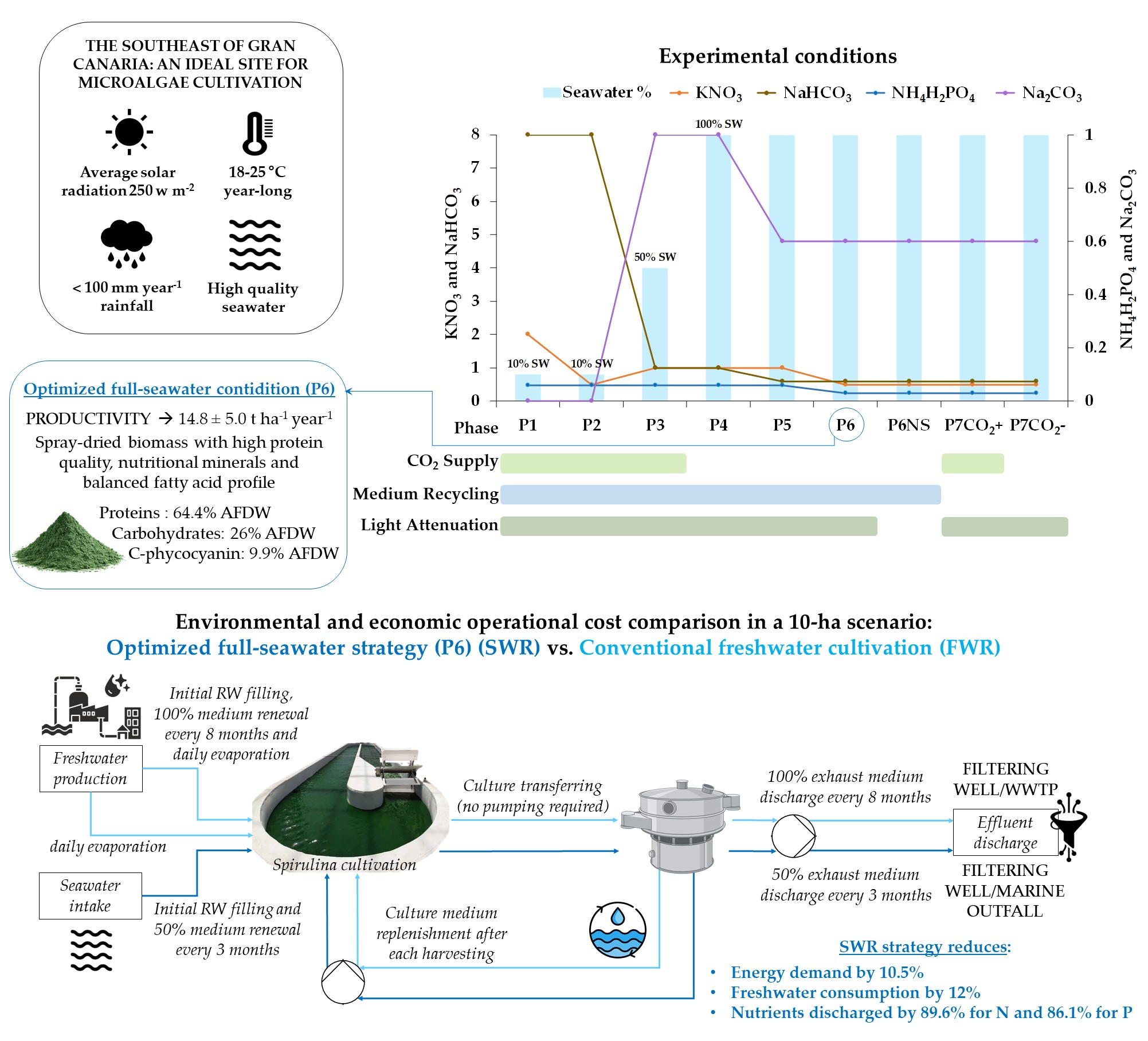
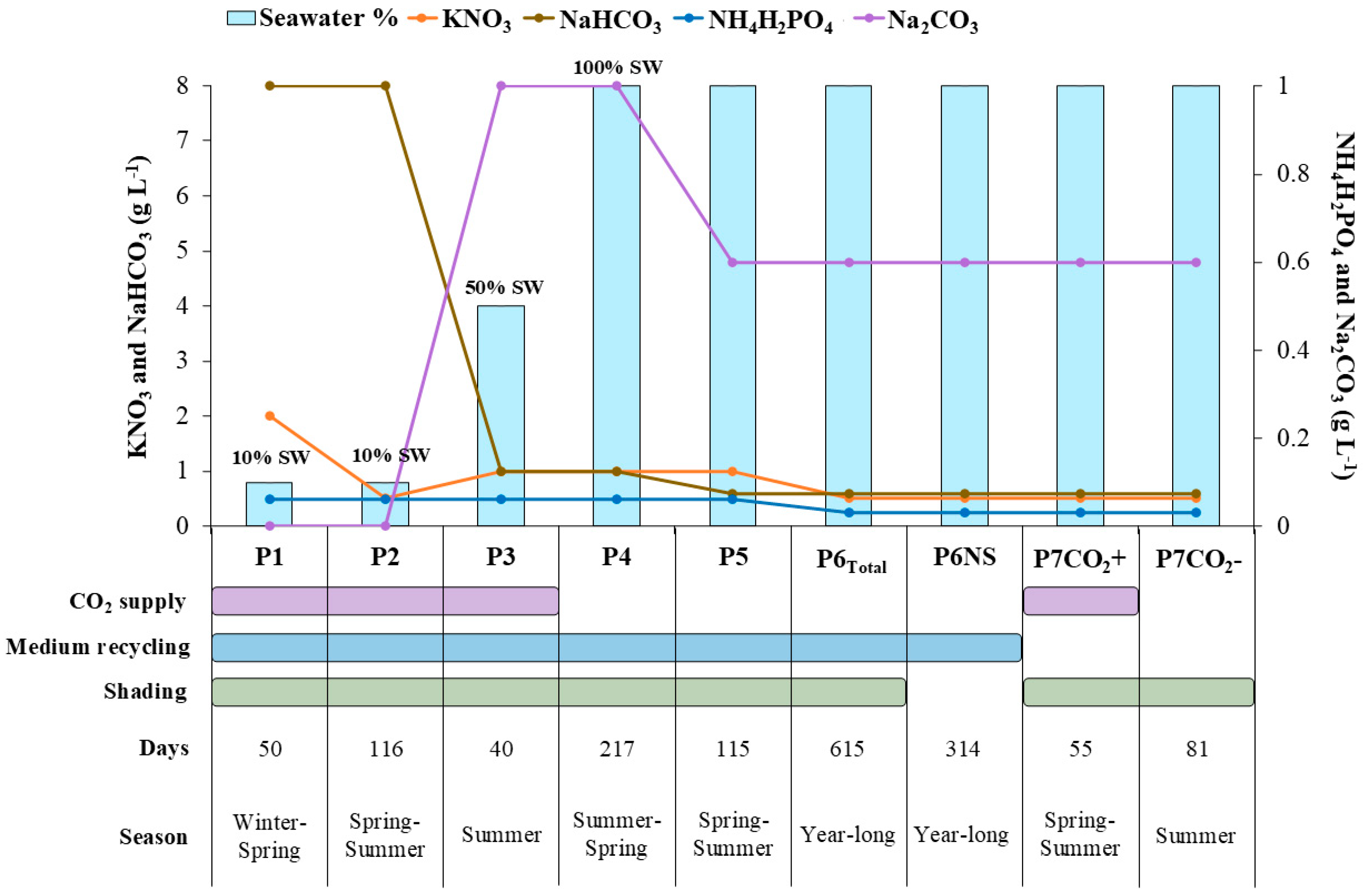
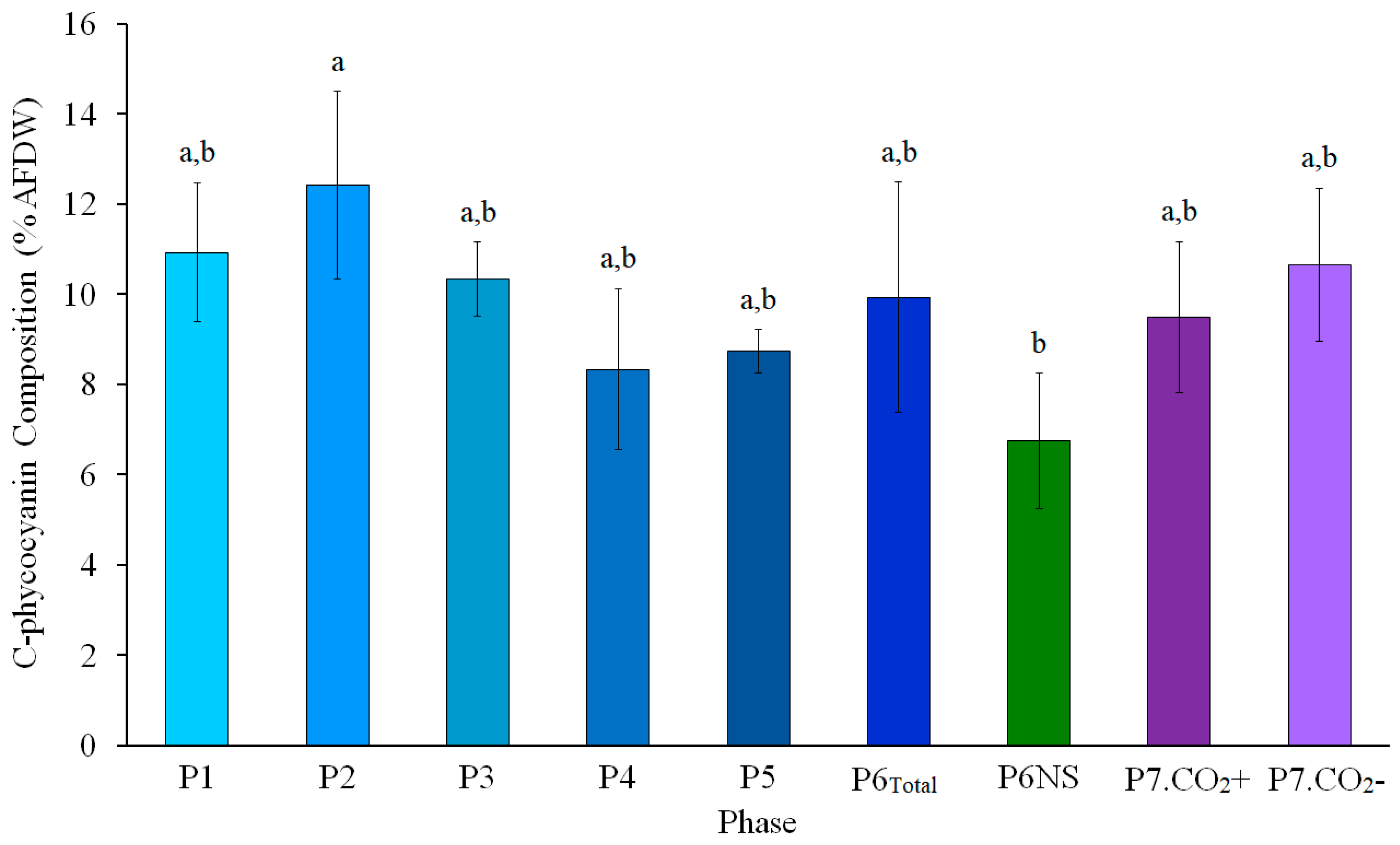
Protein and phycocyanin production is challenged by freshwater scarcity in arid coastal regions. This study assessed and optimized the cultivation of Limnospira platensis BEA 1257B in full seawater. Eight cultivation phases were conducted in 10,000 L raceways under a greenhouse to evaluate the effects of seawater content, nutrient availability, shading, CO2 supply, and medium recycling on biomass productivity and biochemical composition. Freshwater, energy, and fertilizer savings, together with effluent characteristics of the optimized full-seawater recirculation strategy (SWR), were evaluated against a conventional freshwater cultivation process. Lower productivity was associated with high salinity and irradiance. Under long-term optimized conditions (615 days), the strain achieved stable productivities of 4.1 ± 1.4 gDW m−2 day−1 (14.8 ± 5.0 tDW ha−1 year−1). Increasing salinity promoted carbohydrate accumulation in the biomass (26.0% AFWD), while protein (64.4%) and C-phycocyanin (9.9%) moderately decreased. Nevertheless, protein quality, phycocyanin, and essential fatty acids remained high. Spray-dried biomass exhibited nutritionally relevant contents of K, Mg, Ca, Fe, and Mn, and complied with international food safety standards. SWR reduced energy demand by 10.5% and freshwater consumption by 12% on a surface basis, although these advantages were partially offset when expressed per unit of product, while clearly supporting environmentally sustainable and regulatory-compliant Limnospira production.
Keywords: Limnospira; seawater medium recycling; long-term cultivation; freshwater scarcity; energy and nutrient efficiency; alternative proteins; phycocyanin; food-grade biomass; environmental sustainability Limnospira; seawater medium recycling; long-term cultivation; freshwater scarcity; energy and nutrient efficiency; alternative proteins; phycocyanin; food-grade biomass; environmental sustainability
Graphical Abstract