2.1. Structural Determination
Corallomycetellain A (
1) was obtained as a light-yellow amorphous powder. Its molecular formula was determined to be C
21H
18N
2O
4S, based on the molecular ion at
m/z 417.0880 [M + Na]
+ observed in HRESIMS, indicating 14 degrees of unsaturation. The 1D NMR (
Table 1) and HSQC spectra of
1 revealed the presence of one methylthio group (
δC/H 13.1/2.09), one acetyl methyl group (
δC/H 21.6/2.23), one methylene (
δC/H 40.6/3.10), ten methines (one oxygenated (
δC/H 74.9/6.31), one nitrogenated (
δC/H 64.7/5.27), and eight olefinic ones (
δC/H 115.0/7.45,
δC/H 116.4/8.44,
δC/H 120.6/6.03,
δC/H 122.8/7.70,
δC/H 125.3/6.03,
δC/H 125.6/7.41,
δC/H 128.2/7.54,
δC/H 128.5/5.65)), one quaternary sp
3 carbon (
δC 76.4), four olefinic nonprotonated carbons (
δC 128.9, 129.3, 133.9, 134.7), one ketone carbonyl (
δC 171.4) and two amide carbonyls (
δC 163.7, 155.7). Nine of the compound’s fourteen degrees of unsaturation were accounted for by the structural features identified so far, suggesting that compound
1 possessed a penta-cyclic core.
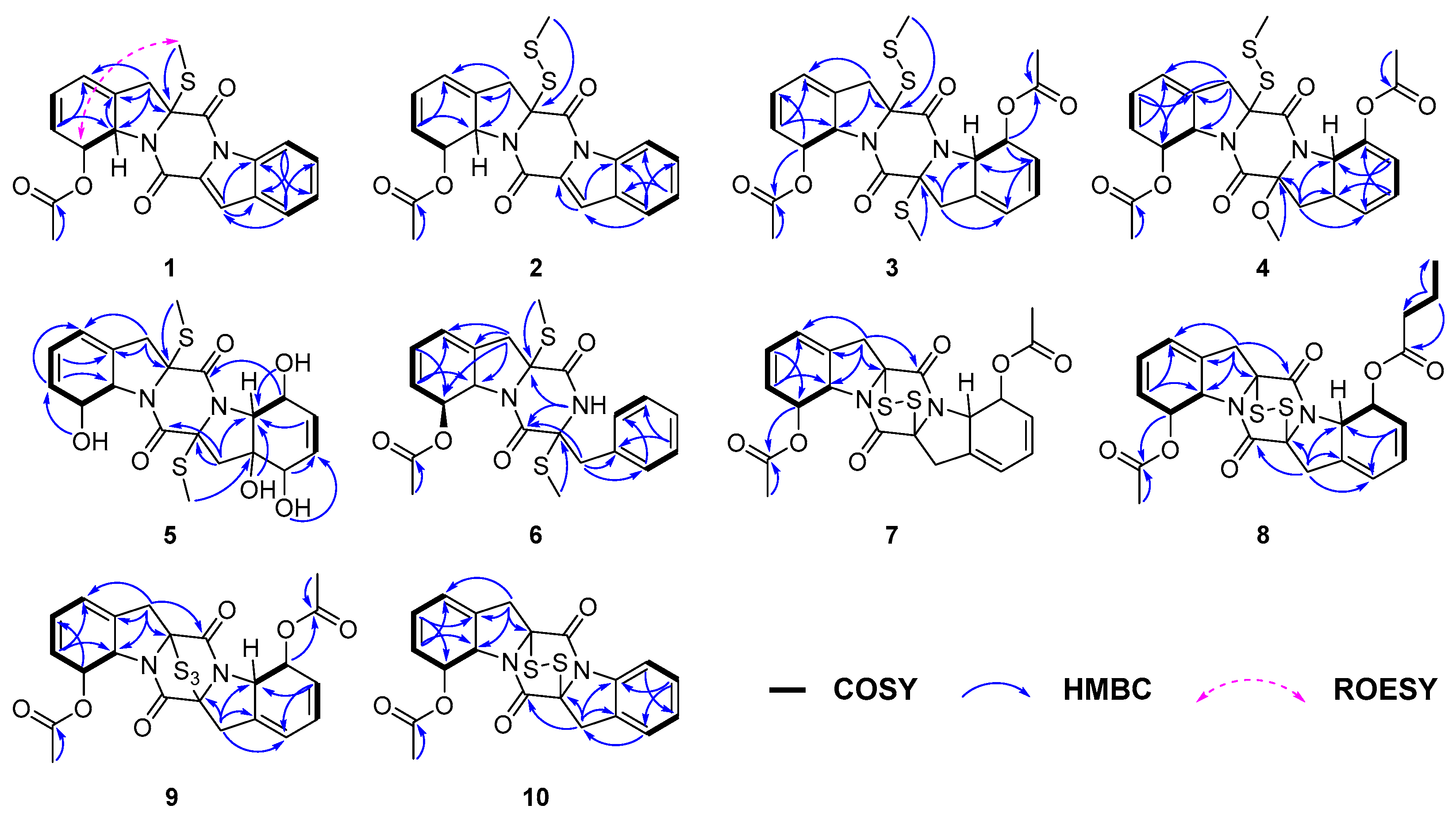
A series of the COSY correlations from H-6 (
δH 6.03)/H-7 (
δH 5.65) and H-8 (
δH 6.31)/H-9 (
δH 5.27) as well as the HMBC correlations from H-7 to C-5 (
δC 120.6)/C-9 (
δC 64.7), from H-9 to C-4 (
δC 133.9) and from H
2-3 to C-2 (
δC 76.4)/C-4/C-5/C-9 indicated the presence of six membered rings combined with five membered rings in
1. (
Figure 3). While the right series of the COSY correlations from H-5′ (
δH 7.70)/H-6′ (
δH 7.41) and H-7′ (
δH 7.54)/H-8′ (
δH 8.44) as well as the HMBC correlations from H-5′ to C-3′ (
δC 115.0)/C-9′ (
δC 134.7)/C-7′ (
δC 128.2), from H-8′ to C-4′ (
δC 129.3)/C-6′ (125.6) and from H-3′ (
δH 7.45) to C-2′ (
δC 128.9)/C-9′ revealed an extra six membered rings combined with five membered rings (
Figure 3). Moreover, the compound was deduced to possess a 6-5-6-5-6 fused diketopiperazine (DKP) skeleton, based on the characteristic chemical shifts of the amide carbonyls (
δC 163.7, C-1;
δC 155.7, C-1′) and the molecular weight. Analysis of the NMR data (
Table 1) for the left C-11 (
δC 171.4) and C-12 (
δC 21.6) of
1 and HMBC correlation from H-12 (
δH 2.23) to C-11 indicated the presence of an acetyl group. Based on all relevant signals and chemical shifts, we hypothesized that the acetyl group can only form an ester bond with the oxygen at the C-8 (
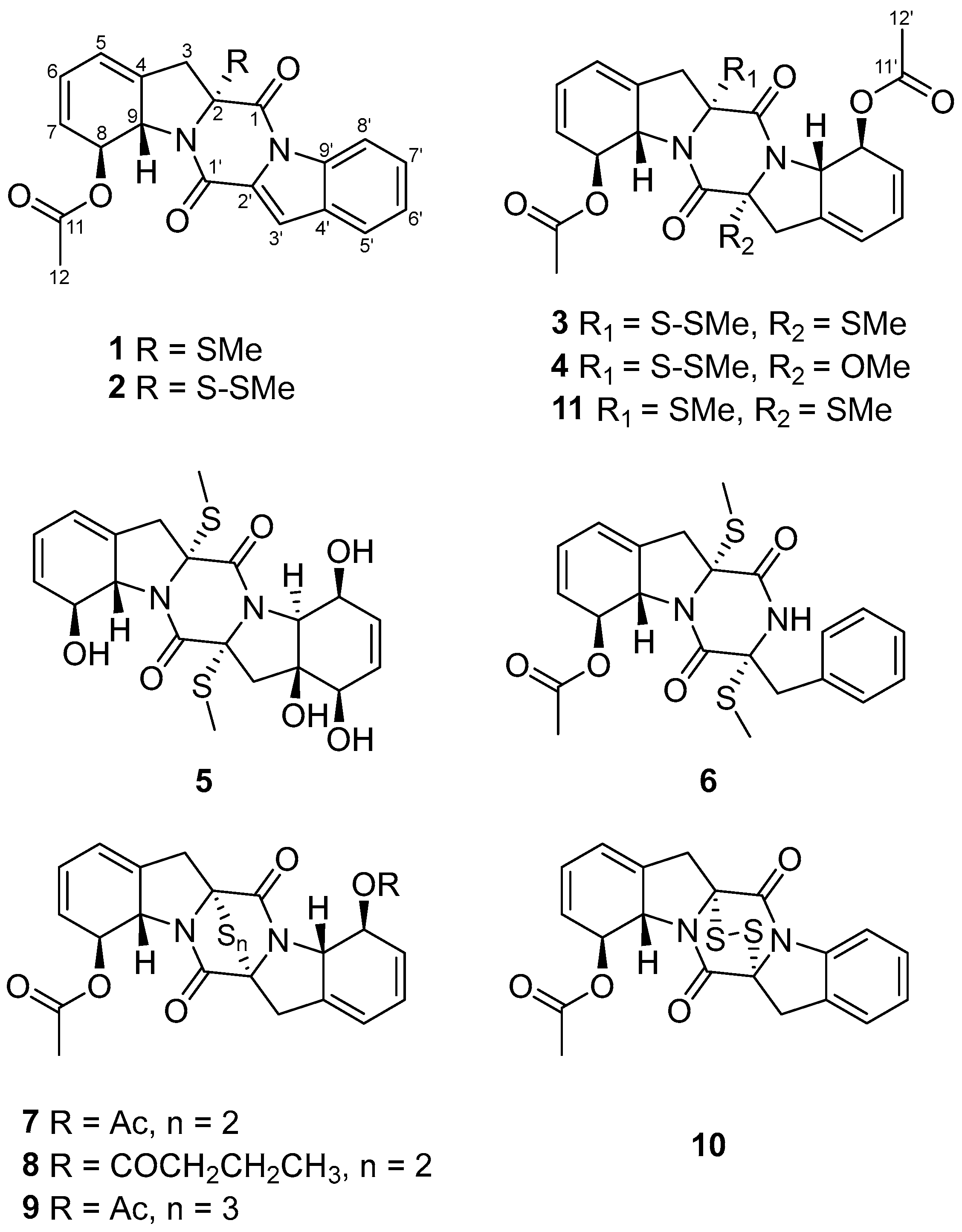
δC 74.9) position. Therefore, the planer structure of
1 with the presence of a 6/5/6/5/6 diketopiperazine skeleton was suggested, as shown in
Figure 2.
The relative configurations of
1 were established as 2
R*,8
S*,9
S* by the coupling constants analysis of H-8/H-9 (
3JH-8, H-9 = 14.0 Hz) and the ROESY correlation between SMe-2 (
δH 2.09) and H-8 (
δH 6.31). To determine the absolute configurations of
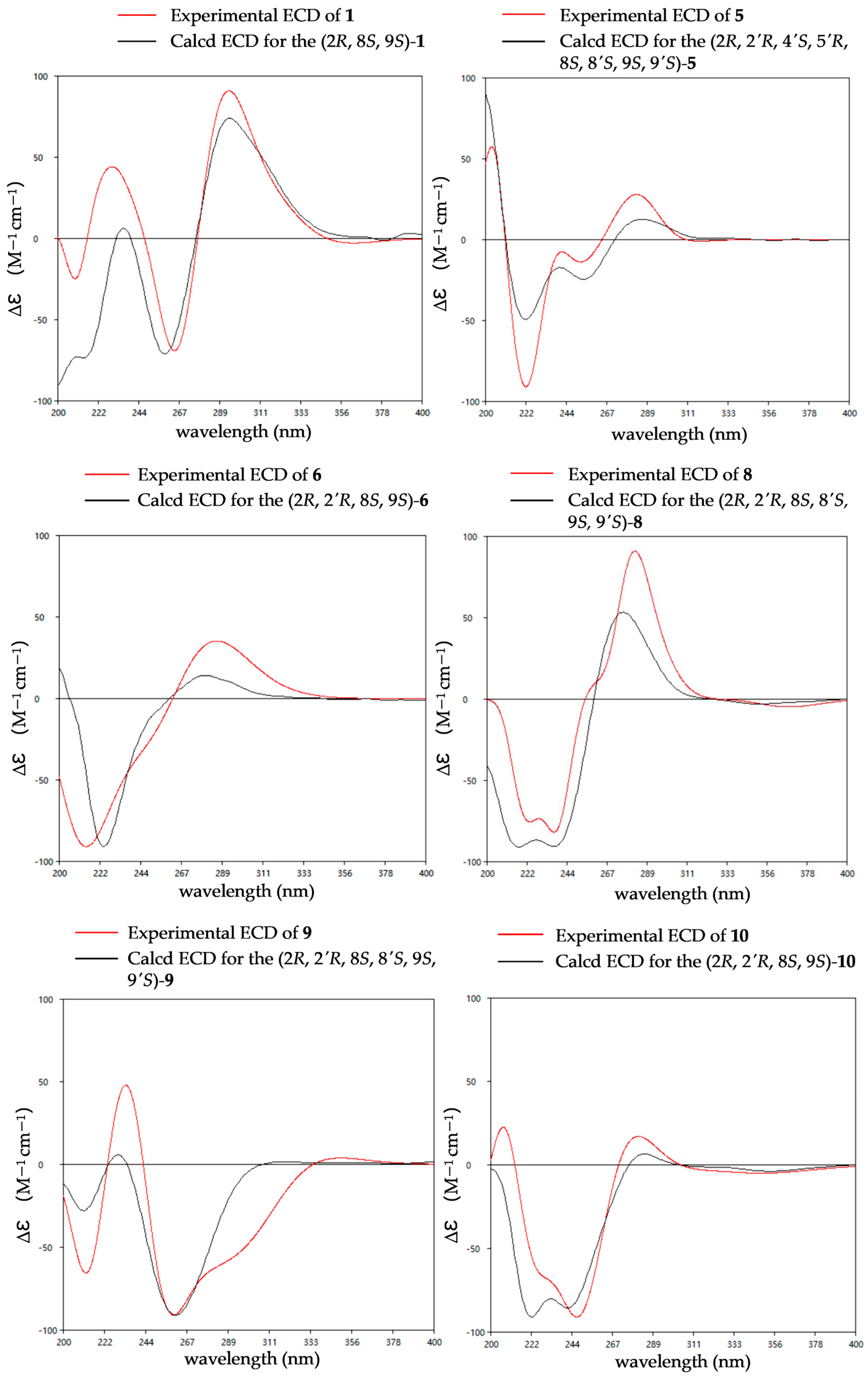
1, ECD calculations were performed at the B3LYP/6-31+G(d) level. The tendencies of the experimental ECD spectrum were in reasonable agreement with the calculated one of (2
R*,8
S*,9
S*)-
1 (
Figure 4), establishing the absolute configuration as 2
R, 8
S, 9
S in
1.
The molecular formula of corallomycetellain B (
2), obtained as a light-yellow amorphous powder, was C
21H
18N
2O
4S
2, deduced by HRESIMS. Comparison of
1H and
13C NMR spectra (
Table 1) of
1 and
2 revealed that they shared the same 6/5/6/5/6 diketopiperazine skeleton with an aromatic indole moiety. The only difference was an existence of a disulfide bond in C-2 (
δC 78.9) in
2 supported by the HRESIMS results and chemical shift differences of Me-R-2 in
1 and
2 (
δC 13.1 in
1 while
δC was 23.5 in
2).
The relative configurations of
2 were established in the same way as
1 by the coupling constants analysis of H-8/9 (
3JH-8, H-9 = 14.0 Hz) and the comparison of 1D NMR data with
1 (
Table 1). Consequently, the absolute configuration of
2 was determined as 2
R, 8
S, 9
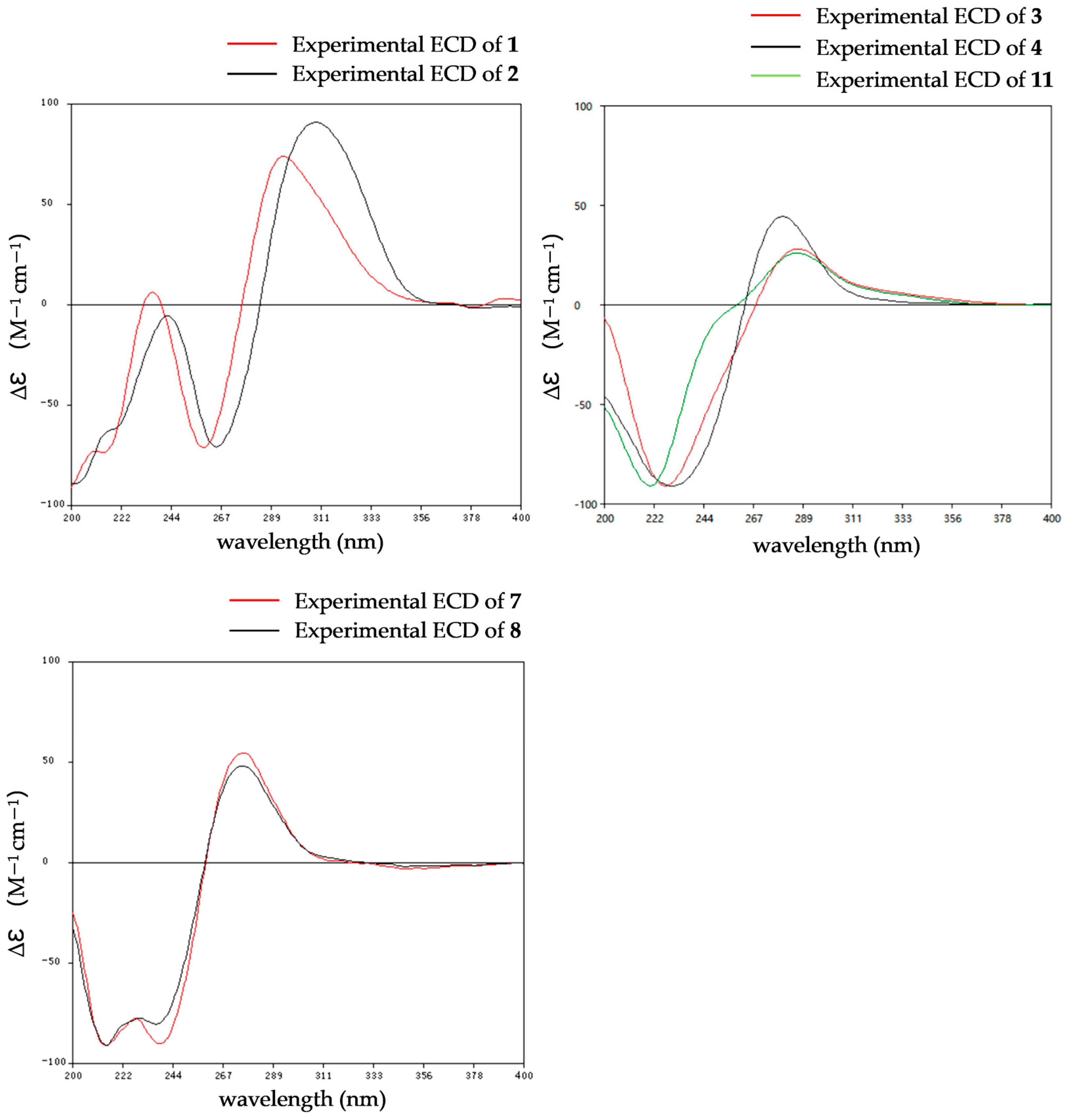
S, since the experimental ECD curves of
1 and
2 agreed perfectly (
Figure 5). Reported ETPs typically feature a sulfur-bridged diketopiperazine core, frequently integrated with fused oxazine rings. In comparison, compounds
1–
2 represent the first two examples of aranotin-type ETPs possessing a rare aromatic indole unit (
Figure S2).
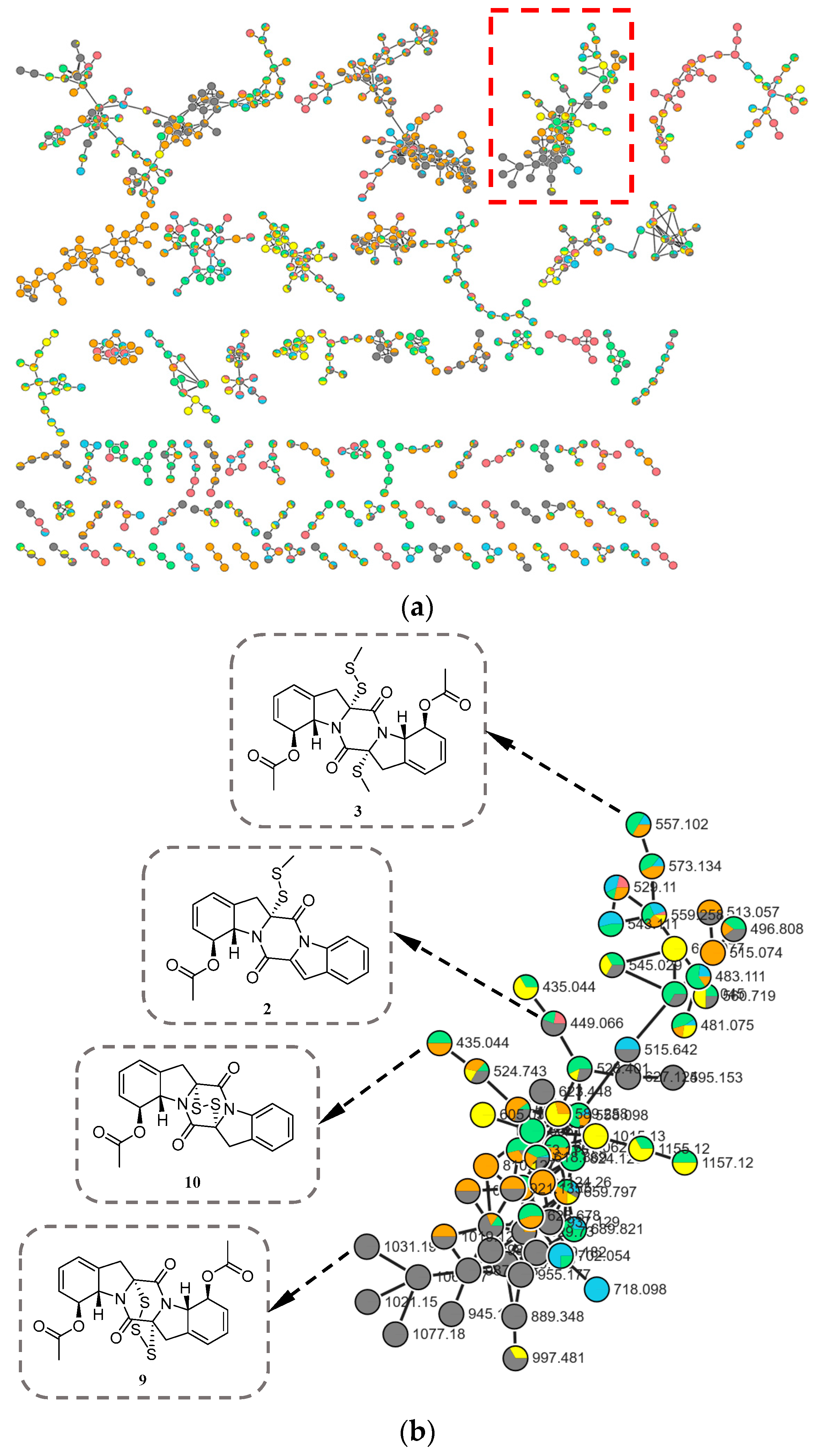
Corallomycetellain C (
3) and corallomycetellain D (
4) were obtained as a light-yellow amorphous powders with the molecular formulae of C
24H
26N
2O
6S
3 and C
24H
26N
2O
7S
2, deduced by HRESIMS, respectively. Analysis of the
1H and
13C NMR data of
3 with those of haematocin (
11) [
13] indicated that
3 has the same skeleton as
11 (
Table 2). The difference in mass of 32 Da between
3 and
11 indicated an addition of a sulfur atom in
3, which is supported by the HRESIMS analysis. The HMBC correlation from S-SMe-2 (
δH 23.8) to C-2 (
δC 77.4), along with the differences in chemical shifts of C-2 and S-SMe-2 (
δC 74.2 and
δC 14.5 in
11 [
13], compared to
δC 77.4 and
δC 23.8 in
3), revealed the presence of a disulfide bond at C-2 in
3 (
Figure 3). Compound
4 had a methoxy group instead of a methylthio group in C-2′, which was supported by chemical shifts of OMe-2′ (
δC 53.3 and
δH 3.50) and C-2′ (
δC 95.4) as well as an HMBC correlation from OMe-2′ to C-2′ (
Figure 3).
The relative configurations of
3–
4 were established by
1H-
1H coupling constants and ROESY data, and the comparison of 1D NMR data with haematocin (
11). The coupling constants between H-8/8′ and H-9/9′ were more than 14.0 Hz, which revealed
trans relationships of H-8/H-9 and H-8′/H-9′. The ROESY correlations from H-3a/3′a (
δH 2.89) to H-9/9′ (
δH 5.19), from H-3b (
δH 3.69) to S-SMe-2 (
δH 2.47) and from H-3′b (
δH 3.00) to SMe-2′ (
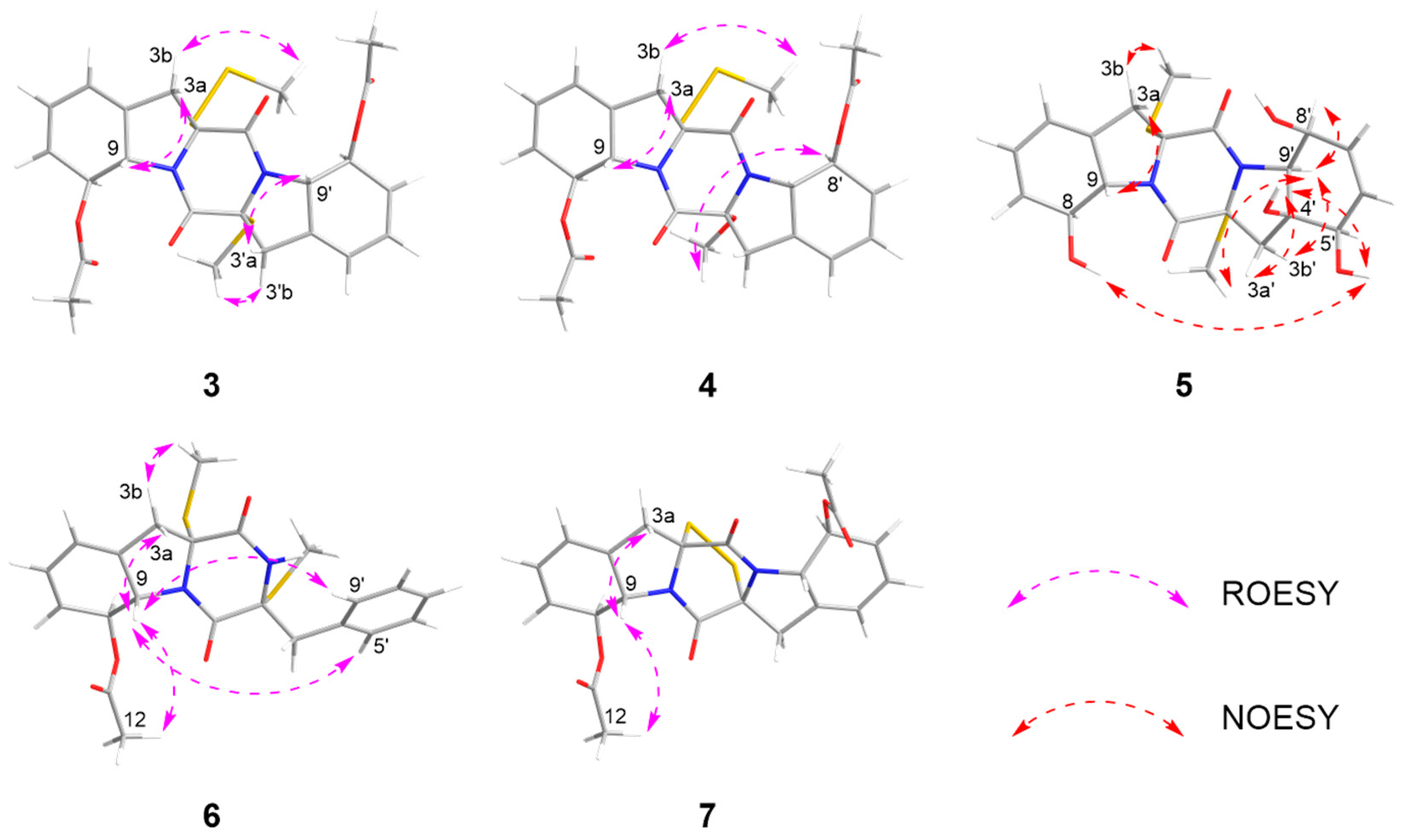
δH 2.23) indicated that S-SMe-2/SMe-2′ and H-9/9′ were located on the opposite side of the pyrrole ring (
Figure 6). Therefore, the relative configuration of
3 was suggested. According to the ROESY correlations from H-3a (
δH 2.89) to H-9 (
δH 5.16), from H-3b (
δH 3.67) to S-SMe-2 (
δH 2.51), from H-8 (
δH 5.86) to OMe-2′ (
δH 3.50) (
Figure 6) and the coupling constants analysis of H-8′/9′ (
3JH-8′, H-9′ = 14.0 Hz), the relative configurations of
4 were established to be the same as
3. The experimental ECD curves for
3–
4 and haematocin (
11) agreed perfectly (
Figure 5), which demonstrated that their absolute configurations were 2
R,2′
R,8
S,8′
S,9
S,9′
S.
Corallomycetellain E (
5), obtained as yellow oil, had a molecular formula of C
20H
24N
2O
6S
2 deduced by an HRESIMS peak at
m/z 453.1139 [M + H]
+. Comparison of
1H and
13C NMR data of
5 (
Table 3) to those of rostratazine B [
14] revealed that
5 shared the same skeleton with rostratazine B. The difference was the replacement of a hydroxyl group at C-4′ (
δC 69.8) in
5, supported by the HMBC correlation from OH-4′ (
δH 5.32) to C-9′ (
δC 68.2) (
Figure 3). Therefore, the planer structure of
5 was proposed.
The relative configuration of compound
5 was assigned based on NOESY data and coupling constant analysis. For the left moiety, the relative configuration of 2
R*,8
S*,9
S* was determined from the following key observations: NOE correlations between H-3a (
δH 2.88) and H-9 (
δH 4.78), and between H-3b (
δH 3.08) and SMe-2 (
δH 2.16), together with a large coupling constant between H-8 and H-9 (
3JH-8, H-9 = 13.0 Hz) (
Figure 6). For the right moiety, a
cis relationship between H-8′ and H-9′ was indicated by their smaller coupling constant (
3JH-8′, H-9′ = 9.6 Hz). Furthermore, the relative configuration was confirmed by a network of NOE correlations: H-3′a (
δH 2.92)/OH-4′ (
δH 5.32), OH-4′ (
δH 5.32)/OH-5′ (
δH 4.88), OH-5′ (
δH 4.88)/OH-8 (
δH 5.27), H-3′b (
δH 2.50)/H-9′ (
δH 3.96), H-9′ (
δH 3.96)/SMe-2′ (
δH 2.13) (
Figure 6). Therefore, the relative configurations of
5 were proposed as 2R*,2′R*,4′S*,5′R*,8S*,8′S*,9S*,9′S*. Consequently, the absolute configurations of
5 were determined as 2
R,2′
R,4′
S,5′
R,8
S,8′
S,9
S,9′
S by comparing the experimental electronic circular dichroism (ECD) curve with the calculated one (
Figure 4).
Corallomycetellain F (
6) was isolated as colorless oil with a molecular formula of C
22H
24N
2O
4S
2 deduced by a HRESIMS peak at
m/z 467.1070 [M + Na]
+. Comparison of the
1H and
13C NMR data (
Table 4) to those of phomazine B revealed that
6 shared the same skeleton with phomazine B [
15]. The difference was the replacement of an acetoxyl group at C-6 (
δC 74.9) in
6, supported by the HMBC correlation from H-12 (
δH 2.19) to C-11 (
δC 171.1) (
Figure 3).
The relative configuration of
6 was established by
1H-
1H coupling constants and ROESY data. The large
J value (14.3 Hz) between H-9 (
δH 4.90) and H-8 (
δH 6.22) indicated the
trans-orientations of H-8 and H-9, which was further supported by the observed ROE correlation between H-9 and H-12 (
δH 2.19). In addition, ROESY correlations between H-9 and H-3a (
δH 1.56), between H-9 and H-5′/8′ (
δH 7.15) and between SMe-2 (
δH 2.26) and H-3b (
δH 2.58) (
Figure 6) allowed the assignment of the two thiomethyl groups as
cis to each other and both
trans relative to H-9. Hence, the relative of
6 was assigned as 2
R*,2′
R*,8
S*,9
S*. To determine the absolute configuration of
6, ECD calculations were performed at the B3LYP/6-31+G(d) level. The overall pattern of the experimental ECD spectrum was in reasonable agreement with the calculated one of (2
R,2′
R,8
S,9
S)-
6, indicating the absolute configuration of C-2, C-2′, C-8 and C-9 in
6 as 2
R,2′
R,8
S,9
S (
Figure 4).
Corallomycetellains G–I (
7–
9), isolated as white powder, have the molecular formulae of C
22H
20N
2O
6S
2, C
24H
24N
2O
6S
2 and C
22H
20N
2O
6S
3, respectively, deduced by HRESIMS. The
1H and
13C NMR spectra of compound
7 revealed 10 proton signals and 11 carbon signals, precisely half of the total counts indicated by their molecular formulae. This observation suggests that
7 possesses a symmetrical structure. Comparative analysis of
1H and
13C NMR data (
Table 2 and
Table 5) of
7 and
3 confirmed that both share an identical 6/5/6/5/6 diketopiperazine core. The structural distinction was the presence of an additional disulfide bridge between C-2 and C-2′ in
7. The planar structure of
7 was further elucidated based on 2D NMR correlations. Key COSY correlations were observed between H-6 (
δH 5.98) and H-7 (
δH 5.55) and between H-8 (
δH 6.04) and H-9 (
δH 4.98). Additionally, HMBC correlations from H-3 to C-1 (
δC 162.8), C-2 (
δC 78.2), C-4 (
δC 132.3), C-5 (
δC 119.8) and C-9 (
δC 64.3); from H-7 to C-5 and C-9; from H-6 to C-8 (
δC 74.1); and from both H-8 and H-12 (
δH 2.15) to C-11 (
δC 170.6) collectively supported the proposed connectivity, as illustrated in
Figure 3.
The key structural difference between
7 and
8 was the presence of a butanoyl group at C-8′ (
δC 74.3) in
8 instead of an acetoxy group in
7, which was supported by the HMBC correlations from H-13′ (
δH 1.66) to C-12′ (
δC 35.9), C-11′ (
δC 173.3) and C-14′ (
δC 132.1) (
Figure 3). In contrast to
7, compound
9 was proposed to feature a trisulfide bridge. This inference was supported by HRESIMS data and by the distinct chemical shifts of C-2 and C-2′ in
9 (
δC 78.2 and
δC 82.4, respectively) compared to those in
7 (both
δC 78.2).
Corallomycetellain G (
7) was first isolated in 2001 from the fermentation broth filtrate of
Rhizostilbella sp. [
16] However, the relative configurations were not confirmed. Here, we determined the relative configurations of
7 based on the analysis of the coupling constants between H-8/8′ and H-9/9′ (
3JH-8/8′, H-9/9′ = 13.2 Hz) as well as the ROESY correlations between H-3a (
δH 3.70) and H-9 (
δH 4.98) and between H-9 (
δH 4.98) and H-12 (
δH 2.15) (
Figure 6). Comparison of 1D and 2D NMR spectra between
7 and
8–
9 indicated the same relative configurations of them, supported by the coupling constants and chemical shifts (
Table 5 and
Table 6).
The comparison of the ECD curve of
7 [(218 (negative), 239 (negative), 276 (positive) and 359 nm (negative)] with those of emethallcin E [
17] [(217 (negative), 237 (negative), 273 (positive), and 328 nm (negative)] confirmed that they had the same configuration around the epidithiodioxopiperazine ring. Therefore, the absolute configuration of
7 was determined as 2
R,2′
R,8
S,8′
S,9
S,9′
S. Based on the highly similar ECD spectra, the absolute configurations of
8 were proposed to be the same as those of
7 (
Figure 5), which was further supported by computational calculations (
Figure 4). The absolute configuration of
9 was determined as 2
R,2′
R,8
S,8′
S,9
S,9′
S by comparison of its experimental ECD spectrum with the calculated ones (
Figure 4).
Corallomycetellain J (
10) was obtained as a light-yellow amorphous powder with a molecular formula of C
20H
16N
2O
4S
2 deduced by an HRESIMS peak at
m/z 435.0432 [M + Na]
+. The
1H and
13C NMR data of
10 revealed that
10 was similar to deoxyapoaranotin [
18] (
Table 6). The obvious difference was the presence of a 1,3-cyclohexadiene skeleton in ring A, supported by HMBC correlations from H-6 (
δH 6.01) to C-4 (
δC 132.1) and C-8 (
δC 74.2) and from H-7 (
δH 5.58) to C-5 (
δC 120.0) and C-9 (
δC 64.6), as well as a COSY correlation between H-8 (
δH 6.14) and H-9 (
δH 5.05) (
Figure 3).
The coupling constants between H-8 and H-9 (
3JH-8, H-9 = 18.0 Hz) indicated the
transorientation of H-8 and H-9. Comparison of the 1D NMR data for
10 with those of
7 (
Table 5 and
Table 6), particularly for positions C-1 through C-9 and C-1′ through C-3′, confirmed that they had the same configuration around the epidithiodioxopiperazine ring. Accordingly, the relative configurations of
10 were proposed as 2
R*,2′
R*,8
S*,9
S*. Comparing the ECD curve with the calculated ones (
Figure 4), the absolute configuration of
10 was determined as 2
R,2′
R,8
S,9
S.



 ,
,