1. Introduction
Marine ecosystems represent one of the most chemically diverse yet underexplored sources of natural products. Marine algae are recognized for producing a wide array of structurally unique metabolites with significant biological potential. Among these, halogenated compounds, especially brominated derivatives, stand out, since bromination occurs almost exclusively in marine environments due to the high bromide concentration in seawater. Brominated compounds were first reported in algae in the early 1900s, and since then, numerous structures have been isolated and investigated for their biological properties [
1].
Within this group, bromophenols (BPs) have attracted considerable attention. These compounds typically consist of one or more benzene rings with varying numbers of hydroxyl, bromine, and/or other substituents [
2]. Bromophenols are most abundant in red algae but are also found in green and brown algae, and occasionally in marine animals and fungi [
3].
Over the years, several studies have demonstrated that marine bromophenols exhibit various biological activities in vitro and in vivo, including anticancer, antioxidant, anti-inflammatory, antidiabetic, and antimicrobial effects [
2,
4]. Consequently, they have emerged as promising candidates for applications in pharmaceuticals, nutraceuticals, and functional foods, with possible roles in managing cancer, cardiovascular diseases, neurodegeneration, inflammation, diabetes, and microbial infections [
2,
4].
Despite this promise, research on bromophenols faces several challenges. Their natural abundance is generally low, limiting the quantities available for structural characterization and biological evaluation. For example, in the case of
Rhodomela confervoides, more than 15 kg of dried material is required to obtain sufficient amounts of bromophenols [
5,
6,
7]. As a result, traditional bioprospecting, harvesting marine organisms, raises ethical, ecological, and sustainability concerns [
8]. Furthermore, the chemical profile of algae can vary substantially with location and season [
9], introducing additional uncertainty on the yield and composition of bioactive metabolites. Collectively, these factors hinder the practical exploitation of marine bromophenols.
These limitations underscore the need for sustainable strategies, and mariculture now plays an increasingly important role in addressing this demand. Norway, which harbors one of the largest standing kelp biomasses globally [
10], has a long tradition of seaweed harvesting and utilization. Each year, more than 150,000 wet tons of
Laminaria hyperborea are collected from regulated harvesting areas, ensuring both a reliable biomass supply and ecological balance [
10,
11]. The kelp stipe hosts a rich epiphytic community dominated by red algae, along with small invertebrates that use its surface as a substrate. Our previous work has shown that the dominant epiphytic species include
Palmaria palmata,
Rhodomela sp.,
Ptilota gunneri, and
Membranoptera alata, along with smaller amounts of other red algae [
8]. Many of these species are known or expected to produce diverse metabolites with possible bioactivities. Despite this potential, during industrial processing, the epiphytic biomass—around 7500 tons annually—is removed and treated as waste [
8].
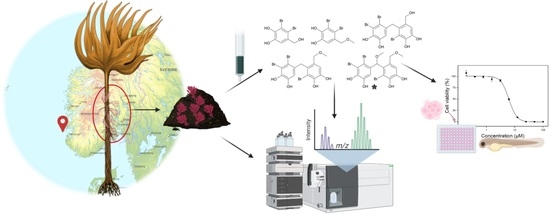
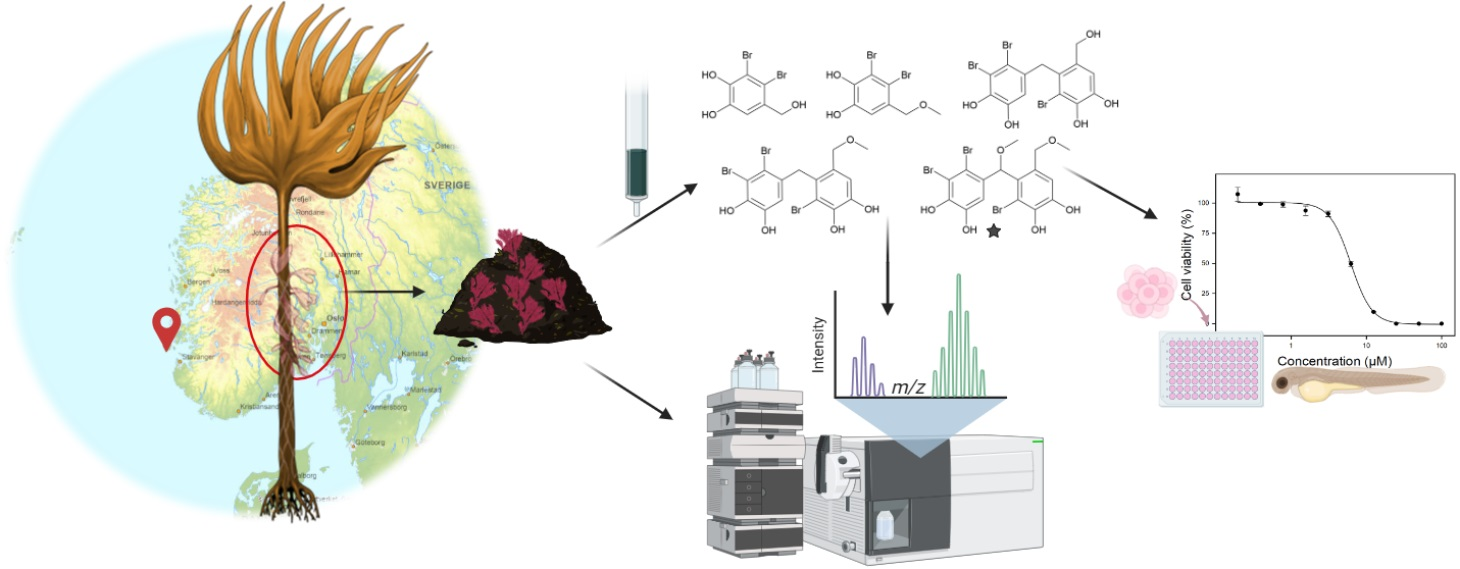
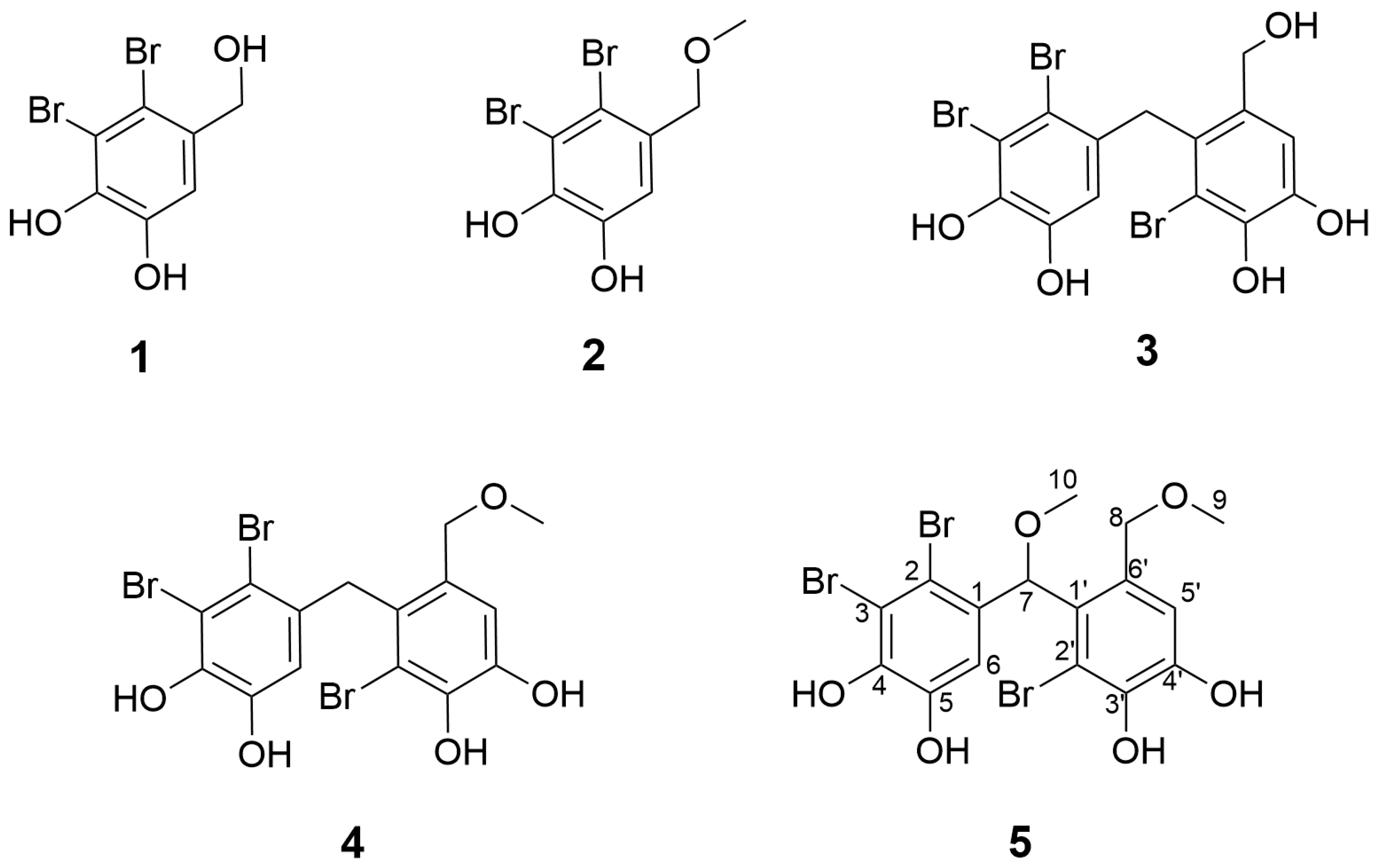
The novelty and aim of this study are to valorize this underutilized epiphytic biomass as a source of high-value compounds, particularly bromophenols. Five bromophenols (1–5) were isolated from the ethyl acetate fraction using various chromatographic techniques, and their structures were elucidated by mass spectrometry and NMR spectroscopy. Notably, compound 5 was identified as a previously undescribed bromophenol, adding to the chemical diversity of brominated metabolites. The compounds were evaluated for cytotoxicity against leukemia cells, and two normal cell lines in vitro, as well as zebrafish larvae in vivo. Antioxidant assays were performed on the major bromophenols 1–4 to examine the relationship between radical-scavenging capacity and cytotoxic behavior. Given the pronounced antioxidant activity of 4, its protective effect against doxorubicin-induced cardiotoxicity was further investigated. Finally, HRMS-QTOF analysis was employed to characterize the broader bromophenolic profile of the epiphytes, tentatively identify an additional nine candidate metabolites, and trace their origin to the individual algal species, including Rhodomela lycopodioides, whose chemistry has not previously been described.
3. Discussion
During the industrial processing of
Laminaria hyperborea, the associated epiphytic biomass is routinely removed and discarded, despite being a biologically and chemically rich material. This biomass contains several red algae, which are potential reservoirs of structurally diverse metabolites and therefore represent a valuable yet largely underutilized source for bioactive compounds. To valorize this waste material, we focused on bromophenols, as they are among the most characteristic metabolites of Rhodophyta and exhibit a wide range of reported biological activities [
2,
4]. The crude extract of the epiphytes contained several bromophenols typical of the
Rhodomelaceae family. However, due to the complexity of this biomass, multiple fractionation steps were required to target these compounds. Combined chromatographic techniques,
1H NMR, and MS analyses were employed to localize the major bromophenols to a few enriched fractions for isolation. This optimized workflow enabled the isolation of bromophenols in sufficient amounts, addressing the common challenge of low natural abundance and supporting their potential applicability for industrial use. Among the isolated metabolites, compounds
1–
4 were the most abundant, while the first described compound
5 was present in minor amounts. In addition, nine additional bromophenols were tentatively identified by HRMS-QTOF.
Jacobtorweihen et al. categorized marine algae bromophenols into fifteen structural scaffold types to describe their phylogenetic distribution across taxa [
18]. All compounds tentatively identified in this study fit within this classification: the 3-bromo-4-hydroxybenzyl type (A) (
6,
9), the lanosol type (B) (
1,
2,
7,
10,
11), their dimeric forms (
3,
4,
5,
13,
14), and the 2,3,6-tribromo-4,5-dihydroxybenzyl type (D) (
8,
12). Despite the abundance of sulfur in seawater and the plethora of sulfated marine compounds, only a few examples of sulfated bromophenols have been reported to date [
15,
19,
20,
21,
22,
23]. The sulfated compounds suggested in this study (
7,
8,
10,
11) share the aforementioned scaffolds, indicating that sulfation may occur as a secondary modification within these biosynthetic categories.
Overall, these findings align with previous reports on the chemical profile of the
Rhodomela genus among red algae. The individual LC-MS/MS analyses of the dominant species strongly support that
R. lycopodioides and, to a lesser extent,
R. confervoides are the main contributors of bromophenols within the epiphytic biomass.
R. confervoides is well established as one of the richest natural sources of bromophenols and has been reported to contain compounds
1–
4 [
5,
6,
22,
24,
25], along with several of the tentatively identified metabolites (
9,
10, and
11) [
5,
15]. In contrast, the chemical profile of
R. lycopodioides has not been previously described. To the best of our knowledge, this is the first study on the phytochemistry of this species, and our results highlight the importance of further investigating its bromophenolic diversity. Finally, our observations indicate that other dominant species of the epiphytic biomass, such as
Palmaria palmata,
Ptilota gunneri, and
Membranoptera alata, do not synthesize bromophenols. It is worth mentioning that bromophenol content in marine algae is known to vary with season and location [
9,
26]. However, as the present material was collected at a single time point, temporal variability was not assessed and remains a subject for future investigation.
Although LC–MS is widely applied in marine metabolomics, bromophenols are rarely investigated using MS-based profiling approaches and are more commonly accessed through classical isolation workflows. The present results demonstrate that LC–MS-based profiling can facilitate mapping bromophenol diversity, tracing species origin, and guiding targeted isolation from complex biomasses, supporting more efficient and sustainable bioprospecting strategies.
To further explore the potential of the main bromophenols from epiphytes, the isolated compounds were evaluated for their cytotoxic, antioxidant, and cardioprotective activities. Bromophenols
1–
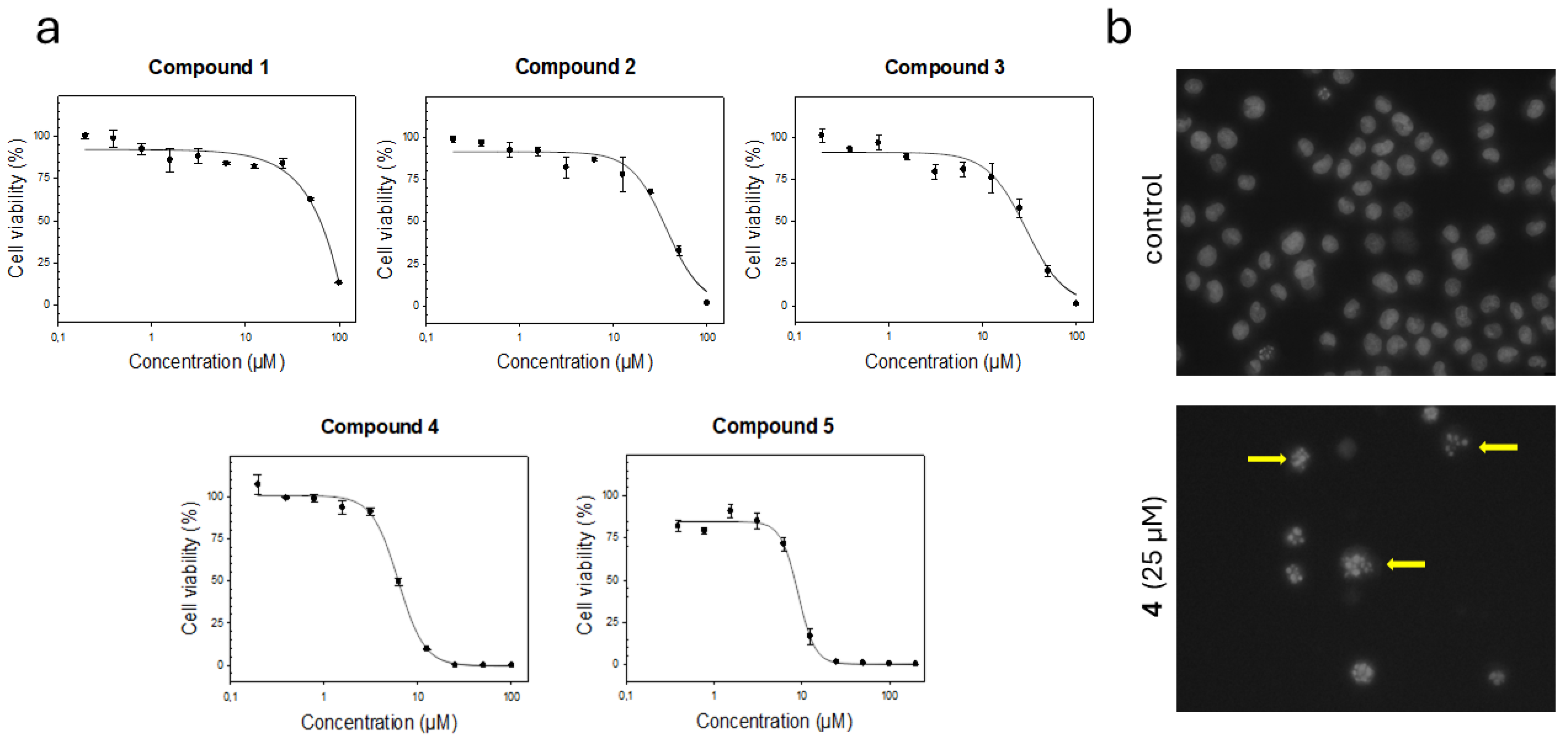
5 were tested against leukemia cells, specifically acute myeloid leukemia (AML). When assessed on MOLM-13 cells, compound
4 exhibited the highest activity, with an EC
50 value of 6.23 μM, notably lower than that of compound
3, while compound
5 had a value of approximately 9 μM. To the best of our knowledge, this is the first report describing the cytotoxic activity of these bromophenols against leukemia cells. These results are consistent with previous reports on the cytotoxicity of compounds
1–
4 against various cancer cell lines [
27,
28,
29,
30,
31]. For instance, compound
4 has demonstrated activity against lung adenocarcinoma (A549) (19.5 μM), stomach cancer (BGC-823) (8.6 μM), hepatoma (Bel7402) (1.9 μM) [
30], breast cancer (MCF-7) (17.6 μM), hepatoma (Bel7402) (1.9 μM), human malignant melanoma (B16-BL6) (15.5 μM), human sarcoma (HT-1080) (10.4 μM), and human colon cancer (HCT-8) (18.9 μM) [
27].
Although these compounds exhibit activity across various cancer cells, their selectivity needs to be considered. Previous studies have not evaluated these bromophenols against any non-cancerous cell lines, representing a common limitation in natural product drug discovery. To address this gap, we assessed their toxicity toward two normal cell lines to determine selectivity. Compounds 1–3 showed no detectable cytotoxicity against either NRK or H9c2 cells. Compound 4, consistent with its cytotoxic profile, exhibited increased toxicity in higher concentrations, particularly towards NRK cells, but maintained a tolerable selectivity window up to 25 μM.
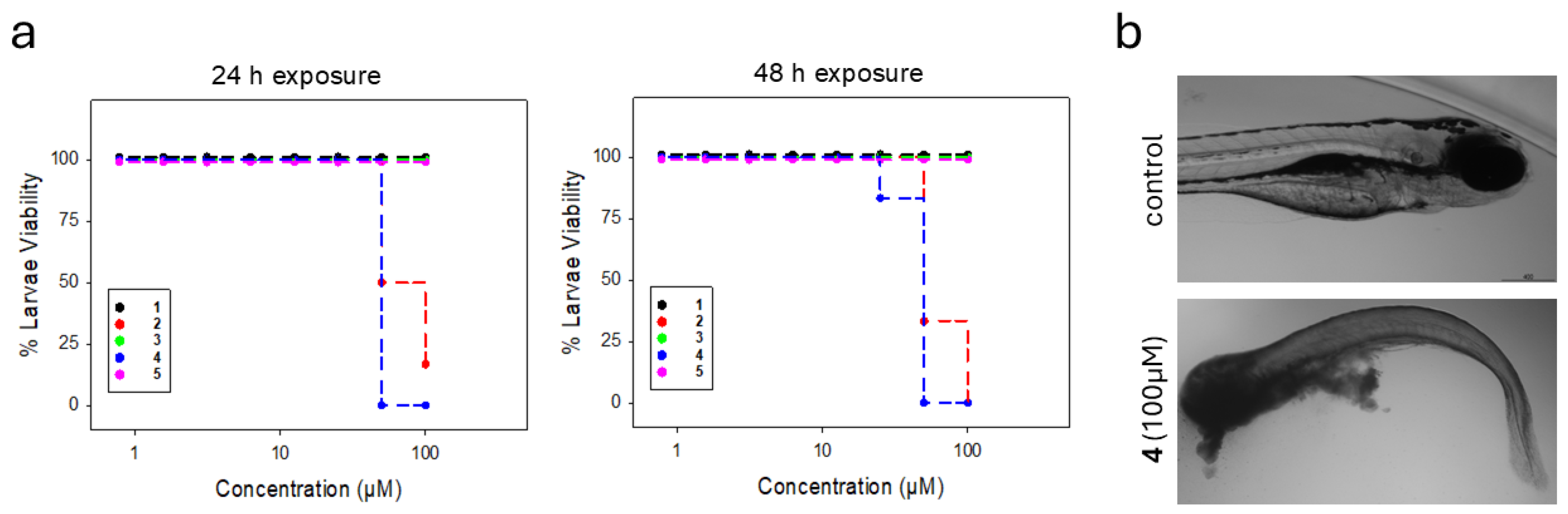
While in vitro assays provide an initial indication of toxicity, they do not always reflect whole-organism responses. Zebrafish larvae are increasingly used as a predictive model, offering a more physiologically relevant assessment of drug safety [
32]. In vivo observations in zebrafish larvae supported these interpretations; toxicity was limited to the highest concentrations of compounds
2 and
4, whereas all lower doses were well tolerated and did not induce mortality or visible morphological abnormalities during the exposure period. In contrast, other bromophenols such as bis(2,3-dibromo-4,5-dihydroxybenzyl) ether (BDDE) have shown clearer signs of in vivo toxicity, including decreased hatching and increased mortality at similar concentrations [
33].
Collectively, cellular and larval data indicate that compound 4 exhibits dose-dependent toxicity, occurring primarily at concentrations well above its effective range against leukemia cells. These findings provide a more comprehensive evaluation of overall toxicity and suggest promising anticancer potential for bromophenol 4 in terms of potency and selectivity.
In contrast, the new compound 5 displayed clear cytotoxic activity against MOLM-13, but, unlike compounds 1–4, it was more toxic to the normal cells in vitro. However, when tested in vivo, no mortality or morphological changes were detected in zebrafish larvae at the tested concentrations. This reflects the difference between direct exposure to cultured cells and whole organisms, where factors such as uptake, distribution, and metabolism must be considered. It is possible that the larvae did not take up enough of compound 5, or that any toxic effects were buffered or metabolized in vivo. As a result, the toxicity observed in cell assays does not necessarily translate into acute toxicity in the zebrafish model under the conditions tested. But overall, the lack of selectivity, together with the fact that the sample is partially pure, limits the interpretation of its biological potential. The observed toxicity toward normal cells may be influenced by non-selective cytotoxic effects of co-isolated fatty acids or other impurities. Therefore, the selectivity of the bromophenol itself remains uncertain.
In addition to cytotoxicity, compounds
1–
4 were evaluated for antioxidant activity. As expected for phenolic structures and consistent with previous reports [
5,
25,
31], these bromophenols acted as effective radical scavengers. Free radicals play a central role in the pathogenesis of several diseases, including cancer, and such activity may be related to the observed cytotoxic effects. Compound
4 again demonstrated the strongest ABTS radical-scavenging activity, with an IC
50 value of 22.1 μM, while
1–
3 had moderate activity. Although overall ABTS activity was lower than that of the positive control (ascorbic acid), contradicting previous findings by Li et al., the relative potency trend (
4 >
3 >
2 >
1) was consistent with earlier studies [
5,
25].
Compounds with radical-scavenging activity could potentially protect cardiomyocytes against Dox-induced cytotoxicity. Dox is a widely used anti-cancer drug, but it is associated with severe side effects like cardiomyopathy, which can lead to heart failure. One mechanism underlying this toxicity is the generation of reactive oxygen species (ROS) during its intracellular metabolism, which triggers oxidative stress pathways leading to mitochondrial dysfunction and cellular damage [
34]. Considering the central role of oxidative stress in this pathophysiology and the antioxidant capacity of compound
4, we co-administered it with Dox to reduce oxidative damage in heart cells. The results showed no significant improvement in cell viability. However, this outcome may not fully represent cardiotoxic events in vivo. Previous studies have demonstrated that short-term reduction in ROS levels does not necessarily correlate with decreased cytotoxicity in vitro [
35]. Nevertheless, the possibility that the antioxidant capacity of compound
4 is insufficient to counteract ROS accumulation cannot be excluded.
The cytotoxicity against MOLM-13 cells and antioxidant results (
Table 1) indicate that activity is strongly influenced by the number and position of hydroxyl and bromine substituents. In both assays, dimeric compounds exhibited higher activity than monomeric analogues. Consistent with previous reports, the 2,3-dibromo-4,5-dihydroxybenzyl scaffold appears to be a key structural determinant for bioactivity [
11]. It has been found that extensive hydroxyl substitution, particularly ortho-dihydroxyl substitution, enhances the antioxidant activity of bromophenols in radical-scavenging assays [
36]. This trend is reflected in our results, where dimeric compounds
3 and
4, bearing more hydroxyl groups, showed superior radical-scavenging capacity. Additional studies suggest that hydroxylation generally plays a more significant role than bromination in the antioxidant activity [
37], whereas bromine substituents appear to have a stronger influence on cytotoxic effects [
28].
The methylation of hydroxyl groups also affected the activity. The most active compound in each series was the methylated derivative: bromophenol
2 is more active than
1, and
4 is more active than
3. Typically, methylation of phenolic hydroxyl groups reduces antioxidant activity because methylated hydroxyls cannot donate hydrogen atoms and provide weaker electron-donating effects, resulting in less stabilized phenoxy radicals [
38,
39]. Similarly, methylation often diminishes cytotoxicity [
28]. However, methylation of a hydroxyl group on a side chain rather than directly on the aromatic ring does not interfere with the aromatic O–H bond and therefore does not reduce radical-scavenging activity. On the contrary, the alkyl substituents have an important role in bioactivity, and elongation of the side chain appears to enhance both the antioxidant and the cytotoxic capacity, as reported previously [
5,
25,
28] and confirmed in this study. This effect may be explained by favorable changes in molecular conformation, improving the accessibility of aromatic hydroxyl groups for hydrogen donation to free radicals. Increased lipophilicity due to methylation may also enhance membrane permeability and interactions with intracellular targets. Furthermore, conformational changes due to methylation could improve binding to proteins or enzymes involved in cytotoxic mechanisms. Although these interpretations remain hypothetical, they align with previous findings that even minor changes in substitution patterns can significantly influence target affinity and, consequently, both antioxidant and cytotoxic profiles of bromophenols. These observations provide a preliminary structure–activity relationship that may guide the synthesis of analogues and deepen understanding of their underlying mechanisms, which should be addressed in future mechanistic and in vivo studies.
4. Materials and Methods
4.1. Biological Material
The epiphyte biomass was acquired from Alginor ASA (Haugesund, Norway).
Laminaria hyperborea, with its epiphytes, was harvested from the coast of Haugesund, Norway, field 56A (59°12′26.6″ N, 5°09′14.2″ E), in November 2022. The epiphyte biomass had been collected through gentle mechanical scraping and frozen immediately after separation. After receiving the biomass, the collected epiphyte material was washed thoroughly with water, and the species were separated and examined macroscopically and microscopically, as described previously [
8] (
Table S1). Next, 1.5 kg of frozen biomass was freeze-dried, milled with a kitchen-type blender, and stored at −20 °C when not in use.
4.2. Instruments and Chemicals
All solvents used were of analytical and HPLC grade from Sigma-Aldrich Inc. (Sigma-Aldrich, St. Louis, MO, USA). Ultrapure water was either deionized at the University of Bergen or produced by a Millipore Milli-Q Direct 8 water purification system. Stationary phases for column chromatography were Silica gel 60, 230–400 mesh (Merck KGaA, Darmstadt, Germany), Sephadex LH-20 (Cytiva, Marlborough, MA, USA), XAD-7 (Sigma-Aldrich), and C18-Silica gel (Merck KGaA).
All NMR spectra (1H, 13C, and 2D) were recorded in methanol-d4 on a Bruker 600 MHz and 850 MHz AVANCE NEO 850 MHz instrument (Bruker BioSpin, Zürich, Switzerland) at 25 °C. Chemical shifts are expressed in δ (ppm), and the following abbreviations were used to describe the multiplicities: s = singlet, d = doublet.
High-resolution mass spectrometry ESI MS data were measured on an Agilent QTOF (Agilent Technologies, Santa Clara, CA, USA) coupled with an Agilent Technologies 1260 Infinity Series system. ESI operation conditions: 12 L/min N2, 310 °C drying gas temperature, 35 psig nebulizer, and 4000 V capillary in negative ionization mode. DDA data were recorded in Auto MS/MS mode; full scan and MS/MS spectra were acquired within a range of 60 to 1500 m/z, 10, 20, 30, and 40 eV collision energy A Luna Omega C18 (Phenomenex, Torrance, CA, USA) UHPLC column 150 × 2.1 mm, 1.6 μm was used for separation with a gradient of 5 to 25% B for 5 min, 25 to 100% B for 10 min, and 100% B for 10 min at a 0.350 mL/min flow rate, where A is water with formic acid 0.1% v/v and B is acetonitrile (MeCN) with formic acid 0.1% v/v. UV–vis spectral data for all peaks were obtained in the range of 200–800 nm and at 210, 220, 280, and 290 nm.
Optical rotation was measured using an Autopol IV (Rudolph Research Analytical, Hackettstown, NJ, USA) at 24 °C and 589 nm. The compound concentration was 0.1 g/100 mL, and the solvent used was CH3Cl.
For the cell assays, DMEM (D6429) and RPMI medium (R5886), penicillin/streptomycin (P0781), glutamine (G7513), fetal bovine serum (F7524), formaldehyde, and phosphate-buffered saline tablets (PBS) were purchased from Sigma-Aldrich (St. Louis, MO, USA). Cell Counting Kit-8 (CCK-8) was purchased from MedChemExpress (Monmouth Junction, NJ, USA), and Hoechst 33342 fluorescent DNA staining reagent from Thermo Fisher Scientific (Waltham, MA, USA).
4.3. Extraction and Isolation
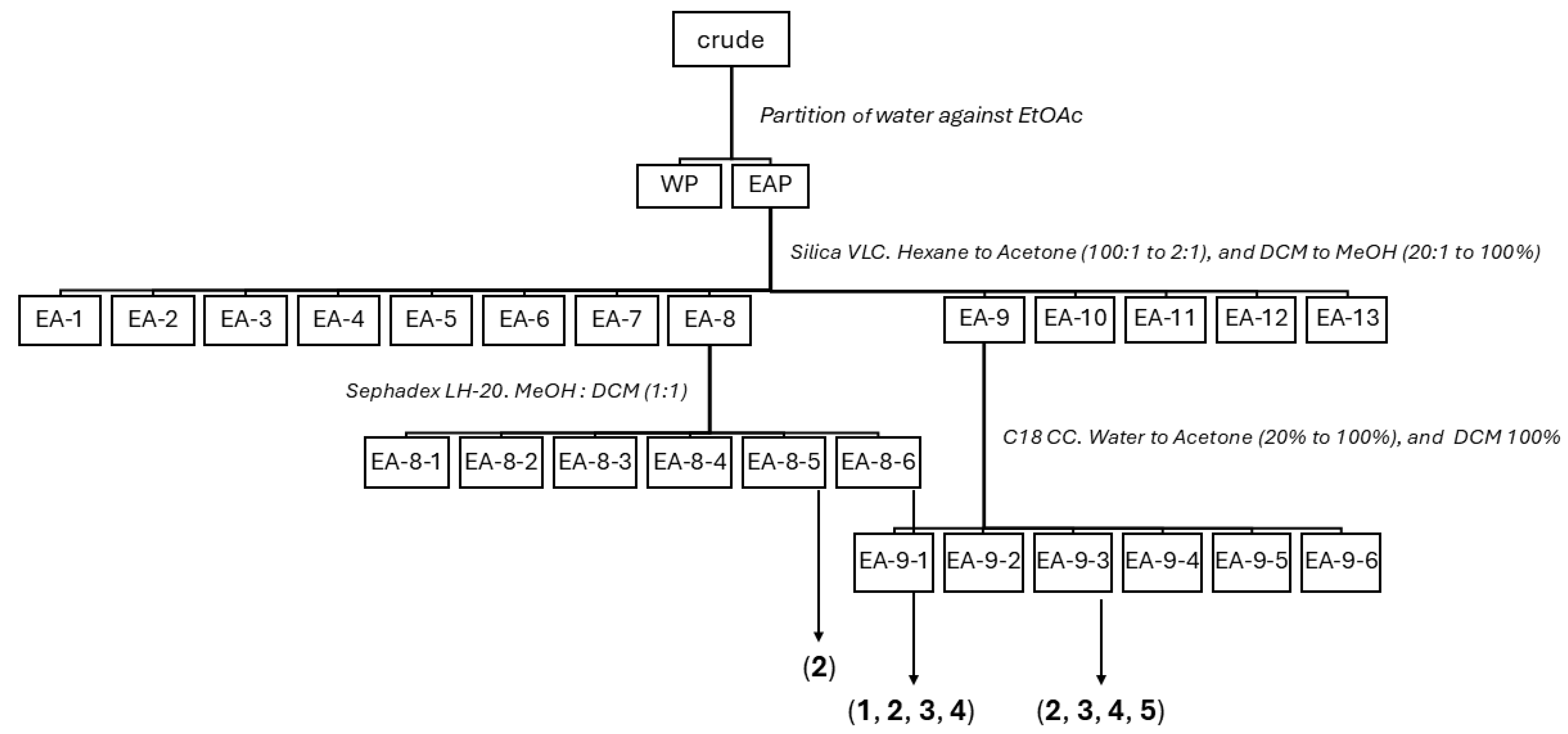
The dried epiphytic biomass (450 g) was extracted with methanol (MeOH) and dichloromethane (DCM) with an ultrasonic bath at room temperature. The MeOH/DCM extract was evaporated to dryness, resulting in an oily dark green residual (185 g). The crude was suspended and partitioned successively with EtOAc (EA) and water (WP). The EA fraction (12 g) was subject to vacuum column chromatography (VCC) in a stepwise elution with n-hexane: acetone (100:1 to 2:1) followed by DCM:MeOH (20:1 to 0:100), each 300 mL, yielding a total of 13 fractions (EA-1 to EA-13). The EA-9 fraction (440 mg) eluted with 20:1 DCM:MeOH was chromatographed over reversed-phase silica gel chromatography (C18 CC), eluting with a gradient increasing acetone (20–100%) in water, and finally flushed by DCM and separated into 6 main subfractions (EA-9-1 to EA-9-6). Subfraction EA-9-3 (90 mg), eluted with 60% acetone, was then subjected to preparative HPLC (Ascentis C18, 250 × 21.2 mm, 5 μm) with a gradient of 35 to 100% B in A for 30 min at a 10 mL/min flow rate, where A is water with formic acid 0.1% v/v and B is acetonitrile (MeCN) with formic acid 0.1% v/v. UV was set to 220 and 280 nm. This yielded the four main compounds 2 (10 mg), 3 (17 mg), 4 (27 mg), and 5 (1.5 mg). To obtain a larger quantity of the above, the EA-8 fraction (270 mg) was chromatographed over Sephadex LH-20, eluting with DCM:MeOH, to give six subfractions (EA-8-1 to EA-8-6). Subfraction EA-8-5 and EA-8-6 were subject to semi-preparative HPLC (Luna C18, 250 × 10 mm, 5 μm) with a gradient of 0 to 20% B for 5 min and 20 to 100% B for 30 min at a 4.5 mL/min flow rate, where A is water with formic acid 0.1% v/v and B is acetonitrile (MeCN) with formic acid 0.1% v/v. UV was set to 220 and 280 nm. This yielded more of compounds 2–4, as well as small amounts of compound 1 (2 mg). All the separation steps were monitored on the basis of TLC, HPLC, and NMR analyses. Their chemical structures were determined based on NMR spectral data and HRMS data and compared with the literature.
Lanosol, 2,3-dibromo-4,5-dihydroxybenzyl alcohol, (3,4-dibromo-5-(hydroxymethyl)benzene-1,2-diol) (1): brown–pink solid; UV (MeCN, water)
λmax 214, 292 nm;
1H and
13C NMR data
Table 1; HRESI-MS
m/
z 294.8609 [M − H]
− (calcd. for C
7H
579Br
2O
3−, 294.8611); observed adducts and fragments: 408.8534 [M + TFA − H]
−, 374.7860 [M + Br]
−, 590.7289 [2M − H]
−, 214.9347 [M − HBr − H]
−.
Lanosol methyl ether, 2,3-dibromo-4,5-dihydroxybenzyl methyl ether, (3,4-dibromo-5-(methoxymethyl)benzene-1,2-diol) (2): brown–pink solid; UV (MeCN, water)
λmax 214, 292 nm;
1H and
13C NMR data,
Table 1; HRESI-MS
m/
z 308.8766 [M − H]
− (calcd. for C
8H
779Br
2O
3−, 308.8767); observed adducts and fragments MS1: 422.8689 [M + TFA − H]
−, 388.8021 [M + Br]
−.
2,2′,3-tribromo-3,4,4′,5-tetrahydroxy-6′-hydroxymethyldiphenylmethane, (5-(2-bromo-3,4-dihydroxy-6-(hydroxymethyl)benzyl)-3,4-dibromobenzene-1,2-diol) (3): bright pink solid; UV (MeCN, water)
λmax 220, 290 nm;
1H and
13C NMR data,
Table 1; HRESI-MS
m/
z 494.8073 [M − H]
− (calcd. for C
14H
1079Br
3O
5−, 494.8084); observed adducts and fragments MS1: 608.7998 [M + TFA − H]
−, 574.7345 [M + Br]
−, 990.6241 [2M − H]
−.
2,2′,3-tribromo-3′,4,4′,5-tetrahydroxy-6′-methoxymethyldiphenylmethane, (5-(2-bromo-3,4-dihydroxy-6-(methoxymethyl)benzyl)-3,4-dibromobenzene-1,2-diol) (4): pink–brown solid; UV (MeCN, water)
λmax 236, 290 nm;
1H and
13C NMR data,
Table 1; HRESI-MS
m/
z 508.8230 [M − H]
− (calcd. for C
15H
1379Br
3O
5−, 508.8240); observed adducts and fragments MS1: 622.8157 [M + TFA − H]
−, 588.7490 [M + Br]
−, 1018.6530 [2M − H]
−.
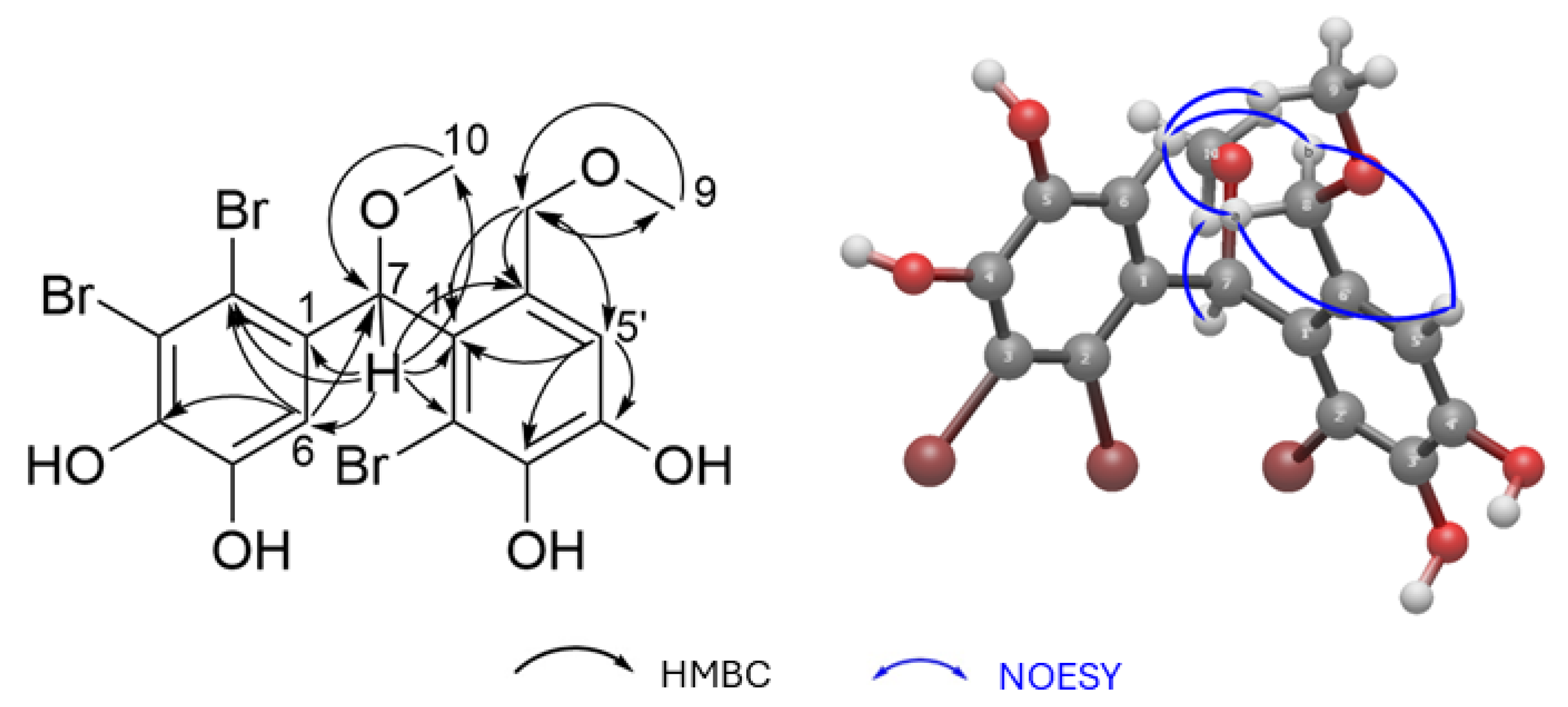
2,2′,3-tribromo-3′,4,4′,5-tetrahydroxy-6′-methoxymethyldiphenyl-methoxymethane, (5-((2-bromo-3,4-dihydroxy-6-(methoxymethyl)phenyl)(methoxy)methyl)-3,4-dibromobenzene-1,2-diol) (5): pale pink oil; [α]
24D = +18° (c 0.1, CHCl
3); UV (MeCN, water)
λmax 218, 290 nm;
1H and
13C NMR data,
Table 1; HRESI-MS
m/
z 538.8336 [M − H]
− (calcd. for C
16H
1479Br
3O
6−, 538.8346); observed ion cluster at
m/
z 538.8336, 540.8320, 542.8301, and 544.8283 with relative intensities 1.06:3.09:3.01:1.00; adducts and fragments MS1: 652.8264 [M + TFA − H]
−, 618.7540 [M + Br]
−, 1078.6733 [2M − H]
−, 458.9077 [M − HBr − H]
−, 508.8070 [M − MeOH − H]
−, 426.8819 [M − MeOH − HBr − H]
−; main fragments MS/MS: 474.7823 [M − 2MeOH − H]
−, 395.8638 [M -2 MeOH − Br − H]
−, 314.9300 [M − 2MeOH − 2Br − H]
−, see
Figure S14 for fragmentation.
4.4. Sample Preparation for LC-MS
The algal materials
Palmaria palmata, Ptilota gunneri, Membranoptera alata, Rhodomela lycopodioides, and
Rhodomela confervoides were separated from the epiphytic biomass, cleaned, freeze-dried, milled, and extracted with MeOH, as in
Section 4.3, to obtain the crude extracts. A few mg of each extract, as well as the epiphytic biomass extract, were re-dissolved in MeOH to a concentration of approximately 2 mg/mL. The samples were qualitatively analyzed with an Agilent QTOF LC-MS system, as described in
Section 4.2.
4.5. ABTS Antioxidant Assay
The ABTS method by Re et al. [
40] was slightly modified and optimized for use with a microplate spectrophotometer. An ABTS stock solution was prepared from a mixture 1:1 of a 7 mM ABTS solution and a 2.45 mM K
2S
2O
8 solution, both in distilled water, and was incubated in the dark for at least 12 h. The stock solution was used within 5 days after preparation. The ABTS working solution was prepared from a dilution of 1:10 of the stock solution with water. A 20 µL sample in dimethyl sulfoxide (DMSO) was mixed with 80 µL distilled water and 180 µL of the working solution and then incubated in the dark for 30 min. Absorbance was measured at 734 nm. Ascorbic acid was used as a positive control for comparison.
The EC50 was calculated from a four-parameter non-linear regression analysis model of the percentage decrease in the absorbance of the ABTS solution versus the concentration of the sample. All experiments were performed in triplicate (duplicate for compound 2), and mean values were calculated for each treatment ± standard deviation. All statistical analyses were carried out using SigmaPlot.
4.6. In Vitro Cytotoxicity
4.6.1. Cell Cultures
Compounds
1–
5 were tested for their activity against human acute myeloid leukemia (AML) cell line MOLM-13 (DSMZ, ACC-554) [
41] and the non-cancerous cell lines, normal epithelial rat kidney cell line NRK (ATCC, CRL-6509), and normal rat cardiomyoblast line H9c2 (ATCC, CRL-1446). MOLM-13 cells were cultured in RPMI medium, and NRK and H9c2 were cultured in Dulbecco’s modified Eagle’s medium (DMEM), both supplemented with 10% (
v/
v) fetal serum (FBS), 0.2 mM L-glutamine, 100 IU/mL penicillin, and 0.1 mg/L streptomycin. The MOLM-13 cells were suspended and cultured to a density of 10–80 × 10
4 cells/mL and diluted by adding fresh medium. The adherent cell lines H9c2 and NRK were cultured until they reached 80–90% confluence. They were then detached by mild trypsinization, centrifuged at 200×
g for 5 min, and reseeded in fresh medium at around 30% and 10% confluence, respectively. Cells were incubated at 37 °C in a humidified atmosphere with 5% CO
2. Adherent cells that had undergone more than 14 passages were not used.
4.6.2. Cell Viability Assay
For cytotoxic testing, MOLM-13 cells were seeded at 40,000 cells/well in 96-well microplates with 100 mL medium/well on the day of the experiment. The adherent cells were seeded the day before the experiment to allow the cells to attach to the substratum. H9c2 cells were seeded at 3000 cells/well, and NRK cells were seeded at 2000 cells/well in 96-well microplates with 100 mL medium/well. The cells were exposed to various concentrations of the compounds (dissolved in DMSO) for 48 h and incubated in the same conditions as described in
Section 2.6; 1% DMSO was used for comparison. The cell viability was assessed by CCK-8 reagent, following the manufacturer’s instructions. The assay is based on the ability of the mitochondria of the viable cells to convert the CCK-8 reagent into a soluble formazan dye, which can be measured spectrophotometrically, and the degree of conversion is proportional to the number of viable cells. The plates were further incubated for 2 h before the signal was recorded at 450 nm with reference at 620 nm using a Multilabel reader. Percent growth inhibition of cells exposed to treatments was calculated as follows:
where A is the absorbance of the treated well with the sample; A
c is the absorbance of the control; A
b is the absorbance of the blank medium. Four-parameter non-linear regression analysis was used to calculate EC
50 values from the CCK-8 assay data. Data analysis was performed using Office Excel 365 (Microsoft) and SigmaPlot 16.0 (Grafiti).
Selectivity indices (SIs) were calculated according to the following equation:
using the mean EC
50 values. For normal cell lines NRK and H9c2, where EC
50 values exceeded the highest tested concentration, SI values are reported as minimum estimates.
The cells were next fixed by adding 100 mL 4% buffered formaldehyde (pH 7.4) containing 0.01 mg/mL of the DNA-specific fluorescent dye, Hoechst 33342, and the morphology of the nuclei was visualized by fluorescence microscopy using a Nikon Diaphot 300 microscope fitted with a 40 × Flu-Phase contrast lens and a DS-Fi3 camera.
All experiments were performed in triplicate (quadruplicate for compound 4), and mean viability values were calculated for each treatment ± standard deviation. All statistical analyses were carried out using SigmaPlot. One-way ANOVA and Holm–Sidak tests with multiple comparisons, α = 0.05, were performed. Values of p < 0.05 were considered significantly different.
4.7. In Vivo Testing in Zebrafish Larvae
4.7.1. Zebrafish Larvae Handling
Fertilized zebrafish (Danio rerio) eggs of the AB (ZFIN ID: SDB-GENO-960809-7) strain were obtained from the Zebrafish Facility at the Department of Biological Sciences, University of Bergen. The facility is run according to the European Convention for the Protection of Vertebrate Animals used for Experimental and Other Scientific Purposes. The embryos were kept in petri dishes with E3 medium containing 4.5 mM NaCl, 0.15 mM KCl, 0.30 mM CaCl2, and 0.30 mM MgSO4 in ddH2O at 28.5 °C, and dead eggs were removed during the first 24 h post fertilization. At day 5 post-fertilization, the larvae were euthanized by cooling on ice for 60 min before being transferred to −20 °C.
4.7.2. Toxicity in Zebrafish Larvae
One zebrafish larva was added to each well in a 96-well plate containing a total of 100 μL of embryo water containing the compounds at different concentrations. Compounds 1–5 and control DMSO (starting concentrations, 1% v/v) were tested in six parallels in dilution series. The plate with the larvae was incubated in the dark at 28.5 °C and studied after 24 and 48 h for signs of toxicity. Larvae were examined under a Nikon Diaphot 300 microscope fitted with a 10× Flu-Phase contrast lens and a DS-Fi3 camera.
4.8. Dox-Induced Toxicity Test
For the doxorubicin-induced toxicity test, the H9c2 cells were seeded at 5000 cells/well in 96-well microplates with 100 mL medium/well one day before adding the drugs. During the experiment, the cells were exposed to various concentrations of Dox, 4, 2, 1, 0.5, and 0.25 μM, incubated for 1 h, and then the bromophenols were added at concentrations of 12.5, 25, and 50 μM for 24 h.
Due to the interference of Dox with the CCK-8, cell viability was assessed by fluorescence microscopy based on morphological evaluation and manual counting of live and dead cells. For each well of interest, multiple random microscopic fields were captured, with a minimum of 100 cells for each well, and the percentage of viable cells was calculated relative to the total number of cells observed. All experiments were performed in duplicate, and mean viability values were calculated for each treatment ± standard deviation. All statistical analyses were carried out using SigmaPlot. Student’s t-test, α = 0.05, was performed to compare each concentration of the drug to the DOX-alone control treatment. Values of p < 0.05 were considered significantly different.