

Synthesis and Characterization of N,N,N-trimethyl-O-(ureidopyridinium)acetyl Chitosan Derivatives with Antioxidant and Antifungal Activities


Abstract
1. Introduction
2. Results and Discussion
2.1. Chemical Synthesis and Characterization
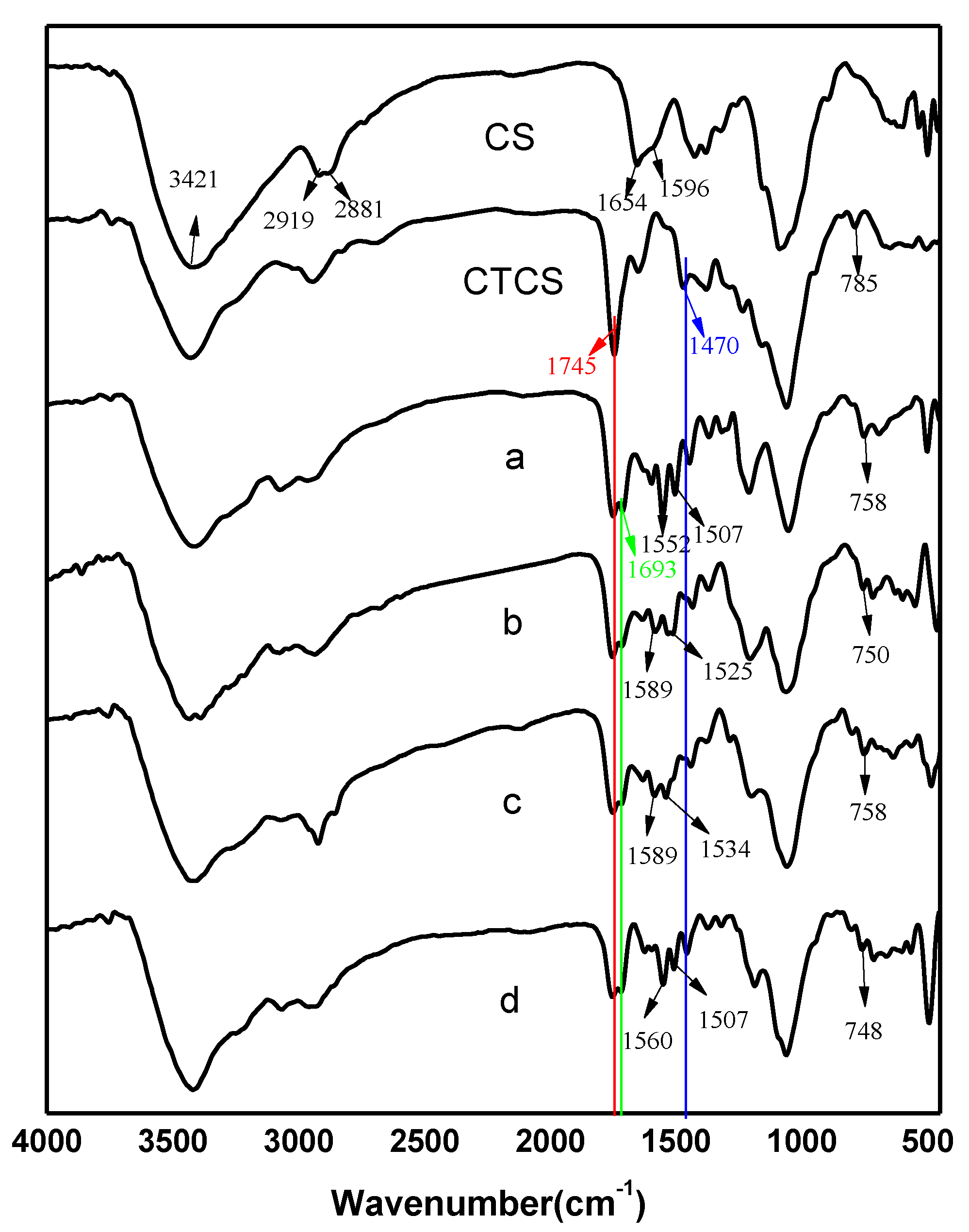
2.1.1. FTIR Spectra
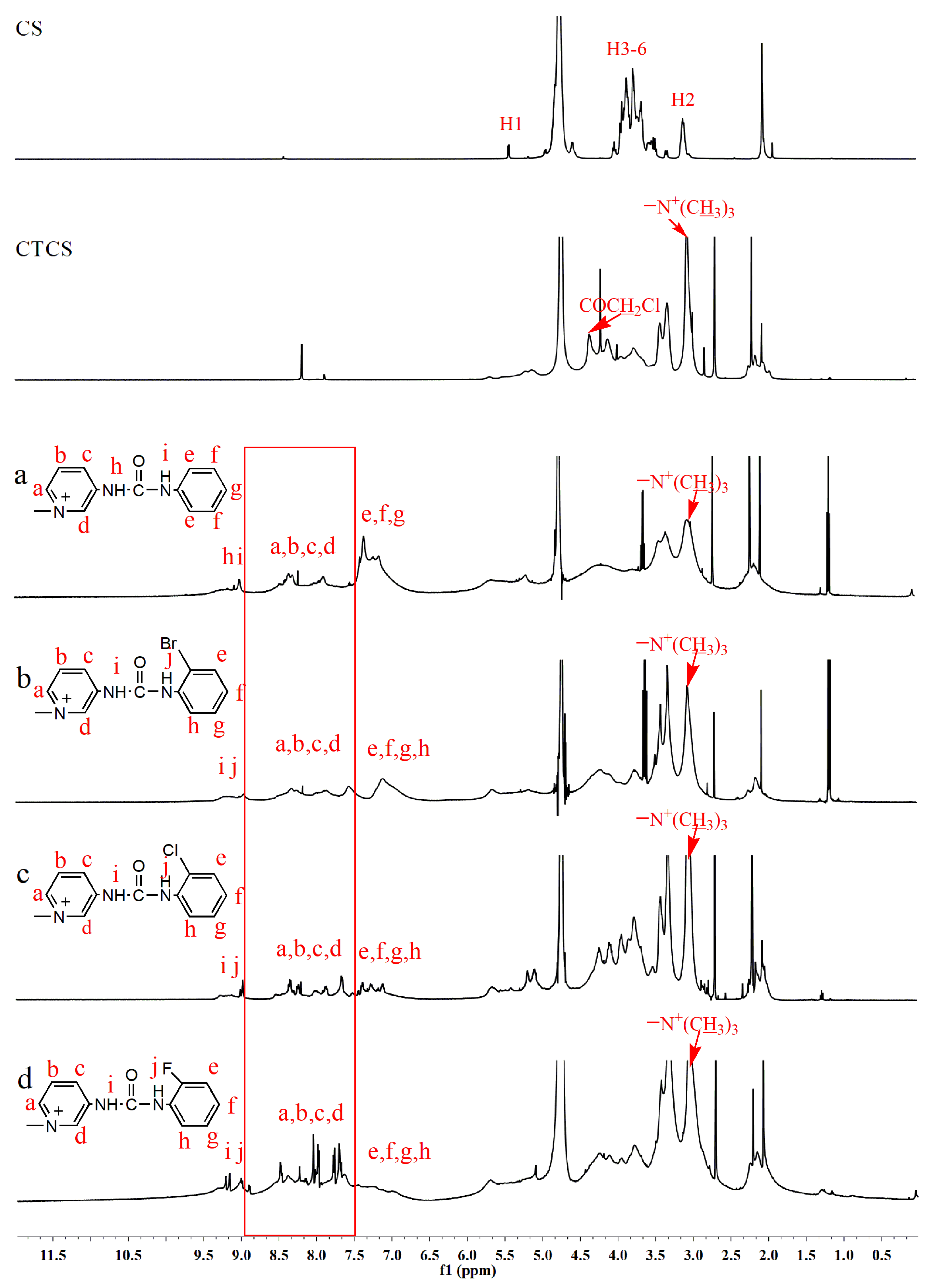
2.1.2. 1H NMR Spectra
2.1.3. Elemental Analysis
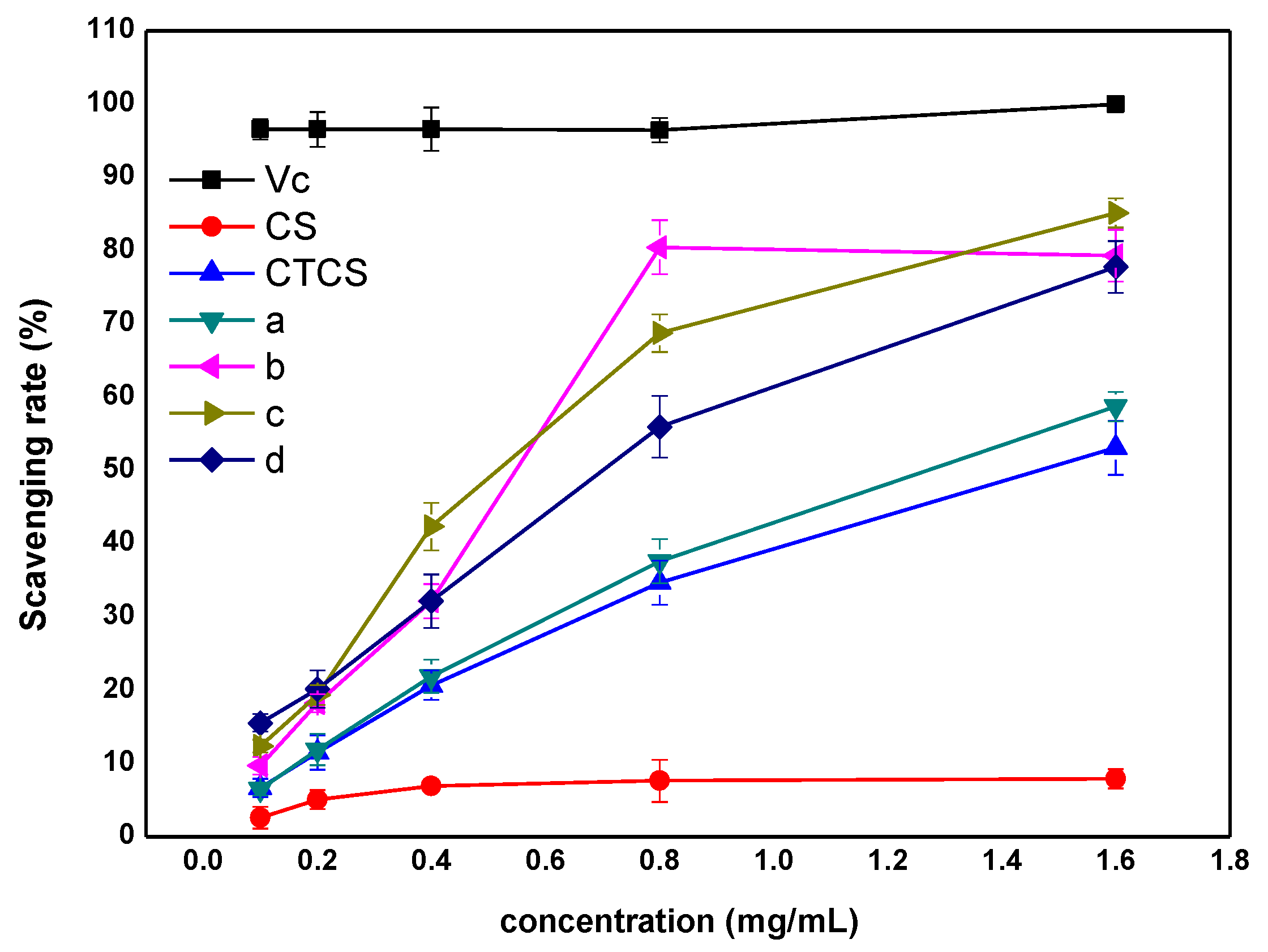
2.2. Antioxidant Activity
2.3. Antifungal Activity
2.4. Cytotoxicity Analysis
3. Materials and Methods
3.1. Materials
3.2. Synthesis of Chitosan Derivatives
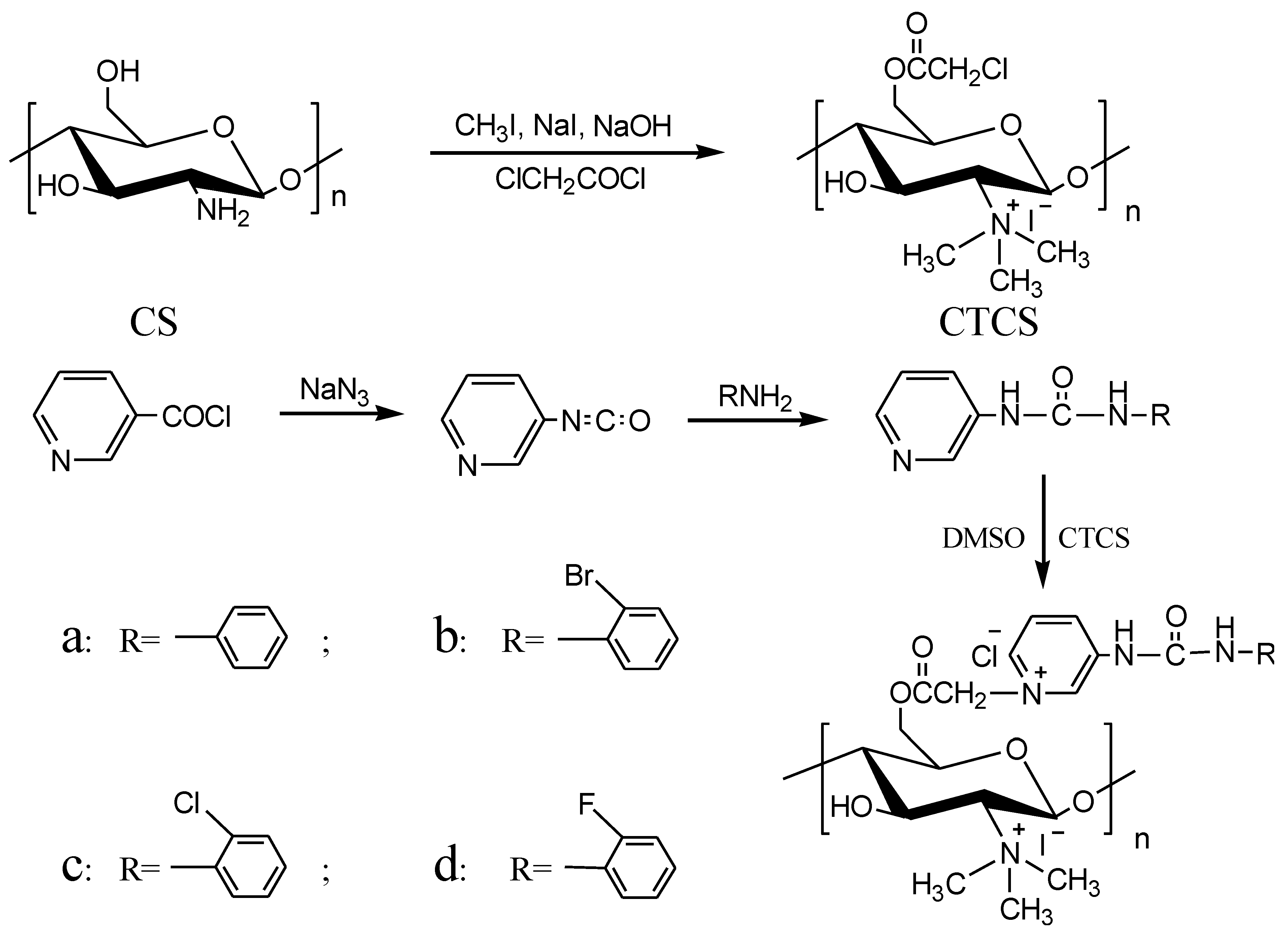
3.2.1. Synthesis of Pyridylurea Groups
3.2.2. Synthesis of Chitosan Derivative CTCS
3.2.3. Synthesis of Chitosan Derivatives a, b, c, and d
3.3. Analytical Methods
3.3.1. Fourier Transform Infrared (FTIR) Spectroscopy
3.3.2. Nuclear Magnetic Resonance (NMR) Spectroscopy
3.3.3. Elemental Analysis
3.4. Antioxidant Assay
3.4.1. DPPH-Radical Scavenging Activity Assay
3.4.2. Hydroxyl-Radical Scavenging Activity Assay
3.4.3. Superoxide-Radical Scavenging Activity Assay
3.5. Antifungal Assay
3.6. Cytotoxicity Assay
3.7. Statistical Analysis
4. Conclusions
Author Contributions
Funding
Conflicts of Interest
References
- Bakshi, P.S.; Selvakumar, D.; Kadirvelu, K.; Kumar, N.S. Chitosan as an environment friendly biomaterial—A review on recent modifications and applications. Int. J. Biol. Macromol. 2019. [Google Scholar] [CrossRef] [Scilit] [PubMed]
- Davoodbasha, M.; Lee, S.Y.; Kim, J.W. Solution plasma mediated formation of low molecular weight chitosan and its application as a biomaterial. Int. J. Biol. Macromol. 2018, 118 Pt B, 1511–1517. [Google Scholar] [CrossRef] [Scilit]
- Elmehbad, N.Y.; Mohamed, N.A. Designing, preparation and evaluation of the antimicrobial activity of biomaterials based on chitosan modified with silver nanoparticles. Int. J. Biol. Macromol. 2020, 151, 92–103. [Google Scholar] [CrossRef] [Scilit] [PubMed]
- Vanden Braber, N.L.; Paredes, A.J.; Rossi, Y.E.; Porporatto, C.; Allemandi, D.A.; Borsarelli, C.D.; Correa, S.G.; Montenegro, M.A. Controlled release and antioxidant activity of chitosan or its glucosamine water-soluble derivative microcapsules loaded with quercetin. Int. J. Biol. Macromol. 2018, 112, 399–404. [Google Scholar] [CrossRef] [Scilit] [PubMed]
- Vigani, B.; Rossi, S.; Sandri, G.; Bonferoni, M.C.; Rui, M.; Collina, S.; Fagiani, F.; Lanni, C.; Ferrari, F. Dual-Functioning Scaffolds for the Treatment of Spinal Cord Injury: Alginate Nanofibers Loaded with the Sigma 1 Receptor (S1R) Agonist RC-33 in Chitosan Films. Mar. Drugs 2019, 18, 21. [Google Scholar] [CrossRef] [Scilit] [PubMed]
- Khan, F.; Pham, D.T.N.; Oloketuyi, S.F.; Manivasagan, P.; Oh, J.; Kim, Y.M. Chitosan and their derivatives: Antibiofilm drugs against pathogenic bacteria. Colloid Surf. B 2020, 185, 110627. [Google Scholar] [CrossRef] [Scilit]
- Qin, Y.; Li, P. Antimicrobial Chitosan Conjugates: Current Synthetic Strategies and Potential Applications. Int. J. Mol. Sci. 2020, 21, 499. [Google Scholar] [CrossRef] [Scilit]
- Chang, S.H.; Chen, C.H.; Tsai, G.J. Effects of Chitosan on Clostridium perfringens and Application in the Preservation of Pork Sausage. Mar. Drugs 2020, 18, 70. [Google Scholar] [CrossRef] [Scilit]
- Imran, M.; Sajwan, M.; Alsuwayt, B.; Asif, M. Synthesis, characterization and anticoagulant activity of chitosan derivatives. Saudi Pharm. J. 2020, 28, 25–32. [Google Scholar] [CrossRef] [Scilit]
- Souza, V.G.L.; Pires, J.R.A.; Rodrigues, C.; Coelhoso, I.M.; Fernando, A.L. Chitosan Composites in Packaging Industry-Current Trends and Future Challenges. Polymers 2020, 12, 417. [Google Scholar] [CrossRef] [Scilit]
- Sedghi, R.; Gholami, M.; Shaabani, A.; Saber, M.; Niknejad, H. Preparation of novel chitosan derivative nanofibers for prevention of breast cancer recurrence. Eur. Polym. J. 2020, 123, 109421. [Google Scholar] [CrossRef] [Scilit]
- Chu, L.; Zhang, Y.; Feng, Z.; Yang, J.; Tian, Q.; Yao, X.; Zhao, X.; Tan, H.; Chen, Y. Synthesis and application of a series of amphipathic chitosan derivatives and the corresponding magnetic nanoparticle-embedded polymeric micelles. Carbohydr. Polym. 2019, 223, 114966. [Google Scholar] [CrossRef] [Scilit] [PubMed]
- Han, Y.; Liang, N.; Yan, P.; Kawashima, Y.; Cui, F.; Sun, S. A Chitosan-Based Micellar System as Nanocarrier For the Delivery of Paclitaxel. Polymers 2020, 12, 380. [Google Scholar] [CrossRef] [Scilit] [PubMed]
- Wu, M.; Long, Z.; Xiao, H.; Dong, C. Recent research progress on preparation and application of N,N,N-trimethyl chitosan. Carbohydr. Res. 2016, 434, 27–32. [Google Scholar] [CrossRef] [Scilit]
- Li, J.; Xie, B.; Xia, K.; Zhao, C.; Li, Y.; Li, D.; Han, J. Facile synthesis and characterization of cross-linked chitosan quaternary ammonium salt membrane for antibacterial coating of piezoelectric sensors. Int. J. Biol. Macromol. 2018, 120, 745–752. [Google Scholar] [CrossRef] [Scilit]
- Lee, S.-J.; Getachew, B.A.; Kim, J.-H. Restoring the virus removal capability of damaged hollow fiber membranes via chitosan-based in situ healing. J. Membr. Sci. 2016, 497, 387–393. [Google Scholar] [CrossRef] [Scilit]
- Zhang, J.; Tan, W.; Wang, G.; Yin, X.; Li, Q.; Dong, F.; Guo, Z. Synthesis, characterization, and the antioxidant activity of N,N,N-trimethyl chitosan salts. Int. J. Biol. Macromol. 2018, 118 Pt A, 9–14. [Google Scholar] [CrossRef] [Scilit]
- Zhang, J.; Tan, W.; Luan, F.; Yin, X.; Dong, F.; Li, Q.; Guo, Z. Synthesis of Quaternary Ammonium Salts of Chitosan Bearing Halogenated Acetate for Antifungal and Antibacterial Activities. Polymers 2018, 10, 530. [Google Scholar] [CrossRef] [Scilit]
- Martins, A.F.; Bueno, P.V.; Almeida, E.A.; Rodrigues, F.H.; Rubira, A.F.; Muniz, E.C. Characterization of N-trimethyl chitosan/alginate complexes and curcumin release. Int. J. Biol. Macromol. 2013, 57, 174–184. [Google Scholar] [CrossRef] [Scilit]
- de Britto, D.; Assis, O.B.G. Chemical, biochemical, and microbiological aspects of chitosan quaternary salt as active coating on sliced apples. Food Sci. Technol. 2012, 32, 599–605. [Google Scholar] [CrossRef] [Scilit]
- Patrulea, V.; Applegate, L.A.; Ostafe, V.; Jordan, O.; Borchard, G. Optimized synthesis of O-carboxymethyl-N,N,N-trimethyl chitosan. Carbohydr. Polym. 2015, 122, 46–52. [Google Scholar] [CrossRef] [Scilit] [PubMed]
- Wei, L.; Tan, W.; Wang, G.; Li, Q.; Dong, F.; Guo, Z. The antioxidant and antifungal activity of chitosan derivatives bearing Schiff bases and quaternary ammonium salts. Carbohydr. Polym. 2019, 226, 115256. [Google Scholar] [CrossRef] [Scilit] [PubMed]
- Wei, L.; Li, Q.; Chen, Y.; Zhang, J.; Mi, Y.; Dong, F.; Lei, C.; Guo, Z. Enhanced antioxidant and antifungal activity of chitosan derivatives bearing 6-O-imidazole-based quaternary ammonium salts. Carbohydr. Polym. 2019, 206, 493–503. [Google Scholar] [CrossRef] [Scilit]
- Li, Q.; Tan, W.; Zhang, C.; Gu, G.; Guo, Z. Synthesis of water soluble chitosan derivatives with halogeno-1,2,3-triazole and their antifungal activity. Int. J. Biol. Macromol. 2016, 91, 623–629. [Google Scholar] [CrossRef] [Scilit] [PubMed]
- Patil, M.; Poyil, A.N.; Joshi, S.D.; Patil, S.A.; Patil, S.A.; Bugarin, A. Synthesis, molecular docking studies, and antimicrobial evaluation of new structurally diverse ureas. Bioorg. Chem. 2019, 87, 302–311. [Google Scholar] [CrossRef] [Scilit] [PubMed]
- Upadhayaya, R.S.; Kulkarni, G.M.; Vasireddy, N.R.; Vandavasi, J.K.; Dixit, S.S.; Sharma, V.; Chattopadhyaya, J. Design, synthesis and biological evaluation of novel triazole, urea and thiourea derivatives of quinoline against Mycobacterium tuberculosis. Bioorg. Med. Chem. 2009, 17, 4681–4692. [Google Scholar] [CrossRef] [Scilit]
- Zhang, J.; Tan, W.; Wei, L.; Chen, Y.; Mi, Y.; Sun, X.; Li, Q.; Dong, F.; Guo, Z. Synthesis of urea-functionalized chitosan derivatives for potential antifungal and antioxidant applications. Carbohydr. Polym. 2019, 215, 108–118. [Google Scholar] [CrossRef] [Scilit]
- Guo, Z.; Li, Q.; Wang, G.; Dong, F.; Zhou, H.; Zhang, J. Synthesis, characterization, and antifungal activity of novel inulin derivatives with chlorinated benzene. Carbohydr. Polym. 2014, 99, 469–473. [Google Scholar] [CrossRef] [Scilit]
- Barbosa, H.F.G.; Attjioui, M.; Leitao, A.; Moerschbacher, B.M.; Cavalheiro, E.T.G. Characterization, solubility and biological activity of amphihilic biopolymeric Schiff bases synthesized using chitosans. Carbohydr. Polym. 2019, 220, 1–11. [Google Scholar] [CrossRef] [Scilit]
- Menezes, J.E.S.A.; dos Santos, H.S.; Ferreira, M.K.A.; Magalhães, F.E.A.; da Silva, D.S.; Bandeira, P.N.; Saraiva, G.D.; Pessoa, O.D.L.; Ricardo, N.M.P.S.; Cruz, B.G.; et al. Preparation, structural and spectroscopic characterization of chitosan membranes containing allantoin. J. Mol. Struct. 2020, 1199, 126968. [Google Scholar] [CrossRef] [Scilit]
- Dang, Q.; Zhang, Q.; Liu, C.; Yan, J.; Chang, G.; Xin, Y.; Cheng, X.; Cao, Y.; Gao, H.; Liu, Y. Decanoic acid functionalized chitosan: Synthesis, characterization, and evaluation as potential wound dressing material. Int. J. Biol. Macromol. 2019, 139, 1046–1053. [Google Scholar] [CrossRef] [Scilit] [PubMed]
- Zhong, Q.; Wei, B.; Wang, S.; Ke, S.; Chen, J.; Zhang, H.; Wang, H. The Antioxidant Activity of Polysaccharides Derived from Marine Organisms: An Overview. Mar. Drugs 2019, 17, 674. [Google Scholar] [CrossRef] [Scilit] [PubMed]
- Anraku, M.; Gebicki, J.M.; Iohara, D.; Tomida, H.; Uekama, K.; Maruyama, T.; Hirayama, F.; Otagiri, M. Antioxidant activities of chitosans and its derivatives in in vitro and in vivo studies. Carbohydr. Polym. 2018, 199, 141–149. [Google Scholar] [CrossRef] [Scilit] [PubMed]
- Chang, S.H.; Wu, C.H.; Tsai, G.J. Effects of chitosan molecular weight on its antioxidant and antimutagenic properties. Carbohydr. Polym. 2018, 181, 1026–1032. [Google Scholar] [CrossRef] [Scilit]
- Jianu, C.; Golet, I.; Stoin, D.; Cocan, I.; Lukinich-Gruia, A.T. Antioxidant activity of pastinaca sativa L. ssp. sylvestris [Mill.] Rouy and Camus Essential Oil. Molecules 2020, 25, 869. [Google Scholar] [CrossRef] [Scilit]
- Zhao, B.; Wang, X.; Liu, H.; Lv, C.; Lu, J. Structural characterization and antioxidant activity of oligosaccharides from Panax ginseng C. A. Meyer. Int. J. Biol. Macromol. 2020, 150, 737–745. [Google Scholar] [CrossRef] [Scilit]
- Hu, H.; Li, H.; Han, M.; Cao, Q.; Liang, H.; Yuan, R.; Sun, J.; Zhang, L.; Wu, Y. Chemical modification and antioxidant activity of the polysaccharide from Acanthopanax leucorrhizus. Carbohydr. Res. 2019, 487, 107890. [Google Scholar] [CrossRef] [Scilit] [PubMed]
- Chen, F.; Huang, G. Extraction, derivatization and antioxidant activity of bitter gourd polysaccharide. Int. J. Biol. Macromol. 2019, 141, 14–20. [Google Scholar] [CrossRef] [Scilit]
- Ji, X.; Hou, C.; Yan, Y.; Shi, M.; Liu, Y. Comparison of structural characterization and antioxidant activity of polysaccharides from jujube (Ziziphus jujuba Mill.) fruit. Int. J. Biol. Macromol. 2020, 149, 1008–1018. [Google Scholar] [CrossRef] [Scilit]
- Brands, S.; Schein, P.; Castro-Ochoa, K.F.; Galinski, E.A. Hydroxyl radical scavenging of the compatible solute ectoine generates two N-acetimides. Arch. Biochem. Biophys. 2019, 674, 108097. [Google Scholar] [CrossRef] [Scilit]
- Bajpai, V.K.; Baek, K.H.; Kang, S.C. Antioxidant and free radical scavenging activities of taxoquinone, a diterpenoid isolated from Metasequoia glyptostroboides. S. Afr. J. Bot. 2017, 111, 93–98. [Google Scholar] [CrossRef] [Scilit]
- Zhang, M.; Zhao, H.; Shen, Y.; Wang, Y.; Zhao, Z.; Zhang, Y. Preparation, characterization and antioxidant activity evaluation in vitro of Fritillaria ussuriensis polysaccharide-zinc complex. Int. J. Biol. Macromol. 2020, 146, 462–474. [Google Scholar] [CrossRef] [Scilit] [PubMed]
- Qin, Y.; Li, P.; Guo, Z. Cationic chitosan derivatives as potential antifungals: A review of structural optimization and applications. Carbohydr. Polym. 2020, 236, 116002. [Google Scholar] [CrossRef] [Scilit]

| Compounds | Yields (%) | Elemental Analyses (%) | Degrees of Substitution | Deacetylation | |||
|---|---|---|---|---|---|---|---|
| C | N | H | C/N | ||||
| CS | 43.42 | 7.98 | 6.30 | 5.44 | 0.83 | ||
| CTCS | 85.9 | 35.90 | 4.50 | 6.27 | 7.98 | 0.60 | |
| a b c d | 72.2 69.6 70.3 69.4 | 43.31 39.88 39.81 42.28 | 7.88 7.35 7.00 7.62 | 5.77 5.34 6.47 5.83 | 5.50 5.43 5.69 5.55 | 0.40 0.42 0.34 0.38 | |
| Sample | DPPH-Radical Scavenging Rate (%) | ||||
|---|---|---|---|---|---|
| 0.1 mg/mL | 0.2 mg/mL | 0.4 mg/mL | 0.8 mg/mL | 1.6 mg/mL | |
| CS | 2.61 ± 1.53 | 5.07 ± 1.32 | 6.94 ± 0.46 | 7.66 ± 2.87 | 7.92 ± 1.32 |
| CTCS | 6.68 ± 1.23 ** | 11.48 ± 2.34 * | 20.68 ± 2.01 * | 34.69 ± 3.05 *** | 53.09 ± 3.69 ** |
| a | 6.51 ± 0.89 * | 11.89 ± 2.15 * | 21.91 ± 2.25 * | 37.62 ± 2.98 *** | 58.71 ± 1.99 *** |
| b | 9.69 ± 1.21 *** | 18.24 ± 1.25 *** | 32.17 ± 2.36 ** | 80.46 ± 3.67 *** | 79.32 ± 3.54 *** |
| c d | 12.35 ± 0.87 ** 15.54 ± 1.21 *** | 19.35 ± 1.35 *** 20.15 ± 2.54 * | 42.35 ± 3.25 ** 32.15 ± 3.64 * | 68.73 ± 2.58 *** 55.94 ± 4.21 *** | 85.14 ± 1.99 *** 77.77 ± 3.54 *** |
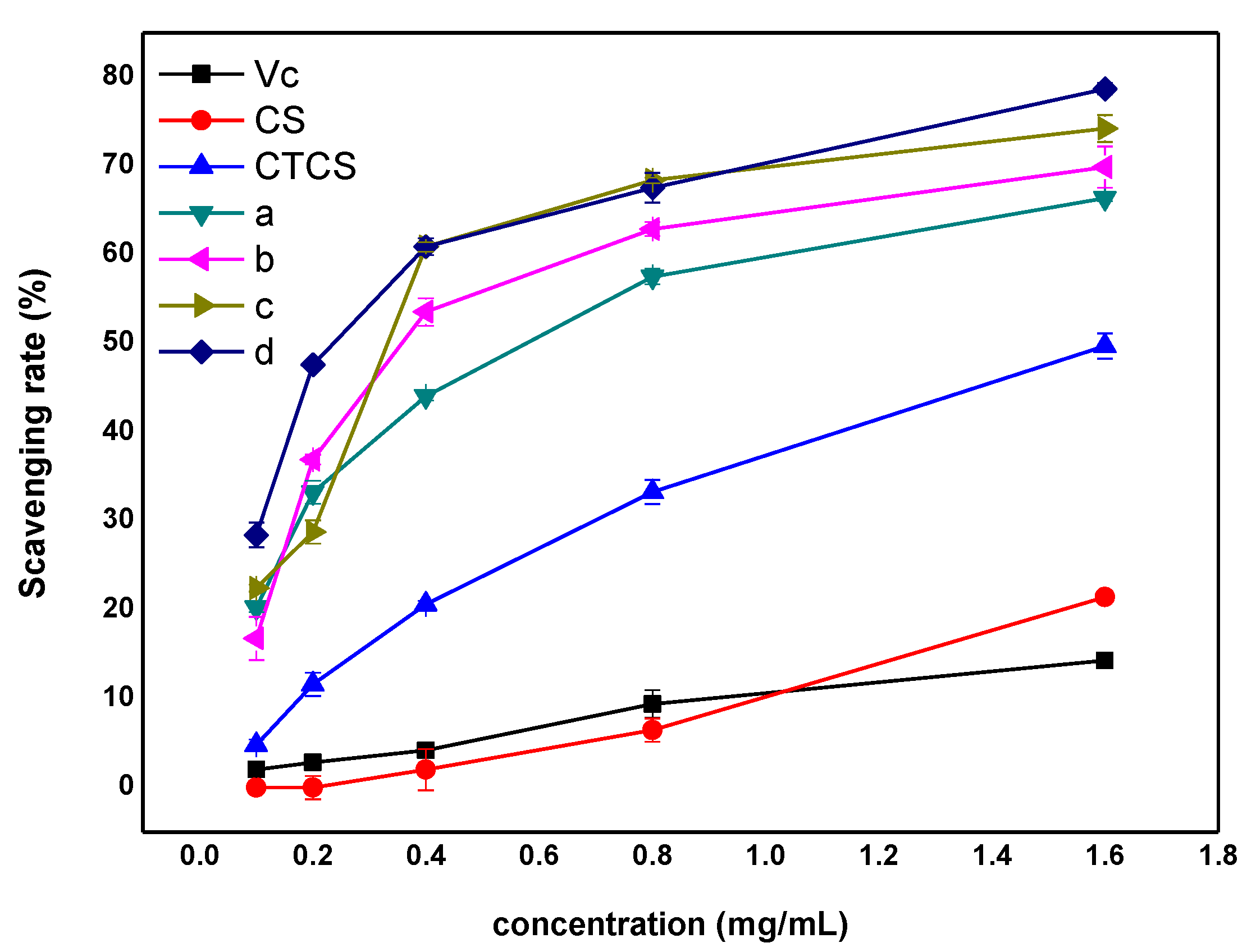
| Sample | Hydroxyl-Radical Scavenging Rate (%) | ||||
|---|---|---|---|---|---|
| 0.1 mg/mL | 0.2 mg/mL | 0.4 mg/mL | 0.8 mg/mL | 1.6 mg/mL | |
| CS | 0 | 0 | 2.01 ± 2.33 | 6.48 ± 1.32 | 21.45 ± 0.54 |
| CTCS | 4.83 ± 0.58 * | 11.65 ± 1.32 * | 20.63 ± 0.42 * | 33.28 ± 1.36 *** | 49.75 ± 1.41 *** |
| a | 20.28 ± 0.49 *** | 33.26 ± 1.33 *** | 44.06 ± 0.46 ** | 57.55 ± 0.87 *** | 66.37 ± 0.32 *** |
| b | 16.81 ± 2.41 * | 36.94 ± 0.54 *** | 53.58 ± 1.53 *** | 62.89 ± 0.78 *** | 69.88 ± 2.33 *** |
| c d | 22.46 ± 0.40 *** 28.45 ± 1.39 ** | 28.79 ± 1.29 ** 47.59 ± 0.36 *** | 60.90 ± 0.55 ** 60.88 ± 0.96 *** | 68.39 ± 0.32 *** 67.55 ± 1.66 *** | 74.21 ± 1.51 *** 78.72 ± 0.65 *** |
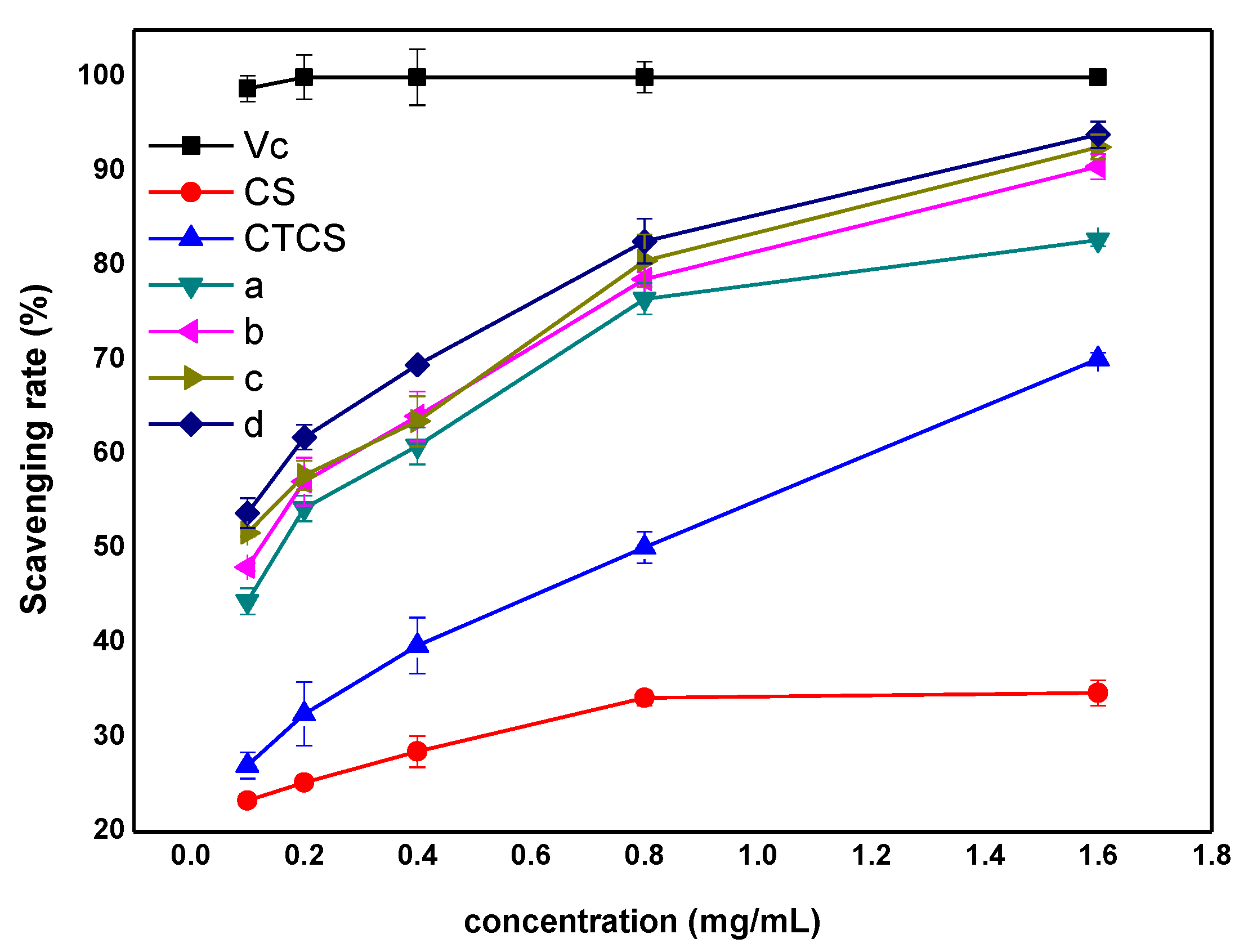
| Sample | Superoxide-Radical Scavenging Rate (%) | ||||
|---|---|---|---|---|---|
| 0.1 mg/mL | 0.2 mg/mL | 0.4 mg/mL | 0.8 mg/mL | 1.6 mg/mL | |
| CS | 23.31 ± 0.41 | 25.22 ± 0.54 | 28.49 ± 1.64 | 34.17 ± 0.78 | 34.72 ± 1.33 |
| CTCS | 27.01 ± 1.39 | 32.48 ± 3.36 | 39.74 ± 2.96 * | 50.16 ± 1.66 ** | 70.14 ± 0.65 *** |
| a | 44.42 ± 1.41 ** | 54.29 ± 1.36 *** | 60.91 ± 1.98 *** | 76.49 ± 1.59 *** | 82.73 ± 0.70 *** |
| b | 48.05 ± 0.40 * | 57.14 ± 2.54 ** | 64.03 ± 2.62 *** | 78.57 ± 0.78 *** | 90.52 ± 1.33 *** |
| c d | 51.69 ± 0.43 ** 53.77 ± 1.58 *** | 57.79 ± 1.56 *** 61.82 ± 1.32 * | 63.51 ± 2.71 *** 69.48 ± 0.42 *** | 80.52 ± 2.69 *** 82.60 ± 2.36 ** | 92.61 ± 1.29 *** 93.93 ± 1.41 *** |
© 2020 by the authors. Licensee MDPI, Basel, Switzerland. This article is an open access article distributed under the terms and conditions of the Creative Commons Attribution (CC BY) license (http://creativecommons.org/licenses/by/4.0/).
Share and Cite
Zhang, J.; Tan, W.; Li, Q.; Dong, F.; Guo, Z. Synthesis and Characterization of N,N,N-trimethyl-O-(ureidopyridinium)acetyl Chitosan Derivatives with Antioxidant and Antifungal Activities. Mar. Drugs 2020, 18, 163. https://doi.org/10.3390/md18030163
Zhang J, Tan W, Li Q, Dong F, Guo Z. Synthesis and Characterization of N,N,N-trimethyl-O-(ureidopyridinium)acetyl Chitosan Derivatives with Antioxidant and Antifungal Activities. Marine Drugs. 2020; 18(3):163. https://doi.org/10.3390/md18030163
Chicago/Turabian StyleZhang, Jingjing, Wenqiang Tan, Qing Li, Fang Dong, and Zhanyong Guo. 2020. "Synthesis and Characterization of N,N,N-trimethyl-O-(ureidopyridinium)acetyl Chitosan Derivatives with Antioxidant and Antifungal Activities" Marine Drugs 18, no. 3: 163. https://doi.org/10.3390/md18030163
APA StyleZhang, J., Tan, W., Li, Q., Dong, F., & Guo, Z. (2020). Synthesis and Characterization of N,N,N-trimethyl-O-(ureidopyridinium)acetyl Chitosan Derivatives with Antioxidant and Antifungal Activities. Marine Drugs, 18(3), 163. https://doi.org/10.3390/md18030163

