Abstract
Two new sterols, columnaristerols B (1) and C (2), along with two known analogues, 5,6-epoxylitosterol (3) and litosterol (4), were obtained from the octocoral Nephthea columnaris. The structures of new sterols 1 and 2 were elucidated by using spectroscopic methods and comparing the spectroscopic data with those of known related metabolites. Sterol 3 was found to suppress superoxide anion production and elastase secretion by human neutrophils.
1. Introduction
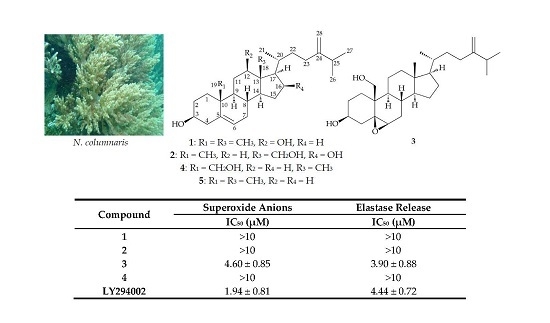
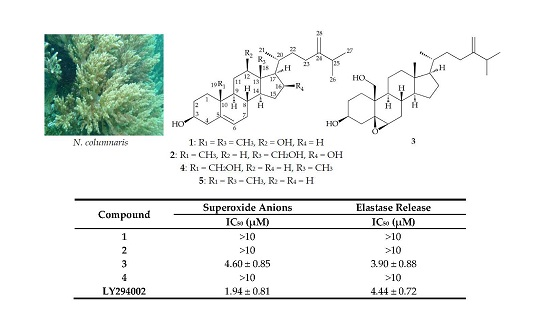
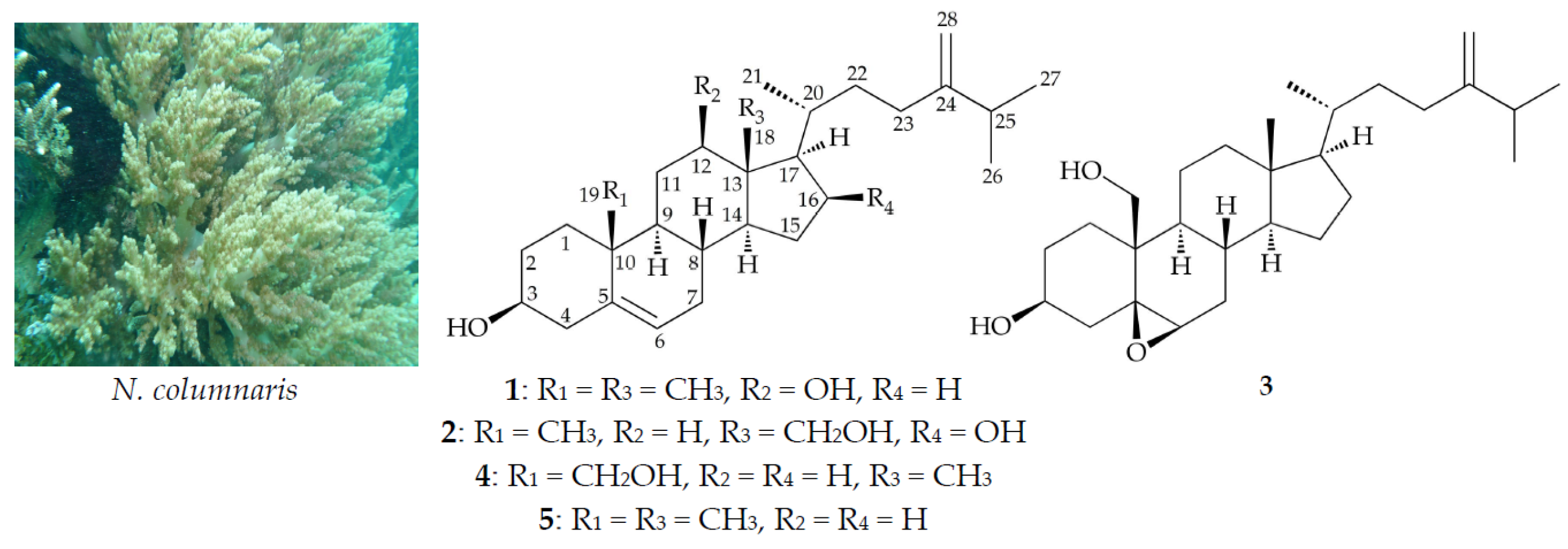
The octocoral Nephthea columnaris (Studer, 1895) (family Nephtheidae, order Alcyonacea, class Anthozoa, phylum Cnidaria) comprises large quantities of terpenoid [1,2] and steroid [3,4] analogues, which often have complex structures and biological activities. In continuing studies of the constituents of N. columnaris collected from the southern waters off the coast of Taiwan, two new sterols, columnaristerols B (1) and C (2), and known analogues, 5,6-epoxylitosterol (3) and litosterol (4) [5] (Figure 1), were obtained. Sterol 3 was found to inhibit the production of superoxide anions and release of elastase by human neutrophils.
Figure 1.
Octocoral N. columnaris and structures of columnaristerols B (1), C (2), 5,6-epoxylitosterol (3), litosterol (4), and 24-methylenecholesterol (5).
2. Results and Discussion
Columnaristerol B (1) was obtained as a non-crystalline powder, and high-resolution electrospray ionization mass spectrum (HRESIMS) analysis revealed that 1 had a pseudomolecular peak at m/z 437.33918 (calcd. for C28H46O2 + Na, 437.33900), which established the molecular formula C28H46O2, indicating six degrees of unsaturation. Data from 1H NMR and distortionless enhancement of polarization transfer (DEPT) analyses and examination along with the molecular formula of the compound suggested that there were two exchangeable protons that required the presence of two hydroxyl groups. IR spectrum analysis showed a broad absorption at 3386 cm−1, which further confirmed that interpretation. Combined examination of the molecular formula, 13C NMR and DEPT data revealed the presence of 28 carbons in 1 (Table 1), including five methyls, nine sp3 methylenes, eight sp3 methines (including two oxymethines, δC 79.5 and 71.7), an exocyclic double bond (δC 156.8 and 106.0), a trisubstituted double bond (δC 140.6 and 121.6), and two sp3 quaternary carbons.
Table 1.
1H (400 MHz, CDCl3) and 13C (100 MHz, CDCl3) NMR data and 1H–1H COSY and HMBC correlations for sterol 1.
In addition, the 1H NMR spectrum (Table 1) exhibited five methyl signals at δH 1.04 (3H, d, J = 6.4 Hz), 1.03 (3H, d, J = 6.8 Hz), 1.02 (3H, d, J = 6.8 Hz), 1.02 (3H, s), and 0.72 (3H, s). As the trisubstituted double bond and exocyclic double bond accounted for two of the six degrees of unsaturation, the remaining four degrees of unsaturation were ascribed to the presence of a tetracyclic compound.
By 1H–1H correlation spectroscopy (COSY) of 1, proton signal correlations between δH 1.09/δH 1.84 and 1.49/δH 3.51/δH 2.31 and 2.22; δH 5.35/δH 1.99 and 1.49/δH 1.36/δH 1.06/δH 1.71 and 1.49/δH 3.46; δH 1.36/δH 0.92/δH 1.64 and 1.21/δH 1.76 and 1.52/δH 1.44/δH 1.77/δH 1.64 and 1.14/δH 2.12 and 1.92; δH 1.77/δH 1.04; δH 2.23/δH 1.02; and δH 2.23/δH 1.03 established the proton sequences H2-1/H2-2/ H-3/H2-4, H-6/H2-7/H-8/H-9/H2-11/H-12, H-8/H-14/H2-15/H2-16/H-17/H-20/H2-22/H2-23, H-20/H3-21, H-25/H3-26, and H-25/H3-27, respectively (Table 1). These data, together with the key heteronuclear multiple bond coherence (HMBC) correlations from H2-4 to C-5, C-6, and C-10; from H-6 to C-4 and C-10; from H2-7 to C-5; from H-8 to C-10; from H2-11 to C-13; from H-12 to C-18; from H-14 to C-12, C-13, and C-18; from H-17 to C-12, C-13, and C-18; from H3-18 to C-12, C-13, C-14, and C-17; from H3-19 to C-1, C-5, C-9, and C-10; from H2-23 to C-24 and C-28; from H-25 to C-23, C-24, and C-28; from H3-26 to C-24; from H3-27 to C-24; and from H2-28 to C-24 enabled elucidation of the carbon skeleton of 1 (Table 1). Moreover, the planar structure of 1 was determined by comparison of the 13C NMR data with those of a known principal sterol, 24-methylenecholesterol (5) (Figure 1) [5,6].
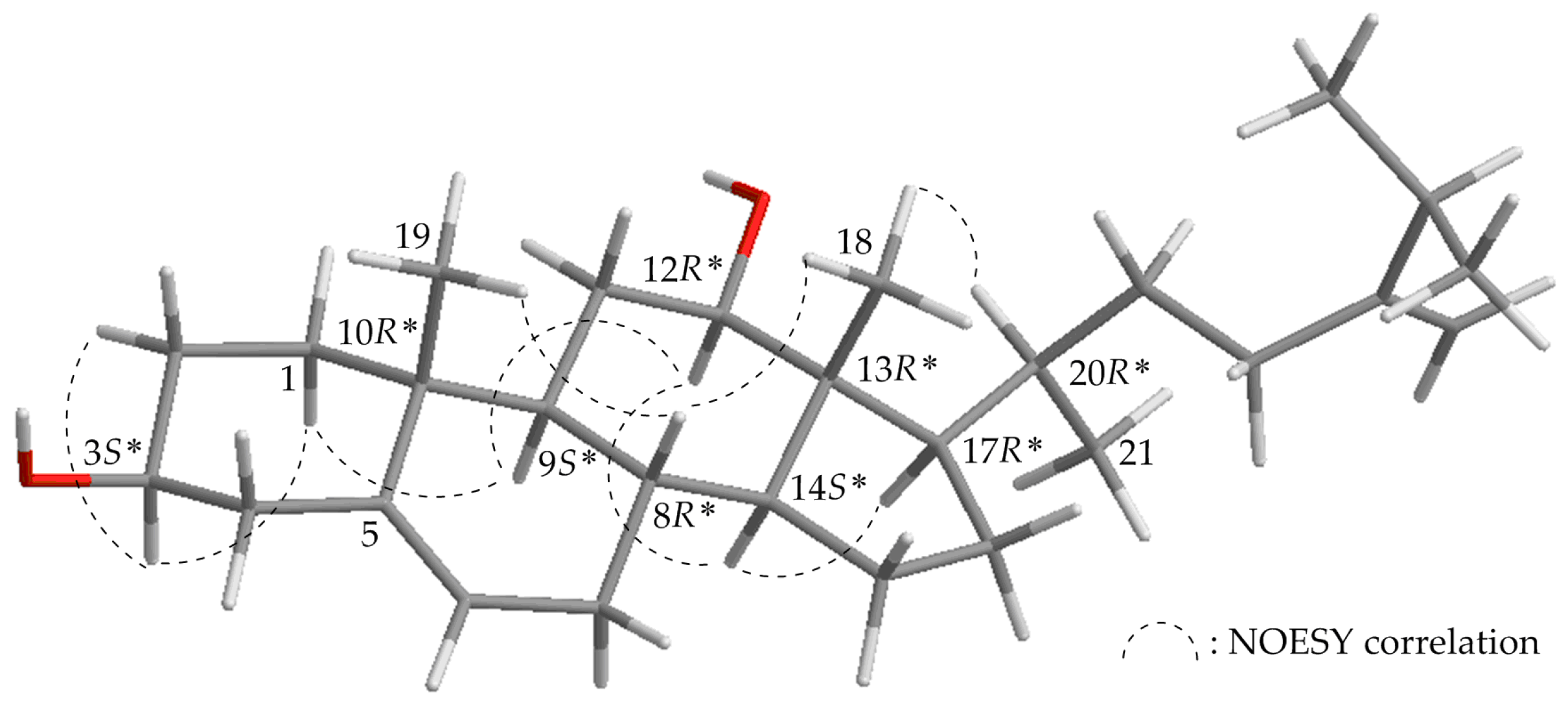
The relative stereochemistry of 1 was established by comparison of NMR data with those of sterol 5 [5,6] and from the interactions observed in the nuclear Overhauser effect spectroscopy (NOESY) experiment, which were corroborated by MM2 force field calculations, suggesting the most stable conformation to be as shown in Figure 2 [7]. The configurations at C-3 (δC 71.7), C-8 (δC 30.6), C-9 (δC 49.5), C-10 (δC 36.5), C-13 (δC 47.6), C-14 (δC 54.7), C-17 (δC 57.3), and C-20 (δC 33.4) in 1 were found to be similar to those of 5 (C-3, δC 71.7; C-8, δC 31.9; C-9, δC 50.1; C-10, δC 36.5; C-13, δC 42.3; C-14, δC 56.7; C-17, δC 56.0; C-20, δC 35.7) [5], (C-3, δC 71.84; C-8, δC 31.94; C-9, δC 50.17; C-10, δC 36.52; C-13, δC 42.31; C-14, δC 56.80; C-17, δC 56.04; C-20, δC 35.79) [6]. A key correlation map obtained from the NOESY experiment for 1 showed interactions between H-1α (δH 1.84)/H-3 (δH 3.51), H-1α/H-9 (δH 1.06), H-2α (δH 1.84)/H-3, H-8 (δH 1.36)/H3-18 (δH 0.72), H-8/H3-19 (δH 1.02), H-9/H-12 (δH 3.46), H-12/H-14 (δH 0.92), H-14/H-17 (δH 1.44), and H3-18/H-20 (δH 1.77) (Figure 2). Thus, the hydroxyl groups at C-3 and C-12 should be positioned on the β-face according to modeling analysis [7]. The aforementioned findings clearly confirmed the structure of columnaristerol B (1).
Figure 2.
Computer-generated model of 1 using MM2 force field calculations and selected protons with key NOESY correlations. Red color: oxygen atom; gray color: hydrogen atom; black color: carbon atom; *: relative configuration.
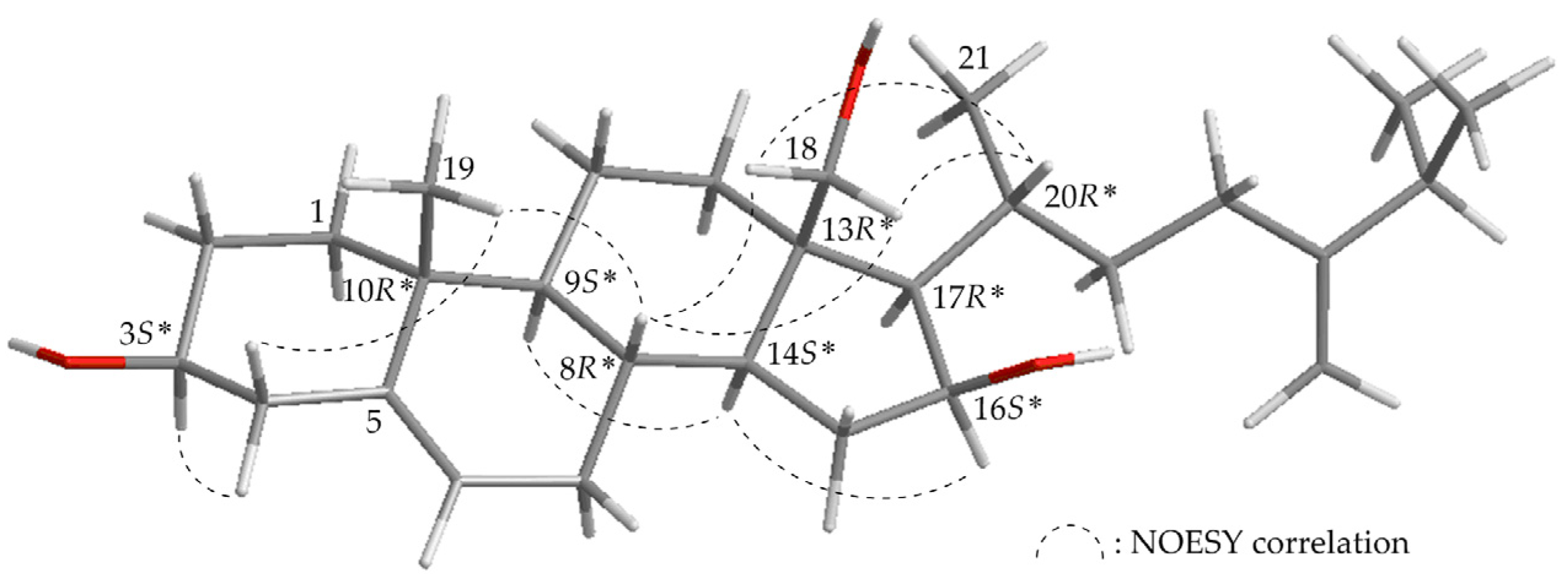
HRESIMS of new metabolite columnaristerol C (2) suggested a molecular formula of C28H46O3, as analysis showed a signal at m/z 453.33366 (calcd. for C28H46O3 + Na, 453.33392); in addition, the presence of a hydroxyl group was determined, as the IR spectrum of 2 showed a band at νmax 3331 cm−1. The existence of a tertiary methyl (δH 1.03), three secondary methyls (δH 1.04, 3H, d, J = 6.4 Hz; 1.02, 6H, d, J = 6.8 Hz), two oxymethines (δH 4.25, 1H, m; 3.53, 1H, m), and one oxymethylene (δH 4.00, 3.68, JAB = 12.0 Hz) were identified from the 1H NMR data, and the presence of a trisubstituted double bond was revealed by NMR data at δH 5.38 (1H, m), and δC 140.9 (C) and 121.2 (CH) (Table 2). Combined analysis of the molecular formula and the resonances of the 13C NMR and DEPT spectra revealed that 2 contained 4 methyls, 10 sp3 methylenes (including 1 oxymethylene), 8 sp3 methines (including 2 oxymethines), 2 sp3 quaternary carbons, 1 sp2 methylene, 1 sp2 methine, and 2 sp2 quaternary carbons. Comparison of the NMR chemical shift values of 2 with those of 24-methylenecholesterol (5) [5,6], as well as its HMBC cross-peaks from H2-18 to C-12, C-13, C-14, and C-17, and 1H–1H COSY correlations between the oxymethine proton signal at δH 4.25 (H-16)/δH 2.42 and 1.52 (H2-15) and δH 4.25 (H-16)/δH 1.20 (H-17), suggested that 2 may be a 16,18-dihydroxyl analogue of 5. Finally, the structure of 2 was confirmed based on the NOESY correlations (Figure 3) observed between H-3/H-4α, H-4β/H3-19, H-8/H2-18, H-8/H3-19, H-9/H-14, H-14/H-16, and H2-18/H-20.
Table 2.
1H (400 MHz, CDCl3) and 13C (100 MHz, CDCl3) NMR data and 1H–1H COSY and HMBC correlations for sterol 2.
Figure 3.
Computer-generated model of 2 using MM2 force field calculations and selected protons with key NOESY correlations. Red color: oxygen atom; gray color: hydrogen atom; black color: carbon atom; *: relative configuration.
Sterols 3 and 4 were identified as 5,6-epoxylitosterol (5β,6β-epoxyergost-24(28)-ene-3β,19-diol) and litosterol (ergosta-5,24(28)-diene-3β,19-diol), which had been previously isolated from the Okinawan soft coral Litophyton viridis [5]. To the best of our knowledge, this was the first time that these two marine-origin sterols had been obtained from Nephthea columnaris.
In vitro anti-inflammatory activity assays were performed using human neutrophils, and the results demonstrated that sterol 3 had inhibitory effects on the generation of superoxide anions and the release of elastase, with IC50 values of 4.60 and 3.90 μM, respectively, but sterol 4 displayed no anti-inflammatory effects (Table 3). Comparison with the structures and anti-inflammatory activities of sterols 3 and 4 implied that the presence of a 5β,6β-epoxy group enhanced the activity.
Table 3.
Inhibitory effects of sterols 1–4 on superoxide anion generation and elastase release by human neutrophils in response to fMet-Leu-Phe/Cytochalastin B.
3. Experimental Section
3.1. General Experimental Procedures
Column chromatography was carried out using silica gel (230–400 mesh size; Merck, Darmstadt, Germany). TLC was performed on plates precoated with Kieselgel 60 (with fluorescent indicator 254, 0.25-mm-thick; Merck), and the spots on the plates were visualized by spraying with 10% H2SO4 solution followed by heating. Normal-phase HPLC (NP-HPLC) was performed using a HPLC system equipped with a Hitachi L-7110 pump (Hitachi, Tokyo, Japan) and an injection port (7725; Rheodyne, Rohnert Park, CA, USA). A semi-preparative normal-phase column (25 cm × 21.2 mm, 5 μM, Ascentis Si, Cat.: 581515-U, Sigma-Aldrich, St. Louis, MO, USA) was employed. Reverse-phase HPLC (RP-HPLC) was performed using a system equipped with a Hitachi L-7100 pump, a photodiode array detector (Hitachi L-2455), an injection port (Rheodyne 7725) and a 250 × 21.2 mm column (5 μM, Luna RP-18e; Phenomenex Inc., Torrance, CA, USA) or a 250 × 10.0 mm column (5 μM; Ascentis C18 Cat.: 581343-U, Sigma-Aldrich). IR spectra were obtained using a spectrophotometer (Nicolet iS5 FT-IR; Thermo Scientific, Waltham, MA, USA). NMR spectra were recorded on a NMR spectrometer (Varian Mercury 400 MHz Plus system; Varian, Palo Alto, CA, USA) using the residual CHCl3 signal (δH 7.26 ppm) and CDCl3 signal (δC 77.1 ppm) as the internal standard for 1H NMR and 13C NMR, respectively. Coupling constants (J) are presented in Hz. ESIMS and HRESIMS were recorded using a mass spectrometer (7 Tesla SolariX FTMS system; Bruker, Bremen, Germany). Melting points of the natural products were determined using a Fargo apparatus (Panchum Scientific, Kaohsiung, Taiwan), and the values were uncorrected. Optical rotation values were measured using a digital polarimeter (Jasco P-1010; Japan Spectroscopic, Tokyo, Japan).
3.2. Animal Material
Specimens of the octocoral N. columnaris were collected by hand using scuba equipment off the coast of Southern Taiwan in February, 2012. The samples were stored in a −20 °C freezer immediately until extraction. A voucher specimen (NMMBA-TW-SC-12057) was deposited in the National Museum of Marine Biology and Aquarium, Taiwan [8].
3.3. Extraction and Isolation
Sliced bodies of N. columnaris (wet weight 800 g, dry weight 76.7 g) were extracted with a mixture of methanol (MeOH) and dichloromethane (DCM) (v:v = 1:1). The extract (25.1 g) was partitioned between ethyl acetate (EtOAc) and H2O. The EtOAc layer (7.35 g) was separated on silica gel and eluted with n-hexane/EtOAc (stepwise, v:v = 100:1 to 100% EtOAc) to yield 12 subfractions A–L. Fraction G was separated by silica gel column chromatography and then eluted with n-hexane/acetone (stepwise, v:v = 20:1 to 100% acetone) to afford 10 subfractions G1–G10. Fraction G5 was purified by NP-HPLC using a mixture of n-hexane/acetone (v:v = 3:1) to afford ten subfractions G5A–G5J. Fraction G5E was repurified by RP-HPLC using a mixture of acetonitrile/H2O (v:v = 80:20) to yield four subfractions G5E1–G5E4. Fraction G5E3 was repurified by RP-HPLC using a mixture of MeOH/H2O (v:v = 95:5 at a flow rate of 4.0 mL/min) to yield 1 (0.8 mg). Fraction I was separated by silica gel column chromatography and then eluted with n-hexane/EtOAc (stepwise, v:v = 100:1 to 100% EtOAc) to afford 15 subfractions I1–I15. Fraction I13 was purified by NP-HPLC using a mixture of n-hexane/acetone/DCM (v:v:v = 3:1:1) to afford 11 subfractions I13A–I13K. Fraction I13G was repurified by RP-HPLC using a mixture of MeOH/H2O/tetrahydrofuran (v:v:v = 90:9.5:0.5 at a flow rate of 2.0 mL/min) to yield 2 (0.7 mg). Fraction I13H was repurified by RP-HPLC using a mixture of MeOH/H2O (v:v = 80:20) to afford seven subfractions I13H1–I13H7. Fraction I13H7 was further separated by NP-HPLC using a mixture of n-hexane/EtOAC (v:v = 2:1) to afford three subfractions I13H7A–I13H7C. Fraction I13H7C was repurified by RP-HPLC using a mixture of MeOH/H2O (v:v = 95/5 at a flow rate of 4.0 mL/min) to yield 3 (1.3 mg) and 4 (5.1 mg), respectively.
Columnaristerol B (1): white powder; mp 143–144 °C; −200 (c 0.53, CHCl3); IR (neat) νmax 3386 cm−1, 1643 cm−1; 1H (400 MHz, CDCl3) and 13C (100 MHz, CDCl3) NMR data (see Table 1); ESIMS: m/z 437 [M + Na]+; HRESIMS: m/z 437.33918 (calcd. for C28H46O2 + Na, 437.33900).
Columnaristerol C (2): white powder; mp 140 °C; +31 (c 0.22, CHCl3); IR (neat) νmax 3331 cm−1, 1640 cm−1; 1H (400 MHz, CDCl3) and 13C (100 MHz, CDCl3) NMR data (see Table 2); ESIMS: m/z 453 [M + Na]+; HRESIMS: m/z 453.33366 (calcd. for C28H46O3 + Na, 453.33392).
5,6-Epoxylitosterol (3): white powder; mp 160–161 °C (ref. [5], mp 179–183 °C); +17 (c 0.07, CHCl3) (ref. [5], [α] D +3.8 (c 0.26, CHCl3)); IR (neat) νmax 3386 cm−1, 1641 cm−1; 1H (CDCl3, 400 MHz) and 13C (CDCl3, 100 MHz) NMR data were found to be in complete agreement with previous reports [5]; ESIMS m/z 453 [M + Na]+.
Litosterol (4): white powder; mp 147–149 °C (ref. [5], mp 147.5–150 °C); −31 (c 0.26, CHCl3) (ref. [5], [α] D −25.8 (c 0.24, CHCl3)); IR (neat) νmax 3419 cm−1, 1635 cm−1; 1H (CDCl3, 400 MHz) and 13C (CDCl3, 100 MHz) NMR data were found to be in complete agreement with previous reports [5]; ESIMS m/z 437 [M + Na]+
3.4. Molecular Mechanics Calculations
Implementation of the MM2 force field [7] in ChemBio 3D Ultra software from Cambridge Soft Corporation (ver. 12.0, Cambridge, MA, USA) was used to create molecular models.
3.5. Generation of Superoxide Anions and Release of Elastase by Human Neutrophils
Human neutrophils were obtained from whole blood using the method of dextran sedimentation and Ficoll centrifugation. Measurements of superoxide anion generation and the release of elastase by neutrophils were carried out according to previously described procedures [9,10]. Briefly, superoxide anion production was assayed by monitoring the superoxide dismutase-inhibitable reduction of ferricytochrome c. Elastase release experiments were performed using MeO–Suc–Ala–Ala–Pro–Valp–nitroanilide as the elastase substrate.
4. Conclusions
In the present study, our further investigation of natural substances obtained by extraction of N. columnaris led to the isolation of two new sterols, columnaristerols B (1) and C (2), as well as two known sterols, 5,6-epoxylitosterol (3) and litosterol (4) [5]. Our results demonstrated that 3 possessed potential anti-inflammatory activity in a human neutrophil model. The findings suggested that continued investigation of interesting secondary metabolites together with potentially useful bioactive substances from N. columnaris is worthwhile to inform potential new drug development.
Supplementary Materials
HRESIMS, and 1D (1H NMR, 13C NMR, and DEPT spectra) and 2D (HSQC, 1H−1H COSY, HMBC, and NOESY spectra) NMR spectra of new compounds 1 and 2 are available online at www.mdpi.com/1660-3397/15/7/212/s1.
Acknowledgments
This research was supported by grants from the National Museum of Marine Biology and Aquarium; the National Dong Hwa University; the National Sun Yat-sen University; and the National Research Program for Biopharmaceuticals, Ministry of Science and Technology (Grant Nos: MOST 105-2325-B- 291-001, 104-2325-B-291-001, 103-2325-B-291-001, and 104-2320-B-291-001-MY3) awarded to Ping-Jyun Sung.
Author Contributions
Tsong-Long Hwang and Ping-Jyun Sung designed the whole experiment and contributed to manuscript preparation. Ta-Yuan Whuang and Hong-Chieh Tsai researched data. Yin-Di Su analyzed the data and performed data acquisition.
Conflicts of Interest
The authors declare no conflicts of interest.
References
- Hsiao, T.-H.; Sung, C.-S.; Lan, Y.-H.; Wang, Y.-C.; Lu, M.-C.; Wen, Z.-H.; Wu, Y.-C.; Sung, P.-J. New anti- inflammatory cembranes from the cultured soft coral Nephthea columnaris. Mar. Drugs 2015, 13, 3443–3453. [Google Scholar] [CrossRef] [PubMed]
- Hsiao, T.-H.; Cheng, C.-H.; Wu, T.-Y.; Lu, M.-C.; Chen, W.-F.; Wen, Z.-H.; Dai, C.-F.; Wu, Y.-C.; Sung, P.-J. New cembranoid diterpenes from the cultured Nephthea columnaris. Molecules 2015, 20, 13205–13215. [Google Scholar] [CrossRef] [PubMed]
- Whuang, T.-Y.; Tsai, W.-C.; Chen, N.-F.; Chen, Z.-C.; Tsui, K.-H.; Wen, Z.-H.; Su, Y.-D.; Chang, Y.-C.; Chen, Y.-H.; Lu, M.-C.; et al. Columnaristerol A, a novel 19-norsterol from the Formosan octocoral Nephthea columnaris. Bioorg. Med. Chem. Lett. 2016, 26, 4966–4969. [Google Scholar] [CrossRef] [PubMed]
- Lin, C.-C.; Whuang, T.-Y.; Su, J.-H.; Hwang, T.-L.; Wu, Y.-C.; Sung, P.-J. 4α-Methylergosta-22(E), 24(28)-dien-3β-ol, a new marine sterol from the octocoral Nephthea columnaris. Nat. Prod. Commun. 2017, 12, 345–346. [Google Scholar]
- Iguchi, K.; Saitoh, S.; Yamada, Y. Novel 19-oxygenated sterols from the Okinawan soft coral Litophyton viridis. Chem. Pharm. Bull. 1989, 37, 2553–2554. [Google Scholar] [CrossRef]
- McInnes, A.G.; Walter, J.A.; Wright, J.L.C. 13C NMR spectra of Δ24(28) phytosterols. Org. Magn. Reson. 1980, 13, 302–303. [Google Scholar] [CrossRef]
- Allinger, N.L. Conformational analysis. 130. MM2. A hydrocarbon force field utilizing V1 and V2 torsional terms. J. Am. Chem. Soc. 1977, 99, 8127–8134. [Google Scholar] [CrossRef]
- Van Ofwegen, L.P. Annotated check list of New Caledonian soft corals. In Compendium of Marine Species of New Caledonia, 2nd ed.; Payri, C.E., Richer de Forges, B., Eds.; Institut de Recherche Pour le Développement: Nouméa, New Caledonia, France, 2007; pp. 139–144. [Google Scholar]
- Yang, S.-C.; Chung, P.-J.; Ho, C.-M.; Kuo, C.-Y.; Hung, M.-F.; Huang, Y.-T.; Chang, W.-Y.; Chang, Y.-W.; Chan, K.-H.; Hwang, T.-L. Propofol inhibits superoxide production, elastase release, and chemotaxis in formyl peptide-activated human neutrophils by blocking formyl peptide receptor 1. J. Immunol. 2013, 190, 6511–6519. [Google Scholar] [CrossRef] [PubMed]
- Yu, H.-P.; Hsieh, P.-W.; Chang, Y.-J.; Chung, P.-J.; Kuo, L.-M.; Hwang, T.-L. 2-(2-Fluorobenzamido) benzoate ethyl ester (EFB-1) inhibits superoxide production by human neutrophils and attenuates hemorrhagic shock-induced organ dysfunction in rats. Free Radic. Biol. Med. 2011, 50, 1737–1748. [Google Scholar] [CrossRef] [PubMed]
© 2017 by the authors. Licensee MDPI, Basel, Switzerland. This article is an open access article distributed under the terms and conditions of the Creative Commons Attribution (CC BY) license (http://creativecommons.org/licenses/by/4.0/).