CHEK1 Expression Correlates with Tumor Progression in Lung Adenocarcinoma but Not in Squamous Cell Carcinoma

Abstract
1. Introduction
2. Materials and Methods
2.1. TCGA Data Analysis
2.2. Statistical Analysis
3. Result
3.1. Association of CHEK1 Expression with Clinicopathological Features in NSCLC
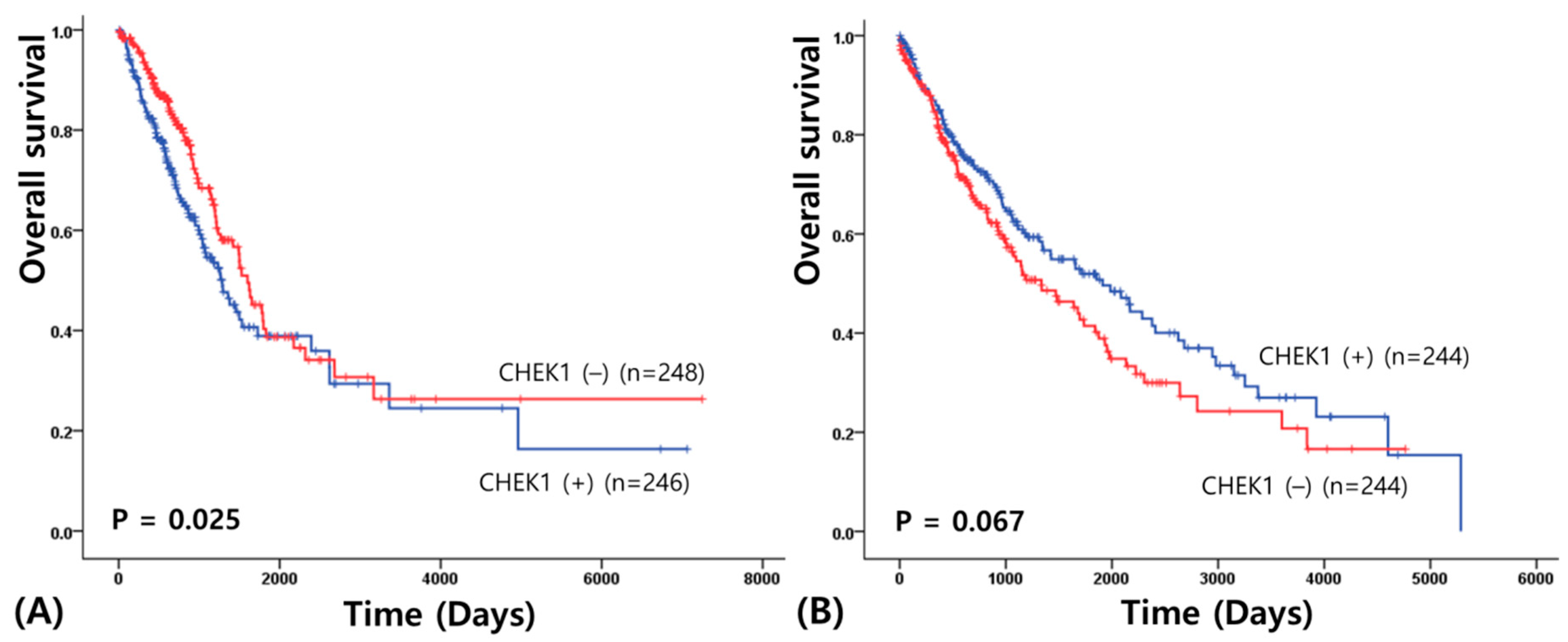
3.2. Prognostic Significance of CHEK1 Expression in AD and SCC
4. Discussion
5. Conclusions
Author Contributions
Funding
Institutional Review Board Statement
Informed Consent Statement
Data Availability Statement
Conflicts of Interest
References
- Sung, H.; Ferlay, J.; Siegel, R.L.; Laversanne, M.; Soerjomataram, I.; Jemal, A.; Bray, F. Global Cancer Statistics 2020: GLOBOCAN Estimates of Incidence and Mortality Worldwide for 36 Cancers in 185 Countries. CA Cancer J. Clin. 2021, 71, 209–249. [Google Scholar] [CrossRef]
- Siegel, R.L.; Miller, K.D.; Fuchs, H.E.; Jemal, A. Cancer Statistics, 2021. CA Cancer J. Clin. 2021, 71, 7–33. [Google Scholar] [CrossRef]
- Travis, W.D.; Brambilla, E.; Nicholson, A.G.; Yatabe, Y.; Austin, J.H.M.; Beasley, M.B.; Chirieac, L.R.; Dacic, S.; Duhig, E.; Flieder, D.B.; et al. The 2015 World Health Organization Classification of Lung Tumors: Impact of Genetic, Clinical and Radiologic Advances Since the 2004 Classification. J. Thorac. Oncol. 2015, 10, 1243–1260. [Google Scholar] [CrossRef]
- Hirsch, F.R.; Scagliotti, G.V.; Mulshine, J.L.; Kwon, R.; Curran, W.J., Jr.; Wu, Y.L.; Paz-Ares, L. Lung Cancer: Current Therapies and New Targeted Treatments. Lancet 2017, 389, 299–311. [Google Scholar] [CrossRef] [PubMed]
- Herbst, R.S.; Morgensztern, D.; Boshoff, C. The Biology and Management of Non-Small Cell Lung Cancer. Nature 2018, 553, 446–454. [Google Scholar] [CrossRef] [PubMed]
- Cancer Genome Atlas Research Network. Comprehensive Molecular Profiling of Lung Adenocarcinoma. Nature 2014, 511, 543–550. [Google Scholar] [CrossRef] [PubMed]
- Cancer Genome Atlas Research Network. Comprehensive Genomic Characterization of Squamous Cell Lung Cancers. Nature 2012, 489, 519–525. [Google Scholar] [CrossRef]
- Goldstraw, P.; Chansky, K.; Crowley, J.; Rami-Porta, R.; Asamura, H.; Eberhardt, W.E.; Nicholson, A.G.; Groome, P.; Mitchell, A.; Bolejack, V.; et al. The IASLC Lung Cancer Staging Project: Proposals for Revision of the TNM Stage Groupings in the Forthcoming (Eighth) Edition of the TNM Classification for Lung Cancer. J. Thorac. Oncol. 2016, 11, 39–51. [Google Scholar] [CrossRef] [PubMed]
- Zhang, Y.; Hunter, T. Roles of Chk1 in Cell Biology and Cancer Therapy. Int. J. Cancer 2014, 134, 1013–1023. [Google Scholar] [CrossRef]
- Hoadley, K.A.; Yau, C.; Hinoue, T.; Wolf, D.M.; Lazar, A.J.; Drill, E.; Shen, R.; Taylor, A.M.; Cherniack, A.D.; Thorsson, V.; et al. Cell-of-Origin Patterns Dominate the Molecular Classification of 10,000 Tumors from 33 Types of Cancer. Cell 2018, 173, 291–304.e6. [Google Scholar] [CrossRef]
- Lapenna, S.; Giordano, A. Cell Cycle Kinases as Therapeutic Targets for Cancer. Nat. Rev. Drug Discov. 2009, 8, 547–566. [Google Scholar] [CrossRef]
- Patil, M.; Pabla, N.; Dong, Z. Checkpoint Kinase 1 in DNA Damage Response and Cell Cycle Regulation. Cell. Mol. Life Sci. 2013, 70, 4009–4021. [Google Scholar] [CrossRef]
- Bartek, J.; Lukas, J. Chk1 and Chk2 Kinases in Checkpoint Control and Cancer. Cancer Cell 2003, 3, 421–429. [Google Scholar] [CrossRef]
- Dai, Y.; Grant, S. New Insights into Checkpoint Kinase 1 in the DNA Damage Response Signaling Network. Clin. Cancer Res. 2010, 16, 376–383. [Google Scholar] [CrossRef]
- Gaillard, H.; García-Muse, T.; Aguilera, A. Replication Stress and Cancer. Nat. Rev. Cancer 2015, 15, 276–289. [Google Scholar] [CrossRef]
- Hanahan, D.; Weinberg, R.A. Hallmarks of Cancer: The Next Generation. Cell 2011, 144, 646–674. [Google Scholar] [CrossRef]
- Negrini, S.; Gorgoulis, V.G.; Halazonetis, T.D. Genomic Instability—An Evolving Hallmark of Cancer. Nat. Rev. Mol. Cell Biol. 2010, 11, 220–228. [Google Scholar] [CrossRef] [PubMed]
- Bryant, C.; Rawlinson, R.; Massey, A.J. Chk1 Inhibition as a Novel Therapeutic Strategy for Treating Triple-Negative Breast and Ovarian Cancers. BMC Cancer 2014, 14, 570. [Google Scholar] [CrossRef] [PubMed]
- Venkatesha, V.A.; Parsels, L.A.; Parsels, J.D.; Zhao, L.; Zabludoff, S.D.; Simeone, D.M.; Maybaum, J.; Lawrence, T.S.; Morgan, M.A. Sensitization of Pancreatic Cancer Stem Cells to Gemcitabine by Chk1 Inhibition. Neoplasia 2012, 14, 519–525. [Google Scholar] [CrossRef] [PubMed]
- Qiu, Z.; Oleinick, N.L.; Zhang, J. ATR/CHK1 Inhibitors and Cancer Therapy. Radiother. Oncol. 2018, 126, 450–464. [Google Scholar] [CrossRef]
- Liu, B.; Qu, J.; Xu, F.; Guo, Y.; Wang, Y.; Yu, H.; Qian, B. MiR-195 Suppresses Non-Small Cell Lung Cancer by Targeting CHEK1. Oncotarget 2015, 6, 9445–9456. [Google Scholar] [CrossRef] [PubMed]
- Grabauskiene, S.; Bergeron, E.J.; Chen, G.; Thomas, D.G.; Giordano, T.J.; Beer, D.G.; Morgan, M.A.; Reddy, R.M. Checkpoint Kinase 1 Protein Expression Indicates Sensitization to Therapy by Checkpoint Kinase 1 Inhibition in Non-Small Cell Lung Cancer. J. Surg. Res. 2014, 187, 6–13. [Google Scholar] [CrossRef] [PubMed]
- Sen, T.; Tong, P.; Stewart, C.A.; Cristea, S.; Valliani, A.; Shames, D.S.; Redwood, A.B.; Fan, Y.H.; Li, L.; Glisson, B.S.; et al. CHK1 Inhibition in Small-Cell Lung Cancer Produces Single-Agent Activity in Biomarker-Defined Disease Subsets and Combination Activity with Cisplatin or Olaparib. Cancer Res. 2017, 77, 3870–3884. [Google Scholar] [CrossRef]
- Zabludoff, S.D.; Deng, C.; Grondine, M.R.; Sheehy, A.M.; Ashwell, S.; Caleb, B.L.; Green, S.; Haye, H.R.; Horn, C.L.; Janetka, J.W.; et al. AZD7762, a Novel Checkpoint Kinase Inhibitor, Drives Checkpoint Abrogation and Potentiates DNA-Targeted Therapies. Mol. Cancer Ther. 2008, 7, 2955–2966. [Google Scholar] [CrossRef] [PubMed]
- Lee, J.M.; Nair, J.; Zimmer, A.; Lipkowitz, S.; Annunziata, C.M.; Merino, M.J.; Swisher, E.M.; Harrell, M.I.; Trepel, J.B.; Lee, M.J.; et al. Prexasertib, a Cell Cycle Checkpoint Kinase 1 and 2 Inhibitor, in BRCA Wild-Type Recurrent High-Grade Serous Ovarian Cancer: A First-in-Class Proof-of-Concept Phase 2 Study. Lancet Oncol. 2018, 19, 207–215. [Google Scholar] [CrossRef]
- Hong, D.; Infante, J.; Janku, F.; Jones, S.; Nguyen, L.M.; Burris, H.; Naing, A.; Bauer, T.M.; Piha-Paul, S.; Johnson, F.M.; et al. Phase I Study of LY2606368, a Checkpoint Kinase 1 Inhibitor, in Patients with Advanced Cancer. J. Clin. Oncol. 2016, 34, 1764–1771. [Google Scholar] [CrossRef]
- Tan, Z.; Chen, M.; Wang, Y.; Peng, F.; Zhu, X.; Li, X.; Zhang, L.; Li, Y.; Liu, Y. CHEK1: A Hub Gene Related to Poor Prognosis for Lung Adenocarcinoma. Biomark. Med. 2022, 16, 83–100. [Google Scholar] [CrossRef]
- Rekhtman, N.; Ang, D.C.; Sima, C.S.; Travis, W.D.; Moreira, A.L. Immunohistochemical Algorithm for Differentiation of Lung Adenocarcinoma and Squamous Cell Carcinoma Based on Whole-Tissue Sections with Validation in Small Specimens. Mod. Pathol. 2011, 24, 1348–1359. [Google Scholar] [CrossRef]
- Bland, J.M.; Altman, D.G. Survival Probabilities (the Kaplan–Meier Method). BMJ 1998, 317, 1572. [Google Scholar] [CrossRef]
- Chen, Z.; Fillmore, C.M.; Hammerman, P.S.; Kim, C.F.; Wong, K.K. Non-Small-Cell Lung Cancers: A Heterogeneous Set of Diseases. Nat. Rev. Cancer 2014, 14, 535–546. [Google Scholar] [CrossRef]
- Sacher, A.G.; Dahlberg, S.E.; Heng, J.; Mach, S.; Jänne, P.A.; Oxnard, G.R. Association Between Younger Age and Targetable Genomic Alterations and Prognosis in Non-Small-Cell Lung Cancer. JAMA Oncol. 2016, 2, 313–320. [Google Scholar] [CrossRef] [PubMed]
- Bewick, V.; Cheek, L.; Ball, J. Statistics Review 12: Survival Analysis. Crit. Care 2004, 8, 389–394. [Google Scholar] [CrossRef] [PubMed]
- Clark, T.G.; Bradburn, M.J.; Love, S.B.; Altman, D.G. Survival Analysis Part I: Basic Concepts and First Analyses. Br. J. Cancer 2003, 89, 232–238. [Google Scholar] [CrossRef] [PubMed]


| CHEK1 Expression | p Value | ||
|---|---|---|---|
| High (%, N) | Low (%, N) | ||
| Age | 0.017 | ||
| ≤65 years | 55.5 (131) | 44.5 (105) | |
| ≥65 years | 44.7 (114) | 55.3 (141) | |
| Sex | 0.015 | ||
| Male | 56.0 (126) | 44.0 (99) | |
| Female | 44.9 (120) | 55.1 (147) | |
| M stage | 0.096 | ||
| M0 | 49.1 (159) | 50.9 (165) | |
| M1 | 66.7 (16) | 33.3 (8) | |
| N stage | 0.025 | ||
| N0 | 46.9 (149) | 53.1 (169) | |
| ≥N1 | 57.7 (94) | 42.3 (69) | |
| T stage | <0.001 | ||
| T1 | 37.3 (62) | 62.7 (104) | |
| T2 | 56.9 (148) | 43.1 (112) | |
| T3 | 57.8 (26) | 42.2 (19) | |
| T4 | 44.4 (8) | 55.6 (10) | |
| EGFR mutation | 0.180 | ||
| (+) | 34.5 (10) | 65.5 (19) | |
| (−) | 47.8 (88) | 52.2 (96) | |
| Smoking status | 0.629 | ||
| Yes | 69.1 (170) | 67.1(165) | |
| No | 30.9 (76) | 32.9 (81) | |
| CHEK1 Expression | p Value | ||
|---|---|---|---|
| High (%, N) | Low (%, N) | ||
| Age | 0.642 | ||
| ≤65 years | 48.7 (92) | 51.3 (97) | |
| ≥65 years | 50.8 (152) | 49.2 (147) | |
| Sex | 0.836 | ||
| Male | 50.3 (182) | 49.7 (180) | |
| Female | 49.2 (62) | 50.8 (64) | |
| M stage | 0.59 | ||
| M0 | 53.1 (213) | 46.9 (188) | |
| M1 | 42.9 (3) | 57.1 (4) | |
| N stage | 0.973 | ||
| N0 | 49.8 (155) | 50.2 (156) | |
| ≥N1 | 50.9 (87) | 49.1 (84) | |
| T stage | 0.949 | ||
| T1 | 48.6 (53) | 51.4 (56) | |
| T2 | 50.0 (143) | 50.0 (143) | |
| T3 | 52.9 (37) | 47.1 (33) | |
| T4 | 47.8 (11) | 52.2 (12) | |
| EGFR mutation | 0.435 | ||
| (+) | 42.9 (9) | 57.1 (12) | |
| (−) | 48.2 (131) | 51.8 (141) | |
| Smoking status | 0.900 | ||
| Yes | 42.2 (206) | 42.4 (207) | |
| No | 7.8 (38) | 7.6 (37) | |
Disclaimer/Publisher’s Note: The statements, opinions and data contained in all publications are solely those of the individual author(s) and contributor(s) and not of MDPI and/or the editor(s). MDPI and/or the editor(s) disclaim responsibility for any injury to people or property resulting from any ideas, methods, instructions or products referred to in the content. |
© 2026 by the authors. Published by MDPI on behalf of the Lithuanian University of Health Sciences. Licensee MDPI, Basel, Switzerland. This article is an open access article distributed under the terms and conditions of the Creative Commons Attribution (CC BY) license.
Share and Cite
Kim, N.; Cha, H.; Lee, J.-C.; Lee, J.-H.; Kim, T.-Y. CHEK1 Expression Correlates with Tumor Progression in Lung Adenocarcinoma but Not in Squamous Cell Carcinoma. Medicina 2026, 62, 335. https://doi.org/10.3390/medicina62020335
Kim N, Cha H, Lee J-C, Lee J-H, Kim T-Y. CHEK1 Expression Correlates with Tumor Progression in Lung Adenocarcinoma but Not in Squamous Cell Carcinoma. Medicina. 2026; 62(2):335. https://doi.org/10.3390/medicina62020335
Chicago/Turabian StyleKim, Nahyeon, Hyunbin Cha, Jun-Chae Lee, Jae-Ho Lee, and Tae-Young Kim. 2026. "CHEK1 Expression Correlates with Tumor Progression in Lung Adenocarcinoma but Not in Squamous Cell Carcinoma" Medicina 62, no. 2: 335. https://doi.org/10.3390/medicina62020335
APA StyleKim, N., Cha, H., Lee, J.-C., Lee, J.-H., & Kim, T.-Y. (2026). CHEK1 Expression Correlates with Tumor Progression in Lung Adenocarcinoma but Not in Squamous Cell Carcinoma. Medicina, 62(2), 335. https://doi.org/10.3390/medicina62020335