
Fecal Microbiota Transplantation for Autism Spectrum Disorder in Children: Results from a Prospective Open-Label Controlled Observational Study


Abstract
1. Introduction
2. Materials and Methods
2.1. Objective
2.2. Study Design and Ethical Considerations
2.2.1. ASD Intervention Group
2.2.2. ASD Control Group
2.3. Intervention
2.3.1. Donor Eligibility and Exclusion Criteria
2.3.2. Stool Screening Panel
2.3.3. Blood Screening Panel
2.3.4. Stool Collection, Handling, and Administration
2.4. Statistical Analysis
3. Results
Safety Outcomes
4. Discussion
Limitations
5. Conclusions
Author Contributions
Funding
Institutional Review Board Statement
Informed Consent Statement
Data Availability Statement
Acknowledgments
Conflicts of Interest
Abbreviations
| ASD | Autism spectrum disorder |
| FMT | Fecal microbiota transplantation |
| GSRS | Gastrointestinal Symptoms Rating Scale |
| ADOS | Autism Diagnostic Observation Schedule |
| CARS | Childhood Autism Rating Scale |
| ASEBA | Achenbach System of Empirically Based Assessment |
| PGI-R | Parent Global Impression |
| GIS | Gastrointestinal symptoms |
| NC | Neurotypical children |
| GBA | Gut–brain axis |
| CNS | Central nervous system |
| LPS | Lipopolysaccharides |
| SCFAs | Short-chain fatty acids |
| BBB | Blood–brain barrier |
| GABA | γ-Aminobutyric acid |
| 5-HT | Serotonin |
| HPA | Hypothalamic–pituitary–adrenal |
| ASDi | Autism spectrum disorder intervention |
| ASDc | Autism spectrum disorder control |
| IBD | Inflammatory bowel disease |
| RCT | Randomized controlled trial |
Appendix A

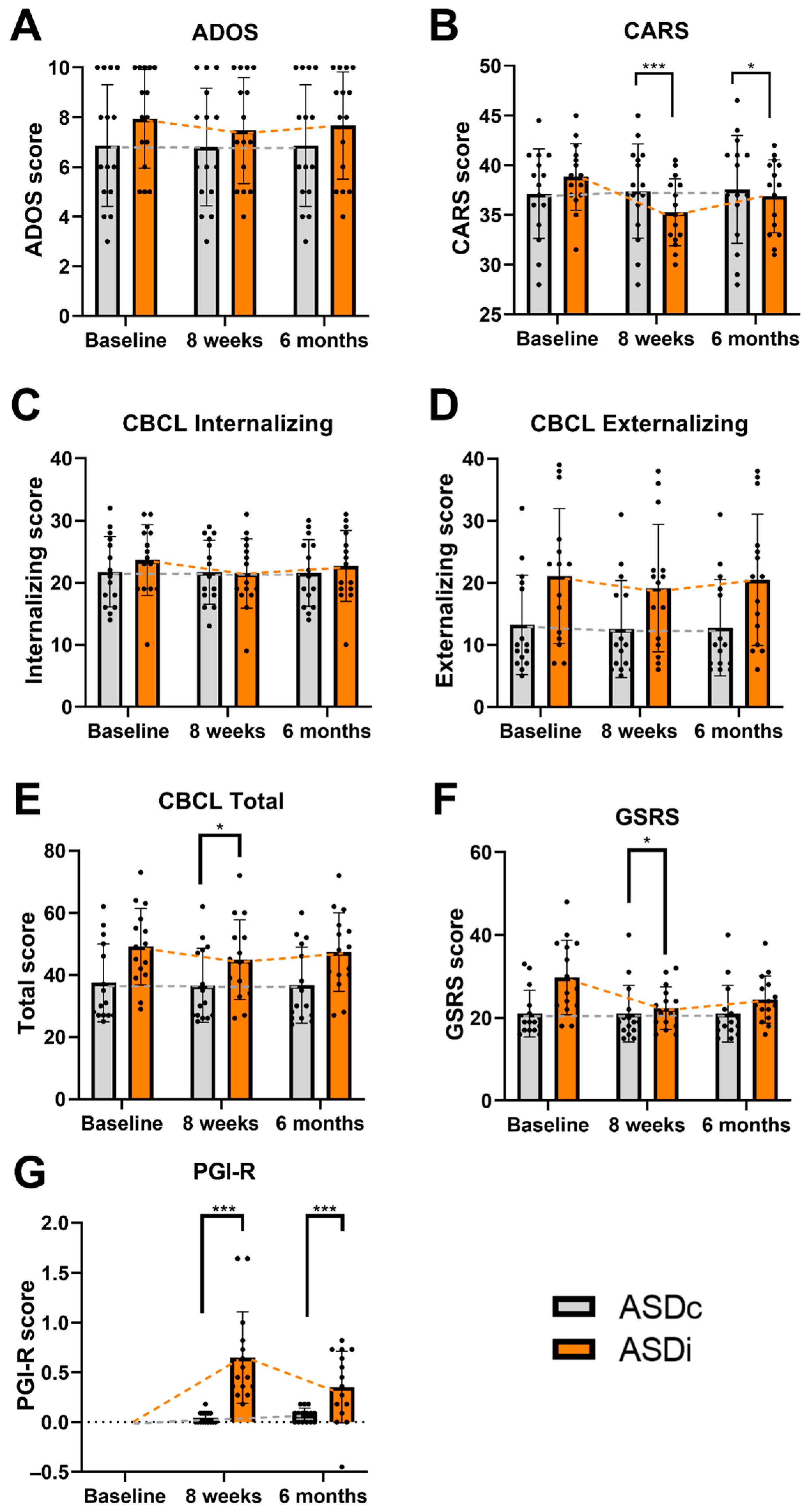
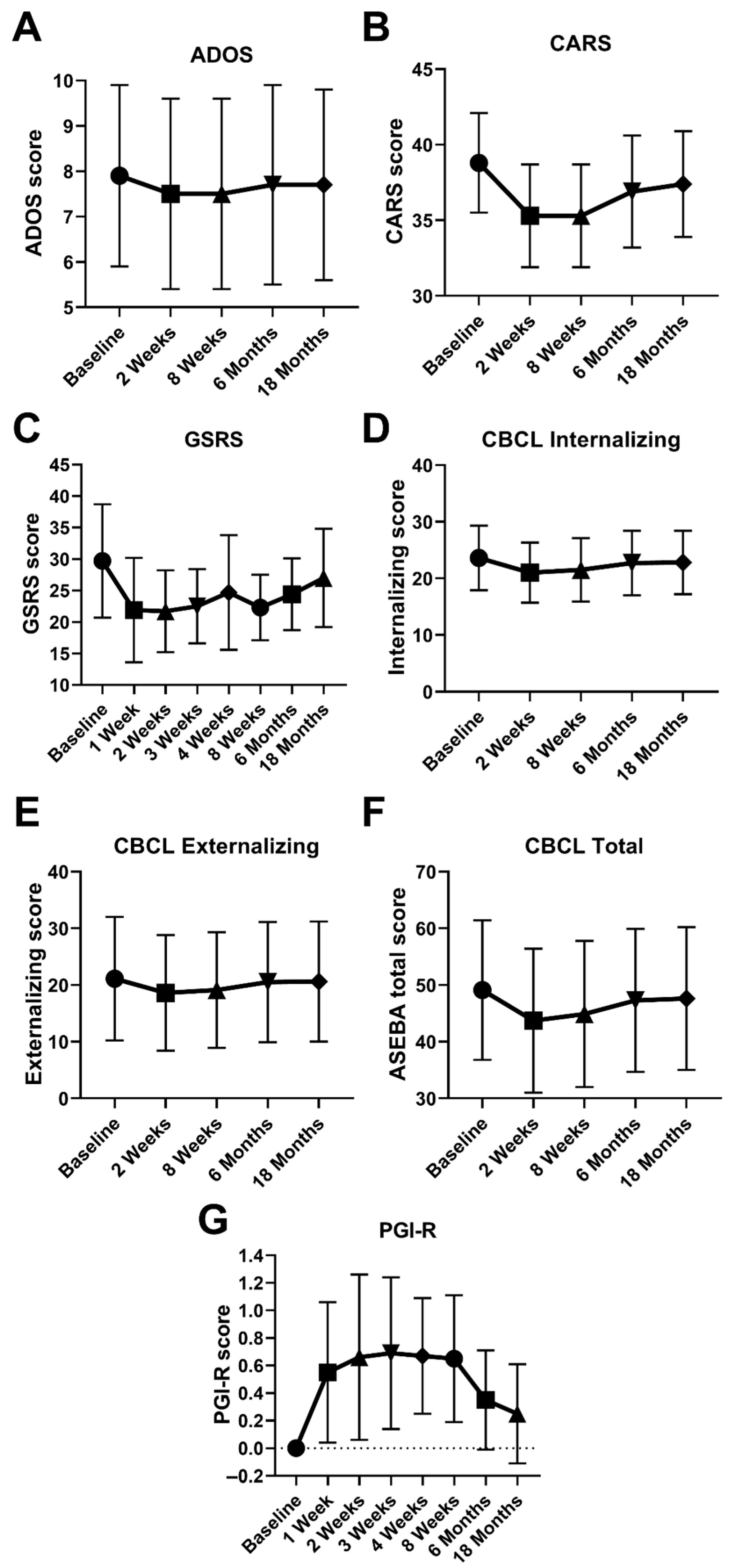
| Group | Variable | Time Point | Mean ± SD | Median [IQR] |
|---|---|---|---|---|
| ASDi | ADOS | Baseline | 7.9 ± 2.0 | 8.0 [6.0–10.0] |
| ASDi | CARS | Baseline | 38.8 ± 3.3 | 39.0 [37.0–41.0] |
| ASDi | GSRS | Baseline | 29.7 ± 9.0 | 27.0 [23.0–38.0] |
| ASDi | CBCL Internalizing Problems | Baseline | 23.6 ± 5.7 | 24.0 [19.0–28.0] |
| ASDi | CBCL Externalizing Problems | Baseline | 21.1 ± 10.9 | 23.0 [11.0–27.0] |
| ASDi | CBCL Total Problems | Baseline | 49.1 ± 12.3 | 49.0 [40.0–58.0] |
| ASDi | GSRS | 1 week | 21.9 ± 8.3 | 19.0 [17.0–26.0] |
| ASDi | GSRS | 2 weeks | 21.7 ± 6.5 | 19.0 [17.0–23.0] |
| ASDi | CBCL Internalizing Problems | 2 weeks | 21.0 ± 5.3 | 22.0 [18.0–24.0] |
| ASDi | CBCL Externalizing Problems | 2 weeks | 18.6 ± 10.2 | 17.0 [10.0–22.0] |
| ASDi | CBCL Total Problems | 2 weeks | 43.7 ± 12.7 | 43.0 [34.0–49.0] |
| ASDi | ADOS | 2 weeks | 7.5 ± 2.1 | 8.0 [5.0–10.0] |
| ASDi | CARS | 2 weeks | 35.3 ± 3.4 | 36.0 [32.0–38.0] |
| ASDi | GSRS | 3 weeks | 22.5 ± 5.9 | 21.0 [17.0–25.0] |
| ASDi | GSRS | 4 weeks | 24.7 ± 9.1 | 21.0 [18.0–29.0] |
| ASDi | GSRS | 8 weeks | 22.3 ± 5.2 | 21.0 [18.0–26.0] |
| ASDi | CBCL Internalizing Problems | 8 weeks | 21.5 ± 5.6 | 20.0 [18.0–26.0] |
| ASDi | CBCL Externalizing Problems | 8 weeks | 19.1 ± 10.2 | 20.0 [10.0–22.0] |
| ASDi | CBCL Total Problems | 8 weeks | 44.9 ± 12.9 | 44.0 [34.0–52.0] |
| ASDi | ADOS | 8 weeks | 7.5 ± 2.1 | 7.0 [5.0–10.0] |
| ASDi | CARS | 8 weeks | 35.3 ± 3.4 | 35.0 [32.5–38.0] |
| ASDi | GSRS | 6 months | 24.4 ± 5.7 | 23.0 [20.0–28.0] |
| ASDi | CBCL Internalizing Problems | 6 months | 22.7 ± 5.7 | 23.0 [19.0–28.0] |
| ASDi | CBCL Externalizing Problems | 6 months | 20.5 ± 10.6 | 21.0 [10.0–26.0] |
| ASDi | CBCL Total Problems | 6 months | 47.3 ± 12.6 | 48.0 [40.0–56.0] |
| ASDi | ADOS | 6 months | 7.7 ± 2.2 | 8.0 [5.0–10.0] |
| ASDi | CARS | 6 months | 36.9 ± 3.7 | 38.0 [33.0–40.0] |
| ASDi | GSRS | 18 months | 27.0 ± 7.8 | 25.0 [20.0–35.0] |
| ASDi | CBCL Internalizing Problems | 18 months | 22.8 ± 5.6 | 23.0 [19.0–27.0] |
| ASDi | CBCL Externalizing Problems | 18 months | 20.6 ± 10.6 | 21.0 [11.0–28.0] |
| ASDi | CBCL Total problems | 18 months | 47.6 ± 12.6 | 48.0 [41.0–55.0] |
| ASDi | ADOS | 18 months | 7.7 ± 2.1 | 8.0 [6.0–10.0] |
| ASDi | CARS | 18 months | 37.4 ± 3.5 | 37.0 [34.0–41.0] |
| ASDi | PGI-R | 1 week | 0.55 ± 0.51 | 0.45 [0.27–0.91] |
| ASDi | PGI-R | 2 weeks | 0.66 ± 0.6 | 0.45 [0.27–0.91] |
| ASDi | PGI-R | 3 weeks | 0.69 ± 0.55 | 0.55 [0.27–0.91] |
| ASDi | PGI-R | 4 weeks | 0.67 ± 0.42 | 0.64 [0.27–0.82] |
| ASDi | PGI-R | 8 weeks | 0.65 ± 0.46 | 0.45 [0.36–0.82] |
| ASDi | PGI-R | 6 months | 0.35 ± 0.36 | 0.36 [0.09–0.73] |
| ASDi | PGI-R | 18 months | 0.25 ± 0.36 | 0.18 [0.00–0.27] |
| Group | Variable | Time Point | Mean ± SD | Median [IQR] |
|---|---|---|---|---|
| ASDc | ADOS | Baseline | 6.9 ± 2.4 | 6.0 [5.0–10.0] |
| ASDc | CARS | Baseline | 37.1 ± 4.5 | 38.0 [34.0–41.0] |
| ASDc | GSRS | Baseline | 21.0 ± 5.6 | 19.0 [17.0–23.0] |
| ASDc | CBCL Internalizing Problems | Baseline | 21.7 ± 5.7 | 21.0 [16.0–27.0] |
| ASDc | CBCL Externalizing Problems | Baseline | 13.2 ± 8.0 | 10.0 [7.0–20.0] |
| ASDc | CBCL Total Problems | Baseline | 37.4 ± 12.5 | 31.0 [27.0–50.0] |
| ASDc | GSRS | 8 weeks | 21.0 ± 6.8 | 19.0 [17.0–22.0] |
| ASDc | CBCL Internalizing Problems | 8 weeks | 21.7 ± 5.1 | 21.0 [18.0–27.0] |
| ASDc | CBCL Externalizing Problems | 8 weeks | 12.5 ± 7.8 | 10.0 [6.0–18.0] |
| ASDc | CBCL Total Problems | 8 weeks | 36.6 ± 11.9 | 31.0 [27.0–48.0] |
| ASDc | ADOS | 8 weeks | 6.8 ± 2.4 | 6.0 [5.0–9.0] |
| ASDc | CARS | 8 weeks | 37.4 ± 4.7 | 38.0 [34.0–41.0] |
| ASDc | GSRS | 6 months | 21.0 ± 6.8 | 19.0 [17.0–22.0] |
| ASDc | CBCL Internalizing Problems | 6 months | 21.5 ± 5.4 | 21.0 [16.0–26.0] |
| ASDc | CBCL Externalizing Problems | 6 months | 12.7 ± 7.8 | 10.0 [7.0–19.0] |
| ASDc | CBCL Total Problems | 6 months | 36.7 ± 12.2 | 30.0 [26.0–50.0] |
| ASDc | ADOS | 6 months | 6.9 ± 2.4 | 6.0 [5.0–10.0] |
| ASDc | CARS | 6 months | 37.6 ± 5.4 | 37.0 [33.0–41.0] |
| ASDc | PGI-R | 8 weeks | 0.04 ± 0.06 | 0.00 [0.0–0.09] |
| ASDc | PGI-R | 6 months | 0.07 ± 0.07 | 0.09 [0.0–0.09] |
References
- World Health Organization. International Classification of Diseases, 11th Revision (ICD-11) for Mortality and Morbidity Statistics, 2024–01Release. World Health Organization, 2024. Available online: https://icd.who.int/browse/2024-01/mms/en#437815624 (accessed on 3 January 2025).
- Lord, C.; Elsabbagh, M.; Baird, G.; Veenstra-Vanderweele, J. Autism spectrum disorder. Lancet 2018, 392, 508–520. [Google Scholar] [CrossRef] [PubMed]
- Li, Y.-A.; Chen, Z.-J.; Li, X.-D.; Gu, M.-H.; Xia, N.; Gong, C.; Zhou, Z.-W.; Yasin, G.; Xie, H.-Y.; Wei, X.-P.; et al. Epidemiology of autism spectrum disorders: Global burden of disease 2019 and bibliometric analysis of risk factors. Front. Pediatr. 2022, 10, 972809. [Google Scholar] [CrossRef] [PubMed]
- Centers for Disease Control and Prevention. Prevalence of Autism Spectrum Disorders—Autism and Developmental Disabilities Monitoring Network, Six Sites, United States, 2007. Available online: https://www.cdc.gov/mmwr/preview/mmwrhtml/ss5601a1.htm (accessed on 3 January 2025).
- Maenner, M.J.; Warren, Z.; Williams, A.R.; Amoakohene, E.; Bakian, A.V.; Bilder, D.A.; Durkin, M.S.; Fitzgerald, R.T.; Furnier, S.M.; Hughes, M.M.; et al. Prevalence and Characteristics of Autism Spectrum Disorder Among Children Aged 8 Years—Autism and Developmental Disabilities Monitoring Network, 11 Sites, United States, 2020. MMWR Surveill. Summ. 2023, 72, 1–14. [Google Scholar] [CrossRef] [PubMed]
- Li, Z.; Yang, L.; Chen, H.; Fang, Y.; Zhang, T.; Yin, X.; Man, J.; Yang, X.; Lu, M. Global, regional and national burden of autism spectrum disorder from 1990 to 2019: Results from the Global Burden of Disease Study 2019. Epidemiol. Psychiatr. Sci. 2022, 31, e33. [Google Scholar] [CrossRef]
- Sharma, S.R.; Gonda, X.; Tarazi, F.I. Autism Spectrum Disorder: Classification, diagnosis and therapy. Pharmacol. Ther. 2018, 190, 91–104. [Google Scholar] [CrossRef]
- Jiang, C.-C.; Lin, L.-S.; Long, S.; Ke, X.-Y.; Fukunaga, K.; Lu, Y.-M.; Han, F. Signalling pathways in autism spectrum disorder: Mechanisms and therapeutic implications. Signal Transduct. Target. Ther. 2022, 7, 229. [Google Scholar] [CrossRef]
- Rylaarsdam, L.; Guemez-Gamboa, A. Genetic Causes and Modifiers of Autism Spectrum Disorder. Front. Cell Neurosci. 2019, 13, 385. [Google Scholar] [CrossRef]
- Cheroni, C.; Caporale, N.; Testa, G. Autism spectrum disorder at the crossroad between genes and environment: Contributions, convergences, and interactions in ASD developmental pathophysiology. Mol. Autism 2020, 11, 69. [Google Scholar] [CrossRef]
- Duque-Cartagena, T.; Dalla, M.D.B.; Mundstock, E.; Neto, F.K.; Espinoza, S.A.R.; De Moura, S.K.; Zanirati, G.; Padoin, A.V.; Jimenez, J.G.P.; Stein, A.T.; et al. Environmental pollutants as risk factors for autism spectrum disorders: A systematic review and meta-analysis of cohort studies. BMC Public Health 2024, 24, 2388. [Google Scholar] [CrossRef]
- Meltzer, A.; Van De Water, J. The Role of the Immune System in Autism Spectrum Disorder. Neuropsychopharmacology 2017, 42, 284–298. [Google Scholar] [CrossRef]
- Hughes, H.K.; Rose, D.; Ashwood, P. The Gut Microbiota and Dysbiosis in Autism Spectrum Disorders. Curr. Neurol. Neurosci. Rep. 2018, 18, 81. [Google Scholar] [CrossRef] [PubMed]
- Horecka-Lewitowicz, A.; Lewitowicz, W.; Wawszczak-Kasza, M.; Lim, H.; Lewitowicz, P. Autism Spectrum Disorder Pathogenesis—A Cross-Sectional Literature Review Emphasizing Molecular Aspects. Int. J. Mol. Sci. 2024, 25, 11283. [Google Scholar] [CrossRef] [PubMed]
- Beopoulos, A.; Géa, M.; Fasano, A.; Iris, F. Autism spectrum disorders pathogenesis: Toward a comprehensive model based on neuroanatomic and neurodevelopment considerations. Front. Neurosci. 2022, 16, 988735. [Google Scholar] [CrossRef] [PubMed]
- Holingue, C.; Newill, C.; Lee, L.; Pasricha, P.J.; Daniele Fallin, M. Gastrointestinal symptoms in autism spectrum disorder: A review of the literature on ascertainment and prevalence. Autism Res. 2018, 11, 24–36. [Google Scholar] [CrossRef]
- McElhanon, B.O.; McCracken, C.; Karpen, S.; Sharp, W.G. Gastrointestinal Symptoms in Autism Spectrum Disorder: A Meta-analysis. Pediatrics 2014, 133, 872–883. [Google Scholar] [CrossRef]
- Leader, G.; Abberton, C.; Cunningham, S.; Gilmartin, K.; Grudzien, M.; Higgins, E.; Joshi, L.; Whelan, S.; Mannion, A. Gastrointestinal Symptoms in Autism Spectrum Disorder: A Systematic Review. Nutrients 2022, 14, 1471. [Google Scholar] [CrossRef]
- Restrepo, B.; Angkustsiri, K.; Taylor, S.L.; Rogers, S.J.; Cabral, J.; Heath, B.; Hechtman, A.; Solomon, M.; Ashwood, P.; Amaral, D.G.; et al. Developmental–behavioral profiles in children with autism spectrum disorder and co-occurring gastrointestinal symptoms. Autism Res. 2020, 13, 1778–1789. [Google Scholar] [CrossRef]
- Cryan, J.F. Microbiome and Brain Development: A Tale of Two Systems. Ann. Nutr. Metab. 2025, 81, 34–46. [Google Scholar] [CrossRef]
- Burokas, A.; Moloney, R.D.; Dinan, T.G.; Cryan, J.F. Microbiota Regulation of the Mammalian Gut–Brain Axis. In Advances in Applied Microbiology; Elsevier: Amsterdam, The Netherlands, 2015; pp. 1–62. [Google Scholar] [CrossRef]
- Andreo-Martínez, P.; Rubio-Aparicio, M.; Sánchez-Meca, J.; Veas, A.; Martínez-González, A.E. A Meta-analysis of Gut Microbiota in Children with Autism. J. Autism Dev. Disord. 2022, 52, 1374–1387. [Google Scholar] [CrossRef]
- Iglesias-Vázquez, L.; Van Ginkel Riba, G.; Arija, V.; Canals, J. Composition of Gut Microbiota in Children with Autism Spectrum Disorder: A Systematic Review and Meta-Analysis. Nutrients 2020, 12, 792. [Google Scholar] [CrossRef]
- Yang, C.; Xiao, H.; Zhu, H.; Du, Y.; Wang, L. Revealing the gut microbiome mystery: A meta-analysis revealing differences between individuals with autism spectrum disorder and neurotypical children. Biosci. Trends 2024, 18, 233–249. [Google Scholar] [CrossRef]
- Kim, S.; Kim, H.; Yim, Y.S.; Ha, S.; Atarashi, K.; Tan, T.G.; Longman, R.S.; Honda, K.; Littman, D.R.; Choi, G.B.; et al. Maternal gut bacteria promote neurodevelopmental abnormalities in mouse offspring. Nature 2017, 549, 528–532. [Google Scholar] [CrossRef]
- Golubeva, A.V.; Joyce, S.A.; Moloney, G.; Burokas, A.; Sherwin, E.; Arboleya, S.; Flynn, I.; Khochanskiy, D.; Moya-Pérez, A.; Peterson, V.; et al. Microbiota-related Changes in Bile Acid & Tryptophan Metabolism are Associated with Gastrointestinal Dysfunction in a Mouse Model of Autism. eBioMedicine 2017, 24, 166–178. [Google Scholar] [CrossRef]
- Butler, M.I.; Bastiaanssen, T.F.S.; Long-Smith, C.; Morkl, S.; Berding, K.; Ritz, N.L.; Strain, C.; Patangia, D.; Patel, S.; Stanton, C.; et al. The gut microbiome in social anxiety disorder: Evidence of altered composition and function. Transl. Psychiatry 2023, 13, 95. [Google Scholar] [CrossRef]
- Sandler, R.H.; Finegold, S.M.; Bolte, E.R.; Buchanan, C.P.; Maxwell, A.P.; Väisänen, M.-L.; Nelson, M.N.; Wexler, H.M. Short-Term Benefit From Oral Vancomycin Treatment of Regressive-Onset Autism. J. Child. Neurol. 2000, 15, 429–435. [Google Scholar] [CrossRef]
- Rhee, S.H.; Pothoulakis, C.; Mayer, E.A. Principles and clinical implications of the brain–gut–enteric microbiota axis. Nat. Rev. Gastroenterol. Hepatol. 2009, 6, 306–314. [Google Scholar] [CrossRef]
- Grenham, S.; Clarke, G.; Cryan, J.F.; Dinan, T.G. Brain?Gut?Microbe Communication in Health and Disease. Front. Physio 2011, 2, 94. [Google Scholar] [CrossRef]
- Alharthi, A.; Alhazmi, S.; Alburae, N.; Bahieldin, A. The Human Gut Microbiome as a Potential Factor in Autism Spectrum Disorder. Int. J. Mol. Sci. 2022, 23, 1363. [Google Scholar] [CrossRef]
- Cryan, J.F.; O’Riordan, K.J.; Cowan, C.S.M.; Sandhu, K.V.; Bastiaanssen, T.F.S.; Boehme, M.; Codagnone, M.G.; Cussotto, S.; Fulling, C.; Golubeva, A.V.; et al. The Microbiota-Gut-Brain Axis. Physiol. Rev. 2019, 99, 1877–2013. [Google Scholar] [CrossRef]
- Vancamelbeke, M.; Vermeire, S. The intestinal barrier: A fundamental role in health and disease. Expert. Rev. Gastroenterol. Hepatol. 2017, 11, 821–834. [Google Scholar] [CrossRef] [PubMed]
- De Magistris, L.; Familiari, V.; Pascotto, A.; Sapone, A.; Frolli, A.; Iardino, P.; Carteni, M.; De Rosa, M.; Francavilla, R.; Riegler, G.; et al. Alterations of the Intestinal Barrier in Patients with Autism Spectrum Disorders and in Their First-degree Relatives. J. Pediatr. Gastroenterol. Nutr. 2010, 51, 418–424. [Google Scholar] [CrossRef] [PubMed]
- Zhao, J.; Bi, W.; Xiao, S.; Lan, X.; Cheng, X.; Zhang, J.; Lu, D.; Wei, W.; Wang, Y.; Li, H.; et al. Neuroinflammation induced by lipopolysaccharide causes cognitive impairment in mice. Sci. Rep. 2019, 9, 5790. [Google Scholar] [CrossRef] [PubMed]
- Chernikova, M.A.; Flores, G.D.; Kilroy, E.; Labus, J.S.; Mayer, E.A.; Aziz-Zadeh, L. The Brain-Gut-Microbiome System: Pathways and Implications for Autism Spectrum Disorder. Nutrients 2021, 13, 4497. [Google Scholar] [CrossRef] [PubMed]
- Pascale, A.; Marchesi, N.; Marelli, C.; Coppola, A.; Luzi, L.; Govoni, S.; Giustina, A.; Gazzaruso, C. Microbiota and metabolic diseases. Endocrine 2018, 61, 357–371. [Google Scholar] [CrossRef]
- Zhang, S.; Zhao, J.; Xie, F.; He, H.; Johnston, L.J.; Dai, X.; Wu, C.; Ma, X. Dietary fiber-derived short-chain fatty acids: A potential therapeutic target to alleviate obesity-related nonalcoholic fatty liver disease. Obes. Rev. 2021, 22, e13316. [Google Scholar] [CrossRef]
- He, J.; Gong, X.; Hu, B.; Lin, L.; Lin, X.; Gong, W.; Zhang, B.; Cao, M.; Xu, Y.; Xia, R.; et al. Altered Gut Microbiota and Short-chain Fatty Acids in Chinese Children with Constipated Autism Spectrum Disorder. Sci. Rep. 2023, 13, 19103. [Google Scholar] [CrossRef]
- Choi, J.; Lee, S.; Won, J.; Jin, Y.; Hong, Y.; Hur, T.-Y.; Kim, J.-H.; Lee, S.-R.; Hong, Y. Pathophysiological and neurobehavioral characteristics of a propionic acid-mediated autism-like rat model. PLoS ONE 2018, 13, e0192925. [Google Scholar] [CrossRef]
- Korteniemi, J.; Karlsson, L.; Aatsinki, A. Systematic review: Autism spectrum disorder and the gut microbiota. Acta Psychiatr. Scand. 2023, 148, 242–254. [Google Scholar] [CrossRef]
- Lagod, P.P.; Naser, S.A. The Role of Short-Chain Fatty Acids and Altered Microbiota Composition in Autism Spectrum Disorder: A Comprehensive Literature Review. Int. J. Mol. Sci. 2023, 24, 17432. [Google Scholar] [CrossRef]
- Boets, E.; Gomand, S.V.; Deroover, L.; Preston, T.; Vermeulen, K.; De Preter, V.; Hamer, H.M.; Van Den Mooter, G.; De Vuyst, L.; Courtin, C.M.; et al. Systemic availability and metabolism of colonic-derived short-chain fatty acids in healthy subjects: A stable isotope study. J. Physiol. 2017, 595, 541–555. [Google Scholar] [CrossRef]
- Chambers, E.S.; Viardot, A.; Psichas, A.; Morrison, D.J.; Murphy, K.G.; Zac-Varghese, S.E.K.; MacDougall, K.; Preston, T.; Tedford, C.; Finlayson, G.S.; et al. Effects of targeted delivery of propionate to the human colon on appetite regulation, body weight maintenance and adiposity in overweight adults. Gut 2015, 64, 1744–1754. [Google Scholar] [CrossRef] [PubMed]
- Peng, L.; Li, Z.-R.; Green, R.S.; Holzmanr, I.R.; Lin, J. Butyrate Enhances the Intestinal Barrier by Facilitating Tight Junction Assembly via Activation of AMP-Activated Protein Kinase in Caco-2 Cell Monolayers. J. Nutr. 2009, 139, 1619–1625. [Google Scholar] [CrossRef] [PubMed]
- Morrison, D.J.; Preston, T. Formation of short chain fatty acids by the gut microbiota and their impact on human metabolism. Gut Microbes 2016, 7, 189–200. [Google Scholar] [CrossRef] [PubMed]
- Koh, A.; De Vadder, F.; Kovatcheva-Datchary, P.; Bäckhed, F. From Dietary Fiber to Host Physiology: Short-Chain Fatty Acids as Key Bacterial Metabolites. Cell 2016, 165, 1332–1345. [Google Scholar] [CrossRef]
- Silva, Y.P.; Bernardi, A.; Frozza, R.L. The Role of Short-Chain Fatty Acids From Gut Microbiota in Gut-Brain Communication. Front. Endocrinol. 2020, 11, 25. [Google Scholar] [CrossRef]
- Socała, K.; Doboszewska, U.; Szopa, A.; Serefko, A.; Włodarczyk, M.; Zielińska, A.; Poleszak, E.; Fichna, J.; Wlaź, P. The role of microbiota-gut-brain axis in neuropsychiatric and neurological disorders. Pharmacol. Res. 2021, 172, 105840. [Google Scholar] [CrossRef]
- Lyte, M. Microbial Endocrinology and the Microbiota-Gut-Brain Axis. In Microbial Endocrinology: The Microbiota-Gut-Brain Axis in Health and Disease; Lyte, M., Cryan, J.F., Eds.; Advances in Experimental Medicine and Biology; Springer: New York, NY, USA, 2014; pp. 3–24. [Google Scholar] [CrossRef]
- Otaru, N.; Ye, K.; Mujezinovic, D.; Berchtold, L.; Constancias, F.; Cornejo, F.A.; Krzystek, A.; De Wouters, T.; Braegger, C.; Lacroix, C.; et al. GABA Production by Human Intestinal Bacteroides spp.: Prevalence, Regulation, and Role in Acid Stress Tolerance. Front. Microbiol. 2021, 12, 656895. [Google Scholar] [CrossRef]
- Auteri, M.; Zizzo, M.G.; Serio, R. GABA and GABA receptors in the gastrointestinal tract: From motility to inflammation. Pharmacol. Res. 2015, 93, 11–21. [Google Scholar] [CrossRef]
- Braat, S.; Kooy, R.F. The GABAA Receptor as a Therapeutic Target for Neurodevelopmental Disorders. Neuron 2015, 86, 1119–1130. [Google Scholar] [CrossRef]
- Koevoet, D.; Deschamps, P.K.H.; Kenemans, J.L. Catecholaminergic and cholinergic neuromodulation in autism spectrum disorder: A comparison to attention-deficit hyperactivity disorder. Front. Neurosci. 2023, 16, 1078586. [Google Scholar] [CrossRef]
- Averina, O.V.; Danilenko, V.N. Human intestinal microbiota: Role in development and functioning of the nervous system. Microbiology 2017, 86, 5–24. [Google Scholar] [CrossRef] [PubMed]
- Pavăl, D. The dopamine hypothesis of autism spectrum disorder: A comprehensive analysis of the evidence. In International Review of Neurobiology; Elsevier: Amsterdam, The Netherlands, 2023; pp. 1–42. [Google Scholar] [CrossRef]
- Beversdorf, D.Q. The Role of the Noradrenergic System in Autism Spectrum Disorders, Implications for Treatment. Semin. Pediatr. Neurol. 2020, 35, 100834. [Google Scholar] [CrossRef] [PubMed]
- Makris, G.; Agorastos, A.; Chrousos, G.P.; Pervanidou, P. Stress System Activation in Children and Adolescents with Autism Spectrum Disorder. Front. Neurosci. 2022, 15, 756628. [Google Scholar] [CrossRef] [PubMed]
- Mawe, G.M.; Hoffman, J.M. Serotonin signalling in the gut—Functions, dysfunctions and therapeutic targets. Nat. Rev. Gastroenterol. Hepatol. 2013, 10, 473–486. [Google Scholar] [CrossRef]
- Foster, J.A.; Rinaman, L.; Cryan, J.F. Stress & the gut-brain axis: Regulation by the microbiome. Neurobiol. Stress 2017, 7, 124–136. [Google Scholar] [CrossRef]
- Muller, C.L.; Anacker, A.M.J.; Veenstra-VanderWeele, J. The serotonin system in autism spectrum disorder: From biomarker to animal models. Neuroscience 2016, 321, 24–41. [Google Scholar] [CrossRef]
- Terry, N.; Margolis, K.G. Serotonergic Mechanisms Regulating the GI Tract: Experimental Evidence and Therapeutic Relevance. In Gastrointestinal Pharmacology; Greenwood-Van Meerveld, B., Ed.; Handbook of Experimental Pharmacology; Springer International Publishing: Cham, Switzerland, 2016; pp. 319–342. [Google Scholar] [CrossRef]
- Dinan, T.G.; Stilling, R.M.; Stanton, C.; Cryan, J.F. Collective unconscious: How gut microbes shape human behavior. J. Psychiatr. Res. 2015, 63, 1–9. [Google Scholar] [CrossRef]
- Dezfouli, M.A.; Rashidi, S.K.; Yazdanfar, N.; Khalili, H.; Goudarzi, M.; Saadi, A.; Kiani Deh Kiani, A. The emerging roles of neuroactive components produced by gut microbiota. Mol. Biol. Rep. 2025, 52, 1. [Google Scholar] [CrossRef]
- Potter, K.; Gayle, E.J.; Deb, S. Effect of gut microbiome on serotonin metabolism: A personalized treatment approach. Naunyn-Schmiedeberg’s Arch. Pharmacol. 2024, 397, 2589–2602. [Google Scholar] [CrossRef]
- Hepsomali, P.; Groeger, J.A.; Nishihira, J.; Scholey, A. Effects of Oral Gamma-Aminobutyric Acid (GABA) Administration on Stress and Sleep in Humans: A Systematic Review. Front. Neurosci. 2020, 14, 923. [Google Scholar] [CrossRef]
- Gao, K.; Mu, C.; Farzi, A.; Zhu, W. Tryptophan Metabolism: A Link Between the Gut Microbiota and Brain. Adv. Nutr. 2020, 11, 709–723. [Google Scholar] [CrossRef] [PubMed]
- Jin, Y.; Kong, J. Transcutaneous Vagus Nerve Stimulation: A Promising Method for Treatment of Autism Spectrum Disorders. Front. Neurosci. 2017, 10, 609. [Google Scholar] [CrossRef] [PubMed]
- Van Hoorn, A.; Carpenter, T.; Oak, K.; Laugharne, R.; Ring, H.; Shankar, R. Neuromodulation of autism spectrum disorders using vagal nerve stimulation. J. Clin. Neurosci. 2019, 63, 8–12. [Google Scholar] [CrossRef] [PubMed]
- Braniste, V.; Al-Asmakh, M.; Kowal, C.; Anuar, F.; Abbaspour, A.; Tóth, M.; Korecka, A.; Bakocevic, N.; Ng, L.G.; Kundu, P.; et al. The gut microbiota influences blood-brain barrier permeability in mice. Sci. Transl. Med. 2014, 6, 263ra158. [Google Scholar] [CrossRef] [PubMed]
- Hoyles, L.; Pontifex, M.G.; Rodriguez-Ramiro, I.; Anis-Alavi, M.A.; Jelane, K.S.; Snelling, T.; Solito, E.; Fonseca, S.; Carvalho, A.L.; Carding, S.R.; et al. Regulation of blood–brain barrier integrity by microbiome-associated methylamines and cognition by trimethylamine N-oxide. Microbiome 2021, 9, 235. [Google Scholar] [CrossRef]
- Parker, A.; Fonseca, S.; Carding, S.R. Gut microbes and metabolites as modulators of blood-brain barrier integrity and brain health. Gut Microbes 2020, 11, 135–157. [Google Scholar] [CrossRef]
- Fiorentino, M.; Sapone, A.; Senger, S.; Camhi, S.S.; Kadzielski, S.M.; Buie, T.M.; Kelly, D.L.; Cascella, N.; Fasano, A. Blood–brain barrier and intestinal epithelial barrier alterations in autism spectrum disorders. Mol. Autism 2016, 7, 49. [Google Scholar] [CrossRef]
- Eshraghi, R.S.; Davies, C.; Iyengar, R.; Perez, L.; Mittal, R.; Eshraghi, A.A. Gut-Induced Inflammation during Development May Compromise the Blood-Brain Barrier and Predispose to Autism Spectrum Disorder. J. Clin. Med. 2020, 10, 27. [Google Scholar] [CrossRef]
- Misiak, B.; Łoniewski, I.; Marlicz, W.; Frydecka, D.; Szulc, A.; Rudzki, L.; Samochowiec, J. The HPA axis dysregulation in severe mental illness: Can we shift the blame to gut microbiota? Prog. Neuro-Psychopharmacol. Biol. Psychiatry 2020, 102, 109951. [Google Scholar] [CrossRef]
- Rusch, J.A.; Layden, B.T.; Dugas, L.R. Signalling cognition: The gut microbiota and hypothalamic-pituitary-adrenal axis. Front. Endocrinol. 2023, 14, 1130689. [Google Scholar] [CrossRef]
- Mamun, A.A.; Geng, P.; Wang, S.; Shao, C.; Xiao, J. IUPHAR review: Targeted therapies of signaling pathways based on the gut microbiome in autism spectrum disorders: Mechanistic and therapeutic applications. Pharmacol. Res. 2025, 211, 107559. [Google Scholar] [CrossRef] [PubMed]
- Kotowska, M.; Kołodziej, M.; Szajewska, H.; Łukasik, J. The impact of probiotics on core autism symptoms—A systematic review and meta-analysis of randomized clinical trials. Clin. Nutr. ESPEN 2024, 63, 893–902. [Google Scholar] [CrossRef] [PubMed]
- He, X.; Liu, W.; Tang, F.; Chen, X.; Song, G. Effects of Probiotics on Autism Spectrum Disorder in Children: A Systematic Review and Meta-Analysis of Clinical Trials. Nutrients 2023, 15, 1415. [Google Scholar] [CrossRef] [PubMed]
- Barba-Vila, O.; García-Mieres, H.; Ramos, B. Probiotics in autism spectrum disorders: A systematic review of clinical studies and future directions. Nutr. Rev. 2025, 83, 329–343. [Google Scholar] [CrossRef]
- Davidovics, Z.H.; Michail, S.; Nicholson, M.R.; Kociolek, L.K.; Pai, N.; Hansen, R.; Schwerd, T.; Maspons, A.; Shamir, R.; Szajewska, H.; et al. Fecal Microbiota Transplantation for Recurrent Clostridium difficile Infection and Other Conditions in Children: A Joint Position Paper From the North American Society for Pediatric Gastroenterology, Hepatology, and Nutrition and the European Society for Pediatric Gastroenterology, Hepatology, and Nutrition. J. Pediatr. Gastroenterol. Nutr. 2019, 68, 130–143. [Google Scholar] [CrossRef]
- Lee, J.Y.; Kim, Y.; Kim, J.; Kim, J.K. Fecal Microbiota Transplantation: Indications, Methods, and Challenges. J. Microbiol. 2024, 62, 1057–1074. [Google Scholar] [CrossRef]
- Liu, C.; Du, M.-X.; Abuduaini, R.; Yu, H.-Y.; Li, D.-H.; Wang, Y.-J.; Zhou, N.; Jiang, M.-Z.; Niu, P.-X.; Han, S.-S.; et al. Enlightening the taxonomy darkness of human gut microbiomes with a cultured biobank. Microbiome 2021, 9, 119. [Google Scholar] [CrossRef]
- Kang, D.-W.; Adams, J.B.; Gregory, A.C.; Borody, T.; Chittick, L.; Fasano, A.; Khoruts, A.; Geis, E.; Maldonado, J.; McDonough-Means, S.; et al. Microbiota Transfer Therapy alters gut ecosystem and improves gastrointestinal and autism symptoms: An open-label study. Microbiome 2017, 5, 10. [Google Scholar] [CrossRef]
- Kang, D.-W.; Adams, J.B.; Coleman, D.M.; Pollard, E.L.; Maldonado, J.; McDonough-Means, S.; Caporaso, J.G.; Krajmalnik-Brown, R. Long-term benefit of Microbiota Transfer Therapy on autism symptoms and gut microbiota. Sci. Rep. 2019, 9, 5821. [Google Scholar] [CrossRef]
- Wang, J.; Yang, R.; Zhong, H.; Liu, Y.-J. Fecal microbiota transplants in pediatric autism: Opportunities and challenges. World J. Pediatr. 2024, 20, 1201–1204. [Google Scholar] [CrossRef]
- Vaughan, C.A. Test Review: E. Schopler, M.E. Van Bourgondien, G.J. Wellman, & S. R. Love Childhood Autism Rating Scale (2nd ed.). Los Angeles, CA: Western Psychological Services, 2010. J. Psychoeduc. Assess. 2011, 29, 489–493. [Google Scholar] [CrossRef]
- Lord, C.; Rutter, M.; Goode, S.; Heemsbergen, J.; Jordan, H.; Mawhood, L.; Schopler, E. Autism Diagnostic Observation Schedule. 2016. Available online: https://psycnet.apa.org/doiLanding?doi=10.1037%2Ft54175-000 (accessed on 15 October 2025).
- Adams, J.B.; Audhya, T.; McDonough-Means, S.; Rubin, R.A.; Quig, D.; Geis, E.; Gehn, E.; Loresto, M.; Mitchell, J.; Atwood, S.; et al. Effect of a vitamin/mineral supplement on children and adults with autism. BMC Pediatr. 2011, 11, 111. [Google Scholar] [CrossRef]
- Achenbach, T.M.; Rescorla, L.A. Manual for the ASEBA Preschool Forms & Profiles: An Integrated System of Multi-Informant Assessment; University of Vermont, Research Center for Children, Youth, & Families: Burlington, VT, USA, 2000. [Google Scholar]
- Li, N.; Chen, H.; Cheng, Y.; Xu, F.; Ruan, G.; Ying, S.; Tang, W.; Chen, L.; Chen, M.; Lv, L.; et al. Fecal Microbiota Transplantation Relieves Gastrointestinal and Autism Symptoms by Improving the Gut Microbiota in an Open-Label Study. Front. Cell Infect. Microbiol. 2021, 11, 759435. [Google Scholar] [CrossRef]
- Zhang, Y.; Zhang, J.; Pan, Z.; He, X. Effects of Washed Fecal Bacteria Transplantation in Sleep Quality, Stool Features and Autism Symptomatology: A Chinese Preliminary Observational Study. Neuropsychiatr. Dis. Treat. 2022, 18, 1165–1173. [Google Scholar] [CrossRef] [PubMed]
- Pan, Z.-Y.; Zhong, H.-J.; Huang, D.-N.; Wu, L.-H.; He, X.-X. Beneficial Effects of Repeated Washed Microbiota Transplantation in Children with Autism. Front. Pediatr. 2022, 10, 928785. [Google Scholar] [CrossRef] [PubMed]
- Liu, N.-H.; Liu, H.-Q.; Zheng, J.-Y.; Zhu, M.-L.; Wu, L.-H.; Pan, H.-F.; He, X.-X. Fresh Washed Microbiota Transplantation Alters Gut Microbiota Metabolites to Ameliorate Sleeping Disorder Symptom of Autistic Children. J. Microbiol. 2023, 61, 741–753. [Google Scholar] [CrossRef]
- Chen, Q.; Wu, C.; Xu, J.; Ye, C.; Chen, X.; Tian, H.; Zong, N.; Zhang, S.; Li, L.; Gao, Y.; et al. Donor-recipient intermicrobial interactions impact transfer of subspecies and fecal microbiota transplantation outcome. Cell Host Microbe 2024, 32, 349–365.e4. [Google Scholar] [CrossRef]
- Li, Y.; Xiao, P.; Cao, R.; Le, J.; Xu, Q.; Xiao, F.; Ye, L.; Wang, X.; Wang, Y.; Zhang, T. Effects and microbiota changes following oral lyophilized fecal microbiota transplantation in children with autism spectrum disorder. Front. Pediatr. 2024, 12, 1369823. [Google Scholar] [CrossRef]
- Zhang, Y.J.; Bousvaros, A.; Docktor, M.; Kaplan, A.L.; Rufo, P.A.; Leier, M.; Weatherly, M.; Zimmerman, L.; Nguyen, L.T.T.; Barton, B.; et al. Higher Alpha Diversity and Lactobacillus Blooms Are Associated with Better Engraftment after Fecal Microbiota Transplant in Inflammatory Bowel Disease. Sci. Rep. 2024, 14, 18188. [Google Scholar] [CrossRef]
- Wang, L.; Yu, L.; Liu, Z.; Che, C.; Wang, Y.; Zhao, Y.; Zhu, M.; Yang, G.; Cao, A. FMT intervention decreases urine 5-HIAA levels: A randomized double-blind controlled study. Front. Med. 2024, 11, 1411089. [Google Scholar] [CrossRef]
- Wan, L.; Wang, H.; Liang, Y.; Zhang, X.; Yao, X.; Zhu, G.; Cai, J.; Liu, G.; Liu, X.; Niu, Q.; et al. Effect of oral faecal microbiota transplantation intervention for children with autism spectrum disorder: A randomised, double-blind, placebo-controlled trial. Clin. Transl. Med. 2024, 14, e70006. [Google Scholar] [CrossRef]
- Ramai, D.; Zakhia, K.; Fields, P.J.; Ofosu, A.; Patel, G.; Shahnazarian, V.; Lai, J.K.; Dhaliwal, A.; Reddy, M.; Chang, S. Fecal Microbiota Transplantation (FMT) with Colonoscopy Is Superior to Enema and Nasogastric Tube While Comparable to Capsule for the Treatment of Recurrent Clostridioides difficile Infection: A Systematic Review and Meta-Analysis. Dig. Dis. Sci. 2021, 66, 369–380. [Google Scholar] [CrossRef] [PubMed]
- McConachie, H.; Parr, J.R.; Glod, M.; Hanratty, J.; Livingstone, N.; Oono, I.P.; Robalino, S.; Baird, G.; Beresford, B.; Charman, T.; et al. Systematic Review of Tools to Measure Outcomes for Young Children with Autism Spectrum Disorder. Health Technol. Assess. 2015, 19, 1–506. [Google Scholar] [CrossRef] [PubMed]
- Thurman, A.J.; Nunnally, A.D.; Nguyen, V.; Berry-Kravis, E.; Sterling, A.; Edgin, J.; Hamilton, D.; Aschkenasy, J.; Abbeduto, L. Short-Term and Long-Term Stability of the Autism Diagnostic Observation Schedule (ADOS-2) Calibrated Comparison Scores (CCS) and Classification Scores in Youth with Down Syndrome or Fragile X Syndrome with Intellectual Disability. J. Autism Dev. Disord. 2024; published online. [Google Scholar] [CrossRef] [PubMed]
- Elias, R.; Lord, C. Diagnostic Stability in Individuals with Autism Spectrum Disorder: Insights from a Longitudinal Follow-up Study. Child. Psychol. Psychiatry 2022, 63, 973–983. [Google Scholar] [CrossRef]
- Siafis, S.; Çıray, O.; Schneider-Thoma, J.; Bighelli, I.; Krause, M.; Rodolico, A.; Ceraso, A.; Deste, G.; Huhn, M.; Fraguas, D.; et al. Placebo Response in Pharmacological and Dietary Supplement Trials of Autism Spectrum Disorder (ASD): Systematic Review and Meta-Regression Analysis. Mol. Autism 2020, 11, 66. [Google Scholar] [CrossRef]
- Curie, A.; Oberlander, T.F.; Jensen, K.B. Placebo Effects in Children with Autism Spectrum Disorder. Dev. Med. Child Neuro 2023, 65, 1316–1320. [Google Scholar] [CrossRef]
- Pergantis, P.; Bamicha, V.; Doulou, A.; Christou, A.I.; Bardis, N.; Skianis, C.; Drigas, A. Assistive and Emerging Technologies to Detect and Reduce Neurophysiological Stress and Anxiety in Children and Adolescents with Autism and Sensory Processing Disorders: A Systematic Review. Technologies 2025, 13, 144. [Google Scholar] [CrossRef]
- Mysore, A.; Kaku, S.M. Predictors of Outcome in Autism Spectrum Disorders: A Perspective for Clinicians and Therapists. Indian J. Psychol. Med. 2025, 47, 290–294. [Google Scholar] [CrossRef]
- Posar, A. Long-Term Outcome of Autism Spectrum Disorder. Turk. Pediatr. Ars. 2019, 54, 207–212. [Google Scholar] [CrossRef]


| Measure | Control Group Mean (SD) | Intervention Group Mean (SD) | Median [IQR] Control vs. Intervention | p |
|---|---|---|---|---|
| Age (years) | 4.40 (0.83) | 5.13 (1.36) | 4.0 [4.0–5.0] vs. 5.0 [4.0–6.0] | 0.116 |
| ADOS | 6.87 (2.45) | 7.93 (1.98) | 6.0 [5.0–10.0] vs. 8.0 [6.0–10.0] | 0.250 |
| CARS | 37.13 (4.50) | 38.83 (3.34) | 38.0 [34.0–41.0] vs. 39.0 [37.0–41.0] | 0.367 |
| GSRS | 21.00 (5.59) | 29.73 (8.97) | 19.0 [17.0–23.0] vs. 27.0 [23.0–38.0] | 0.002 |
| CBCL Internalizing | 21.73 (5.68) | 23.60 (5.71) | 21.0 [16.0–27.0] vs. 24.0 [19.0–28.0] | 0.285 |
| CBCL Externalizing | 13.20 (7.99) | 21.07 (10.89) | 10.0 [7.0–20.0] vs. 23.0 [11.0–27.0] | 0.026 |
| CBCL Total Problems | 37.40 (12.55) | 49.07 (12.35) | 31.0 [27.0–50.0] vs. 49.0 [40.0–58.0] | 0.015 |
| Measure | Time Point | Median (ASDc) | IQR (ASDc) | Median (ASDi) | IQR (ASDi) | p (MWU) |
|---|---|---|---|---|---|---|
| ADOS | 8 weeks | 0.0 | [−1.00–1.00] | −1.0 | [−2.00–0.00] | 0.061 |
| ADOS | 6 months | −0.5 | [−1.00–0.00] | −1.0 | [−3.00–0.00] | 0.367 |
| CARS | 8 weeks | 0.0 | [−1.00–1.00] | −4.0 | [−5.00–3.00] | <0.001 |
| CARS | 6 months | −1.0 | [−2.00–0.00] | −5.0 | [−7.00–3.00] | 0.045 |
| PGI-R | 8 weeks | 1.0 | [1.00–2.00] | 3.0 | [3.00–4.00] | <0.001 |
| PGI-R | 6 months | 2.0 | [1.00–3.00] | 3.0 | [3.00–4.00] | 0.007 |
| CBCL Internalizing | 8 weeks | 0.0 | [−2.00–2.00] | −4.0 | [−5.00–2.00] | 0.001 |
| CBCL Internalizing | 6 months | −3.0 | [−4.00–2.00] | −4.0 | [−6.00–1.00] | 0.250 |
| Measure | Time Point | Adjusted p | Partial Eta2 |
|---|---|---|---|
| GSRS | 8 weeks | 0.037 | 0.152 |
| GSRS | 6 months | 0.240 | 0.051 |
| CBCL Externalizing | 8 weeks | 0.309 | 0.038 |
| CBCL Externalizing | 6 months | 0.947 | 0.000 |
| CBCL Total | 8 weeks | 0.001 | 0.323 |
| CBCL Total | 6 months | 0.402 | 0.026 |
| Measure | Total Time Points | Friedman χ2 | df | p-Value |
|---|---|---|---|---|
| ADOS | 5 | 17.647 | 4 | 0.0014 |
| CARS | 5 | 33.224 | 4 | <0.0001 |
| CBCL Internalizing | 5 | 37.82 | 4 | <0.0001 |
| CBCL Externalizing | 5 | 25.192 | 4 | <0.0001 |
| CBCL Total Problems | 5 | 34.756 | 4 | <0.0001 |
| GSRS | 7 | 28.858 | 6 | <0.0001 |
| PGI-R | 7 | 22.484 | 6 | 0.001 |
| Outcome | Comparison | Z | p-Value | Effect Size (r) |
|---|---|---|---|---|
| ADOS | Baseline vs. 2 w | −2.449 | 0.031 | 0.632 |
| ADOS | Baseline vs. 8 w | −2.646 | 0.016 | 0.683 |
| ADOS | Baseline vs. 6 m | −2 | 0.125 | 0.516 |
| ADOS | Baseline vs. 18 m | −1.732 | 0.25 | 0.447 |
| CARS | Baseline vs. 2 w | −3.192 | <0.001 | 0.824 |
| CARS | Baseline vs. 8 w | −3.208 | <0.001 | 0.828 |
| CARS | Baseline vs. 6 m | −2.558 | 0.008 | 0.66 |
| CARS | Baseline vs. 18 m | −2.453 | 0.012 | 0.633 |
| CBCL Internalizing | Baseline vs. 2 w | −3.319 | <0.001 | 0.857 |
| CBCL Internalizing | Baseline vs. 8 w | −3.078 | <0.001 | 0.795 |
| CBCL Internalizing | Baseline vs. 6 m | −2.585 | 0.008 | 0.667 |
| CBCL Internalizing | Baseline vs. 18 m | −2.489 | 0.016 | 0.643 |
| CBCL Externalizing | Baseline vs. 2 w | −3.052 | 0.001 | 0.788 |
| CBCL Externalizing | Baseline vs. 8 w | −3.09 | 0.001 | 0.798 |
| CBCL Externalizing | Baseline vs. 6 m | −1.83 | 0.093 | 0.473 |
| CBCL Externalizing | Baseline vs. 18 m | −1.615 | 0.143 | 0.417 |
| CBCL Total | Baseline vs. 2 w | −3.301 | <0.001 | 0.852 |
| CBCL Total | Baseline vs. 8 w | −3.31 | <0.001 | 0.855 |
| CBCL Total | Baseline vs. 6 m | −2.912 | 0.003 | 0.752 |
| CBCL Total | Baseline vs. 18 m | −2.503 | 0.011 | 0.646 |
| GSRS | Baseline vs. 2 w | −3.413 | <0.001 | 0.881 |
| GSRS | Baseline vs. 8 w | −3.306 | <0.001 | 0.854 |
| GSRS | Baseline vs. 6 m | −2.882 | 0.003 | 0.744 |
| GSRS | Baseline vs. 18 m | −2.668 | 0.007 | 0.689 |
| PGI-R | Baseline vs. 2 w | −3.105 | 0.001 | 0.802 |
| PGI-R | Baseline vs. 8 w | −4.023 | <0.001 | 1.039 |
| PGI-R | Baseline vs. 6 m | −3.623 | <0.001 | 0.935 |
| PGI-R | Baseline vs. 18 m | −2.677 | 0.004 | 0.691 |
Disclaimer/Publisher’s Note: The statements, opinions and data contained in all publications are solely those of the individual author(s) and contributor(s) and not of MDPI and/or the editor(s). MDPI and/or the editor(s) disclaim responsibility for any injury to people or property resulting from any ideas, methods, instructions or products referred to in the content. |
© 2025 by the authors. Published by MDPI on behalf of the Lithuanian University of Health Sciences. Licensee MDPI, Basel, Switzerland. This article is an open access article distributed under the terms and conditions of the Creative Commons Attribution (CC BY) license.
Share and Cite
Varnas, D.; Kunevičius, A.; Burokas, A.; Urbonas, V. Fecal Microbiota Transplantation for Autism Spectrum Disorder in Children: Results from a Prospective Open-Label Controlled Observational Study. Medicina 2026, 62, 65. https://doi.org/10.3390/medicina62010065
Varnas D, Kunevičius A, Burokas A, Urbonas V. Fecal Microbiota Transplantation for Autism Spectrum Disorder in Children: Results from a Prospective Open-Label Controlled Observational Study. Medicina. 2026; 62(1):65. https://doi.org/10.3390/medicina62010065
Chicago/Turabian StyleVarnas, Dominykas, Arnas Kunevičius, Aurelijus Burokas, and Vaidotas Urbonas. 2026. "Fecal Microbiota Transplantation for Autism Spectrum Disorder in Children: Results from a Prospective Open-Label Controlled Observational Study" Medicina 62, no. 1: 65. https://doi.org/10.3390/medicina62010065
APA StyleVarnas, D., Kunevičius, A., Burokas, A., & Urbonas, V. (2026). Fecal Microbiota Transplantation for Autism Spectrum Disorder in Children: Results from a Prospective Open-Label Controlled Observational Study. Medicina, 62(1), 65. https://doi.org/10.3390/medicina62010065