The Role of Ophthalmic Artery Doppler in Predicting Preeclampsia: A Review of the Literature
 ,
,  ,
,  ,
, 
Abstract
1. Introduction
2. Materials and Methods
3. Results
3.1. Foundational Hemodynamic Evidence and Cerebral Vasodilation
3.2. Early Screening for Preterm PE (First-Trimester Assessment)
3.3. Later Prediction and Differential Diagnosis (Second and Third Trimester)
3.4. Conflicting Findings in Biomarker Selection
3.5. Large-Scale Validations and Multi-Parametric Models
3.6. Prognostic Assessment and the “Imminent Delivery” Paradigm
3.7. Pharmacological Influence and Literature Gaps
4. Discussion
- First Trimester: Adding the PSV ratio to maternal risk factors improved the detection rate of preterm PE from 46.3% to 58.4% (at a 10% FPR). However, when combined with a full suite of markers (MAP, UtA-PI, and PlGF), the improvement was more marginal (74.6% to 76.7%), and no significant benefit was observed for term PE [39].
- Second Trimester: Similar trends were noted, with the PSV ratio enhancing the detection of preterm PE from 84.9% to 89.8% when added to a comprehensive multi-marker model [32].
5. Conclusions
Author Contributions
Funding
Data Availability Statement
Conflicts of Interest
Abbreviations
| PE | Preeclampsia |
| OA | Ophthalmic artery |
| FPR | False-positive rate |
| MAP | Mean arterial blood pressure |
| PI | Pulsatility index |
| RI | Resistance index |
| PR | peak ratio (first end-diastolic velocity to first systolic peak velocity) |
| PRF | Pulse repetition frequency |
| PlGF | Placental growth factor |
| PSV | Peak systolic velocity |
| PMDV | Peak mesodiastolic velocity |
| sFlt | Soluble FMS-like Tyrosine Kinase-1 |
| UtA-PI | uterine artery pulsatility index |
References
- Paauw, N.D.; Lely, A.T. Cardiovascular Sequels During and After PE. Adv. Exp. Med. Biol. 2018, 1065, 455–470. [Google Scholar]
- Panaitescu, A.M.; Peltecu, G. Afectiuni Medicale in Sarcina; Editura Academiei Romane: Bucharest, Romania, 2017. [Google Scholar]
- Khan, B.; Yar, R.A.; Khakwani, A.K.; Karim, S.; Ali, H.A. Preeclampsia Incidence and Its Maternal and Neonatal Outcomes with Associated Risk Factors. Cureus 2022, 14, e31143. [Google Scholar] [CrossRef]
- Poon, L.C.; Shennan, A.; Hyett, J.A.; Kapur, A.; Hadar, E.; Divakar, H.; McAuliffe, F.; da Silva Costa, F.; von Dadelszen, P.; McIntyre, H.D.; et al. The International Federation of Gynecology and Obstetrics (FIGO) initiative on pre-eclampsia: A pragmatic guide for first-trimester screening and prevention. Int. J. Gynaecol. Obstet. Off. Organ Int. Fed. Gynaecol. Obstet. 2019, 145, 390–391. [Google Scholar] [CrossRef]
- Hersh, A.R.; Mischkot, B.F.; Greiner, K.S.; Garg, B.; Caughey, A.B. Maternal and infant hospitalization costs associated with hypertensive disorders of pregnancy in a California cohort*. J. Matern.-Fetal Neonatal Med. 2022, 35, 4208–4220. [Google Scholar] [CrossRef]
- Chaemsaithong, P.; Sahota, D.S.; Poon, L.C. First-trimester PE screening and prediction. Am. J. Obstet. Gynecol. 2022, 226, S1071–S1097.e2. [Google Scholar] [CrossRef] [PubMed]
- Rolnik, D.L.; Wright, D.; Poon, L.C.; O’Gorman, N.; Syngelaki, A.; de Paco Matallana, C.; Akolekar, R.; Cicero, S.; Janga, D.; Singh, M.; et al. Aspirin versus Placebo in Pregnancies at High Risk for Preterm Preeclampsia. N. Engl. J. Med. 2017, 377, 613–622. [Google Scholar] [CrossRef] [PubMed]
- Sotiriadis, A.; Hernandez-Andrade, E.; da Silva Costa, F.; Ghi, T.; Glanc, P.; Khalil, A.; Martins, W.; Odibo, A.; Papageorghiou, A.; Salomon, L.; et al. ISUOG Practice Guidelines: Role of ultrasound in screening for and follow-up of pre-eclampsia. Ultrasound Obstet. Gynecol. 2019, 53, 7–22. [Google Scholar] [CrossRef]
- Litwinska, M.; Wright, D.; Efeturk, T.; Ceccacci, I.; Nicolaides, K.H. Proposed clinical management of pregnancies after combined screening for pre-eclampsia at 19–24 weeks’ gestation. Ultrasound Obstet. Gynecol. 2017, 50, 367–372. [Google Scholar] [CrossRef]
- Wright, D.; Dragan, I.; Syngelaki, A.; Akolekar, R.; Nicolaides, K.H. Proposed clinical management of pregnancies after combined screening for pre-eclampsia at 30–34 weeks’ gestation. Ultrasound Obstet. Gynecol. 2017, 49, 194–200. [Google Scholar] [CrossRef] [PubMed]
- Nicolaides, K.H.; Sarno, M.; Wright, A. Ophthalmic artery Doppler in the prediction of preeclampsia. Am. J. Obstet. Gynecol. 2022, 226, S1098–S1101. [Google Scholar] [CrossRef]
- Matias, D.S.; Costa, R.F.; Matias, B.; Gordiano, L.; Correia, L.C.L. Ophthalmic artery Doppler velocimetric values in pregnant women at risk for preeclampsia. J. Ultrasound Med. 2012, 31, 1659–1664. [Google Scholar] [CrossRef]
- Erickson, S.J.; Hendrix, L.E.; Massaro, B.M.; Harris, G.J.; Lewandowski, M.F.; Foley, W.D.; Lawson, T.L. Color Doppler flow imaging of the normal and abnormal orbit. Radiology 1989, 173, 511–516. [Google Scholar] [CrossRef] [PubMed]
- Gonser, M.; Vonzun, L.; Ochsenbein-Kölble, N. Ophthalmic artery Doppler in prediction of pre-eclampsia: Insights from hemodynamic considerations. Ultrasound Obstet. Gynecol. 2021, 58, 145–147. [Google Scholar] [CrossRef]
- Dai, X.; Kang, L.; Ge, H. Doppler parameters of ophthalmic artery in women with PE: A meta-analysis. J. Clin. Hypertens. 2023, 25, 5–12. [Google Scholar] [CrossRef]
- Hata, T.; Senoh, D.; Hata, K.; Kitao, M. Ophthalmic artery velocimetry in pregnant women. Lancet 1992, 340, 182–183. [Google Scholar] [CrossRef]
- Hata, T.; Hata, K.; Moritake, K. Maternal ophthalmic artery Doppler velocimetry in normotensive pregnancies and pregnancies complicated by hypertensive disorders. Am. J. Obstet. Gynecol. 1997, 177, 174–178. [Google Scholar] [CrossRef] [PubMed]
- Kumari, N.; Ranjan, R.K.; Rai, N.; Xalxo, A.R.; Toppo, S.K.; Ram, P.N. A Correlational Study of Ophthalmic Artery Doppler Parameters and Maternal Blood Pressure in Normotensive and Pre-eclamptic Pregnancies at a Tertiary Care Hospital. Cureus 2023, 15, e40713. [Google Scholar] [CrossRef] [PubMed]
- Alves, J.G.; Brennecke, S.P.; da Silva Costa, F. OS088. First trimester triple vascular test for pre-eclampsia prediction. Pregnancy Hypertens. 2012, 2, 226. [Google Scholar] [CrossRef]
- Brandão, A.H.; Cabral, M.A.; Leite, H.V.; Cabral, A.C. Endothelial function, uterine perfusion and central flow in pregnancies complicated by PE. Arq. Bras. Cardiol. 2012, 99, 931–935. [Google Scholar] [CrossRef]
- de Aquino, L.O.; Leite, H.V.; Cabral, A.C.V.; Brandão, A.H.F. Doppler flowmetry of ophthalmic arteries for prediction of pre-eclampsia. Front. Public Health 2014, 60, 538–541. [Google Scholar] [CrossRef]
- de Oliveira, C.A.; de Sá, R.A.M.; Velarde, L.G.C.; da Silva, F.C.; Vale, F.A.D.; Netto, H.C. Changes in ophthalmic artery doppler indices in hypertensive disorders during pregnancY. J. Ultrasound Med. 2013, 32, 609–619. [Google Scholar] [CrossRef]
- Porto, L.B.; Brandão, A.H.F.; Leite, H.V.; Cabral, A.C.V. Longitudinal evaluation of uterine perfusion, endothelial function and central blood flow in early onset pre-eclampsia. Pregnancy Hypertens. 2017, 10, 161–164. [Google Scholar] [CrossRef]
- Muthyal, G.Y.; Sakalecha, A.K.; Kumar, G.S.H.; Sawkar, S.; Venkat, V. Analysis of Ophthalmic Artery Doppler in Normotensive, Preeclamptic, and Eclamptic Pregnancies in Correlation with Clinical Parameters in a Tertiary Care Hospital in India. Cureus 2024, 16, e74696. [Google Scholar] [CrossRef]
- Lau, K.G.; Kountouris, E.; Salazar-Rios, L.; Nicolaides, K.H.; Kametas, N.A. Prediction of adverse outcome by ophthalmic artery Doppler and angiogenic markers in pregnancies with new onset hypertension. Pregnancy Hypertens. 2023, 34, 110–115. [Google Scholar] [CrossRef]
- Kaplan, A.; Özel, A.; Yalçınkaya, C.; Özyılmaz, S.; Kale, I.; Muhcu, M. Evaluation of Ophthalmic Artery Doppler Parameters in Preeclamptic and Normotensive Pregnant Women. Z. Geburtshilfe Neonatol. 2025, 229, 22–28. [Google Scholar] [CrossRef]
- Matias, D.S.; Costa, R.F.; Matias, B.S.; Gordiano, L.; Correia, L.C. Predictive value of ophthalmic artery Doppler velocimetry in relation to development of pre-eclampsia. Ultrasound Obstet Gynecol. 2014, 44, 419–426. [Google Scholar] [CrossRef]
- Gurgel Alves, J.A.; Praciano de Sousa, P.C.; Bezerra Maia e Holanda Moura, S.; Kane, S.C.; da Silva Costa, F. First-trimester maternal ophthalmic artery Doppler analysis for prediction of pre-eclampsia. Ultrasound Obstet. Gynecol. 2014, 44, 411–418. [Google Scholar] [CrossRef] [PubMed]
- Praciano de Souza, P.C.; Gurgel Alves, J.A.; Bezerra Maia EHolanda Moura, S.; Araujo Júnior, E.; Martins, W.P.; Da Silva Costa, F. Second Trimester Screening of PE Using Maternal Characteristics and Uterine and Ophthalmic Artery Doppler. Ultraschall Med. 2018, 39, 190–197. [Google Scholar] [PubMed]
- Sarno, M.; Wright, A.; Vieira, N.; Sapantzoglou, I.; Charakida, M.; Nicolaides, K.H. Ophthalmic artery Doppler in prediction of pre-eclampsia at 35–37 weeks’ gestation. Ultrasound Obstet. Gynecol. 2020, 56, 717–724, Erratum in Ultrasound Obstet. Gynecol. 2022, 59, 407. [Google Scholar] [CrossRef]
- Sarno, M.; Wright, A.; Vieira, N.; Sapantzoglou, I.; Charakida, M.; Nicolaides, K.H. Ophthalmic artery Doppler in combination with other biomarkers in prediction of pre-eclampsia at 35–37 weeks’ gestation. Ultrasound Obstet. Gynecol. 2021, 57, 600–606. [Google Scholar] [CrossRef] [PubMed]
- Sapantzoglou, I.; Wright, A.; Arozena, M.G.; Campos, R.V.; Charakida, M.; Nicolaides, K.H. Ophthalmic artery Doppler in combination with other biomarkers in prediction of pre-eclampsia at 19–23 weeks’ gestation. Ultrasound Obstet. Gynecol. 2021, 57, 75–83. [Google Scholar] [CrossRef]
- Gibbone, E.; Sapantzoglou, I.; Nuñez-Cerrato, M.E.; Wright, A.; Nicolaides, K.H.; Charakida, M. Relationship between ophthalmic artery Doppler and maternal cardiovascular function. Ultrasound Obstet. Gynecol. 2021, 57, 733–738. [Google Scholar] [CrossRef] [PubMed]
- Gyokova, E.; Hristova-Atanasova, E.; Iskrov, G. Preeclampsia Management and Maternal Ophthalmic Artery Doppler Measurements between 19 and 23 Weeks of Gestation. J. Clin. Med. 2024, 13, 950. [Google Scholar] [CrossRef]
- Shah, P.; Maitra, N.; Vaishnav, P.; Dhruv, J.; Shyam, T.S.; Pandya, P. Performance of HDP-Gestosis Score and Ophthalmic Artery Doppler in Prediction of Pre-eclampsia. J. Obstet. Gynecol. India 2023, 73, 43–50. [Google Scholar] [CrossRef] [PubMed]
- Reddy, M.; Palmer, K.; Rolnik, D.L.; Wallace, E.M.; Mol, B.W.; da Silva Costa, F. Role of placental, fetal and maternal cardiovascular markers in predicting adverse outcome in women with suspected or confirmed pre-eclampsia. Ultrasound Obstet. Gynecol. 2022, 59, 596–605. [Google Scholar] [CrossRef]
- Saleh, M.; Naemi, M.; Aghajanian, S.; Saleh, M.; Hessami, K.; Bakhtiyari, M. Diagnostic value of ophthalmic artery Doppler indices for prediction of PE at 28–32 weeks of gestation. Int. J. Gynecol. Obstet. 2023, 160, 120–130. [Google Scholar] [CrossRef]
- Lau, K.; Wright, A.; Sarno, M.; Kametas, N.A.; Nicolaides, K.H. Comparison of ophthalmic artery Doppler with PlGF and sFlt-1/PlGF ratio at 35–37 weeks’ gestation in prediction of imminent pre-eclampsia. Ultrasound Obstet. Gynecol. 2022, 59, 606–612. [Google Scholar] [CrossRef]
- Gana, N.; Sarno, M.; Vieira, N.; Wright, A.; Charakida, M.; Nicolaides, K.H. Ophthalmic artery Doppler at 11–13 weeks’ gestation in prediction of pre-eclampsia. Ultrasound Obstet. Gynecol. 2022, 59, 731–736. [Google Scholar] [CrossRef] [PubMed]
- Kusuma, R.A.; Nurdiati, D.S.; Al Fattah, A.N.; Danukusumo, D.; Abdullah, S.; Sini, I. Ophthalmic artery Doppler for pre-eclampsia prediction at the first trimester: A Bayesian survival-time model. J. Ultrasound 2022, 26, 155–162. [Google Scholar] [CrossRef]
- Mansukhani, T.; Wright, A.; Arechvo, A.; Laich, A.; Iglesias, M.; Charakida, M.; Nicolaides, K.H. Ophthalmic artery Doppler at 36 weeks’ gestation in prediction of pre-eclampsia: Validation and update of previous model. Ultrasound Obstet. Gynecol. 2024, 63, 230–236. [Google Scholar] [CrossRef]
- Anzoategui, S.; Gibbone, E.; Wright, A.; Nicolaides, K.H.; Charakida, M. Midgestation cardiovascular phenotype in women who develop gestational diabetes and hypertensive disorders of pregnancy: Comparative study. Ultrasound Obstet. Gynecol. 2022, 60, 207–214. [Google Scholar] [CrossRef]
- Kane, S.C.; Brennecke, S.P.; Costa, F.d.S. Ophthalmic artery Doppler analysis: A window into the cerebrovasculature of women with pre-eclampsia. Ultrasound Obstet. Gynecol. 2017, 49, 15–21. [Google Scholar] [CrossRef]
- Ozdemir, M.E.; Demirci, O.; Ozturkmen, H.A.; Ulusoy, N.B.; Ohanoglu, K.; Cilingir, I.U. What Is the Role of the Maternal Ophthalmic and Cervical Internal Carotid Arteries in Predicting Maternal Adverse Outcomes in PE? J. Ultrasound Med. 2020, 39, 1527–1535. [Google Scholar] [CrossRef]
- Matias, D.S.; Santos, R.; Ferreira, T.; Matias, B.S.; Correia, L.C.L. Predictive value of ophthalmic artery Doppler velocimetry in relation to hypertensive disorders of pregnancy. J. Clin. Ultrasound 2020, 48, 388–395. [Google Scholar] [CrossRef]
- Ilechie, A.; Daudi, A. The Relationship Between Systemic Blood Pressure and Intraocular Pressure in a Hospital Sample of Ghanaian Adults. J. Ghana Sci. Assoc. 2011, 13, 35–43. [Google Scholar] [CrossRef]
- Yasukawa, T.; Hanyuda, A.; Yamagishi, K.; Yuki, K.; Uchino, M.; Ozawa, Y.; Sasaki, M.; Tsubota, K.; Sawada, N.; Negishi, K.; et al. Relationship between blood pressure and intraocular pressure in the JPHC-NEXT eye study. Sci. Rep. 2022, 12, 17493. [Google Scholar] [CrossRef] [PubMed] [PubMed Central]
- Roberts, J.; Hubel, C. The Two Stage Model of Preeclampsia: Variations on the Theme. Placenta 2009, 30, 32–37. [Google Scholar] [CrossRef]
- Roberts, J.M.; Taylor, R.N.; Musci, T.J.; Rodgers, G.M.; Hubel, C.A.; McLaughlin, M.K. PE: An endothelial cell disorder. Am. J. Obstet. Gynecol. 1989, 161, 1200–1204. [Google Scholar] [CrossRef] [PubMed]
- Phipps, E.A.; Thadhani, R.; Benzing, T.; Karumanchi, S.A. Pre-eclampsia: Pathogenesis, novel diagnostics and therapies. Nat. Rev. Nephrol. 2019, 15, 275–289. [Google Scholar] [CrossRef]
- Debs Diniz, A.L. Conflict in interpretation of ophthalmic artery Doppler waveform. Ultrasound Obstet. Gynecol. 2019, 53, 137. [Google Scholar] [CrossRef]
- Monteiro, V.N.P.; de Oliveira, C.A.; Junior, S.C.G.; Cima, L.C.D.; Naves, W.U.; Diniz, A.L.D.; Júnior, E.A.; de Sá, R.A.M. Ophthalmic Artery Doppler as a Predictor of Adverse Neonatal Outcomes in Women with Preeclampsia. J. Clin. Ultrasound 2025, 53, 504–509. [Google Scholar] [CrossRef] [PubMed]



| Diagnostic Parameter | Delivery Within 1 Week (Imminent) | Delivery Later (Non-Imminent) | Relative Difference and Significance |
|---|---|---|---|
| OA PSV-ratio | Markedly Elevated | Lower (Baseline) | Significantly Higher |
| sFlt-1/PlGF ratio | Slightly Elevated | Lower (Baseline) | Marginally Elevated |
| Authors | Number of Cases | Gestational Age | Results |
|---|---|---|---|
| Hata et al. [16] | 27 | <16 weeks | PI was lower in PE. |
| Hata et al. [17] | 76 | 7–40 weeks | PI was lower in PE. |
| Kumari et al. [18] | 96 | 20–40 weeks | The PE group demonstrated significantly elevated hemodynamic parameters compared to controls. |
| Alves et al. [19] | 487 | 1–13 weeks | A combination of maternal factors + MAP + uterine artery Doppler or OA Doppler can detect 78% of early-onset PE with 10% FPR. |
| Brandão et al. [20] | 74 | 24–28 weeks | RI is not a predictive value for PE. |
| Aquino et al. [21] | 73 | 24–28 weeks | RI is not a predictive value for PE. |
| de Oliveira et al. [22] | 379 | 20–40 weeks | Low PI and RI and a high PR are associated with PE. |
| Porto et al. [23] | 62 | 16 + 0 and 19 + 6 weeks, 24 + 0 and 27 + 6 weeks and from hospital admission to delivery | Lower RI was detected in the PE group. |
| Muthyal et al. [24] | 70 | >20 weeks | Progressive RI and PI reductions might serve as potential biomarkers for disease progression from preeclampsia to eclampsia. |
| Lau et al. [25] | 1247 | 11–24 weeks | OA PSV ratio or sFlt-1/PlGF ratio alone does not provide sufficient discrimination for clinical decision-making in this PE population. |
| Kaplan et al. [26] | 92 | - | Second PSV ≥ 43.75 cm/s was demonstrated to be the most discriminative parameter for PE detection. |
| Matias et al. [27] | 347 | 20–28 weeks | High PMDV and PR were detected in women with PE. |
| Gurgel Alves et al. [28] | 440 | 11–14 weeks | High OA first diastolic peak was described as a marker for PE. |
| Praciano de Souza et al. [29] | 415 | 18–23 weeks | OA Doppler did not promote a significant increase in the PE detection rate. |
| Ozdemir et al. [44] | 100 | >20 weeks | RI was the strongest predictor of maternal outcomes. |
| Matias et al. [45] | 305 | 20–28 weeks | PSV2 is an independent predictor of PE. |
| Sarno et al. [30] | 2287 | 35–37 weeks | PSV ratio can predict PE, especially within 3 weeks after assessment. |
| Sarno et al. [31] | 2287 | 35–37 weeks | PSV ratio + maternal factors + MAP + PlGF increased the detection rate from 84.8% to 88.6%, at a FPR of 10%. |
| Sapantzoglou et al. [32] | 2853 | 19–23 weeks | PSV ratio alone and in combination with other biomarkers is potentially useful for the prediction of PE, especially preterm PE. |
| Gibbone et al. [33] | 2853 | 19–23 weeks | The increase in PSV ratio in women who develop PE is associated with increased afterload and an increase in left ventricular thickness. |
| Gyokova et al. [34] | 200 | 19–23 weeks | If it is combined with established biomarkers, the Doppler index improves discriminatory power for PE risk stratification. |
| Shah et al. [35] | 440 | 19–24 weeks | OA Doppler has an additive value in PE risk stratification, particularly when combined with the Gestosis Score. |
| Reddy et al. [36] | 126 | 33 weeks | The addition of cardiovascular or fetal indices to the model is unlikely to improve the prognostic performance of the sFlt-1/PlGF ratio. |
| Saleh et al. [37] | 795 | 28–32 weeks | High PSV and PI were statistically different in women with PE. |
| Lau et al. [38] | 2338 | 35–37 weeks | PSV ratio in combination with maternal risk factors and blood pressure could potentially replace measurement of PlGF and sFlt-1/PlGF ratio in the prediction of imminent PE. |
| Gana et al. [39] | 4066 | 11–13 weeks | PSV ratio was significantly increased in PE pregnancies. |
| Kusuma et al. [40] | 946 | 11–13 weeks | PSV ratio in combination with other biomarkers could improve the detection rate of preterm PE. |
| Mansukhani [41] | 6746 | 35–37 weeks | For PE delivery within 3 weeks, it had an 85.0% detection rate, outperforming isolated biochemical markers. |
| Anzoategui et al. [42] | 5214 | 19–23 weeks | An increased PSV ratio was detected in hypertensive pregnancies. |
| Doppler Parameter | Normotensive Pregnancy (Typical Reference Range) | Preeclampsia (Typical Pattern/Proposed Cut-Off) | Clinical Interpretation of Altered Pattern |
|---|---|---|---|
| Resistance Index (RI) | 0.60–0.70 | Reduced (Typically <0.60; some studies suggest <0.58 for high risk) | Indicates decreased downstream vascular resistance and orbital vasodilation, a sign of cerebral hyperperfusion. |
| Pulsatility Index (PI) | 1.2–1.5 | Reduced (Typically <1.2) | Similar to RI, reflecting lower impedance to blood flow in the cerebral circulation. |
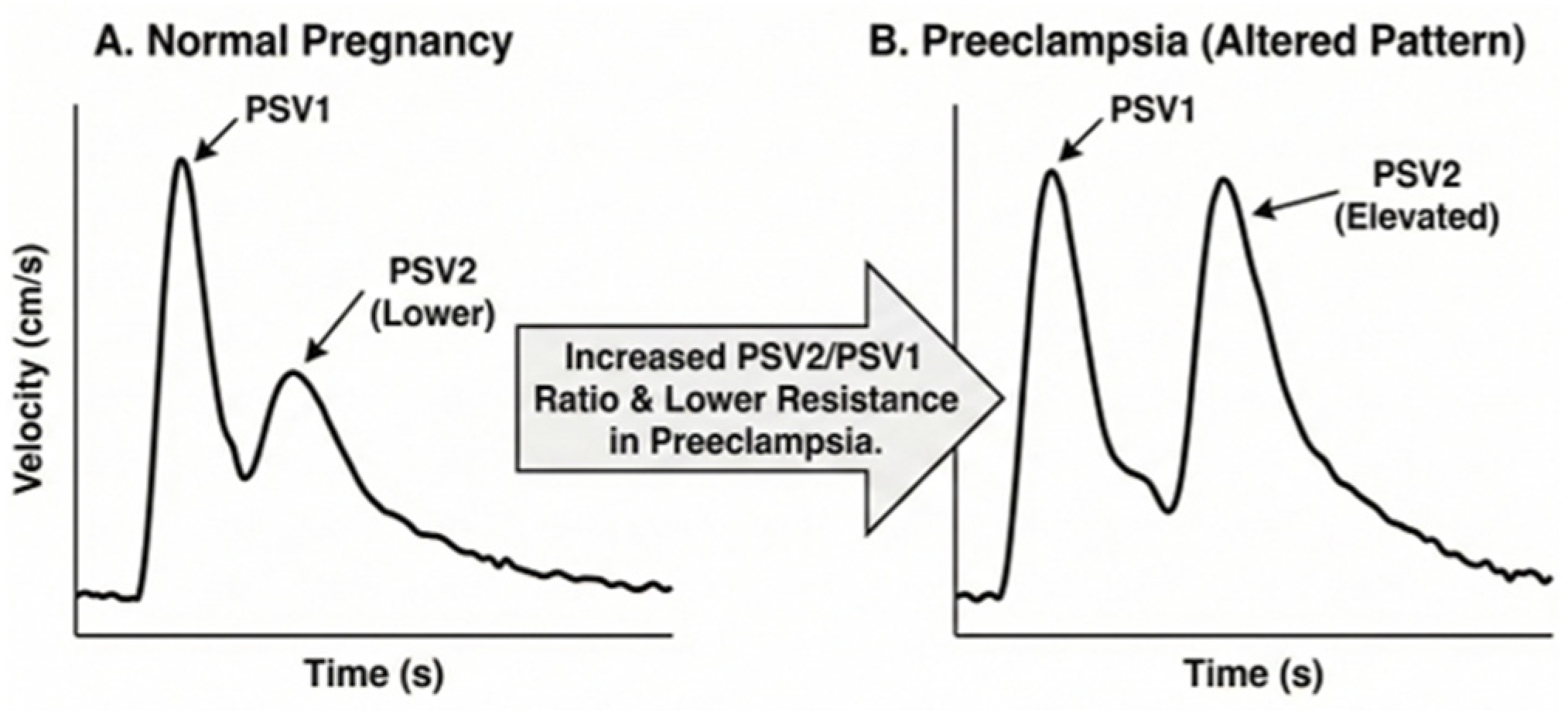
| PSV Ratio (P2/P1) | Low (P2 is significantly lower than P1; ratio typically < 0.6) | Elevated (P2 approaches or exceeds P1; ratio often > 0.65–0.75, depending on gestational age) | The elevation of the second peak (P2) signifies a loss of normal vascular tone and autoregulation, leading to a “high-flow” state. |
| Second Peak Systolic Velocity (PSV2 or P2) | Lower absolute velocity | Elevated (A cut-off of ≥43.75 cm/s has been identified as highly discriminatory) | A direct measure of increased systolic flow velocity, correlating with increased cerebral perfusion pressure. |
Disclaimer/Publisher’s Note: The statements, opinions and data contained in all publications are solely those of the individual author(s) and contributor(s) and not of MDPI and/or the editor(s). MDPI and/or the editor(s) disclaim responsibility for any injury to people or property resulting from any ideas, methods, instructions or products referred to in the content. |
© 2026 by the authors. Published by MDPI on behalf of the Lithuanian University of Health Sciences. Licensee MDPI, Basel, Switzerland. This article is an open access article distributed under the terms and conditions of the Creative Commons Attribution (CC BY) license.
Share and Cite
Gana, N.; Năstac, A.; Apostol, L.M.; Huluță, I.; Gica, C.; Peltecu, G.; Gica, N. The Role of Ophthalmic Artery Doppler in Predicting Preeclampsia: A Review of the Literature. Medicina 2026, 62, 186. https://doi.org/10.3390/medicina62010186
Gana N, Năstac A, Apostol LM, Huluță I, Gica C, Peltecu G, Gica N. The Role of Ophthalmic Artery Doppler in Predicting Preeclampsia: A Review of the Literature. Medicina. 2026; 62(1):186. https://doi.org/10.3390/medicina62010186
Chicago/Turabian StyleGana, Nicoleta, Ancuța Năstac, Livia Mihaela Apostol, Iulia Huluță, Corina Gica, Gheorghe Peltecu, and Nicolae Gica. 2026. "The Role of Ophthalmic Artery Doppler in Predicting Preeclampsia: A Review of the Literature" Medicina 62, no. 1: 186. https://doi.org/10.3390/medicina62010186
APA StyleGana, N., Năstac, A., Apostol, L. M., Huluță, I., Gica, C., Peltecu, G., & Gica, N. (2026). The Role of Ophthalmic Artery Doppler in Predicting Preeclampsia: A Review of the Literature. Medicina, 62(1), 186. https://doi.org/10.3390/medicina62010186