Assessment of Motor Performance in Children with Autism Spectrum Disorder: The Relationship Between Clinical Characteristics and Intelligence—An Exploratory Cross-Sectional Study


Abstract
1. Introduction
2. Materials and Methods
2.1. Study Design and Participants
2.2. Sample Size
2.3. Clinical Characteristics (Autism Severity and Intelligence)
2.4. Procedures and Outcome Measures
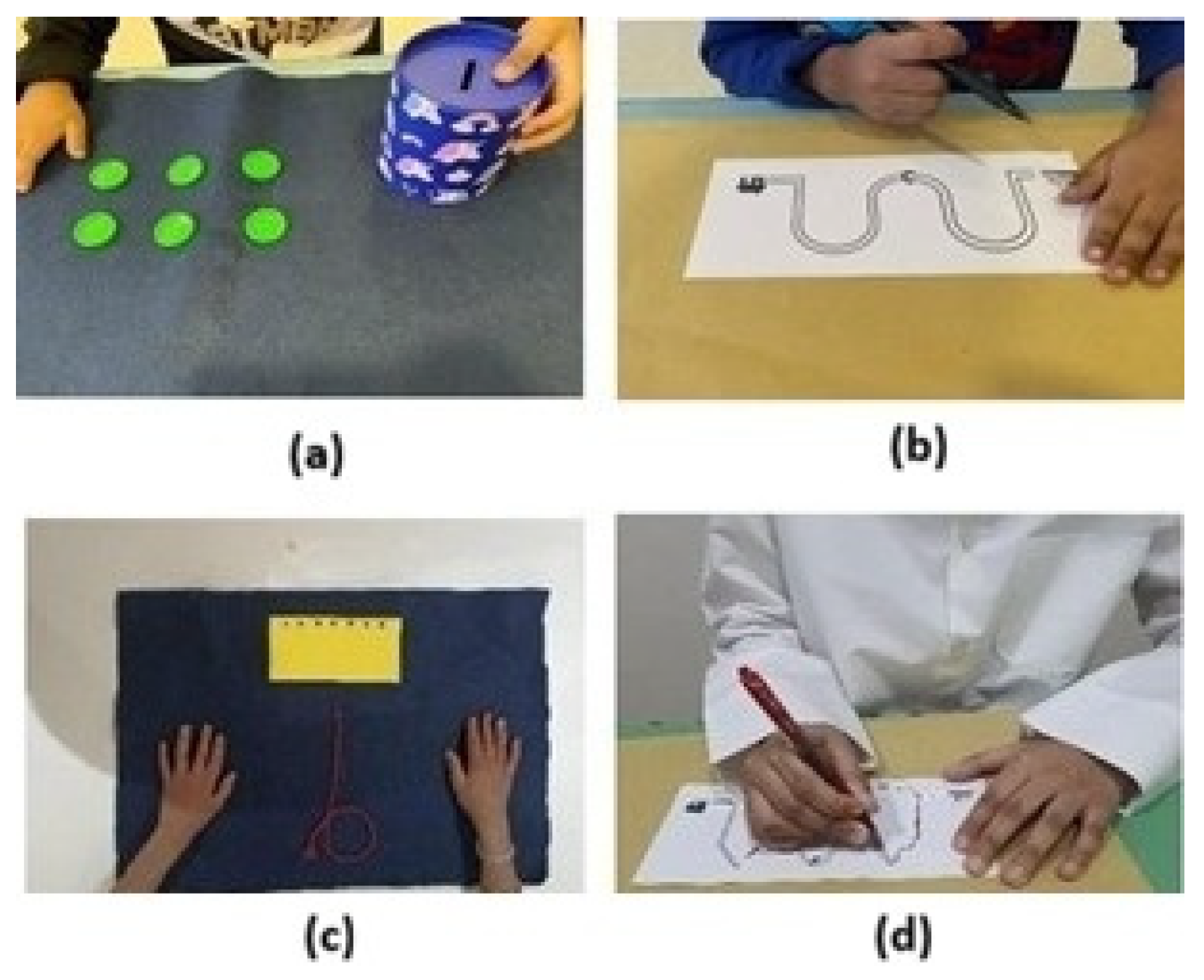
2.4.1. Movement Assessment Battery for Children-2 (MABC-2) (Primary Outcome Measure)
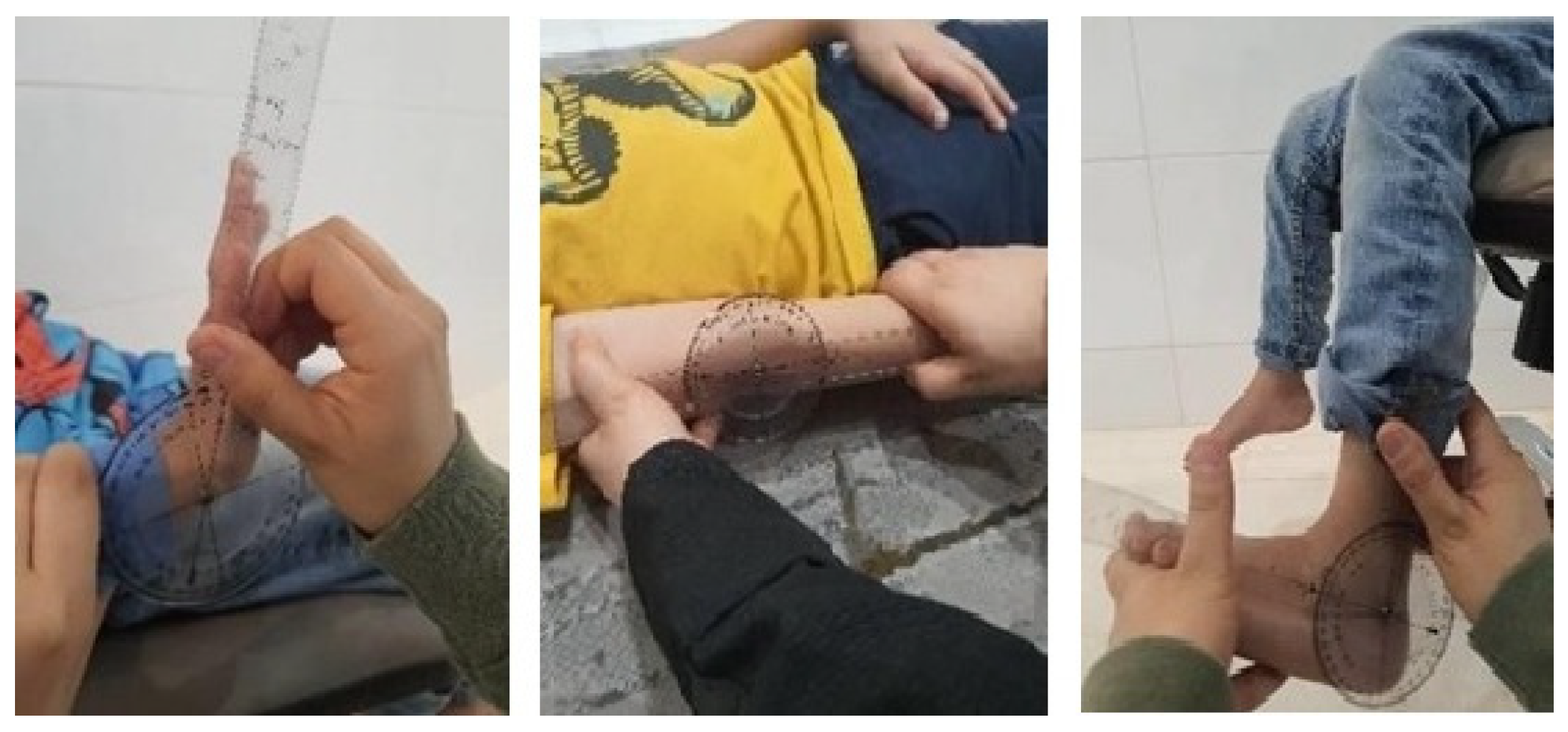
2.4.2. Passive Range of Motion
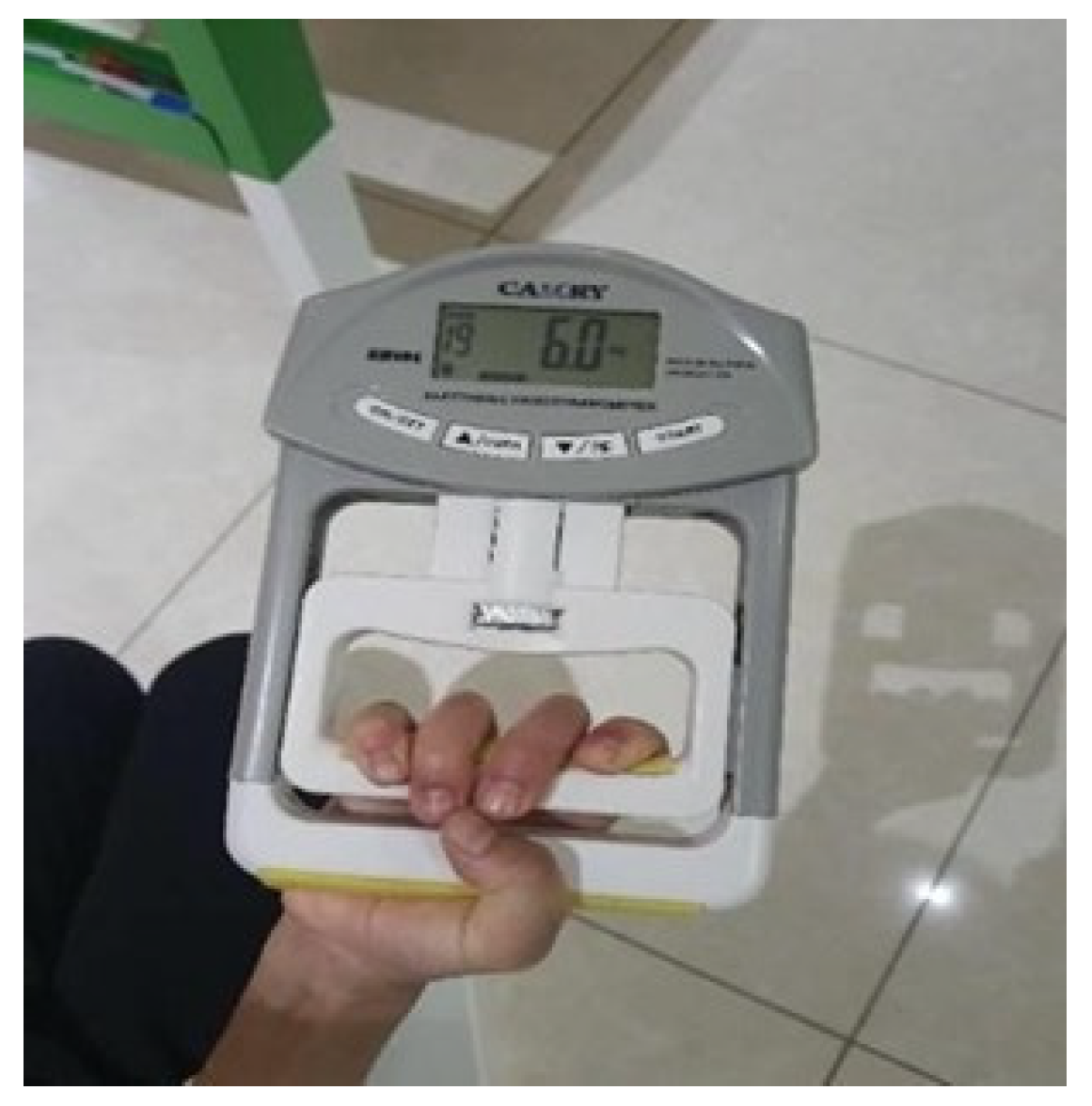
2.4.3. Muscle Strength
2.4.4. Modified 6-Minute Walk Test (M6MWT)
2.4.5. Standing Long Jump (SLJ)
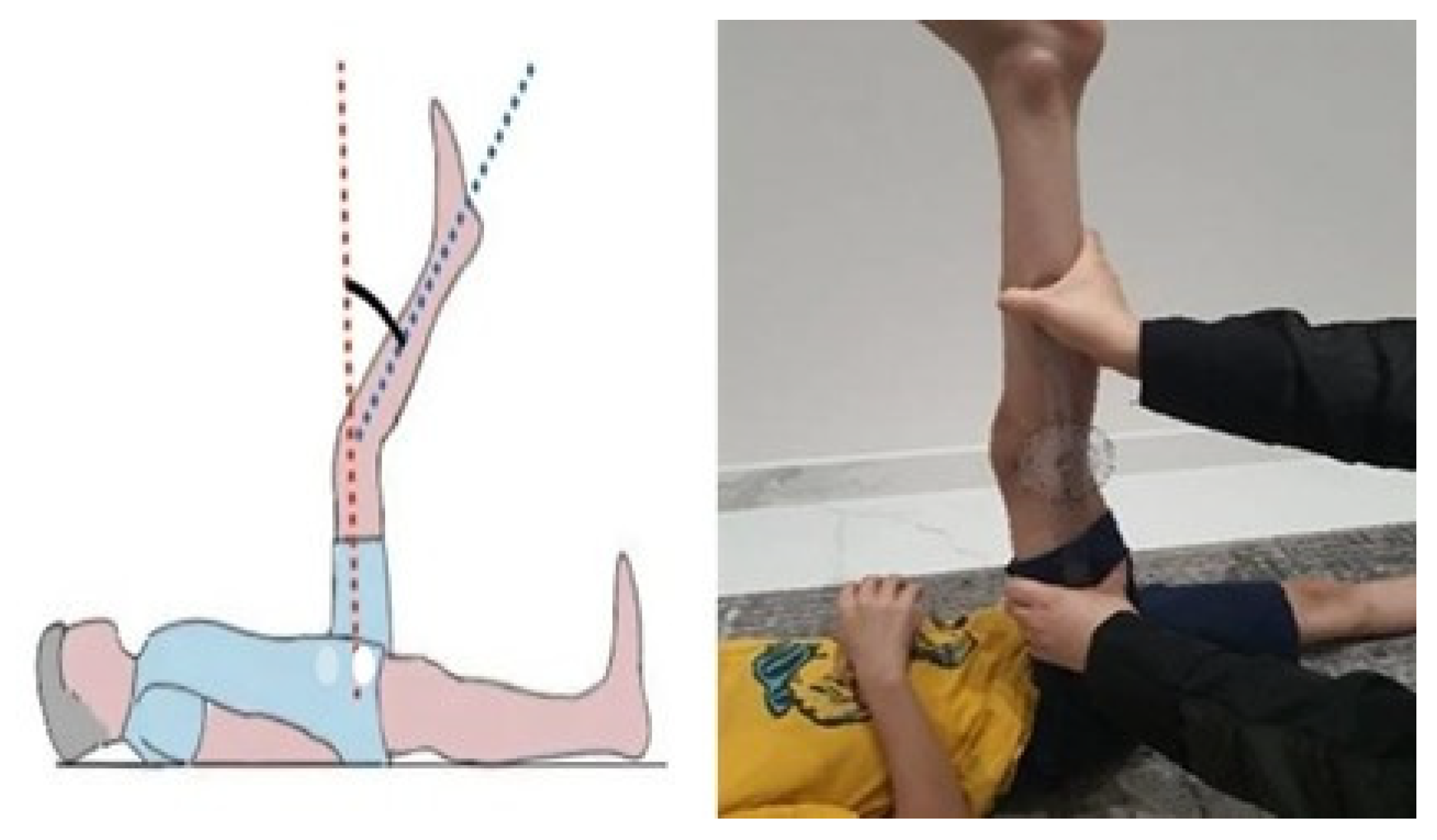
2.4.6. Musculoskeletal Flexibility: Passive Knee Extension Test
2.5. Statistical Analysis
3. Results
3.1. Demographic, Anthropometric, and Clinical Characteristics
3.2. Movement Assessment Battery for Children-2 (MABC-2)
3.3. Passive Range of Motion
3.4. Muscle Strength, Endurance, and Flexibility
3.5. Association Between Motor Performance Parameters, Clinical, and Intellectual Characteristics
4. Discussion
Limitations
5. Conclusions
Author Contributions
Funding
Institutional Review Board Statement
Informed Consent Statement
Data Availability Statement
Acknowledgments
Conflicts of Interest
Abbreviations
| ASD | Autism Spectrum Disorder |
| ADHD | Attention Deficit Hyperactivity Disorder |
| TD | Typically Developing |
| CARS-2 | Childhood Autism Rating Scale—Second Edition |
| IQ | Intelligence Quotient |
| MABC-2 | Movement Assessment Battery for Children—Second Edition |
| SB5 | Stanford–Binet Intelligence Scale, Fifth Edition |
| VIQ | Verbal IQ |
| PIQ | Performance IQ |
| ROM | Range of Motion |
| M6MWT | Modified 6-Minute Walk Test |
| SLJ | Standing Long Jump |
| FMS | Fundamental Movement Skill |
| IRB | Institutional Review Board |
References
- American Psychiatric Association. Diagnostic and Statistical Manual of Mental Disorders, 5th ed.; American Psychiatric Association: Washington, DC, USA, 2013. [Google Scholar]
- Kern, J.K.; Geier, D.A.; Adams, J.B.; Troutman, M.R.; Davis, G.; King, P.G.; Young, J.L.; Geier, M.R. Autism severity and muscle strength: A correlation analysis. Res. Autism Spectr. Disord. 2011, 5, 1011–1015. [Google Scholar] [CrossRef] [Scilit]
- Kanner, L. Autistic disturbances of affective contact. Nerv. Child. 1943, 2, 217–250. [Google Scholar]
- Draudvilienė, L.; Sosunkevič, S.; Daniusevičiūtė-Brazaitė, L.; Burkauskienė, A.; Draudvila, J. The benefit assessment of physiotherapy sessions for children with autism spectrum disorder. Balt. J. Sport Health Sci. 2020, 3, 25–32. [Google Scholar] [CrossRef] [Scilit]
- Piochon, C.; Kloth, A.D.; Grasselli, G.; Titley, H.K.; Nakayama, H.; Hashimoto, K.; Wan, V.; Simmons, D.H.; Eissa, T.; Nakatani, J.; et al. Cerebellar plasticity and motor learning deficits in a copy-number variation mouse model of autism. Nat. Commun. 2014, 5, 5586. [Google Scholar] [CrossRef] [Scilit]
- Cook, E.H., Jr.; Scherer, S.W. Copy-number variations associated with neuropsychiatric conditions. Nature 2008, 455, 919–923. [Google Scholar] [CrossRef] [Scilit]
- Stins, J.F.; Emck, C. Balance performance in autism: A brief overview. Front. Psychol. 2018, 9, 901. [Google Scholar] [CrossRef] [Scilit]
- Lang, R.; Koegel, L.K.; Ashbaugh, K.; Regester, A.; Ence, W.; Smith, W. Physical exercise and individuals with autism spectrum disorders: A systematic review. Res. Autism Spectr. Disord. 2010, 4, 565–576. [Google Scholar] [CrossRef] [Scilit]
- Wilson, R.B.; Enticott, P.G.; Rinehart, N.J. Motor development and delay: Advances in assessment of motor skills in autism spectrum disorders. Curr. Opin. Neurol. 2018, 31, 134–139. [Google Scholar] [CrossRef] [Scilit]
- Yu, T.Y.; Chou, W.; Chow, J.C.; Lin, C.H.; Tung, L.C.; Chen, K.L. IQ discrepancy differentiates levels of fine motor skills and their relationship in children with autism spectrum disorders. Neuropsychiatr. Dis. Treat. 2018, 14, 597–605. [Google Scholar] [CrossRef] [Scilit] [PubMed]
- Eggleston, J.D.; Harry, J.R.; Dufek, J.S. Lower extremity joint stiffness during walking distinguishes children with and without autism. Hum. Mov. Sci. 2018, 62, 25–33. [Google Scholar] [CrossRef] [Scilit] [PubMed]
- Bremer, E.; Cairney, J. Reliable and feasible fitness testing for children on the autism spectrum. Res. Q. Exerc. Sport 2019, 90, 497–506. [Google Scholar] [CrossRef] [Scilit]
- Tyler, K.; MacDonald, M.; Menear, K. Physical activity and physical fitness of school-aged children and youth with autism spectrum disorders. Autism Res. Treat. 2014, 2014, 312163. [Google Scholar] [CrossRef] [Scilit] [PubMed]
- Moon, S.J.; Hwang, J.S.; Shin, A.L.; Kim, J.Y.; Bae, S.M.; Sheehy-Knight, J.; Kim, J.W. Accuracy of the Childhood Autism Rating Scale: A systematic review and meta-analysis. Dev. Med. Child. Neurol. 2019, 61, 1030–1038. [Google Scholar] [CrossRef] [Scilit] [PubMed]
- Schopler, E.; Van Bourgondien, M.E.; Wellman, G.J.; Love, S.R. Childhood Autism Rating Scale, 2nd ed.; Western Psychological Services: Los Angeles, CA, USA, 2010. [Google Scholar]
- Thabtah, F.; Peebles, D. Early autism screening: A comprehensive review. Int. J. Environ. Res. Public Health 2019, 16, 3502. [Google Scholar] [CrossRef] [Scilit] [PubMed]
- Lichtenberger, E.O. General measures of cognition for the preschool child. Ment. Retard. Dev. Disabil. Res. Rev. 2005, 11, 197–208. [Google Scholar] [CrossRef] [Scilit]
- Henderson, S.E.; Sugden, D.A.; Barnett, A.L. Movement Assessment Battery for Children-2 [Database Record]; APA PsycTests; Pearson: London, UK, 2007. [Google Scholar] [CrossRef] [Scilit]
- Schoemaker, M.M.; Niemeijer, A.S.; Flapper, B.C.T.; Smits-Engelsman, B.C.M. Validity and reliability of the Movement Assessment Battery for Children-2 Checklist for children with and without motor impairments. Dev. Med. Child Neurol. 2012, 54, 368–375. [Google Scholar] [CrossRef] [Scilit]
- Arbi, Z.E.; Mnejja, K.; Negra, Y.; Albaret, J.-M.; Rebai, H.; Sahli, S. Movement Assessment Battery for Children—Second Edition (MABC-2): Aspects of reliability for Tunisian children (age band 1). Sport Sci. Health 2025, 21, 1197–1207. [Google Scholar] [CrossRef] [Scilit]
- Shetreat-Klein, M.; Shinnar, S.; Rapin, I. Abnormalities of joint mobility and gait in children with autism spectrum disorders. Brain Dev. 2014, 36, 91–96. [Google Scholar] [CrossRef] [Scilit]
- Wind, A.E.; Takken, T.; Helders, P.J.M.; Engelbert, R.H.H. Is grip strength a predictor for total muscle strength in healthy children, adolescents, and young adults? Eur. J. Pediatr. 2010, 169, 281–287. [Google Scholar] [CrossRef] [Scilit]
- Molenaar, H.M.; de Kraker, M.; Zuidam, J.M.; Hovius, S.E.R.; Stam, H.J.; Selles, R.W. Visual feedback and weight reduction of a grip strength dynamometer do not increase reliability in healthy children. J. Hand Ther. 2010, 23, 272–280. [Google Scholar] [CrossRef] [Scilit]
- Li, A.M.; Jin, Y.; Yu, C.C.W.; Tsang, T.; So, H.K.; Wong, E.; Chan, D.; Hon, E.K.L.; Sung, R. The six-minute walk test in healthy children: Reliability and validity. Eur. Respir. J. 2005, 25, 1057–1060. [Google Scholar] [CrossRef] [Scilit]
- Fredriksen, H.; Dagfinrud, H.; Jacobsen, V.; Maehlum, S. Passive knee extension test to measure hamstring tightness. Scand. J. Med. Sci. Sports 1997, 7, 279–282. [Google Scholar] [CrossRef] [Scilit] [PubMed]
- Gülgösteren, E.; Demirci, N.; Toptaş Demirci, P. The effects of COVID-19 restrictions on dietary behaviors, supplement use, and physical activity habits of children with autism spectrum disorder. Prog. Nutr. 2022, 24, e2022102. [Google Scholar] [CrossRef]
- Craig, F.; Lorenzo, A.; Lucarelli, E.; Russo, L.; Fanizza, I.; Trabacca, A. Motor competency and social communication skills in preschool children with autism spectrum disorder. Autism Res. 2018, 11, 893–902. [Google Scholar] [CrossRef] [Scilit] [PubMed]
- Ramos-Sánchez, C.P.; Kortekaas, D.; Van Biesen, D.; Vancampfort, D.; Van Damme, T. The Relationship between motor skills and intelligence in Children with Autism Spectrum Disorder. J. Autism Dev. Disord. 2022, 52, 1189–1199. [Google Scholar] [CrossRef] [Scilit]
- Green, D.; Charman, T.; Pickles, A.; Chandler, S.; Loucas, T.; Simonoff, E.; Baird, G. Impairment in movement skills of children with autistic spectrum disorders. Dev. Med. Child Neurol. 2009, 51, 311–316. [Google Scholar] [CrossRef] [Scilit]
- von Hofsten, C. Action in development. Dev. Sci. 2007, 10, 54–60. [Google Scholar] [CrossRef] [Scilit]
- Tsui, K.M.; Yanco, H.A.; Kontak, D.; Beliveau, L. Experimental design for human-robot interaction with assistive technology. In Proceedings of the ACM/IEEE International Conference on Human-Robot Interaction, Amsterdam, The Netherlands, 12–15 March 2008. [Google Scholar]
- Berkeley, S.L.; Zittel, L.L.; Pitney, L.V.; Nichols, S.E. Locomotor and object control skills of children diagnosed with autism. Adapt. Phys. Activ. Q. 2001, 18, 405–416. [Google Scholar] [CrossRef] [Scilit]
- Whyatt, C.P.; Craig, C.M. Motor skills in 7–10-year-old children with ASD. J. Autism Dev. Disord. 2012, 42, 1799–1809. [Google Scholar] [CrossRef] [Scilit]
- Liu, T.; Breslin, C.M. The effect of a picture activity schedule on performance of the MABC-2 for children with autism spectrum disorder. Res. Q. Exerc. Sport 2013, 84, 206–212. [Google Scholar] [CrossRef] [Scilit]
- Travers, B.G.; Powell, P.S.; Klinger, L.G.; Klinger, M.R. Motor difficulties in autism spectrum disorder: Linking symptom severity and postural stability. J. Autism Dev. Disord. 2013, 43, 1568–1583. [Google Scholar] [CrossRef] [Scilit]
- Jansiewicz, E.M.; Goldberg, M.C.; Newschaffer, C.J.; Denckla, M.B.; Landa, R.; Mostofsky, S.H. Motor signs distinguish children with high functioning autism and Asperger’s syndrome from controls. J. Autism Dev. Disord. 2006, 36, 613–621. [Google Scholar] [CrossRef] [Scilit]
- Papadopoulos, N.; McGinley, J.; Tonge, B.; Bradshaw, J.; Saunders, K.; Murphy, A.; Rinehart, N. Motor proficiency and emotional/behavioural disturbance in autism and Asperger’s disorder: Another piece of the neurological puzzle? Autism 2012, 16, 627–640. [Google Scholar] [CrossRef] [Scilit]
- Weimer, A.K.; Schatz, A.M.; Lincoln, A.; Ballantyne, A.O.; Trauner, D.A. “Motor” impairment in Asperger syndrome: Evidence for a deficit in proprioception. J. Dev. Behav. Pediatr. 2001, 22, 92–101. [Google Scholar] [CrossRef] [Scilit] [PubMed]
- Luna, B.; Doll, S.K.; Hegedus, S.J.; Minshew, N.J.; Sweeney, J.A. Maturation of executive function in autism. Biol. Psychiatry 2007, 61, 474–481. [Google Scholar] [CrossRef] [Scilit] [PubMed]
- Tedla, J.S.; Asiri, F.; Alshahrani, M.S.; Gular, K. Hypermobility among children with autism spectrum disorders and its correlation with anthropometric characteristics. J. Pak. Med. Assoc. 2021, 71, 1076–1080. [Google Scholar] [CrossRef] [Scilit] [PubMed]
- Kindgren, E.; Quiñones Perez, A.; Knez, R. Prevalence of ADHD and autism spectrum disorder in children with hypermobility spectrum disorders or hypermobile Ehlers-Danlos syndrome: A retrospective study. Neuropsychiatr. Dis. Treat. 2021, 17, 379–388. [Google Scholar] [CrossRef] [Scilit]
- Li, Y.; Koldenhoven, R.M.; Liu, T.; Venuti, C.E. Age-related gait development in children with autism spectrum disorder. Gait Posture 2021, 84, 260–266. [Google Scholar] [CrossRef] [Scilit]
- Kao, S.C.; Tsai, Y.J.; Hsieh, S.S.; Chen, I.-F.; Schmitt, S.; Hung, T.-M. The relationship of muscular endurance and coordination and dexterity with behavioral and neuroelectric indices of attention in preschool children. Sci. Rep. 2022, 12, 7059. [Google Scholar] [CrossRef] [Scilit]
- LeCheminant, J. Comparison of Standing Long Jump Performance in Young Adults with and Without Autism Spectrum Disorder. Master’s Thesis, Utah State University, Logan, UT, USA, 2019. [Google Scholar]
- Yordanova, J.; Kolev, V.; Polich, J. P300 and alpha event-related desynchronization (ERD). Psychophysiology 2001, 38, 143–152. [Google Scholar] [CrossRef] [Scilit]
- Kern, J.K.; Geier, D.A.; Adams, J.B.; Troutman, M.R.; Davis, G.A.; King, P.G.; Geier, M.R. Handgrip strength in autism spectrum disorder compared with controls. J. Strength Cond. Res. 2013, 27, 2277–2281. [Google Scholar] [CrossRef] [Scilit]
- Bricout, V.A.; Pace, M.; Dumortier, L.; Baillieul, F.; Favre-Juvin, A.; Guinot, M. Reduced cardiorespiratory capacity in children with autism spectrum disorders. J. Clin. Med. 2018, 7, 361. [Google Scholar] [CrossRef] [Scilit] [PubMed]
- Fournier, K.A.; Hass, C.J.; Naik, S.K.; Lodha, N.; Cauraugh, J.H. Motor coordination in autism spectrum disorders: A synthesis and meta-analysis. J. Autism Dev. Disord. 2010, 40, 1227–1240. [Google Scholar] [CrossRef] [Scilit] [PubMed]
- Bhat, A.N. Motor impairment increases in children with autism spectrum disorder as a function of social communication, cognitive and functional impairment, repetitive behavior severity, and comorbid diagnoses: A SPARK study report. Autism Res. 2021, 14, 202–219. [Google Scholar] [CrossRef] [Scilit] [PubMed]
- Lloyd, M.; MacDonald, M.; Lord, C. Motor skills of toddlers with autism spectrum disorders. Autism 2011, 17, 133–146. [Google Scholar] [CrossRef] [Scilit]
- Bremer, E.; Crozier, M.; Lloyd, M. A systematic review of the behavioural outcomes following exercise interventions for children and youth with autism spectrum disorder. Autism 2016, 20, 899–915. [Google Scholar] [CrossRef] [Scilit]



| Characteristics | TD | Mild/Moderate ASD | Severe ASD | p Value (Kruskal–Wallis Test) | p Value (Mann–Whitney Test) | |
|---|---|---|---|---|---|---|
| Number | 27 | 18 | 8 | - | - | |
| Age (Years) (Mean/SD) | 7.9 ± 2.2 | 8.8 ± 1.7 | 7.5 ± 2.9 | 0.38 | ||
| Sex (No.) (%) | ♂ | 21 (77.8) | 16 (88.9) | 5 (62.5) | 0.31 | |
| ♀ | 6 (22.2) | 2 (11.1) | 3 (37.5) | |||
| Handedness (No.) (%) | Rt | 24 (88.9) | 17 (94.4) | 6 (75.0) | 0.37 | |
| Lt | 2 (7.4) | 0 (0) | 1 (12.5) | |||
| No Preference | 1 (3.7) | 1 (5.6) | 1 (12.5) | |||
| Weight (Kg) (Mean/SD) | 25.9 ± 8.3 | 31.2 ± 10.9 | 30.1 ± 12.6 | 0.23 | ||
| Height (m) (Mean/SD) | 1.3 ± 0.1 | 1.3 ± 0.1 | 1.2 ± 0.2 | 0.53 | ||
| BMI [Kg/(m)2] (Mean/SD) | 15.9 ± 2.7 | 17.7 ± 3.2 | 19.1 ± 4.4 | 0.02 * | ||
| CARS-2 Score (Mean/SD) | Not Documented | 31.2 ± 3.6 | 38.9 ± 2.6 | - | <0.001 * | |
| IQ Score (Mean/SD) | Not Documented | 64.9 ± 25.5 | 57.7 ± 16.1 | - | 0.4 | |
| Parameters | Groups (Mean/SD) (Mean Rank) | Chi-Square | Sig. | |
|---|---|---|---|---|
| Manual Dexterity Standard Score | TD (7.1 ± 3.0) (31.5) | MM-ASD(1.9 ± 0.8) (10.3) | 29.0 | <0.001 * |
| TD (7.1 ± 3.0) ((21.7)) | S-ASD (2.0 ± 0.9) (5.6) | 15.5 | <0.001 * | |
| MM-ASD(1.9 ± 0.8) (13.2) | S-ASD (2.0 ± 0.9) (14.3) | 0.1 | 0.7 | |
| Manual Dexterity Percentile | TD (24.7 ± 24.8) (21.7) (31.3) | MM-ASD(0.5 ± 0.4) (10.6) | 27.6 | <0.001 * |
| TD (24.7 ± 24.8) (21.6) | S-ASD (0.5 ± 0.4) (5.9) | 14.7 | <0.001 * | |
| MM-ASD (0.5 ± 0.4) (13.2) | S-ASD (0.5 ± 0.4) (14.3) | 0.1 | 0.7 | |
| Aiming and Catching Standard Score | TD (10.2 ± 3.0) (30.9) | MM-ASD (3.6 ± 2.6) (11.1) | 25.0 | <0.001 * |
| TD (10.2 ± 3.0) (21.8) | S-ASD (2.4 ± 2.3) (5.3) | 16.2 | <0.001 * | |
| MM-ASD (3.6 ± 2.6) (14.8) | S-ASD (2.4 ± 2.3) (10.6) | 1.9 | 0.2 | |
| Aiming and Catching Percentile | TD (53.0 ± 30.5) (30.9) | MM-ASD (6.2 ± 11.6) (11.1) | 25.0 | <0.001 * |
| TD (53.0 ± 30.5) (22.0) | S-ASD (0.4 ± 0.2) (4.5) | 18.2 | <0.001 * | |
| MM-ASD (6.2 ± 11.6) (15.3) | S-ASD (0.4 ± 0.2) (9.4) | 3.8 | 0.05 * | |
| Balance Standard Score | TD (11.2 ± 2.8) (31.7) | MM-ASD (2.6 ± 2.5) (9.9) | 30.6 | <0.001 * |
| TD (11.2 ± 2.8) (22.0) | S-ASD (1.8 ± 1.5) (4.5) | 18.3 | <0.001 * | |
| MM-ASD (2.6 ± 2.5) (14.1) | S-ASD (1.8 ± 1.5) (12.1) | 0.6 | 0.5 | |
| Balance Standard Percentile | TD (59.0 ± 30.7) (31.7) | MM-ASD (3.7 ± 8.0) (10.0) | 30.0 | <0.001 * |
| TD (59.0 ± 30.7) (22.0) | S-ASD (0.8 ± 1.7) (4.5) | 18.3 | <0.001 * | |
| MM-ASD (3.7 ± 8.0) (14.1) | S-ASD (0.8 ± 1.7) (12.1) | 0.6 | 0.5 | |
| Parameters | Groups (Mean/SD) (Mean Rank) | Chi- Square | Sig. | |
|---|---|---|---|---|
| Passive Range of Motion | ||||
| Elbow Flexion | TD (145.6 ± 7.1) (29.5) | MM-ASD (135.7 ± 5.5) (13.3) | 17.1 | <0.001 * |
| TD (145.6 ± 7.1) (20.9) | S-ASD (133.6 ± 8.2) (8.2) | 9.8 | 0.002 * | |
| MM-ASD (135.7 ± 5.5) (14.0) | S-ASD (133.6 ± 8.2) (12.4) | 0.2 | 0.6 | |
| Elbow Hyperextension | TD (2.0 ± 3.5) (20.2) | MM-ASD (5.5 ± 6.2) (27.3) | 4.1 | 0.04 * |
| TD (2.0 ± 3.5) (17.0) | S-ASD (4.1 ± 4.6) (21.3) | 1.5 | 0.2 | |
| MM-ASD (5.5 ± 6.2) (13.9) | S-ASD (4.1 ± 4.6) (12.5) | 0.2 | 0.6 | |
| Wrist Flexion | TD (97.0 ± 9.5) (22.5) | MM-ASD (96.9 ± 7.6) (23.7) | 0.1 | 0.8 |
| TD (97.0 ± 9.5) (18.4) | S-ASD (95.8 ± 8.6) (16.8) | 0.2 | 0.7 | |
| MM-ASD (96.9 ± 7.6) (14.3) | S-ASD (95.8 ± 8.6) (11.6) | 0.7 | 0.4 | |
| Wrist Extension | TD (97.7 ± 10.4) (26.8) | MM-ASD (87.6 ± 13.2) (17.3) | 6.1 | 0.01 * |
| TD (97.7 ± 10.4) (20.3) | S-ASD (87.8 ± 5.3) (10.1) | 7.9 | 0.005 * | |
| MM-ASD (87.6 ± 13.2) (13.6) | S-ASD (87.8 ± 5.3) (13.4) | 0.003 | 1.0 | |
| Finger Flexion | TD (94.9 ± 8.6) (25.4) | MM-ASD (88.9 ± 10.7) (19.3) | 3.0 | 0.08 |
| TD (94.9 ± 8.6) (18.4) | S-ASD (91.8 ± 3.6) (16.6) | 0.3 | 0.6 | |
| MM-ASD (88.9 ± 10.7) (12.8) | S-ASD (91.8 ± 3.6) (15.1) | 0.6 | 0.4 | |
| Finger Extension | TD (80.3 ± 10.1) (20.5) | MM-ASD (84.8 ± 19.2) (26.8) | 2.6 | 0.1 |
| TD (80.3 ± 10.1) (17.0) | S-ASD (84.8 ± 6.8) (21.5) | 1.3 | 0.3 | |
| MM-ASD (84.8 ± 19.2) (14.1) | S-ASD (84.8 ± 6.8) (12.2) | 0.02 | 0.9 | |
| Ankle Dorsiflexion | TD (24.9 ± 7.6) (28.4) | MM-ASD (15.4 ± 9.7) (14.9) | 11.8 | 0.001 * |
| TD (24.9 ± 7.6) (18.7) | S-ASD (23.4 ± 9.5) (15.6) | 0.6 | 0.4 | |
| MM-ASD (15.4 ± 9.7) (11.6) | S-ASD (23.4 ± 9.5) (17.9) | 4.0 | 0.05 * | |
| Ankle Plantarflexion | TD (59.8 ± 8.5) (24.1) | MM-ASD (56.4 ± 15.1) (21.3) | 0.5 | 0.5 |
| TD (59.8 ± 8.5) (18.7) | S-ASD (54.1 ± 15.8) (15.8) | 0.5 | 0.5 | |
| MM-ASD (56.4 ± 15.1) (13.7) | S-ASD (54.1 ± 15.8) (13.1) | 0.04 | 0.8 | |
| Parameters | Groups (Mean/SD) (Mean Rank) | Chi- Square | Sig. | |
|---|---|---|---|---|
| Muscle Strength | ||||
| Hand Grip (Right) | TD (11.5 ± 4.4) (30.4) | MM-ASD (4.5 ± 2.9) (11.9) | 21.5 | <0.001 * |
| TD (11.5 ± 4.4) (21.6) | S-ASD (3.6 ± 3.0) (5.9) | 14.5 | <0.001 * | |
| MM-ASD (4.5 ± 2.9) (14.3) | S-ASD (3.6 ± 3.0) (11.8) | 0.6 | 0.4 | |
| Hand Grip (Left) | TD (10.7 ± 4.7) (29.7) | MM-ASD (3.9 ± 3.5) (12.9) | 17.8 | <0.001 * |
| TD (10.7 ± 4.7) (21.4) | S-ASD (3.4 ± 2.9) (6.5) | 13.1 | <0.001 * | |
| MM-ASD (3.9 ± 3.5) (13.4) | S-ASD (3.4 ± 2.9) (13.8) | 0.01 | 0.9 | |
| Average Hand Grip | TD (11.1 ± 4.5) (30.2) | MM-ASD (4.2 ± 3.1) (12.3) | 20.0 | <0.001 * |
| TD (11.1 ± 4.5) (21.5) | S-ASD (3.5 ± 2.8) (6.3) | 13.6 | <0.001 * | |
| MM-ASD (4.2 ± 3.1) (13.9) | S-ASD (3.5 ± 2.8) (12.6) | 0.2 | 0.7 | |
| Endurance | ||||
| 6-Minutes Walking Distance | TD (500.6 ± 109.5) (30.5) | MM-ASD (353.3 ± 48.1) (11.8) | 21.9 | <0.001 * |
| TD (500.6 ± 109.5) (21.4) | S-ASD (309.4 ± 141.4) (6.4) | 13.3 | <0.001 * | |
| MM-ASD (353.3 ± 48.1) (13.6) | S-ASD (309.4 ± 141.4) (13.2) | 0.02 | 0.9 | |
| Standing Long-Jump Distance | TD (136.3 ± 46.3) (31.6) | MM-ASD (21.8 ± 21.6) (10.2) | 28.7 | <0.001 * |
| TD (136.3 ± 46.3) (20.9) | S-ASD (11.9 ± 20.3) (4.3) | 15.6 | <0.001 * | |
| MM-ASD (21.8 ± 21.6) (14.1) | S-ASD (11.9 ± 20.3) (10.1) | 1.7 | 0.2 | |
| Musculoskeletal Flexibility | ||||
| Knee Angle (Right) | TD (2.8 ± 5.3) (22.2) | MM-ASD (12.2 ± 17.4) (27.2) | 4.1 | 0.04 * |
| TD (2.8 ± 5.3) (16.1) | S-ASD (8.3 ± 9.8) (21.3) | 2.2 | 0.1 | |
| MM-ASD (12.2 ± 17.4) (12.6) | S-ASD (8.3 ± 9.8) (12.1) | 0.03 | 0.9 | |
| Knee Angle (Left) | TD (3.1 ± 5.6) (20.4) | MM-ASD (13.6 ± 19.2) (26.9) | 3.6 | 0.06 |
| TD (3.1 ± 5.6) (16.1) | S-ASD (8.3 ± 9.8) (20.9) | 1.7 | 0.2 | |
| MM-ASD (13.6 ± 19.2) (12.7) | S-ASD (8.3 ± 9.8) (12.0) | 0.05 | 0.8 | |
| Average Knee Angle | TD (3.0 ± 5.2) (20.4) | MM-ASD (12.9 ± 18.2) (27.0) | 3.6 | 0.06 |
| TD (3.0 ± 5.2) (16.1) | S-ASD (8.3 ± 9.8) (21.2) | 1.9 | 0.2 | |
| MM-ASD (12.9 ± 18.2) (12.7) | S-ASD (8.3 ± 9.8) (12.0) | 0.05 | 0.8 | |
| Independent Parameters | Spearman Correlation | |||||||
|---|---|---|---|---|---|---|---|---|
| Movement Assessment Battery for Children-2 (MABC-2) | ||||||||
| MDSS | ACSS | BSS | TSS | |||||
| r | p | r | p | r | p | r | p | |
| CARS-2 | −0.16 | 0.43 | −0.38 | 0.05 * | −0.12 | 0.57 | −0.30 | 0.14 |
| IQ | 0.17 | 0.49 | 0.51 | 0.03 * | 0.002 | 1.00 | 0.15 | 0.55 |
| Hand Grip Right | 0.23 | 0.26 | 0.59 | 0.001 ** | 0.36 | 0.07 | 0.39 | 0.05 * |
| Hand Grip Left | 0.01 | 0.95 | 0.48 | 0.01 * | 0.49 | 0.01 * | 0.44 | 0.02 * |
| Average Hand Grip | 0.14 | 0.49 | 0.55 | 0.003 ** | 0.44 | 0.02 * | 0.43 | 0.03 * |
| 6-Minute Walking Distance | 0.22 | 0.29 | 0.58 | 0.002 ** | 0.31 | 0.12 | 0.42 | 0.03 * |
| Standing Long-Jump Distance | 0.12 | 0.57 | 0.44 | 0.03 * | 0.32 | 0.12 | 0.26 | 0.20 |
Disclaimer/Publisher’s Note: The statements, opinions and data contained in all publications are solely those of the individual author(s) and contributor(s) and not of MDPI and/or the editor(s). MDPI and/or the editor(s) disclaim responsibility for any injury to people or property resulting from any ideas, methods, instructions or products referred to in the content. |
© 2026 by the authors. Published by MDPI on behalf of the Lithuanian University of Health Sciences. Licensee MDPI, Basel, Switzerland. This article is an open access article distributed under the terms and conditions of the Creative Commons Attribution (CC BY) license.
Share and Cite
Alhussain, J.M.; Ibrahim, A.I. Assessment of Motor Performance in Children with Autism Spectrum Disorder: The Relationship Between Clinical Characteristics and Intelligence—An Exploratory Cross-Sectional Study. Medicina 2026, 62, 145. https://doi.org/10.3390/medicina62010145
Alhussain JM, Ibrahim AI. Assessment of Motor Performance in Children with Autism Spectrum Disorder: The Relationship Between Clinical Characteristics and Intelligence—An Exploratory Cross-Sectional Study. Medicina. 2026; 62(1):145. https://doi.org/10.3390/medicina62010145
Chicago/Turabian StyleAlhussain, Jenan M., and Alaa I. Ibrahim. 2026. "Assessment of Motor Performance in Children with Autism Spectrum Disorder: The Relationship Between Clinical Characteristics and Intelligence—An Exploratory Cross-Sectional Study" Medicina 62, no. 1: 145. https://doi.org/10.3390/medicina62010145
APA StyleAlhussain, J. M., & Ibrahim, A. I. (2026). Assessment of Motor Performance in Children with Autism Spectrum Disorder: The Relationship Between Clinical Characteristics and Intelligence—An Exploratory Cross-Sectional Study. Medicina, 62(1), 145. https://doi.org/10.3390/medicina62010145