
Association of Abdominal Circumference with Stepping Reaction Time and Functional Balance Among Adults: A Cross-Sectional Study

 ,
,  , ,
, ,
Abstract
1. Introduction
2. Materials and Methods
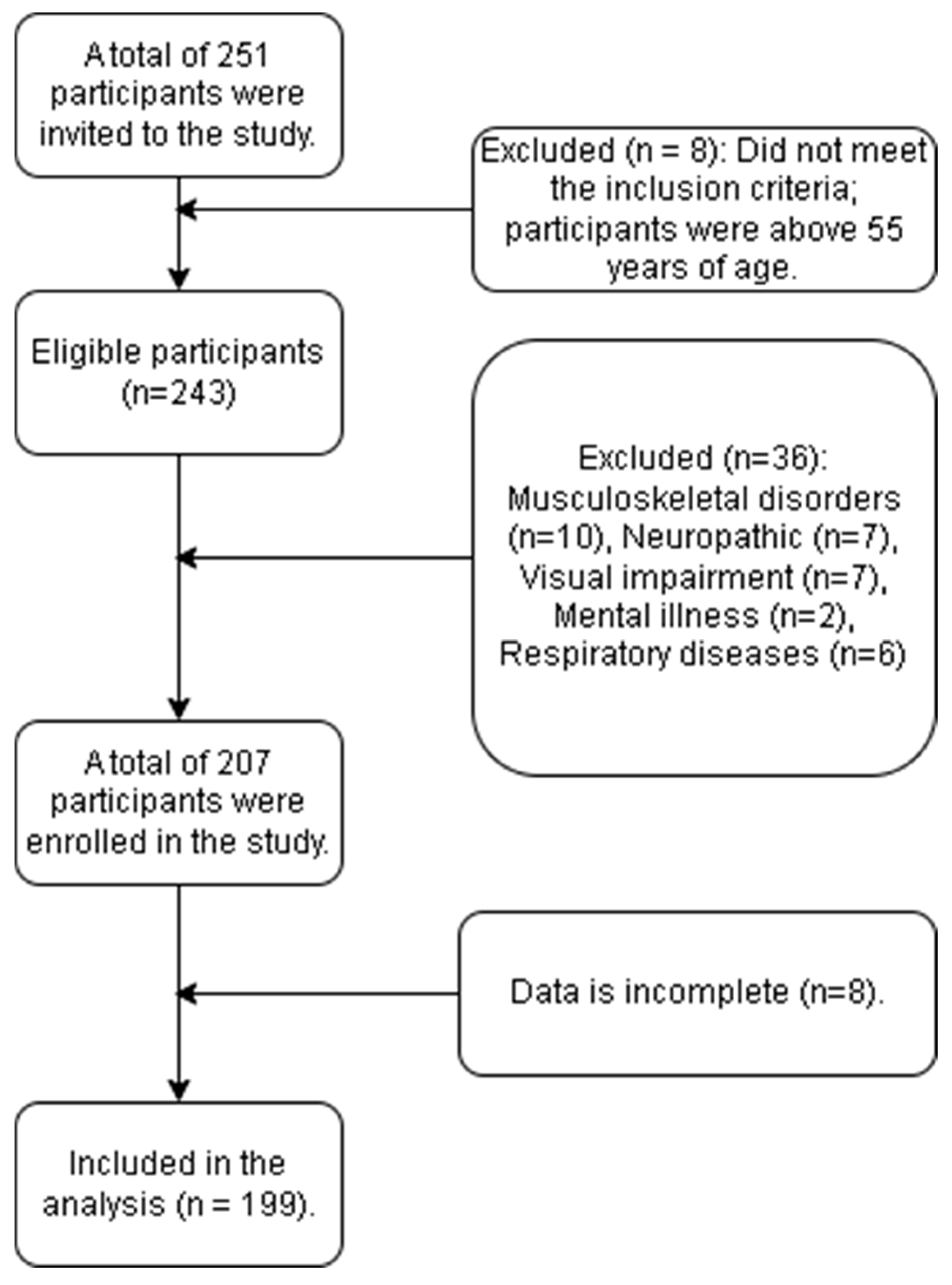
- Stable body weight (±3 kg) for the preceding three months to eliminate confounding effects of recent weight fluctuations.
- No current pharmacological treatments known to affect balance or reaction time.
- Corrected visual acuity of 20/40.
- Age between 18 and 55 years. The age limitation of 55 years was implemented to minimize age-related confounding effects on reaction time performance, as established normative data demonstrate significant increases in stepping reaction times beyond this age threshold [20].The dominant foot was established by asking which leg the participants were using while kicking the ball [29].
- Ability to ambulate independently without assistive devices.
- Neurological conditions defined as any diagnosed central or peripheral nervous system disorder including but not limited to stroke, multiple sclerosis, peripheral neuropathy, or traumatic brain injury with residual symptoms.
- Previous fall history exclusion specifically referred to any unintentional ground-level fall within the preceding 24 months, documented through participant self-report and medical record verification where available.
- Psychiatric disorder exclusions included active major depressive disorder, generalized anxiety disorder with moderate-to-severe symptom burden, or any psychotic spectrum disorder, as these conditions may influence motor performance and cognitive processing during reaction time assessments.
2.1. Participants Recruitment
2.2. Sample Size Calculation
2.3. Anthropometric Measurements
2.4. Stepping Reaction Time
2.5. Limits of Stability Assessment Specifications
2.6. Data Analysis
3. Results
4. Discussion
4.1. Abdominal Circumference and Stepping Reaction Time
4.2. Balance and Demographic Predictors of SRT
4.3. Limb Asymmetries in Stepping Performance
4.4. Clinical Implications and Future Research
5. Strengths and Limitations
6. Conclusions
Author Contributions
Funding
Institutional Review Board Statement
Informed Consent Statement
Data Availability Statement
Acknowledgments
Conflicts of Interest
Abbreviations
| SRT | Stepping reaction time |
| AC | Abdominal circumference |
| LOS | Limits of stability |
| BMI | Body mass index |
| RT | Reaction time |
| STABLE | Stability and Balance Learning Environment Apparatus |
| COP | Center of pressure |
References
- Alice, A.; Yadav, M.; Verma, R.; Kumari, M.; Arora, S. Effect of obesity on balance: A literature review. Int. J. Health. Sci. 2022, 6, 3261–3279. [Google Scholar] [CrossRef]
- Hu, L.; Huang, X.; You, C.; Li, J.; Hong, K.; Li, P.; Wu, Y.; Wu, Q.; Wang, Z.; Gao, R.; et al. Prevalence of overweight, obesity, abdominal obesity and obesity-related risk factors in southern China. PLoS ONE 2017, 12, e0183934. [Google Scholar] [CrossRef]
- Smith, L.; Sánchez, G.F.L.; Veronese, N.; Soysal, P.; Rahmati, M.; Jacob, L.; Kostev, K.; Haro, J.M.; Alghamdi, A.A.; Butler, L.; et al. Dynapenic abdominal obesity increases risk for falls among adults aged≥ 50 years: A prospective analysis of the Irish Longitudinal Study on Ageing. J. Gerontol. Ser. A 2024, 79, glad104. [Google Scholar] [CrossRef] [PubMed]
- Rubino, F.; Cummings, D.E.; Eckel, R.H.; Cohen, R.V.; Wilding, J.P.H.; Brown, W.A.; Stanford, F.C.; Batterham, R.L.; Farooqi, I.S.; Farpour-Lambert, N.J.; et al. Definition and diagnostic criteria of clinical obesity. Lancet Diabetes Endocrinol. 2025, 13, 221–262. [Google Scholar] [CrossRef]
- Jeong, S.M.; Jung, J.H.; Yang, Y.S.; Kim, W.; Cho, I.Y.; Lee, Y.B.; Park, K.Y.; Nam, G.E.; Han, K.; Taskforce Team of the Obesity Fact Sheet of the Korean Society for the Study of Obesity. 2023 obesity fact sheet: Prevalence of obesity and abdominal obesity in adults, adolescents, and children in Korea from 2012 to 2021. J. Obes. Metab. Syndr. 2024, 33, 27. [Google Scholar] [CrossRef]
- Liang, Z.; Jin, W.; Huang, L.; Chen, H. Body mass index, waist circumference, hip circumference, abdominal volume index, and cognitive function in older Chinese people: A nationwide study. BMC Geriatr. 2024, 24, 925. [Google Scholar] [CrossRef]
- Kawano, K.; Ueno, T.; Maeda, T.; Nohara, C.; Maki, K.; Iwanaga, K.; Morinaga, A.; Funakoshi, S.; Abe, M.; Satoh, A.; et al. Relationship between abdominal circumference and the incidence of hyperuricemia in the general Japanese population. Sci. Rep. 2024, 14, 4573. [Google Scholar] [CrossRef]
- Berg, J.; Nauman, J.; Wisløff, U. Normative values for body composition in 22,191 healthy Norwegian adults 20–99 years: The HUNT4 study. Prog. Cardiovasc. Dis. 2024, 85, 82–92. [Google Scholar] [CrossRef]
- Güngörenler, C.Y.; Tarsuslu, T. Effect of Core Stabilization Exercises on Balance and Postural Control in Children with Obesity and Overweight. Clin. Pediatr. 2025, 64, 1425–1436. [Google Scholar] [CrossRef]
- Chaksari, H.R.; Ebrahimi, P.; Yavari, T.; Sharifi, F.; Ramezai, P.; Pirdehghan, R.; Naderi, F.; Moodi, M.; Khorashadizadeh, M.; Payab, M.; et al. Association between Dynapenic abdominal obesity and fall risk among older adults: A longitudinal study in Birjand. Aging Clin. Exp. Res. 2025, 37, 201. [Google Scholar] [CrossRef] [PubMed]
- Orhan, B.; Baydar, M.; Gülbahar, S.; Gürcan, A.; Alper, S. Effect of Obesity on Proprioception and Balance. J. Phys. Med. Rehabil. Sci. 2025, 28, 142–149. [Google Scholar] [CrossRef]
- Guzmán-Muñoz, E.; Concha-Cisternas, Y.; Méndez-Rebolledo, G.; Vásquez-Muñoz, M.; Valdés-Badilla, P.; Herrera-Valenzuela, T.; Núñez-Espinosa, C.; Hernández-Martínez, J. Relationship between body mass index and fat mass percentage with proprioception in children. J. Funct. Morphol. Kinesiol. 2025, 10, 59. [Google Scholar] [CrossRef] [PubMed]
- Vieira-Potter, V.J.; Mishra, G.; Townsend, K.L. Health of adipose tissue: Oestrogen matters. Nat. Rev. Endocrinol. 2025, 1–16. [Google Scholar] [CrossRef]
- Noaman, D.S. The Relation between Different body weights and Center of Pressure Displacement in adolescents during quiet standing: A review. Delta Univ. Sci. J. 2025, 8, 160–179. [Google Scholar] [CrossRef]
- Migliaccio, G.M.; Di Filippo, G.; Russo, L.; Orgiana, T.; Ardigò, L.P.; Casal, M.Z.; Peyré-Tartaruga, L.A.; Padulo, J. Effects of mental fatigue on reaction time in sportsmen. Int. J. Environ. Res. Public Health 2022, 19, 14360. [Google Scholar] [CrossRef]
- Craighero, L. The role of the sensorimotor system in cognitive functions. Brain Sci. 2022, 12, 604. [Google Scholar] [CrossRef]
- Nikam, L.H.; Gadkari, J.V. Effect of age, gender and body mass index on visual and auditory reaction times in Indian population. Indian J. Physiol. Pharmacol. 2012, 56, 94–99. [Google Scholar]
- Woods, D.L.; Wyma, J.M.; Yund, E.W.; Herron, T.J.; Reed, B. Factors influencing the latency of simple reaction time. Front. Hum. Neurosci. 2015, 9, 131. [Google Scholar] [CrossRef]
- Okubo, Y.; Schoene, D.; Caetano, M.J.; Pliner, E.M.; Osuka, Y.; Toson, B.; Lord, S.R. Stepping impairment and falls in older adults: A systematic review and meta-analysis of volitional and reactive step tests. Ageing Res. Rev. 2021, 66, 101238. [Google Scholar] [CrossRef]
- Lord, S.R.; Fitzpatrick, R.C. Choice stepping reaction time: A composite measure of falls risk in older people. J. Gerontol. Ser. A Biol. Sci. Med. Sci. 2001, 56, M627–M632. [Google Scholar] [CrossRef] [PubMed]
- Fukuda, W.; Yoshihisa, T.; Yamada, Y. Effects of muscle quantity, muscle quality, and phase angle on whole-body reaction time in 5164 adults aged 20–91 years. Eur. J. Appl. Physiol. 2025, 125, 167–173. [Google Scholar] [CrossRef] [PubMed]
- Menant, J.; Goldstein, D.; Au, K.; Trinh, T.; van Schooten, K.; McCrary, J.; Harris, C.; Forster, B.; Park, S. Evidence of slow and variable choice-stepping reaction time in cancer survivors with chemotherapy-induced peripheral neuropathy. Gait Posture 2021, 89, 178–185. [Google Scholar] [CrossRef]
- Rajkumar, A.; Vanitha, G.; Xavier Christu Rajan, V. A Comparative Study of Visual and Auditory Reaction Times Among Professional Bus Drivers and Non-Drivers. Int. J. Med. Pharm. Res. 2025, 6, 531–533. [Google Scholar]
- Okut, S.; Kızılca, S. The effects of open and closed kinetic chain exercises on visual reaction times and certain motor skills in young male boxers. Anemon Muş Alparslan Üniversitesi Sos. Bilim. Derg. 2024, 12, 373–383. [Google Scholar] [CrossRef]
- Walker, S.; Tanel, M.; Vekki, S.; Kidgell, D.J.; Baker, S.N. The effects of the StartReact on reaction time, rate of force development, and muscle activity in biceps brachii. Scand. J. Med. Sci. Sports 2024, 34, e14733. [Google Scholar] [CrossRef] [PubMed]
- Yılmaz, H.Ö.; Şahin, K.; Ayvaz, H. A comparative study of cognitive function and reaction time in obese and non-obese adults. Neurol. Res. 2025, 47, 201–210. [Google Scholar] [CrossRef]
- Roopashree, K.; Ghosh, S.; Nandini, C. Effects of age, gender, and anthropometric measurements on simple visual and auditory reaction time in healthy Indian adults. Natl. J. Physiol. Pharm. Pharmacol. 2022, 12, 60–64. [Google Scholar]
- Rossi-Izquierdo, M.; Santos-Pérez, S.; Faraldo-García, A.; Vaamonde-Sánchez-Andrade, I.; Gayoso-Diz, P.; Del-Río-Valeiras, M.; Lirola-Delgado, A.; Soto-Varela, A. Impact of obesity in elderly patients with postural instability. Aging Clin. Exp. Res. 2016, 28, 423–428. [Google Scholar] [CrossRef]
- van Melick, N.; Meddeler, B.M.; Hoogeboom, T.J.; Nijhuis-van der Sanden, M.W.G.; van Cingel, R.E.H. How to determine leg dominance: The agreement between self-reported and observed performance in healthy adults. PLoS ONE 2017, 12, e0189876. [Google Scholar] [CrossRef]
- Wahabi, H.; Fayed, A.A.; Shata, Z.; Esmaeil, S.; Alzeidan, R.; Saeed, E.; Amer, Y.; Titi, M.; Bahkali, K.; Hneiny, L. The impact of age, gender, temporality, and geographical region on the prevalence of obesity and overweight in Saudi Arabia: Scope of evidence. Healthcare 2023, 11, 1143. [Google Scholar] [CrossRef]
- Ferhi, H.; Maktouf, W. The impact of obesity on static and proactive balance and gait patterns in sarcopenic older adults: An analytical cross-sectional investigation. PeerJ 2023, 11, e16428. [Google Scholar] [CrossRef]
- Shim, G.Y.; Yoo, M.C.; Soh, Y.; Chon, J.; Won, C.W. Obesity, physical performance, balance confidence, and falls in community-dwelling older adults: Results from the Korean Frailty and Aging Cohort Study. Nutrients 2024, 16, 614. [Google Scholar] [CrossRef] [PubMed]
- Lim, J.Y.; Lee, S.J.; Park, D.-S. Choice stepping reaction time under unstable conditions in healthy young and older adults: A reliability and comparison study. J. Korean Phys. Ther. 2021, 33, 265–271. [Google Scholar] [CrossRef]
- Park, K.-M.; Kim, O.; Seo, E.Y.; Gemechu, D.T.; Lee, S.J. Age-related differences in pivoting neuromuscular control during a stepping task. Eur. J. Appl. Physiol. 2025, 125, 1–11. [Google Scholar] [CrossRef]
- Olivier, G.N.; Paul, S.S.; Walter, C.S.; Hayes, H.A.; Foreman, K.B.; Duff, K.; Schaefer, S.Y.; Dibble, L.E. The feasibility and efficacy of a serial reaction time task that measures motor learning of anticipatory stepping. Gait Posture 2021, 86, 346–353. [Google Scholar] [CrossRef]
- Göğebakan, R.; Baştürk, D.; Arguz, A.; Bayraktar, Y.; Erkmen, N.; Say, S. The effect of sports specific warm-up on lower and upper extremity visual response time in female athletes. Phys. Educ. Stud. 2024, 28, 296–302. [Google Scholar] [CrossRef]
- Wagener, N.; Böhle, S.; Kirschberg, J.; Rohe, S.; Heinecke, M.; Di Fazio, P.; Matziolis, G.; Röhner, E. Knee arthrodesis affects Gait Kinematics more in the Ankle Than in the Hip Joint. Medicina 2022, 58, 696. [Google Scholar] [CrossRef] [PubMed]
- Dehkordi, P.S.; Dinan, P.H.; Heydari, M.; Meysamnejad, F. Effect of Hemispheric Asymmetry and Sleep on Motor Memory Consolidation. J. Mot. Control. Learn. 2025, 7, e149890. [Google Scholar] [CrossRef]
- Pelicioni, P.H.S.; Lord, S.R.; Menant, J.C.; Chaplin, C.; Canning, C.; Brodie, M.A.; Sturnieks, D.L.; Okubo, Y. Combined reactive and volitional step training improves balance recovery and stepping reaction time in people with Parkinson’s disease: A randomised controlled trial. Neurorehabilit. Neural Repair 2023, 37, 694–704. [Google Scholar] [CrossRef] [PubMed]



| Characteristic | Female (n = 89) | Male (n = 104) | p-Value |
|---|---|---|---|
| Demographic | |||
| Age (years), M (SD) | 26.18 (8.61) | 24.58 (6.21) | 0.146 |
| Age Category, n (%) | 0.399 a | ||
| Adolescent (A) | 26 (29.2) | 27 (26.0) | |
| Middle-Aged Adult (MAA) | 4 (4.5) | 1 (1.0) | |
| Young Adult (YA) | 59 (66.3) | 76 (73.1) | |
| Limb Dominance, n (%) | 0.463 b | ||
| Right | 83 (93.3) | 94 (90.4) | |
| Left | 6 (6.7) | 10 (9.6) | |
| Anthropometric | |||
| Abdominal Circumference (inches), M (SD) | 33.54 (5.06) | 36.23 (5.76) | <0.001 * |
| Neurophysiological | |||
| Stepping Reaction Time Rt (s), M (SD) | 1.21 (0.22) | 1.15 (0.22) | 0.078 |
| Stepping Reaction Time Lt (s), M (SD) | 1.33 (0.26) | 1.22 (0.21) | 0.001 * |
| Postural Control | |||
| Functional Reach Test Rt (cm), M (SD) | 12.50 (2.25) | 13.62 (3.18) | 0.005 * |
| Functional Reach Test Lt (cm), M (SD) | 12.57 (2.27) | 13.64 (3.49) | 0.012 * |
| Limits of Stability: Legs Apart (cm), M (SD) | 104.08 (17.38) | 115.48 (13.20) | <0.001 * |
| Limits of Stability: Legs Together (cm), M (SD) | 78.59 (80.54) | 78.73 (9.91) | <0.001 * |
| Characteristic | Total (N = 193) | Underweight (UW) (n = 7) | Normal Weight (NW) (n = 82) | Overweight (OW) (n = 56) | Obese Class 1 (OC1) (n = 38) | Obese Class 2 (OC2) (n = 10) | p-Value |
|---|---|---|---|---|---|---|---|
| Demographics | |||||||
| Age (years) | 25.3 (7.4) | 22.1 (1.5) | 22.9 (5.3) | 26.8 (7.8) | 28.2 (9.5) | 27.6 (8.3) | <0.001 |
| Sex, n (%) | 0.245 b | ||||||
| Female | 89 (46.1) | 1 (14.3) | 36 (43.9) | 27 (48.2) | 18 (47.4) | 7 (70.0) | |
| Male | 104 (53.9) | 6 (85.7) | 46 (56.1) | 29 (51.8) | 20 (52.6) | 3 (30.0) | |
| Anthropometrics | |||||||
| Height (cm) | 165.0 (9.6) | 168.3 (9.2) | 165.0 (9.6) | 165.0 (9.2) | 165.1 (10.9) | 162.0 (8.4) | 0.778 |
| Weight (kg) | 72.1 (17.1) | 49.6 (5.0) | 60.6 (9.4) | 74.0 (8.8) | 91.9 (14.2) | 96.0 (13.1) | <0.001 |
| BMI (kg/m2) | 26.4 (5.5) | 17.4 (0.7) | 22.1 (1.9) | 27.2 (1.6) | 33.7 (3.0) | 36.4 (1.7) | <0.001 |
| Abdominal Circumference (inches) | 35.0 (5.6) | 28.9 (1.7) | 31.0 (2.9) | 35.8 (3.2) | 41.6 (4.9) | 42.1 (4.1) | <0.001 |
| Balance and Functional Measures | |||||||
| Functional Reach Right (cm) | 13.1 (2.8) | 13.6 (2.8) | 13.6 (3.1) | 12.9 (2.6) | 12.5 (2.6) | 11.6 (2.4) | 0.103 |
| Functional Reach Left (cm) | 13.1 (3.0) | 14.9 (3.0) | 13.4 (3.0) | 13.1 (3.1) | 12.8 (2.9) | 11.9 (2.8) | 0.311 |
| Limits of Stability: Legs Apart (cm) | 110.2 (16.3) | 107.9 (13.0) | 110.7 (16.6) | 111.5 (17.2) | 107.7 (15.4) | 110.1 (14.3) | 0.84 |
| Limits of Stability: Legs Together (cm) | 78.7 (55.0) | 74.3 (11.1) | 84.9 (83.0) | 74.4 (12.5) | 73.4 (12.2) | 74.3 (14.9) | 0.766 |
| Reaction Time (s) | |||||||
| Right Hand | 1.18 (0.22) | 1.14 (0.21) | 1.15 (0.23) | 1.19 (0.21) | 1.21 (0.21) | 1.25 (0.29) | 0.57 |
| Left Hand | 1.27 (0.24) | 1.23 (0.21) | 1.24 (0.22) | 1.30 (0.23) | 1.30 (0.30) | 1.21 (0.15) | 0.473 |
| Categorical Variable | |||||||
| Dominant Foot, n (%) | 0.755 f | ||||||
| Right | 177 (91.7) | 7 (100) | 75 (91.5) | 51 (91.1) | 34 (89.5) | 10 (100) | |
| Left | 16 (8.3) | 0 (0) | 7 (8.5) | 5 (8.9) | 4 (10.5) | 0 (0) |
| Variable | 1 | 2 | 3 | 4 | 5 | 6 | 7 | 8 |
|---|---|---|---|---|---|---|---|---|
| 1. Age | — | |||||||
| 2. Height | −0.044 | — | ||||||
| 3. Weight | 0.225 ** | 0.444 *** | — | |||||
| 4. BMI | 0.275 *** | −0.016 | 0.866 *** | — | ||||
| 5. Abdominal Circumference | 0.341 *** | 0.276 *** | 0.894 *** | 0.855 *** | — | |||
| 6. Functional Reach (Rt) | −0.202 ** | 0.323 *** | 0.022 | −0.13 | −0.101 | — | ||
| 7. Limits of Stability (Apart) | −0.085 | 0.361 *** | 0.145 * | −0.007 | 0.061 | 0.295 *** | — | |
| 8. Reaction Time (Rt) | 0.182 * | −0.059 | 0.041 | 0.096 | 0.093 | −0.088 | −0.277 * | — |
| 9. Reaction Time (Lt) | 0.244 * | −0.163 * | −0.066 | 0.01 | 0.01 | −0.117 | −0.325 * | 0.567 * |
| Predictor | B | SE | β | t | p |
|---|---|---|---|---|---|
| (Intercept) | 0.415 | 0.39 | 1.065 | 0.288 | |
| Limits of Stability (Legs Apart) | −0.002 | 0.001 | −0.144 | −2.084 | 0.039 |
| Reaction Time (Left) | 0.429 | 0.062 | 0.451 | 6.879 | <0.001 |
| Limits of Stability (Legs Together) | −0.0004 | 0.0003 | −0.098 | −1.585 | 0.115 |
| Height | 0.003 | 0.003 | 0.119 | 1.097 | 0.274 |
| Abdominal Circumference | 0.003 | 0.003 | 0.079 | 1.19 | 0.236 |
| Dominant Foot (Left) | −0.083 | 0.05 | −1.649 | 0.101 | |
| Sex (Male) | −0.028 | 0.047 | −0.606 | 0.545 | |
| Functional Reach (Right) | −0.006 | 0.005 | −0.074 | −1.064 | 0.289 |
| Predictor | B | SE | β | t | p |
|---|---|---|---|---|---|
| (Intercept) | 0.889 | 0.17 | 5.237 | <0.001 | |
| Limits of Stability (Legs Apart) | −0.002 | 0.001 | −0.105 | −1.535 | 0.127 |
| BMI | −0.003 | 0.003 | −0.08 | −1.264 | 0.208 |
| Age | 0.006 | 0.002 | 0.203 | 3.114 | 0.002 |
| Functional Reach (Left) | 0.001 | 0.005 | 0.007 | 0.108 | 0.914 |
| Right Foot Stepping Reaction Time | 0.425 | 0.069 | 0.405 | 6.145 | <0.001 |
| Foot Dominance (Left) | −0.024 | 0.053 | −0.465 | 0.642 | |
| Sex (Male) | −0.061 | 0.031 | −1.992 | 0.048 |
Disclaimer/Publisher’s Note: The statements, opinions and data contained in all publications are solely those of the individual author(s) and contributor(s) and not of MDPI and/or the editor(s). MDPI and/or the editor(s) disclaim responsibility for any injury to people or property resulting from any ideas, methods, instructions or products referred to in the content. |
© 2025 by the authors. Published by MDPI on behalf of the Lithuanian University of Health Sciences. Licensee MDPI, Basel, Switzerland. This article is an open access article distributed under the terms and conditions of the Creative Commons Attribution (CC BY) license (https://creativecommons.org/licenses/by/4.0/).
Share and Cite
Alsaheli, S.J.M.; Alyahya, D.; Kashoo, F.; Almutairi, R.; Almutairi, A.; Aloufi, M.; Alsahli, N.; Alsahli, S.; Alzhrani, T.; Agarwal, S. Association of Abdominal Circumference with Stepping Reaction Time and Functional Balance Among Adults: A Cross-Sectional Study. Medicina 2025, 61, 2021. https://doi.org/10.3390/medicina61112021
Alsaheli SJM, Alyahya D, Kashoo F, Almutairi R, Almutairi A, Aloufi M, Alsahli N, Alsahli S, Alzhrani T, Agarwal S. Association of Abdominal Circumference with Stepping Reaction Time and Functional Balance Among Adults: A Cross-Sectional Study. Medicina. 2025; 61(11):2021. https://doi.org/10.3390/medicina61112021
Chicago/Turabian StyleAlsaheli, Shaikha Jadi M., Danah Alyahya, Faizan Kashoo, Rima Almutairi, Aamal Almutairi, Muhannad Aloufi, Nouf Alsahli, Saud Alsahli, Turki Alzhrani, and Shagun Agarwal. 2025. "Association of Abdominal Circumference with Stepping Reaction Time and Functional Balance Among Adults: A Cross-Sectional Study" Medicina 61, no. 11: 2021. https://doi.org/10.3390/medicina61112021
APA StyleAlsaheli, S. J. M., Alyahya, D., Kashoo, F., Almutairi, R., Almutairi, A., Aloufi, M., Alsahli, N., Alsahli, S., Alzhrani, T., & Agarwal, S. (2025). Association of Abdominal Circumference with Stepping Reaction Time and Functional Balance Among Adults: A Cross-Sectional Study. Medicina, 61(11), 2021. https://doi.org/10.3390/medicina61112021