Abstract
Although dermatomyositis is known to be a possible paraneoplastic syndrome, often in the setting of gynecological cancers, Wong-type dermatomyositis—a rare variant of dermatomyositis—has not been clearly associated with internal malignancies to date. There is only one report from Japan of a woman who developed Wong-type dermatomyositis together with the recurrence of uterine cancer. We report the case of a Caucasian patient who presented with infrequent Wong-type dermatomyositis with positive anti-TIF1γ antibodies; screening for internal malignancies revealed fallopian tube carcinoma.
1. Introduction
Dermatomyositis (DM) is an inflammatory disease that affects skin and muscles [1]. Wong-type dermatomyositis (WTDM) is considered a rare subset of DM, presenting with erythematous hyperkeratotic follicular papules, mimicking pityriasis rubra pilaris [2]. Although some correlation between DM and cancer is widely accepted [1,3], the literature lacks reports of malignancy-associated WTDM.
2. Case Report
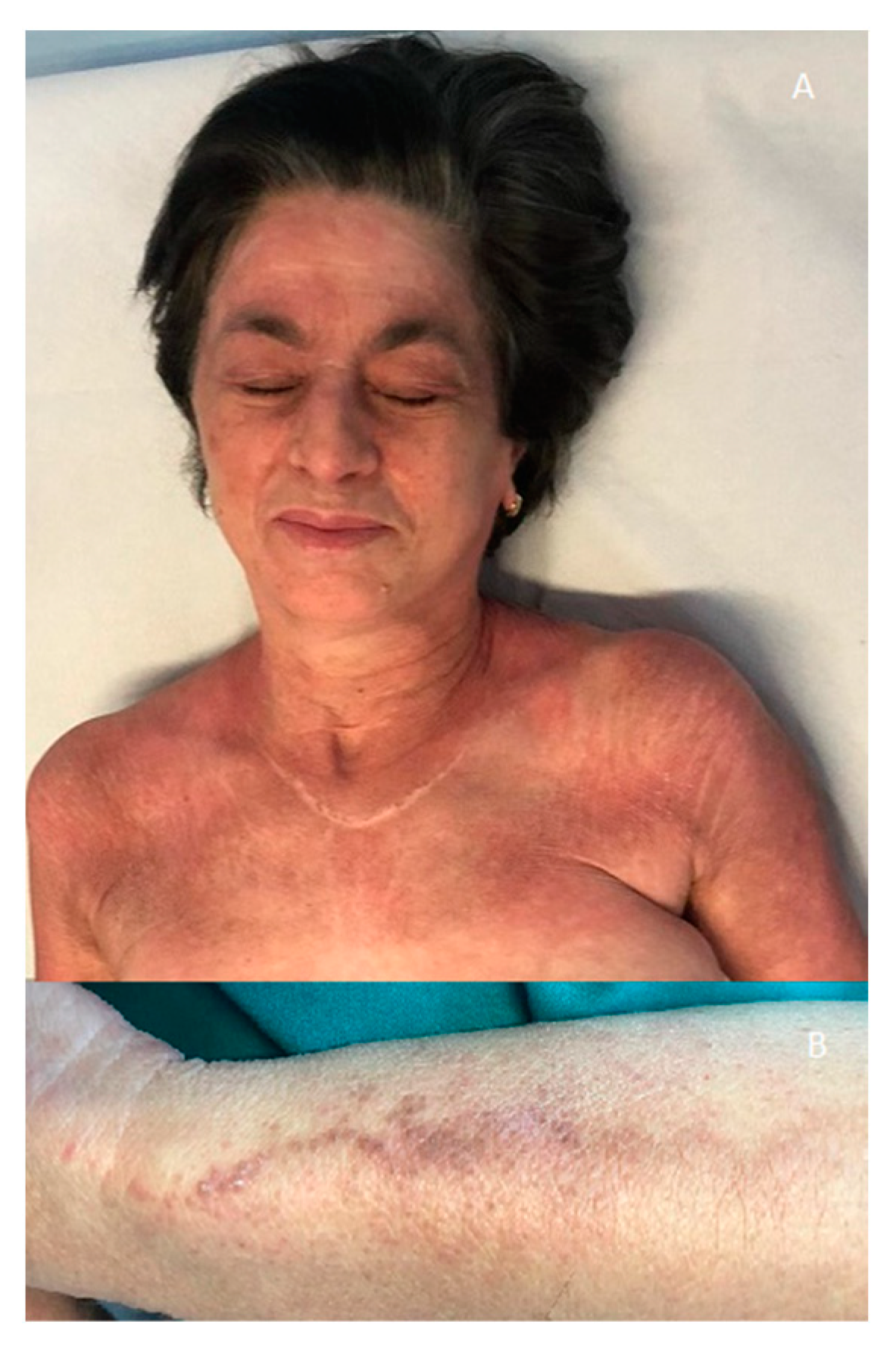
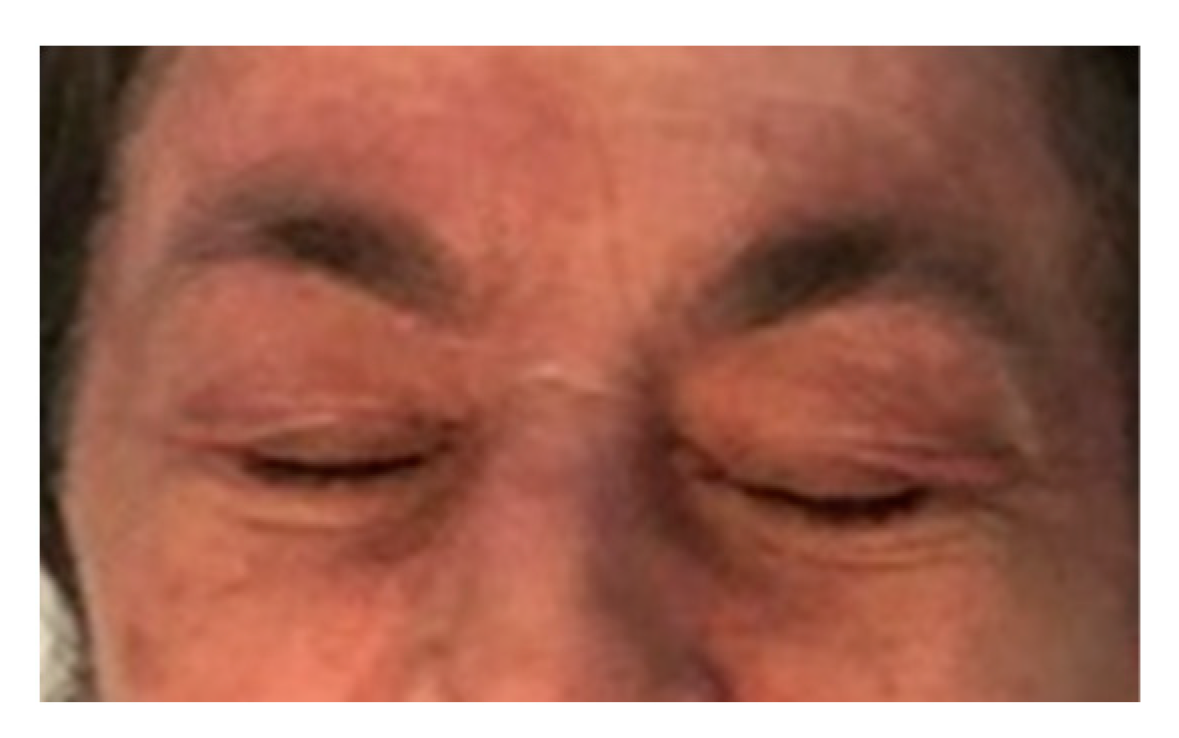
A 69-year-old Caucasian woman presented with a 2-month history of palpebral edema, heliotropic erythema of the face, neck, chest, shoulder and arms, Gottron papules and Gottron signs; hyperkeratotic, erythematous, follicular confluent papules arranged in a linear fashion were noted on the bony prominences of the chest, back and forearms (Figure 1 and Figure 2). The patient denied any muscular weakness. No anomalies were detected in laboratory exams including serum creatine kinase, lactic dehydrogenase, aldolase and transaminases. A myositis-specific antibodies test revealed positive anti-TIF1γ.
Figure 1.
(A) Palpebral edema; heliotropic erythema of face, neck, chest, shoulder and arms. (B) Particular of hyperkeratotic, erythematous, follicular confluent papules arranged in a linear fashion on forearm.
Figure 2.
Close-up view of palpebral heliotropic erythema.
Clinical and laboratory findings allowed the diagnosis of amyopathic DM [4]. Hyperkeratotic, follicular, confluent, linearly arranged papules suggested WTDM [5]. A histological evaluation of a skin biopsy revealed follicular hyperkeratosis, keratotic plugs filling dilated follicular infundibula, vacuolar interface dermatitis and increased dermal mucin, confirming WTDM [2]. Systemic corticotherapy (prednisone 1 mg/kg) was administered with only mild response after 4 weeks.
Since anti-TIF1γ positivity is often associated with underlying neoplasia [1], the patient was screened for malignancies. CT-scans of the abdomen revealed a solid lesion and a cystic lesion involving the right fallopian tube and ovarian. The patient underwent surgical excision of both fallopian tubes and ovaries, uterus and infracolic omentum, peritoneal washing and peritoneal biopsies. Histological examination revealed fallopian tube carcinoma, without macroscopic residual disease after surgery. Four weeks after surgery, dermatological evaluation revealed the remission of DM.
3. Discussion
WTDM is rare, as very few cases have been reported. It may occur in children and adults. Hyperkeratotic follicular papules and typical features of DM may overlap differently; when the former are prevalent, the diagnosis of WTDM may be delayed, as the clinical picture could be evocative of pityriasis rubra pilaris or other conditions with follicular hyperkeratosis [2]. Therefore, dermatologists should be very aware of this uncommon subset of DM, which in our opinion should be considered as a possible paraneoplastic dermatosis, similarly to typical DM.
In fact, the prevalence of malignancy in patients with DM is assumed to be as high as 30% [1]. Gynecological cancers have been strongly associated with DM [3]. However, in the currently available literature, WTDM is not clearly associated with malignancies. In fact, Wong’s first report described 23 patients with DM, 52% of whom presented malignancy; however, only 11 of them were classified as WTDM, and the incidence of malignancy among them was not reported distinctly [6]. From then on, the only published report of malignancy-associated WTDM was a patient who developed WTDM simultaneously with the recurrence of uterine cancer; the cutaneous disease improved with corticotherapy, but the patient died a few months later because of metastatic disease [7]. Therefore, our report is the second one describing the overlap of WTDM with malignancy: interestingly, in both cases, there was an association with a gynecological cancer. Although a clear association between WTDM and malignancies have not been demonstrated in the literature, we believe that our report, together with the previous one [7], may allow us to propose WTDM as a possible paraneoplastic syndrome with a particular relationship with gynecological cancers; however, one should consider the fact that there are reports of WTDM with no associated malignancies [8]. Still, the well-known association between other subsets of DM and malignancies appears to endorse our hypothesis. The possible misdiagnosis and underreporting of this difficult-to-diagnose condition may explain the lack of similar reports so far. Dermatologists should be aware of the possibility of this correlation, avoid the pitfall of considering this clinical subset of DM as free from an association with cancer and screen their patients for malignancies as they do for other variants of DM.
Author Contributions
All authors, R.R., G.G., E.C., B.G. and A.P., contributed to ideation, conceptualization, data collection, writing the manuscript and approving its final version. All authors have read and agreed to the published version of the manuscript.
Funding
This research received no external funding.
Institutional Review Board Statement
Not applicable.
Informed Consent Statement
Informed consent was obtained from all subjects involved in the study. Written informed consent has been obtained from the patient(s) to publish this paper.
Data Availability Statement
Not applicable.
Conflicts of Interest
The authors declare no conflict of interest.
References
- Schlecht, N.; Sunderkötter, C.; Niehaus, S.; Nashan, D. Update on dermatomyositis in adults. J. Dtsch. Dermatol. Ges. 2020, 18, 995–1013. [Google Scholar] [CrossRef] [PubMed]
- Mutasim, D.F.; Egesi, A.; Spicknall, K.E. Wong-type Dermatomyositis: A mimic of many dermatoses. J. Cutan. Pathol. 2016, 43, 781–786. [Google Scholar] [CrossRef] [PubMed]
- Didona, D.; Fania, L.; Didona, B.; Eming, R.; Hertl, M.; Di Zenzo, G. Paraneoplastic dermatoses: A brief general review and an extensive analysis of paraneoplastic pemphigus and paraneoplastic dermatomyositis. Int. J. Mol. Sci. 2020, 21, 2178. [Google Scholar] [CrossRef] [PubMed] [Green Version]
- Lundberg, I.E.; Tjarnlund, A.; Bottai, M.; Werth, V.P.; Pilkington, C.; de Visser, M.; Alfredsson, L.; Amato, A.A.; Barohn, R.J.; Liang, M.H.; et al. 2017 European League Against Rheumatism/American College of Rheumatology classification criteria for adult and juvenile idiopathic inflammatory myopathies and their major subgroups. Arthritis Rheumatol. 2017, 69, 2771–22282. [Google Scholar] [CrossRef] [PubMed]
- Didona, D.; Juratli, H.A.; Scarsella, L.; Eming, R.; Hertl, M. The polymorphous spectrum of dermatomyositis: Classic features, newly described skin lesions, and rare variants. Eur. J. Dermatol. 2020, 30, 229–242. [Google Scholar] [CrossRef] [PubMed]
- Wong, K.O. Dermatomyositis: A clinical investigation of twenty three cases in Hong Kong. Br. J. Dermatol. 1969, 81, 544–547. [Google Scholar] [CrossRef] [PubMed]
- Ishikawa, M.; Yamamoto, T. Wong-type dermatomyositis: A first report from Japan. J. Dermatol. 2017, 44, e336–e337. [Google Scholar] [CrossRef] [PubMed]
- Bax, C.E.; Grinnell, M.; Concha, J.S.S.; Werth, V.P. Wong-type dermatomyositis in an African American patient. Arthritis Rheumatol. 2020, 73, 630. [Google Scholar] [CrossRef] [PubMed]
Publisher’s Note: MDPI stays neutral with regard to jurisdictional claims in published maps and institutional affiliations. |
© 2022 by the authors. Licensee MDPI, Basel, Switzerland. This article is an open access article distributed under the terms and conditions of the Creative Commons Attribution (CC BY) license (https://creativecommons.org/licenses/by/4.0/).