


Accessing Citizens’ Perceptions of Land-Related Policy in a Social Media Setting: The Case of Rural Grazing Area Settlement Programme in Nigeria

Abstract
1. Introduction
2. Social Media as a Data Source for Citizens’ Perceptions
3. Methodology
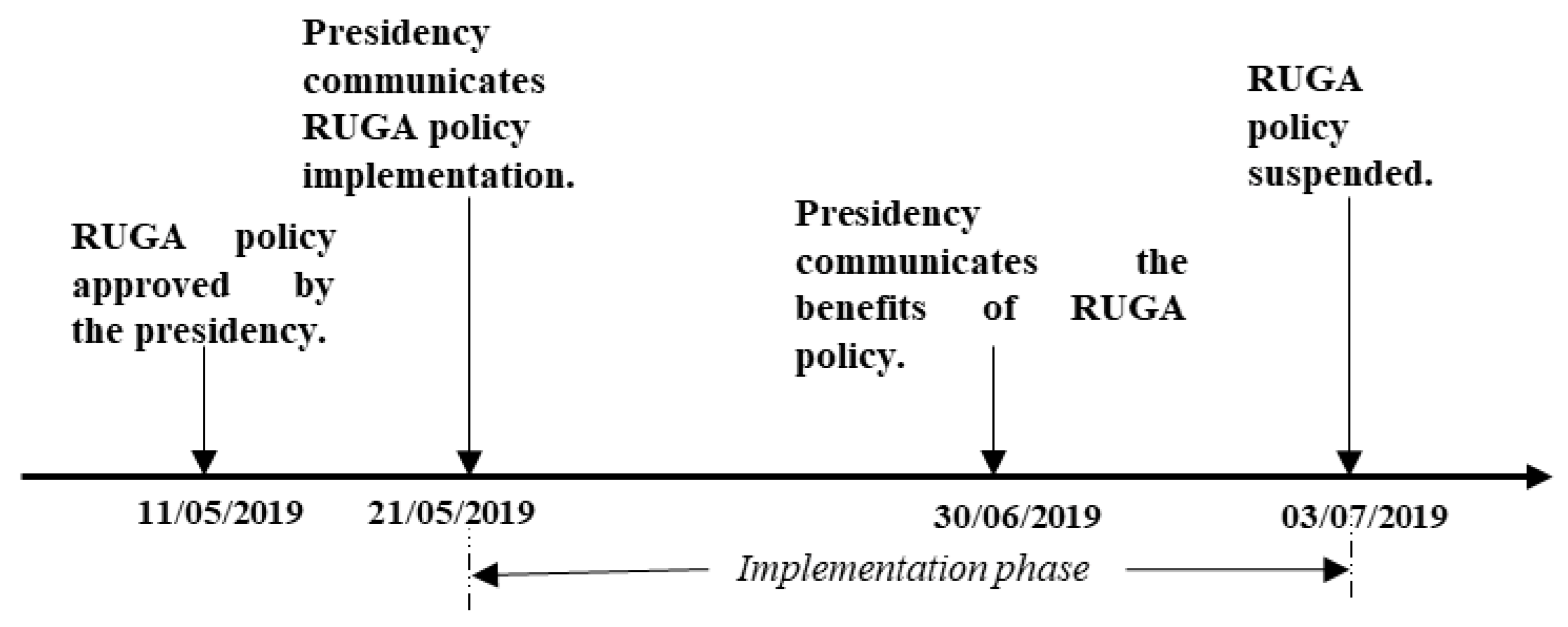
3.1. Case Study: Rural Grazing Area Settlement (RUGA) Policy
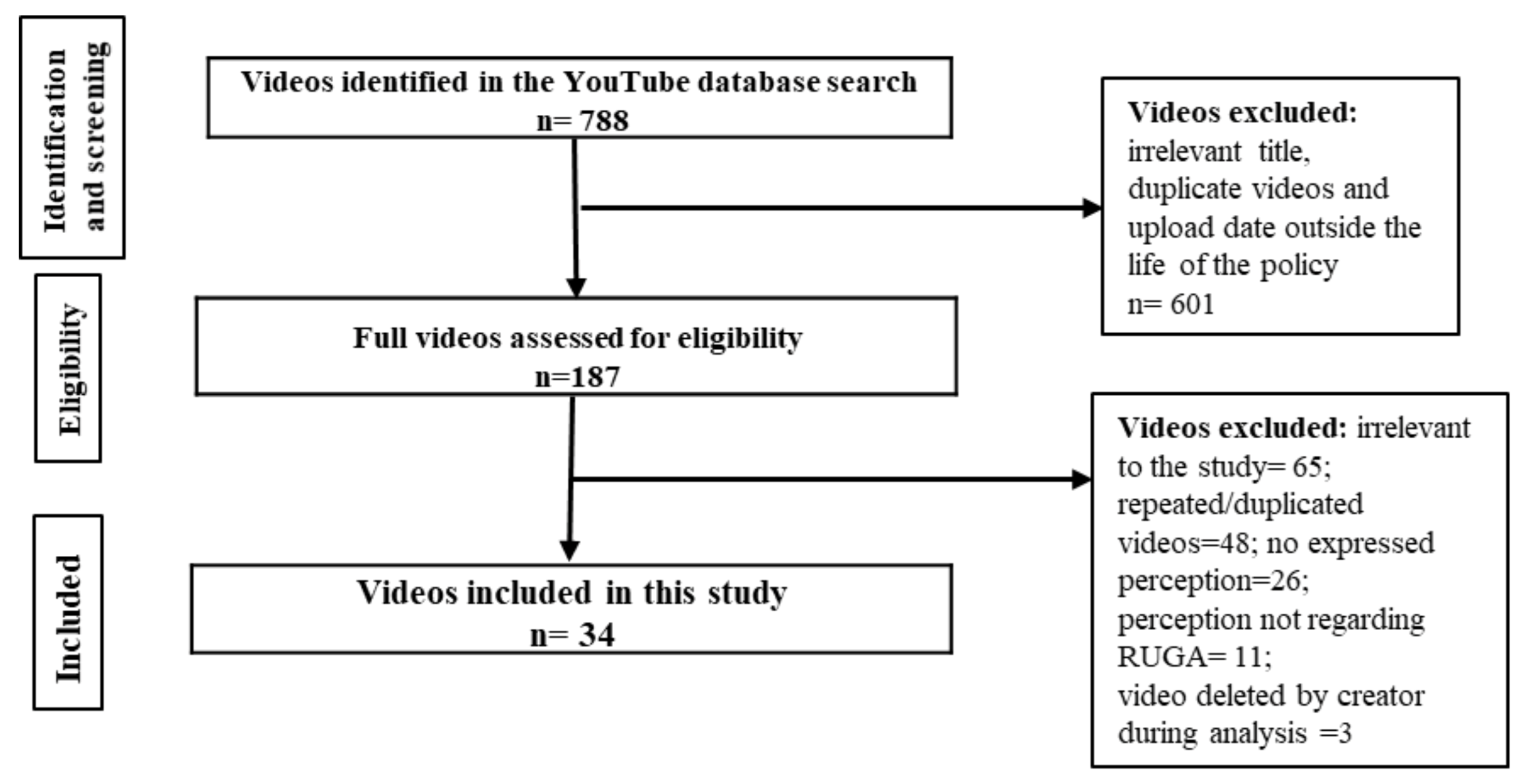
3.2. Data Collection
3.3. Data Analysis
4. Results
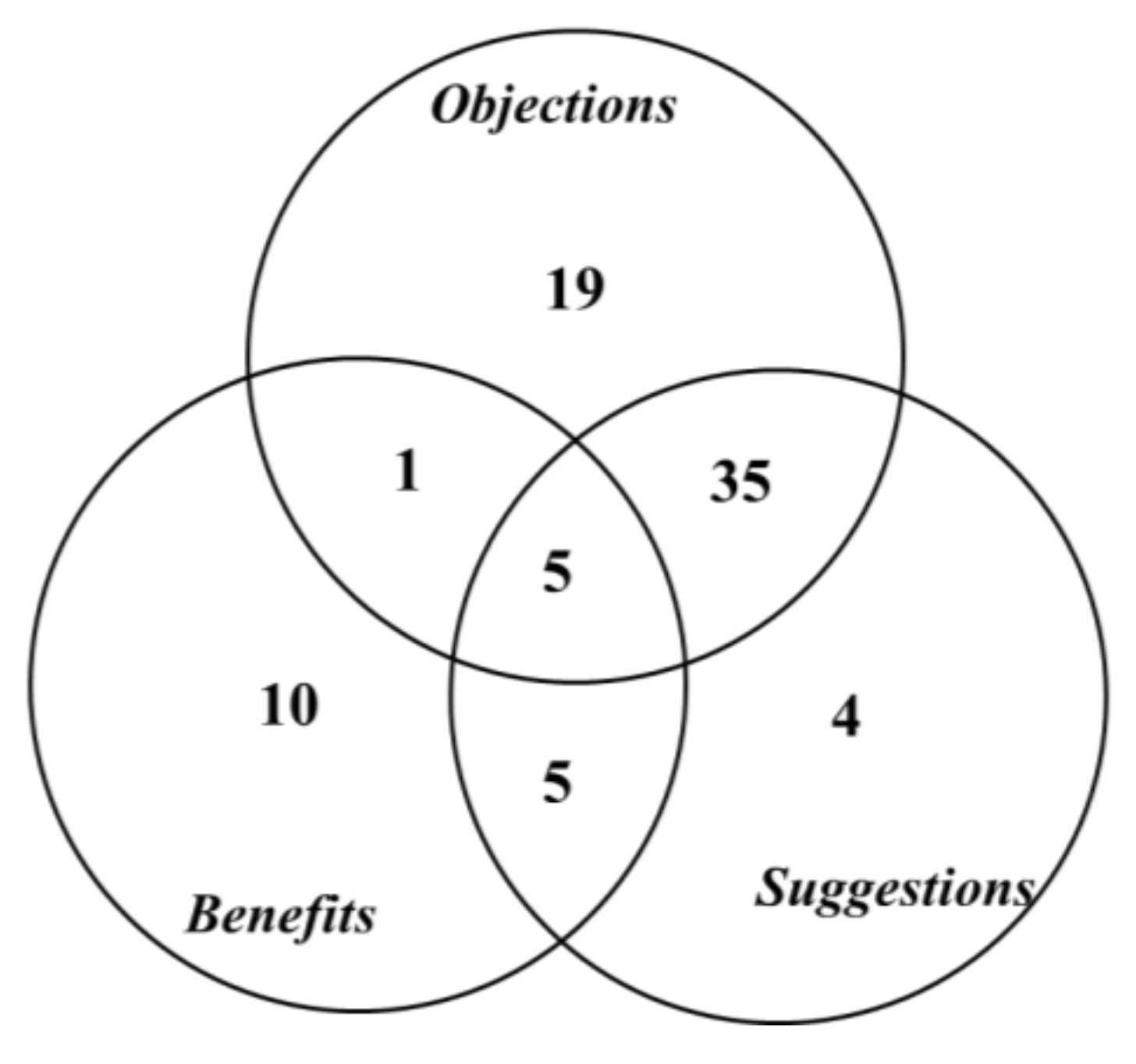
4.1. Descriptive Analysis of the Emergent Themes
4.2. Citizens’ Perceptions of the RUGA Policy
4.2.1. Policy Benefits
4.2.2. Policy Objections
4.2.3. Suggestions Regarding the RUGA Policy
5. Discussion
6. Conclusions
Author Contributions
Funding
Informed Consent Statement
Data Availability Statement
Acknowledgments
Conflicts of Interest
Appendix A

| S/No. | No. of People | Mode of Expression | Views | Time |
|---|---|---|---|---|
| 1 | 1 | personal | 469 | 29;30 |
| 2 | 1 | interview | 5157 | 21;40 |
| 3 | 1 | personal | 69,785 | 21;27 |
| 4 | 5 | Interview (2 streets) | 6942 | 17;26 |
| 5 | 2 | interview | 115,917 | 34;00 |
| 6 | 1 | interview | 18,486 | 15;27 |
| 7 | 2 | interview | 28,219 | 22;46 |
| 8 | 1 | interview | 11,605 | 26;10 |
| 9 | 2 | interview | 2082 | 6;54 |
| 10 | 2 | Interview (street) | 58 | 31;44 |
| 11 | 1 | personal | 2132 | 12;21 |
| 12 | 1 | personal | 897 | 22;55 |
| 13 | 1 | interview | 34 | 23;25 |
| 14 | 1 | personal | 1301 | 13;49 |
| 15 | 1 | personal | 10 | 2;15 |
| 16 | 1 | interview | 288 | 3;26 |
| 17 | 1 | personal | 246 | 8;27 |
| 18 | 1 | interview | 60,640 | 22;57 |
| 19 | 2 | interview | 31,625 | 23;56 |
| 20 | 1 | interview | 18,843 | 22;33 |
| 21 | 12 | Interview (street) | 1422 | 16;45 |
| 22 | 1 | personal | 56 | 5;19 |
| 23 | 1 | personal | 157 | 1;41 |
| 24 | 1 | interview | 52,111 | 17;41 |
| 25 | 8 | Interview (street) | 6941 | 9;22 |
| 26 | 2 | Interview | 770 | 15;08 |
| 27 | 1 | personal | 459 | 4;52 |
| 28 | 2 | interview | 371 | 1;58 |
| 29 | 3 | Interview (street) | 138 | 4;42 |
| 30 | 7 | interview | 16,394 | 51;29 |
| 31 | 2 | interview | 30,576 | 20;40 |
| 32 | 5 | Interview (3 streets) | 499 | 2;47 |
| 33 | 4 | Interview (street) | 1581 | 3;08 |
| 34 | 1 | personal | 741 | 5;03 |
References
- Sobkowicz, P.; Kaschesky, M.; Bouchard, G. Opinion mining in social media: Modeling, simulating, and forecasting political opinions in the web. Gov. Inf. Q. 2012, 29, 470–479. [Google Scholar] [CrossRef] [Scilit]
- Ali, A.H. The power of social media in developing nations: New tools for closing the global digital divide and beyond. Harv. Hum. Rts. J. 2011, 24, 185–219. [Google Scholar]
- Kassens-Noor, E.; Wilson, M.; Cai, M.; Durst, N.; Decaminada, T. Autonomous vs. Self-Driving Vehicles: The Power of Language to Shape Public Perceptions. J. Urban Technol. 2020, 28, 5–24. [Google Scholar] [CrossRef] [Scilit]
- Fan, Y. A Research about Public Participation in the Process of Master-Urban-Planning in China—An Introduction of Practice of Gathering Public Opinion via Questionnaire Survey. Adv. Appl. Sociol. 2015, 5, 13–22. [Google Scholar] [CrossRef]
- Morgan, M.G. Public perception, understanding, and values. In the Industrial Green Game: Implications for Environmental Design and Management; Richards, D.J., Ed.; National Academy Press: Washington, DC, USA, 1997; pp. 200–211. [Google Scholar]
- OECD. Focus on Citizens: Public Engagement for Better Policy and Services; OECD: Paris, France, 2009; pp. 300–322. [Google Scholar]
- Clifton, J.; Díaz-Fuentes, D. Evaluating eu policies on public services: A citizens’ perspective. Ann. Public Coop. Econ. 2010, 81, 281–311. [Google Scholar] [CrossRef] [Scilit]
- Barisione, M.; Ceron, A. A Digital Movement of Opinion? Contesting Austerity Through Social Media. In Social Media and European Politics; Barisione, M., Michailidou, A., Eds.; Palgrave Macmillan: London, UK, 2017; pp. 77–104. [Google Scholar]
- Kang, Y.; Wang, Y.; Zhang, D.; Zhou, L. The public’s opinions on a new school meals policy for childhood obesity prevention in the US: A social media analytics approach. Int. J. Med. Inform. 2017, 103, 83–88. [Google Scholar] [CrossRef] [Scilit]
- Hu, G.; Han, X.; Zhou, H.; Liu, Y. Public Perception on Healthcare Services: Evidence from Social Media Platforms in China. Int. J. Environ. Res. Public Health 2019, 16, 1273. [Google Scholar] [CrossRef] [Scilit]
- Li, R.; Crowe, J.; Leifer, D.; Zou, L.; Schoof, J. Beyond big data: Social media challenges and opportunities for understanding social perception of energy. Energy Res. Soc. Sci. 2019, 56, 101217. [Google Scholar] [CrossRef] [Scilit]
- Raghupathi, V.; Ren, J.; Raghupathi, W. Studying Public Perception about Vaccination: A Sentiment Analysis of Tweets. Int. J. Environ. Res. Public Health 2020, 17, 3464. [Google Scholar] [CrossRef] [Scilit]
- Deininger, K.W. Land Policies for Growth and Poverty Reduction. A World Bank Policy Research Report; World Bank Publications: Washington, DC, USA, 2003; pp. 215–239. [Google Scholar]
- D’Aquino, P.; Bah, A. Land Policies for Climate Change Adaptation in West Africa: A Multilevel Companion Modelling Approach. Simul. Gaming 2012, 44, 391–408. [Google Scholar] [CrossRef] [Scilit]
- Chigbu, U.E.; Enemark, S.; Zevenbergen, J. Improving the Mode of Academic Networking to Scale up Land Education in Africa. In Proceeding of FIG Working Week 2020 Smart Surveyors for Land and Water Management, Amsterdam, The Netherlands, 10–14 May 2020. [Google Scholar]
- Chimhowu, A. The ‘new’ African customary land tenure. Characteristic, features and policy implications of a new paradigm. Land Use Policy 2019, 81, 897–903. [Google Scholar] [CrossRef] [Scilit]
- Gilbert, J. Custodians of the land: Indigenous peoples, human rights and cultural integrity. In Cultural Diversity, Heritage and Human Rights: Intersections in Theory and Practice; Langfield, M., Logan, W., Craith, M., Eds.; Routledge: London, UK, 2010; pp. 31–44. [Google Scholar]
- Shipton, P.M. Mortgaging the Ancestors: Ideologies of attachment in Africa; Yale University Press: New Haven, CT, USA; London, UK, 2009; pp. 1–352. [Google Scholar]
- Statista: Most Popular Social Networks Worldwide as of October 2020, Ranked by Number of Active Users. Available online: https://www.statista.com/statistics/272014/global-social-networks-ranked-by-number-of-users/ (accessed on 18 December 2020).
- Statista: Forecast of the number of YouTube users in Nigeria from 2017 to 2025. Available online: https://www.statista.com/forecasts/1144636/youtube-users-in-nigeria (accessed on 1 November 2021).
- Dowler, E.; Green, J.; Gasperoni, C. Assessing public perception: Issues and methods. In Health, Hazards and Public Debate: Lessons from BSE/CJD Saga; Dora, C., Ed.; WHO Regional Office for Europe: Copenhagen, Denmark, 2006; pp. 39–60. [Google Scholar]
- Scott, A. Assessing Public Perception of Landscape: The LANDMAP experience. Landsc. Res. 2002, 27, 271–295. [Google Scholar] [CrossRef] [Scilit]
- Chatzakou, D.; Vakali, A. Harvesting Opinions and Emotions from Social Media Textual Resources. IEEE Internet Comput. 2015, 19, 46–50. [Google Scholar] [CrossRef] [Scilit]
- Schober, M.F.; Pasek, J.; Guggenheim, L.; Lampe, C.; Conrad, F.G. Social Media Analyses for Social Measurement. Public Opin. Q. 2016, 80, 180–211. [Google Scholar] [CrossRef] [Scilit]
- Conrad, F.G.; Gagnon-Bartsch, J.; Ferg, R.A.; Schober, M.; Pasek, J.; Hou, E. Social Media as an Alternative to Surveys of Opinions About the Economy. Soc. Sci. Comput. Rev. 2019, 39, 489–508. [Google Scholar] [CrossRef] [Scilit]
- Tumasjan, A.; Sprenger, T.; Sandner, P.; Welpe, I. Predicting elections with twitter: What 140 characters reveal about political sentiment. In Proceedings of the International AAAI Conference on Web and Social Media, Washington, DC, USA, 23–26 May 2010; Volume 4. [Google Scholar]
- Sang, E.T.K.; Bos, J. Predicting the 2011 Dutch senate election results with twitter. In Proceedings of the Workshop on Semantic Analysis in Social Media, Avignon, France, 23 April 2012; pp. 53–60. [Google Scholar]
- Jensen, M.J.; Anstead, N. Psephological investigations: Tweets, votes, and unknown unknowns in the republican nomination process. Policy Internet 2013, 5, 161–182. [Google Scholar] [CrossRef] [Scilit]
- Brick, J.M.; Williams, D. Explaining Rising Nonresponse Rates in Cross-Sectional Surveys. Ann. Am. Acad. Polit. Soc. Sci. 2012, 645, 36–59. [Google Scholar] [CrossRef] [Scilit]
- Schober, M.F.; Conrad, F.G.; Antoun, C.; Ehlen, P.; Fail, S.; Hupp, A.; Johnston, M.; Vickers, L.; Yan, H.Y.; Zhang, C. Precision and Disclosure in Text and Voice Interviews on Smartphones. PLoS ONE 2015, 10, e0128337. [Google Scholar] [CrossRef] [Scilit]
- Statista: Global Social Network User Growth from 2018 to 2026. Available online: https://www.statista.com/statistics/270919/worldwide-social-network-user-growth/ (accessed on 1 November 2021).
- van Dijck, J. Users like you? Theorizing agency in user-generated content. Media Cult. Soc. 2009, 31, 41–58. [Google Scholar] [CrossRef] [Scilit]
- Ruths, D.; Pfeffer, J. Social media for large studies of behavior. Science 2014, 346, 1063–1064. [Google Scholar] [CrossRef] [Scilit]
- Mahrt, M.; Scharkow, M. The Value of Big Data in Digital Media Research. J. Broadcast. Electron. Media 2013, 57, 20–33. [Google Scholar] [CrossRef] [Scilit]
- Lomborg, S.; Bechmann, A. Using APIs for Data Collection on Social Media. Inf. Soc. 2014, 30, 256–265. [Google Scholar] [CrossRef] [Scilit]
- Patterson, A.N. YouTube Generated Video Clips as Qualitative Research Data: One Researcher’s Reflections on the Process. Qual. Inq. 2018, 24, 759–767. [Google Scholar] [CrossRef] [Scilit]
- Lomborg, S. Personal internet archives and ethics. Res. Ethics 2012, 9, 20–31. [Google Scholar] [CrossRef] [Scilit]
- Staff, C.; King, H.; Roberts, M.; Pannell, S.; Roberts, D.; Wilson, N.; Mann, R.; Cooper, A. Using Social Media for Social Research: An Introduction; Social Science in Government; Social Media Research Group: London, UK, 2016; pp. 1–23. Available online: http://dera.ioe.ac.uk/id/eprint/26600 (accessed on 1 November 2021).
- International Crisis Group. Herders against Farmers: Nigeria’s Expanding Deadly Conflict. Africa Report; International Crisis Group (ICG): Brussels, Belgium, 2017; pp. 1–31. Available online: https://www.refworld.org/docid/59c21a454.html (accessed on 1 November 2021).
- Jonathan, P. Discourse Analysis as a Way of Analysing Naturally Occurring Talk. In Qualitative Research: Theory, Method and Practice, 2nd ed.; Silverman, D., Ed.; SAGE Publications: London, UK, 2004; pp. 200–221. [Google Scholar]
- Braun, V.; Clarke, V. Using thematic analysis in psychology. Qual. Res. Psychol. 2006, 3, 77–101. [Google Scholar] [CrossRef] [Scilit]
- Pottier, J. Land Reform for Peace? Rwanda’s 2005 Land Law in Context. J. Agrar. Chang. 2006, 6, 509–537. [Google Scholar] [CrossRef] [Scilit]
- Collins, A.; Mitchell, M.I. Revisiting the World Bank’s land law reform agenda in Africa: The promise and perils of customary practices. J. Agrar. Chang. 2017, 18, 112–131. [Google Scholar] [CrossRef] [Scilit]
- Adekola, O.; Krigsholm, P.; Riekkinen, K. Towards a holistic land law evaluation in sub-Saharan Africa: A novel framework with an application to Rwanda’s organic land law 2005. Land Use Policy 2021, 103, 105291. [Google Scholar] [CrossRef] [Scilit]
- Grover, R.; Törhönen, M.P.; Palmer, D.; Munro-Faure, P. Good Governance in Land Tenure and Administration; Food & Agriculture Organization of the UN (FAO): Rome, Italy, 2007; Volume 9, pp. 1–57. ISBN 9789251057537. [Google Scholar]
- Bakshy, E.; Messing, S.; Adamic, L.A. Exposure to ideologically diverse news and opinion on Facebook. Science 2015, 348, 1130–1132. [Google Scholar] [CrossRef] [Scilit]
- Wu, L.; Morstatter, F.; Carley, K.M.; Liu, H. Misinformation in Social Media: Definition, Manipulation, and Detection. ACM SIGKDD Explor. Newsl. 2019, 21, 80–90. [Google Scholar] [CrossRef] [Scilit]
| Theme | Subthemes | No. of People (n = 79) |
|---|---|---|
| Policy benefits | Economic contribution | 21 |
| Conflict prevention | ||
| Policy objections | Loss of valuable land | 60 |
| Disregard for the rule of law | ||
| Security concerns | ||
| Favouritism | ||
| Distrust in government | ||
| Fear of hegemony | ||
| Policy suggestions | Alternative and localised solutions | 49 |
| Inclusiveness and education of stakeholders Focus on priority |
Publisher’s Note: MDPI stays neutral with regard to jurisdictional claims in published maps and institutional affiliations. |
© 2022 by the authors. Licensee MDPI, Basel, Switzerland. This article is an open access article distributed under the terms and conditions of the Creative Commons Attribution (CC BY) license (https://creativecommons.org/licenses/by/4.0/).
Share and Cite
Adekola, O.; Krigsholm, P.; Riekkinen, K. Accessing Citizens’ Perceptions of Land-Related Policy in a Social Media Setting: The Case of Rural Grazing Area Settlement Programme in Nigeria. Land 2022, 11, 200. https://doi.org/10.3390/land11020200
Adekola O, Krigsholm P, Riekkinen K. Accessing Citizens’ Perceptions of Land-Related Policy in a Social Media Setting: The Case of Rural Grazing Area Settlement Programme in Nigeria. Land. 2022; 11(2):200. https://doi.org/10.3390/land11020200
Chicago/Turabian StyleAdekola, Oluwafemi, Pauliina Krigsholm, and Kirsikka Riekkinen. 2022. "Accessing Citizens’ Perceptions of Land-Related Policy in a Social Media Setting: The Case of Rural Grazing Area Settlement Programme in Nigeria" Land 11, no. 2: 200. https://doi.org/10.3390/land11020200
APA StyleAdekola, O., Krigsholm, P., & Riekkinen, K. (2022). Accessing Citizens’ Perceptions of Land-Related Policy in a Social Media Setting: The Case of Rural Grazing Area Settlement Programme in Nigeria. Land, 11(2), 200. https://doi.org/10.3390/land11020200

