
Article

Genome-Wide Identification and Expression Analysis of the Thaumatin-like Protein Genes in Filipendula ulmaria under Bipolaris sorokiniana Infection

by
Ekaterina A. Istomina
,
Marina P. Slezina
and
Tatyana I. Odintsova
*
Vavilov Institute of General Genetics, Russian Academy of Sciences, 119333 Moscow, Russia
*
Author to whom correspondence should be addressed.
Curr. Issues Mol. Biol. 2026, 48(6), 640; https://doi.org/10.3390/cimb48060640 (registering DOI)
Submission received: 26 May 2026 / Revised: 11 June 2026 / Accepted: 18 June 2026 / Published: 20 June 2026

Abstract

Pathogenesis-related (PR) proteins are crucial for plant defense against pathogen infection. However, the specific role of thaumatin-like proteins (TLPs), which comprise the PR-5 family, in plant immune responses has not been thoroughly investigated. Filipendula ulmaria is a medicinal plant with valuable pharmacological properties, including antimicrobial, anti-inflammatory, gastroprotective, immunomodulatory, and anticancer activities. The structure of the TLP family and its role in the immune system of meadowsweet have not been studied so far. The goal of this study was to analyze in detail the TLP gene family in meadowsweet and explore its response to fungal infection. In the meadowsweet genome, we identified 27 putative TLP genes, examined their structure and location on chromosomes, analyzed cis-regulatory elements in the promoter regions, predicted the structure and physicochemical characteristics of the encoded proteins, and performed a phylogenetic analysis. We also studied the differential expression of TLP genes under Bipolaris sorokiniana infection. Of six differentially expressed genes, three genes were up-regulated 48 h post-infection, suggesting their involvement in defense response to the fungus. The results obtained shed light on the role of the TLP gene family in the immune system of F. ulmaria and form the foundation for the creation of disease-resistant crops in agriculture and the development of bio-based antimicrobials in medicine.

1. Introduction

Pathogen infection is one of the main causes of reduced crop yields, which are the primary source of food for the world’s population. An assessment of global agricultural production indicates that the total crop losses caused by pathogen infection amount to 20–40% [1]. The use of chemical pesticides and the development of resistant varieties are the main strategies for protecting plants from diseases. Currently, pesticides play a key role in maintaining crop yields and ensuring food security, as without their use, yield losses could reach up to 78% for fruits, 54% for vegetables, and 32% for grains [2]. However, pesticides can be toxic not only to pathogens but to other organisms as well, including birds, fish, beneficial insects, and non-target plants. They also pollute air, water, soil, and agricultural crops, leading to environmental pollution in general and contamination of food products in particular [2]. All these factors negatively impact human health, causing various diseases, from acute poisoning to cancer. Additionally, climate change also influences pesticide use, contributing to increased application and, consequently, pollution. Besides the negative effects on ecology and human health, the use of pesticides boosts the development of antimicrobial resistance in pathogenic microorganisms.
In the context of sustainable agriculture, there is a need for effective and safe biopesticides that eliminate pests but pose minimal risks to the environment. In recent years, proteins and peptides have become a promising area in plant protection due to their high inhibitory activity and ecological compatibility. Of prime interest are defense proteins of the plant itself.
Throughout their lives, plants encounter diverse stressful conditions. To withstand environmental challenges, they have developed physical and chemical defense mechanisms, one of which is the production of pathogenesis-related proteins (PR proteins). PR proteins play a pivotal role in plant defense against biotic and abiotic stressors. They were first discovered in tobacco plants with a hypersensitive response to tobacco mosaic virus infection. Accumulation of PR proteins was closely associated with the intensity of symptoms observed on the infected plants [3,4]. In subsequent studies on proteins induced in response to pathogens, PR proteins were discovered in different plant species. Diverse in structure and mode of action, PR proteins have been categorized into 19 classes [5]. Most of them possess antimicrobial properties in vitro. Transgenic plants expressing PR protein genes display enhanced resistance to pathogens [6].
The PR-5 protein family is represented by related polypeptides with sequence similarity to thaumatin, a sweet-tasting protein from the fruits of the shrub Thaumatococcus danielli found in West Africa, and therefore referred to as thaumatin-like proteins (TLPs) [7,8,9]. This protein family contains acidic, neutral, and very basic members, which are located extracellularly or within vacuoles. Most PR-5 proteins share a highly conserved thaumatin family signature G-x-{GF}-x-C-x-T-{GA}-D-C-x(1,2)-{GQ}-x(2,3)-C [8]. Two types of TLPs have been described in plants: large TLPs (L-type TLPs) with a molecular weight ranging from 20 to 26 kDa and containing 16 conserved cysteine residues forming 8 intra-chain disulfide bonds, and small TLPs (S-type TLPs) with a molecular weight of approximately 17 kDa, and only 10 conserved cysteine residues forming five disulfide bonds, which are found in monocots and conifers [7]. TLPs possess a highly conserved three-dimensional structure composed of three domains and a cleft between domains I and II [10]. This cleft can exhibit acidic, neutral, or basic properties, enabling it to bind various ligands or receptors. The acidic cleft composed of highly conserved amino acids REDDD is particularly associated with antifungal activity [7].
The first report on the biological activity of PR-5 proteins was the discovery that zeamatin, a 22-kDa thaumatin-like protein from maize (Zea mays), was antifungal and displayed membrane-permeabilizing activity [11]. It was then shown that tobacco osmotin and its tomato analog were active against Phytophtlora infestans [12]. The results demonstrating inhibition of fungal hyphal growth or spore germination by PR-5 proteins were extended to different plant species by in vitro antifungal assays. However, there are no reports on antibacterial activity for these proteins. Comparative studies of the activity spectrum of individual family proteins reveal significant differences [13]. Thus, each protein likely exhibits characteristic specificity toward certain fungi depending on its amino acid sequence. In an early study, two basic TLPs, R and S, from barley (Hordeum vulgare) grain, were shown to inhibit growth of Trichoderma viride and Candida albicans, acting synergistically with barley grain chitinase C [14]. A recombinant thaumatin-like protein from naked oat (Avena nuda) exhibited antifungal activity against Fusarium oxysporum [15]. The protein also caused membrane permeabilization and accumulation of reactive oxygen species in the mycelium of F. oxysporum. Three TLPs from leaves of barley infected with Rhynchosporium secalis exhibited antifungal activity [16]. A TLP with antifungal activity against Candida species, whose expression was induced by laminarin oligosaccharides and salicylic acid, was isolated from Cassia didymobotrya cell cultures [17]. BanTLP from banana significantly suppressed the growth of Penicillium expansum and caused morphological changes in the fungus. It was demonstrated that BanTLP affected the fungal cell wall, disrupting its integrity and increasing permeability, leading to fungal cell death [18]. However, it should be noted that some PR-5-like proteins, including thaumatin itself, an acidic PR-5-like protein from cherry fruits, and certain pathogen-induced acidic PR-5-like proteins of tobacco, apparently do not possess antifungal activity [13].
The mode of action of PR-5 proteins is not completely understood. It has been suggested that the antifungal properties of TLPs are associated with hydrolysis of fungal cell wall glucans or inhibition of cell-wall degrading enzymes (e.g., fungal xylanase) [19,20,21], as well as with the ability to destroy fungal cell membranes and induce programmed cell death [7]. Indeed, some TLPs exhibit endo-β-1,3-glucanase activity [22,23]. However, it remains unclear whether glucan binding and glucanase activity are necessary for the antifungal activity of PR-5 proteins. For example, two TLPs from germinated barley PR-5b and HvPR5c differed significantly in binding insoluble (1,3)-β-D-glucan, and neither displayed glucanase activity. However, both inhibited fungal growth in vitro [24].
Besides in vitro tests of isolated proteins, the defensive role of PR-5 proteins has been confirmed by induction of gene expression by biotic and abiotic stressful factors and enhanced tolerance to stresses of transgenic plants overexpressing PR-5 protein genes [25,26,27,28].
Studies employing genome-wide analysis of a range of plant species, such as barley, tomato, cotton, garlic, poplar, bamboo, grape, etc., demonstrated that thaumatin-like proteins are the products of a large and complex gene family involved in host defense and developmental processes [29,30,31,32,33,34,35,36,37,38]. However, the roles of individual members of the TLP superfamily remain largely unknown.
Filipendula ulmaria (Rosaceae family), or meadowsweet, is a perennial herbaceous plant that grows on wet ground in swamps, marshes, wet woods, meadows, and by rivers. It is a medicinal plant with valuable pharmacological properties. Extracts from this plant exhibit anti-inflammatory, antimicrobial, gastroprotective, immunomodulatory, and anticancer activities [39]. The advantageous pharmacological characteristics of meadowsweet have historically been ascribed to its secondary metabolites. However, recent research indicates that the antimicrobial effects of F. ulmaria are at least partially due to the presence of defense peptides (AMPs) in this remarkable herb [40]. In this work, we extend our search for polypeptide-based antimicrobial compounds in meadowsweet and focus on the enigmatic PR-5 protein family.
The aim of this study was to perform genomic and transcriptomic analyses of the TLP gene family in F. ulmaria to broaden our understanding of these proteins, which are an integral part of the plant’s defense system, and pave the way for innovative strategies of crop protection. In this work, we studied the structure of meadowsweet genes and their location on chromosomes, predicted the structure and physicochemical characteristics of the encoded proteins, their domain structure, and subcellular localization. We analyzed the cis-acting regulatory elements in the promoter regions of F. ulmaria TLP genes and explored their differential expression in response to infection with the pathogenic fungus Bipolaris sorokiniana to shed light on the role of the TLPs in stress response. Harnessing the potential of meadowsweet TLPs holds promise for various agricultural and biomedical applications, including the development of resistant crops, bio-based products, and pharmaceuticals.

2. Materials and Methods

2.1. Search for TLP Genes in the Genomic Data of F. ulmaria

The search for TLP genes was conducted using the genome assembly of F. ulmaria, drFilUlma1 (Accession PRJEB77879), which contained nucleotide sequences of all seven chromosomes. As a query for identifying TLPs from the Rosaceae family, motifs of thaumatin-like proteins (cd09218, pfam00314) from the NCBI CDD database (https://www.ncbi.nlm.nih.gov/cdd/, accessed on 23 December 2025) were used with the InterProScan program [41,42]. Then F. ulmaria genome was aligned with the TLP protein sequences from the Rosaceae family using the NCBI TBLASTN search algorithm (https://blast.ncbi.nlm.nih.gov/Blast.cgi, accessed on 15 January 2026) with an E-value cut-off of <1 × 10⁻¹⁰ [43]. Open reading frames were analyzed with the Augustus software (http://bioinf.uni-greifswald.de/augustus/submission.php, accessed on 15 January 2026) and FGENESH (http://www.softberry.com/berry.phtml?topic=fgenesh&group=help&subgroup=gfind, accessed on 15 January 2026) [44,45]. To identify conserved domains within the proteins, InterProScan was employed (https://www.ebi.ac.uk/interpro/search/sequence/, accessed on 19 February 2026) [42], and only the sequences containing the pfam00314 domain were considered to be the TLP sequences.
Nucleotide and protein sequences of the identified members of the FuTLP gene family were compared with the complete genome sequences of F. ulmaria using BLAST (https://blast.ncbi.nlm.nih.gov/Blast.cgi, accesed on 21 January 2026), and the corresponding genomic sequences, chromosomal positions, and patterns of exon–intron distribution for each family member were obtained. To localize thaumatin genes on chromosomes, the online program MF2C v2.1 (http://mg2c.iask.in/mg2c_v2.1, accessed on 4 February 2026) was used [46]. For visualization of exon–intron structures of the genes, the online program Gene Structure Display Server 2.0 (https://gsds.gao-lab.org/Gsds_about.php, accessed on 5 February 2026) was employed [47].

2.2. Experimental Design

Seeds of Filipendula ulmaria (L.) Maxim. used in the experiment were collected in the Moscow region (Russia). Bipolaris sorokiniana strain VKM F-4006 was sourced from the State Collection of Plant Pathogenic Microorganisms at the All-Russian Research Institute of Phytopathology (Moscow region, Russia). The fungus was cultured as described earlier [48]. Seeds of F. ulmaria were surface-sterilized by soaking in 70% ethanol for 5 min, followed by three rinses with a large volume of sterile water. The sterilized seeds were sown in a mixture of soil and perlite (ratio 1:2, v/v), which had been pre-steamed, into four plastic containers containing 100 seeds each. To induce cold stratification, the sealed containers were kept in the dark at +8 °C for three months. Afterward, they were moved to a climate chamber set at +25 °C for two weeks until the seedlings developed two true leaves. At this point, plants from each container were divided into two groups: one inoculated with the pathogen (B. sorokiniana) and the other serving as a mock-inoculated control, with each group transplanted into separate new containers. This process resulted in four experimental replicates. For inoculation, a freshly prepared conidial suspension (7 mL per container, at a concentration of 0.5 × 10⁶ conidia/mL) was applied to the leaves. Control plants received the same volume of sterile water. After treatment, all plants were kept in the climate chamber at +25 °C with a 16 h light/8 h dark photoperiod. For RNA isolation, four samples of plant tissue from the control and infected groups were taken 24 and 48 h post-inoculation (hpi) or water treatment. These samples were labeled as control 1 and 3 (at 24 and 48 hpi, respectively) and infected 2 and 4 (at 24 and 48 hpi, respectively). For each experimental group, a pooled sample consisting of 8–12 whole plants (200–250 mg of plant tissue) from four containers was cut into pieces and split into two equal parts (replicates a and b), each preserved in 1 mL of IntactRNA reagent (Eurogen, Moscow, Russia) within Eppendorf tubes.

2.3. RNA Isolation, Library Preparation and Next-Generation Sequencing (NGS)

Total RNA was extracted using the Plant RNA Isolation Aid kit (Ambion, ThermoFisher, Waltham, MA, USA) following the manufacturer’s instructions. The RNA concentration was measured with a Qubit fluorimeter (Invitrogen, ThermoFisher, Waltham, MA, USA), and the RNA quality was assessed using an Agilent 2100 Bioanalyzer (Agilent Technologies, Santa Clara, CA, USA). Half of each RNA sample was used to prepare eight cDNA libraries for sequencing, while the other half was reserved for validation via qRT-PCR.
After enrichment of mRNA using oligo(dT) beads, cDNA libraries (1a, 1b, 2a, 2b, 3a, 3b, 4a, and 4b) were constructed using the TruSeq Stranded mRNA Library Prep Kit (Illumina) according to the manufacturer’s protocol. The quality of these libraries was checked with an Agilent 2100 Bioanalyzer. Sequencing was performed on the Illumina NextSeq 500 platform (Illumina, San Diego, CA, USA) at the EIMB RAS “Genome” Center. For libraries 1a, 1b, 2a, and 2b, 75 bp single-end reads were generated, while for libraries 3a, 3b, 4a, and 4b, 150 bp paired-end reads were obtained. The resulting FASTQ files were generated using the bcl2fastq Conversion Software v1.8.4 (Illumina).

2.4. Search for TLP Genes in the Transcriptomic Data of F. ulmaria

Sequencing data were deposited in NCBI at BioProject accession number PRJNA1047088 [48]. Transcript assembly was performed using the rnaSPAdes v3.15.4 program [49]. TransDecoder v5.5.0 was used to identify open reading frames in contigs [50].
Differential gene expression analysis was based on read counts in infected plants compared to uninfected controls. Differentially expressed genes (DEGs) were identified using the DESeq2 package [51]. Clean reads were aligned to the combined transcriptome assembly using the BWA MEM algorithm and SAMtools [52,53]. Expression levels were calculated as counts per million (CPM) reads. Genes with |log2FoldChange| > 1 and p < 0.05 were considered DEGs.

2.5. qRT-PCR Analysis

To validate the transcriptomic data, 12 trFuTLP genes were analyzed using PCR with the specific primers flanking the open reading frame region (Table S1). Another set of primers was used for validation of gene expression levels by real-time PCR (Table S2). Primers were selected using the Primer Blast program (https://www.ncbi.nlm.nih.gov/tools/primer-blast/index.cgi, accessed on 26 February 2026). The optimal annealing temperature for each set of primers on the cDNA template was determined by gradient PCR, varying the temperature in the range from 55 °C to 65 °C. The specificity of amplification was assessed by analyzing the melting curves of PCR fragments, as well as by electrophoretic separation of PCR products in a 3% agarose gel. The EF1-α gene of F. ulmaria was used as an internal control. The obtained characteristics of the calibration curve (slope = −3.65, amplification efficiency (E) = 87.9%, determination coefficient (R2) = 0.99974) indicate high linearity and acceptable efficiency of the PCR reaction for the EF1-α gene. F. ulmaria RNA obtained by pooling RNA samples from two replicates of the same sample in equal proportions was used for cDNA synthesis with oligo(dT)-primers and the Mint cDNA synthesis kit (Evrogen, Moscow, Russia) following the manufacturer’s instructions.
Quantitative RT-PCR was performed using the qPCRmix-HS SYBR+HighROX kit (Evrogen) according to the manufacturer’s protocol on a DT-96 Real-Time instrument (DNA-technology, Moscow, Russia). PCR conditions were as follows: initial denaturation at 94 °C for 2 min; 40 cycles of denaturation at 94 °C for 30 s; primer annealing at 58–60 °C for 30 s; primer extension at 72 °C for 30 s; with a final extension at 72 °C for 5 min. Each experiment was performed in three technical replicates. The specificity of PCR amplification was confirmed by sequencing the PCR product. Relative transcript levels were assessed using the 2−ΔΔCT method [54]. Results were presented as mean ± standard error (SE).

2.6. Characterization of the TLPs

For annotation and homology identification between TLPs discovered in the genome and transcriptomes (FuTLPs and trFuTLPs), the BLAST program and the GenBank database were used [43,55]. The presence of signal sequences and transmembrane helices (TMHs) in proteins was predicted using the server SignalP 6.0 (https://services.healthtech.dtu.dk/services/SignalP-6.0/, accessed on 17 February 2026) and TMHMM - 2.0 (https://services.healthtech.dtu.dk/services/TMHMM-2.0/, accessed on 17 February 2026), respectively [56]. Physicochemical properties of TLPs were predicted using the ProtParam program (http://web.expasy.org/protparam/, accessed on 2 March 2026) [57]. Net charge at pH 7, pI, GRAVY index, and aliphatic index were computed for protein sequences without signal peptides. Subcellular localization was determined using the program Cell-PLoc 2.0 (http://www.csbio.sjtu.edu.cn/bioinf/Cell-PLoc-2/, accessed on 2 March 2026) [58]. Conserved motifs in TLPs, with a maximum of 7 motifs and an optimal motif width of 20–50 residues, were identified using the MEME program (https://meme-suite.org/meme/tools/meme, accessed on 20 May 2026) [59]. Cis-acting regulatory elements in the promoter region 2000 bp upstream of each TLP gene’s start codon were predicted with the PlantCARE database (https://bioinformatics.psb.ugent.be/webtools/plantcare/html/, accessed on 12 May 2026) [60].
Sequence alignment was performed using the Vector NTI Advance 9 software (Invitrogen, Waltham, MA, USA). The phylogenetic tree of the TLPs was constructed using the Maximum Likelihood method in MEGA X [61], with a bootstrap value of 1000. The three-dimensional structures of the identified meadowsweet TLPs were predicted using SWISS-MODEL (https://swissmodel.expasy.org/interactive, accessed on 10 March 2026) [62]. In addition, the quality of the predicted protein structures was evaluated using VERIFY 3D (https://saves.mbi.ucla.edu/, accessed on 12 March 2026) and ProQ server (https://proq.bioinfo.se/cgi-bin/ProQ/ProQ.cgi, accessed on 12 March 2026) [63,64].

3. Results

3.1. Search for Thaumatin-like Protein Genes in the Genome Data of F. ulmaria

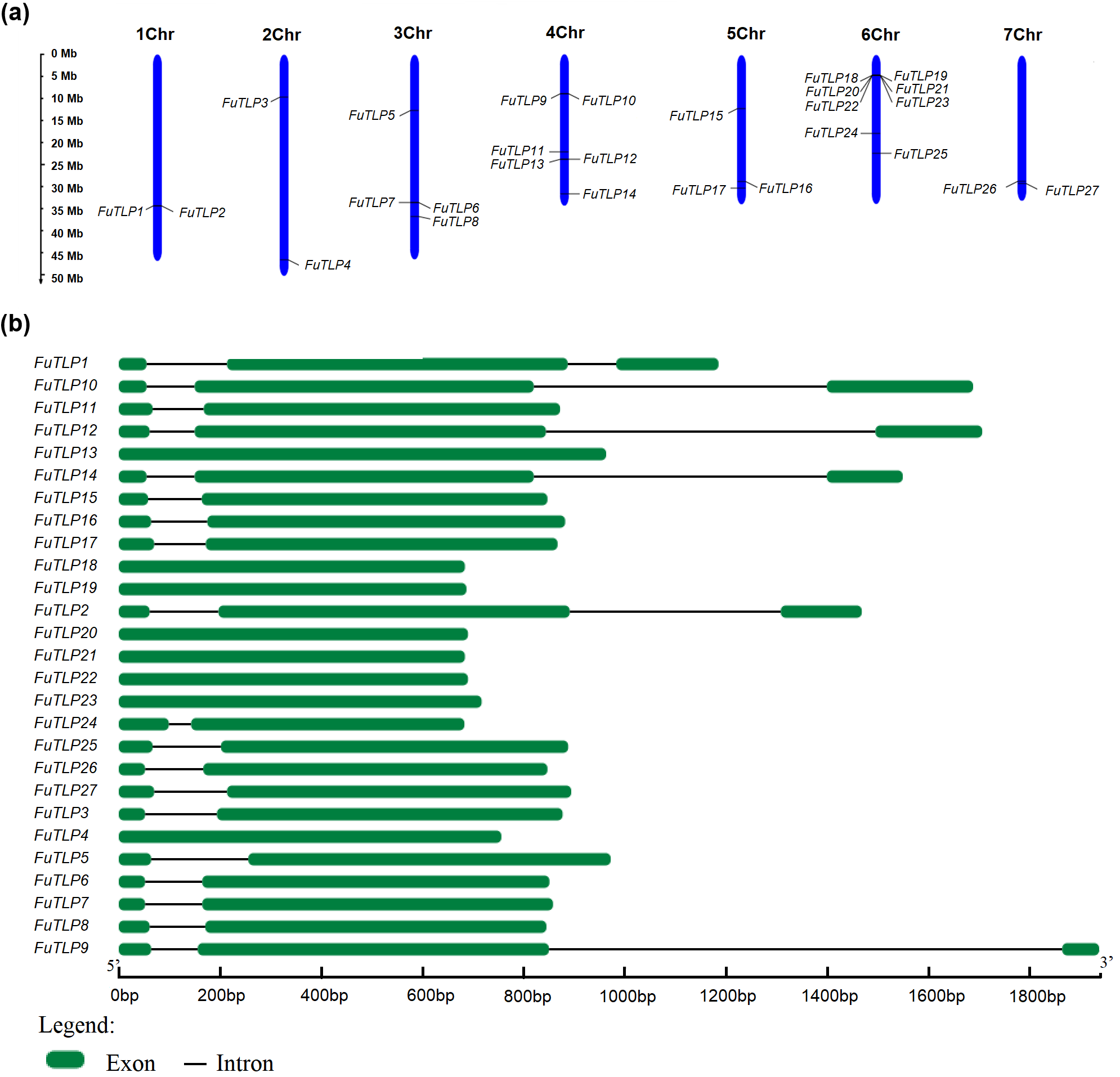
In the meadowsweet genome, 27 full-length genes encoding TLP precursors were identified. All detected genes were organized according to their relative linear positions on the chromosomes and named from FuTLP1 to FuTLP27 accordingly (Table S3, Figure 1a). The FuTLP genes were found on all seven chromosomes; however, their distribution on the chromosomes was uneven. For example, only two genes were identified on chromosomes 1, 2, and 7, while the highest number of genes (8) was found on chromosome 6 (Figure 1a).
Aligning the coding regions of the TLP genes with complete genomic nucleotide sequences revealed that 13 FuTLP genes contained one intron, and six genes had two introns (Figure 1b); eight genes carried no introns.
The characteristics of the translated proteins are shown in Table 1. All identified proteins showed homology with the TLP family of Rosaceae, with the percentage of homology ranging from 57 to 91%. BLAST annotation showed that 21 FuTLP sequences showed homology to thaumatin-like and osmotin-like proteins of the PR-5 family (Table 1). Two pairs of proteins (FuTLP14 and 24; FuTLP6 and 7) exhibited sequence similarity to hypothetical proteins from Rubus argutus and Malus domestica, respectively. Two proteins, FuTLP20 and FuTLP22, displayed sequence similarity to the P21 protein of R. chinensis.
The length of predicted FuTLP proteins ranged from 212 to 337 amino acid residues, and their molecular weights varied from 23.2 to 34.5 kDa (Table 1). All 27 FuTLP precursors were predicted to contain a signal peptide, with a length varying from 19 to 30 amino acid residues. Eight proteins were predicted to have one transmembrane domain, while FuTLP17 had two transmembrane domains (Table 1). It was established that six of the identified FuTLPs are found in vacuoles, while the others are localized extracellularly.
The pI values of the proteins ranged from 4.20 to 9.18: for 16 FuTLPs, pI values were in the acidic range from 4.20 to 6.77; three proteins had pI = 7.50 (FuTLP14), 7.52 (FuTLP5), and 7.54 (FuTLP8); and for eight proteins, pI was in the alkaline region from 7.92 to 9.18 (Table 1).
The aliphatic index of the identified FuTLPs varied from 41.74 to 78.44, characterizing these proteins as moderately thermostable (Table 1). The GRAVY index was in the range from −0.464 to 0.174, with 22 FuTLPs having negative GRAVY values. A negative GRAVY value indicates that the protein is hydrophilic and highly soluble in water.

3.2. Search for Thaumatin-like Protein Genes in Transcriptomic Data of Meadowsweet After Infection with B. sorokiniana

As a result of transcriptomic analysis of F. ulmaria infected with B. sorokiniana, 12 TLP genes were identified (Table S4); their sequences were confirmed by PCR. All sequences detected showed homology to FuTLP genes and were named trFuTLPs, and their numbers corresponded to those of their genomic counterparts. The results of the comparison of FuTLPs and trFuTLPs sequences are presented in Table 2. Three trFuTLPs (trFuTLP14, 21, 23) had 100% sequence similarity at the nucleotide and amino acid levels with their respective homologs found in the genome. trFuTLP2 had only one nucleotide substitution and no amino acid substitutions compared to FuTLP2. The maximum number of nucleotide substitutions (32) was observed in trFuTLP20, resulting in 12 amino acid substitutions in the protein sequence compared to the corresponding FuTLP homolog, followed by trFuTLP22 (20 nucleotide and 10 amino acid substitutions) and trFuTLP18 (11 nucleotide and 7 amino acid substitutions) (Table 2). The occurrence of nucleotide and amino acid substitutions in transcriptomic data compared to genomic data might reflect the genetic diversity, including allelic variation, mutations, etc., of TLP genes within the species.
All identified trFuTLP proteins exhibited homology to the TLP family of Rosaceae plants, with homology levels ranging from 75% to 95% (Table 3). Among the homologs were thaumatin-like proteins of the PR-5 family of Rosa rugosa, R. chinensis, R. sericea, and Fragaria vesca, an osmotin-like protein of R. rugosa (trFuTLP4), a hypothetical protein from Rubus argutus (trFuTLP14), and protein P21 of R. chinensis (trFuTLP20 and trFuTLP22).
The length of trFuTLPs ranged from 227 to 337 amino acid residues (Table 3). For all trFuTLP precursors, the presence of a signal peptide was predicted, ranging in length from 19 to 30 amino acids. Four TLPs were predicted to contain transmembrane domains (Table 3). Seven thaumatin-like proteins are localized extracellularly, and five are in vacuoles.
The pI values varied from 4.29 to 8.48, with seven proteins having pI in the acidic range (Table 3). The aliphatic index of trFuTLPs ranged from 41.29 to 73.00, characterizing these proteins as moderately thermostable. The GRAVY index values ranged from −0.463 to 0.174, with nine trFuTLPs having negative GRAVY values, indicating hydrophilic properties, while the other three exhibited more hydrophobic properties.

3.3. Amino Acid Sequences of Thaumatin-like Proteins

The amino acid sequences of TLPs from meadowsweet are shown in Figure S1. All the identified sequences contained a conserved motif characteristic of thaumatin-like proteins: G-x-{GF}-x-C-x-T-{GA}-D-C-x(1,2)-{GQ}-x(2,3)-C and 16 cysteine residues (Figure 2). FuTLP15 had two extra cysteine residues neighboring C2 and C8; FuTLP8 (and the corresponding homolog trFuTLP8) and FuTLP27 had an extra cysteine residue before C8 and C7, respectively; and FuTLP11 and trFuTLP11 had an extra residue between C14 and C15 (Figure S1). Three TLP sequences (FuTLP1, FuTLP2, and FuTLP10) and the corresponding homologs had one additional cysteine residue in the C-terminal prodomain, while FuTLP14 and trFuTLP14 had two cysteine residues in this domain. The REDDD motif is fully conserved in 33 of the 39 TLP sequences, except for FuTLP4, trFuTLP4, FuTLP5, FuTLP17, FuTLP19, and FuTLP24 (Figure S1).
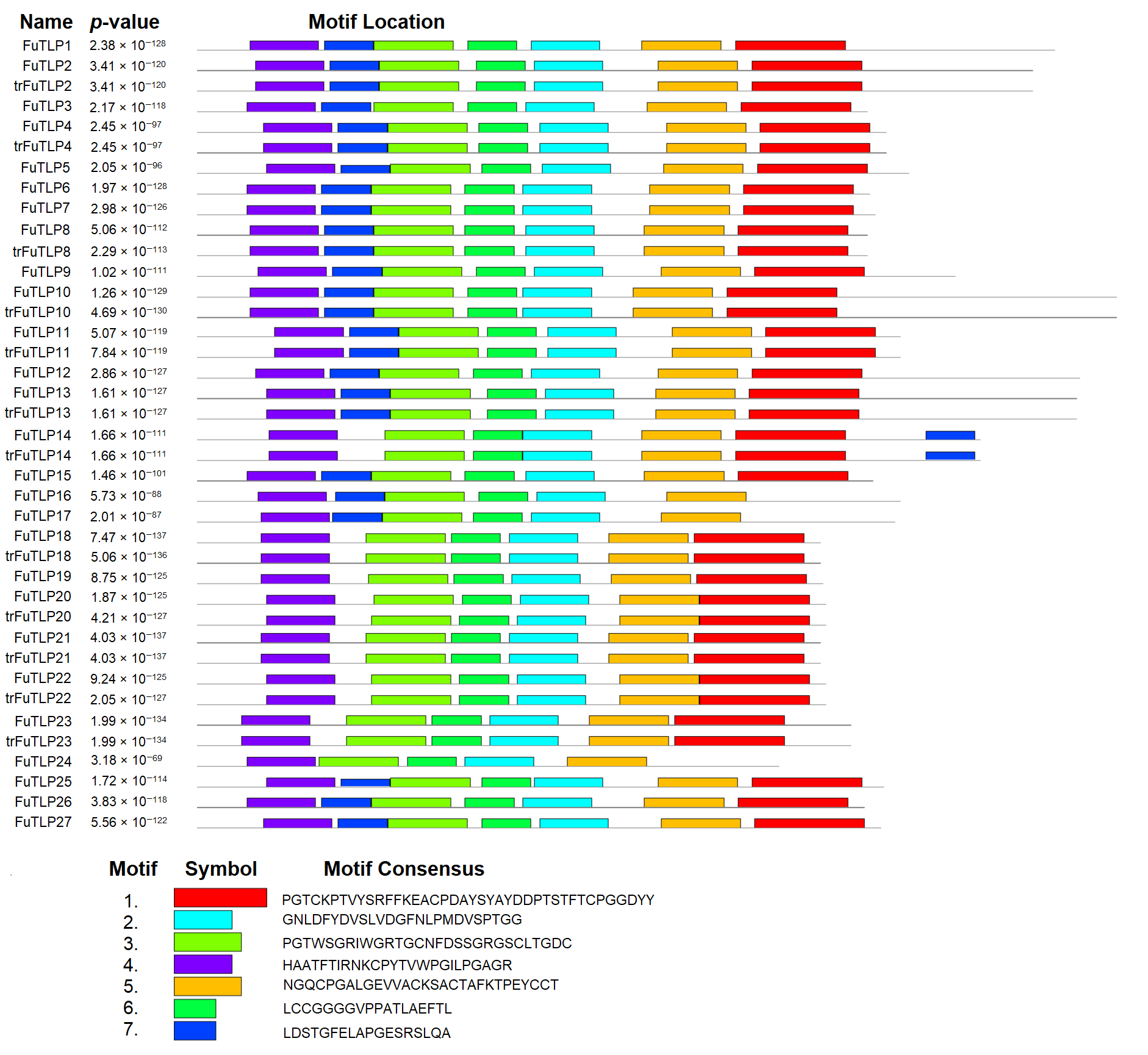
The presence of conserved motifs in FuTLPs and trFuTLPs was predicted using the MEME program [59]. We identified seven conserved motifs in FuTLP and trFuTLP sequences. Their distribution is shown in Figure 2. In most proteins, the motifs were arranged in the order 4-7-3-6-2-5-1; however, some proteins (FuTLP18, 19, 20, 21, 22, 23, 24, and the corresponding homologs) did not contain the 7th motif, and in FuTLP14 and trFuTLP14, the 7th motif is located at the very end of the molecule.

3.4. Modeling of the Three-Dimensional Structure of TLPs

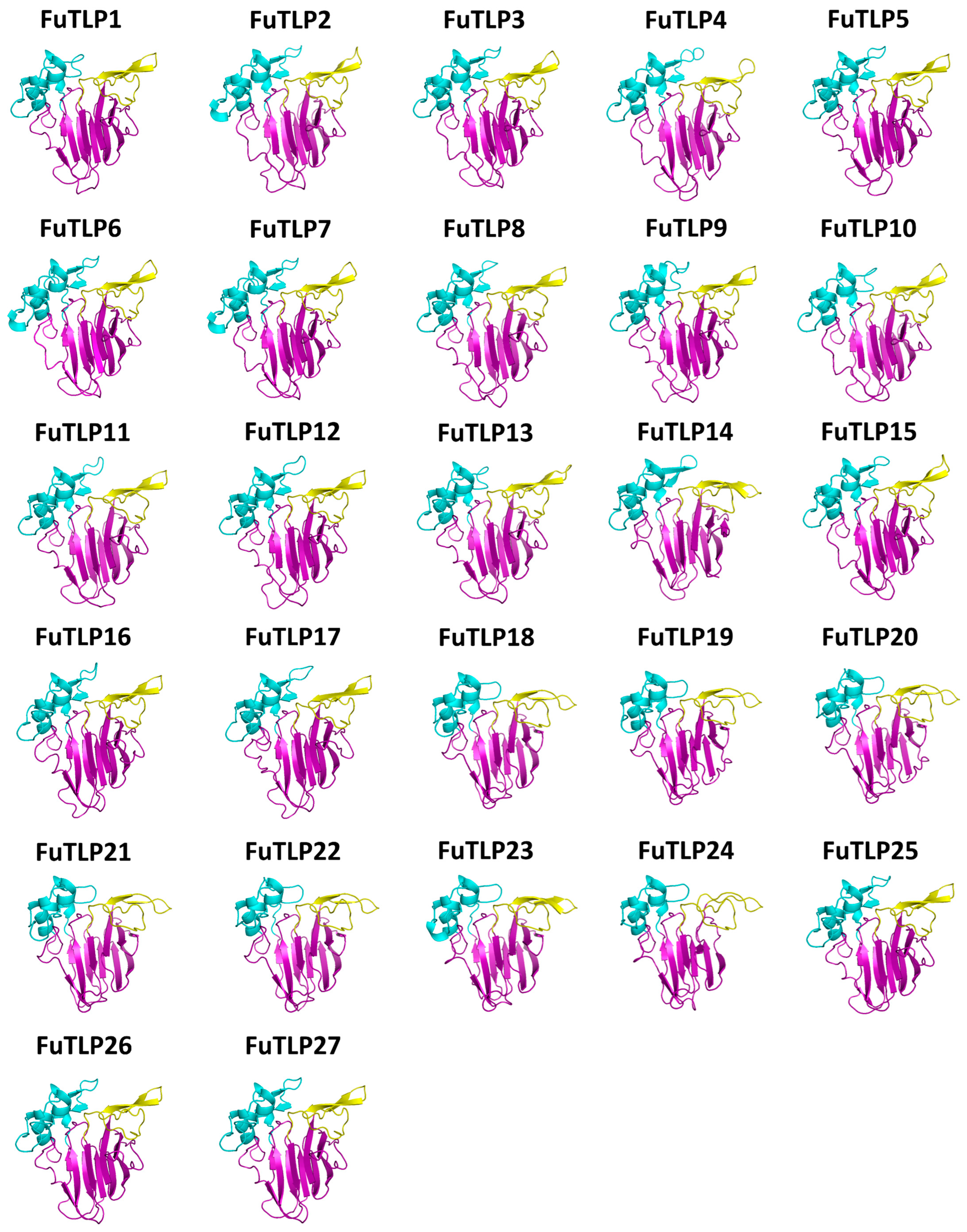
The 3D structure of FuTLPs was predicted using the homology-modeling server SWISS-MODEL (Figure 3) [62]. The best templates for the meadowsweet TLPs were 1Z3Q (Mus a 4, Musa acuminata), 3ZS3 (Mal d 2, Malus domestica), 2AHN (Pru av 2, Prunus avium), 4L2J (Osmotin, Calotropis procera), and 7P20 (Jun a 3, Juniperus ashei), whose crystallographic structures have been determined. The identity of FuTLPs and templates ranged from 42.73 to 83.00% (Table S5). The assessment of the quality of the models obtained showed that the predicted 3D structures of FuTLPs were quite reliable (Table S5).
Thaumatin-like proteins from meadowsweet, like typical TLPs, have a three-dimensional structure with three conserved domains, namely I, II, and III (Figure 3). Domain I is a lectin-like β-barrel consisting of 9–11 β-strands, while domain II is composed of 4–5 α-helical regions and loops (domain II of several TLPs also contains two antiparallel β-strands); domain III consists of a small loop and two antiparallel β-strands, with the exception of FuTLP24, in which domain III is represented by an unstructured coil (Figure 3). Two domains, I and II, form a central V-shaped cleft on the surface of the molecule, which contains predominantly hydrophilic residues (Figure 3 and Figure S2). In almost all meadowsweet TLPs, the cleft is acidic due to the presence of five highly conserved amino acid residues (arginine, glutamic acid, and three aspartic acid residues) (Figure S2), which are supposed to provide the antifungal function of TLPs [7]. The exception is FuTLP24, whose cleft is neutral because of three amino acid substitutions (Figures S1 and S2).

3.5. Phylogenetic Analysis of TLPs

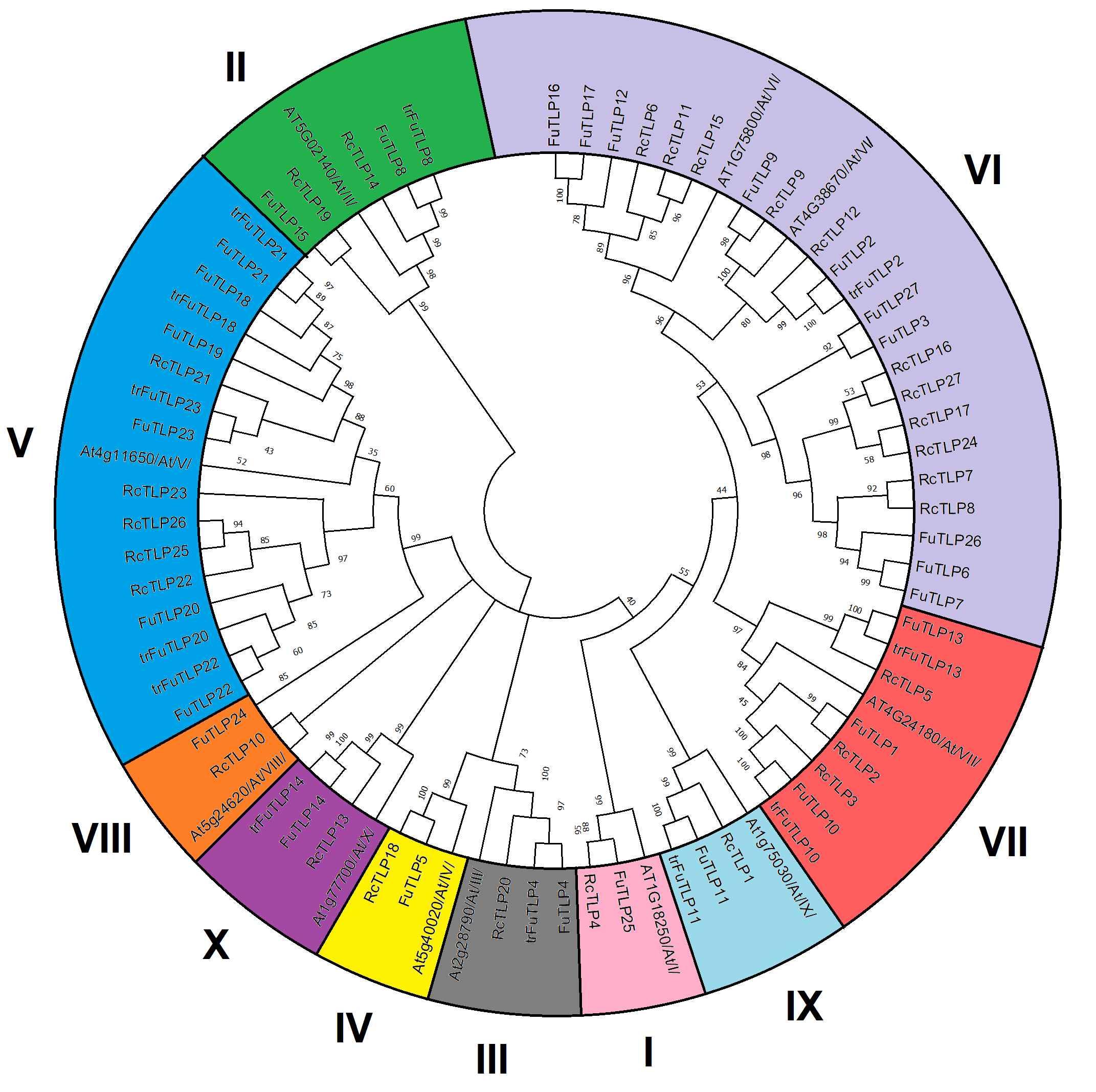
In the phylogenetic analysis of TLPs from meadowsweet, 11 TLP sequences from A. thaliana and 27 RcTLP sequences from Rosa chinensis were used as references. The distribution of meadowsweet TLPs was uneven. Thirty-nine FuTLPs (27 FuTLPs and 12 trFuTLPs) fell into 10 phylogenetic groups labeled from I to X (Figure 4). The most numerous groups, V and VI, included 11 TLPs each: Group V comprised FuTLP18, 19, 20, 21, 22, and 23, and the corresponding homologs trFuTlp18, 20, 21, 22, and 23; Group VI—FuTLP2, 3, 6, 7, 9, 12, 16, 17, 26, 27, and trFuTLP2 (Figure 4). Group VII contained five TLPs: FuTLP1, 10, 13, and trFuTLP10 and 13. Group II included three TLPs: FuTLP8, trFuTLP8, and FuTLP15. Some groups comprised one TLP along with its transcriptomic homolog (Group III, FuTLP 4 and trFuTLP4; Group IX, FuTLP11 and trFuTLP11; Group X, FuTLP14 and trFuTLP14). Group I contained a single protein, FuTLP25, as well as Group IV (FuTLP5) and Group VIII (FuTLP24).

3.6. Analysis of Differentially Expressed TLP Genes upon Infection with B. sorokiniana

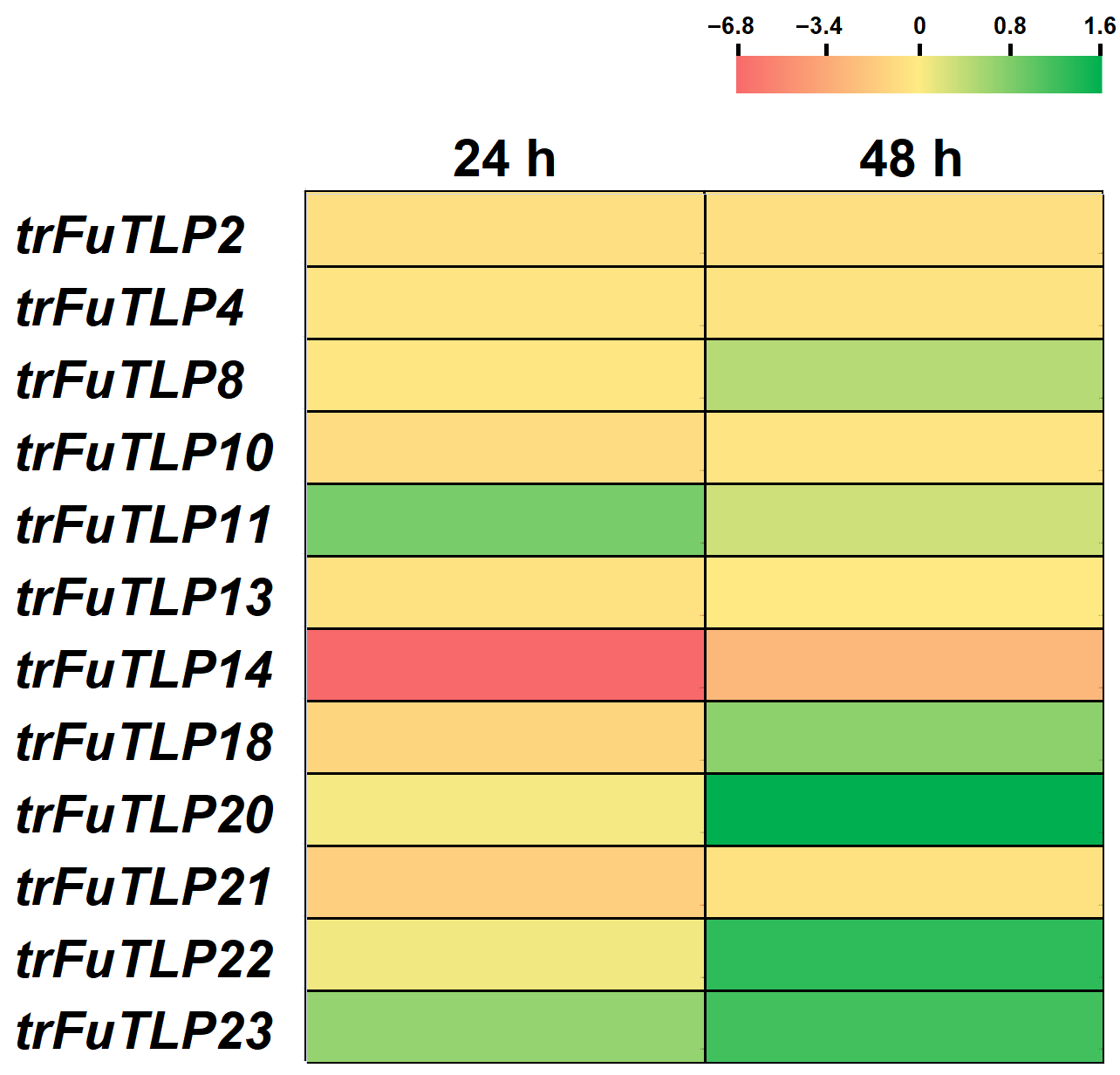
Transcriptomic analysis of F. ulmaria after infection with B. sorokiniana at 24 and 48 h post-infection revealed 12 trFuTLP genes (Figure 5). Transcriptional profiling showed that the expression of 6 out of 12 genes changed significantly in response to infection (|log2FoldChange| > 1) (Figure 5, Table S6). At 24 h after pathogen inoculation, the expression of three genes, trFuTLP14, trFuTLP18, and trFuTLP21, decreased relative to the control; moreover, the expression of the trFuTLP14 gene also decreased 48 h after infection. After 48 h, the expression of three other genes, trFuTLP20, trFuTLP22, and trFuTLP23, increased, with log2FoldChange values ranging from 1.11 to 1.60 (Figure 5). The remaining six genes did not show differential expression. Notably, only the genes from one phylogenetic group V were up-regulated in meadowsweet after infection with the fungus.
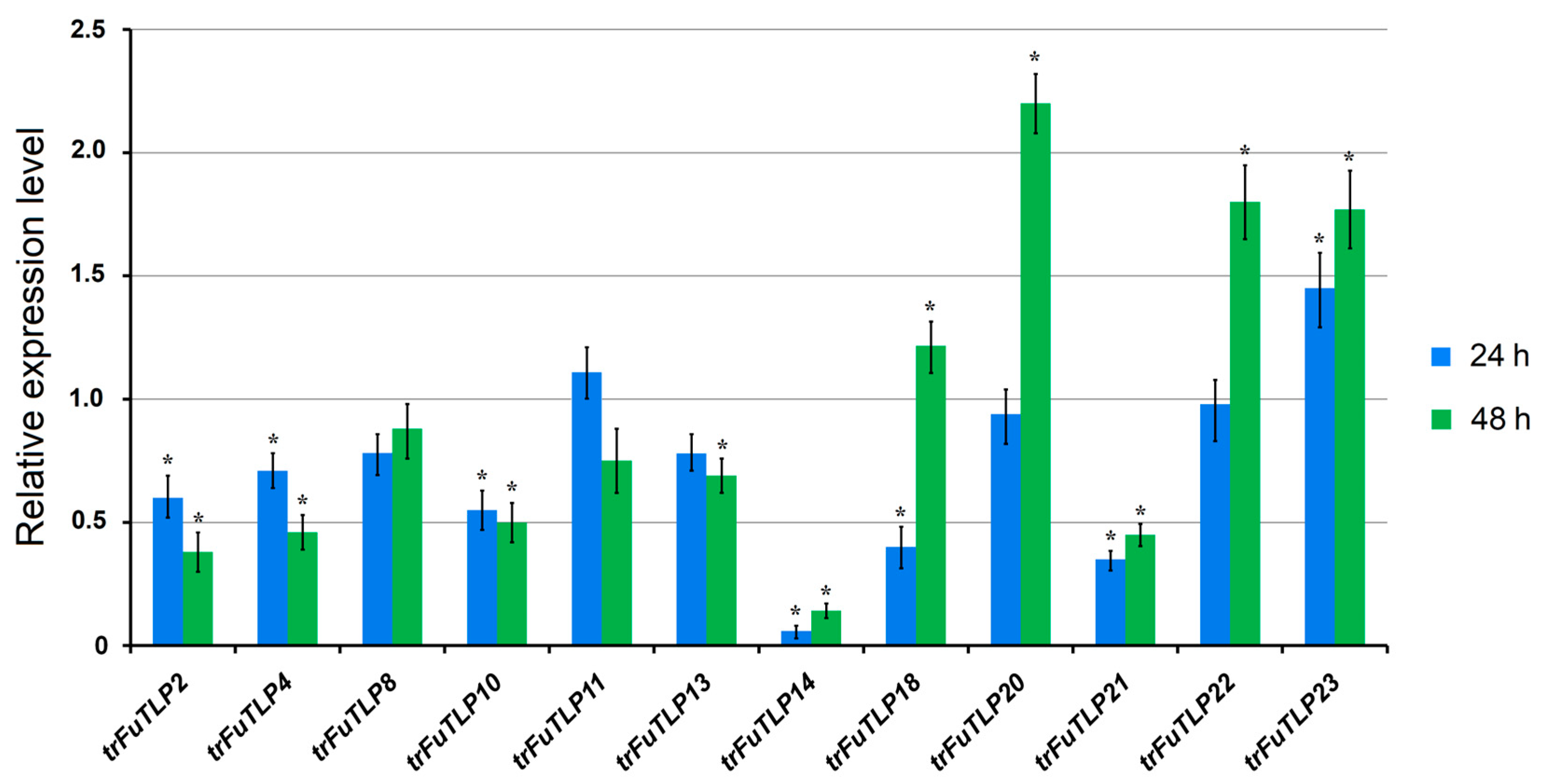
To confirm the expression levels of trFuTLP genes, quantitative real-time PCR was performed with all trFuTLP genes after infection with B. sorokiniana at 24 and 48 h (Figure 6). Increased expression of the trFuTLP23 gene was observed at 24 h, and of trFuTLP20, 22, and 23 at 48 h. Decreased expression levels were observed for the trFuTLP2, 4, 10, 14, 18, and 21 genes at 24 h, and at 48 h for trFuTLP2, 4, 10, 14, and 21. Accordingly, the results of real-time PCR matched the transcriptomic data, although the expression levels at 48 h were slightly lower than expected.

3.7. Cis-Acting Regulatory Elements in the Promoter Regions of FuTLP Genes

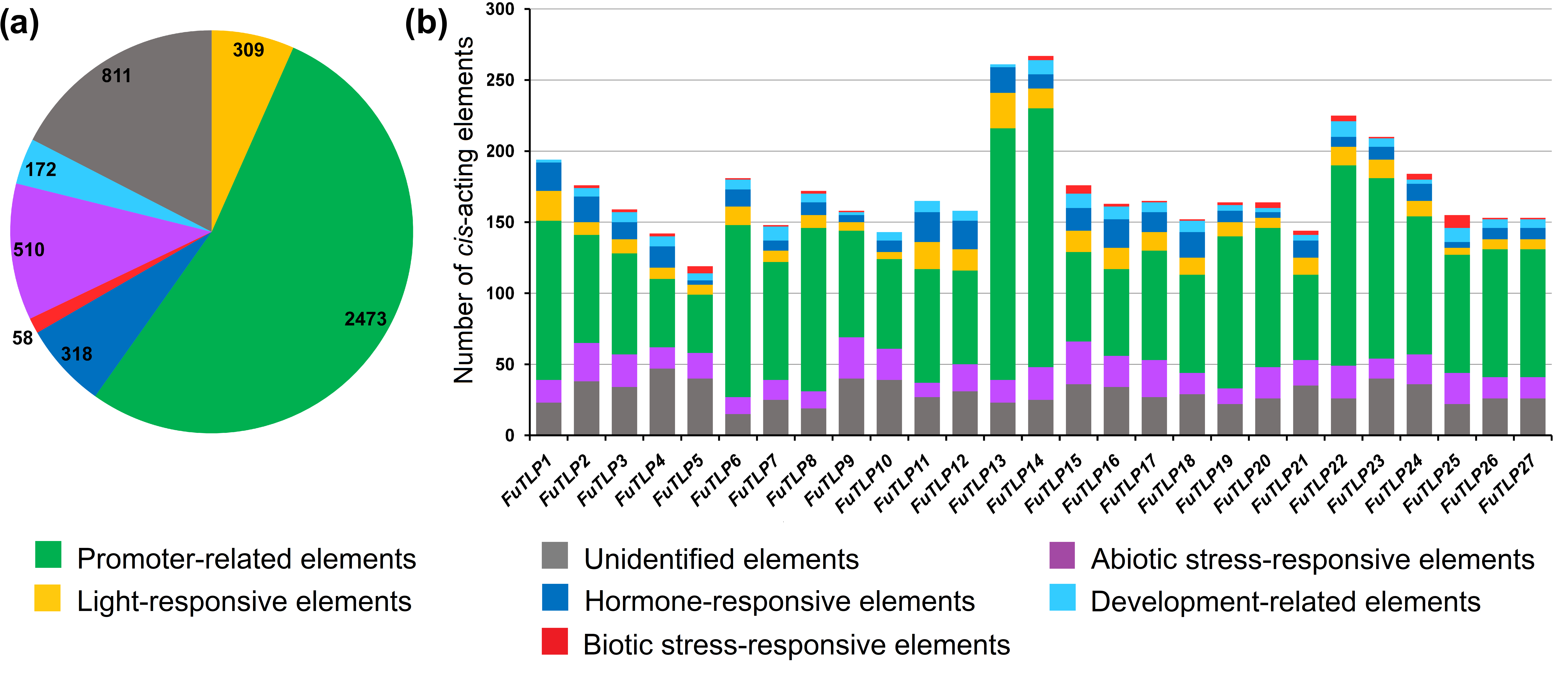
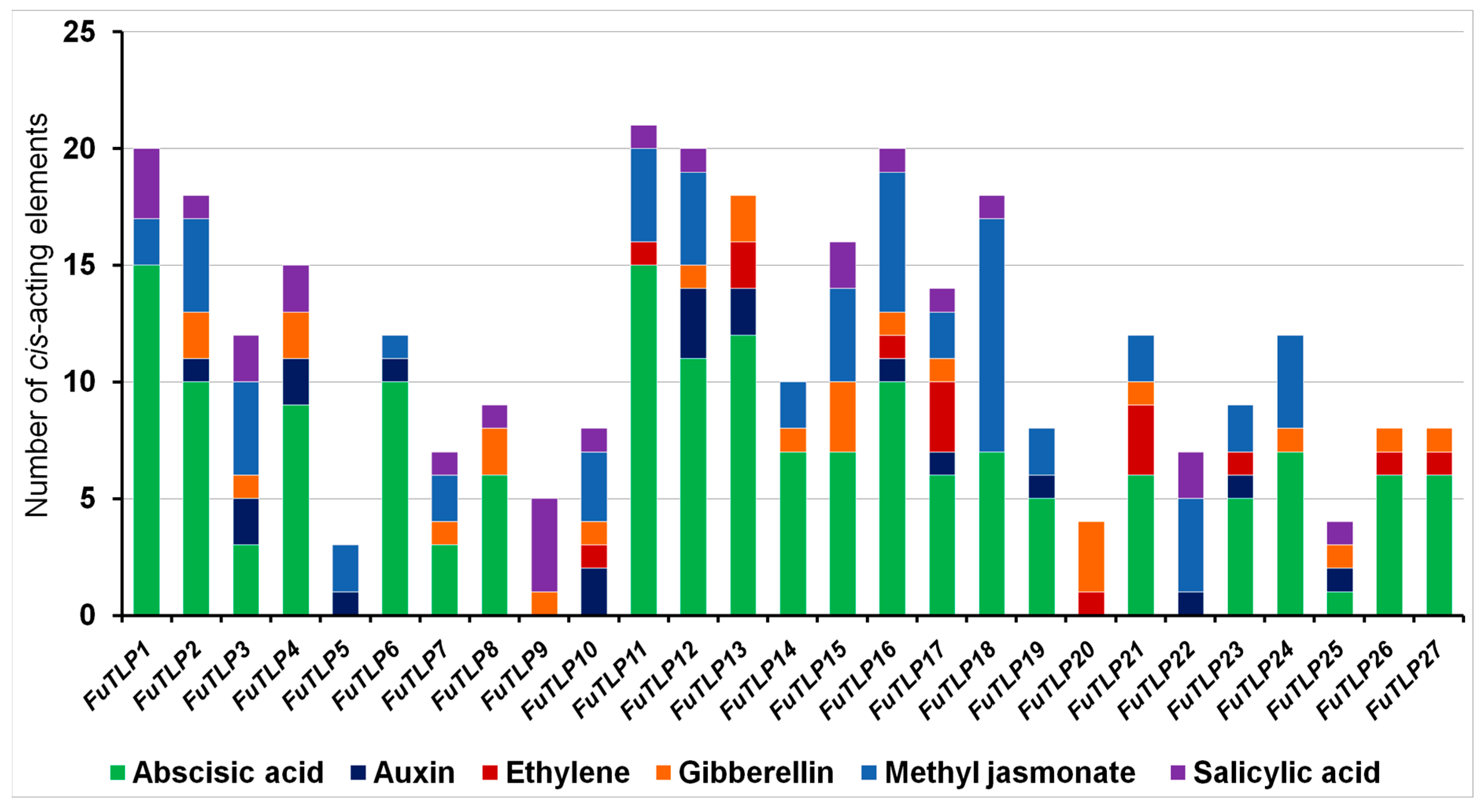
The cis-acting elements (CEs) in the gene promoter region are responsible for the regulation of gene expression, mainly by binding to specific transcription factors, during plant development and under different environmental conditions. To reveal potential CEs controlling FuTLP gene expression, the promoter sequence 2000 bp upstream of the start codon site was analyzed. A total of 93 different types of cis-acting regulatory elements were identified, with their total number reaching 4651. These elements were divided into seven groups depending on the biological processes they are putatively involved in: (1) promoter-related elements, (2) light-responsive elements, (3) elements responsive to abiotic stress, (4) elements responsive to biotic stress, (5) hormone-responsive elements, (6) development-related elements, and (7) unidentified cis-acting elements (Figure 7, Table S7).
The number of promoter-related CEs, specifically TATA-box, CAAT-box, AT~TATA-box, A-box, and TATA, totaled 2473; their number ranged from 60 in FuTLP21 to 182 in FuTLP14 (Figure 7, Table S7). The second largest group consisted of 811 CEs that were not functionally characterized. They were distributed from 15 in FuTLP6 to 47 in FuTLP4. Another group of CEs, consisting of 309 sites, is responsive to light (Figure 7, Table S7). The most numerous CEs in this group are Box 4, G-box, GT1-motif, GATA-motif, and Sp1. The number of elements ranged from 5 in FuTLP10 and FuTLP25 to 25 in FuTLP13. CEs involved in plant development were also identified in the promoters of FuTLP genes (Figure 7, Table S7). Among the 172 elements discovered, the most numerous were the AAGAA-motif, CAT-box, and O2-site. The highest number of CEs putatively involved in developmental processes was observed in FuTLP22 (11 CEs), while FuTLP1, FuTLP9, and FuTLP13 had only two such elements.
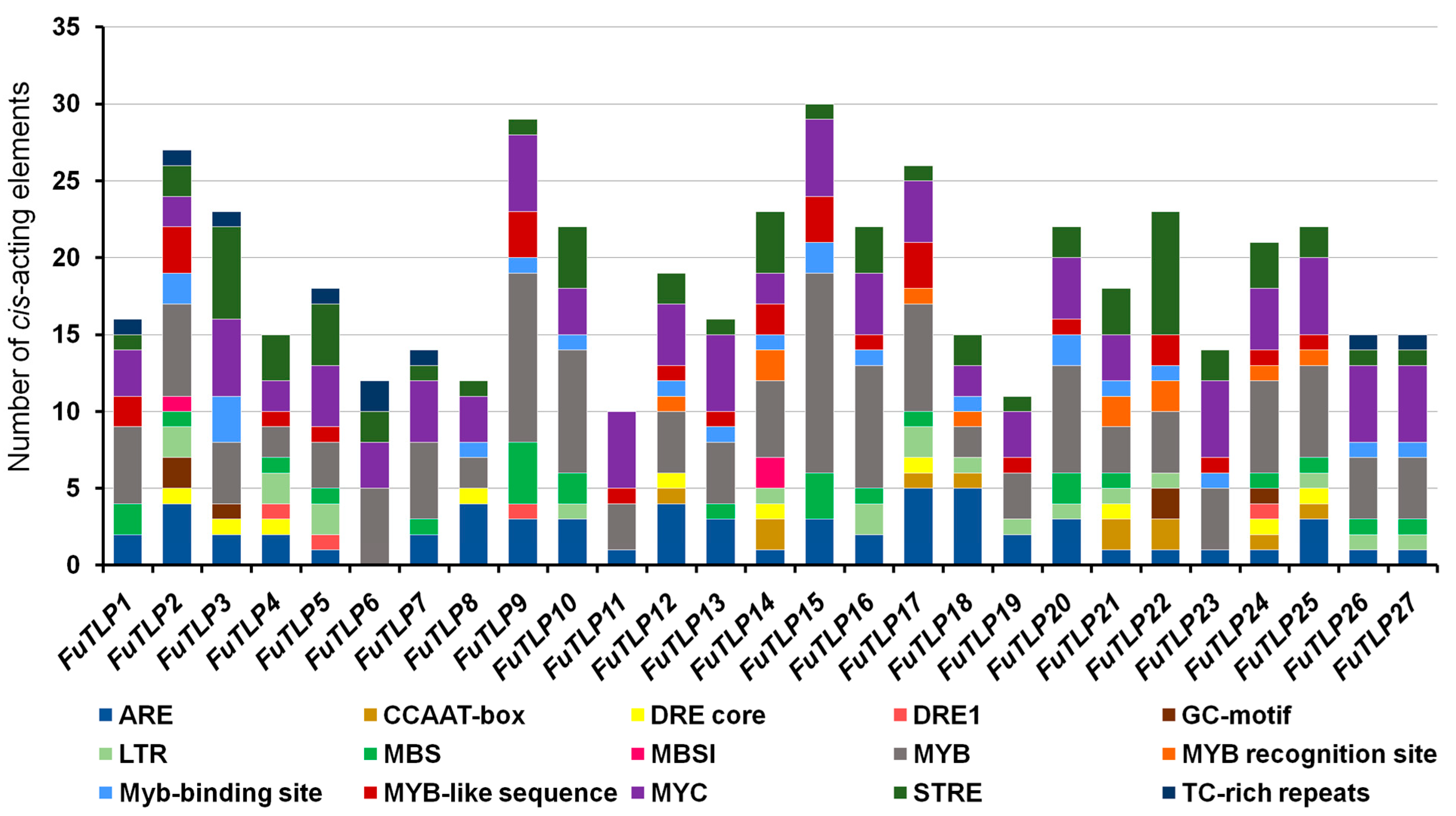
The group of abiotic stress-responsive elements included 510 CEs (Figure 7 and Figure 8). The highest number (30 CEs) of these elements was found in FuTLP15, and the lowest number (10 CEs) was discovered in FuTLP11. The most numerous CEs, MYB and MYC, putatively involved in responses to abiotic stress and in plant developmental processes, were discovered in all genes (Figure 8, Table S7) [66,67]. A stress-responsive element (STRE) that initiates transcriptional regulation of genes in response to diverse stresses was found in all FuTLP genes except FuTLP22. An anaerobic-responsive element (ARE) essential for anaerobic induction was found in all FuTLP genes except FuTLP6 (Figure 8, Table S7). It is noteworthy that a low-temperature responsive element (LTR) was detected in 15 FuTLP genes: FuTLP2, 4, 5, 10, 14, 16, 17, 18, 19, 20, 21, 22, 25, 26, and 27. Therefore, the expression of FuTLP genes may be regulated by abiotic stress-responsive CEs.
The next group of CEs, including 318 sites that were found in the promoters of FuTLP genes, comprises elements responsive to hormones (Figure 9, Table S7). All FuTLPs contained hormone-responsive elements, with the majority putatively responding to at least two of the six hormones (Figure 9). Most FuTLPs (22) had CEs responsive to abscisic acid (ABA): ABRE, ABRE3a, ABRE4, and AT~ABRE. Less common were elements responsive to methyl jasmonate (CGTCA-motif, GTGGC-motif, TGACG-motif) and gibberellin (GARE-motif, P-box, TATC-box). Such CEs, as AuxRR-core, TGA-box, and TGA-element, are involved in auxin responsiveness. TCA and TCA-elements participate in the response to salicylic acid. The ERE element is sensitive to ethylene.
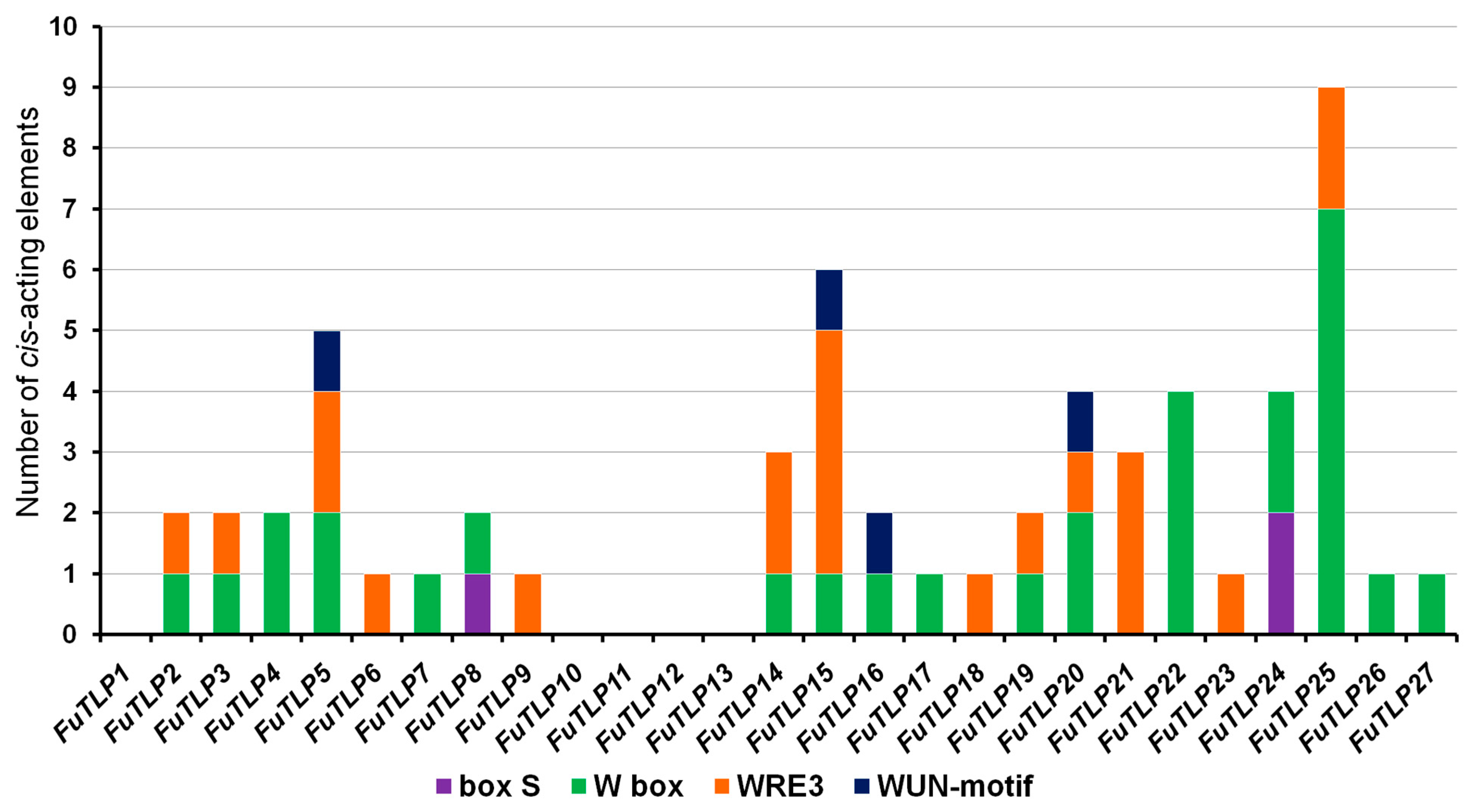
The smallest group, consisting of 58 CEs, includes those responsive to biotic stress (Figure 10, Table S7). Cis-elements, such as box S, W box, WRE3, and WUN-motif, interact with transcription factors under biotic stress conditions and act as damage-responsive elements [68]. The most numerous of these elements, the W-BOX, responds to wounding and fungal elicitors and was detected in FuTLP2, 3, 4, 5, 7, 8, 14, 15, 16, 17, 19, 20, 22 (4 CEs), 24, 25 (7 CEs), 26, and 27. It is also worth noting that FuTLP1, 10, 11, 12, and 13 did not have any CEs involved in biotic stress responses.

4. Discussion

PR-5 family proteins were discovered in different plant species several decades ago. They are encoded by multigene families and found not only in plants, but in animals and fungi as well. Plant PR-5 proteins comprise polypeptides with considerable sequence similarity among family members both within and between species and a common fold of the molecule. The concept that PR-5 family proteins are involved in defense against biotic and abiotic stresses and in developmental processes has been well substantiated by experimental data [7]. Although considerable progress has been achieved in PR-5 protein family research, the biological activity of the individual members, the mode of action, and the determinants of antifungal activity remain largely unexplored and are only beginning to be clarified.
Meadowsweet F. ulmaria (2n = 14) is a well-known medicinal plant used in traditional medicine to cure various diseases. Beyond its ability to alleviate pain, meadowsweet exhibits anti-inflammatory, antibacterial, and antioxidant effects, which can be used to treat various conditions such as colds, flu-like illnesses, and joint or muscle pain. The role of PR proteins in the biological activities of meadowsweet has not been studied so far. In this work, we performed a genome-wide analysis of F. ulmaria TLP genes, belonging to the PR-5 protein family, studied the structure of FuTLP genes and encoded proteins, and examined transcription of FuTLP genes in response to the fungal infection.
In the meadowsweet genome, we identified 27 putative TLP genes named FuTLP1–27. In a closely related diploid species, R. chinensis, the same number of TLP genes was discovered by genome-wide analysis [36]. In contrast, in an octaploid cultivated strawberry, Fragaria × ananassa, belonging to the same Rosaceae family, 76 TLPs were identified [37]. Thus, the number of TLP genes varies in different species.
The FuTLP genes were unevenly distributed on all seven chromosomes. The highest number of genes (8) was found on chromosome 6, and only two genes were identified on chromosomes 1, 2, and 7 (Figure 1a). On chromosome 6, a cluster of six genes, including FuTLP18FuTLP23, was discovered. Several FuTLP genes formed pairs of genes located in close proximity to each other: FuTLP1 and FuTLP2 on chromosome 1; FuTLP6 and FuTLP7 on chromosome 3; FuTLP9 and FuTLP10, as well as FuTLP12 and FuTLP13 on chromosome 4; and FuTLP26 and FuTLP27 on chromosome 7. Clustering of multiple TLP genes on the same chromosome suggests tandem duplication as one of the possible mechanisms for the expansion of the TLP family in meadowsweet. As a driving force of evolution, duplications often lead to neofunctionalization—the acquisition of new functions—for the duplicated genes. We observed the diversification of functions among the TLP family members (see below).
Most FuTLP genes contained one or two introns. Eight genes (FuTLP4, 13, 18, 19, 20, 21, 22, 23) carried no introns (Figure 1b). Note that six of them were located in the gene cluster on chromosome 6. The transcription and translation of genes without introns occur more quickly than that of intron-containing genes due to the absence of splicing of primary transcripts, which is important for a quick response to environmental stressors.
F. ulmaria TLPs are synthesized as precursor proteins containing a signal peptide that mediates transport across the membrane of the endoplasmic reticulum and subsequent transport to other organelles or extracellular space [69]. Most FuTLPs are predicted to be secreted to the extracellular space, and only 6 (FuTLP18, 19, 20, 21, 22, 23) are localized in the vacuole. This finding suggests that these six FuTLPs are functionally different from the other FuTLPs.
Prediction of physicochemical properties of FuTLPs showed that the family comprises acidic, neutral, and basic proteins, which is typical for TLP families from other plants (Table 1 and Table 3). All FuTLPs contain a signature G-x-{GF}-x-C-x-T-{GA}-D-C-x(1,2)-{GQ}-x(2,3)-C, characteristic of the plant TLP family. They also have 16 cysteine residues found in “long” plant TLPs in conserved positions that form disulfide bonds. Two extra cysteine residues of FuTLP15 and an extra cysteine residue of FuTLP8, FuTLP27, and FuTLP11 are not involved in the formation of disulfide bonds and do not affect the spatial structure of the proteins. Furthermore, four TLPs, FuTLP1, 2, 10, and 14, have additional cysteines in the C-terminal extensions (Figure S1).
FuTLPs show sequence similarity of 57–91% to the TLPs from Rosaceae plants. Analysis of the conserved motifs in FuTLP sequences with MEME disclosed seven motifs arranged in the same order in most FuTLPs; however, seven proteins (FuTLP18, 19, 20, 21, 22, 23, 24) lacked one of the motifs, and in FuTLP14, it was located at the C-terminal region of the molecule. It is of interest that again FuTLP18, 19, 20, 21, 22, and 23 stay apart from other FuTLPs. Several FuTLPs (FuTLP1, 2, 9, 10, 12, 13, 14, 23) have C-terminal extensions after the last conserved motif. The role of the C-terminal prodomain remains obscure. In Solanum nigrum osmotins, it is supposed to target them to the vacuole [70]. However, not all osmotins harbor the C-terminal propeptide. For example, soybean osmotins GmOLPa and P21, as well as P21-like and GmOLPa-like isoforms, do not have C-terminal extensions [71]. In meadowsweet, six FuTLPs (FuTLP18–23) were predicted to be located in the vacuoles (Table 1). However, only FuTLP23 possesses a C-terminal propeptide of 18 amino acid residues, suggesting that vacuolar transport of FuTLPs may not be associated with the C-terminal prodomain.
Molecular modeling shows that FuTLPs adopt a typical structure of plant TLPs, consisting of three domains with a V-shaped cleft between domains I and II, which is supposed to bind ligands or receptors (Figure 3 and Figure S2). In most FuTLPs, the cleft is composed of five conserved residues REDDD (the negative charge −3), which are assumed to be important for antifungal activity [7]. The five conserved residues are found in all FuTLPs except FuTLP4, 5, 17, 19, and 24, in which substitutions at positions II, III, and IV are observed (Figure S2). In FuTLP19, D is replaced by E; however, the same negative charge of the cleft is retained; in FuTLP5, the acidic glutamic acid is replaced for neutral Q, just reducing the negative charge of the cleft by 1; in addition to this, in FuTLP4 there was another substitution of the first aspartic acid residue for G, which led to a reduced negative charge of −1; while in FuTLP24, three amino acid residues EDD are substituted for QSN, resulting in the neutral charge of the pentapeptide in the cleft. We may suggest that FuTLP24 exhibits other functions than the remaining meadowsweet TLPs; however, this suggestion requires experimental verification.
Phylogenetic analysis of F. ulmaria TLPs, in combination with A. thaliana TLPs and R. chinensis TLPs, showed that they fall into 10 clusters, with an uneven distribution of family members among the clusters (Figure 4). Groups V and VI were the most abundant. It is worth noting that group V includes TLP AT4G11650 (ATOSM34) from Arabidopsis involved in the defense response to pathogens and environmental stress, and RcTLP21 and RcTLP23 from rose, responsive to drought and salt stress [36,72,73,74], suggesting that FuTLP18–23 in this cluster might have similar functions. It is also known that the TLP AT1G75800 from Arabidopsis, belonging to group VI, participates in defense responses against both biotic and abiotic stresses, and several rose TLPs from the same group (RcTLP6, RcTLP7, RcTLP8, RcTLP24, and RcTLP27) are involved in drought and salt response [36,75]. We may speculate that eleven meadowsweet TLPs in this Group VI have similar properties. However, this suggestion needs experimental validation.
Studies of the R. chinensis TLPs at three different stages of flower development showed that genes of six RcTLPs (RcTLP3 (Group VII), RcTLP4 (Group I), RcTLP6 (Group VI), RcTLP16 (Group VI), RcTLP20 (Group III), and RcTLP27 (Group VI)) have high expression levels in the ovary, tube, and flower [36]. It can be hypothesized that meadowsweet TLPs in these clusters may also play a role in flower development.
Transcriptomic analysis of F. ulmaria after infection with B. sorokiniana showed that of 27 TLP genes found in the genome, 12 were expressed under the experimental conditions used. Infection with the fungus led to considerable changes in the expression of six TLP genes. In F. ulmaria, 24 h after pathogen inoculation, three genes, trFuTLP14, trFuTLP18, and trFuTLP21, were down-regulated (Figure 5). After 48 h, three other genes, trFuTLP20, trFuTLP22, and trFuTLP23, were up-regulated while trFuTLP14 was still down-regulated. It is of particular interest that the meadowsweet differentially expressed genes (with one exception, trFuTLP14) have no introns (see above), and thus can be rapidly expressed in response to infection or other types of stress. The up-regulated genes—trFuTLP20, trFuTLP22, and trFuTLP23—are, thus, involved in response to B. sorokiniana infection. Notably, only the genes from the phylogenetic Group V associated with stress response were up-regulated in F. ulmaria. Some meadowsweet TLP genes are not responsive to B. sorokiniana infection. This observation suggests that these constitutively expressed genes may participate in the physiological processes that are not associated with biotic stress.
Our results on up-regulation of meadowsweet TLP genes in response to infection are supported by studies on other plants. For example, in rose, following infection with the fungal pathogen Botrytis cinerea, up-regulation of three RcTLP genes (RcTLP23, RcTLP6, and RcTLP7) was observed, with the maximum expression level occurring within 48 h after infection [36]. In Vitis vinifera, high expression levels of osmotin and other thaumatin-like protein genes were observed in leaves and berries after infection with Uncinula necator, Phomopsis viticola, and B. cinerea [76]. High expression level of thaumatin and osmotin genes in a resistant grapevine variety (V. vinifera, Chardonnay) correlated with suppression of growth of spores and hyphae of Elsinoe ampelina [77]. A thaumatin protein gene, TaPR5 from wheat, was induced by stripe rust fungus [78]. Several TLP genes of Fragaria × ananassa were up-regulated after Colletotrichum gloeosporioides infection [37]. The TLP genes from garlic were differentially expressed in resistant and susceptible garlic cultivars in response to Fusarium proliferatum infection [31]. All these results support the idea that TLPs from different plants participate in defense responses against pathogens.
All promoters of FuTLP genes contain cis-acting regulatory elements associated with the activation of defense mechanisms in response to biotic and abiotic stress (such as anaerobic conditions, drought (dehydration), low temperature, and salinity) (Figure 7, Figure 8 and Figure 10). Additionally, CEs involved in hormone activation, responsible for initiating signaling pathways, were identified (Figure 9). A large number of CEs involved in the regulation of plant development throughout the entire vegetative period were also found. The presence of particular CEs in the promoters of FuTLP genes might point to possible functions of the corresponding proteins. Thus, TLP genes activated in response to B. sorokiniana infection—trFuTLP20, trFuTLP22, and trFuTLP23—are enriched in CEs associated with biotic stress response, supporting this suggestion. Nevertheless, the promoters of each FuTLP gene contain a variety of different CEs. Only a few FuTLPs, FuTLP1, 10, 11, 12, and 13, do not possess CEs related to activation of biotic stress response.
The abundance of regulatory elements in the promoter regions of TLP genes was reported for other plant species [29,30,31,35,36,37,38]. The presence of such a wide variety of regulatory elements in the promoters of TLP genes suggests that these genes are expressed under variable conditions and that they perform multiple functions in plants.

5. Conclusions

In summary, a total of 27 TLP genes were discovered in the F. ulmaria genome. The FuTLP genes are unevenly distributed across seven chromosomes, with chromosome 6 containing the highest number (8 genes). Several FuTLP genes have no introns; the remaining genes have one or two introns. Studies of the FuTLP promoter cis-acting elements revealed a multiplicity of predicted regulatory elements putatively associated with hormone signaling and abiotic and biotic stress responses. Subcellular localization predictions showed that most FuTLPs are located in the extracellular space and only six are in vacuoles. Multiple sequence alignment demonstrated that most TLPs possessed five conserved REDDD amino acid sequences associated with antifungal activity. Phylogenetic analysis with A. thaliana and R. chinensis TLPs grouped the FuTLPs into 10 clusters. Transcription profiling of meadowsweet TLP genes in response to B. sorokiniana infection revealed six differentially expressed genes, of which three genes, trFuTLP20, 22, and 23, were up-regulated, suggesting their involvement in defense response to fungal infection. This suggestion is supported by the intronless structure of the up-regulated genes, the presence of biotic stress-responsive cis-regulatory elements in their promoter regions, and phylogenetic analysis, grouping these genes together with TLPs from other plant species with established defensive roles. The combined data on the F. ulmaria TLP genes and proteins, phylogenetic analysis, cis-acting regulatory elements, and expression in response to stress indicate the divergence of functions among FuTLP family members. Overall, we comprehensively studied the TLPs genes and proteins in meadowsweet and their involvement in response to fungal infection. The results obtained offer valuable clues for understanding the various biological functions of FuTLPs. Future studies will disclose their specific role in resistance to biotic and abiotic stressors and developmental processes and elucidate the structural basis of their biological activity.

Supplementary Materials

The following supporting information can be downloaded at https://www.mdpi.com/article/10.3390/cimb48060640/s1.

Author Contributions

Conceptualization, E.A.I. and T.I.O.; methodology, E.A.I. and M.P.S.; validation, E.A.I. and M.P.S.; formal analysis, E.A.I., M.P.S. and T.I.O.; investigation, E.A.I. and M.P.S.; data curation, E.A.I. and M.P.S.; writing—original draft preparation, E.A.I., M.P.S. and T.I.O.; writing—review and editing, M.P.S. and T.I.O.; visualization, E.A.I. and M.P.S.; funding acquisition, E.A.I., M.P.S. and T.I.O. All authors have read and agreed to the published version of the manuscript.

Funding

This research was funded by the state assignment of the Ministry of Science and Higher Education of the Russian Federation for VIGG RAS number 125091010191-6.

Institutional Review Board Statement

Not applicable.

Informed Consent Statement

Not applicable.

Data Availability Statement

The original contributions presented in this study are included in the article. Further inquiries can be directed to the corresponding author.

Conflicts of Interest

The authors declare no conflicts of interest.

Abbreviations

The following abbreviations are used in this manuscript:
PR proteinsPathogenesis-related proteins
PR-5Pathogenesis-related protein family 5
TLPThaumatin-like protein
AMPsAntimicrobial peptides
pIIsoelectric point
GRAVYGrand Average of Hydropathy
CECis-acting element

References

  1. Oerke, E.C. Crop losses to pests. J. Agric. Sci. 2006, 144, 31–43. [Google Scholar] [CrossRef]
  2. Tudi, M.; Daniel Ruan, H.; Wang, L.; Lyu, J.; Sadler, R.; Connell, D.; Chu, C.; Phung, D.T. Agriculture development, pesticide application and its impact on the environment. Int. J. Environ. Res. Public Health 2021, 18, 1112. [Google Scholar] [CrossRef] [PubMed]
  3. Gianinazzi, S.; Martin, C.; Vallée, J.C. Hypersensitivity to viruses, temperature and soluble proteins in Nicotiana Xanthi n.c. appearance of new macromolecules at the repression of viral synthesis. C. R. Hebd. Seances Acad. Sci. Ser. D Sci. Nat. 1970, 270, 2383–2386. [Google Scholar]
  4. van Loon, L.C.; van Kammen, A. Polyacrylamide disc electrophoresis of the soluble leaf proteins from Nicotiana tabacum var. “Samsun” and “Samsun NN”. II. Changes in protein constitution after infection with tobacco mosaic virus. Virology 1970, 40, 190–211. [Google Scholar] [CrossRef] [PubMed]
  5. Dos Santos, C.; Franco, O.L. Pathogenesis-related proteins (PRs) with enzyme activity activating plant defense responses. Plants 2023, 12, 2226. [Google Scholar] [CrossRef] [PubMed]
  6. Kaur, A.; Kaur, S.; Kaur, A.; Sarao, N.K.; Sharma, D. Pathogenesis-related proteins and their transgenic expression for developing disease-resistant crops: Strategies progress and challenges. In Case Studies of Breeding Strategies in Major Plant Species; Wang, H., Ed.; IntechOpen: London, UK, 2022; pp. 1–28. [Google Scholar] [CrossRef]
  7. Liu, J.J.; Sturrock, R.; Ekramoddoullah, A.K.M. The superfamily of thaumatin-like proteins: Its origin, evolution, and expression towards biological function. Plant Cell Rep. 2010, 29, 419–436. [Google Scholar] [CrossRef] [PubMed]
  8. de Jesús-Pires, C.; Ferreira-Neto, J.R.C.; Pacifico Bezerra-Neto, J.; Kido, E.A.; de Oliveira Silva, R.L.; Pandolfi, V.; Wanderley-Nogueira, A.C.; Binneck, E.; da Costa, A.F.; Pio-Ribeiro, G.; et al. Plant thaumatin-like proteins: Function, evolution and biotechnological applications. Curr. Protein Pept. Sci. 2020, 21, 36–51. [Google Scholar] [CrossRef] [PubMed]
  9. Feng, L.; Wei, S.; Li, Y. Thaumatin-like proteins in legumes: Functions and potential applications—A review. Plants 2024, 13, 1124. [Google Scholar] [CrossRef] [PubMed]
  10. Koiwa, H.; Kato, H.; Nakatsu, T.; Oda, J.; Yamada, Y.; Sato, F. Crystal structure of tobacco PR-5d protein at 1,8 Å resolution reveals a conserved acidic cleft structure in antifungal thaumatin-like proteins. J. Mol. Biol. 1999, 286, 1137–1145. [Google Scholar] [CrossRef] [PubMed]
  11. Roberts, W.K.; Selitrennikoff, C.P. Zeamatin, an antifungal protein from maize with membrane-permeabilizing activity. J. Gen. Microbiol. 1990, 136, 1771–1778. [Google Scholar] [CrossRef]
  12. Woloshuk, C.P.; Meulenhoff, J.S.; Sela-Buurlage, M.; Van den Elzen, P.J.M.; Cornelissen, B.J.C. Pathogen-induced proteins with inhibitory activity toward Phytophthora infestans. Plant Cell 1991, 3, 619–628. [Google Scholar] [CrossRef] [PubMed]
  13. Vigers, A.J.; Wiedemann, S.; Roberts, W.K.; Legrand, M.; Selitrennikoff, C.P.; Fritig, B. Thaumatin-like pathogenesis-related proteins are antifungal. Plant Sci. 1992, 83, 155–161. [Google Scholar] [CrossRef]
  14. Hejgaard, J.; Jacobsen, S.; Svendsen, I. Two antifungal thaumatin-like proteins from barley grain. FEBS Lett. 1991, 291, 127–131. [Google Scholar] [CrossRef] [PubMed]
  15. Liu, J.; Han, D.; Shi, Y. Gene cloning, expression, and antifungal activities of permatin from naked oat (Avena nuda). Probiotics Antimicrob. Proteins 2019, 11, 299–309. [Google Scholar] [CrossRef] [PubMed]
  16. Zareie, R.; Melanson, D.L.; Murphy, P.J. Isolation of fungal cell wall degrading proteins from barley (Hordeum vulgare L.) leaves infected with Rhynchosporium secalis. Mol. Plant Microbe Interact. 2002, 15, 1031–1039. [Google Scholar] [CrossRef] [PubMed]
  17. Vitali, A.; Pacini, L.; Bordi, E.; De Mori, P.; Pucillo, L.; Maras, B.; Botta, B.; Brancaccio, A.; Giardina, B. Purification and characterization of an antifungal thaumatin-like protein from Cassia didymobotrya cell culture. Plant Physiol. Biochem. 2006, 44, 604–610. [Google Scholar] [CrossRef] [PubMed]
  18. Jiao, W.; Li, X.; Zhao, H.; Cao, J.; Jiang, W. Antifungal activity of an abundant thaumatin-like protein from banana against Penicillium expansum, and its possible mechanisms of action. Molecules 2018, 23, 1442. [Google Scholar] [CrossRef] [PubMed]
  19. Fierens, E.; Rombouts, S.; Gebruers, K.; Goesaert, H.; Brijs, K.; Beaugrand, J.; Volckaert, G.; Van Campenhout, S.; Proost, P.; Courtin, C.M.; et al. TLXI, a novel type of xylanase inhibitor from wheat (Triticum aestivum) belonging to the thaumatin family. Biochem J. 2007, 403, 583–591. [Google Scholar] [CrossRef] [PubMed]
  20. Fierens, E.; Gebruers, K.; Voet, A.R.; De Maeyer, M.; Courtin, C.M.; Delcour, J.A. Biochemical and structural characterization of TLXI, the Triticum aestivum L. thaumatin-like xylanase inhibitor. J. Enzym. Inhib. Med. Chem. 2009, 24, 646–654. [Google Scholar] [CrossRef] [PubMed]
  21. Tundo, S.; Mandalà, G.; Sella, L.; Favaron, F.; Bedre, R.; Kalunke, R.M. Xylanase inhibitors: Defense players in plant immunity with implications in agro-industrial processing. Int. J. Mol. Sci. 2022, 23, 14994. [Google Scholar] [CrossRef] [PubMed]
  22. Grenier, J.; Potvin, C.; Trudel, J.; Asselin, A. Some thaumatin-like proteins hydrolyse polymeric beta-1,3-glucans. Plant J. 1999, 19, 473–480. [Google Scholar] [CrossRef] [PubMed]
  23. Li, X.; Xu, B.; Xu, J.; Li, Z.; Jiang, C.; Zhou, Y.; Yang, Z.; Deng, M.; Lv, J.; Zhao, K. Tomato thaumatin-like protein genes Solyc08g080660 and Solyc08g080670 confer resistance to five soil-borne diseases by enhancing β-1,3 glucanase activity. Genes 2023, 14, 1622. [Google Scholar] [CrossRef] [PubMed]
  24. Osmond, R.I.W.; Hrmova, M.; Fontaine, F.; Imberty, A.; Fincher, G.B. Binding interactions between barley thaumatin-like proteins and (1,3)-β-D-glucans. Eur. J. Biochem. 2001, 268, 4190–4199. [Google Scholar] [CrossRef] [PubMed]
  25. Parkhi, V.; Kumar, V.; Sunilkumar, G.; Campbell, L.M.; Singh, N.K.; Rathore, K.S. Expression of apoplastically secreted tobacco osmotin in cotton confers drought tolerance. Mol. Breed. 2009, 23, 625–639. [Google Scholar] [CrossRef]
  26. Subramanyam, K.; Arun, M.; Mariashibu, T.S.; Theboral, J.; Rajesh, M.; Singh, N.K.; Manickavasagam, M.; Ganapathi, A. Overexpression of tobacco osmotin (Tbosm) in soybean conferred resistance to salinity stress and fungal infections. Planta 2012, 236, 1909–1925. [Google Scholar] [CrossRef] [PubMed]
  27. Le, T.T.; Williams, B.; Mundree, S.G. An osmotin from the resurrection plant Tripogon loliiformis (TlOsm) confers tolerance to multiple abiotic stresses in transgenic rice. Physiol. Plant. 2018, 162, 13–34. [Google Scholar] [CrossRef] [PubMed]
  28. Zhao, Q.; Qiu, B.; Li, S.; Zhang, Y.; Cui, X.; Liu, D. Osmotin-like protein gene from Panax notoginseng is regulated by jasmonic acid and involved in defense responses to Fusarium solani. Phytopathology 2020, 110, 1419–1427. [Google Scholar] [CrossRef] [PubMed]
  29. Wang, L.; Xu, Z.; Yin, W.; Xu, K.; Wang, S.; Shang, Q.; Sa, W.; Liang, J.; Wang, L. Genome-wide analysis of the Thaumatin-like gene family in Qingke (Hordeum vulgare L. var. nudum) uncovers candidates involved in plant defense against biotic and abiotic stresses. Front. Plant Sci. 2022, 13, 912296. [Google Scholar] [CrossRef] [PubMed]
  30. Pang, X.; Wang, Y.; Jiang, B.; Li, D.; Zhang, H.; Liu, D.; Xu, X.; Zhao, T. Bioinformatics analysis of the tomato SlPR5 gene family and the thaumatin-like protein SlPR5-3 positively regulates tomato resistance to Pst DC3000. Plants 2025, 14, 3389. [Google Scholar] [CrossRef] [PubMed]
  31. Anisimova, O.K.; Kochieva, E.Z.; Shchennikova, A.V.; Filyushin, M.A. Thaumatin-like protein (TLP) genes in garlic (Allium sativum L.): Genome-wide identification, characterization, and expression in response to Fusarium proliferatum infection. Plants 2022, 11, 748. [Google Scholar] [CrossRef] [PubMed]
  32. Guo, M.; Ma, X.; Xu, S.; Cheng, J.; Xu, W.; Elsheery, N.I.; Cheng, Y. Genome-wide identification of TLP gene family in Populus trichocarpa and functional characterization of PtTLP6, preferentially expressed in phloem. Int. J. Mol. Sci. 2024, 25, 5990. [Google Scholar] [CrossRef] [PubMed]
  33. Gu, Y.; Yu, H.; He, S.; Zhang, P.; Ma, X. Genome-wide identification and characterization of the TLP gene family in Phyllostachys edulis and association with witches’ broom disease resistance in bamboo. Int. J. Mol. Sci. 2023, 24, 10257. [Google Scholar] [CrossRef] [PubMed]
  34. Yan, X.; Qiao, H.; Zhang, X.; Guo, C.; Wang, M.; Wang, Y.; Wang, X. Analysis of the grape (Vitis vinifera L.) thaumatin-like protein (TLP) gene family and demonstration that TLP29 contributes to disease resistance. Sci. Rep. 2017, 7, 4269. [Google Scholar] [CrossRef] [PubMed]
  35. Li, Z.; Wang, X.; Cui, Y.; Qiao, K.; Zhu, L.; Fan, S.; Ma, Q. Comprehensive genome-wide analysis of thaumatin-like gene family in four cotton species and functional identification of GhTLP19 involved in regulating tolerance to Verticillium dahlia and drought. Front. Plant Sci. 2020, 11, 575015. [Google Scholar] [CrossRef] [PubMed]
  36. Su, L.; Zhao, X.; Geng, L.; Fu, L.; Lu, Y.; Liu, Q.; Jiang, X. Analysis of the thaumatin-like genes of Rosa chinensis and functional analysis of the role of RcTLP6 in salt stress tolerance. Planta 2021, 254, 118. [Google Scholar] [CrossRef] [PubMed]
  37. Zhang, Y.; Miao, L.; Yang, X.; Jiang, G. Genome-wide characterization and expression of the TLP gene family associated with Colletotrichum gloeosporioides inoculation in Fragaria × ananassa. PeerJ 2022, 10, e12979. [Google Scholar] [CrossRef] [PubMed]
  38. Li, X.; Fan, L.; Liu, C.; Wang, X.; Zhang, X.; Tong, X. Genome-wide identification and biotic stress responses of TLP gene family in Citrus sinensis. Int. J. Mol. Sci. 2025, 26, 10133. [Google Scholar] [CrossRef] [PubMed]
  39. Andonova, T.; Muhovski, Y.; Apostolova, E.; Naimov, S.; Mladenova, S.; Slavov, I.; Dincheva, I.; Georgiev, V.; Pavlov, A.; Dimitrova-Dyulgerova, I. DNA-protective, antioxidant and anti-carcinogenic potential of meadowsweet (Filipendula ulmaria) dry tincture. Antioxidants 2024, 13, 1200. [Google Scholar] [CrossRef] [PubMed]
  40. Slezina, M.P.; Kulakovskaya, E.V.; Istomina, E.A.; Abashina, T.N.; Odintsova, T.I. Broad-spectrum antimicrobial potential of the γ-core motif peptides of Filipendula ulmaria for practical applications in agriculture and medicine. Int. J. Mol. Sci. 2025, 26, 7959. [Google Scholar] [CrossRef] [PubMed]
  41. Wang, J.; Chitsaz, F.; Derbyshire, M.K.; Gonzales, N.R.; Gwadz, M.; Lu, S.; Marchler, G.H.; Song, J.S.; Thanki, N.; Yamashita, R.A.; et al. The conserved domain database in 2023. Nucleic Acids Res. 2023, 51, D384–D388. [Google Scholar] [CrossRef] [PubMed]
  42. Blum, M.; Andreeva, A.; Florentino, L.C.; Chuguransky, S.R.; Grego, T.; Hobbs, E.; Pinto, B.L.; Orr, A.; Paysan-Lafosse, T.; Ponamareva, I.; et al. InterPro: The protein sequence classification resource in 2025. Nucleic Acids Res. 2025, 53, D444–D456. [Google Scholar] [CrossRef] [PubMed]
  43. Altschul, S.F.; Gish, W.; Miller, W.; Myers, E.W.; Lipman, D.J. Basic local alignment search tool. J. Mol. Biol. 1990, 215, 403–410. [Google Scholar] [CrossRef] [PubMed]
  44. Keller, O.; Kollmar, M.; Stanke, M.; Waack, S. A novel hybrid gene prediction method employing protein multiple sequence alignments. Bioinformatics 2011, 27, 757–763. [Google Scholar] [CrossRef] [PubMed]
  45. Solovyev, V.; Kosarev, P.; Seledsov, I.; Vorobyev, D. Automatic annotation of eukaryotic genes, pseudogenes and promoters. Genome Biol. 2006, 7, 10.1–10.12. [Google Scholar] [CrossRef] [PubMed]
  46. Chao, J.; Li, Z.; Sun, Y.; Aluko, O.O.; Wu, X.; Wang, Q.; Liu, G. MG2C: A user-friendly online tool for drawing genetic maps. Mol. Hortic. 2021, 1, 16. [Google Scholar] [CrossRef] [PubMed]
  47. Hu, B.; Jin, J.; Guo, A.Y.; Zhang, H.; Luo, J.; Gao, G. GSDS 2.0: An upgraded gene feature visualization server. Bioinformatics 2015, 31, 1296–1297. [Google Scholar] [CrossRef] [PubMed]
  48. Istomina, E.A.; Korostyleva, T.V.; Kovtun, A.S.; Slezina, M.P.; Odintsova, T.I. Transcriptome-wide identification and expression analysis of genes encoding defense-related peptides of Filipendula ulmaria in response to Bipolaris sorokiniana infection. J. Fungi 2024, 10, 258. [Google Scholar] [CrossRef] [PubMed]
  49. Bushmanova, E.; Antipov, D.; Lapidus, A.; Prjibelski, A.D. rnaSPAdes: A de novo transcriptome assembler and its application to RNA-Seq data. GigaScience 2019, 8, giz100. [Google Scholar] [CrossRef] [PubMed]
  50. TransDecoder. TransDecoder (Find Coding Regions within Transcripts). Available online: https://github.com/TransDecoder/TransDecoder/wiki (accessed on 15 January 2023).
  51. Love, M.I.; Huber, W.; Anders, S. Moderated estimation of fold change and dispersion for RNA-seq data with DESeq2. Genome Biol. 2014, 15, 550. [Google Scholar] [CrossRef] [PubMed]
  52. Li, H.; Durbin, R. Fast and accurate short read alignment with Burrows-Wheeler transform. Bioinformatics 2009, 25, 1754−1760. [Google Scholar] [CrossRef] [PubMed]
  53. Danecek, P.; Bonfield, J.K.; Liddle, J.; Marshall, J.; Ohan, V.; Pollard, M.O.; Whitwham, A.; Keane, T.; McCarthy, S.A.; Davies, R.M.; et al. Twelve years of SAMtools and BCFtools. GigaScience 2021, 10, giab008. [Google Scholar] [CrossRef] [PubMed]
  54. Livak, K.J.; Schmittgen, T.D. Analysis of relative gene expression data using realtime quantitative PCR and the 2−ΔΔCT method. Methods 2011, 25, 402–408. [Google Scholar] [CrossRef]
  55. Benson, D.A.; Cavanaugh, M.; Clark, K.; Karsch-Mizrachi, I.; Lipman, D.J.; Ostell, J.; Sayers, E.W. GenBank. Nucleic Acids Res. 2013, 41, D36–D42. [Google Scholar] [CrossRef] [PubMed]
  56. Teufel, F.; Almagro Armenteros, J.J.; Johansen, A.R.; Gíslason, M.H.; Pihl, S.I.; Tsirigos, K.D.; Winther, O.; Brunak, S.; von Heijne, G.; Nielsen, H. SignalP 6.0 predicts all five types of signal peptides using protein language models. Nat. Biotechnol. 2022, 40, 1023–1025. [Google Scholar] [CrossRef] [PubMed]
  57. Gasteiger, E.; Hoogland, C.; Gattiker, A.; Duvaud, S.; Wilkins, M.R.; Appel, R.D.; Bairoch, A. Protein identification and analysis tools on the ExPASy server. In The Proteomics Protocols Handbook; Walker, J.M., Ed.; Humana Press: Totowa, NJ, USA, 2005; pp. 571–607. [Google Scholar]
  58. Chou, K.C.; Shen, H.B. Cell-PLoc 2.0: An improved package of web-servers for predicting subcellular localization of proteins in various organisms. Nat. Sci. 2010, 2, 1090–1103. [Google Scholar] [CrossRef]
  59. Bailey, T.L.; Johnson, J.; Grant, C.E.; Noble, W.S. The MEME suite. Nucleic Acids Res. 2015, 43, W39–W49. [Google Scholar] [CrossRef] [PubMed]
  60. Lescot, M.; Dehais, P.; Thijs, G.; Marchal, K.; Moreau, Y.; Van de Peer, Y.; Rouze, P.; Rombauts, S. PlantCARE, a database of plant cis-acting regulatory elements and a portal to tools for in silico analysis of promoter sequences. Nucleic Acids Res. 2002, 30, 325–327. [Google Scholar] [CrossRef] [PubMed]
  61. Kumar, S.; Stecher, G.; Li, M.; Knyaz, C.; Tamura, K. MEGA X: Molecular Evolutionary Genetics Analysis across computing platforms. Mol. Biol. Evol. 2018, 35, 1547–1549. [Google Scholar] [CrossRef] [PubMed]
  62. Waterhouse, A.; Bertoni, M.; Bienert, S.; Studer, G.; Tauriello, G.; Gumienny, R.; Heer, F.T.; de Beer, T.A.P.; Rempfer, C.; Bordoli, L.; et al. SWISS-MODEL: Homology modelling of protein structures and complexes. Nucleic Acids Res. 2018, 46, W296–W303. [Google Scholar] [CrossRef] [PubMed]
  63. Eisenberg, D.; Lüthy, R.; Bowie, J.U. VERIFY3D: Assessment of protein models with three-dimensional profiles. Methods Enzymol. 1997, 277, 396–404. [Google Scholar] [CrossRef] [PubMed]
  64. Wallner, B.; Elofsson, A. Can correct protein models be identified? Protein Sci. 2003, 12, 1073–1086. [Google Scholar] [CrossRef] [PubMed]
  65. Shatters, R.G., Jr.; Boykin, L.M.; Lapointe, S.L.; Hunter, W.B.; Weathersbee, A.A. Phylogenetic and structural relationships of the PR5 gene family reveal an ancient multigene family conserved in plants and select animal taxa. J. Mol. Evol. 2006, 63, 12–29. [Google Scholar] [CrossRef] [PubMed]
  66. Hrmova, M.; Hussain, S.S. Plant transcription factors involved in drought and associated stresses. Int. J. Mol. Sci. 2021, 22, 5662. [Google Scholar] [CrossRef] [PubMed]
  67. Li, S.; Hu, Y.; Yang, H.; Tian, S.; Wei, D.; Tang, Q.; Yang, Y.; Wang, Z. The regulatory roles of MYC TFs in plant stamen development. Plant Sci. 2023, 333, 111734. [Google Scholar] [CrossRef] [PubMed]
  68. Baruah, I.; Baldodiya, G.M.; Sahu, J.; Baruah, G. Dissecting the role of promoters of pathogen-sensitive genes in plant defense. Curr. Genom. 2020, 21, 491–503. [Google Scholar] [CrossRef] [PubMed]
  69. Anžlovar, S.; Dermastia, M. The comparative analysis of osmotins and osmotin-like PR-5 proteins. Plant Biol. 2003, 5, 116–124. [Google Scholar] [CrossRef]
  70. Campos, M.A.; Ribeiro, S.G.; Rigden, D.J.; Monte, D.C.; Grossi de sa, M.F. Putative pathogenesis-related genes within Solanum nigrum L. var. americanum genome: Isolation of two genes coding for PR5-like proteins, phylogenetic and sequence analysis. Physiol. Mol. Plant Pathol. 2002, 61, 205–216. [Google Scholar] [CrossRef]
  71. Faillace, G.R.; Caruso, P.B.; Timmers, L.F.S.M.; Favero, D.; Guzman, F.L.; Rechenmacher, C.; de Oliveira-Busatto, L.A.; de Souza, O.N.; Bredemeier, C.; Bodanese-Zanettini, M.H. Molecular characterisation of soybean osmotins and their involvement in drought stress response. Front. Genet. 2021, 12, 632685. [Google Scholar] [CrossRef] [PubMed]
  72. Mukherjee, A.K.; Carp, M.J.; Zuchman, R.; Ziv, T.; Horwitz, B.A.; Gepstein, S. Proteomics of the response of Arabidopsis thaliana to infection with Alternaria brassicicola. J. Proteom. 2009, 73, 709–720. [Google Scholar] [CrossRef]
  73. Vibhuti, M.; Kumar, A.; Sheoran, N.; Nadakkakath, A.V.; Eapen, S.J. Molecular basis of endophytic bacillus megaterium-induced growth promotion in Arabidopsis thaliana: Revelation by microarray-based gene expression analysis. J. Plant Growth Regul. 2017, 36, 118–130. [Google Scholar] [CrossRef]
  74. Park, E.J.; Kim, T.H. Arabidopsis OSMOTIN 34 functions in the ABA signaling pathway and is regulated by proteolysis. Int. J. Mol. Sci. 2021, 22, 7915. [Google Scholar] [CrossRef] [PubMed]
  75. Park, E.J.; Kim, T.H. Thaumatin-like genes function in the control of both biotic stress signaling and ABA signaling pathways. Biochem. Biophys. Res. Commun. 2021, 567, 17–21. [Google Scholar] [CrossRef] [PubMed]
  76. Monteiro, S.; Barakat, M.; Piçarra-Pereira, M.A.; Teixeira, A.R.; Ferreira, R.B. Osmotin and thaumatin from grape: A putative general defense mechanism against pathogenic fungi. Phytopathology 2003, 93, 1505–1512. [Google Scholar] [CrossRef] [PubMed]
  77. Jayasankar, S.; Li, Z.; Gray, D.J. Constitutive expression of Vitis vinifera thaumatin-like protein after in vitro selection and its role in anthracnose resistance. Funct. Plant Biol. 2003, 30, 1105–1115. [Google Scholar] [CrossRef] [PubMed]
  78. Wang, X.; Tang, C.; Deng, L.; Cai, G.; Liu, X.; Liu, B.; Han, Q.; Buchenauer, H.; Wei, G.; Han, D.; et al. Characterization of a pathogenesis-related thaumatin-like protein gene TaPR5 from wheat induced by stripe rust fungus. Physiol. Plant. 2010, 139, 27–38. [Google Scholar] [CrossRef] [PubMed]
Figure 1. Analysis of F. ulmaria TLP genes: (a) Distribution on chromosomes; (b) exon–intron structure.
Cimb 48 00640 g001
Figure 2. Distribution of conserved motifs in meadowsweet TLP sequences, predicted with the MEME program [59].
Cimb 48 00640 g002
Figure 3. Predicted 3D structures of FuTLPs (cartoon representation). Modeling was performed using SWISS-MODEL [62]. Domains I, II, and III are shown in purple, cyan, and yellow, respectively.
Cimb 48 00640 g003
Figure 4. A phylogenetic tree of F. ulmaria TLPs and selected TLPs of A. thaliana (At) and R. chinensis (Rc) [36,65]. The tree was constructed with MEGA X software using the Maximum Likelihood method; bootstrapping was performed 1000 times to obtain support values for each branch [61]. All identified F. ulmaria TLPs were clustered into 10 groups (I to X), shown by different colors.
Cimb 48 00640 g004
Figure 5. Expression profiles of trFuTLP genes at 24 and 48 h after infection with B. sorokiniana. The color gradient indicates expression changes from low (red) to high (green).
Cimb 48 00640 g005
Figure 6. qRT-PCR validation of expression levels for trFuTLP genes in response to B. sorokiniana infection at 24 and 48 h post-infection. Relative expression values were normalized using the EF1-α gene as an internal control and standardized relative to the control values. Bars represent mean ± standard error (SE). Asterisks indicate significant differences between infected and control plants (Student’s t-test, p < 0.05; n = 3).
Cimb 48 00640 g006
Figure 7. Statistics for predicted cis-acting regulatory elements in the promoters of FuTLP genes: (a) Distribution of the total number of cis-acting elements across biological processes for all FuTLP genes; (b) representation of cis-acting elements of different categories in the promoters of FuTLP genes.
Cimb 48 00640 g007
Figure 8. Distribution of cis-acting regulatory elements responsive to abiotic stress in promoters of FuTLP genes.
Cimb 48 00640 g008
Figure 9. Distribution of cis-acting regulatory elements responsive to hormones in promoters of FuTLP genes.
Cimb 48 00640 g009
Figure 10. Distribution of cis-acting regulatory elements responsive to biotic stress in promoters of FuTLP genes.
Cimb 48 00640 g010
Table 1. Characteristics of the predicted FuTLPs.
NameBlast HomologyAccession NumberIdentity, %Molecular Weight, DaLength, aaSignal Peptide, aaTMHsSubcellular LocalizationpINet Charge at pH 7Aliphatic IndexGRAVY
FuTLP1PREDICTED: thaumatin-like protein 1b [F.v.]XP_004287804.18031,838.45312221Extracellular4.46−1059.000.006
FuTLP2thaumatin-like protein 1b [R.r.]XP_062010792.18331,118.01304220Extracellular4.34−1067.290.174
FuTLP3thaumatin-like protein 1 isoform X2 [P.p.]XP_020416932.18025,965.71244240Extracellular8.14358.65−0.149
FuTLP4osmotin-like protein [R.r.]XP_062015632.18826,942.83251210Extracellular8.48566.75−0.146
FuTLP5PREDICTED: thaumatin-like protein [F.v.]XP_004302370.18428,481.48259230Extracellular7.52163.61−0.275
FuTLP6hypothetical protein DVH24_000808 [M.d.]RXI00574.18225,693.86245261Extracellular4.24−1057.95−0.145
FuTLP7hypothetical protein DVH24_000808 [M.d.]RXI00574.18125,801.87247211Extracellular4.20−1055.71−0.165
FuTLP8thaumatin-like protein [R.r.]XP_062002078.18325,768.63244210Extracellular7.54173.330.025
FuTLP9thaumatin-like protein 1b [R.c.]XP_024161880.19129,434.79276220Extracellular8.67768.8−0.025
FuTLP10PREDICTED: thaumatin-like protein 1b [F.v.]XP_011457931.18534,494.34337250Extracellular4.29−1452.13−0.095
FuTLP11PREDICTED: pathogenesis-related protein 5 [F.v.]XP_004293225.28326,275.51256221Extracellular4.47−1157.390.018
FuTLP12pathogenesis-related thaumatin-like protein 3.5 [A.a.]XP_050367124.18233,631.54321251Extracellular4.69−1254.55−0.218
FuTLP13thaumatin-like protein 1 [R.s.]KAM5565145.17532,763.63320241Extracellular4.42−956.66−0.043
FuTLP14hypothetical protein M0R45_011253 [R.a.]KAK9945754.18430,560.88285270Extracellular7.50169.46−0.037
FuTLP15thaumatin-like protein [P.y.]PQQ06625.18526,150.37246280Extracellular8.52678.440.062
FuTLP16thaumatin-like protein 1 [P.p.]XP_007222615.16427,126.49256210Extracellular4.5−954.89−0.248
FuTLP17thaumatin-like protein 1 [P.p.]XP_007222615.16526,869.28254252Extracellular5.09−456.87−0.171
FuTLP18thaumatin-like protein 1 [R.r.]XP_062029155.18324,575.49227240Vacuole4.73−441.74−0.423
FuTLP19thaumatin-like protein 1 [R.r.]XP_062029155.17824,777.98228260Vacuole5.4−349.26−0.440
FuTLP20protein P21 [R.c.]XP_024173800.18924,702.62229260Vacuole5.27−145.67−0.443
FuTLP21thaumatin-like protein 1 [R.r.]XP_062029155.18424,603.55227281Vacuole4.87−342.24−0.420
FuTLP22protein P21 [R.c.]XP_024173800.18624,940.1229261Vacuole8.35447.61−0.464
FuTLP23thaumatin-like protein 1 [R.c.]XP_024173799.18525,903.14238280Vacuole7.92245.89−0.463
FuTLP24hypothetical protein M0R45_024472 [R.a.]KAK9927280.15723,222.44212190Extracellular9.181154.66−0.376
FuTLP25thaumatin-like protein [P.d.]XP_034216898.18626,464.36250210Extracellular8.86962.88−0.148
FuTLP26thaumatin-like protein 1b [R.c.]XP_024176062.17926,072.52243280Extracellular4.91−552.75−0.255
FuTLP27thaumatin-like protein 1 [R.r.]XP_061991270.18525,884.07249210Extracellular4.4−858.96−0.031
The following abbreviations were used: Rubus argutus, R.a.; Rosa rugosa, R.r.; Rosa chinensis, R.c.; Rosa sericea, R.s.; Prunus dulcis, P.d.; Fragaria vesca, F.v.; Prunus persica, P.p.; Argentina anserina, A.a.; Malus domestica, M.d.; Prunus yedoensis var. nudiflora, P.y.
Table 2. Results of the comparison of nucleotide sequences of meadowsweet TLP genes found in transcriptome (trFuTLPs) and genome (FuTLPs), as well as amino acid sequences of the encoded proteins.
Gene NameNucleotide Sequence Identity, % (bp) *Amino Acid Sequence Identity, % (aa) **
trFuTLPFuTLP
trFuTLP2FuTLP299.89 (1)100.00 (0)
trFuTLP4FuTLP499.49 (4)99.63 (1)
trFuTLP8FuTLP899.61 (3)99.62 (1)
trFuTLP10FuTLP1099.72 (3)99.71 (1)
trFuTLP11FuTLP1199.88 (1)99.64 (1)
trFuTLP13FuTLP1399.90 (1)99.69 (1)
trFuTLP14FuTLP14100.00 (0)100.00 (0)
trFuTLP18FuTLP1898.48 (11)97.19 (7)
trFuTLP20FuTLP2095.62 (32)95.22 (12)
trFuTLP21FuTLP21100.00 (0)100.00 (0)
trFuTLP22FuTLP2297.26 (20)96.02 (10)
trFuTLP23FuTLP23100.00 (0)100.00 (0)
The number of nucleotide (*) and amino acid substitutions (**) is shown in parentheses.
Table 3. Characteristics of the predicted trFuTLPs.
NameBlast HomologyAccession NumberIdentity, %Molecular Weight, DaLength, aaSignal Peptide, aaTMHsSubcellular LocalizationpINet Charge at pH 7Aliphatic IndexGRAVY
trFuTLP2thaumatin-like protein 1b [R.r.]XP_062010792.18331,118.01304240Extracellular4.34−1067.290.174
trFuTLP4osmotin-like protein [R.r.]XP_062015632.18826,952.87251230Extracellular8.48566.75−0.146
trFuTLP8thaumatin-like protein [R.r.]XP_062002078.19525,767.65244220Extracellular7.89273.000.023
trFuTLP10PREDICTED: thaumatin-like protein 1b [F.v.]XP_011457931.18634,528.36337220Extracellular4.29−1450.89−0.1
trFuTLP11PREDICTED: pathogenesis-related protein 5 [F.v.]XP_004293225.28326,261.48256301Extracellular4.47−1158.660.046
trFuTLP13thaumatin-like protein 1 [R.s.]KAM5565145.17532,797.65320271Extracellular4.42−955.32−0.046
trFuTLP14hypothetical protein M0R45_011253 [R.a.]KAK9945754.18430,560.88285280Extracellular7.50169.46−0.037
trFuTLP18thaumatin-like protein 1 [R.r.]XP_062029155.18324,623.53227260Vacuole4.92−341.29−0.443
trFuTLP20protein P21 [R.c.]XP_024173800.19024,710.68229280Vacuole5.27−146.62−0.441
trFuTLP21thaumatin-like protein 1 [R.r.]XP_062029155.18424,603.55227261Vacuole4.87−342.24−0.420
trFuTLP22protein P21 [R.c.]XP_024173800.18824,861.00229281Vacuole8.17349.55−0.406
trFuTLP23thaumatin-like protein 1 [R.c.]XP_024173799.18525,903.14238190Vacuole7.92245.89−0.463
The following abbreviations were used: Rubus argutus, R.a.; Rosa rugosa, R.r.; Rosa chinensis, R.c.; Rosa sericea, R.s.; Fragaria vesca, F.v.
Disclaimer/Publisher’s Note: The statements, opinions and data contained in all publications are solely those of the individual author(s) and contributor(s) and not of MDPI and/or the editor(s). MDPI and/or the editor(s) disclaim responsibility for any injury to people or property resulting from any ideas, methods, instructions or products referred to in the content.