Presence of Tuft Cells Expressing Hematopoietic Prostaglandin D Synthase in Acinar-to-Ductal Metaplasia in Human Obstructive Pancreatitis
 , , and
Abstract
1. Introduction
2. Materials and Methods
2.1. Patient Selection
2.2. Histopathological Analysis
2.3. Immunohistochemical Analysis
3. Results
3.1. Patient Characteristics
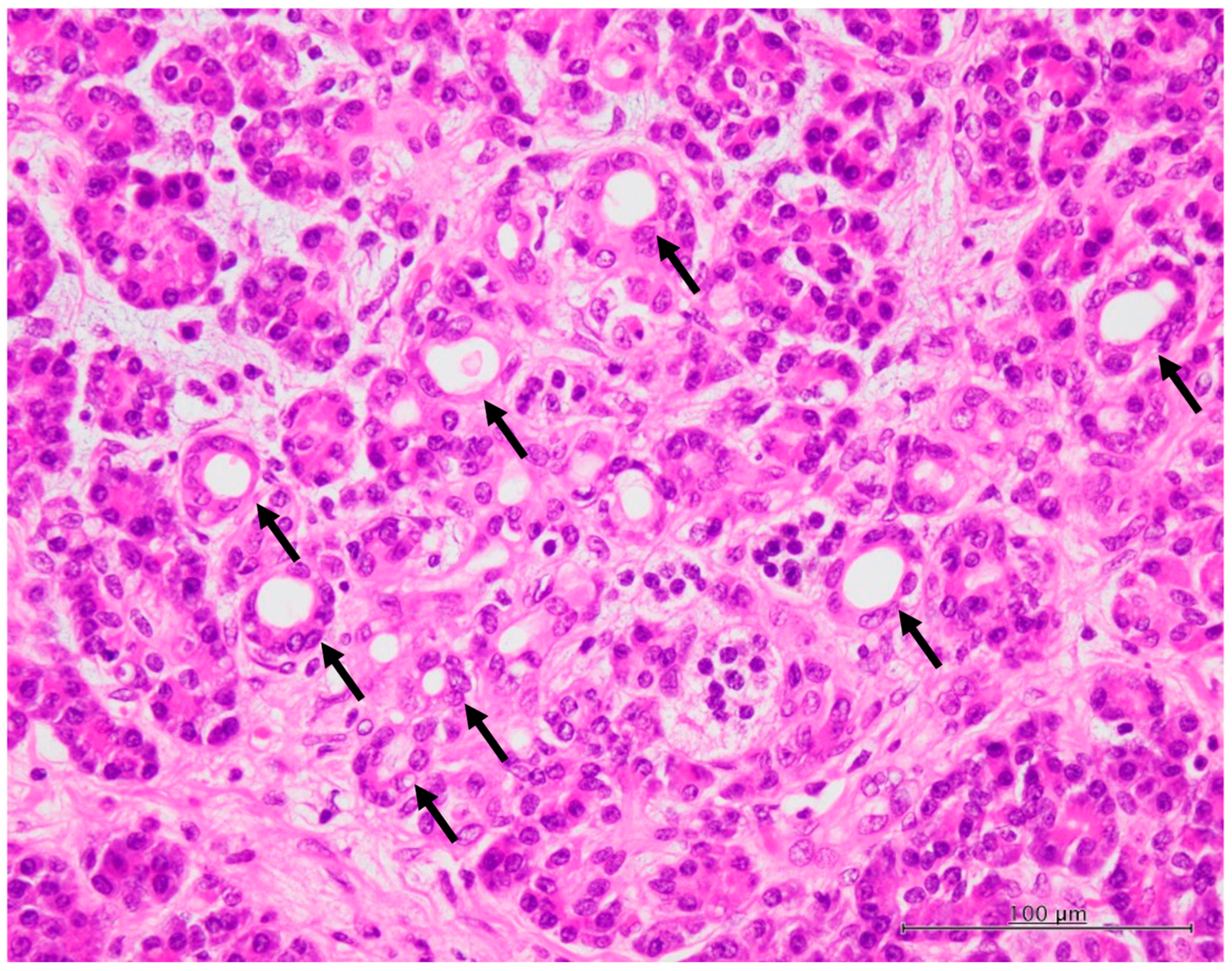
3.2. ADM in Obstructive Pancreatitis
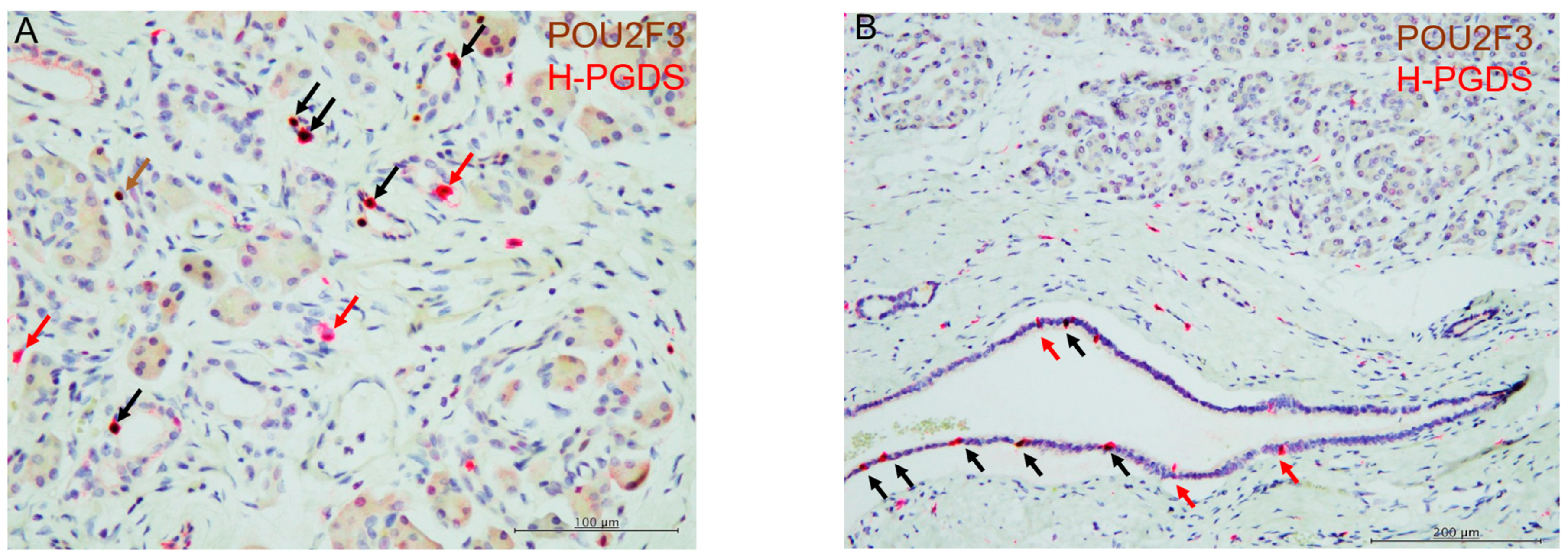
3.3. Tuft Cells Expressed H-PGDS
4. Discussion
5. Conclusions
Author Contributions
Funding
Institutional Review Board Statement
Informed Consent Statement
Data Availability Statement
Acknowledgments
Conflicts of Interest
Abbreviations
| ADM | acinar-to-ductal metaplasia |
| COX | cyclooxygenase |
| CRTH2 | chemoattractant receptor-homologous molecule expressed on Th2 cells |
| DLCK1 | doublecortin-like kinase 1 |
| DP1 | D-prostanoid 1 |
| H-PGDS | hematopoietic prostaglandin D synthase |
| IPMN | intraductal papillary mucinous neoplasm |
| L-PGDS | lipocalin-type prostaglandin D synthase |
| PanIN | pancreatic intraepithelial neoplasia |
| PDAC | pancreatic ductal adenocarcinoma |
| PGD2 | prostaglandin D2 |
| POU2F3 | POU domain class 2 transcription factor 3 |
References
- Rodríguez Gil, Y.; Jiménez Sánchez, P.; Muñoz Velasco, R.; García García, A.; Sánchez-Arévalo Lobo, V.J. Molecular alterations in pancreatic cancer: Transfer to the clinic. Int. J. Mol. Sci. 2021, 22, 2077. [Google Scholar] [CrossRef] [PubMed]
- Marstrand-Daucé, L.; Lorenzo, D.; Chassac, A.; Nicole, P.; Couvelard, A.; Haumaitre, C. Acinar-to-ductal metaplasia (ADM): On the road to pancreatic intraepithelial neoplasia (PanIN) and pancreatic cancer. Int. J. Mol. Sci. 2023, 24, 9946. [Google Scholar] [CrossRef] [PubMed]
- Backx, E.; Coolens, K.; Van den Bossche, J.L.; Houbracken, I.; Espinet, E.; Rooman, I. On the origin of pancreatic cancer: Molecular tumor subtypes in perspective of exocrine cell plasticity. Cell. Mol. Gastroenterol. Hepatol. 2022, 13, 1243–1253. [Google Scholar] [CrossRef]
- Storz, P. Acinar cell plasticity and development of pancreatic ductal adenocarcinoma. Nat. Rev. Gastroenterol. Hepatol. 2017, 14, 296–304. [Google Scholar] [CrossRef]
- Pinho, A.V.; Rooman, I.; Reichert, M.; De Medts, N.; Bouwens, L.; Rustgi, A.K.; Real, F.X. Adult pancreatic acinar cells dedifferentiate to an embryonic progenitor phenotype with concomitant activation of a senescence programme that is present in chronic pancreatitis. Gut 2011, 60, 958–966. [Google Scholar] [CrossRef] [PubMed]
- Willemer, S.; Adler, G. Histochemical and ultrastructural characteristics of tubular complexes in human acute pancreatitis. Dig. Dis. Sci. 1989, 34, 46–55. [Google Scholar] [CrossRef]
- Parsa, I.; Longnecker, D.S.; Scarpelli, D.G.; Pour, P.; Reddy, J.K.; Lefkowitz, M. Ductal metaplasia of human exocrine pancreas and its association with carcinoma. Cancer Res. 1985, 45, 1285–1290. [Google Scholar]
- Strobel, O.; Dor, Y.; Alsina, J.; Stirman, A.; Lauwers, G.; Trainor, A.; Castillo, C.F.D.; Warshaw, A.L.; Thayer, S.P. In vivo lineage tracing defines the role of acinar-to-ductal transdifferentiation in inflammatory ductal metaplasia. Gastroenterology 2007, 133, 1999–2009. [Google Scholar] [CrossRef]
- DelGiorno, K.E.; Chung, C.Y.; Vavinskaya, V.; Maurer, H.C.; Novak, S.W.; Lytle, N.K.; Ma, Z.; Giraddi, R.R.; Wang, D.; Fang, L.; et al. Tuft cells inhibit pancreatic tumorigenesis in mice by producing prostaglandin D2. Gastroenterology 2020, 159, 1866–1881.e8. [Google Scholar] [CrossRef]
- Gerbe, F.; Legraverend, C.; Jay, P. The intestinal epithelium tuft cells: Specification and function. Cell. Mol. Life Sci. 2012, 69, 2907–2917. [Google Scholar] [CrossRef]
- Billipp, T.E.; Nadjsombati, M.S.; von Moltke, J. Tuning tuft cells: New ligands and effector functions reveal tissue-specific function. Curr. Opin. Immunol. 2021, 68, 98–106. [Google Scholar] [CrossRef]
- Huang, Y.H.; Klingbeil, O.; He, X.Y.; Wu, X.S.; Arun, G.; Lu, B.; Somerville, T.D.D.; Milazzo, J.P.; Wilkinson, J.E.; Demerdash, O.E.; et al. POU2F3 is a master regulator of a tuft cell-like variant of small cell lung cancer. Genes Dev. 2018, 32, 915–928. [Google Scholar] [CrossRef] [PubMed]
- Schneider, C.; O’Leary, C.E.; Locksley, R.M. Regulation of immune responses by tuft cells. Nat. Rev. Immunol. 2019, 19, 584–593. [Google Scholar] [CrossRef] [PubMed]
- Kotas, M.E.; O’Leary, C.E.; Locksley, R.M. Tuft cells: Context- and tissue-specific programming for a conserved cell lineage. Annu. Rev. Pathol. 2023, 18, 311–335. [Google Scholar] [CrossRef] [PubMed]
- DelGiorno, K.E.; Naeem, R.F.; Fang, L.; Chung, C.Y.; Ramos, C.; Luhtala, N.; O’Connor, C.; Hunter, T.; Manor, U.; Wahl, G.M. Tuft cell formation reflects epithelial plasticity in pancreatic injury: Implications for modeling human pancreatitis. Front. Physiol. 2020, 11, 88. [Google Scholar] [CrossRef]
- Ma, Z.; Lytle, N.K.; Chen, B.; Jyotsana, N.; Novak, S.W.; Cho, C.J.; Caplan, L.; Ben-Levy, O.; Neininger, A.C.; Burnette, D.T.; et al. Single-cell transcriptomics reveals a conserved metaplasia program in pancreatic injury. Gastroenterology 2022, 162, 604–620.e20. [Google Scholar] [CrossRef]
- Ricciotti, E.; FitzGerald, G.A. Prostaglandins and inflammation. Arterioscler. Thromb. Vasc. Biol. 2011, 31, 986–1000. [Google Scholar] [CrossRef][Green Version]
- Seo, M.J.; Oh, D.K. Prostaglandin synthases: Molecular characterization and involvement in prostaglandin biosynthesis. Prog. Lipid Res. 2017, 66, 50–68. [Google Scholar] [CrossRef]
- Urade, Y. Biochemical and structural characteristics, gene regulation, physiological, pathological and clinical features of lipocalin-type prostaglandin D2 synthase as a multifunctional lipocalin. Front. Physiol. 2021, 12, 718002. [Google Scholar] [CrossRef]
- Kanaoka, Y.; Urade, Y. Hematopoietic prostaglandin D synthase. Prostaglandins Leukot. Essent. Fat. Acids 2003, 69, 163–167. [Google Scholar] [CrossRef]
- Redensek, A.; Rathore, K.I.; Berard, J.L.; López-Vales, R.; Swayne, L.A.; Bennett, S.A.L.; Mohri, I.; Taniike, M.; Urade, Y.; David, S. Expression and detrimental role of hematopoietic prostaglandin D synthase in spinal cord contusion injury. Glia 2011, 59, 603–614. [Google Scholar] [CrossRef]
- Hashimoto, K.; Ethridge, R.T.; Saito, H.; Rajaraman, S.; Evers, B.M. The PPARgamma ligand, 15d-PGJ2, attenuates the severity of cerulein-induced acute pancreatitis. Pancreas 2003, 27, 58–66. [Google Scholar] [CrossRef]
- Tosti, L.; Hang, Y.; Debnath, O.; Tiesmeyer, S.; Trefzer, T.; Steiger, K.; Ten, F.W.; Lukassen, S.; Ballke, S.; Kühl, A.A.; et al. Single-nucleus and in situ RNA–sequencing reveal cell topographies in the human pancreas. Gastroenterology 2021, 160, 1330–1344.e11. [Google Scholar] [CrossRef]
- Nakanishi, K.; Ishida, M.; Taniguchi, K.; Hosomi, K.; Arima, J.; Tomioka, A.; Asakuma, M.; Miyamoto, Y.; Fujimori, K.; Hirose, Y.; et al. Immunohistochemical demonstration of tuft cells in human acinar-to-ductal metaplasia and pancreatic intraepithelial neoplasia. Biomedicines 2025, 13, 1944. [Google Scholar] [CrossRef] [PubMed]
- Hosomi, K.; Sato, A.; Ishida, M.; Nakanishi, K.; Terada, T.; Haginomori, S.I.; Hirose, Y.; Fujimori, K. Differential expression of haematopoietic prostaglandin D synthase by POU2F3-positive tuft cells in conventional bilayered oncocytic and metaplastic epithelia of Warthin tumours. Mol. Med. Rep. 2025, 32, 259. [Google Scholar] [CrossRef] [PubMed]
- Mohri, I.; Eguchi, N.; Suzuki, K.; Urade, Y.; Taniike, M. Hematopoietic prostaglandin D synthase is expressed in microglia in the developing postnatal mouse brain. Glia 2003, 42, 263–274. [Google Scholar] [CrossRef] [PubMed]
- Yamada, Y.; Simon, R.; Iwane, K.; Nakanishi, Y.; Takeuchi, Y.; Yoshizawa, A.; Takada, M.; Toi, M.; Haga, H.; Marx, A.; et al. An exploratory study for tuft cells in the breast and their relevance in triple-negative breast cancer: The possible relationship of SOX9. BMC Cancer 2023, 23, 438. [Google Scholar] [CrossRef]
- Helliwell, R.J.A.; Keelan, J.A.; Marvin, K.W.; Adams, L.; Chang, M.C.; Anand, A.; Sato, T.A.; O’Carroll, S.; Chaiworapongsa, T.; Romero, R.J.; et al. Gestational age-dependent up-regulation of prostaglandin D synthase (PGDS) and production of PGDS-derived antiinflammatory prostaglandins in human placenta. J. Clin. Endocrinol. Metab. 2006, 91, 597–606. [Google Scholar] [CrossRef]
- Pettipher, R. The roles of the prostaglandin D(2) receptors DP(1) and CRTH2 in promoting allergic responses. Br. J. Pharmacol. 2008, 153, S191–S199. [Google Scholar] [CrossRef]
- Oyesola, O.O.; Tait Wojno, E.D. Prostaglandin regulation of type 2 inflammation: From basic biology to therapeutic interventions. Eur. J. Immunol. 2021, 51, 2399–2416. [Google Scholar] [CrossRef]
- Hirai, H.; Tanaka, K.; Yoshie, O.; Ogawa, K.; Kenmotsu, K.; Takamori, Y.; Ichimasa, M.; Sugamura, K.; Nakamura, M.; Takano, S.; et al. Prostaglandin D2 selectively induces chemotaxis in T helper type 2 cells, eosinophils, and basophils via seven-transmembrane receptor CRTH2. J. Exp. Med. 2001, 193, 255–261. [Google Scholar] [CrossRef]
- Luo, M.; He, N.; Xu, Q.; Wen, Z.; Wang, Z.; Zhao, J.; Liu, Y. Roles of prostaglandins in immunosuppression. Clin. Immunol. 2024, 265, 110298. [Google Scholar] [CrossRef] [PubMed]
- Joo, M.; Sadikot, R.T. PGD synthase and PGD2 in immune response. Mediat. Inflam. 2012, 2012, 503128. [Google Scholar] [CrossRef] [PubMed]
- Tian, H.; Ge, K.; Wang, L.; Gao, P.; Chen, A.; Wang, F.; Guo, F.; Wang, F.; Zhang, Q. Advances in PGD2/PTGDR2 signaling pathway in tumors: A review. Biomol. Biomed. 2024, 24, 1055–1067. [Google Scholar] [CrossRef] [PubMed]
- Nevo, S.; Kadouri, N.; Abramson, J. Tuft cells: From the mucosa to the thymus. Immunol. Lett. 2019, 210, 1–9. [Google Scholar] [CrossRef]
- Schütz, B.; Ruppert, A.L.; Strobel, O.; Lazarus, M.; Urade, Y.; Büchler, M.W.; Weihe, E. Distribution pattern and molecular signature of cholinergic tuft cells in human gastro-intestinal and pancreatic-biliary tract. Sci. Rep. 2019, 9, 17466. [Google Scholar] [CrossRef]
- Yang, Y.; Ding, L.; Cao, Z.; Qu, D.; Weygant, N. Tuft cells: An emerging therapeutic target for pancreatitis and pancreatic cancer? Expert Opin. Ther. Targets 2020, 24, 1183–1186. [Google Scholar] [CrossRef]


Disclaimer/Publisher’s Note: The statements, opinions and data contained in all publications are solely those of the individual author(s) and contributor(s) and not of MDPI and/or the editor(s). MDPI and/or the editor(s) disclaim responsibility for any injury to people or property resulting from any ideas, methods, instructions or products referred to in the content. |
© 2026 by the authors. Licensee MDPI, Basel, Switzerland. This article is an open access article distributed under the terms and conditions of the Creative Commons Attribution (CC BY) license.
Share and Cite
Hosomi, K.; Ishida, M.; Nakanishi, K.; Taniguchi, K.; Arima, J.; Tomioka, A.; Asakuma, M.; Lee, S.-W.; Fujimori, K.; Hirose, Y. Presence of Tuft Cells Expressing Hematopoietic Prostaglandin D Synthase in Acinar-to-Ductal Metaplasia in Human Obstructive Pancreatitis. Curr. Issues Mol. Biol. 2026, 48, 585. https://doi.org/10.3390/cimb48060585
Hosomi K, Ishida M, Nakanishi K, Taniguchi K, Arima J, Tomioka A, Asakuma M, Lee S-W, Fujimori K, Hirose Y. Presence of Tuft Cells Expressing Hematopoietic Prostaglandin D Synthase in Acinar-to-Ductal Metaplasia in Human Obstructive Pancreatitis. Current Issues in Molecular Biology. 2026; 48(6):585. https://doi.org/10.3390/cimb48060585
Chicago/Turabian StyleHosomi, Kenta, Mitsuaki Ishida, Kensuke Nakanishi, Kohei Taniguchi, Jun Arima, Atsushi Tomioka, Mitsuhiro Asakuma, Sang-Woong Lee, Ko Fujimori, and Yoshinobu Hirose. 2026. "Presence of Tuft Cells Expressing Hematopoietic Prostaglandin D Synthase in Acinar-to-Ductal Metaplasia in Human Obstructive Pancreatitis" Current Issues in Molecular Biology 48, no. 6: 585. https://doi.org/10.3390/cimb48060585
APA StyleHosomi, K., Ishida, M., Nakanishi, K., Taniguchi, K., Arima, J., Tomioka, A., Asakuma, M., Lee, S.-W., Fujimori, K., & Hirose, Y. (2026). Presence of Tuft Cells Expressing Hematopoietic Prostaglandin D Synthase in Acinar-to-Ductal Metaplasia in Human Obstructive Pancreatitis. Current Issues in Molecular Biology, 48(6), 585. https://doi.org/10.3390/cimb48060585