Article

Genome-Wide Identification and Expression Analysis of the Fructose 1,6-Bisphosphate Aldolase (FBA) Gene Family Members in Seashore Paspalum in Response to Cadmium Stress
1
College of Landscape Architecture, Jiangsu Vocational College of Agriculture and Forestry, Zhenjiang 212400, China
2
College of Agro-Grassland Science, Nanjing Agricultural University, Nanjing 210014, China
*
Author to whom correspondence should be addressed.
Curr. Issues Mol. Biol. 2026, 48(6), 563; https://doi.org/10.3390/cimb48060563
Submission received: 20 February 2026 / Revised: 8 May 2026 / Accepted: 23 May 2026 / Published: 28 May 2026
(This article belongs to the Section Molecular Plant Sciences)

Abstract

The fructose 1,6-bisphosphate aldolase (FBA) gene family plays crucial roles in plant energy metabolism, growth, development, and abiotic stress responses, as it modulates antioxidant synthesis and soluble sugar accumulation to enhance plant cadmium tolerance. Seashore paspalum (Paspalum vaginatum Sw.), a halophytic perennial C4 turfgrass renowned for its exceptional cadmium tolerance, is ideal for phytoremediation of cadmium-contaminated soil. FBA family genes have been identified in several grass species, such as maize, rice, and wheat, but systematic investigations into FBA family genes and their functions in seashore paspalum remain scarce. In this study, seven class I FBAs (named as PvFBA1PvFBA7) and one class II FBA (named as PvFBA8) in seashore paspalum were identified. The physicochemical properties, evolutionary relationships, gene structures, conserved domains, protein structures, cis-acting regulatory elements, chromosomal localizations, and collinearity relationships of eight PvFBAs were analyzed. These analyses suggested that PvFBA genes had highly conserved domains and belonged to ultra-conserved core genes. Expression pattern analysis indicated that the PvFBA gene family was dynamically responsive to cadmium stress. PvFBA6 and PvFBA7 were highly expressed in leaves, whereas PvFBA1 and PvFBA3 showed almost no expression. The RT-qPCR results suggested that the expression levels of PvFBA5 and PvFBA6 were highly consistent with the FPKM value trends analyzed in the transcriptomic data. Collectively, this study not only provides a theoretical foundation for the understanding of the evolution of the PvFBA gene family but also offers potential candidate genes for enhancing cadmium stress tolerance in plants.

1. Introduction

Fructose-1,6-bisphosphate aldolase (FBA; EC 4.1.2.13) is an essential enzyme in glycometabolism. FBAs can be divided into two classes based on different catalytic mechanisms and the evolutionary origins of species. Class I FBAs are mainly distributed in plants and animals, while class II FBAs are mainly found in microorganisms and a few algae and plant species. In plants, two distinct isozyme forms are recognized: cytoplasmic and chloroplast-localized [1]. The cytoplasmic type is a key enzyme in the sucrose biosynthetic and glycolytic/gluconeogenesis pathways, while the chloroplast type is a critical enzyme in the Calvin–Benson cycle [2]. FBA not only catalyzes the reversible reaction of fructose-1,6-diphosphate (FBP) converting into dihydroxyacetone phosphate (DHAP) and glyceraldehyde-3-phosphate (G3P) but also mediates the reversible reaction of erythrose-4-phosphate (E4P) and DHAP to form sedoheptulose-1,7-bisphosphate (SuBP) [3].
FBA plays a significant role in coordinating intracellular metabolic integration and energy flow within cells, as well as in regulating growth and development processes [2]. In Arabidopsis thaliana, overexpression of NtFBA enhances the activity of aldolase, growth rate and biomass [4], while AtFBA1, AtFBA2 and AtFBA3 are involved in photosynthetic or non-photosynthetic metabolism [5]. FBA genes are also involved in the response regulation of various abiotic stresses, mainly including salinity [6], cold [7,8,9], cadmium [10], heat [11], and suboptimal temperature [12]. These findings highlight that FBA genes are promising targets for plant genetic engineering aimed at improving crop yield, quality and stress resistance.
Poaceae, also called the grass family, is one of the most geographically widespread, economically significant and ecologically dominant plant families globally [13]. Seashore paspalum (Paspalum vaginatum Sw.), a halophytic perennial C4 turfgrass, is native to the tropical and subtropical Americas. This species, together with maize (Zea mays L.) and sorghum (Sorghum bicolor L.) belongs to the Poaceae family and shares a close phylogenetic relationship [14]. It is widely utilized in animal forage, commercial and residential landscaping, golf courses, sports fields, erosion control, wetland restorations, and site reclamation on oil and gas well sites [15,16]. It is highly tolerant of various environmental stresses, making it an ideal choice for environmental turfgrass applications [17,18,19,20]. Although FBA gene families have been extensively characterized in Arabidopsis [21], tomato (Solanum lycopersicum L.) [12], wheat (Triticum aestivum L.) [11], cucumber (Cucumis sativus L.) [22], and sweet potato (Ipomoea batatas L.) [23], limited information exists regarding this gene family in the stress-tolerant non-model plant, seashore paspalum. This study aims to fill this knowledge gap by conducting a comprehensive genome-wide analysis of the FBA gene family in seashore paspalum and investigating its expression patterns under cadmium stress.
In this study, eight FBA genes were identified in seashore paspalum through the comprehensive analysis of the FBA gene family and the recently published high-quality genome assembly [14]. The analysis encompassed several aspects, including evolutionary relationships, gene structures, conserved domains, and cis-acting regulatory elements. Furthermore, we determined the expression patterns of PvFBA genes in response to cadmium stress. These findings lay a critical foundation for understanding the molecular regulatory mechanism of the PvFBA gene family under cadmium stress and subsequently are helpful in the development of grass breeding and environmental remediation.

2. Materials and Methods

2.1. Genome-Wide Identification of the FBA Gene Family in Seashore Paspalum

The whole-genome sequence of seashore paspalum was downloaded from the Phytozome database (https://phytozome-next.jgi.doe.gov/info/Pvaginatum_v3_1/, accessed on 12 November 2025) to establish a local database. The genomic data of the maize and rice (Oryza sativa L.) FBA gene family were downloaded from the Maize Genetics and Genomics Database (MaizeGDB, https://www.maizegdb.org/, accessed on 12 November 2025) and the Rice Genome Annotation Project (RGAP, https://rice.uga.edu/, accessed on 12 November 2025). The protein sequences of Arabidopsis, potato, wheat, and tomato FBA gene family were sourced from the TAIR database (http://www.arabidopsis.org, accessed on 20 November 2025), and the Ensemble database (http://plants.ensembl.org/index.html, accessed on 20 November 2025), reserved for subsequent analysis. Using the amino acid sequences of maize and rice FBA proteins as queries, an algorithm based on BLASTP (E-value < 1 × 10⁻¹⁰ and other parameters as default values) was used in the protein databases of seashore paspalum using the TBtools-II software (v2.376, https://github.com/CJ-Chen/TBtools-II/releases, accessed on 12 November 2025) [24]. The Hidden Markov Model (HMM) of the glycolytic (PF00274.26) and fructose–bisphosphate aldolase class II (PF01116.27) domains was extracted from the InterPro database (https://www.ebi.ac.uk/interpro/, accessed on 12 November 2025) to identify all PvFBA proteins using the HMMER SEARCH (v3.3.2) program (E-value < 1 × 10⁻⁵ and other parameters as default values, http://www.hmmer.org/, accessed on 12 November 2025) [25], and then, redundant sequences without completed glycolytic or fructose–bisphosphate aldolase class II domains (coverage < 70%) were manually deleted by the Simple Modular Architecture Research Tool (SMART) (https://smart.embl.de/smart/change_mode.cgi, accessed on 20 November 2025) and the NCBI Conserved Domain database (CDD) (https://www.ncbi.nlm.nih.gov/Structure/cdd/wrpsb.cgi, accessed on 20 November 2025). Finally, a total of eight predicted PvFBA protein sequences were obtained.

2.2. Prediction of Physicochemical Properties of PvFBA Proteins

The key physicochemical properties of the identified PvFBA proteins were predicted, including length, isoelectric point (pI), molecular weight (MW), and grand average of hydropathicity (GRAVY), using the Expert Protein Analysis System (ExPASy) server (https://www.expasy.org/, accessed on 21 November 2025). Concurrently, the putative subcellular localization of eight PvFBA proteins was analyzed using the WoLF PSORT online tool (https://wolfpsort.hgc.jp/, accessed on 21 November 2025).

2.3. Phylogenetic Analysis of PvFBA Proteins

The ClustalW software (v2.1) [26] was used to analyze eight PvFBA protein sequences of seashore paspalum, ten ZmFBA protein sequences of maize (relative of seashore paspalum), and eight OsFBA protein sequences of rice (relative of seashore paspalum) with default parameters. The phylogenetic tree of FBA proteins from seashore paspalum, maize, rice, Arabidopsis, potato, wheat, and tomato was constructed using the unrooted neighbor-joining method in the MEGA X software (v10.2.6 https://megasoftware.net/, accessed on 20 November 2025) [27] with a bootstrap value of 1000 replicates, default parameters and the Poisson correction model, and the tree was further refined by the Interactive Tree Of Life (ITOL) online tool (https://itol.embl.de/, accessed on 20 November 2025).

2.4. Gene Structure, Conserved Motif and Promoter Analysis

The coding sequence (CDS) and its corresponding genomic sequence of PvFBA family members were obtained from the Phytozome database and visualized by the TBtools-II software (v2.376) [24]. The conserved domains and motifs of PvFBAs were analyzed using the CD-search tool (https://www.ncbi.nlm.nih.gov/Structure/bwrpsb/bwrpsb.cgi/, accessed on 21 November 2025) (all other parameters being default) and the MEME (v5.5.9) suite (https://meme-suite.org/meme/, accessed on 21 November 2025) (motif length ranging from 6 to 60 amino acid residues, maximum motif number set to 20, with other parameters as default values). The 2000 bp sequences upstream of the initiation codon, as a hypothetical promoter, were extracted from the Phytozome database and then submitted to the PlantCare online tool (https://bioinformatics.psb.ugent.be/webtools/plantcare/html/, accessed on 21 November 2025) [28] to predict cis-acting regulatory elements. Visualizations of the cis-acting regulatory elements were drawn by using the TBtools-II software (v2.376) [24].

2.5. Structure Prediction of PvFBA Proteins

The secondary structures of eight PvFBA proteins were predicted by using the Network Protein Sequence Analysis (SOPMA v20251015, https://npsa.lyon.inserm.fr/, accessed on 6 January 2026) online software [29]. AlphaFold2, an artificial intelligence (AI) program, was used to predict protein tertiary structures of eight PvFBA proteins [30]. Eight models of PvFBA proteins can be downloaded from the Supplementary Materials (Model S1). The PyMOL software (v3.1.6.1, https://pymol.org/, accessed on 10 January 2026), a molecular visualization and analysis software for 3D structures, was used for visual analytics of the prediction structures of AlphaFold2 [30].

2.6. Chromosomal Distributions and Collinearity Analysis

MapGene2Chrome (MG2C, v2.1, http://mg2c.iask.in/mg2c_v2.1/, accessed on 2 November 2025), a tool used to draw gene physical maps, was used to draft a chromosomal location map of the PvFBA genes based on the genome annotation files of seashore paspalum [31]. The synteny relationships of the FBA genes within and among seashore paspalum, maize, and rice were analyzed by TBtools-II software (v2.376) [24] using the One Step MCScanX method [32], with an E-value parameter of <1 × 10⁻⁵.

2.7. Gene Expression Pattern Analysis

To analyze the expression levels of the PvFBA genes, the published transcriptome data of seashore paspalum [33] were downloaded for the calculation. Fragments per kilobase of exon per million fragments mapped (FPKM) values were obtained from the transcriptome data and normalized via log2 transformation. The heatmap was generated by the TBtools-II software (v2.376) [24].

2.8. Cadmium Stress Treatment of Seashore Paspalum

Erect stems of seashore paspalum (cultivar ‘Sea Spray’) were cut and hydroponically cultured in black plastic containers (31 cm length, 28.5 cm width, and 18 cm depth) filled with Hoagland’s nutrient solution (pH  =  6.0, renewed every 7 days; the solution contained 5.0 mM Ca(NO3)2·4H2O, 5.0 mM KNO3, 2 mM MgSO4·7H2O, and 1.0 mM KH2PO4, 46.2 μM H3BO3, 9.1 μM MnCl2·4H2O, 0.76 μM ZnSO4·7H2O, 0.32 μM CuSO4·5H2O, 0.10 μM Na2MoO4·2H2O, and 53.7 μM Fe-EDTA) [34] and then maintained in a controlled growth chamber (MT8070iE, Xubang, Jinan, China) with growing conditions maintained at 30/25 °C (day/night), 70% relative humidity, and a 14/10-h photoperiod with photosynthetically active radiation of 650 μmol m−2 s−1 for three weeks. Three-week-old seashore paspalum was utilized for the cadmium treatment of 300 μM CdCl2. Leaf, stem, and root samples (0.1 g each) were collected at five time points (0, 1, 4, 12, and 24 h) under cadmium treatment and stored at −80 °C for further analysis.

2.9. RNA Extraction and RT-qPCR Analysis

Total RNA was extracted using the E.Z.N.A.® Plant RNA Kit (OMEGA Bio-Tek, Norcross, GA, USA) according to the manufacturer’s instructions and reverse-transcribed into cDNA with the PrimeScript™ RT reagent Kit with gDNA Eraser (Takara, Kusatsu, Japan). The RT-qPCR analysis of target genes was conducted using a LightCycler 480 II Instrument (Roche Diagnostics, Rotkreuz, Switzerland). The RT-qPCR reaction volume was 20 μL, containing 10 μL of 2× SYBR Green Master Mix (Roche), 1 μL of forward primer, 1 μL of reverse primer, 2 μL of cDNA template, and 6 μL of double-distilled water. The reaction conditions were set as follows: initial denaturation at 95 °C for 10 min, followed by 40 cycles of 95 °C for 15 s, 60 °C for 15 s, and 72 °C for 20 s. PvU2AF [35] (chosen for its expression stability under cadmium stress) was used as the internal reference gene for seashore paspalum’s response to cadmium stress and was employed to normalize the expression levels of each gene. All RT-qPCR primers are listed in Supplementary Table S1. The specificity of all primers was confirmed by melting curve analysis of qRT-PCR amplicons, each yielding a single peak (Figure S1). All RT-qPCR experiments were performed using three independent biological replicates, and each biological sample had three technical replicates. The expression levels of target genes were calculated employing the 2−ΔΔCT method [36].

2.10. Statistical Analysis

The statistical analyses of all data were subjected to one-way analysis of variance (ANOVA) using the SPSS software (v22, SPSS Inc., Chicago, IL, USA). The statistical significance of the difference was assessed using Fisher’s protected LSD test (p < 0.05). Data shown are mean values ± standard error (SE) of three independent biological replicates and three technical replicates. The GraphPad Prism software (v10.1.2, GraphPad Software LLC, Boston, MA, USA) was used to draw all figures.

3. Results

3.1. Identification and Protein Characterization of the PvFBA Gene Family

To explore the PvFBA gene family, a total of eight PvFBA genes (named PvFBA1PvFBA8) were identified by whole-genome screening of seashore paspalum using the FBA genes of rice [37] and maize [38]. Specific details of these PvFBA genes, including gene name, gene ID, chromosome location, protein length, pI, MW, GRAVY, and predicted subcellular localization, were analyzed (Table 1). The protein length of eight PvFBA proteins ranged from 359 amino acids (aa; PvFBA5) to 1376 aa (PvFBA8). The pI values ranged from 5.93 for PvFBA5 to 9.04 for PvFBA4, with five PvFBA proteins having acidic properties. The MW ranged from 37992.35 Da (PvFBA5) to 147793.06 Da (PvFBA8). The GRAVY indicates that all members of the PvFBA family (except PvFBA8) were hydrophilic proteins, as they exhibited negative hydrophilicity indices. Eight PvFBA proteins were located in two cellular compartments: PvFBA1–PvFBA4 were in the chloroplast and were thus named CpFBAs, whereas PvFBA5–PvFBA8 were localized in the cytoplasm and are hereafter designated as cFBAs (Table 1).

3.2. Classification and Phylogenetic Analysis of PvFBAs

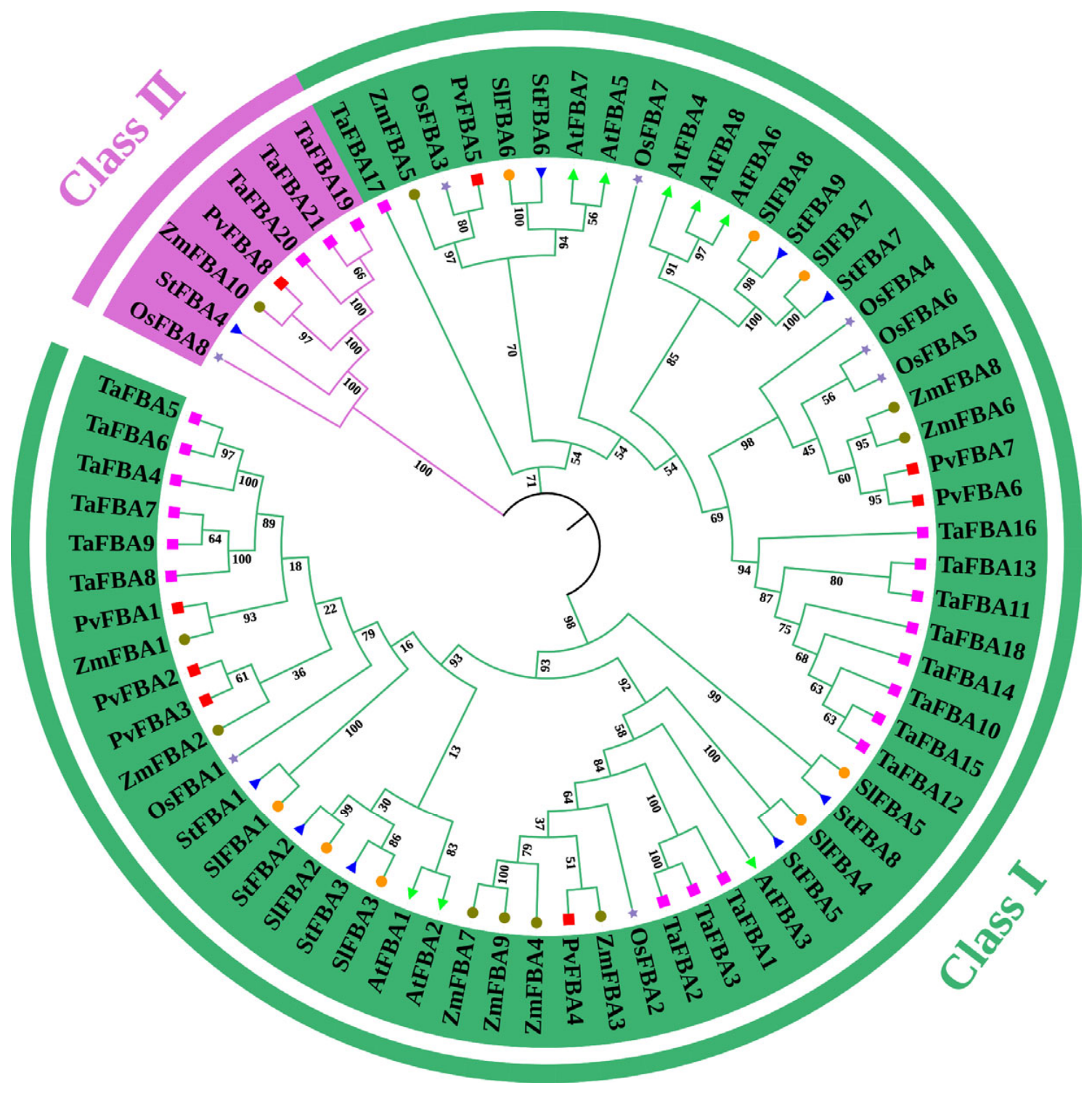
To investigate the evolutionary relationships among the FBA proteins of plants, a phylogenetic tree was constructed using multiple sequence alignment (Figure 1). The phylogenetic tree included eight PvFBAs, ten ZmFBAs, eight OsFBAs, eight AtFBAs, nine StFBAs, twenty-one TaFBAs, and eight SlFBAs (Table S2), which were divided into two subfamilies (classes I and II) based on the evolutionary distance. Class I included sixty-five members, while class II contained only seven members. It is worth noting that three members of class II come from seashore paspalum, maize, potato, and rice (Figure 1). Therefore, seven FBA genes, PvFBA8, ZmFBA10, OsFBA8, StFBA4, and TaFBA19-TaFBA21, had sequence differences from other FBA genes and might have functional differences.

3.3. Gene Structure and Conserved Domain Analysis of PvFBAs

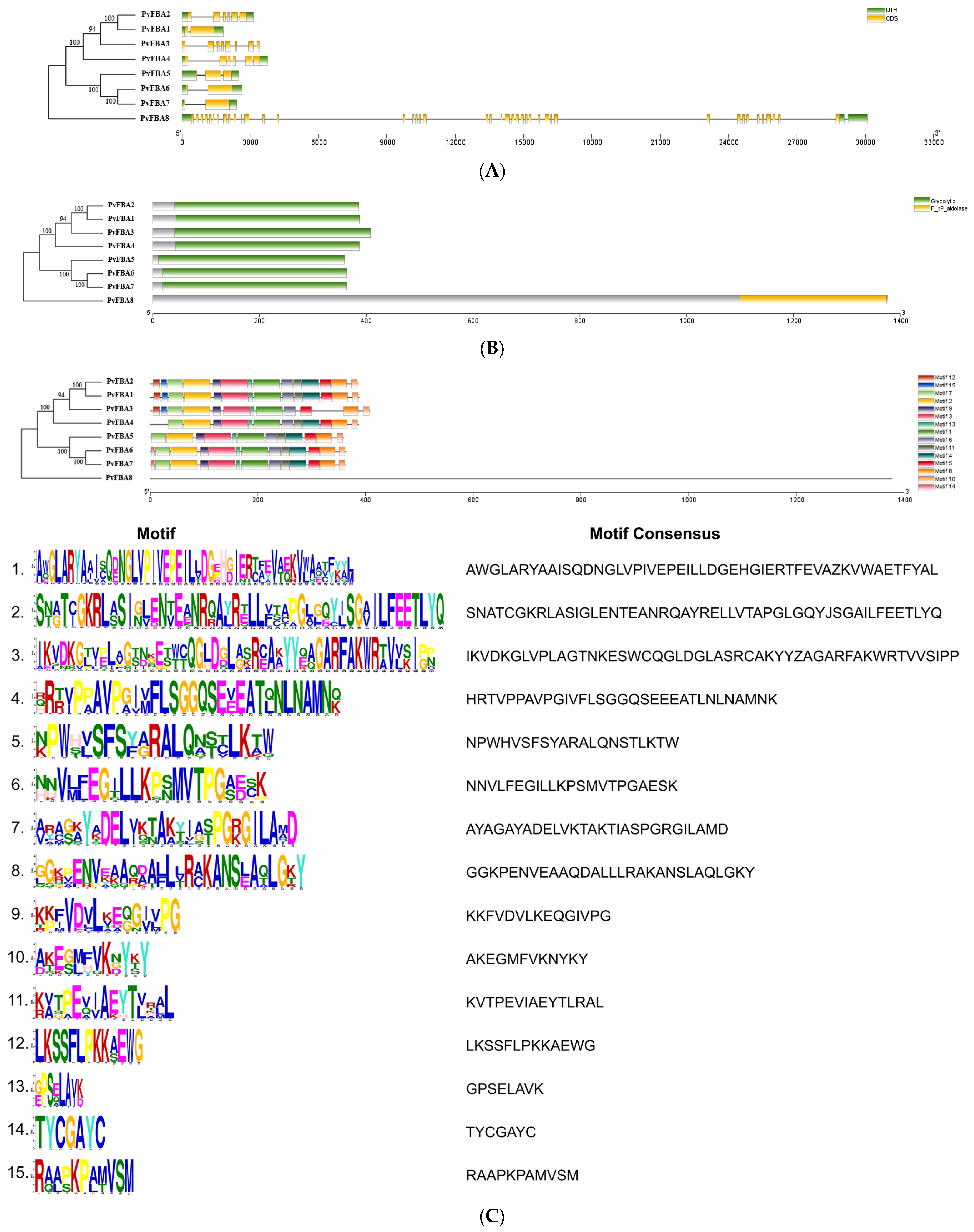
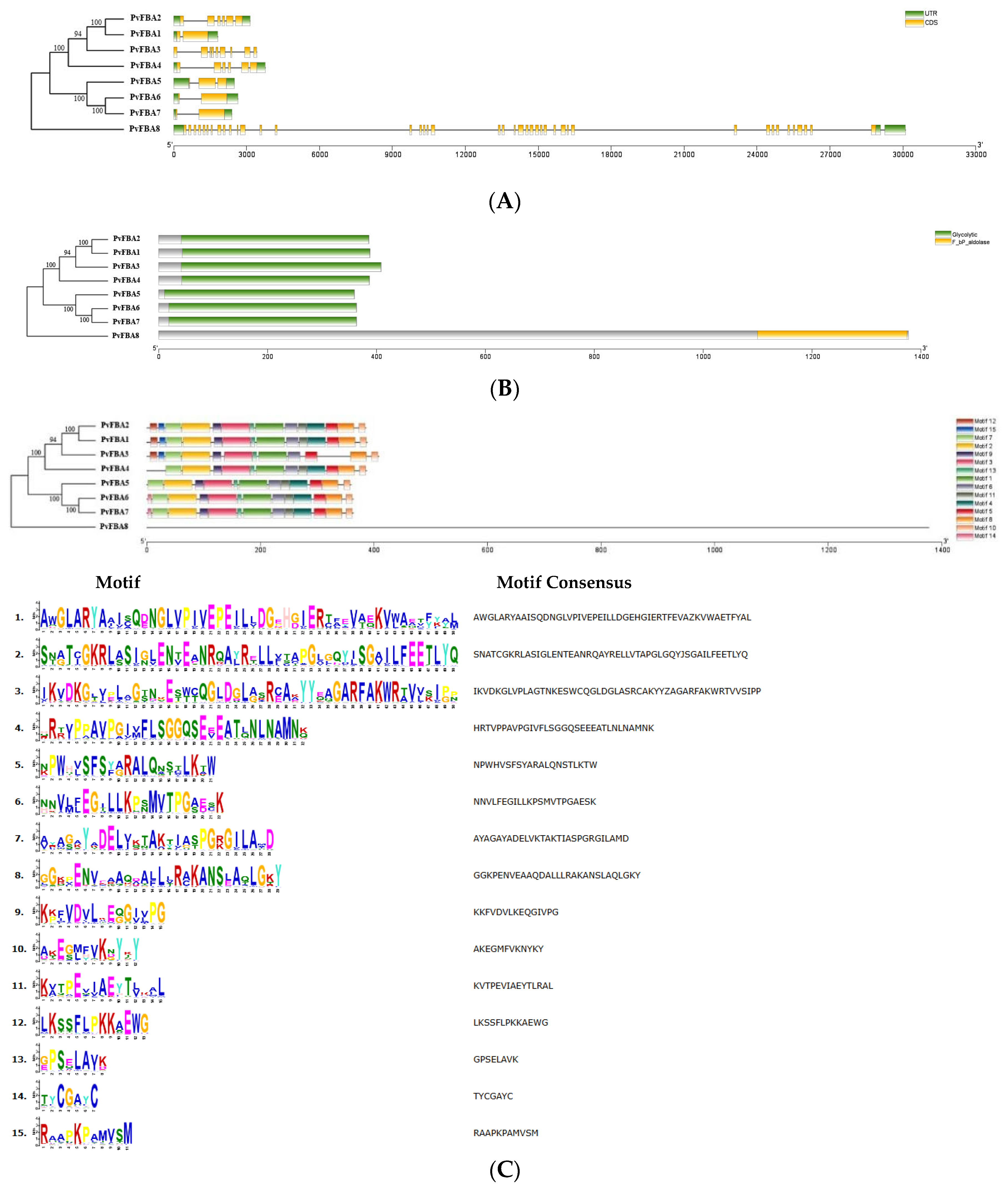
To understand the gene evolution and potential functions of the PvFBA gene family, their gene structures and conserved domains were analyzed (Figure 2). For the seven class I PvFBA genes, the number of exons ranged from two to nine, with the fewest exons found in PvFBA1, PvFBA6, and PvFBA7 and the most in PvFBA3. Class II PvFBA8 contained 42 exons, which is significantly more than class I PvFBA members. This suggested that PvFBA8 might have a more complex structure, potentially including functional domains or regulatory elements. Notably, PvFBA3 had no UTRs, while the other seven PvFBAs had two UTRs (Figure 2A). The conserved domain analysis of the PvFBA protein sequences showed that, except for PvFBA8, the other PvFBA proteins contained a glycolytic domain located at the protein C-terminus (carboxyl terminus). However, PvFBA8 contained a fructose–bisphosphate aldolase domain (F_bP_aldolase) located at the protein C-terminus (Figure 2B). A total of fifteen motifs (named motif1–motif15) were identified, ranging in length from 9 to 30 aa, as the most prevalent structural elements within the PvFBA gene family. Ten motifs, motifs 1, 2, 3, 5, 6, 7, 8, 9, 10, and 13, were the most conserved and widely present in seven class I PvFBA genes. Although motifs 1, 2, and 3 were longer and contained 30 aa, they appeared only in adjacent branches of the phylogenetic tree. Notably, PvFBA8 lacked these motifs but still belonged to the PvFBA gene family (Figure 2C). The differences in the gene structure or conserved motifs of the PvFBA genes might be related to the complex biological functions.

3.4. Tertiary Structure of the PvFBA Proteins

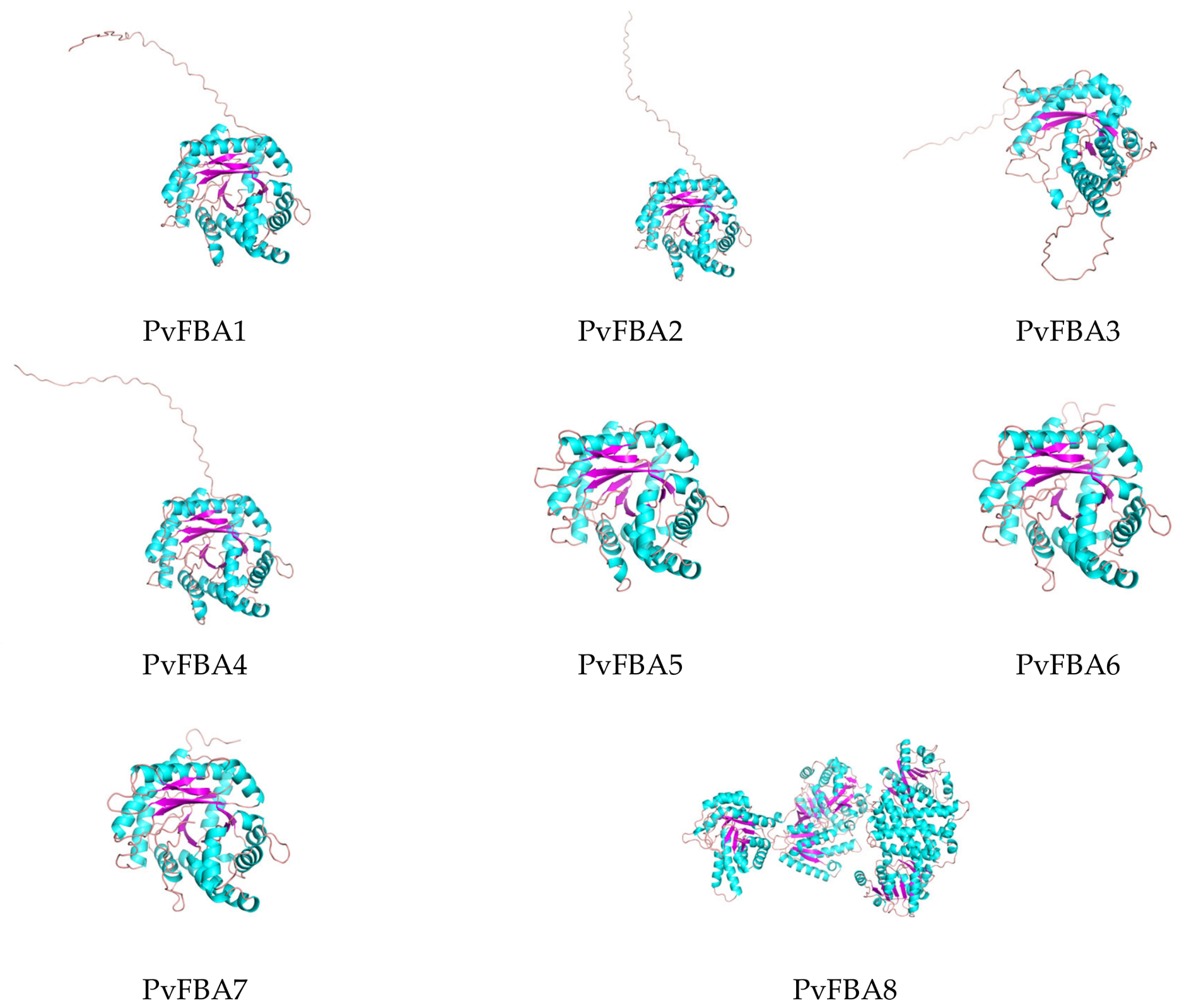
The structure of proteins is crucial to their functions. Secondary structure involves folding the amino acid chain into repeating structures, such as α-helices and β-turns. The tertiary structure determines functional specificity and cellular stability [39]. Analyses of tertiary structures revealed that PvFBA mainly consists of α-helices, extended strands, β-turns, and random coils. The proportion of α-helices was the highest (ranging from 46.58% to 53.61%), followed by random coils (ranging from 30.08% to 34.31%), while extended strands and β-turns accounted for a lower proportion (Table S4). Analysis of the predicted tertiary structures of the PvFBA proteins revealed that there were significant differences in the protein structures of classes I and II. The three-dimensional conformations of seven class I PvFBA proteins were comparable. Six class I PvFBA proteins, PvFBA1, PvFBA2, PvFBA4, PvFBA5, PvFBA6, and PvFBA7, were predicted by AlphaFold2 to have more consistent protein structures. The sole member of the class II, PvFBA8, had a longer polypeptide chain and a more complex protein tertiary structure (Figure 3), suggesting that its biological function was different from other PvFBAs and may be involved in more complex biological processes. It is also noteworthy that all predicted local distance difference test (pLDDT) scores for the eight PvFBA proteins exceeded 70 (Table S5 and Figure S2), indicating reliable prediction at the individual domain level.

3.5. Cis-Acting Regulatory Elements Analysis in the PvFBA Gene Family

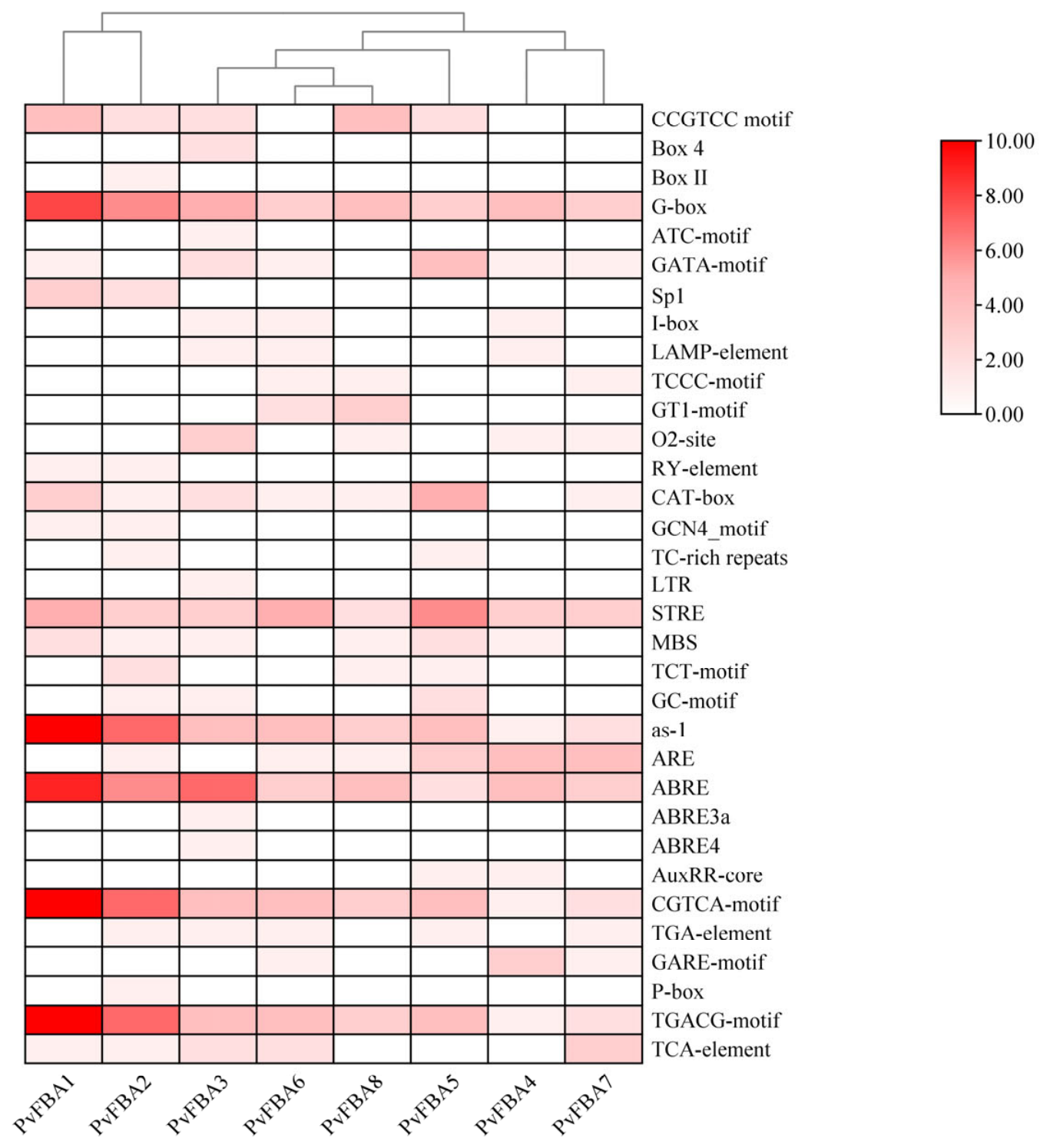
To clarify the potential function of PvFBAs, a 2000 bp sequence upstream of the predicted initiation codon for eight PvFBA genes was analyzed for putative cis-acting regulatory elements using the PlantCARE database. Thirty-seven putative cis-acting regulatory elements were identified in the PvFBA promoters (Table S3). PvFBA2 and PvFBA3 promoters had the most cis-acting regulatory elements (twenty-three), whereas PvFBA8 promoters had the fewest cis-acting regulatory elements (fourteen). Twelve phytohormone-associated elements were detected, associated with the plant’s response to auxin (as-1), abscisic acid responsiveness (ABRE), abscisic acid response element (ABRE3a and ABRE4), auxin responsiveness (AuxRR-core), cis-acting regulatory element involved in the MeJA-responsiveness (TGACG-motif), auxin-responsive element (TGA-element), gibberellin-responsive element (GARE-motif), MeJA-responsiveness (CGTCA-motif), ethylene-responsive element (ERE), salicylic acid responsiveness (TCA-element), and gibberellin-responsive element (P-box). Ten light-responsive elements were found in the promoters of PvFBA genes, including part of a conserved DNA module involved in light-responsiveness (Box 4), part of a light-responsive element (GATA-motif, LAMP-element, and TCCC-motif), a light-responsive element (G-box, Sp1, and GT1-motif), light-responsiveness (ATC-motif), part of a light-responsive module (AE-box), and an MYB binding site involved in light-responsiveness (MRE). Eight stress-responsive elements were identified, including low-temperature responsiveness (LTR), drought-inducibility (MBS), enhancer-like element involved in anoxic-specific inducibility (GC-motif), stress-responsive element (STRE), dehydration-responsive element (DRE and DRE core), and defense and stress responsiveness (TC-rich repeats). Seven growth and development-related elements were observed, including a cis-acting regulatory element related to meristem-specific activation (CCGTCC motif and CCGTCC-box), zein metabolism regulation (O2-site), meristem expression (CAT-box), a cis-acting regulatory element involved in endosperm expression (GCN4_motif), an MYBHv1 binding site (CCAAT-box), and a root-specific cis-acting regulatory element (motif I). Overall, six core/binding elements, specifically G-box, as-1, STRE, ABRE, the TGACG-motif, and the CGTCA-motif, were ubiquitously present across the promoter region of all PvFBA genes (Figure 4). These results indicated that PvFBA genes were involved in light-responsiveness, hormone-responsiveness, stress adaptation, and growth/development regulation. In conclusion, these analyses indicated that there were varying degrees of differences in the type and number of cis-acting regulatory elements among PvFBA genes, and the biological functions of these elements required further experimental research.

3.6. Chromosomal Distributions and Collinearity Analysis of the FBA Gene Family

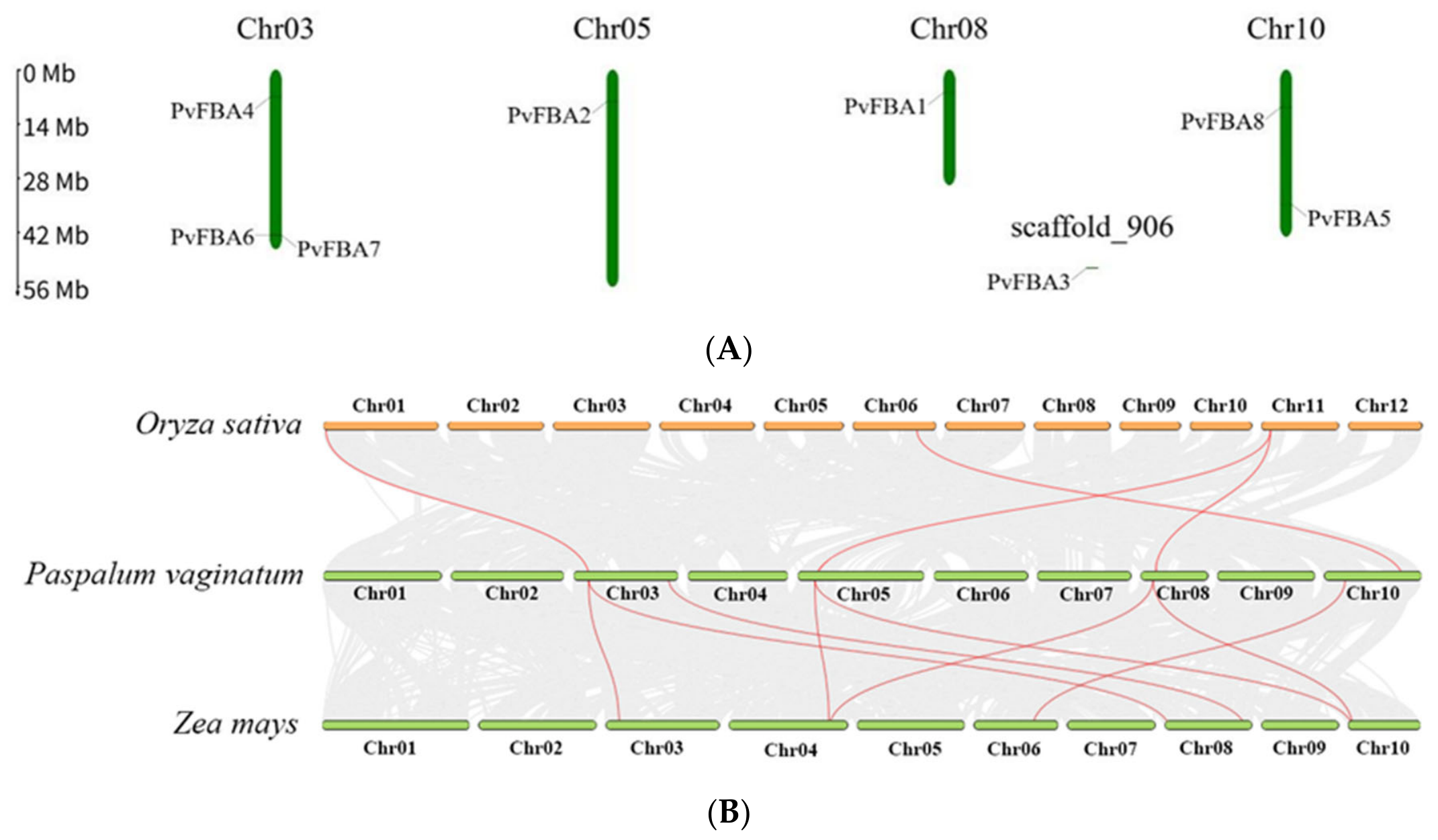
All PvFBA genes except PvFBA3, which was located on unmapped scaffolds, were unevenly distributed on four chromosomes. There were three genes (PvFBA4, PvFBA6, and PvFBA7) on chromosome 03, two genes (PvFBA5 and PvFBA7) on chromosome 10, and one gene on each of the other two chromosomes (Figure 5A). Collinearity analysis among seashore paspalum, maize, and rice uncovered greater homology between seashore paspalum and maize FBA genes compared to rice, with eight orthologous gene pairs identified in maize and only four in rice (Figure 5). These results showed that the PvFBA gene family was more closely related to that of maize than to that of rice.

3.7. Expression Patterns of PvFBA Genes in Leaves Under Cadmium Stress Treatment

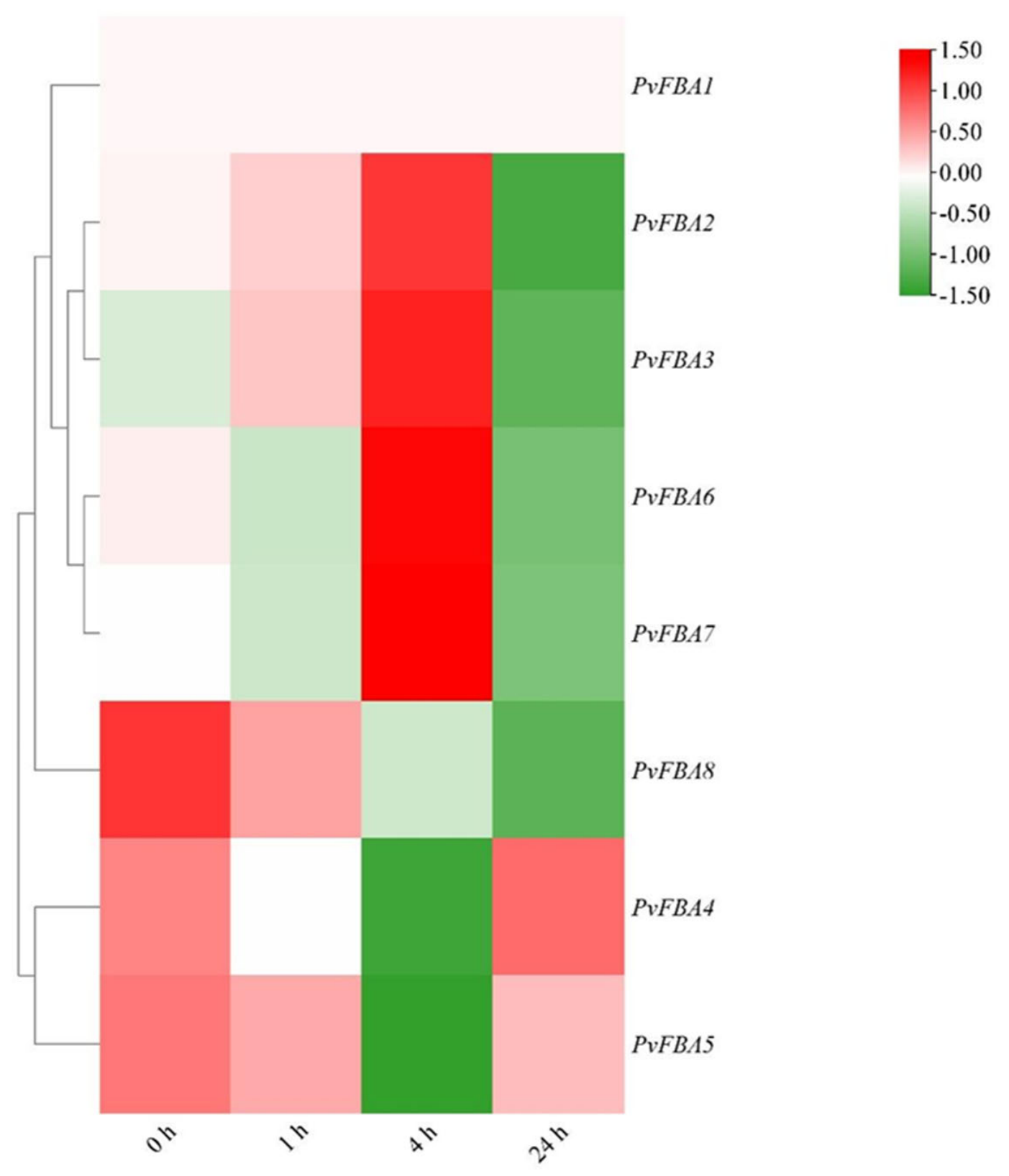
To further analyze the biological functions of PvFBA genes under different environmental conditions, the transcriptome data of seashore paspalum were downloaded from the NCBI SRA database [33]. The expression patterns of the PvFBA gene family under cadmium stress were analyzed, indicating that the expression levels of most PvFBA genes changed to varying degrees in response to cadmium stress. In the 1-h treatment, five PvFBA genes (PvFBA4, PvFBA5, PvFBA6, PvFBA7, and PvFBA8) showed downregulated expression. The expression levels of PvFBA2, PvFBA3, PvFBA6, and PvFBA7 peaked in the 4-h treatment; then, all of them showed a decreasing trend. Notably, PvFBA8 remained consistently downregulated under prolonged cadmium treatment (1, 4, and 24 h), whereas no expression level of PvFBA1 was detected (Figure 6). These results suggested that PvFBA genes might play a specific role in the tolerance mechanisms to cadmium stress.

3.8. Validation of Transcriptomic Data with RT-qPCR

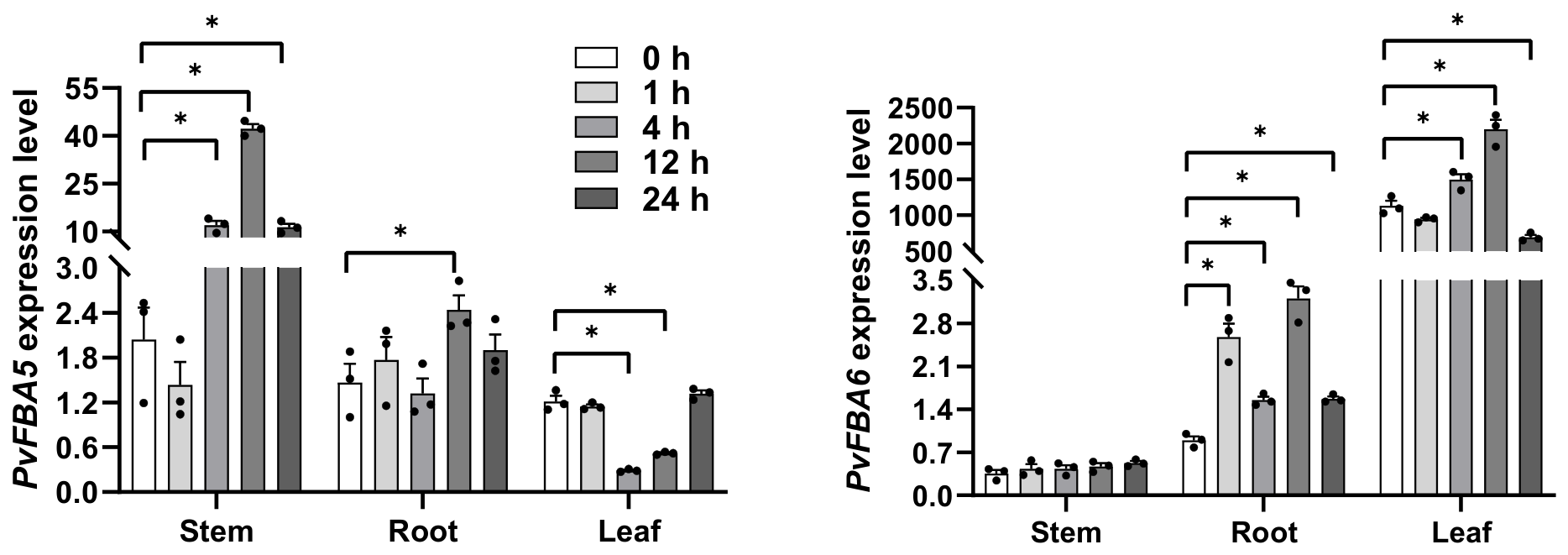
Two genes, PvFBA5 and PvFBA6, were selected randomly from eight PvFBA genes, and their expression levels were analyzed using RT-qPCR to validate the transcriptome data of seashore paspalum in response to cadmium stress. In leaves, the expression level of PvFBA5 exhibited a significant decrease at 4 h, followed by a gradual increase at 12 and 24 h. In contrast, the expression level of PvFBA6 peaked at 12 h and then showed a decreasing trend (Figure 7). The RT-qPCR results of PvFBA5 and PvFBA6 were consistent with the expression trends from transcriptomic data, validating the reliability of the transcriptomic data results. Moreover, the expression levels of PvFBA5 and PvFBA6 were examined in stems and roots under cadmium stress. In roots, cadmium treatment significantly upregulated the expression levels of PvFBA5 and PvFBA6, peaking at 12 h. The expression level of PvFBA5 showed the most significant induction in stems, with its expression level increasing by 5.8-fold compared to the 0-h condition. These results suggested that PvFBA5 and PvFBA6 likely played crucial roles in cadmium stress responses.

4. Discussion

Seashore paspalum is a perennial Poaceae species renowned for its exceptional tolerance to cadmium and salinity. It is widely utilized for phytoremediation in cadmium-contaminated areas and as the environmental turfgrass in salinity-affected regions [20,40]. For this species, however, the gene-level basis of cadmium-responsiveness remains incompletely resolved. Because FBA enzymes connect carbon metabolism with stress-related energy and redox processes, characterization of the PvFBA family provides a useful entry point for identifying candidate components involved in cadmium response. The FBA gene family has been identified in several crops, including maize (ten ZmFBAs) [38], rice (eight OsFBAs) [37], and wheat (twenty-one TaFBAs) [11]. To date, no genome-wide interpretation of the FBA family in seashore paspalum has been linked directly with cadmium-responsive expression patterns. In the present study, eight PvFBA genes (PvFBA1PvFBA8) were identified in the complete genome sequence of seashore paspalum, which were classified into class I and class II members based on their conserved domain architectures (Table 1). Seashore paspalum, like rice, included seven class I FBA members, fewer than the number reported in maize, Arabidopsis, potato, wheat, and tomato. This difference may be likely due to the expansion of the FBA gene family in maize following the split between Andropogonea (maize) and Paspaleae (seashore paspalum) approximately 28 million years ago [14]. The collinearity results support this evolutionary explanation, although they do not, by themselves, demonstrate functional divergence among the duplicated genes.
The physicochemical properties of PvFBA members further separated the conventional class I members from the atypical PvFBA8 member (class II). Chloroplast-localized Subfamily I members (PvFBA1–PvFBA4) exhibited higher pI values (6.86–9.04) than cytoplasmic members (PvFBA5–PvFBA7, pI 5.93–7.48), likely reflecting adaptation to the alkaline stroma environment. All Subfamily I members shared similar MW (37–45 kDa) consistent with a conserved glycolytic domain (Table 1 and Figure 2B). A class II FBA (PvFBA8) was identified in seashore paspalum, which contained 1376 aa and 42 exons, a significantly higher number than class I FBAs (PvFBA1–PvFBA7) (Table 1 and Figure 2A). Similar phenomena have also been observed in the FBA gene family from other plants, such as rice [37], maize [38], tomato [12], and potato (Solanum tuberosum L.) [41]. In addition, PvFBA8 displayed an exceptionally high MW (147.8 kDa) and a slightly positive GRAVY (0.110), suggesting additional structural domains and possible hydrophobic surface patches (Table 1). These results suggest that PvFBA8 may represent a structurally divergent FBA member, although its specific biochemical activity and biological role remain to be experimentally verified.
It is noteworthy that the predicted secondary and tertiary structures of the PvFBA proteins (Figure 3 and Table S4) are highly consistent with the previously reported tertiary structure of the potato FBA proteins [41], supporting the conservation of FBA genes during their evolution in vascular plants. In addition, a previous cell-type foundational gene analysis identified FBA genes as ultra-conserved core genes in vascular plants [42]. Nevertheless, structural conservation does not necessarily indicate identical physiological function. For example, functional impairment of OsFBA1 leads to gradual chlorosis at the two-leaf stage and eventual death at the three-leaf stage in rice, whereas the loss of OsFBA3 [43,44] and ZmFBA8 [38] function does not affect plant survival. These findings suggest that OsFBA1 plays a unique and irreplaceable role in sustaining photosynthetic activity and carbon assimilation, while OsFBA3 and ZmFBA8 exhibit partial functional redundancy. These observations indicate that FBA genes appear to have undergone functional diversification and redundancy during vascular plant evolution.
Cis-acting regulatory elements, including enhancers and promoters, play essential roles in plant growth, development, and physiology by flexibly regulating gene expression [45]. In this study, the promoter regions of PvFBA genes contained multiple growth/development-, light- and stress-related elements (Figure 4 and Table S3). Most cis-acting regulatory elements were phytohormone-responsive (especially abscisic acid and MeJA-responsive elements) and light-responsive, a pattern consistent with observations in potato [41] and wheat [11]. Some elements have been widely reported in other plant species as key mediators of heavy metal detoxification and stress signaling. ABREs are known to integrate abscisic acid signaling under various abiotic stresses, and accumulating evidence suggests that cadmium stress triggers ABA accumulation, which in turn activates downstream defense genes via ABRE-dependent pathways. Similarly, G-box elements serve as binding sites for MYB transcription factors, and recent studies have demonstrated their direct involvement in cadmium tolerance. This result suggests that PvFBA gene expression is tightly regulated by abscisic acid and MeJA signaling pathways, which are well documented to mediate plant abiotic stress responses, including cadmium tolerance [46,47]. The promoter regions of some PvFBA genes, such as PvFBA1 and PvFBA2, showed a high degree of similarity in cis-acting regulatory elements, which was speculated to have a similarity in gene expression. However, because promoter analysis is based on software prediction, the regulatory roles of these elements require further validation, such as promoter-reporter assays or transcription factor binding analyses.
FBAs are key enzymes in plants, participating in numerous critical physiological and biochemical processes, including energy metabolism, signal transduction, plant development, and defense and response to biotic and abiotic stresses [4,7,38,48]. Phylogenetic and synteny analyses (Figure 1 and Figure 5B) revealed that seashore paspalum is more related to maize than to rice. OsFBA1, which was essential for regulating chloroplast development, energy generation, photosynthesis, and carbon metabolism in rice, was upregulated by the transcription factor mEmBP-1, which directly binds to the G-box motif in its promoter region [37,49]. MiR775A inhibits the expression of ZmFBA4, which leads to the activation of the expression of ZmFBA8 and the regulation of the glycolytic pathway [50]. PvFBA6 can bind Cd, directly enhancing the phosphorylation level of the PvFBA6 protein, enhancing aldolase activity to increase soluble sugar content and facilitate the pentose phosphate pathway, ultimately boosting NADPH levels for antioxidant synthesis and improving cadmium tolerance in plants [10]. These studies support the biological relevance of FBA genes, but the functions of individual PvFBA members identified here still require targeted validation.
Although multiple previous studies have identified FBA proteins as cadmium-binding proteins [10,51], the PvFBA members lack classical cadmium-binding motifs (e.g., Cys-rich clusters and Cys/His coordination sites). This suggests that cadmium binding of the FBA protein may occur through non-canonical sites such as the native Zn2+ pocket or surface residues. To explore the transcriptional responses of PvFBA genes to cadmium tolerance, the public transcriptome data of seashore paspalum [33] was analyzed. Notably, PvFBA6 and PvFBA7 showed relatively high expression levels in leaves, with expression trends of initial decrease, followed by increase, and subsequent decrease (Figure 6), highlighting their potential key roles in mediating cadmium tolerance. Notably, PvFBA2 and PvFBA3, as well as PvFBA6 and PvFBA7, which had the most closely related evolutionary relationship (Figure 1), also belonged to the same phylogenetic cluster in the expression levels of PvFBA genes. These observations suggest that PvFBA7, like PvFBA6, is likely involved in regulating cadmium stress responses, warranting further functional characterization. Furthermore, PvFBA2, PvFBA3 and PvFBA5 showed relatively low expression in leaves, suggesting that they may be predominantly expressed in other tissues or under cadmium stress conditions. These results potentially indicated functional correlation or synergistic action within the relatively close evolutionary relationships of the PvFBA gene family.
Several limitations should be acknowledged. First, this study is primarily based on genome-wide identification, in silico analyses, transcriptome mining, and RT-qPCR validation of selected genes; therefore, it cannot establish causality. Second, only one cadmium concentration (300 μM CdCl2) and a limited set of sampling time points were examined, which restricts assessment of dose-dependent and long-term responses. Third, only PvFBA5 and PvFBA6 were selected for RT-qPCR validation, and additional PvFBA members should be validated across more tissues and stress conditions. Fourth, protein-level evidence, including enzyme activity assays, protein abundance, subcellular localization, phosphorylation status, cadmium-binding assays, and protein–protein interactions, is still lacking.
Future work employing functional assays, such as gene knockout, overexpression systems, and protein-level validation, will be necessary to elucidate the proposed roles of PvFBA genes in cadmium stress. In the future, integrating transcriptomics, proteomics, and metabolomics data could provide a more comprehensive understanding of how FBA proteins regulate plant responses to environmental stress, thus paving the way for the development of cadmium-tolerant plants.

5. Conclusions

In this study, seven class I and one class II PvFBA genes were systematically identified for the first time from the whole genome of seashore paspalum. The physicochemical properties, evolutionary relationship, gene structure, conserved domain, protein structure, cis-acting regulatory elements, chromosomal localization, and collinearity relationship of eight PvFBA genes were analyzed to reveal eight distinct family members with conserved evolutionary and functional characteristics. PvFBA5 and PvFBA6 may play essential roles in responses to cadmium stress. These results suggested that PvFBA genes played an important role in the response to cadmium stress. This study provided valuable insights for understanding the structure and function of the PvFBA gene family, and identified candidate genes for the practical application of cadmium-tolerant plant improvement.

Supplementary Materials

The following supporting information can be downloaded at https://www.mdpi.com/article/10.3390/cimb48060563/s1.

Author Contributions

Study conception and design: Y.L. and N.L.; data collection: Y.L. and H.L.; analysis and interpretation of results: Y.L., Q.Z., and N.L.; draft manuscript preparation: Y.L. and H.L.; manuscript revision: X.Z. and N.L. All authors have read and agreed to the published version of the manuscript.

Funding

This research was funded by the Science and Technology Program of Jiangsu Vocational College of Agriculture and Forestry (2022kj64), the ‘JBGS’ Project of Seed Industry Revitalization in Jiangsu Province (JBGS[2021]096), and the National Natural Science Foundation of China (32101437).

Institutional Review Board Statement

Not applicable.

Informed Consent Statement

Not applicable.

Data Availability Statement

The original contributions presented in this study are included in the article/Supplementary Materials. Further inquiries can be directed to the corresponding author.

Conflicts of Interest

The authors declare that they have no competing interests.

References

  1. Nakamura, H.; Tokairin, Y.; Tamayama, S.; Kon, S.; Hidaka, S.; Ejiri, S.-i.; Tsutsumi, K.-i. Cell type- and positionally specific regulation of the aldolase P gene expression in rice seedlings. Biosci. Biotechnol. Biochem. 1997, 61, 256–262. [Google Scholar] [CrossRef][Green Version]
  2. Marsh, J.J.; Lebherz, H.G. Fructose-bisphosphate aldolases: An evolutionary history. Trends Biochem. Sci. 1992, 17, 110–113. [Google Scholar] [CrossRef]
  3. Flechner, A.; Gross, W.; Martin, W.F.; Schnarrenberger, C. Chloroplast class I and class II aldolases are bifunctional for fructose-1,6-biphosphate and sedoheptulose-1,7-biphosphate cleavage in the Calvin cycle. FEBS Lett. 1999, 447, 200–202. [Google Scholar] [CrossRef]
  4. Uematsu, K.; Suzuki, N.; Iwamae, T.; Inui, M.; Yukawa, H. Increased fructose 1,6-bisphosphate aldolase in plastids enhances growth and photosynthesis of tobacco plants. J. Exp. Bot. 2012, 63, 3001–3009. [Google Scholar] [CrossRef]
  5. Carrera, D.Á.; George, G.M.; Fischer-Stettler, M.; Galbier, F.; Eicke, S.; Truernit, E.; Streb, S.; Zeeman, S.C. Distinct plastid fructose bisphosphate aldolases function in photosynthetic and non-photosynthetic metabolism in Arabidopsis. J. Exp. Bot. 2021, 72, 3739–3755. [Google Scholar] [CrossRef] [PubMed]
  6. Zhu, D.; Liu, J.; Duan, W.; Sun, H.; Zhang, L.; Yan, Y. Analysis of the chloroplast crotonylome of wheat seedling leaves reveals the roles of crotonylated proteins involved in salt-stress responses. J. Exp. Bot. 2023, 74, 2067–2082. [Google Scholar] [CrossRef] [PubMed]
  7. Mu, J.; Fu, Y.; Liu, B.; Zhang, Y.; Wang, A.; Li, Y.; Zhu, J. SiFBA5, a cold-responsive factor from Saussurea involucrata promotes cold resilience and biomass increase in transgenic tomato plants under cold stress. BMC Plant Biol. 2021, 21, 75. [Google Scholar] [CrossRef] [PubMed]
  8. Yu, S.; Wu, J.; Sun, Y.; Zhu, H.; Sun, Q.; Zhao, P.; Huang, R.; Guo, Z. A calmodulin-like protein (CML10) interacts with cytosolic enzymes GSTU8 and FBA6 to regulate cold tolerance. Plant Physiol. 2022, 190, 1321–1333. [Google Scholar] [CrossRef]
  9. Cai, B.; Li, Q.; Liu, F.; Bi, H.; Ai, X. Decreasing fructose-1,6-bisphosphate aldolase activity reduces plant growth and tolerance to chilling stress in tomato seedlings. Physiol. Plant. 2018, 163, 247–258. [Google Scholar] [CrossRef]
  10. Zheng, Y.; Liu, Y.; Jiang, Y.; Li, Z.; Zhang, Q.; Yu, Q.; Liu, Y.; Liu, J.; Yang, Z.; Chen, Y. Posphoproteomics profiling reveals the regulatory role of a phosphorylated protein PvFBA1 in cadmium tolerance in seashore paspalum. Ecotoxicol. Environ. Saf. 2024, 286, 117220. [Google Scholar] [CrossRef]
  11. Lv, G.; Guo, X.; Xie, L.; Xie, C.; Zhang, X.; Yang, Y.; Xiao, L.; Tang, Y.; Pan, X.; Guo, A.; et al. Molecular characterization, gene evolution, and expression analysis of the fructose-1, 6-bisphosphate aldolase (FBA) gene family in wheat (Triticum aestivum L.). Front. Plant Sci. 2017, 8, 1030. [Google Scholar] [CrossRef] [PubMed]
  12. Cai, B.; Li, Q.; Xu, Y.; Yang, L.; Bi, H.; Ai, X. Genome-wide analysis of the fructose 1,6-bisphosphate aldolase (FBA) gene family and functional characterization of FBA7 in tomato. Plant Physiol. Biochem. 2016, 108, 251–265. [Google Scholar] [CrossRef] [PubMed]
  13. Odintsova, T.I.; Slezina, M.P.; Istomina, E.A. Defensins of grasses: A systematic review. Biomolecules 2020, 10, 1029. [Google Scholar] [CrossRef]
  14. Sun, G.; Wase, N.; Shu, S.; Jenkins, J.; Zhou, B.; Torres-Rodríguez, J.V.; Chen, C.; Sandor, L.; Plott, C.; Yoshinga, Y.; et al. Genome of Paspalum vaginatum and the role of trehalose mediated autophagy in increasing maize biomass. Nat. Commun. 2022, 13, 7731. [Google Scholar] [CrossRef]
  15. Kekere, O. Influence of sea sprays on growth and visual quality of seashore paspalum (Paspalum vaginatum O. Swartz) use in beach landscaping. Int. J. Hortic. 2014, 4, 64–71. [Google Scholar] [CrossRef]
  16. Wu, X.; Tian, Z.; Wang, T.; Hu, X.; Sun, Q.; Wang, Y.; Lu, W.; Ren, Z.; Qi, J.; Wu, X. Genome-wide identification and expression analysis of WRKY transcription factor family members in seashore paspalum under salt stress. Grass Res. 2025, 5, e017. [Google Scholar] [CrossRef]
  17. Cyril, J.; Powell, G.L.; Duncan, R.R.; Baird, W.V. Changes in membrane polar lipid fatty acids of seashore paspalum in response to low temperature exposure. Crop Sci. 2002, 42, 2031–2037. [Google Scholar] [CrossRef]
  18. He, Y.; Xiao, H.; Wang, H.; Chen, Y.; Yu, M. Effect of silicon on chilling-induced changes of solutes, antioxidants, and membrane stability in seashore paspalum turfgrass. Acta Physiol. Plant. 2010, 32, 487–494. [Google Scholar] [CrossRef]
  19. Bamidele, J.F.; Igiri, A. Growth of seashore paspalum, (Paspalum vaginatum L) in soil contaminated with crude petroleum oil. J. Appl. Sci. Environ. Manag. 2011, 15, 303–306. [Google Scholar] [CrossRef][Green Version]
  20. Hu, X.; Pan, L.; Fu, C.; Zhu, Q.; Hao, J.; Wang, X.; Nawaz, M.; Qu, J.; Zhang, J.; Chen, Y.; et al. A multi-omics analysis reveals candidate genes for Cd tolerance in Paspalum vaginatum. BMC Plant Biol. 2025, 25, 441. [Google Scholar] [CrossRef]
  21. Lu, W.; Tang, X.; Huo, Y.; Xu, R.; Qi, S.; Huang, J.; Zheng, C.; Wu, C. Identification and characterization of fructose 1,6-bisphosphate aldolase genes in Arabidopsis reveal a gene family with diverse responses to abiotic stresses. Gene 2012, 503, 65–74. [Google Scholar] [CrossRef]
  22. Zhang, J.; Liu, Y.; Zhou, Z.; Yang, L.; Xue, Z.; Li, Q.; Cai, B. Genome-wide characterization of fructose 1,6-bisphosphate aldolase genes and expression profile reveals their regulatory role in abiotic stress in cucumber. Int. J. Mol. Sci. 2024, 25, 7687. [Google Scholar] [CrossRef]
  23. Jiang, Z.; Du, T.; Zhou, Y.; Qin, Z.; Li, A.; Wang, Q.; Zhang, L.; Hou, F. Genome-wide identification and expression analysis of the fructose-1,6-bisphosphate aldolase (FBA) gene family in sweet potato and its two diploid relatives. Int. J. Mol. Sci. 2025, 26, 7348. [Google Scholar] [CrossRef] [PubMed]
  24. Chen, C.; Wu, Y.; Li, J.; Wang, X.; Zeng, Z.; Xu, J.; Liu, Y.; Feng, J.; Chen, H.; He, Y.; et al. TBtools-II: A “one for all, all for one” bioinformatics platform for biological big-data mining. Mol. Plant 2023, 16, 1733–1742. [Google Scholar] [CrossRef] [PubMed]
  25. Finn, R.D.; Clements, J.; Eddy, S.R. HMMER web server: Interactive sequence similarity searching. Nucleic Acids Res. 2011, 39, W29–W37. [Google Scholar] [CrossRef] [PubMed]
  26. Thompson, J.D.; Gibson, T.J.; Higgins, D.G. Multiple sequence alignment using ClustalW and ClustalX. Curr. Protoc. Bioinform. 2003, 2.3.1–2.3.22. [Google Scholar] [CrossRef]
  27. Kumar, S.; Stecher, G.; Li, M.; Knyaz, C.; Tamura, K. MEGA X: Molecular evolutionary genetics analysis across computing platforms. Mol. Biol. Evol. 2018, 35, 1547–1549. [Google Scholar] [CrossRef]
  28. Lescot, M.; Déhais, P.; Thijs, G.; Marchal, K.; Moreau, Y.; Van de Peer, Y.; Rouzé, P.; Rombauts, S. PlantCARE, a database of plant cis-acting regulatory elements and a portal to tools for in silico analysis of promoter sequences. Nucleic Acids Res. 2002, 30, 325–327. [Google Scholar] [CrossRef]
  29. Geourjon, C.; Deléage, G. SOPMA: Significant improvements in protein secondary structure prediction by consensus prediction from multiple alignments. Bioinformatics 1995, 11, 681–684. [Google Scholar] [CrossRef]
  30. Jumper, J.; Evans, R.; Pritzel, A.; Green, T.; Figurnov, M.; Ronneberger, O.; Tunyasuvunakool, K.; Bates, R.; Žídek, A.; Potapenko, A.; et al. Highly accurate protein structure prediction with AlphaFold. Nature 2021, 596, 583–589. [Google Scholar] [CrossRef]
  31. Chao, J.; Li, Z.; Sun, Y.; Aluko, O.O.; Wu, X.; Wang, Q.; Liu, G. MG2C: A user-friendly online tool for drawing genetic maps. Mol. Hortic. 2021, 1, 16. [Google Scholar] [CrossRef]
  32. Wang, Y.; Tang, H.; DeBarry, J.D.; Tan, X.; Li, J.; Wang, X.; Lee, T.-h.; Jin, H.; Marler, B.; Guo, H.; et al. MCScanX: A toolkit for detection and evolutionary analysis of gene synteny and collinearity. Nucleic Acids Res. 2012, 40, e49. [Google Scholar] [CrossRef] [PubMed]
  33. Xu, L.; Zheng, Y.; Yu, Q.; Liu, J.; Yang, Z.; Chen, Y. Transcriptome analysis reveals the stress tolerance to and accumulation mechanisms of cadmium in Paspalum vaginatum Swartz. Plants 2022, 11, 2078. [Google Scholar] [CrossRef] [PubMed]
  34. Hoagland, D.; Arnon, D. The water culture method for growing plants without soil. Calif. Agric. Exp. Stn. Circ. 1950, 347, 1–32. [Google Scholar]
  35. Liu, Y.; Liu, J.; Xu, L.; Lai, H.; Chen, Y.; Yang, Z.; Huang, B. Identification and validation of reference genes for seashore paspalum response to abiotic stresses. Int. J. Mol. Sci. 2017, 18, 1322. [Google Scholar] [CrossRef]
  36. Livak, K.; Schmittgen, T. Analysis of relative gene expression data using real-time quantitative PCR and the 2−ΔΔCT method. Methods 2001, 25, 402–408. [Google Scholar] [CrossRef]
  37. Liu, X.; Gao, Y.; Tang, S.; Ben, L.; Zhang, X.; Dong, G.; Zhou, J.; Lin, L.; Yang, Z.; Zhou, Y.; et al. A dual-localized fructose bisphosphate aldolase is essential for chloroplast development and carbon metabolism in rice. Rice 2025, 18, 28. [Google Scholar] [CrossRef]
  38. Zhang, Z.; Li, X.; Zhang, Y.; Zhou, J.; Chen, Y.; Li, Y.; Ren, D. Identification of the fructose 1,6-bisphosphate aldolase (FBA) family genes in maize and analysis of the phosphorylation regulation of ZmFBA8. Plant Sci. 2025, 350, 112311. [Google Scholar] [CrossRef]
  39. Ragupathi, A.; Mastrogiannis, A.J.; Rahimi, N. Biochemistry, tertiary protein structure. In StatPearls; StatPearls Publishing LLC: Saint Petersburg, FL, USA, 2025; Available online: https://europepmc.org/article/MED/29262204 (accessed on 2 February 2026).
  40. Chen, Y.; Chen, C.; Tan, Z.; Liu, J.; Zhuang, L.; Yang, Z.; Huang, B. Functional identification and characterization of genes cloned from halophyte seashore paspalum conferring salinity and Cadmium tolerance. Front. Plant Sci. 2016, 7, 102. [Google Scholar] [CrossRef]
  41. Li, T.; Hou, X.; Sun, Z.; Ma, B.; Wu, X.; Feng, T.; Ai, H.; Huang, X.; Li, R. Characterization of FBA genes in potato (Solanum tuberosum L.) and expression patterns in response to light spectrum and abiotic stress. Front. Genet. 2024, 15, 1364944. [Google Scholar] [CrossRef]
  42. Xue, H.; Xu, Z.; Liu, Y.; Wang, L.; Ming, X.; Wu, Z.; Lian, H.; Han, Y.; Xu, J.; Zhang, Z.; et al. A unified cell atlas of vascular plants reveals cell-type foundational genes and accelerates gene discovery. Cell 2025, 188, 6370–6390. [Google Scholar] [CrossRef]
  43. Zhang, F.; Zhang, P.; Zhang, Y.; Wang, S.; Qu, L.; Liu, X.; Luo, J. Identification of a peroxisomal-targeted aldolase involved in chlorophyll biosynthesis and sugar metabolism in rice. Plant Sci. 2016, 250, 205–215. [Google Scholar] [CrossRef]
  44. Wen, R.; Zhu, M.; Yu, J.; Kou, L.; Ahmad, S.; Wei, X.; Jiao, G.; Hu, S.; Sheng, Z.; Zhao, F.; et al. Photosynthesis regulates tillering bud elongation and nitrogen-use efficiency via sugar-induced NGR5 in rice. New Phytol. 2024, 243, 1440–1454. [Google Scholar] [CrossRef]
  45. Wittkopp, P.J.; Kalay, G. Cis-regulatory elements: Molecular mechanisms and evolutionary processes underlying divergence. Nat. Rev. Genet. 2012, 13, 59–69. [Google Scholar] [CrossRef]
  46. Wei, Y.; Javed, T.; Liu, T.; Ali, A.; Gao, S. Mechanisms of Abscisic acid (ABA)-mediated plant defense responses: An updated review. Plant Stress 2025, 15, 100724. [Google Scholar] [CrossRef]
  47. Hewedy, O.A.; Elsheery, N.I.; Karkour, A.M.; Elhamouly, N.; Arafa, R.A.; Mahmoud, G.A.-E.; Dawood, M.F.A.; Hussein, W.E.; Mansour, A.; Amin, D.H.; et al. Jasmonic acid regulates plant development and orchestrates stress response during tough times. Environ. Exp. Bot. 2023, 208, 105260. [Google Scholar] [CrossRef]
  48. Wang, Y.; Yang, Y.; Yang, L.; Zhang, H.; Zhu, Z.; Li, Y.; Yang, N.; Xie, X.; Liu, X.; Hou, J.; et al. BcNAC55.2 activates BcFBA8 to enhance abiotic stress tolerance in Wucai. Int. J. Biol. Macromol. 2025, 331, 148458. [Google Scholar] [CrossRef] [PubMed]
  49. Perveen, S.; Qu, M.; Chen, F.; Essemine, J.; Khan, N.; Lyu, M.A.; Chang, T.; Song, Q.; Chen, G.; Zhu, X. Overexpression of maize transcription factor mEmBP-1 increases photosynthesis, biomass, and yield in rice. J. Exp. Bot. 2020, 71, 4944–4957. [Google Scholar] [CrossRef] [PubMed]
  50. Fedorin, D.N.; Khomutova, A.E.; Eprintsev, A.T.; Igamberdiev, A.U. Involvement of miR775 in the post-transcriptional regulation of fructose-1,6-bisphosphate aldolase in maize (Zea mays L.) leaves under hypoxia. Int. J. Mol. Sci. 2025, 26, 865. [Google Scholar] [CrossRef] [PubMed]
  51. Yu, X.; Wei, S.; Yang, Y.; Ding, Z.; Wang, Q.; Zhao, J.; Liu, X.; Chu, X.; Tian, J.; Wu, N.; et al. Identification of cadmium-binding proteins from rice (Oryza sativa L.). Int. J. Biol. Macromol. 2018, 119, 597–603. [Google Scholar] [CrossRef] [PubMed]
Figure 1. Evolutionary relationships of the FBA gene family in seashore paspalum, maize, rice, Arabidopsis, potato, wheat, and tomato. Based on the neighbor-joining method with the MEGA X software, a total of 72 FBAs were classified into two subfamilies (classes I and II, denoted with green and purple, respectively). The red squares represented eight PvFBAs in seashore paspalum. The olive circles represent ten ZmFBAs in maize. The violet stars represent eight OsFBAs in rice. The green triangles represent eight AtFBAs in Arabidopsis. The blue triangles represent nine StFBAs in potato. The fuchsia squares represent twenty-one TaFBAs in wheat. The orange circles represent eight SlFBAs in tomato.
Cimb 48 00563 g001
Figure 2. Exon–intron structures, gene domains, and conserved motifs of PvFBA genes. (A) Gene structure analysis of PvFBA genes. The untranslated region (UTR) and CDS are shown in green and yellow respectively. (B) Conserved domain analysis of PvFBA proteins. Glycolytic (PF00274) and fructose–bisphosphate aldolase domains (F_bP_aldolase; PF01116) are shown in green and yellow respectively. (C) Conserved motif analysis of PvFBA proteins. Fifteen putative motifs are indicated in different colored boxes. The information on the motifs is listed at the bottom.
Cimb 48 00563 g002
Figure 3. Predicted tertiary structures of PvFBA proteins. Helices, sheets, and loops are represented by cyan, magenta, and salmon, respectively.
Cimb 48 00563 g003
Figure 4. Cis-acting regulatory element analysis in the promoters of PvFBA genes. The red color depth of the square represents the number of cis-acting regulatory elements in the promoters of PvFBAs.
Cimb 48 00563 g004
Figure 5. Whole-genome chromosomal distributions and collinearity analysis of the FBA genes. (A) Chromosomal locations of PvFBA genes. (B) Collinearity of PvFBA genes with those of FBA genes from maize and rice. The gray lines between seashore paspalum and maize/rice represent collinearity in wide regions of the whole genomes, while the red lines indicate the duplicated relationships of FBA genes.
Cimb 48 00563 g005
Figure 6. Expression patterns of PvFBA genes in leaves under cadmium stress treatment. The red color depth of the square represents the high expression level of PvFBA genes, while the green color of the square signifies the low expression level of PvFBA genes.
Cimb 48 00563 g006
Figure 7. Expression levels of PvFBA5 and PvFBA6 detected by RT-qPCR under cadmium stress treatment using 300 μM CdCl2. Data shown as the mean values ± SE of three independent biological replicates and three technical replicates. Asterisks indicate significant differences according to Fisher’s protected LSD test (p < 0.05).
Cimb 48 00563 g007
Table 1. Characteristics of PvFBA genes.
Gene NameGene ID in
Assembly
SubfamilyChromosome LocationProtein Length (aa)Isoelectric Point (pI)Molecular Weight (Da)Grand Average of Hydropathicity (GRAVY)Predicted Subcellular Localization
PvFBA1Pavag08G041800.1IChr08:5925129:5926937:−3886.8641703.57−0.157Chloroplast
PvFBA2Pavag05G075100.1IChr05:8468486:8471632:+3866.9241730.68−0.148Chloroplast
PvFBA3PavagK331800.1Iscaffold_906:81050:84461:+4089.0244914.39−0.218Chloroplast
PvFBA4Pavag03G086200.1IChr03:7200541:7204303:+3879.0441722.61−0.218Chloroplast
PvFBA5Pavag10G188000.1IChr10:36049092:36051598:+3595.9337992.35−0.053Cytoplasm
PvFBA6Pavag03G372400.1IChr03:44289962:44292607:−3637.4839466.17−0.241Cytoplasm
PvFBA7Pavag03G372200.1IChr03:44252870:44255271:−3636.9939433.10−0.238Cytoplasm
PvFBA8Pavag10G109200.1IIChr10:10033125:10063220:+13765.98147793.060.110Cytoplasm
Disclaimer/Publisher’s Note: The statements, opinions and data contained in all publications are solely those of the individual author(s) and contributor(s) and not of MDPI and/or the editor(s). MDPI and/or the editor(s) disclaim responsibility for any injury to people or property resulting from any ideas, methods, instructions or products referred to in the content.