Article

Integrated Phylogenomics and Expression Profiling of the Peptide Deformylase Gene Family in Oryza sativa Reveals Their Role in Development and Stress Tolerance

1
Rice Research Institute, Shenyang Agricultural University, Shenyang 110161, China
2
College of Life and Environmental Science, Hangzhou Normal University, Hangzhou 311121, China
3
Liaoning Academy of Agricultural Sciences, Shenyang 110161, China
*
Author to whom correspondence should be addressed.
Curr. Issues Mol. Biol. 2026, 48(4), 396; https://doi.org/10.3390/cimb48040396
Submission received: 12 March 2026 / Revised: 5 April 2026 / Accepted: 8 April 2026 / Published: 13 April 2026
(This article belongs to the Special Issue New Advances in Plant Responses to Environmental Stresses)

Abstract

Peptide deformylase (PDF) belongs to a conserved enzyme family critical for N-terminal methionine excision (NME), an essential protein maturation process in prokaryotes and eukaryotic organelles (chloroplasts, mitochondria). To explore the potential functions of OsPDFs in Oryza sativa, this study employed bioinformatics approaches and experimental validation to systematically identify and analyze the OsPDF gene family. Three OsPDF genes (OsPDF1A, OsPDF1B, OsPDF1B2) were identified in rice. These genes are exclusively distributed on chromosome 1. The biophysical properties of these proteins showed that OsPDF1A and OsPDF1B are alkaline proteins, while OsPDF1B2 is acidic, and all are hydrophilic with moderate thermostability potential. Synteny analysis revealed closer evolutionary relationships between Oryza sativa and the monocot Triticum aestivum than with dicots, reflecting conserved PDF function in gramineous plants. Analysis of cis-acting elements in the 2000 bp upstream region of OsPDF gene promoters revealed numerous elements associated with abiotic stress response and hormone regulation. Furthermore, quantitative real-time PCR (qRT-PCR) data supported these findings, indicating that OsPDF1A and OsPDF1B were upregulated under low-temperature stress, and all three OsPDF genes were transcriptionally activated by heat, salt and UV-B stresses, indicating their active involvement in rice growth, development, and abiotic stress tolerance. In summary, OsPDFs exhibit significant functions in rice’s stress adaptation, growth, and development. This study not only enhances our understanding of the OsPDF gene family’s genomic, evolutionary, and functional characteristics, but also provides new perspectives and foundational data for further exploring their regulatory mechanisms in protein maturation and abiotic stress responses, as well as their potential applications in rice stress tolerance breeding.

1. Introduction

Peptide deformylase (PDF) is a conserved enzyme family that plays a critical role in N-terminal methionine excision (NME), which is a fundamental protein maturation process conserved across prokaryotes and the organelles (chloroplasts and mitochondria) of eukaryotes. Its core function is to catalyze the removal of the formyl group from the N-terminal formylmethionine (fnMet) of nascent polypeptides. This step is a prerequisite for the subsequent cleavage of methionine by methionine aminopeptidase (MAP), which in turn ensures the proper localization, stability, and activity of proteins [1,2,3].
In bacteria, protein synthesis initiates with formylated methionine-tRNA (fMet-tRNAfMet), where the formyl group is added by methionyl-tRNA formyltransferase (FMT) using 10-formyltetrahydrofolate (10-fTHF), which is a metabolite synthesized via FolA (dihydrofolate reductase) and FolD (methylenetetrahydrofolate dehydrogenase) [4,5]. PDF then removes this formyl group from approximately 95% of bacterial proteins (excluding secreted proteins with signal peptides), a step that enables subsequent NME mediated by MAP [6]. PDF is a well-validated antimicrobial target, and this role is linked to the biological activity of formylated peptides. These byproducts of bacterial protein synthesis act as pathogen-associated molecular patterns (PAMPs), binding to formyl peptide receptors (FPRs) on mammalian leukocytes to trigger proinflammatory responses, such as chemotaxis and reactive oxygen species production [7,8]. Inhibitors like actinonin (a potent PDF antagonist with nanomolar affinity) disrupt the NME process, leading to the accumulation of misfolded proteins, membrane defects, and ultimately bacterial cell death [9,10]. However, bacterial resistance to PDF inhibitors has emerged, primarily through mutations in the fmt gene (which encodes FMT), which bypasses the need for formylation, thereby rendering PDF inhibition functionally irrelevant [11]. Notably, genome-reduced pathogens (e.g., mycoplasmas) exhibit unique adaptive traits related to this pathway. A bioinformatic analysis of 54 mycoplasma species (including the swine pathogen Mycoplasma hyopneumoniae) revealed 14 species (all haemoplasmas and a Hominis clade) lack FolA, FolD, FMT, and PDF [12]. LC-MS/MS analysis further confirmed the absence of N-terminal formylmethionine (fnMet) in M. hyopneumoniae proteins, a stark contrast to Mycoplasma pneumoniae (a human pathogen with intact NME machinery). Additionally, the translation initiation factors (IF1, IF2, IF3) of M. hyopneumoniae display structural irregularities. For instance, IF2 lacks critical residues involved in fMet-tRNAfMet binding, which reduces their affinity for fMet-tRNAfMet. These features collectively support an evolutionary shift in M. hyopneumoniae toward using unformylated methionine (nMet) for translation initiation, an adaptation likely driven by the need to evade host immune detection [12].
In eukaryotes, cytoplasmic protein translation initiates with unformylated methionine. However, chloroplasts and mitochondria (endosymbiotic descendants of prokaryotes) retain the prokaryotic trait of fnMet-initiated protein synthesis, which requires organelle-targeted PDFs to complete protein maturation [13]. Plant PDFs of type 1 (PDF1) are classified into two subgroups based on subcellular localization: PDF1A, which targets mitochondria, and PDF1B, which localizes to chloroplasts, mitochondria, or both. For instance, Oryza sativa OsPDF1B is dual-localized to both organelles [14], whereas Eucommia ulmoides EuPDF1B (the first characterized PDF1B from a woody plant) is exclusively chloroplastic. The localization pattern of EuPDF1B is proposed to be a woody-plant-specific adaptive trait [15]. PDF1B plays a critical role in chloroplast development and function. In rice, pdf1b mutants exhibit visible chlorosis (yellowish leaves), stunted growth, and severe chloroplast damage-including disorganized thylakoid membranes, which are essential for photosynthesis [14]. In tobacco, inhibiting PDF activity with actinonin (a potent PDF inhibitor) reduces the accumulation of the D1 protein, a core component of photosystem II (PSII) encoded by the chloroplast psbA gene, ultimately leading to PSII degradation and leaf death [16,17]. For E. ulmoides EuPDF1B, expression analysis reveals tissue-specific and environment-responsive patterns. Its transcript levels are highest in mature leaves (consistent with a role in photosynthesis) and are induced by the hormones abscisic acid (ABA), methyl jasmonate (MeJA), and gibberellin (GA), but suppressed by shading. These expression patterns correlate with cis-acting elements identified in the EuPDF1B promoter, such as ABA-responsive elements (ABREs) and MeJA-responsive CGTCA motifs [15]. Functional validation in transgenic tobacco further confirms EuPDF1B’s role in PSII maintenance. Plants overexpressing EuPDF1B exhibit increased psbA gene expression, enhanced net photosynthetic rate, and increased plant growth compared to wild-type plants [15].
Plant PDFs exhibit distinct biochemical properties that set them apart from their bacterial homologs, with functional traits tailored to plant organelle-specific protein maturation needs. For instance, recombinant PDF1 proteins from Arabidopsis thaliana, pAtDEF1 (PDF1A) and pAtDEF2 (PDF1B) display notable differences in kinetic parameters. pAtDEF2, which targets chloroplasts (and sometimes mitochondria), shows a 240-fold higher catalytic efficiency for the N-terminus of the D1 protein compared to other peptide substrates. In contrast, pAtDEF1 (a mitochondria-targeted PDF1A) has a 2-fold lower binding affinity for actinonin relative to pAtDEF2, reflecting functional specialization linked to their subcellular localizations [17,18]. In woody plants, genome-wide screening of Populus trichocarpa (poplar) identified two PDF1 genes: PtrPDF1A and PtrPDF1B. The initial sequence of PtrPDF1B was truncated, and its full-length sequence was revised using expressed sequence tags (ESTs) to ensure accuracy. Subsequent in silico structural modeling confirmed that PtrPDF1B shares key catalytic features with Arabidopsis PDF1B, indicating that despite evolutionary divergence between herbaceous and woody plants, the core catalytic function of PDF1B is conserved, which further supports the essential role of PDF1B in plant photosynthetic and organelle function [19].
Plant PDFs hold substantial biotechnological value, with applications spanning transgenic selection and herbicide development. Transgenic tobacco studies have demonstrated that overexpression of Arabidopsis thaliana AtDEF1.2 or AtDEF2 confers resistance to actinonin. In contrast, overexpression of AtDEF1.1 (a mitochondria-targeted PDF1A) fails to induce such resistance, confirming that chloroplast localization of PDFs is critical for mediating actinonin tolerance [20]. Notably, actinonin resistance in these transgenic lines cosegregates with kanamycin resistance, a marker typically used for transgenic screening [20]. This finding validates PDFs as effective native selectable markers for plant transformation, which avoids the potential risks associated with transferring antibiotic resistance genes into the environment or food crops. Beyond transgenic selection, PDFs also serve as promising targets for herbicide development. Actinonin inhibits growth across diverse plant species, including agricultural weeds, by disrupting chloroplast function, which is driven by its inhibition of chloroplast-localized PDFs [20]. Importantly, structural differences between plant and bacterial PDFs (e.g., Arabidopsis AtDEF2 is uniquely conserved in plant plastids and Apicomplexa, with no direct bacterial homologs) enable the design of plant-specific PDF inhibitors. Such inhibitors can target weed PDFs without exerting antimicrobial activity against beneficial or pathogenic bacteria, reducing unintended ecological impacts and ensuring biosafety [20,21].
In this study, we comprehensively analyzed three OsPDF members in Oryza sativa. We characterized their structural features and chromosomal distribution and constructed a multi-species phylogenetic tree, and the results revealed that the OsPDF gene family has evolved into two distinctly divergent subfamilies, PDF1A and PDF1B, over long-term evolution. In addition, synteny analysis revealed closer evolutionary relationships between Oryza sativa and Triticum aestivum. qRT-PCR analyses exhibited stress-specific expression patterns among the OsPDF genes, with distinct regulatory profiles suggesting functional specialization in response to multiple abiotic stresses. Our findings not only fill a critical knowledge gap in the research on the OsPDF gene family but also establish a solid foundation for investigating the potential roles of OsPDFs in mediating stress tolerance mechanisms in Oryza sativa.

2. Materials and Methods

2.1. Sequence Alignment and Phylogenetic Analysis of OsPDFs

We used MEGA 11.0.13 software to perform a phylogenetic analysis of the OsPDF families of Oryza sativa, Glycine max, Zea mays, Solanum lycopersicum, Triticum aestivum, Arabidopsis thaliana, Eucommia ulmoides and Escherichia coli. The built-in ClustalW program was used for multiple sequence alignments, and the neighbor-joining (NJ) method with a bootstrap value of 1000 repetitions was used to construct the phylogenetic tree. The iTOL website (https://itol.embl.de/ (accessed on 14 October 2025)) was used to visualize the phylogenetic tree.

2.2. Chromosome Location

We drew a chromosome map of OsPDF family genes with TBtools v2.363 software. The genome annotation file Oryza_sativa.IRGSP-1.0.60.chr.GFF3 used for this was obtained from the website of Ensembl Plants (https://plants.ensembl.org/index.html (accessed on 29 October 2025)).

2.3. Synteny Analysis of OsPDF Genes

To investigate the collinearity of OsPDF genes with other plant species, we employed the One Step McScanX program in TBtools v2.363 to generate collinear files. Genome data of Arabidopsis thaliana (TAIR 10.1), tomato (Solanum lycopersicum), soybean (Glycine max v2.1), maize (Zea mays L. 5.0) and wheat (Triticum aestivum) were obtained from https://plants.ensembl.org/index.html (accessed on 29 October 2025). The results were visualized and built by TBtools v2.363.

2.4. The Biophysical Properties of OsPDFs

The relative molecular weight (Mw), amino acid (AA) number, and theoretical pI of proteins and the members of the OsPDF family gene were calculated by ExPasy (https://www.expasy.org (accessed on 8 November 2025)).

2.5. The Identification of Cis-Regulatory Elements in Promoter Regions

To identify the putative cis-acting elements found in OsPDF genes, the 2.0 kb genomic sequence upstream of the initiation codon (ATG) of each gene was identified in PlantCARE (https://bioinformatics.psb.ugent.be/webtools/plantcare/html/ (accessed on 16 October 2025)). The results were visualized and constructed using TBtools v2.363.

2.6. RNA Isolation and Quantitative Real-Time PCR (qRT-PCR) Analysis

The wild-type seeds were soaked in an incubator at 30 °C, and after 3–4 days, the germinated seeds were sown in a growth chamber. The growth conditions were as follows: temperature 30/22 °C (day/night), relative humidity 60–70%, light cycle 12 h/12 h (day/night), and light intensity approximately 200 µmol m−2s−1.
For gene expression analysis, 10-day-old wild-type seedlings were exposed to simulated temperature stress with the growth condition at 10 °C or 45 °C, salt stress with a 160 mM NaCl solution, and UV-B stress with UV-B treatment.
Samples were collected after each treatment for subsequent RNA extraction. Total RNA was extracted using an RNAprep Pure Plant Total RNA extraction kit (TIANGEN, Beijing, China). After cDNA Synthesis with the FastKing gDNA Dispelling RT SuperMix (TIANGEN, Beijing, China), qRT-PCR was performed using the UltraSYBR Mixture (Cwbio, Taizhou, China) with a CFX Opus 96 real-time PCR system (BIO-RAD, Hercules, CA, USA). The reaction system was as follows: 0.25 µL of each forward and reverse primer, 1 µL of cDNA, 5 µL of 2× UltraSYBR Mixture, and 3.5 µL of ddH2O. The amplification program was as follows: pre-denaturation at 95 °C for 5 min; followed by 40 cycles of denaturation at 95 °C for 10 s and annealing/extension at 60 °C for 25 s. The melting curve program was as follows: 95 °C for 15 s, 60 °C for 1 min, and 95 °C for 15 s. Rice Actin was used as the internal reference gene, and the relative expression level was calculated and analyzed using the 2−∆∆Ct approach. Three biological replicates and three technical replicates were set up for gene expression analysis. The primers used in the experiment are listed in Table S1.

3. Results

3.1. Peptide Deformylase Genes in Rice

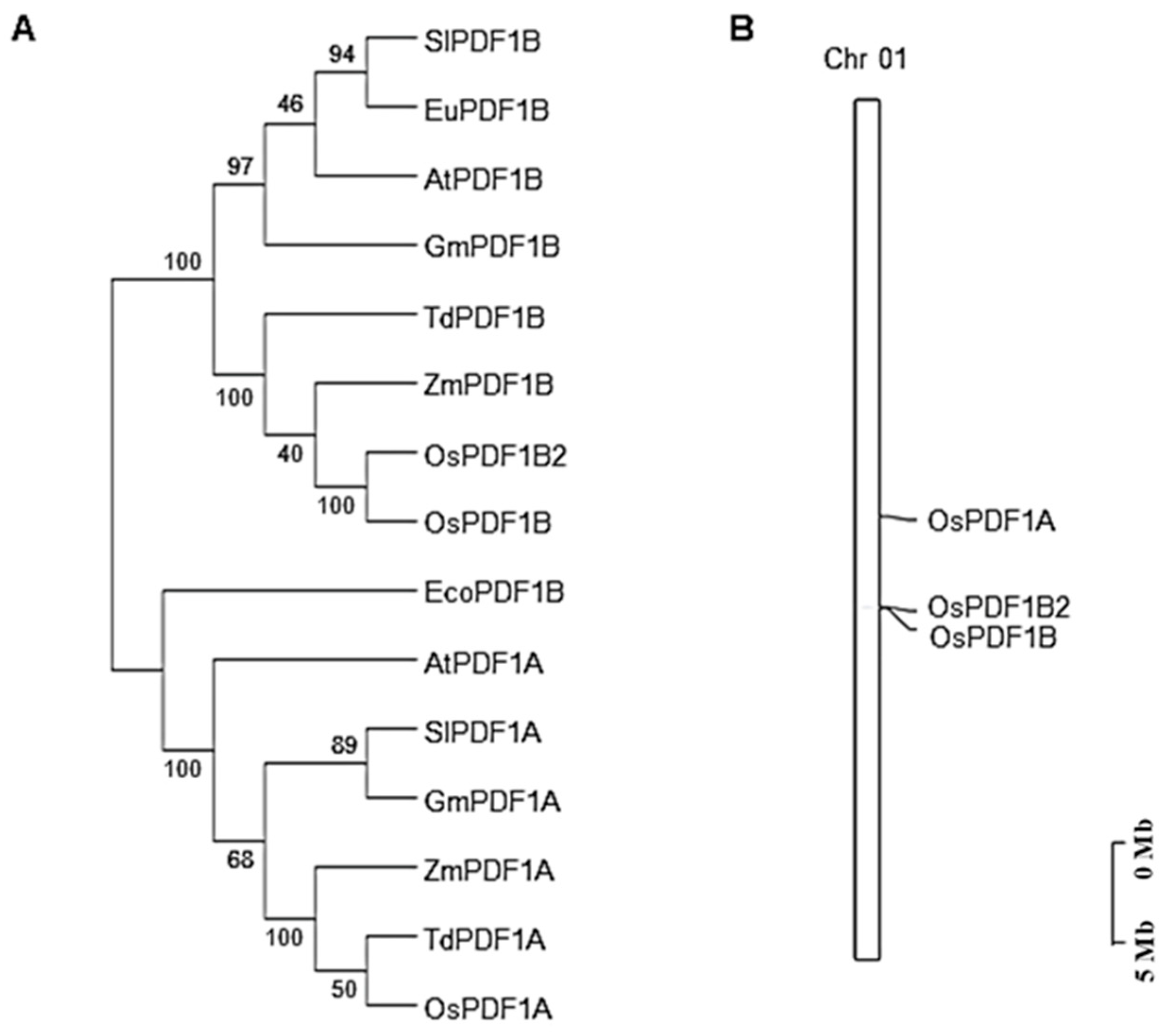
A previous study identified three peptide deformylase genes in Oryza sativa [14]. To further clarify the evolutionary relationships among these PDF family members, we performed comparative sequence alignments of OsPDF genes with their orthologs from other species. Subsequently, an unrooted phylogenetic tree was constructed using MEGA 11.0.13 software. As presented in Figure 1A, the PDF family is clustered into two distinct subfamilies: OsPDF1A is classified into the PDF1A subgroup, while OsPDF1B and OsPDF1B2 are grouped into the PDF1B subgroup. To intuitively visualize the chromosomal localization of OsPDF genes in Oryza sativa, we generated a chromosomal distribution map using TBtools v2.363. Notably, all three OsPDF genes were found to be localized on chromosome 1 (Figure 1B).

3.2. Gene Motif and Structure of the OsPDFs

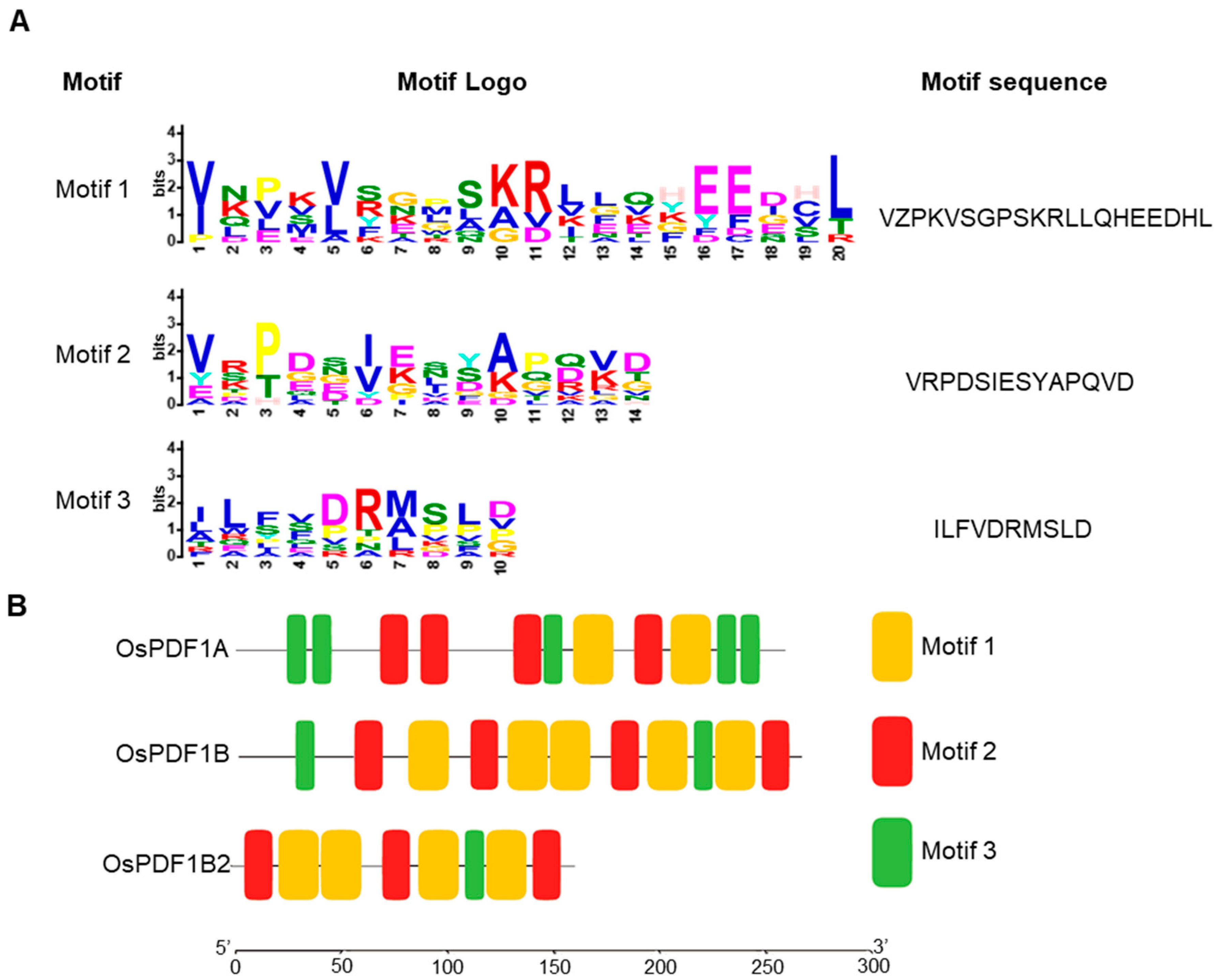
In Oryza sativa, PDF proteins harbor three highly conserved motifs, which are critical for their catalytic function (Figure 2A). A visual analysis of motif distribution across the three OsPDF proteins (OsPDF1A, OsPDF1B, and OsPDF1B2) revealed distinct patterns in the number of Motif3 copies (Figure 2B). Specifically, OsPDF1B and OsPDF1B2 contain only one or two instances of Motif3 along their amino acid sequences, whereas OsPDF1A possesses approximately five copies of Motif3, which account for half of all motifs in its protein sequence (Figure 2B). These differences in motif distribution may underlie the functional divergence and subcellular localization variations observed among the three OsPDF proteins.

3.3. Synteny Analysis of OsPDFs Genes

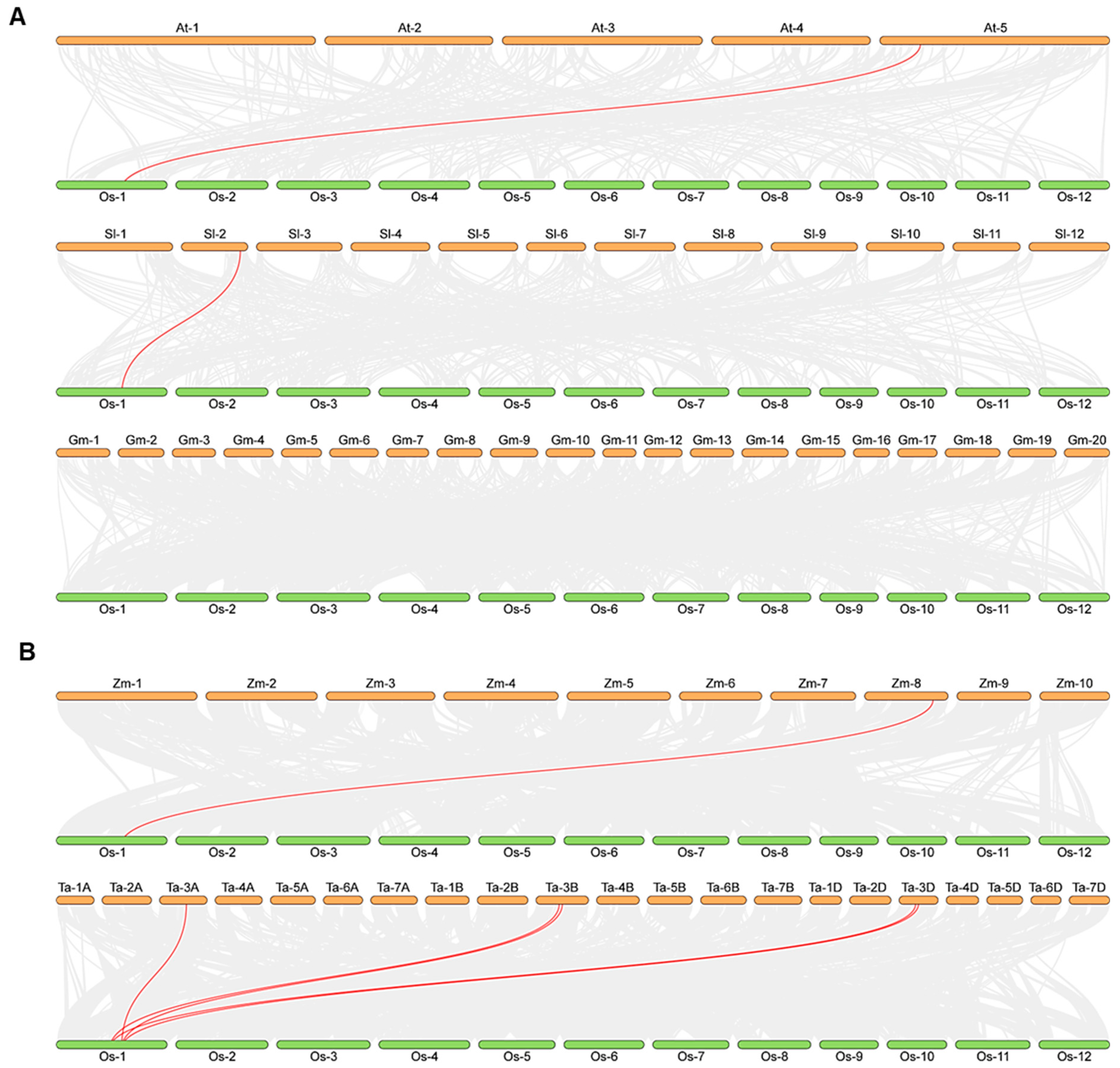
To further explore the evolutionary relationships within the OsPDF family, we constructed a gene collinearity map for Oryza sativa and compared its OsPDF genes with those of five representative species, categorized into dicotyledons (Arabidopsis thaliana, Solanum lycopersicum and Glycine max) and monocotyledons (Zea mays and Triticum aestivum). The synteny analysis results showed distinct patterns of collinear PDF gene pairs between Oryza sativa and the five species: only one collinear pair was identified between Oryza sativa and either Arabidopsis thaliana or Solanum lycopersicum, while no collinear pairs were detected between Oryza sativa and Glycine max (Figure 3A). Among monocot comparisons, Oryza sativa shared one collinear pair with Zea mays and five collinear pairs with Triticum aestivum (Figure 3B). Notably, the number of orthologous PDF genes between monocot species was significantly higher than that between monocots and dicots—an observation consistent with established biological evolutionary patterns. Furthermore, the highest number of collinear PDF gene pairs was found between Oryza sativa and Triticum aestivum, suggesting that these two monocot species may share a closer evolutionary history.

3.4. The Biophysical Properties of OsPDF Proteins

We analyzed the key biophysical properties of three OsPDF proteins in Oryza sativa, with the results summarized in Table 1. In terms of molecular weight, distinct differences were observed among the three proteins: OsPDF1A has a molecular weight of 27.493 kDa, OsPDF1B is slightly larger at 29.676 kDa, and OsPDF1B2 is significantly smaller, weighing 18.007 kDa. Their isoelectric points (pI) also vary notably: OsPDF1A and OsPDF1B have pI values of 8.79 and 8.54, respectively, while OsPDF1B2 has a pI of 5.47. Based on these pI values, OsPDF1A and OsPDF1B are classified as alkaline proteins, while OsPDF1B2 is acidic. Stability predictions indicate that all three OsPDF proteins are unstable, as their instability indices exceed 45. For the aliphatic index (an indicator of potential thermostability), OsPDF1B2 exhibits the highest value (97.89), followed by OsPDF1A (96.81) and OsPDF1B (93.53), suggesting that the family has moderate to strong thermal stability potential. Additionally, the Grand Average of Hydropathicity index for each OsPDF protein is less than 0, which reflects their inherent hydrophilic nature.

3.5. Cis-Regulatory Element Identification in OsPDF Promoters

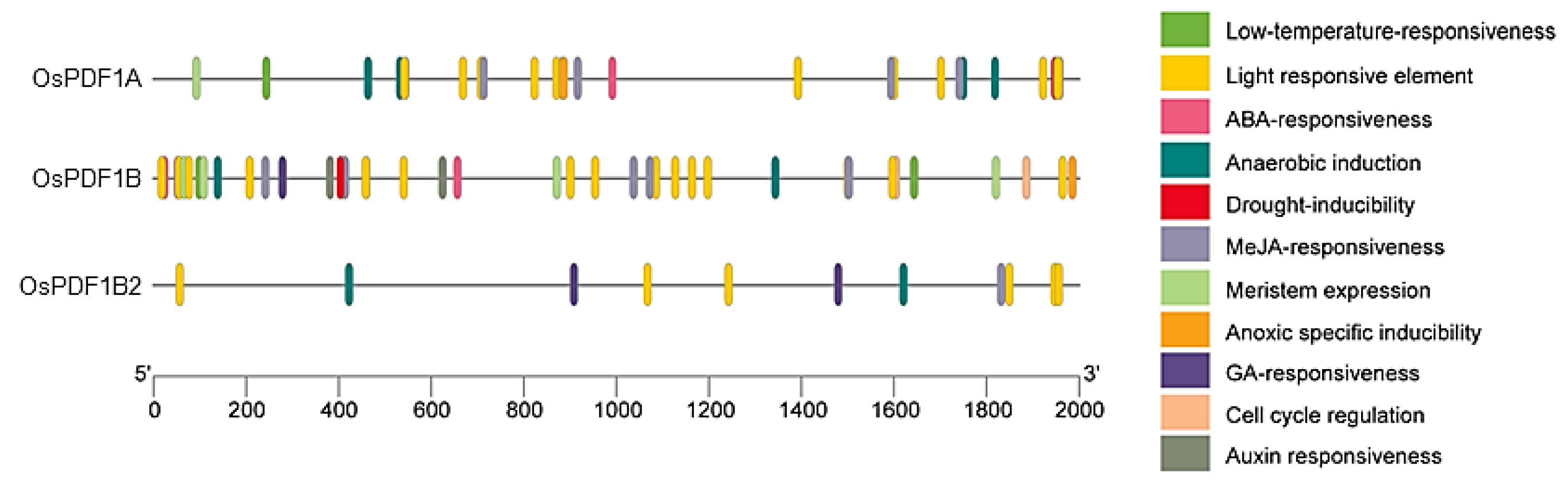
Cis-acting elements in promoter regions are pivotal for regulating the expression of their corresponding genes, as they mediate interactions with various transcription factors. To investigate the regulatory potential of OsPDF genes, we analyzed the 2000 bp sequences upstream of their start codons using the PlantCARE database to identify cis-regulatory elements, and visualized the results via TBtools v2.363 (Figure 4).
All three members of the OsPDF gene family contain cis-acting elements associated with responsiveness to ABA, MeJA, GA, and auxin. Specifically, OsPDF1B harbors all cis-elements corresponding to these four hormones, while OsPDF1A contains only those linked to ABA and MeJA, and OsPDF1B2 carries elements associated with MeJA and GA. This differential distribution of hormone-responsive elements suggests that OsPDF genes may participate in a diverse range of biological processes modulated by these phytohormones. In addition to hormone-responsive elements, the promoters of OsPDF genes also contain light-responsive cis-elements, metabolism-regulatory elements, and cell cycle-regulatory elements. These findings imply potential roles of OsPDFs in regulating plant growth and development, as well as mediating light-dependent physiological pathways. Furthermore, multiple stress-related cis-elements were identified, including those involved in low-temperature-responsiveness, anoxic inducibility, anaerobic induction, and drought-responsiveness. These elements collectively indicate that OsPDF genes might play important roles in enhancing rice’s adaptability to adverse environmental conditions. Overall, this promoter analysis reveals that the OsPDF gene family has evolved a modular combination strategy of cis-acting elements, enabling multi-dimensional responses to hormonal signals, growth cues, and environmental stresses. Among the identified cis-elements, the functional roles of OsPDFs linked to core regulatory elements (e.g., low-temperature-responsive elements) may be prioritized for further experimental validation, thereby helping to elucidate their specific contributions to rice physiology and stress adaptation.

3.6. Transcriptional Response of OsPDF Genes to Abiotic Stress

Abiotic stresses exert profound impacts on plant growth and development. To elucidate the regulatory effects of temperature (low and high), salt stress, and UV-B radiation on the expression of OsPDF genes, we systematically analyzed their transcriptional responses under these stress conditions using quantitative real-time PCR (qRT-PCR).
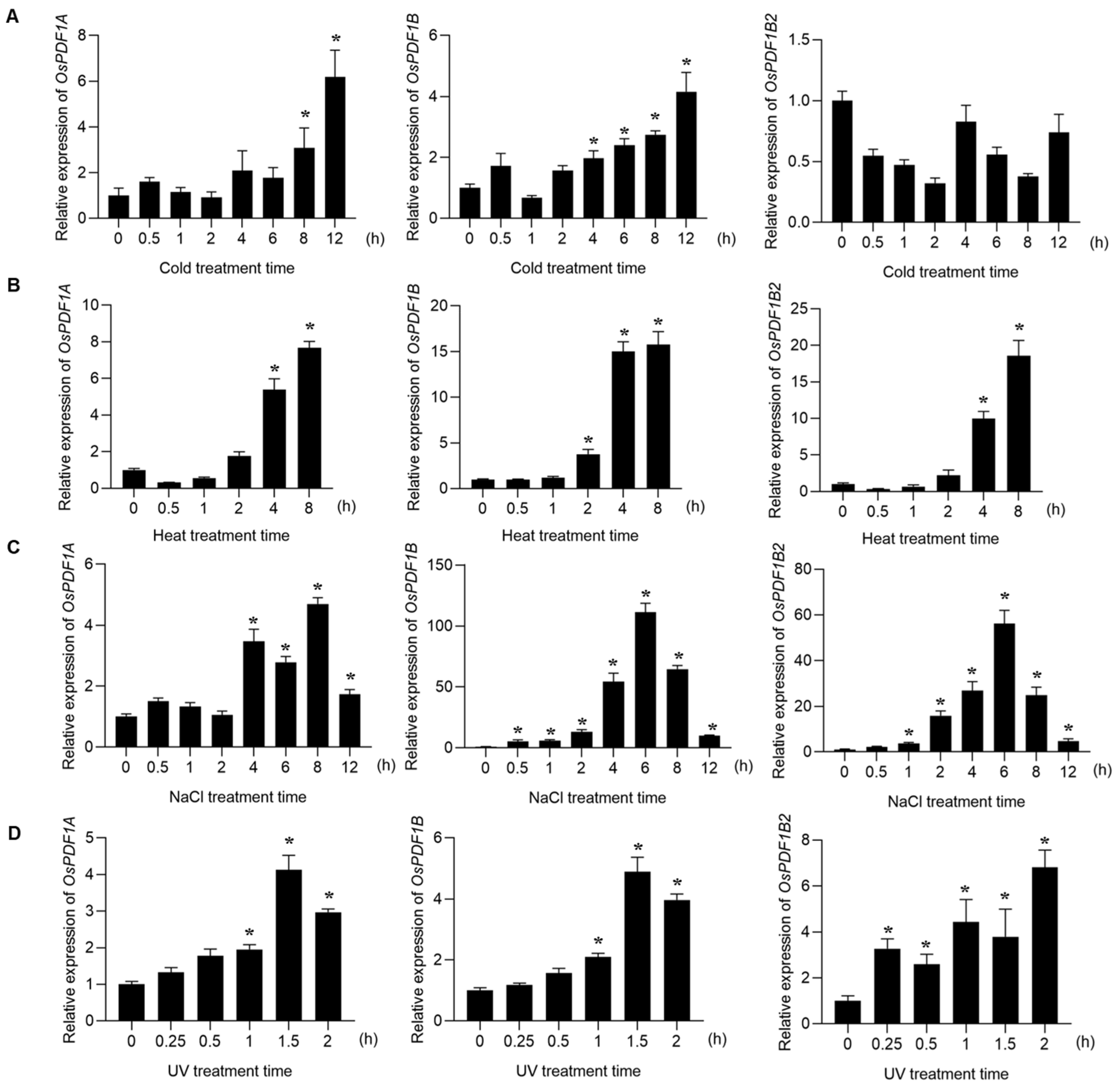
Following low-temperature treatment, OsPDF1A and OsPDF1B exhibited significant upregulation, whereas OsPDF1B2 maintained a nearly stable expression level (Figure 5A). In contrast, all OsPDF genes were transcriptionally activated under heat stress, with their expression levels peaking at 8 h post-treatment (Figure 5B). Under salt stress, all OsPDF genes showed increased expression after treatment. Notably, OsPDF1B displayed more dramatic upregulation, with significant upregulation detected at 6 h post-salt treatment (Figure 5C). Additionally, UV-B irradiation induced the upregulation of all three OsPDF genes, with their expression reaching maximum levels at either 1.5 h or 2 h after treatment (Figure 5D). Collectively, these results demonstrate that members of the OsPDF gene family are universally involved in these stress responses. However, the underlying molecular mechanisms governing their regulatory roles in these stress response pathways require further investigation.

4. Discussion

Peptide deformylase is a key enzyme in the N-terminal methionine excision pathway, which is critical for protein maturation across prokaryotes and eukaryotic organelles (such as chloroplasts and mitochondria) [1,2,13]. In rice, three PDF genes were identified, OsPDF1A, OsPDF1B, and OsPDF1B2. Prior studies have shown that these genes exhibit distinct expression patterns and subcellular localizations. OsPDF1A is highly expressed in seedling roots and localizes exclusively to chloroplasts, while OsPDF1B is strongly expressed in mature leaves and dual-localized to both chloroplasts and mitochondria. Notably, OsPDF1B is essential for rice growth and organelle development. Its dual organelle localization, coupled with the lethal chloroplast defects observed in ospdf1b knockout mutants, confirms its critical role in chloroplast biogenesis [22].
In the present study, we employed bioinformatics approaches to systematically analyze the OsPDF gene family. Specifically, we conducted analyses of phylogenetic relationships, gene collinearity, sequence homology, gene structure, conserved motifs, chromosomal localization, expression patterns, and cis-regulatory elements in promoter regions for all OsPDF family members. From this comprehensive gene family investigation, we drew the following conclusions.

4.1. Genomic Architecture and Evolutionary Dynamics of OsPDF Genes

During species evolution, the PDF family has conservatively diverged into two subfamilies, PDF1A and PDF1B. OsPDF1A belongs to the former, while OsPDF1B and OsPDF1B2 belong to the latter. Such subfamily divergence reflects the functional diversity of this gene family and is closely associated with their differential subcellular localization as well as organelle-regulatory functions of PDF1B such as chloroplast development.
The three genes of the rice PDF family (OsPDF1A, OsPDF1B, and OsPDF1B2) are concentrated on the same chromosome, implying that they coordinately regulate plant growth and development.
Cross-species synteny analysis of PDF genes among Oryza sativa, Arabidopsis thaliana, Solanum lycopersicum, Glycine max, Zea mays, and Triticum aestivum revealed that Oryza sativa and Triticum aestivum (both gramineous monocots) are closely related, with five pairs of orthologous PDF gene identified between the two species (Figure 3). This indicates that the function and genomic arrangement of PDF genes are conserved during the evolution of gramineous plants. This difference suggests that PDF genes have evolved along distinct trajectories after the divergence of monocots and dicots, and such divergence is most likely driven by lineage-specific adaptive requirements for protein maturation in plant organelles (e.g., chloroplasts, mitochondria).

4.2. Functional Prediction of OsPDF Gene Family

To explore the potential roles of the OsPDF gene family in plant stress responses, we conducted a comprehensive integrative analysis, encompassing cis-regulatory element identification in promoters and expression profiling of OsPDF genes. This analysis systematically elucidated the multi-dimensional regulatory mechanisms through which the OsPDF family may mediate plant responses to environmental stresses. Promoter sequence analysis revealed that OsPDF genes are enriched with diverse cis-acting elements, including hormone-responsive motifs (e.g., for ABA, MeJA, GA and auxin), growth- and development-related elements (e.g., light-responsive and cell cycle-regulatory motifs), and stress-responsive elements (e.g., those associated with low temperature). These findings collectively suggest that OsPDF genes are likely involved in plant response pathways to low temperature, as well as in processes modulated by hormones and growth signals.
To validate these predictive results, we performed qRT-PCR analysis to examine OsPDF expression patterns under various stress treatments. The results confirmed that all OsPDF genes showed upregulated expression following low-temperature, high-temperature, salt stress, or UV-B treatment (Figure 5). Under salt stress, OsPDF1A, OsPDF1B and OsPDF1B2 also exhibited consistently elevated expression relative to the control. Notably, OsPDF1B displayed a relatively high expression level compared to the control, which indicates that it may play a more prominent role in the plant’s response to salt stress than the other two OsPDF members.
In summary, the integrative analysis and qRT-PCR validation provide evidence for the involvement of the OsPDF gene family in multiple stress response pathways. Further investigation into the molecular mechanisms underlying their stress-responsive functions, coupled with functional validation (e.g., via gene knockout or overexpression), will help clarify their precise roles in plant stress resistance. This work also holds potential to provide novel theoretical foundations for molecular breeding strategies aimed at improving stress tolerance in rice.

4.3. Limitations and Future Directions

Existing research on plant PDF has primarily focused on the function of the PDF1B subgroup. For instance, in rice (Oryza sativa), two independent T-DNA insertion mutants (pdf1b-1 and pdf1b-2) were generated in prior work, with insertions in the third intron and first intron of OsPDF1B, respectively. Homozygous pdf1b/pdf1b plants exhibited distinct phenotypes, including chlorosis (yellowish leaves), severe growth retardation, chloroplast structural damage, and dysregulated expression of organellar genes [14]. In a more recent study on the woody plant Eucommia ulmoides, functional analysis of transgenic tobacco overexpressing EuPDF1B further confirmed PDF1B’s role. Transgenic tobacco plants overexpressing EuPDF1B showed higher plant height, fresh weight, and net photosynthetic rate compared to wild-type plants, accompanied by increased expression of the chloroplast psbA gene and denser chloroplast grana thylakoid membranes. This aligns with PDF1B’s conserved function in PSII maintenance—overexpression enhances the synthesis and turnover of the D1 protein, thereby supporting efficient PSII repair and sustaining photosynthetic function [15].
Notably, a key limitation of current PDF research lies in the lack of comprehensive functional characterization of the PDF1A subgroup. In the present study, we observed that OsPDF1A (a rice PDF1A member) exhibited altered expression in response to multiple stress treatments, suggesting that it may also play roles in mediating plant stress adaptation. To address this knowledge gap, subsequent research should prioritize functional validation of OsPDF1A by employing CRISPR/Cas9-based genetic manipulation to generate overexpression or knockout mutants, which will be essential to clarify its gene-specific roles in stress responses. Such work will help fill the current gap in our understanding of the functional diversity of the OsPDF gene family and provide a more holistic view of PDF-mediated regulatory networks in rice.

5. Conclusions

This study systematically characterized the OsPDF gene family in Oryza sativa through integrated bioinformatics and experimental analyses, shedding light on their genomic features, evolutionary dynamics, and functional roles in abiotic stress responses.
Three OsPDF genes (OsPDF1A, OsPDF1B, OsPDF1B2) were identified, clustering into two subfamilies (PDF1A and PDF1B) and localizing exclusively on rice chromosome 1. Synteny analysis showed closer evolutionary ties between rice and the monocot Triticum aestivum (with five collinear gene pairs) than with dicots, reflecting conserved PDF function in gramineous plants. Motif analysis revealed differences in conserved catalytic motifs (e.g., more Motif3 copies in OsPDF1A) that may underpin functional specialization. Biophysical property analysis classified OsPDF1A/1B as alkaline and OsPDF1B2 as acidic, with all three being hydrophilic and moderately thermostable. Promoter cis-element analysis identified hormone-responsive (ABA, MeJA, etc.), growth-related (light, cell cycle), and stress-responsive (low temperature, drought, etc.) elements, suggesting that OsPDFs integrate diverse signals for plant development and stress adaptation. The qRT-PCR results confirmed OsPDFs’ transcriptional responses to abiotic stresses: OsPDF1A/1B were upregulated under low temperature; all three genes were activated by heat, salt, and UV-B; and OsPDF1B showed significantly strong upregulation under salt stress.
In short, this study clarifies the genomic, evolutionary, and stress-responsive features of the OsPDF family in rice. Future work on OsPDF1A (a less studied PDF1A member) via genetic tools (e.g., CRISPR/Cas9) will help fill the gaps in our understanding of OsPDF functional diversity, supporting rice stress tolerance breeding.


Supplementary Materials

The following supporting information can be downloaded at: https://www.mdpi.com/article/10.3390/cimb48040396/s1.

Author Contributions

C.Y., M.Z. and D.M. designed the research; C.Y. and Y.Z. performed the experiments; C.Y., Y.Z. and D.M. analyzed the data; C.Y., Y.Z., M.Z. and D.M. wrote the manuscript. All authors have read and agreed to the published version of the manuscript.

Funding

This research was funded by the Liaoning Provincial Science and Technology Major Project (2024JH1/11700006-3) and the National Key R&D Program of China (2024YFD1501505).

Institutional Review Board Statement

Not applicable.

Informed Consent Statement

Not applicable.

Data Availability Statement

The original contributions presented in this study are included in the article/Supplementary Materials. Further inquiries can be directed to the corresponding author.

Conflicts of Interest

The authors declare no conflicts of interest.

References

  1. Giglione, C.; Vallon, O.; Meinnel, T. Control of Protein Life-Span by N-Terminal Methionine Excision. EMBO J. 2003, 22, 13–23. [Google Scholar] [CrossRef] [PubMed]
  2. Varland, S.; Osberg, C.; Arnesen, T. N-Terminal Modifications of Cellular Proteins: The Enzymes Involved, Their Substrate Specificities and Biological Effects. Proteomics 2015, 15, 2385–2401. [Google Scholar] [CrossRef] [PubMed]
  3. Carrozza, F.; Deprez, F.C. Post-Traumatic Ostial Avulsion of a Polar Inferior Renal Artery Treated by Endovascular Covered Aortic Stenting. J. Belg. Soc. Radiol. 2020, 104, 21. [Google Scholar] [CrossRef] [PubMed]
  4. Laursen, B.S.; Sørensen, H.P.; Mortensen, K.K.; Sperling-Petersen, H.U. Initiation of Protein Synthesis in Bacteria. Microbiol. Mol. Biol. Rev. 2005, 69, 101–123. [Google Scholar] [CrossRef]
  5. Piatkov, K.I.; Vu, T.T.M.; Hwang, C.-S.; Varshavsky, A. Formyl-Methionine as a Degradation Signal at the N-Termini of Bacterial Proteins. Microb. Cell 2015, 2, 376–393. [Google Scholar] [CrossRef]
  6. Bienvenut, W.V.; Giglione, C.; Meinnel, T. Proteome-Wide Analysis of the Amino Terminal Status of Proteins at the Steady-State and Upon Deformylation Inhibition. Proteomics 2015, 15, 2503–2518. [Google Scholar] [CrossRef]
  7. Bufe, B.; Schumann, T.; Kappl, R.; Bogeski, I.; Kummerow, C.; Podgórska, M.; Smola, S.; Hoth, M.; Zufall, F. Recognition of Bacterial Signal Peptides by Mammalian Formyl Peptide Receptors. J. Biol. Chem. 2015, 290, 7369–7387. [Google Scholar] [CrossRef]
  8. Dorward, D.A.; Lucas, C.D.; Chapman, G.B.; Haslett, C.; Dhaliwal, K.; Rossi, A.G. The Role of Formylated Peptides and Formyl Peptide Receptor 1 in Governing Neutrophil Function During Acute Inflammation. Am. J. Pathol. 2015, 185, 1172–1184. [Google Scholar] [CrossRef]
  9. Chen, D.Z.; Patel, D.V.; Hackbarth, C.J.; Wang, W.; Dreyer, G.; Young, D.C.; Margolis, P.S.; Wu, C.; Ni, Z.-J.; Trias, J.; et al. Actinonin, a Naturally Occurring Antibacterial Agent, is a Potent Deformylase Inhibitor. Biochemistry 2000, 39, 1256–1262. [Google Scholar] [CrossRef]
  10. Margolis, P.; Hackbarth, C.; Lopez, S.; Maniar, M.; Wang, W.; Yuan, Z.; White, R.; Trias, J. Resistance of Streptococcus pneumoniae to Deformylase Inhibitors is Due to Mutations in defB. Antimicrob. Agents Chemother. 2001, 45, 2432–2435. [Google Scholar] [CrossRef]
  11. Vanunu, M.; Lang, Z.; Barkan, D. The Gene fmt, Encoding tRNAfMet-Formyl Transferase, is Essential for Normal Growth of M. bovis, but Not for Viability. Sci. Rep. 2017, 7, 44829. [Google Scholar] [CrossRef] [PubMed]
  12. Jarocki, V.M.; Steele, J.R.; Widjaja, M.; Tacchi, J.L.; Padula, M.P.; Djordjevic, S.P. Formylated N-Terminal Methionine Is Absent from the Mycoplasma hyopneumoniae Proteome: Implications for Translation Initiation. Int. J. Med. Microbiol. 2019, 309, 288–298. [Google Scholar] [CrossRef] [PubMed]
  13. Giglione, C.; Meinnel, T. Organellar Peptide Deformylases: Universality of the N-Terminal Methionine Cleavage Mechanism. Trends Plant Sci. 2001, 6, 566–572. [Google Scholar] [CrossRef] [PubMed]
  14. Moon, S.; Giglione, C.; Lee, D.Y.; An, S.; Jeong, D.H.; Meinnel, T.; An, G. Rice Peptide Deformylase PDF1B is Crucial for Development of Chloroplasts. Plant Cell Physiol. 2008, 49, 1536–1546. [Google Scholar] [CrossRef]
  15. Wang, Y.M.; Zhao, D.G. Cloning and Functional Characterization of the Peptide Deformylase Encoding Gene EcPDF1B from Eucommia ulmoides Oliv. Sci. Rep. 2024, 14, 10714. [Google Scholar] [CrossRef]
  16. Hou, C.-X.; Dirk, L.M.A.; Williams, M.A. Inhibition of Peptide Deformylase in Nicotiana tabacum Leads to Decreased D1 Protein Accumulation, Ultimately Resulting in a Reduction of Photosystem II Complexes. Am. J. Bot. 2004, 91, 1304–1311. [Google Scholar] [CrossRef]
  17. Dirk, L.M.A.; Schmidt, J.J.; Cai, Y.; Barnes, J.C.; Hanger, K.M.; Nayak, N.R.; Williams, M.A.; Grossman, R.B.; Houtz, R.L.; Rodgers, D.W. Insights into the Substrate Specificity of Plant Peptide Deformylase, an Essential Enzyme with Potential for the Development of Novel Biotechnology Applications in Agriculture. Biochem. J. 2008, 413, 417–427. [Google Scholar] [CrossRef]
  18. Dirk, L.M.; Williams, M.A.; Houtz, R.L. Eukaryotic Peptide Deformylases. Nuclear-Encoded and Chloroplast-Targeted Enzymes in Arabidopsis. Plant Physiol. 2001, 127, 97–107. [Google Scholar] [CrossRef]
  19. Liu, C.C.; Liu, B.G.; Yang, Z.W.; Li, C.M.; Wang, B.C.; Yang, C.P. Genome-Wide Identification and in Silico Analysis of Poplar Peptide Deformylases. Int. J. Mol. Sci. 2012, 13, 5112–5124. [Google Scholar] [CrossRef]
  20. Hou, C.X.; Dirk, L.M.A.; Pattanaik, S.; Das, N.C.; Maiti, I.B.; Houtz, R.L.; Williams, M.A. Plant Peptide Deformylase: A Novel Selectable Marker and Herbicide Target Based on Essential Cotranslational Chloroplast Protein Processing. Plant Biotechnol. J. 2007, 5, 275–281. [Google Scholar] [CrossRef]
  21. Fieulaine, S.; Juillan-Binard, C.; Serero, A.; Dardel, F.; Giglione, C.; Meinnel, T.; Ferrer, J.-L. The Crystal Structure of Mitochondrial (Type 1A) Peptide Deformylase Provides Clear Guidelines for the Design of Inhibitors Specific for the Bacterial Forms. J. Biol. Chem. 2005, 280, 42315–42324. [Google Scholar] [CrossRef]
  22. Kieber-Emmons, A.M.; Topmiller, M.; Carrozza, M.A. Population Mapping for Quality Improvement in a Neighborhood Health Center. Ann. Fam. Med. 2020, 18, 374. [Google Scholar] [CrossRef]
Figure 1. (A) Phylogenetic analysis of the PDF family genes of Oryza sativa, Glycine max, Zea mays, Solanum lycopersicum, Triticum aestivum, Arabidopsis thaliana, Eucommia ulmoides and Escherichia coli. The protein sequence alignments and construction of the phylogenetic tree were performed using MEGA 11.0.13 and the neighbor-joining method with 1000 bootstrap replicates. Branches indicate different evolutionary clades. (B) Chromosome locations of OsPDF family genes. The length of the bars indicates the sizes of Oryza sativa chromosomes. The genes are labeled on the right of the chromosomes.
Cimb 48 00396 g001
Figure 2. (A) Sequences of three motifs identified by MEME v5.5.9. The MEME v5.5.9 tool was used with the following parameters: protein; nostatus; mod anr; nmotifs 6; minsites 17; minw 10; maxw 100. (B) Sequence logo representation of motifs defined from the OsPDF proteins by MEME.
Cimb 48 00396 g002
Figure 3. Analysis of syntenic relationships between Oryza sativa and different species. (A) Arabidopsis thaliana, Solanum lycopersicum and Glycine max; (B) Zea mays and Triticum aestivum. Gray line represents the syntenic block in plant genomes, and red line represents the collinear PDF gene pair.
Cimb 48 00396 g003
Figure 4. Cis-element analysis in the promoter sequences of OsPDF genes. Visualization of the cis components of the OsPDF family with TBtools.
Cimb 48 00396 g004
Figure 5. The relative expression analysis of the OsPDFs under abiotic stresses. (A) Low-temperature treatment, (B) high-temperature treatment, (C) salt treatment, (D) UV-B treatment (n  =  3, mean  ±  SD) (Student’s t test, *, p < 0.001).
Cimb 48 00396 g005
Table 1. Information regarding the OsPDFs.
Sequence IDNumber of Amino AcidMolecular WeightTheoretical pIInstability IndexAliphatic IndexGrand Average of Hydropathicity
OsPDF1A26027,492.778.7948.6996.81−0.043
OsPDF1B26929,676.228.5446.8693.53−0.142
OsPDF1B216118,006.765.4745.2297.89−0.104
Disclaimer/Publisher’s Note: The statements, opinions and data contained in all publications are solely those of the individual author(s) and contributor(s) and not of MDPI and/or the editor(s). MDPI and/or the editor(s) disclaim responsibility for any injury to people or property resulting from any ideas, methods, instructions or products referred to in the content.