


From Adipose Dysfunction to Multi-Organ Steatosis: Defining the Metabolic Steatotic Axis

 , and
, and 
Abstract
1. Introduction
2. Methods–Evidence Selection
3. Initiation of Steatosis
4. Organs of the Metabolic Steatotic Axis
4.1. Liver
4.2. Pancreas
4.3. Heart
4.4. Skeletal Muscle

| Source Organ | Key Mediators | Target Organ | Main Effects in MSA Context | Evidence Level | Clinical Measurability | Ref |
|---|---|---|---|---|---|---|
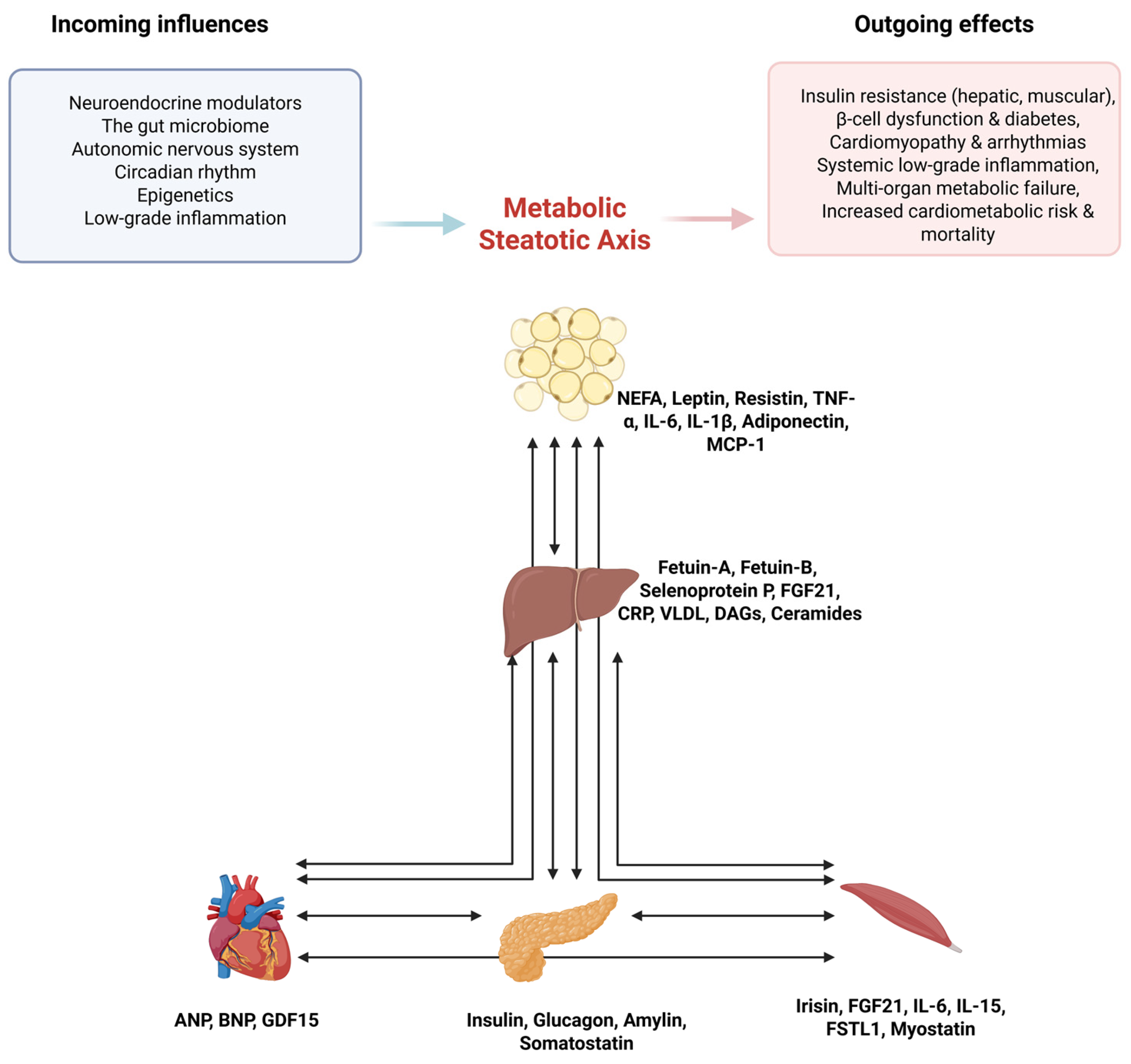
| Adipose Tissue | NEFA, TNF-α, IL-6, Leptin, Resistin, ↓ Adiponectin, MCP-1 | Liver | Hepatic steatosis, insulin resistance, inflammation | Human evidence | Serum NEFA, IL-6, adiponectin; MRI-PDFF | [48,49] |
| Pancreas | β-cell lipotoxicity, impaired insulin secretion | Human + animal evidence | Serum NEFA, adipokines | [50,51,52,53,54] | ||
| Heart | Lipotoxic cardiomyopathy, myocardial inflammation | Human evidence | MRI-PDFF, EAT thickness, circulating adipokines | [55,56,57] | ||
| Skeletal Muscle | Muscle insulin resistance, mitochondrial dysfunction | Human evidence | Serum NEFA, MRI muscle fat | [58,59,60] | ||
| Liver | Fetuin-A, Fetuin-B, Selenoprotein P, FGF21, CRP, VLDL, DAGs, Ceramides | Adipose Tissue | ↑ Lipolysis, systemic insulin resistance, inflammation | Human evidence | Serum Fetuin-A, FGF21, CRP (C- reactive protein) | [61,62,63] |
| Pancreas | β-cell dysfunction, glucotoxicity, impaired insulin secretion | Preclinical only: pancreas models | Histology (β-cell mass, apoptosis), GSIS, oxidative/ER stress markers | [64,65,66] | ||
| Heart | Endothelial dysfunction, cardiometabolic risk | Human evidence | CRP, Fetuin-A serum, MRI cardiac fat | [67,68,69] | ||
| Skeletal Muscle | Muscle insulin resistance, impaired glucose uptake | Human evidence | Serum CRP, MRI muscle fat | [70,71,72] | ||
| Pancreas | Insulin, Amylin, Glucagon | Liver | ↑ Lipogenesis, altered glucose metabolism | Human evidence | Serum insulin, glucagon | [73,74,75] |
| Adipose Tissue | ↑ Lipogenesis, adipose inflammation | Human evidence | Circulating amylin | [76,77,78] | ||
| Heart | Myocardial stress, hypertrophy | Preclinical only: cardiac models | Histology (fibrosis, apoptosis), echocardiography (LVEF, FS), hemodynamic studies (LVEDP, dp/dt) | [79,80,81,82] | ||
| Skeletal Muscle | Muscle insulin resistance, metabolic inflexibility | Human evidence | Serum insulin, glucose uptake studies | [83,84] | ||
| Heart | Natriuretic peptides (ANP, BNP) | Adipose Tissue | ↑ Lipolysis, altered adipocyte metabolism | Human evidence | Plasma BNP, ANP | [85,86,87] |
| Liver | Modulation of hepatic fat metabolism, lipid turnover | Preclinical only: liver models | Histology (steatosis, fibrosis), hepatic oxidative stress, lipid metabolism genes) | [88,89] | ||
| Pancreas | Indirect effects via altered glucose and lipid handling | Human + animal evidence | Circulating natriuretic peptides | [90,91] | ||
| Skeletal Muscle | Improved insulin sensitivity, metabolic flexibility | Human evidence | Muscle glucose uptake studies | [92,93,94] | ||
| Skeletal Muscle | Myokines (Irisin, IL-6, FGF21) | Liver | ↑ FA oxidation, ↓ steatosis, improved glucose metabolism | Human evidence | Serum IL-6, FGF21, Irisin | [95] |
| Adipose Tissue | Browning of white adipose tissue, ↑ energy expenditure | Animal evidence | Circulating myokines | [96,97] | ||
| Pancreas | Modulation of insulin secretion and β-cell stress | Preclinical only: pancreas models | Histology (β-cell mass, apoptosis), GSIS, oxidative/ER stress markers | [98,99,100,101] | ||
| Heart | Cardioprotective effects, improved myocardial metabolism | Human + animal evidence | Circulating FGF21, Irisin | [102,103,104] |
5. Modulators of the Metabolic Steatotic Axis (MSA)
5.1. Neuroendocrine Modulators of the MSA
5.1.1. The Hypothalamus: Central Lipotoxicity as the First Signal
5.1.2. Pituitary Relay: Endocrine Amplification
5.1.3. Adrenal and Autonomic Crosstalk
5.2. Extended Regulatory Modulators of the MSA
5.2.1. The Gut–Microbiome Interface: A Peripheral Neuroendocrine Organ
5.2.2. The Autonomic Nervous System and Vagal–Sympathetic Balance
5.2.3. Circadian and Chronometabolic Regulators
5.2.4. Epigenetic and Transcriptional Regulators
5.2.5. Inflammatory and Immune Neuroendocrine Integration
6. Clinical Implications of the Metabolic Steatotic Axis
7. Operationalizing the Axis: Staging and Biomarkers
8. Future Directions
9. Conclusions
Author Contributions
Funding
Data Availability Statement
Conflicts of Interest
Abbreviations
| CD36 | Scavenger Receptor Class B |
| eIF2α | Eukaryotic Initiation Factor 2 Alpha |
| FGF21 | Fibroblast Growth Factor 21 |
| IRE1 | Inositol-Requiring Enzyme 1 |
| JNK | c-Jun N-terminal Kinase |
| NF-κB | Nuclear Factor Kappa-light-chain |
| NLRP3 | NOD-like Receptor Family Pyrin Domain-containing 3 |
| PERK | PKR-like ER Kinase |
| PKC | Protein Kinase C |
| TNF-α | Tumor Necrosis Factor-alpha |
| TLR4 | Toll-like Receptor 4 |
| XBP1 | X-box Binding Protein 1 |
References
- Younossi, Z.M.; Henry, L. Understanding the Burden of Nonalcoholic Fatty Liver Disease: Time for Action. Diabetes Spectr. 2024, 37, 9–19. [Google Scholar] [CrossRef]
- Targher, G.; Valenti, L.; Byrne, C.D. Metabolic Dysfunction-Associated Steatotic Liver Disease. N. Engl. J. Med. 2025, 393, 683–698. [Google Scholar] [CrossRef]
- Andrade, L.J.O.; Oliveira, G.C.M.; Bittencourt, A.M.V.; Baptista, G.M.; Silva, C.P.; Oliveira, L.M. Association of “Metabolic Dysfunction-Associated Steatotic Pancreas Disease” (MASPD) and Insulin Resistance. Arq. Gastroenterol. 2024, 61, e24070. [Google Scholar] [CrossRef]
- Driessen, S.; Francque, S.M.; Anker, S.D.; Castro Cabezas, M.; Grobbee, D.E.; Tushuizen, M.E.; Holleboom, A.G. Metabolic Dysfunction-Associated Steatotic Liver Disease and the Heart. Hepatology 2025, 82, 487–503. [Google Scholar] [CrossRef]
- Isakov, V. Metabolic Dysfunction-Associated Steatotic Liver Disease: A Story of Muscle and Mass. World J. Gastroenterol. 2025, 31, 105346. [Google Scholar] [CrossRef] [PubMed]
- Lee, E.; Korf, H.; Vidal-Puig, A. An Adipocentric Perspective on the Development and Progression of Non-Alcoholic Fatty Liver Disease. J. Hepatol. 2023, 78, 1048–1062. [Google Scholar] [CrossRef]
- Janssen, J.A.M.J.L. The Causal Role of Ectopic Fat Deposition in the Pathogenesis of Metabolic Syndrome. Int. J. Mol. Sci. 2024, 25, 13238. [Google Scholar] [CrossRef] [PubMed]
- Engin, A. Reappraisal of Adipose Tissue Inflammation in Obesity. Adv. Exp. Med. Biol. 2024, 1460, 297–327. [Google Scholar] [PubMed]
- Mietus-Snyder, M.; Perak, A.M.; Cheng, S.; Hayman, L.L.; Haynes, N.; Meikle, P.J.; Shah, S.H.; Suglia, S.F.; American Heart Association Atherosclerosis, Hypertension and Obesity in the Young Committee of the Council on Lifelong Congenital Heart Disease and Heart Health in the Young; Council on Lifestyle and Cardiometabolic Health; et al. Next Generation, Modifiable Cardiometabolic Biomarkers: Mitochondrial Adaptation and Metabolic Resilience: A Scientific Statement from the American Heart Association. Circulation 2023, 148, 1827–1845. [Google Scholar]
- Ren, Y.; Zhao, H.; Yin, C.; Lan, X.; Wu, L.; Du, X.; Griffiths, H.R.; Gao, D. Adipokines, Hepatokines and Myokines: Focus on Their Role and Molecular Mechanisms in Adipose Tissue Inflammation. Front. Endocrinol. 2022, 13, 873699. [Google Scholar] [CrossRef]
- Kang, Y.E.; Kim, J.M.; Joung, K.H.; Lee, J.H.; You, B.R.; Choi, M.J.; Ryu, M.J.; Ko, Y.B.; Lee, M.A.; Lee, J.; et al. The Roles of Adipokines, Proinflammatory Cytokines, and Adipose Tissue Macrophages in Obesity-Associated Insulin Resistance in Modest Obesity and Early Metabolic Dysfunction. PLoS ONE 2016, 11, e0154003. [Google Scholar] [CrossRef] [PubMed]
- Wicks, S.E.; Vandanmagsar, B.; Haynie, K.R.; Fuller, S.E.; Warfel, J.D.; Stephens, J.M.; Wang, M.; Han, X.; Zhang, J.; Noland, R.C.; et al. Impaired Mitochondrial Fat Oxidation Induces Adaptive Remodeling of Muscle Metabolism. Proc. Natl. Acad. Sci. USA 2015, 112, E3300–E3309. [Google Scholar] [CrossRef] [PubMed]
- Burks, K.H.; Stitziel, N.O.; Davidson, N.O. Molecular Regulation and Therapeutic Targeting of VLDL Production in Cardiometabolic Disease. Cell. Mol. Gastroenterol. Hepatol. 2025, 19, 101409. [Google Scholar] [CrossRef] [PubMed]
- Heeren, J.; Scheja, L. Metabolic-Associated Fatty Liver Disease and Lipoprotein Metabolism. Mol. Metab. 2021, 50, 101238. [Google Scholar] [CrossRef]
- Obaseki, E.; Adebayo, D.; Bandyopadhyay, S.; Hariri, H. Lipid droplets and fatty acid-induced lipotoxicity: In a nutshell. FEBS Lett. 2024, 598, 1207–1214. [Google Scholar] [CrossRef]
- Zhang, S.; Peng, X.; Yang, S.; Li, X.; Huang, M.; Wei, S.; Liu, J.; He, G.; Zheng, H.; Yang, L.; et al. The regulation, function, and role of lipophagy, a form of selective autophagy, in metabolic disorders. Cell Death Dis. 2022, 13, 132. [Google Scholar] [CrossRef]
- Yazıcı, D.; Demir, S.Ç.; Sezer, H. Insulin Resistance, Obesity, and Lipotoxicity. In Obesity and Lipotoxicity; Advances in Experimental Medicine and Biology; Springer: Cham, Switzerland, 2024; Volume 1460, pp. 391–430. [Google Scholar]
- Ferrara, D.; Montecucco, F.; Dallegri, F.; Carbone, F. Impact of Different Ectopic Fat Depots on Cardiovascular and Metabolic Diseases. J. Cell Physiol. 2019, 234, 21630–21641. [Google Scholar] [CrossRef]
- Janssen, J.A.M.J.L. Overnutrition, Hyperinsulinemia and Ectopic Fat: It Is Time for a Paradigm Shift in the Management of Type 2 Diabetes. Int. J. Mol. Sci. 2024, 25, 5488. [Google Scholar] [CrossRef]
- Maya-Monteiro, C.M.; Corrêa-da-Silva, F.; Hofmann, S.S.; Hesselink, M.K.C.; la Fleur, S.E.; Yi, C.X. Lipid Droplets Accumulate in the Hypothalamus of Mice and Humans with and without Metabolic Diseases. Neuroendocrinology 2021, 111, 263–272. [Google Scholar] [CrossRef]
- Liu, J.; Fan, X.; Song, Y.; Zhao, J. Triglyceride-Based Lipotoxicity in the Pathophysiology of Chronic Diseases. Trends Endocrinol. Metab. 2025. [Google Scholar] [CrossRef]
- Bays, H.E.; Kirkpatrick, C.F.; Maki, K.C.; Toth, P.P.; Morgan, R.T.; Tondt, J.; Christensen, S.M.; Dixon, D.L.; Jacobson, T.A. Obesity, Dyslipidemia, and Cardiovascular Disease: A Joint Expert Review from the Obesity Medicine Association and the National Lipid Association 2024. J. Clin. Lipidol. 2024, 18, e320–e350. [Google Scholar] [CrossRef] [PubMed]
- Miao, X.; Alidadipour, A.; Saed, V.; Sayyadi, F.; Jadidi, Y.; Davoudi, M.; Amraee, F.; Jadidi, N.; Afrisham, R. Hepatokines: Unveiling the Molecular and Cellular Mechanisms Connecting Hepatic Tissue to Insulin Resistance and Inflammation. Acta Diabetol. 2024, 61, 1339–1361. [Google Scholar] [CrossRef] [PubMed]
- Le, M.D.; Wu, Y.; Berry, J.D.; Browning, J.D.; de Lemos, J.A.; Neeland, I.J.; Lingvay, I. Associations of liver fat content with cardiometabolic phenotypes and outcomes in a multi-ethnic population: Results from the Dallas Heart Study. Diabetes Obes. Metab. 2023, 25, 586–595. [Google Scholar] [CrossRef]
- Ipsen, D.H.; Lykkesfeldt, J.; Tveden-Nyborg, P. Molecular mechanisms of hepatic lipid accumulation in non-alcoholic fatty liver disease. Cell. Mol. Life Sci. 2018, 75, 3313–3327. [Google Scholar] [CrossRef] [PubMed]
- Sano, A.; Kakazu, E.; Hamada, S.; Inoue, J.; Ninomiya, M.; Iwata, T.; Tsuruoka, M.; Sato, K.; Masamune, A. Steatotic hepatocytes release mature VLDL through methionine and tyrosine metabolism in a Keap1-Nrf2-dependent manner. Hepatology 2021, 74, 1271–1286. [Google Scholar] [CrossRef]
- Gjoni, E.; Brioschi, L.; Cinque, A.; Coant, N.; Islam, M.N.; Ng, C.K.; Verderio, C.; Magnan, C.; Riboni, L.; Viani, P.; et al. Glucolipotoxicity Impairs Ceramide Flow from the Endoplasmic Reticulum to the Golgi Apparatus in INS-1 β-Cells. PLoS ONE 2014, 9, e110875. [Google Scholar] [CrossRef]
- Imai, Y.; Cousins, R.S.; Liu, S.; Phelps, B.M.; Promes, J.A. Connecting Pancreatic Islet Lipid Metabolism with Insulin Secretion and the Development of Type 2 Diabetes. Ann. N. Y. Acad. Sci. 2020, 1461, 53–72. [Google Scholar] [CrossRef]
- Chin, S.O.; Hwang, Y.C.; Cho, I.J.; Jeong, I.K.; Ahn, K.J.; Chung, H.Y. Pancreatic fat accumulation is associated with decreased beta-cell function and deterioration in glucose tolerance in Korean adults. Diabetes Metab. Res. Rev. 2021, 37, e3425. [Google Scholar] [CrossRef]
- Wen, Y.; Chen, C.; Kong, X.; Xia, Z.; Kong, W.; Si, K.; Han, P.; Liu, W.V.; Li, X. Pancreatic fat infiltration, beta-cell function and insulin resistance: A study of the young patients with obesity. Diabetes Res. Clin. Pract. 2022, 187, 109860. [Google Scholar] [CrossRef]
- Binayi, F.; Fahanik-Babaei, J.; Salimi, M.; Eskandari, F.; Sahraei, M.; Ghorbani Ranjbary, A.; Ghasemi, R.; Hedayati, M.; Khodagholi, F.; Eliassi, A.; et al. Endoplasmic reticulum stress inhibition ameliorated WFS1 expression alterations and reduced pancreatic islets’ insulin secretion induced by high-fat diet in rats. Sci. Rep. 2023, 13, 1860. [Google Scholar] [CrossRef]
- Nakamura, M.; Sadoshima, J. Cardiomyopathy in Obesity, Insulin Resistance and Diabetes. J. Physiol. 2020, 598, 2977–2993. [Google Scholar] [CrossRef] [PubMed]
- Kenchaiah, S.; Ding, J.; Carr, J.J.; Allison, M.A.; Budoff, M.J.; Tracy, R.P.; Burke, G.L.; McClelland, R.L.; Arai, A.E.; Bluemke, D.A. Pericardial fat and the risk of heart failure. J. Am. Coll. Cardiol. 2021, 77, 2638–2652. [Google Scholar] [CrossRef] [PubMed]
- Petta, S.; Argano, C.; Colomba, D.; Cammà, C.; Di Marco, V.; Cabibi, D.; Tuttolomondo, A.; Marchesini, G.; Pinto, A.; Licata, G.; et al. Epicardial fat, cardiac geometry and cardiac function in patients with non-alcoholic fatty liver disease: Association with the severity of liver disease. J. Hepatol. 2015, 62, 928–933. [Google Scholar] [CrossRef] [PubMed]
- Gatto, C.; Rusciano, M.R.; Visco, V.; Vecchione, C.; Ciccarelli, M. Pathophysiology of HFpEF: Insights from a Metabolic-Mitochondrial Perspective. Int. J. Mol. Sci. 2026, 27, 284. [Google Scholar] [CrossRef]
- McKenna, C.F.; Stierwalt, H.D.; Zemski Berry, K.A.; Ehrlicher, S.E.; Robinson, M.M.; Zarini, S.; Kahn, D.E.; Snell-Bergeon, J.K.; Perreault, L.; Bergman, B.C.; et al. Intramuscular Diacylglycerol Accumulates with Acute Hyperinsulinemia in Insulin-Resistant Phenotypes. Am. J. Physiol. Endocrinol. Metab. 2024, 327, E183–E193. [Google Scholar] [CrossRef]
- Markova, I.; Huttl, M.; Stastny, J.; Zapletalova, I.; Kacer, P.; Honig, V.; Kacerova, T.; Malinska, H. Skeletal muscle insulin resistance in prediabetes: A lipidomic perspective on diacylglycerols, ceramides, and phospholipids. Sci. Rep. 2025, 15, 38784. [Google Scholar] [CrossRef]
- Xu, W.; Zhang, D.; Ma, Y.; Gaspar, R.C.; Kahn, M.; Nasiri, A.; Murray, S.; Samuel, V.T.; Shulman, G.I. Ceramide synthesis inhibitors prevent lipid-induced insulin resistance through the DAG-PKCε-insulin receptor T1150 phosphorylation pathway. Cell Rep. 2024, 43, 114746. [Google Scholar] [CrossRef]
- Daemen, S.; Gemmink, A.; Brouwers, B.; Meex, R.C.R.; Huntjens, P.R.; Schaart, G.; Moonen-Kornips, E.; Jorgensen, J.; Hoeks, J.; Schrauwen, P.; et al. Distinct lipid droplet characteristics and distribution unmask the apparent contradiction of the athlete’s paradox. Mol. Metab. 2018, 17, 71–81. [Google Scholar] [CrossRef]
- Milani, I.; Codini, M.; Guarisco, G.; Chinucci, M.; Gaita, C.; Leonetti, F.; Capoccia, D. Hepatokines and MASLD: The GLP1-Ras-FGF21-Fetuin-A Crosstalk as a Therapeutic Target. Int. J. Mol. Sci. 2024, 25, 10795. [Google Scholar] [CrossRef]
- Stefan, N.; Schick, F.; Birkenfeld, A.L.; Häring, H.U.; White, M.F. The Role of Hepatokines in NAFLD. Cell Metab. 2023, 35, 236–252. [Google Scholar] [CrossRef]
- Li, L.; Spranger, L.; Stobäus, N.; Beer, F.; Decker, A.M.; Wernicke, C.; Brachs, S.; Brachs, M.; Spranger, J.; Mai, K. Fetuin-B, a Potential Link of Liver-Adipose Tissue Cross Talk during Diet-Induced Weight Loss-Weight Maintenance. Nutr. Diabetes 2021, 11, 31. [Google Scholar] [CrossRef] [PubMed]
- Lafontan, M.; Moro, C.; Berlan, M.; Crampes, F.; Sengenes, C.; Galitzky, J. Control of Lipolysis by Natriuretic Peptides and Cyclic GMP. Trends Endocrinol. Metab. 2008, 19, 130–137. [Google Scholar] [CrossRef] [PubMed]
- Balakrishnan, R.; Thurmond, D.C. Mechanisms by Which Skeletal Muscle Myokines Ameliorate Insulin Resistance. Int. J. Mol. Sci. 2022, 23, 4636. [Google Scholar] [CrossRef] [PubMed]
- Yang, B.; Lu, L.; Zhou, D.; Fan, W.; Barbier-Torres, L.; Steggerda, J.; Yang, H.; Yang, X. Regulatory Network and Interplay of Hepatokines, Stellakines, Myokines and Adipokines in Nonalcoholic Fatty Liver Diseases and Nonalcoholic Steatohepatitis. Front. Endocrinol. 2022, 13, 1007944, Erratum in Front. Endocrinol. 2023, 14, 1284809. [Google Scholar] [CrossRef]
- Tamaki, N.; Munaganuru, N.; Jung, J.; Yonan, A.Q.; Loomba, R.R.; Bettencourt, R.; Ajmera, V.; Valasek, M.A.; Behling, C.; Sirlin, C.B.; et al. Clinical Utility of 30% Relative Decline in MRI-PDFF in Predicting Fibrosis Regression in Non-Alcoholic Fatty Liver Disease. Gut 2022, 71, 983–990. [Google Scholar] [CrossRef]
- Stine, J.G.; Munaganuru, N.; Barnard, A.; Wang, J.L.; Kaulback, K.; Argo, C.K.; Singh, S.; Fowler, K.J.; Sirlin, C.B.; Loomba, R. Change in MRI-PDFF and Histologic Response in Patients with Nonalcoholic Steatohepatitis: A Systematic Review and Meta-Analysis. Clin. Gastroenterol. Hepatol. 2021, 19, 2274–2283.e5. [Google Scholar] [CrossRef]
- Rosso, C.; Kazankov, K.; Younes, R.; Esmaili, S.; Marietti, M.; Sacco, M.; Carli, F.; Gaggini, M.; Salomone, F.; Møller, H.J.; et al. Crosstalk between Adipose Tissue Insulin Resistance and Liver Macrophages in Non-Alcoholic Fatty Liver Disease. J. Hepatol. 2019, 71, 1012–1021. [Google Scholar] [CrossRef]
- France, M.; Kwok, S.; Soran, H.; Williams, S.; Ho, J.H.; Adam, S.; Canoy, D.; Liu, Y.; Durrington, P.N. Liver Fat Measured by MR Spectroscopy: Estimate of Imprecision and Relationship with Serum Glycerol, Caeruloplasmin and Non-Esterified Fatty Acids. Int. J. Mol. Sci. 2016, 17, 1089. [Google Scholar] [CrossRef]
- Rebelos, E.; Seghieri, M.; Natali, A.; Balkau, B.; Golay, A.; Piatti, P.M.; Lalic, N.M.; Laakso, M.; Mari, A.; Ferrannini, E. Influence of Endogenous NEFA on Beta Cell Function in Humans. Diabetologia 2015, 58, 2344–2351. [Google Scholar] [CrossRef]
- Toan, N.L.; Van Hoan, N.; Cuong, D.V.; Dung, N.V.; Dung, P.T.; Hang, N.T.; Dieu, D.T.H.; Chung, D.T.; Son, H.A.; Phong, P.X.; et al. Adipose Tissue-Derived Cytokines and Their Correlations with Clinical Characteristics in Vietnamese Patients with Type 2 Diabetes Mellitus. Diabetol. Metab. Syndr. 2018, 10, 41. [Google Scholar] [CrossRef]
- Naimi, F.; Laflèche, C.R.D.; Battista, M.C.; Carpentier, A.C.; Baillargeon, J.P. Antilipolytic Insulin Sensitivity Indices Measured during an Oral Glucose Challenge: Associations with Insulin-Glucose Clamp and Central Adiposity in Women without Diabetes. Endocrinol. Metab. 2025, 40, 561–573. [Google Scholar] [CrossRef]
- Park, J.H.; Nguyen, T.N.; Shim, H.M.; Yu, G.I.; Ha, E.Y.; Cho, H. Identification of Adipsin as a Biomarker of Beta Cell Function in Patients with Type 2 Diabetes. J. Clin. Med. 2024, 13, 7351. [Google Scholar] [CrossRef] [PubMed]
- Akita, K.; Hasegawa, K.; Fifer, M.A.; Tower-Rader, A.; Jung, J.; Maurer, M.S.; Reilly, M.P.; Shimada, Y.J. Prediction of Cardiac Death in Patients with Hypertrophic Cardiomyopathy Using Plasma Adipokine Levels. Nutr. Metab. Cardiovasc. Dis. 2024, 34, 1352–1360. [Google Scholar] [CrossRef] [PubMed]
- Quispe, R.; Sweeney, T.; Martin, S.S.; Jones, S.R.; Allison, M.A.; Budoff, M.J.; Ndumele, C.E.; Elshazly, M.B.; Michos, E.D. Associations of Adipokine Levels with Levels of Remnant Cholesterol: The Multi-Ethnic Study of Atherosclerosis (MESA). medRxiv 2023. [Google Scholar] [CrossRef]
- Zhu, R.; Wang, W.; Gao, Y.; Liu, J.; Li, B.; Shan, R.; Xue, R.; Yuan, X.; Wang, X.M. Epicardial Adipose Tissue and Left Ventricular Hypertrophy in Hypertensive Patients with Preserved Ejection Fraction: A Multicenter Retrospective Cohort Study. J. Clin. Hypertens 2025, 27, e70003. [Google Scholar] [CrossRef]
- van der Meer, D.; Gurholt, T.P.; Sønderby, I.E.; Shadrin, A.A.; Hindley, G.; Rahman, Z.; de Lange, A.G.; Frei, O.; Leinhard, O.D.; Linge, J.; et al. The Link between Liver Fat and Cardiometabolic Diseases is Highlighted by Genome-Wide Association Study of MRI-Derived Measures of Body Composition. Commun. Biol. 2022, 5, 1271. [Google Scholar] [CrossRef]
- Camacho-Cardenosa, A.; Clavero-Jimeno, A.; Gatti, A.; Dote-Montero, M.; Concepción, M.; Alfaro-Magallanes, V.M.; Martin-Olmedo, J.J.; Cabeza, R.; Idoate, F.; Martín-Rodríguez, J.L.; et al. Impact of Abdominal and Thigh Intermuscular Adipose Tissue on Glucose and Cardiometabolic Risk in Adults with Obesity. J. Clin. Endocrinol. Metab. 2025, 111, 24–32, Erratum in J. Clin. Endocrinol. Metab. 2025, 111, e326. [Google Scholar] [CrossRef]
- Haueise, T.; Schick, F.; Stefan, N.; Machann, J. Comparison of the Accuracy of Commercial Two-Point and Multi-Echo Dixon MRI for Quantification of Fat in Liver, Paravertebral Muscles, and Vertebral Bone Marrow. Eur. J. Radiol. 2024, 172, 111359. [Google Scholar] [CrossRef]
- Kruszynska, Y.T.; Worrall, D.S.; Ofrecio, J.; Frias, J.P.; Macaraeg, G.; Olefsky, J.M. Fatty Acid-Induced Insulin Resistance: Decreased Muscle PI3K Activation but Unchanged Akt Phosphorylation. J. Clin. Endocrinol. Metab. 2002, 87, 226–234. [Google Scholar] [CrossRef]
- Pal, D.; Dasgupta, S.; Kundu, R.; Maitra, S.; Das, G.; Mukhopadhyay, S.; Ray, S.; Majumdar, S.S.; Bhattacharya, S. Fetuin-A Acts as an Endogenous Ligand of TLR4 to Promote Lipid-Induced Insulin Resistance. Nat. Med. 2012, 18, 1279–1285. [Google Scholar] [CrossRef]
- Patt, M.; Karkossa, I.; Krieg, L.; Massier, L.; Makki, K.; Tabei, S.; Karlas, T.; Dietrich, A.; Gericke, M.; Stumvoll, M.; et al. FGF21 and Its Underlying Adipose Tissue-Liver Axis Inform Cardiometabolic Burden and Improvement in Obesity after Metabolic Surgery. EBioMedicine 2024, 110, 105458. [Google Scholar] [CrossRef]
- Baek, S.U.; Yoon, J.H. Systemic Inflammation Across Metabolic Obesity Phenotypes: A Cross-Sectional Study of Korean Adults Using High-Sensitivity C-Reactive Protein as a Biomarker. Int. J. Mol. Sci. 2024, 25, 11540. [Google Scholar] [CrossRef]
- Guo, Y.; Liu, L.; Cheng, Y.; Li, H.; Wan, X.; Ma, J.; Liu, J.; Liang, W.; Zhang, P.; Chen, J.; et al. Steroidogenic Factor 1 Protects Mice from Obesity-Induced Glucose Intolerance via Improving Glucose-Stimulated Insulin Secretion by Beta Cells. iScience 2023, 26, 106451. [Google Scholar] [CrossRef]
- Mukhuty, A.; Fouzder, C.; Kundu, R. Blocking TLR4-NF-κB Pathway Protects Mouse Islets from the Combinatorial Impact of High Fat and Fetuin-A Mediated Dysfunction and Restores Ability for Insulin Secretion. Mol. Cell Endocrinol. 2021, 532, 111314. [Google Scholar] [CrossRef] [PubMed]
- Aleman, J.; Ravikumar, K.; Wiegand, C.; Schurdak, M.E.; Vernetti, L.; Gavlock, D.; Reese, C.; DeBiasio, R.; LaRocca, G.; Angarita, Y.D.; et al. A Metabolic-Dysfunction Associated Steatotic Liver Acinus Biomimetic Induces Pancreatic Islet Dysfunction in a Coupled Microphysiology System. bioRxiv 2024. Update in Commun. Biol. 2024, 7, 1317. [Google Scholar] [CrossRef] [PubMed]
- Icer, M.A.; Yıldıran, H.; Sahinarslan, A.; Topal, S.; Yalcın, Y. Serum Fetuin-A Affected by Nutritional Status as a Novel Biomarker for Coronary Artery Disease. Acta Cardiol. Sin. 2025, 41, 335–345. [Google Scholar] [PubMed]
- Hartley, A.; Rostamian, S.; Kaura, A.; Chrysostomou, P.; Welsh, P.; Ariti, C.; Sattar, N.; Sever, P.; Khamis, R. The Relationship of Baseline High-Sensitivity C-Reactive Protein with Incident Cardiovascular Events and All-Cause Mortality over 20 Years. eBioMedicine 2025, 117, 105786. [Google Scholar]
- Soghomonian, A.; Dutour, A.; Kachenoura, N.; Thuny, F.; Lasbleiz, A.; Ancel, P.; Cristofari, R.; Jouve, E.; Simeoni, U.; Kober, F.; et al. Is Increased Myocardial Triglyceride Content Associated with Early Changes in Left Ventricular Function? A 1H-MRS and MRI Strain Study. Front. Endocrinol. 2023, 14, 1181452. [Google Scholar] [CrossRef]
- Gijbels, A.; Erdős, B.; Trouwborst, I.; Jardon, K.M.; Adriaens, M.E.; Goossens, G.H.; Blaak, E.E.; Feskens, E.J.M.; Afman, L.A. Hepatic Insulin Resistance and Muscle Insulin Resistance Are Characterized by Distinct Postprandial Plasma Metabolite Profiles: A Cross-Sectional Study. Cardiovasc. Diabetol. 2024, 23, 97. [Google Scholar] [CrossRef]
- Emanuelsson, E.B.; Berry, D.B.; Reitzner, S.M.; Arif, M.; Mardinoglu, A.; Gustafsson, T.; Ward, S.R.; Sundberg, C.J.; Chapman, M.A. MRI Characterization of Skeletal Muscle Size and Fatty Infiltration in Long-Term Trained and Untrained Individuals. Physiol. Rep. 2022, 10, e15398. [Google Scholar] [CrossRef]
- Haines, M.S.; Dichtel, L.E.; Santoso, K.; Torriani, M.; Miller, K.K.; Bredella, M.A. Association between Muscle Mass and Insulin Sensitivity Independent of Detrimental Adipose Depots in Young Adults with Overweight/Obesity. Int. J. Obes. 2020, 44, 1851–1858. [Google Scholar] [CrossRef]
- Wong, V.W.; Wong, G.L.; Yeung, D.K.; Abrigo, J.M.; Kong, A.P.; Chan, R.S.; Chim, A.M.; Shen, J.; Ho, C.S.; Woo, J.; et al. Fatty Pancreas, Insulin Resistance, and β-Cell Function: A Population Study Using Fat-Water Magnetic Resonance Imaging. Am. J. Gastroenterol. 2014, 109, 589–597. [Google Scholar] [CrossRef] [PubMed]
- Tushuizen, M.E.; Bunck, M.C.; Pouwels, P.J.; Bontemps, S.; van Waesberghe, J.H.T.; Schindhelm, R.K.; Mari, A.; Heine, R.J.; Diamant, M. Pancreatic Fat Content and β-Cell Function in Men with and without Type 2 Diabetes. Diabetes Care 2007, 30, 2916–2921. [Google Scholar] [CrossRef] [PubMed]
- Nogueira, J.P.; Cusi, K. Role of Insulin Resistance in the Development of Nonalcoholic Fatty Liver Disease in People with Type 2 Diabetes: From Bench to Patient Care. Diabetes Spectr. 2024, 37, 20–28. [Google Scholar] [CrossRef] [PubMed]
- Lim, J.J.; Sequeira-Bisson, I.R.; Yip, W.C.Y.; Lu, L.W.; Miles-Chan, J.L.; Poppitt, S.D. Intra-Pancreatic Fat Is Associated with High Circulating Glucagon and GLP-1 Concentrations Following Whey Protein Ingestion in Overweight Women with Impaired Fasting Glucose: A Randomised Controlled Trial. Diabetes Res. Clin. Pract. 2024, 207, 111084. [Google Scholar] [CrossRef]
- Smith, S.R.; Aronne, L.J.; Burns, C.M.; Kesty, N.C.; Halseth, A.E.; Weyer, C. Sustained Weight Loss Following 12-Month Pramlintide Treatment as an Adjunct to Lifestyle Intervention in Obesity. Diabetes Care 2008, 31, 1816–1823. [Google Scholar] [CrossRef]
- Wielinga, P.Y.; Löwenstein, C.; Muff, S.; Munz, M.; Woods, S.C.; Lutz, T.A. Central Amylin Acts as an Adiposity Signal to Control Body Weight and Energy Expenditure. Physiol. Behav. 2010, 101, 45–52. [Google Scholar] [CrossRef]
- Srinivas, B.; Fortuno, P.; Peng, H.; Xu, J.; Suhail, H.; Sabbah, H.N.; Rhaleb, N.E.; Matrougui, K. Novel Insights into Beta Cell ER Stress CHOP and Its Role in HFpEF Development. Cardiovasc. Diabetol. 2025, 24, 250. [Google Scholar] [CrossRef]
- Despa, S.; Sharma, S.; Harris, T.R.; Dong, H.; Li, N.; Chiamvimonvat, N.; Taegtmeyer, H.; Margulies, K.B.; Hammock, B.D.; Despa, F. Cardioprotection by Controlling Hyperamylinemia in a “Humanized” Diabetic Rat Model. J. Am. Heart Assoc. 2014, 3, e001015. [Google Scholar] [CrossRef]
- Verma, V.K.; Malik, S.; Mutneja, E.; Sahu, A.K.; Prajapati, V.; Mishra, P.; Bhatia, J.; Arya, D.S. Morin Ameliorates Myocardial Injury in Diabetic Rats via Modulation of Inflammatory Pathways. Lab. Anim. Res. 2024, 40, 3. [Google Scholar] [CrossRef]
- Patel, S.S.; Goyal, R.K. Prevention of Diabetes-Induced Myocardial Dysfunction in Rats Using the Juice of the Emblica officinalis Fruit. Exp. Clin. Cardiol. 2011, 16, 87–91. [Google Scholar] [PubMed]
- Fujita, S.; Rasmussen, B.B.; Cadenas, J.G.; Grady, J.J.; Volpi, E. Effect of Insulin on Human Skeletal Muscle Protein Synthesis Is Modulated by Insulin-Induced Changes in Muscle Blood Flow and Amino Acid Availability. Am. J. Physiol. Endocrinol. Metab. 2006, 291, E745–E754. [Google Scholar] [CrossRef] [PubMed]
- Minato-Inokawa, S.; Tsuboi-Kaji, A.; Honda, M.; Takeuchi, M.; Kitaoka, K.; Kurata, M.; Wu, B.; Kazumi, T.; Fukuo, K. Low Muscle Mass Is Associated with Low Insulin Sensitivity, Impaired Pancreatic β Cell Function, and High Glucose Excursion in Nondiabetic Nonobese Japanese Women. Metabolism. Open 2024, 23, 100306. [Google Scholar] [CrossRef] [PubMed]
- Polak, J.; Kotrc, M.; Wedellova, Z.; Jabor, A.; Malek, I.; Kautzner, J.; Kazdova, L.; Melenovsky, V. Lipolytic Effects of B-Type Natriuretic Peptide 1-32 in Adipose Tissue of Heart Failure Patients Compared with Healthy Controls. J. Am. Coll. Cardiol. 2011, 58, 1119–1125. [Google Scholar] [CrossRef]
- Sengenès, C.; Berlan, M.; De Glisezinski, I.; Lafontan, M.; Galitzky, J. Natriuretic Peptides: A New Lipolytic Pathway in Human Adipocytes. FASEB J. 2000, 14, 1345–1351. [Google Scholar] [CrossRef]
- Bachmann, K.N.; Ceddia, R.P.; Gupta, D.K.; Collins, S.; Wang, T.J. Human Adipose Tissue Expression of Uncoupling Protein 1 in Response to Intravenous Administration of B-Type Natriuretic Peptide Hormone: Results from a Randomized Controlled Crossover Study. Diabetes Obes. Metab. 2024, 26, 3458–3461. [Google Scholar] [CrossRef]
- Kimura, H.; Nagoshi, T.; Oi, Y.; Yoshii, A.; Tanaka, Y.; Takahashi, H.; Kashiwagi, Y.; Tanaka, T.D.; Yoshimura, M. Treatment with Atrial Natriuretic Peptide Induces Adipose Tissue Browning and Exerts Thermogenic Actions In Vivo. Sci. Rep. 2021, 11, 17466. [Google Scholar] [CrossRef]
- Badmus, O.O.; da Silva, A.A.; Li, X.; Taylor, L.C.; Greer, J.R.; Wasson, A.R.; McGowan, K.E.; Patel, P.R.; Stec, D.E. Cardiac Lipotoxicity and Fibrosis Underlie Impaired Contractility in a Mouse Model of Metabolic Dysfunction-Associated Steatotic Liver Disease. FASEB Bioadv. 2024, 6, 131–142. [Google Scholar] [CrossRef]
- Tauscher, S.; Nakagawa, H.; Völker, K.; Gaßner, B.; Pröhl, S.; Kuhn, M. Role of Atrial Natriuretic Peptide (ANP) in the Regulation of Insulin Secretion and Vitality of Pancreatic β Cells. BMC Pharmacol. Toxicol. 2015, 16, A92. [Google Scholar] [CrossRef]
- Undank, S.; Kaiser, J.; Sikimic, J.; Düfer, M.; Krippeit-Drews, P.; Drews, G. Atrial Natriuretic Peptide Affects Stimulus-Secretion Coupling of Pancreatic β-Cells. Diabetes 2017, 66, 2840–2848. [Google Scholar] [CrossRef]
- Engeli, S.; Birkenfeld, A.L.; Badin, P.M.; Bourlier, V.; Louche, K.; Viguerie, N.; Thalamas, C.; Montastier, E.; Larrouy, D.; Harant, I.; et al. Natriuretic Peptides Enhance the Oxidative Capacity of Human Skeletal Muscle. J. Clin. Investig. 2012, 122, 4675–4679. [Google Scholar] [CrossRef] [PubMed]
- Birkenfeld, A.L.; Boschmann, M.; Moro, C.; Adams, F.; Heusser, K.; Franke, G.; Berlan, M.; Luft, F.C.; Lafontan, M.; Jordan, J. Lipid Mobilization with Physiological Atrial Natriuretic Peptide Concentrations in Humans. J. Clin. Endocrinol. Metab. 2005, 90, 3622–3628. [Google Scholar] [CrossRef] [PubMed]
- Heinisch, B.B.; Vila, G.; Resl, M.; Riedl, M.; Dieplinger, B.; Mueller, T.; Luger, A.; Pacini, G.; Clodi, M. B-Type Natriuretic Peptide (BNP) Affects the Initial Response to Intravenous Glucose: A Randomised Placebo-Controlled Cross-Over Study in Healthy Men. Diabetologia 2012, 55, 1400–1405. [Google Scholar] [CrossRef] [PubMed][Green Version]
- İlhan Esgin, M.; Aksoy, E.; Goktas, Z. Correlations between Serum FGF21 and IRISIN Levels and Nutritional, Biochemical, and Anthropometric Parameters in Non-Alcoholic Fatty Liver Disease. Clin. Nutr. 2018, 37, S211. [Google Scholar] [CrossRef]
- Boström, P.; Wu, J.; Jedrychowski, M.P.; Korde, A.; Ye, L.; Lo, J.C.; Rasbach, K.A.; Boström, E.A.; Choi, J.H.; Long, J.Z.; et al. A PGC1-α-Dependent Myokine That Drives Brown-Fat-like Development of White Fat and Thermogenesis. Nature 2012, 481, 463–468. [Google Scholar] [CrossRef]
- Jin, L.; Han, S.; Lv, X.; Li, X.; Zhang, Z.; Kuang, H.; Chen, Z.; Lv, C.A.; Peng, W.; Yang, Z.; et al. The Muscle-Enriched Myokine Musclin Impairs Beige Fat Thermogenesis and Systemic Energy Homeostasis via Tfr1/PKA Signaling in Male Mice. Nat. Commun. 2023, 14, 4257. [Google Scholar] [CrossRef]
- Barlow, J.; Solomon, T.P.J. Conditioned Media from Contracting Skeletal Muscle Potentiates Insulin Secretion and Enhances Mitochondrial Energy Metabolism of Pancreatic Beta-Cells. Metabolism 2019, 91, 1–9. [Google Scholar] [CrossRef]
- Langlois, A.; Cherfan, J.; Meugnier, E.; Rida, A.; Arous, C.; Peronet, C.; Hamdard, H.; Zarrouki, B.; Wehrle-Haller, B.; Pinget, M.; et al. DECORIN, a Triceps-Derived Myokine, Protects Sorted β-Cells and Human Islets against Chronic Inflammation Associated with Type 2 Diabetes. Acta Physiol. 2025, 241, e14267. [Google Scholar] [CrossRef]
- Handschin, C.; Choi, C.S.; Chin, S.; Kim, S.; Kawamori, D.; Kurpad, A.J.; Neubauer, N.; Hu, J.; Mootha, V.K.; Kim, Y.B.; et al. Abnormal Glucose Homeostasis in Skeletal Muscle-Specific PGC-1α Knockout Mice Reveals Skeletal Muscle-Pancreatic Beta Cell Crosstalk. J. Clin. Investig. 2007, 117, 3463–3474. [Google Scholar] [CrossRef]
- Liu, S.; Du, F.; Li, X.; Wang, M.; Duan, R.; Zhang, J.; Wu, Y.; Zhang, Q. Effects and Underlying Mechanisms of Irisin on the Proliferation and Apoptosis of Pancreatic β Cells. PLoS ONE 2017, 12, e0175498. [Google Scholar] [CrossRef]
- Berezin, A.E.; Berezina, T.A.; Novikov, E.V.; Berezin, O.O. Serum Levels of Irisin Are Positively Associated with Improved Cardiac Function in Patients with Heart Failure with Reduced Ejection Fraction. Biomedicines 2025, 13, 866. [Google Scholar] [CrossRef]
- Berezin, A.A.; Lichtenauer, M.; Boxhammer, E.; Fushtey, I.M.; Berezin, A.E. Serum Levels of Irisin Predict Cumulative Clinical Outcomes in Heart Failure Patients with Type 2 Diabetes Mellitus. Front. Physiol. 2022, 13, 922775. [Google Scholar] [CrossRef] [PubMed]
- Zhang, K.; Gan, J.; Wang, B.; Lei, W.; Zhen, D.; Yang, J.; Wang, N.; Wen, C.; Gao, X.; Li, X.; et al. FGF21 Protects against HFpEF by Improving Cardiac Mitochondrial Bioenergetics in Mice. Nat. Commun. 2025, 16, 1661. [Google Scholar] [CrossRef]
- Anand, P.K. From Fat to Fire: The Lipid-Inflammasome Connection. Immunol. Rev. 2025, 329, e13403. [Google Scholar] [CrossRef] [PubMed]
- Abdalla, M.M.I. Gut-Liver Axis in Diabetes: Mechanisms and Therapeutic Opportunities. World J. Gastroenterol. 2025, 31, 109090. [Google Scholar] [CrossRef]
- Pan, D.; Li, G.; Jiang, C.; Hu, J.; Hu, X. Regulatory Mechanisms of Macrophage Polarization in Adipose Tissue. Front. Immunol. 2023, 14, 1149366. [Google Scholar] [CrossRef]
- Jais, A.; Brüning, J.C. Arcuate nucleus-dependent regulation of metabolism—Pathways to obesity and diabetes mellitus. Endocr. Rev. 2022, 43, 314–328. [Google Scholar] [CrossRef]
- Cruciani-Guglielmacci, C.; Le Stunff, H.; Magnan, C. Brain lipid sensing and the neural control of energy balance. Biochimie 2024, 223, 159–165. [Google Scholar] [CrossRef]
- Dragano, N.R.; Monfort-Pires, M.; Velloso, L.A. Mechanisms mediating the actions of fatty acids in the hypothalamus. Neuroscience 2020, 447, 15–27. [Google Scholar] [CrossRef]
- Posey, K.A.; Clegg, D.J.; Printz, R.L.; Byun, J.; Morton, G.J.; Vivekanandan-Giri, A.; Pennathur, S.; Baskin, D.G.; Heinecke, J.W.; Woods, S.C.; et al. Hypothalamic proinflammatory lipid accumulation, inflammation, and insulin resistance in rats fed a high-fat diet. Am. J. Physiol. Endocrinol. Metab. 2009, 296, E1003–E1012. [Google Scholar] [CrossRef]
- Zhang, L.; Song, H.; Ge, Y.; Ji, G.; Yao, Z. Temporal relationship between diet-induced steatosis and onset of insulin/leptin resistance in male Wistar rats. PLoS ONE 2015, 10, e0117008. [Google Scholar] [CrossRef]
- Scherer, T.; Lindtner, C.; Zielinski, E.; O’Hare, J.; Filatova, N.; Buettner, C. Short term voluntary overfeeding disrupts brain insulin control of adipose tissue lipolysis. J. Biol. Chem. 2012, 287, 33061–33069. [Google Scholar] [CrossRef]
- Bavaresco, A.; Mazzeo, P.; Lazzara, M.; Barbot, M. Adipose tissue in cortisol excess: What Cushing’s syndrome can teach us? Biochem. Pharmacol. 2024, 223, 116137. [Google Scholar] [CrossRef]
- García-Eguren, G.; Sala-Vila, A.; Giró, O.; Vega-Beyhart, A.; Hanzu, F.A. Long-term hypercortisolism induces lipogenesis promoting palmitic acid accumulation and inflammation in visceral adipose tissue compared with HFD-induced obesity. Am. J. Physiol. Endocrinol. Metab. 2020, 318, E995–E1003. [Google Scholar] [CrossRef]
- Sinha, R.A.; Bruinstroop, E.; Yen, P.M. Actions of thyroid hormones and thyromimetics on the liver. Nat. Rev. Gastroenterol. Hepatol. 2025, 22, 9–22. [Google Scholar] [CrossRef]
- Zhou, J.; Gauthier, K.; Ho, J.P.; Lim, A.; Zhu, X.G.; Han, C.R.; Sinha, R.A.; Cheng, S.Y.; Yen, P.M. Thyroid hormone receptor α regulates autophagy, mitochondrial biogenesis, and fatty acid use in skeletal muscle. Endocrinology 2021, 162, bqab112. [Google Scholar] [CrossRef]
- De Paoli, M.; Zakharia, A.; Werstuck, G.H. The role of estrogen in insulin resistance: A review of clinical and preclinical data. Am. J. Pathol. 2021, 191, 1490–1498. [Google Scholar] [CrossRef]
- Wawrzkiewicz-Jałowiecka, A.; Lalik, A.; Soveral, G. Recent update on the molecular mechanisms of gonadal steroids action in adipose tissue. Int. J. Mol. Sci. 2021, 22, 5226. [Google Scholar] [CrossRef]
- Oquendo, M.B.; Lorza-Gil, E.; Juarez-Lopez, D.; Wagner, R.; Birkenfeld, A.L.; Ullrich, S.; Gerst, F. Effects of adrenergic-stimulated lipolysis and cytokine production on in vitro mouse adipose tissue–islet interactions. Sci. Rep. 2022, 12, 15831. [Google Scholar] [CrossRef]
- Thorp, A.A.; Schlaich, M.P. Relevance of sympathetic nervous system activation in obesity and metabolic syndrome. J. Diabetes Res. 2015, 2015, 341583. [Google Scholar] [CrossRef]
- Lambert, E.A.; Straznicky, N.E.; Dixon, J.B.; Lambert, G.W. Should the sympathetic nervous system be a target to improve cardiometabolic risk in obesity? Am. J. Physiol. Heart Circ. Physiol. 2015, 309, H244–H258. [Google Scholar] [CrossRef]
- Fasano, A. The physiology of hunger. N. Engl. J. Med. 2025, 392, 372–381. [Google Scholar] [CrossRef]
- de Vos, W.M.; Tilg, H.; Van Hul, M.; Cani, P.D. Gut microbiome and health: Mechanistic insights. Gut 2022, 71, 1020–1032. [Google Scholar] [CrossRef]
- Klingbeil, E.; de La Serre, C.B. Microbiota modulation by eating patterns and diet composition: Impact on food intake. Am. J. Physiol. Regul. Integr. Comp. Physiol. 2018, 315, R1254–R1260. [Google Scholar] [CrossRef]
- Iqbal, M.; Yu, Q.; Tang, J.; Xiang, J. Unraveling the gut microbiota’s role in obesity: Key metabolites, microbial species, and therapeutic insights. J. Bacteriol. 2025, 207, e00479-24. [Google Scholar] [CrossRef]
- Hurr, C.; Simonyan, H.; Morgan, D.A.; Rahmouni, K.; Young, C.N. Liver sympathetic denervation reverses obesity-induced hepatic steatosis. J. Physiol. 2019, 597, 4565–4580. [Google Scholar] [CrossRef]
- Tentolouris, N.; Liatis, S.; Katsilambros, N. Sympathetic system activity in obesity and metabolic syndrome. Ann. N. Y. Acad. Sci. 2006, 1083, 129–152. [Google Scholar] [CrossRef]
- Hwang, J.; Okada, J.; Liu, L.; Pessin, J.E.; Schwartz, G.J.; Jo, Y.H. The development of hepatic steatosis depends on the presence of liver-innervating parasympathetic cholinergic neurons in mice fed a high-fat diet. PLoS Biol. 2024, 22, e3002865. [Google Scholar] [CrossRef]
- Martinez-Sanchez, N.; Sweeney, O.; Sidarta-Oliveira, D.; Caron, A.; Stanley, S.A.; Domingos, A.I. The sympathetic nervous system in the 21st century: Neuroimmune interactions in metabolic homeostasis and obesity. Neuron 2022, 110, 3597–3626. [Google Scholar] [CrossRef]
- Brito, C.F.; Fonseca, R.C.; Rodrigues-Ribeiro, L.; Guimarães, J.S.F.; Vaz, B.F.; Tofani, G.S.S.; Batista, A.C.S.; Diniz, A.B.; Fernandes, P.; Nunes, N.A.M.; et al. Vagus nerve mediated liver–brain axis is a major regulator of the metabolic landscape in the liver. Int. J. Mol. Sci. 2025, 26, 2166. [Google Scholar] [CrossRef]
- Hwang, J.; Lee, S.; Okada, J.; Liu, L.; Pessin, J.E.; Chua, S.C., Jr.; Schwartz, G.J.; Jo, Y.H. Liver-innervating vagal sensory neurons are indispensable for the development of hepatic steatosis and anxiety-like behavior in diet-induced obese mice. Nat. Commun. 2025, 16, 991. [Google Scholar] [CrossRef]
- Silva, A.; Caron, A. Pathophysiological mechanisms that alter the autonomic brain–liver communication in metabolic diseases. Endocrinology 2021, 162, bqab164. [Google Scholar] [CrossRef]
- Berthoud, H.R.; Neuhuber, W.L. Vagal mechanisms as neuromodulatory targets for the treatment of metabolic disease. Ann. N. Y. Acad. Sci. 2019, 1454, 42–55. [Google Scholar] [CrossRef]
- Lorenzo-Martín, L.F.; Menacho-Márquez, M.; Fabbiano, S.; Al-Massadi, O.; Abad, A.; Rodríguez-Fdez, S.; Sevilla, M.A.; Montero, M.J.; Diéguez, C.; Nogueiras, R.; et al. Vagal afferents contribute to sympathoexcitation-driven metabolic dysfunctions. J. Endocrinol. 2019, 240, 483–496. [Google Scholar] [CrossRef]
- He, X.; Liu, J.; Zang, W.J. Mitochondrial homeostasis and redox status in cardiovascular diseases: Protective role of the vagal system. Free Radic. Biol. Med. 2022, 178, 369–379. [Google Scholar] [CrossRef]
- Speksnijder, E.M.; Bisschop, P.H.; Siegelaar, S.E.; Stenvers, D.J.; Kalsbeek, A. Circadian desynchrony and glucose metabolism. J. Pineal Res. 2024, 76, e12956. [Google Scholar] [CrossRef]
- Schrader, L.A.; Ronnekleiv-Kelly, S.M.; Hogenesch, J.B.; Bradfield, C.A.; Malecki, K.M. Circadian disruption, clock genes, and metabolic health. J. Clin. Investig. 2024, 134, e170998. [Google Scholar] [CrossRef]
- Engin, A. Misalignment of circadian rhythms in diet-induced obesity. Adv. Exp. Med. Biol. 2024, 1460, 27–71. [Google Scholar]
- Engin, A. Circadian rhythms in diet-induced obesity. In Obesity and Lipotoxicity; Advances in Experimental Medicine and Biology; Springer: Cham, Switzerland, 2017; Volume 960, pp. 19–52. [Google Scholar] [CrossRef]
- Meléndez-Fernández, O.H.; Liu, J.A.; Nelson, R.J. Circadian rhythms disrupted by light at night and mistimed food intake alter hormonal rhythms and metabolism. Int. J. Mol. Sci. 2023, 24, 3392. [Google Scholar] [CrossRef]
- Maury, E. Off the clock: From circadian disruption to metabolic disease. Int. J. Mol. Sci. 2019, 20, 1597. [Google Scholar] [CrossRef]
- Joshi, A.; Upadhyay, K.K.; Vohra, A.; Shirsath, K.; Devkar, R. Melatonin induces Nrf2–HO-1 reprogramming and corrections in hepatic core clock oscillations in non-alcoholic fatty liver disease. FASEB J. 2021, 35, e21803. [Google Scholar] [CrossRef]
- Konakchieva, R.; Mladenov, M.; Konaktchieva, M.; Sazdova, I.; Gagov, H.; Nikolaev, G. Circadian clock deregulation and metabolic reprogramming: A systems biology approach to tissue-specific redox signaling and disease development. Int. J. Mol. Sci. 2025, 26, 6267. [Google Scholar] [CrossRef]
- Abrahams, Y.; Willmer, T.; Patel, O.; Samodien, E.; Muller, C.J.F.; Windvogel, S.; Johnson, R.; Pheiffer, C. A high-fat, high-sugar diet induces hepatic peroxisome proliferator-activated receptor gamma coactivator 1-alpha promoter hypermethylation in male Wistar rats. Biochem. Biophys. Res. Commun. 2023, 680, 25–33. [Google Scholar] [CrossRef]
- Caviglia, G.P.; Casalone, E.; Rosso, C.; Aneli, S.; Allione, A.; Carli, F.; Grange, C.; Armandi, A.; Catalano, C.; Birolo, G.; et al. Extracellular vesicles miRNome profiling reveals miRNAs engagement in dysfunctional lipid metabolism, chronic inflammation and liver damage in subjects with metabolic dysfunction-associated steatotic liver disease. Aliment. Pharmacol. Ther. 2025, 62, 22–32. [Google Scholar] [CrossRef]
- Rahman, H.M.; Bhusal, A.; Lee, W.H.; Lee, I.K.; Suk, K. Hypothalamic inflammation and malfunctioning glia in the pathophysiology of obesity and diabetes: Translational significance. Biochem. Pharmacol. 2018, 153, 123–133. [Google Scholar] [CrossRef]
- Bhusal, A.; Rahman, H.M.; Suk, K. Hypothalamic inflammation in metabolic disorders and aging. Cell. Mol. Life Sci. 2021, 79, 32. [Google Scholar] [CrossRef]
- O’Brien, P.D.; Hinder, L.M.; Callaghan, B.C.; Feldman, E.L. Neurological consequences of obesity. Lancet Neurol. 2017, 16, 465–477. [Google Scholar] [CrossRef]
- Kahn, S.E.; Cooper, M.E.; Del Prato, S. Pathophysiology and treatment of type 2 diabetes: Perspectives on the past, present, and future. Lancet 2014, 383, 1068–1083. [Google Scholar] [CrossRef]
- Xie, C.; Lin, Y.; Qi, C.; Wang, W.; Yuan, Y.; Song, D.; Wang, Z.; Liu, H.; Feng, X.; Gao, H. Neuro-endocrine-immune regulation of metabolic homeostasis. Cytokine Growth Factor Rev. 2025, 85, 165–178. [Google Scholar] [CrossRef]
- Watson, W.D.; Arvidsson, P.M.; Miller, J.J.J.; Lewis, A.J.; Rider, O.J. A Mitochondrial Basis for Heart Failure Progression. Cardiovasc. Drugs Ther. 2024, 38, 1161–1171. [Google Scholar] [CrossRef]
- Piquereau, J.; Veksler, V.; Novotova, M.; Ventura-Clapier, R. Energetic Interactions between Subcellular Organelles in Striated Muscles. Front. Cell Dev. Biol. 2020, 8, 581045. [Google Scholar] [CrossRef]
- Duell, P.B.; Welty, F.K.; Miller, M.; Chait, A.; Hammond, G.; Ahmad, Z.; Cohen, D.E.; Horton, J.D.; Pressman, G.S.; Toth, P.P.; et al. Nonalcoholic Fatty Liver Disease and Cardiovascular Risk: A Scientific Statement from the American Heart Association. Arterioscler. Thromb. Vasc. Biol. 2022, 42, e168–e185. [Google Scholar] [CrossRef]
- Chew, N.W.S.; Pan, X.H.; Chong, B.; Chandramouli, C.; Muthiah, M.; Lam, C.S.P. Type 2 Diabetes Mellitus and Cardiometabolic Outcomes in Metabolic Dysfunction-Associated Steatotic Liver Disease Population. Diabetes Res. Clin. Pract. 2024, 211, 111652. [Google Scholar] [CrossRef]
- Kalyani, R.R. Glucose-Lowering Drugs to Reduce Cardiovascular Risk in Type 2 Diabetes. N. Engl. J. Med. 2021, 384, 1248–1260. [Google Scholar] [CrossRef]
- Jang, H.; Kim, Y.; Lee, D.H.; Joo, S.K.; Koo, B.K.; Lim, S.; Lee, W.; Kim, W. Outcomes of Various Classes of Oral Antidiabetic Drugs on Nonalcoholic Fatty Liver Disease. JAMA Intern. Med. 2024, 184, 375–383. [Google Scholar] [CrossRef]
- Dalpiaz, H.; Masi, S.; Piludu, S.; Agnoletti, D.; Piani, F.; Fiorini, G.; Borghi, C. Managing Glucagon-Like Peptide-1 Receptor Agonists and Sodium-Glucose Cotransporter-2 Inhibitors in Clinical Practice. Heart 2025. [Google Scholar] [CrossRef]
- Cueto-Sánchez, A.; Niu, H.; Álvarez-Álvarez, I.; López-Longarela, B.; Del Campo-Herrera, E.; Ortega-Alonso, A.; García-Cortés, M.; Pinazo-Bandera, J.; Sanabria-Cabrera, J.; Díaz-Mochón, J.J.; et al. Evaluation of Diagnostic and Prognostic Candidate Biomarkers in Drug-Induced Liver Injury vs. Other Forms of Acute Liver Damage. Br. J. Clin. Pharmacol. 2023, 89, 2497–2507. [Google Scholar] [CrossRef]
- Kumar, S.R.; Kimchi, E.T.; Manjunath, Y.; Gajagowni, S.; Stuckel, A.J.; Kaifi, J.T. RNA Cargos in Extracellular Vesicles Derived from Blood Serum in Pancreas Associated Conditions. Sci. Rep. 2020, 10, 2800, Correction in Sci. Rep. 2020, 10, 9981. [Google Scholar] [CrossRef]
- Lippi, G.; Lavie, C.J.; Sanchis-Gomar, F. Detecting Cardiac Injury: The Next Generation of High-Sensitivity Cardiac Troponins Improving Diagnostic Outcomes. Clin. Chem. Lab. Med. 2025, 63, 1941–1951. [Google Scholar] [CrossRef]
- Goel, H.; Melot, J.; Krinock, M.D.; Kumar, A.; Nadar, S.K.; Lip, G.Y.H. Heart-Type Fatty Acid-Binding Protein: An Overlooked Cardiac Biomarker. Ann. Med. 2020, 52, 444–461. [Google Scholar] [CrossRef]
- Real Martinez, Y.; Fernandez-Garcia, C.E.; Fuertes-Yebra, E.; Calvo Soto, M.; Berlana, A.; Barrios, V.; Caldas, M.; Gonzalez Moreno, L.; Garcia-Buey, L.; Molina Baena, B.; et al. Assessment of Skeletal Muscle Alterations and Circulating Myokines in Metabolic Dysfunction-Associated Steatotic Liver Disease: A Cross-Sectional Study. World J. Gastroenterol. 2025, 31, 100039. [Google Scholar] [CrossRef] [PubMed]
- Lee, J.K.; Bettencourt, R.; Brenner, D.; Le, T.A.; Barrett-Connor, E.; Loomba, R. Association between Serum Interleukin-6 Concentrations and Mortality in Older Adults: The Rancho Bernardo Study. PLoS ONE 2012, 7, e34218. [Google Scholar] [CrossRef] [PubMed]
- Tadokoro, T.; Kawanaka, M.; Takahashi, H.; Aishima, S.; Zhao, W.; Yano, R.; Takuma, K.; Nakahara, M.; Oura, K.; Fujita, K.; et al. A Noninvasive Method of Diagnosing Metabolic Dysfunction-Associated Steatohepatitis Using Cytokeratin-18 Fragment and FIB-3 Index. Diagnostics 2025, 15, 1023. [Google Scholar] [CrossRef]
- Aureli, A.; Recupero, R.; Mariani, M.; Manco, M.; Carlomagno, F.; Bocchini, S.; Nicodemo, M.; Marchili, M.R.; Cianfarani, S.; Cappa, M.; et al. Low Levels of Serum Total Vitamin B12 Are Associated with Worse Metabolic Phenotype in a Large Population of Children, Adolescents and Young Adults, from Underweight to Severe Obesity. Int. J. Mol. Sci. 2023, 24, 16588. [Google Scholar] [CrossRef] [PubMed]
- Jayakumar, S.; Middleton, M.S.; Lawitz, E.J.; Mantry, P.S.; Caldwell, S.H.; Arnold, H.; Mae Diehl, A.; Ghalib, R.; Elkhashab, M.; Abdelmalek, M.F.; et al. Longitudinal Correlations between MRE, MRI-PDFF, and Liver Histology in Patients with Non-Alcoholic Steatohepatitis: Analysis of Data from a Phase II Trial of Selonsertib. J. Hepatol. 2019, 70, 133–141. [Google Scholar] [CrossRef]
- Wu, Y.; Zheng, G.; Zhang, F.; Li, W. Association of High-Sensitivity C-Reactive Protein with Hepatic Fibrosis in Patients with Metabolic Dysfunction-Associated Steatotic Liver Disease. Front. Immunol. 2025, 16, 1544917. [Google Scholar] [CrossRef]
- Wang, H.; Ye, J.; Chen, Y.; Sun, Y.; Gong, X.; Deng, H.; Dong, Z.; Xu, L.; Li, X.; Zhong, B. High Sensitivity C-Reactive Protein Implicates Heterogeneous Metabolic Phenotypes and Severity in Metabolic Dysfunction-Associated Steatotic Liver Disease. BMC Gastroenterol. 2025, 25, 231. [Google Scholar] [CrossRef]
- Chen, C.; Gong, J.; Li, M.; Pan, S.; Xia, G.; Xu, Y.; Li, H.; Lin, Q. High Sensitivity C-Reactive Protein May Be a Significant Predictor of Non-Alcoholic Fatty Liver Disease in Non-Obese Adults: A Four-Year Retrospective Study. Nutr. Metab. Cardiovasc. Dis. 2025, 35, 104224. [Google Scholar] [CrossRef]
- Kälsch, J.; Bechmann, L.P.; Heider, D.; Best, J.; Manka, P.; Kälsch, H.; Sowa, J.P.; Moebus, S.; Slomiany, U.; Jöckel, K.H.; et al. Normal Liver Enzymes Are Correlated with Severity of Metabolic Syndrome in a Large Population Based Cohort. Sci. Rep. 2015, 5, 13058. [Google Scholar] [CrossRef]
- Dai, Y.N.; Xu, C.F.; Pan, H.Y.; Huang, H.J.; Chen, M.J.; Li, Y.M.; Yu, C.H. Metabolic Dysfunction Is Associated with Steatosis but No Other Histologic Features in Nonalcoholic Fatty Liver Disease. World J. Clin. Cases 2022, 10, 4097–4109. [Google Scholar] [CrossRef]
- Bhattacharyya, M.; Nickols-Richardson, S.M.; Miller, A.L.; Bhattacharyya, R.; Frankhauser, F.; Miller, L.E. Prevalence and Determinants of Undiagnosed Liver Steatosis and Fibrosis in a Nationally Representative Sample of US Adults. Cureus 2023, 15, e46783. [Google Scholar] [CrossRef]
- Niu, L.; Sulek, K.; Vasilopoulou, C.G.; Santos, A.; Wewer Albrechtsen, N.J.; Rasmussen, S.; Meier, F.; Mann, M. Defining NASH from a Multi-Omics Systems Biology Perspective. J. Clin. Med. 2021, 10, 4673. [Google Scholar] [CrossRef]
- Thiele, M.; Villesen, I.F.; Niu, L.; Johansen, S.; Sulek, K.; Nishijima, S.; Espen, L.V.; Keller, M.; Israelsen, M.; Suvitaival, T.; et al. Opportunities and Barriers in Omics-Based Biomarker Discovery for Steatotic Liver Diseases. J. Hepatol. 2024, 81, 345–359. [Google Scholar] [CrossRef]
- Zannad, F.; Sanyal, A.J.; Butler, J.; Miller, V.; Harrison, S.A. Integrating Liver Endpoints in Clinical Trials of Cardiovascular and Kidney Disease. Nat. Med. 2024, 30, 2423–2431, Erratum in Nat. Med. 2025, 31, 2818. [Google Scholar] [CrossRef]
- Jackson, E.; Dennis, A.; Alkhouri, N.; Samala, N.; Vuppalanchi, R.; Sanyal, A.J.; Muthiah, M.; Banerjee, R.; Banerjee, A. Cardiac and Liver Impairment on Multiorgan MRI and Risk of Major Adverse Cardiovascular and Liver Events. Nat. Med. 2025, 31, 2289–2296. [Google Scholar] [CrossRef]
- Thyfault, J.P.; Rector, R.S. Exercise Combats Hepatic Steatosis: Potential Mechanisms and Clinical Implications. Diabetes 2020, 69, 517–524. [Google Scholar] [CrossRef]
- Taylor, R.; Al-Mrabeh, A.; Zhyzhneuskaya, S.; Peters, C.; Barnes, A.C.; Aribisala, B.S.; Hollingsworth, K.G.; Mathers, J.C.; Sattar, N.; Lean, M.E.J. Remission of Human Type 2 Diabetes Requires Decrease in Liver and Pancreas Fat Content but Is Dependent upon Capacity for β Cell Recovery. Cell Metab. 2018, 28, 547–556.e3. [Google Scholar] [CrossRef]
| Minimal Clinical Panel (Baseline ± 6–12 Months) | Metabolic Core: HbA1c, Fasting Insulin (HOMA-IR), Triglycerides, HDL-C, ALT, AST, GGT Inflammatory Core: hs-CRP, IL-6 Endocrine/Lipotoxicity Markers: Adiponectin, Leptin (Leptin/Adiponectin Ratio), FGF21 Extended (Where Available): CK-18 (M30/M65), Fetuin-A/B, Selenoprotein P, NT-proBNP, FABP3/5, Irisin, NEFA, Ceramides/DAG |
| Imaging Core | Mandatory: Liver and pancreas MRI-PDFF (baseline, 6–12 months) Optional: Epicardial fat (echocardiography/MRI), myocardial fat fraction (MRI/MRS), skeletal muscle PDFF/MRS (m. vastus lateralis/gluteus) Thresholds: ≥30% relative reduction or ≥3 absolute PDFF points = clinically meaningful * |
| Composite Indices (Research Tools) | AXI-Core (0–100): Weighted composite of liver/pancreas PDFF, FGF21, leptin/adiponectin ratio, hs-CRP AXI-OrgCount (0–4): Number of organs above predefined PDFF/biomarker thresholds AXI-Inflam (0–3): Elevated hs-CRP (e.g., >2 mg/L or study-specific thresholds), IL-6 in upper quantiles, CK-18 above established NAFLD/NASH cut-offs ** |
| Trial Endpoints (12–24 weeks) | Primary: Composite AXI-Core change OR hierarchical win-ratio across liver/pancreas PDFF, FGF21, leptin/adiponectin, hs-CRP Secondary: Proportion responders (≥30% PDFF or ≥20% AXI-Core reduction), intramyocellular fat (MRS), epicardial fat, HbA1c, HOMA-IR, NT-proBNP Exploratory: Lipidomics (ceramides/DAG), exosomal miRNAs, stratification by AXI-Inflam |
Disclaimer/Publisher’s Note: The statements, opinions and data contained in all publications are solely those of the individual author(s) and contributor(s) and not of MDPI and/or the editor(s). MDPI and/or the editor(s) disclaim responsibility for any injury to people or property resulting from any ideas, methods, instructions or products referred to in the content. |
© 2026 by the authors. Licensee MDPI, Basel, Switzerland. This article is an open access article distributed under the terms and conditions of the Creative Commons Attribution (CC BY) license.
Share and Cite
Fajkić, A.; Lam, Y.W.; Jahić, R.; Ćavar, I.; Markotić, A.; Belančić, A. From Adipose Dysfunction to Multi-Organ Steatosis: Defining the Metabolic Steatotic Axis. Curr. Issues Mol. Biol. 2026, 48, 178. https://doi.org/10.3390/cimb48020178
Fajkić A, Lam YW, Jahić R, Ćavar I, Markotić A, Belančić A. From Adipose Dysfunction to Multi-Organ Steatosis: Defining the Metabolic Steatotic Axis. Current Issues in Molecular Biology. 2026; 48(2):178. https://doi.org/10.3390/cimb48020178
Chicago/Turabian StyleFajkić, Almir, Yun Wah Lam, Rijad Jahić, Ivan Ćavar, Antonio Markotić, and Andrej Belančić. 2026. "From Adipose Dysfunction to Multi-Organ Steatosis: Defining the Metabolic Steatotic Axis" Current Issues in Molecular Biology 48, no. 2: 178. https://doi.org/10.3390/cimb48020178
APA StyleFajkić, A., Lam, Y. W., Jahić, R., Ćavar, I., Markotić, A., & Belančić, A. (2026). From Adipose Dysfunction to Multi-Organ Steatosis: Defining the Metabolic Steatotic Axis. Current Issues in Molecular Biology, 48(2), 178. https://doi.org/10.3390/cimb48020178

