Cancer Reversion Therapy: Prospects, Progress and Future Directions

 , ,
, ,  and
and 
Abstract
1. Introduction
1.1. Defining Cancer Reversion: Critical Distinctions
- Stable Reversion (Durable Normalization): Sustained differentiation marker expression (>4 weeks in vitro, >3 months in vivo post-treatment); restored tissue architecture; normalized proliferation (<10% baseline); epigenetic consolidation (DNA methylation changes); functional restoration. Example: ATRA-treated APL cells undergo terminal differentiation into functional neutrophils that maintain phenotype indefinitely after treatment cessation.
- Stimulus-Dependent Plasticity (Reversible Transition): Rapid reversion to malignancy (<2 weeks) upon treatment withdrawal; transient histone modifications without DNA methylation changes; retained tumor-initiating capacity; loss of organized architecture. Example: Breast cancer cells in 3D ECM scaffolds form organized structures but resume malignant growth within 7–14 days when returned to standard culture.
- Dormancy/Quiescence: Cell cycle arrest (G0/G1) without differentiation; maintained stemness markers (Oct4, Sox2, Nanog); rapid growth resumption (48–72 h) when conditions permit. Not reversion—temporary growth suppression.
- Senescence: Irreversible cell cycle arrest with SASP but no normalization; persistent DNA damage markers, p16/p21 upregulation, SA-β-gal positivity.
- Cytotoxic Response: Cell death (apoptosis, necrosis, pyroptosis)—elimination, not reprogramming.
1.2. Biological Foundations
1.3. Review Rationale and Objectives
2. Methods
2.1. Search Strategy and Selection Criteria
2.2. Inclusion and Exclusion Criteria
- Studies demonstrating phenotypic normalization of cancer cells (in vitro, in vivo, or clinical)
- Research examining mechanisms of differentiation, epigenetic reprogramming, or microenvironmental normalization
- Clinical trials employing differentiation-inducing agents or reversion-based therapies
- Studies of spontaneous cancer regression with mechanistic investigation
- Technological innovations applicable to reversion therapy (single-cell analyses, CRISPR, organoids, AI/ML)
- Articles providing data on stability or reversibility of induced phenotypic changes
- Studies reporting only growth inhibition or cytotoxicity without evidence of phenotypic normalization
- Papers using “reversion” terminology for genetic back-mutation or revertant cell lines
- Abstracts, conference proceedings, or non-English publications (except when containing critical data unavailable elsewhere)
- Studies with inadequate characterization of phenotypic changes (e.g., proliferation assays alone without differentiation markers).
2.3. Data Extraction and Synthesis
- Conceptual frameworks and theoretical models of cancer reversion
- Experimental evidence for reversion mechanisms (with specific attention to phenotypic stability data)
- Clinical applications and outcomes of reversion-based approaches
- Technological innovations with relevance to cancer reversion
- Challenges, limitations, and future directions
- Evidence characterizing stability vs. reversibility of phenotypic changes:
- Duration of phenotypic maintenance after treatment withdrawal
- Epigenetic consolidation markers (DNA methylation, histone modifications)
- Functional assays (tumor-initiation capacity, metastatic potential)
- Serial transplantation or long-term culture experiments
2.4. Quality Assessment and Evidence Synthesis
- Sample size adequacy
- Appropriate controls (untreated, vehicle, or alternative treatment)
- Blinding and randomization (for animal studies)
- Validation across multiple cell lines or patient samples
- Independent replication by other research groups
- Assessment of phenotypic stability.
- Randomized controlled trials over single-arm studies
- Studies with ≥20 patients (for early phase) or ≥100 patients (for late phase)
- Use of validated response criteria or reversion-specific endpoints
- Adequate follow-up duration (minimum 6 months for hematological malignancies, 12 months for solid tumors)
- Clear documentation of treatment duration and post-treatment observation periods.
- Level 1 evidence (strongest): Serial transplantation studies showing loss of tumor-initiating capacity; long-term clinical remissions (>2 years) maintained after treatment cessation; stable epigenetic changes persisting >3 months post-treatment
- Level 2 evidence (moderate): In vivo studies with ≥4 weeks post-treatment follow-up showing maintained phenotype; clinical responses lasting >6 months after treatment withdrawal; DNA methylation or stable histone modification changes
- Level 3 evidence (limited): In vitro studies with 2–4 weeks post-treatment observation; transient expression of differentiation markers; clinical benefit requiring continuous treatment
- Insufficient evidence: Studies without post-treatment follow-up; phenotypic assessment only during treatment exposure; lack of functional validation.
3. Understanding Cancer Reversion
- Level 1 (Strongest): Serial transplantation showing loss of tumor-initiating capacity; clinical remissions >2 years maintained after treatment cessation; stable epigenetic changes >3 months post-treatment.
- Level 2 (Moderate): In vivo studies with ≥4 weeks post-treatment follow-up; clinical responses >6 months after treatment withdrawal; DNA methylation or stable histone modifications.
- Level 3 (Limited): In vitro studies with 2–4 weeks observation; phenotypic changes during treatment; limited post-treatment data.
- Insufficient: Studies without post-treatment follow-up; assessment only during treatment exposure.
4. Current Evidence and Approaches
4.1. Epigenetic Reprogramming
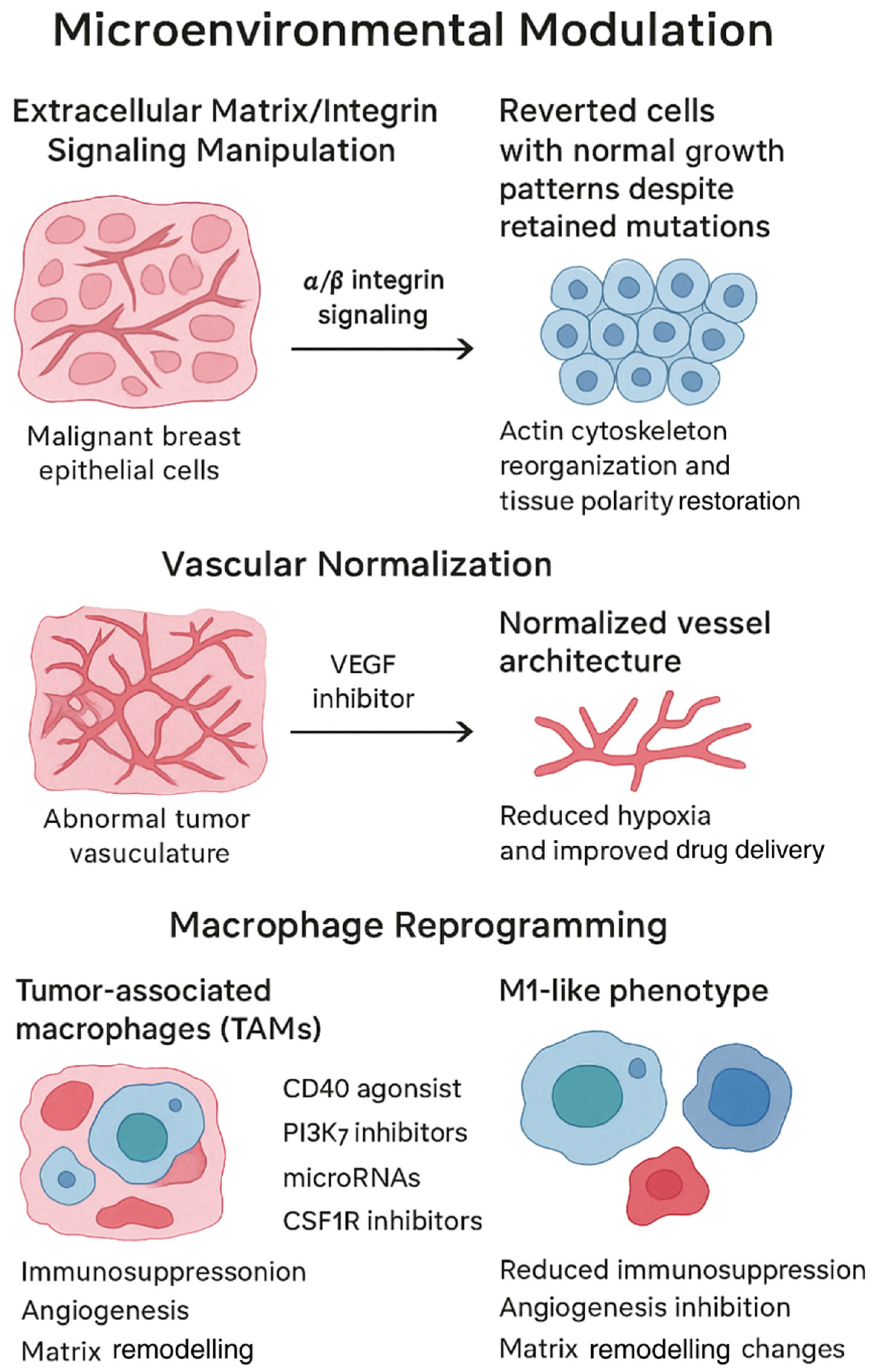
4.2. Microenvironmental Modulation
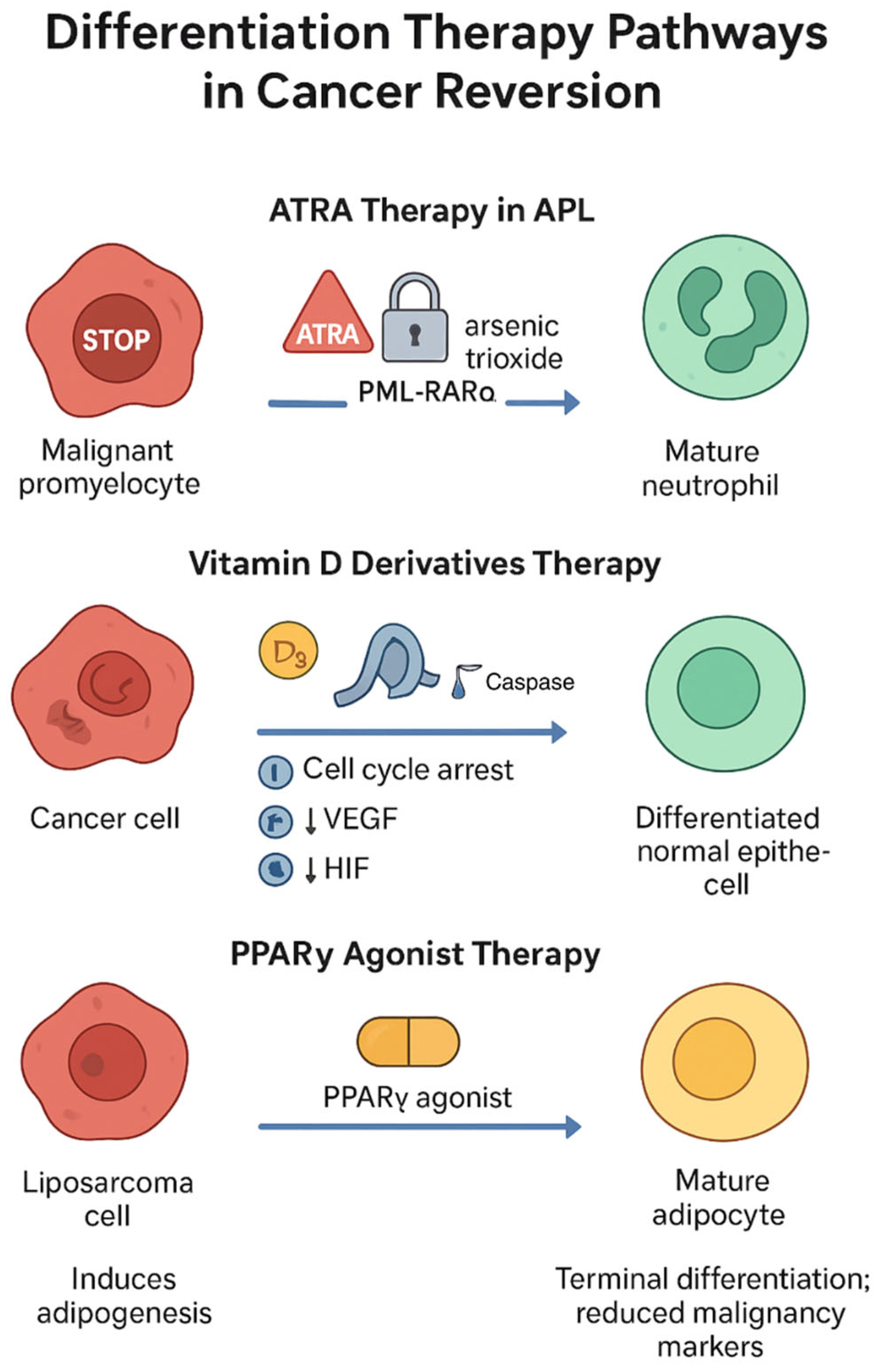
4.3. Differentiation Therapy
4.4. Targeting Oncogene Addiction
5. Emerging Technologies
- Stable Reversion (True Phenotypic Normalization): DNA methylation changes present; sustained differentiation marker expression >3 months post-treatment; loss of tumor-initiating capacity in serial transplantation; restoration of tissue architecture and normal functions; low Ki-67 with mature cell morphology.
- Transient Plasticity (Stimulus-Dependent): Only histone modification changes (no DNA methylation); differentiation markers lost within weeks of treatment cessation; retained tumor-initiating capacity; rapid Ki-67 rebound upon treatment withdrawal.
- Dormancy/Quiescence (Not Reversion): Low Ki-67 but retained stemness markers (Oct4, Sox2); no differentiation marker expression; no functional restoration; tumor-initiating capacity preserved; rapid proliferation resumption when conditions permit.
- Senescence (Not Reversion): High p16/p21, SA-β-gal positive; permanent growth arrest but no differentiation; retained malignant molecular signature; SASP (inflammatory secretome).
- Minimal panel: Differentiation markers (IHC/flow) + Ki-67 + morphology (serial biopsies/imaging);
- Comprehensive panel: Above + cfDNA methylation (liquid biopsy) + metabolic imaging (FDG-PET) + functional assays (where feasible);
- Research/validation studies: Above + serial transplantation + single-cell epigenomics + clonal tracking.
5.1. Single-Cell Technologies
5.2. Crispr-Based Approaches
5.3. Organoid Models
5.4. Artificial Intelligence and Machine Learning
6. Challenges and Limitations
6.1. Cancer Cell Plasticity and Adaptive Resistance
6.2. Establishing and Validating Stable Reversion States
- Genetic background: Cells with fewer oncogenic mutations may be more amenable to stable reversion;
- Epigenetic landscape: Stable DNA methylation changes predict durable reversion; transient histone modifications suggest reversibility;
- Microenvironmental context: Supportive stromal signals may maintain normalized phenotypes; permissive environments may allow relapse;
- Treatment history: Duration and intensity of reversion-inducing therapy may determine epigenetic consolidation;
- Differentiation stage: Terminal differentiation (e.g., ATRA in APL) produces irreversible reversion; partial differentiation may be reversible.
- Lack of validated biomarkers predicting stability vs. reversibility before treatment withdrawal;
- Insufficient long-term follow-up data in most experimental and clinical studies;
- Need for standardized criteria defining “stable reversion” with minimum follow-up durations;
- Limited understanding of molecular mechanisms that lock in vs. allow escape from differentiated states.
6.3. Delivery Challenges for Solid Tumors
- Achieving therapeutic concentrations in poorly vascularized tumor regions;
- Maintaining sustained drug exposure over weeks to months required for epigenetic reprogramming;
- Minimizing off-target effects in normal tissues with high proliferation rates (bone marrow, GI tract);
- Crossing biological barriers (blood–brain barrier for CNS tumors).
6.4. Tumor Heterogeneity and Need for Combination Approaches
- Agents targeting different cellular subpopulations (e.g., differentiated vs. stem-like cancer cells);
- Simultaneous modulation of multiple regulatory networks (e.g., epigenetic + signaling pathway inhibition);
- Addressing both cancer cells and supportive microenvironment (e.g., differentiation therapy + macrophage reprogramming).
- Sophisticated understanding of interaction mechanisms (synergy vs. antagonism);
- Careful management of combined toxicities;
- Complex clinical development pathways and regulatory considerations;
- Determination of optimal sequencing and scheduling.
6.5. Clinical Trial Design and Endpoint Challenges
- Defining appropriate primary endpoints: Overall survival and progression-free survival may not capture early reversion responses; differentiation markers, MRD, functional recovery are candidate surrogate endpoints requiring validation.
- Extended observation periods: Assessing stability requires longer follow-up than typical phase II trials (minimum 6–12 months post-treatment cessation).
- Biomarker development: Robust, validated biomarkers distinguishing stable reversion from transient plasticity are needed.
- Patient selection: Identifying which patients are most likely to achieve stable reversion based on tumor biology, genetic/epigenetic profiles.
- Combination trial complexity: Testing multiple agent combinations with various schedules creates factorial complexity.
- Regulatory pathways: Gaining regulatory acceptance for novel endpoints beyond tumor regression.
6.6. Economic and Developmental Barriers
- Longer-term investment with delayed demonstration of benefit;
- Alternative approaches to demonstrating clinical benefit beyond rapid tumor shrinkage;
- More expensive biomarker assessments (epigenetic profiling, single-cell analyses);
- Extended clinical trial durations to assess stability.
- Public–private partnerships;
- Academic-led trials with alternative funding mechanisms;
- Regulatory incentives for novel therapeutic paradigms;
- Health economic modeling demonstrating long-term value (e.g., reduced toxicity, improved quality of life, potential for treatment-free remission).
- (Established evidence) = Standard practice with regulatory acceptance and extensive clinical experience;
- (Emerging/moderate evidence) = Some clinical precedent, published data, or early regulatory examples exist;
- (Speculative) = Theoretical considerations or proposed approaches lacking substantial validation.
- Stability assessment is paramount: Trials must include planned treatment withdrawal phases with extended post-cessation monitoring;
- Biomarker development is critical: Validated assays distinguishing stable reversion from transient plasticity are urgently needed;
- Patient selection refinement: Predictive biomarkers identifying patients likely to achieve stable vs. transient responses will improve trial efficiency;
- Novel endpoint validation: Regulatory acceptance of reversion-specific endpoints requires robust correlation with clinical benefit;
- Combination complexity: Rational sequencing and timing of combination regimens requires mechanistic understanding and pharmacodynamic monitoring.
7. Future Directions
- Table 4—(A) strategies have evidence supporting mechanistic rationale and feasibility; represent near-term translational opportunities.
- Table 4—(B) strategies are conceptual proposals with plausible biological rationale but lacking experimental validation; represent longer-term research directions.
- Common theme: Combinations address fundamental limitation that single agents often produce incomplete or reversible reversion; rational combinations may achieve stable phenotypic normalization by simultaneously targeting multiple maintenance mechanisms.
- Stability enhancement rationale is critical: combinations should not merely add efficacy but specifically address mechanisms that allow dedifferentiation or phenotypic reversion.
7.1. Integrated Multi-Omics Approaches
7.2. Leveraging Natural Examples of Reversion
7.3. Nanotechnology-Based Delivery Systems
7.4. Synthetic Biology Approaches
8. Limitations of the Review
- Standardized terminology and assessment criteria for reversion phenotypes;
- Minimal standards for post-treatment follow-up duration in experimental and clinical studies;
- Systematic reviews and meta-analyses where appropriate;
- Comprehensive clinical trial reporting including negative results;
- International research collaboration;
- Integration of findings across diverse experimental systems and cancer types.
9. Conclusions
- Definitive successes: ATRA in APL demonstrates that terminal differentiation producing stable, durable remissions is achievable, providing proof-of-principle for cancer reversion as a therapeutic paradigm.
- Partial successes: BCR-ABL inhibition in CML shows that 40–60% of patients can achieve treatment-free remission, while others require continuous therapy, highlighting that stable reversion is context-dependent.
- Promising but unvalidated approaches: Many epigenetic, microenvironmental, and differentiation-based strategies show encouraging preclinical results, but most lack adequate long-term data confirming stable reversion in patients.
- Stimulus-dependent plasticity: Numerous interventions (ECM normalization, vascular normalization, macrophage reprogramming, and some differentiation agents) produce phenotypic normalization only while treatment is maintained, representing valuable combination therapy components but not standalone reversion strategies.
- Cancer cell plasticity enables escape from partially induced differentiation states;
- Distinguishing stable reversion from transient plasticity requires extended post-treatment observation periods rarely performed in current studies;
- Delivery challenges limit solid tumor applications;
- Tumor heterogeneity necessitates combination approaches;
- Clinical trial designs and regulatory pathways need adaptation for reversion-specific endpoints.
- Single-cell analyses can map cellular state transitions and identify stable vs. transient phenotypic changes;
- CRISPR-based approaches enable precise genetic and epigenetic manipulation to test reversion mechanisms;
- Organoid models recapitulate tumor complexity and enable assessment of phenotypic stability;
- AI/machine learning can predict which interventions produce durable reversion;
- Nanotechnology enables sustained delivery of reversion-inducing agents required for epigenetic consolidation;
- Synthetic biology approaches offer intelligent, self-regulating therapeutic systems.
- Establishing rigorous criteria and standardized assessment methods for stable reversion (extending beyond the treatment period);
- Developing and validating biomarkers distinguishing stable reversion from transient plasticity (especially epigenetic stability markers);
- Rational combination strategies that consolidate phenotypic changes induced by individual agents;
- Extended follow-up in experimental and clinical studies (minimum 3–6 months post-treatment in preclinical; 12–24 months in clinical);
- Interdisciplinary collaboration among basic researchers, clinicians, bioengineers, and technology developers;
- Innovative clinical trial designs with reversion-appropriate endpoints and observation periods;
- Regulatory pathways accepting novel endpoints beyond tumor shrinkage.
Author Contributions
Funding
Data Availability Statement
Conflicts of Interest
Abbreviations
| 3D | Three-dimensional |
| AML | Acute myeloid leukemia |
| APL | Acute promyelocytic leukemia |
| ATRA | All-trans retinoic acid |
| BCC | Basal cell carcinoma |
| BET | Bromodomain and extra-terminal |
| CAR-T | Chimeric antigen receptor T-cell |
| CML | Chronic myeloid leukemia |
| CRISPR | Clustered regularly interspaced short palindromic repeats |
| CSC | Cancer stem cell |
| CTC | Circulating tumor cell |
| DNMT | DNA methyltransferase |
| ECM | Extracellular matrix |
| EMT | Epithelial–mesenchymal transition |
| FDA | Food and Drug Administration |
| HDAC | Histone deacetylase |
| HIF | Hypoxia-inducible factor |
| iPSC | Induced pluripotent stem cell |
| MErT | Mesenchymal to epithelial reverting transition |
| NSCLC | Non-small cell lung cancer |
| OS | Overall survival |
| PDX | Patient-derived xenograft |
| PFS | Progression-free survival |
| PPARγ | Peroxisome proliferator-activated receptor gamma |
| PROTAC | Proteolysis-targeting chimera |
| scRNA-seq | Single-cell RNA sequencing |
| TAM | Tumor-associated macrophage |
| TNBC | Triple-negative breast cancer |
| VEGF | Vascular endothelial growth factor |
| VDR | Vitamin D receptor |
References
- Boussios, S.; Pentheroudakis, G.; Katsanos, K.; Pavlidis, N. Systemic treatment-induced gastrointestinal toxicity: Incidence, clinical presentation and management. Ann. Gastroenterol. 2012, 25, 106–118. [Google Scholar]
- Mallikarjun, K.S.; Eldaya, R.W.; Miller-Thomas, M.M.; Orlowski, H.L.; Parsons, M.S. Good Gone Bad: Complications of Chemotherapy, Immunotherapy, and Radiotherapy on the CNS. Curr. Probl. Diagn. Radiol. 2023, 53, 133–149. [Google Scholar] [CrossRef]
- Aweys, H.; Lewis, D.; Sheriff, M.; Rabbani, R.D.; Lapitan, P.; Sanchez, E.; Papadopoulos, V.; Ghose, A.; Boussios, S. Renal Cell Cancer-Insights in Drug Resistance Mechanisms. Anticancer Res. 2023, 43, 4781–4792. [Google Scholar] [CrossRef]
- Telerman, A.; Amson, R. The molecular programme of tumour reversion: The steps beyond malignant transformation. Nat. Rev. Cancer 2009, 9, 206–216. [Google Scholar] [CrossRef]
- De Visser, K.E.; Joyce, J.A. The evolving tumor microenvironment: From cancer initiation to metastatic outgrowth. Cancer Cell 2023, 41, 374–403. [Google Scholar] [CrossRef]
- Sharma, S.; Kelly, T.K.; Jones, P.A. Epigenetics in cancer. Carcinogenesis 2009, 31, 27–36. [Google Scholar] [CrossRef] [PubMed]
- Takahashi, K.; Yamanaka, S. Induction of Pluripotent Stem Cells from Mouse Embryonic and Adult Fibroblast Cultures by Defined Factors. Cell 2006, 126, 663–676. [Google Scholar] [CrossRef] [PubMed]
- Pérez-González, A.; Bévant, K.; Blanpain, C. Cancer cell plasticity during tumor progression, metastasis and response to therapy. Nat. Cancer 2023, 4, 1063–1082. [Google Scholar] [CrossRef] [PubMed]
- Divakar, P.; Khan, M.J.; Polacco, M.; Kerr, D.A.; Paydarfar, J.A. Spontaneous regression of squamous cell carcinoma in the setting of dental infection and needle biopsy. Clin. Case Rep. 2020, 8, 1919–1923. [Google Scholar] [CrossRef]
- Yamamoto, M.; Iizuka, S.; Otsuki, Y.; Nakamura, T. Spontaneous regressions in non-small cell lung cancer with different clinical outcomes. Int. J. Surg. Case Rep. 2022, 92, 106812. [Google Scholar] [CrossRef]
- Yamamoto, N.; Yamamoto, C.; Tajitsu, T. Spontaneous regression of hepatocellular carcinoma in a pure palliative care setting. J. Gen. Fam. Med. 2022, 24, 126–128. [Google Scholar] [CrossRef] [PubMed]
- Taqi, A.M.; Abdurrahman, M.B.; Yakubu, A.M.; Fleming, A.F. Regression of Hodgkin’s disease after measles. Lancet 1981, 317, 1112. [Google Scholar] [CrossRef] [PubMed]
- Bluming, A.Z.; Ziegler, J.L. Regression of Burkitt’s lymphoma in association with measles infection. Lancet 1971, 298, 105–106. [Google Scholar] [CrossRef]
- Dock, G. The influence of complicating diseases upon leukemia. Am. J. Med. Sci. 1904, 127, 563–592. [Google Scholar] [CrossRef]
- Salman, T. Spontaneous tumor regression. J. Oncol. Sci. 2016, 2, 1–4. [Google Scholar] [CrossRef]
- Chen, Z.; Han, F.; Du, Y.; Shi, H.; Zhou, W. Hypoxic microenvironment in cancer: Molecular mechanisms and therapeutic interventions. Signal Transduct. Target. Ther. 2023, 8, 70. [Google Scholar] [CrossRef] [PubMed]
- Abooali, M.; Schlichtner, S.; Lei, X.; Aliu, N.; Ruggiero, S.; Loges, S.; Ziegler, M.; Hertel, F.; Volckmar, A.L.; Stenzinger, A.; et al. Intracellular and extracellular activities of V-domain Ig-containing suppressor of T cell activation (VISTA) modulated by immunosuppressive factors of tumour microenvironment. Cancer Lett. 2025, 616, 217581. [Google Scholar] [CrossRef]
- Cooper, G.M. The Cell: A Molecular Approach, 2nd ed.; Sinauer Associates: Sunderland, MA, USA, 2000. [Google Scholar]
- Zhou, S.; Abdouh, M.; Arena, V.; Arena, M.; Arena, G.O. Reprogramming malignant cancer cells toward a benign phenotype following exposure to human embryonic stem cell microenvironment. PLoS ONE 2017, 12, e0169899. [Google Scholar] [CrossRef]
- Postovit, L.M.; Margaryan, N.V.; Seftor, E.A.; Kirschmann, D.A.; Lipavsky, A.; Wheaton, W.W.; Abbott, D.E.; Seftor, R.E.B.; Hendrix, M.J.C. Human embryonic stem cell microenvironment suppresses the tumorigenic phenotype of aggressive cancer cells. Proc. Natl. Acad. Sci. USA 2008, 105, 4329–4334. [Google Scholar] [CrossRef]
- Shin, D.; Cho, K.H. Critical transition and reversion of tumorigenesis. Exp. Mol. Med. 2023, 55, 692–705. [Google Scholar] [CrossRef]
- Garg, P.; Singhal, G.; Pareek, S.; Kulkarni, P.; Horne, D.; Nath, A.; Salgia, R.; Singhal, S.S. Unveiling the potential of gene editing techniques in revolutionizing cancer treatment: A comprehensive overview. Biochim. Biophys. Acta (BBA) Rev. Cancer 2025, 1880, 189233. [Google Scholar] [CrossRef]
- Aguirre, A.J.; Meyers, R.M.; Weir, B.A.; Vazquez, F.; Zhang, C.Z.; Ben-David, U.; Cook, A.; Ha, G.; Harrington, W.F.; Doshi, M.B.; et al. Genomic copy number dictates a gene-independent cell response to CRISPR/Cas9 targeting. Cancer Discov. 2016, 6, 914–929. [Google Scholar] [CrossRef]
- Azeez, S.S.; Hamad, R.S.; Hamad, B.K.; Shekha, M.S.; Bergsten, P. Advances in CRISPR-Cas technology and its applications: Revolutionising precision medicine. Front. Genome Ed. 2024, 6, 1509924. [Google Scholar] [CrossRef]
- Fahrner, J.A.; Eguchi, S.; Herman, J.G.; Baylin, S.B. Dependence of histone modifications and gene expression on DNA hypermethylation in cancer. Cancer Res. 2002, 62, 7213–7218. [Google Scholar]
- Ballestar, E. Methyl-CpG binding proteins identify novel sites of epigenetic inactivation in human cancer. EMBO J. 2003, 22, 6335–6345. [Google Scholar] [CrossRef]
- Gu, M.; Ren, B.; Fang, Y.; Ren, J.; Liu, X.; Wang, X.; Zhou, F.; Xiao, R.; Luo, X.; You, L.; et al. Epigenetic regulation in cancer. MedComm 2024, 5, e495. [Google Scholar] [CrossRef]
- Plati, J.; Bucur, O.; Khosravi-Far, R. Apoptotic cell signaling in cancer progression and therapy. Integr. Biol. 2011, 3, 279–296. [Google Scholar] [CrossRef] [PubMed]
- Zhou, G.B.; Zhang, J.; Wang, Z.Y.; Chen, S.J.; Chen, Z. Treatment of acute promyelocytic leukaemia with all-trans retinoic acid and arsenic trioxide: A paradigm of synergistic molecular targeting therapy. Philos. Trans. R. Soc. B Biol. Sci. 2007, 362, 959–971. [Google Scholar] [CrossRef] [PubMed]
- Fenaux, P.; Chomienne, C.; Degos, L. All-trans retinoic acid and chemotherapy in the treatment of acute promyelocytic leukemia. Semin. Hematol. 2001, 38, 13–25. [Google Scholar] [CrossRef] [PubMed]
- Liu, G.; Chen, T.; Zhang, X.; Ma, X.; Shi, H. Small molecule inhibitors targeting the cancers. MedComm 2022, 3, e181. [Google Scholar] [CrossRef]
- Maucort, C.; Giorgio, A.D.; Azoulay, S.; Duca, M. Differentiation of cancer stem cells by using synthetic small molecules: Toward new therapeutic strategies against therapy resistance. ChemMedChem 2020, 16, 14–29. [Google Scholar] [CrossRef]
- Weigelt, B.; Ghajar, C.M.; Bissell, M.J. The need for complex 3D culture models to unravel novel pathways and identify accurate biomarkers in breast cancer. Adv. Drug Deliv. Rev. 2014, 69–70, 42–51. [Google Scholar] [CrossRef] [PubMed]
- Salinas-Vera, Y.M.; Valdés, J.; Pérez-Navarro, Y.; Mandujano-Lazaro, G.; Marchat, L.A.; Ramos-Payán, R.; Nuñez-Olvera, S.I.; Pérez-Plascencia, C.; López-Camarillo, C. Three-dimensional (3D) culture models in gynecological and breast cancer research. Front. Oncol. 2022, 12, 826113. [Google Scholar] [CrossRef]
- Peng, Y.; Croce, C.M. The role of microRNAs in human cancer. Signal Transduct. Target. Ther. 2016, 1, 15004. [Google Scholar] [CrossRef] [PubMed]
- Otmani, K.; Lewalle, P. Tumor suppressor miRNA in cancer cells and the tumor microenvironment: Mechanism of deregulation and clinical implications. Front. Oncol. 2021, 11, 708765. [Google Scholar] [CrossRef]
- Massagué, J.; Ganesh, K. Metastasis-initiating cells and ecosystems. Cancer Discov. 2021, 11, 971–994. [Google Scholar] [CrossRef]
- Ganesh, K.; Massagué, J. Targeting metastatic cancer. Nat. Med. 2021, 27, 34–44. [Google Scholar] [CrossRef]
- Khosravi, H.; Akabane, A.L.; Alloo, A.; Nazarian, R.M.; Boland, G.M. Metastatic melanoma with spontaneous complete regression of a thick primary lesion. JAAD Case Rep. 2016, 2, 439. [Google Scholar] [CrossRef]
- Brodeur, G.M. Spontaneous regression of neuroblastoma. Cell Tissue Res. 2018, 372, 277–286. [Google Scholar] [CrossRef] [PubMed]
- Rashidi, A.; Fisher, S.I. Spontaneous remission of acute myeloid leukemia. Leuk. Lymphoma 2014, 56, 1727–1734. [Google Scholar] [CrossRef]
- Everson, T.C.; Cole, W.H. Spontaneous regression of cancer. Ann. Surg. 1956, 144, 366–383. [Google Scholar] [CrossRef] [PubMed]
- Weigelt, B.; Bissell, M.J. Unraveling the microenvironmental influences on the normal mammary gland and breast cancer. Semin. Cancer Biol. 2008, 18, 311–321. [Google Scholar] [CrossRef]
- Jones, P.A.; Baylin, S.B. The fundamental role of epigenetic events in cancer. Nat. Rev. Genet. 2002, 3, 415–428. [Google Scholar] [CrossRef]
- Jones, P.A.; Baylin, S.B. The epigenomics of cancer. Cell 2007, 128, 683–692. [Google Scholar] [CrossRef]
- Tahghighi, A.; Seyedhashemi, E.; Mohammadi, J.; Moradi, A.; Esmaeili, A.; Pornour, M.; Jafarifar, K.; Ganji, S.M. Epigenetic marvels: Exploring the landscape of colorectal cancer treatment through cutting-edge epigenetic-based drug strategies. Clin. Epigenetics 2025, 17, 34. [Google Scholar] [CrossRef]
- Wang, Y.; Wang, C.; Zhong, R.; Wang, L.; Sun, L. Research progress of DNA methylation in colorectal cancer (Review). Mol. Med. Rep. 2024, 30, 154. [Google Scholar] [CrossRef]
- Hendrix, M.J.C.; Seftor, E.A.; Seftor, R.E.B.; Postovit, L.M. Cancer cell plasticity: A plausible explanation for the lack of success of current therapies in melanoma. Pigment Cell Melanoma Res. 2007, 20, 112–118. [Google Scholar] [CrossRef]
- Pelullo, M.; Zema, S.; Nardozza, F.; Checquolo, S.; Screpanti, I.; Bellavia, D. Wnt, Notch, and TGF-β Pathways Impinge on Hedgehog Signaling Complexity: An Open Window on Cancer. Front. Genet. 2019, 10, 711. [Google Scholar] [CrossRef]
- Muñoz, J.P.; Pérez-Moreno, P.; Pérez, Y.; Calaf, G.M. The Role of MicroRNAs in Breast Cancer and the Challenges of Their Clinical Application. Diagnostics 2023, 13, 3072. [Google Scholar] [CrossRef] [PubMed]
- Sikder, S.; Bhattacharya, A.; Agrawal, A.; Sethi, G.; Kundu, T.K. Micro-RNAs in Breast Cancer Progression and Metastasis: A Chromatin and Metabolic Perspective. Heliyon 2024, 10, e38193. [Google Scholar] [CrossRef] [PubMed]
- Hassani, B.; Taheri, M.; Asgari, Y.; Zekri, A.; Sattari, A.; Ghafouri-Fard, S.; Pouresmaeili, F. Expression Analysis of Long Non-Coding RNAs Related with FOXM1, GATA3, FOXA1 and ESR1 in Breast Tissues. Front. Oncol. 2021, 11, 671418. [Google Scholar] [CrossRef] [PubMed]
- Corbin, A.S.; Agarwal, A.; Loriaux, M.; Cortes, J.; Deininger, M.W.; Druker, B.J. Human Chronic Myeloid Leukemia Stem Cells Are Insensitive to Imatinib despite Inhibition of BCR-ABL Activity. J. Clin. Investig. 2011, 121, 396–409. [Google Scholar] [CrossRef]
- Kanouni, T.; Severin, C.; Cho, R.W.; Yuen, N.Y.-Y.; Xu, J.; Shi, L.; Lai, C.; Del Rosario, J.R.; Stansfield, R.K.; Lawton, L.N.; et al. Discovery of CC-90011: A Potent and Selective Reversible Inhibitor of Lysine Specific Demethylase 1 (LSD1). J. Med. Chem. 2020, 63, 14522–14529. [Google Scholar] [CrossRef]
- Yano, M.; Imamura, T.; Sakamoto, K.; Yoshida, H.; Fujiki, A.; Hirashima, Y.; Ishida, H.; Hosoi, H. LSD1 Inhibitor Activates Retinoic Acid Pathway in MLL Fusion Positive Acute Myeloid Leukemia. Blood 2012, 120, 1345. [Google Scholar] [CrossRef]
- Cicconi, L.; Platzbecker, U.; Avvisati, G.; Paoloni, F.; Thiede, C.; Vignetti, M.; Fazi, P.; Ferrara, F.; Divona, M.; Albano, F.; et al. Long-term results of all-trans retinoic acid and arsenic trioxide in non-high-risk acute promyelocytic leukemia: Update of the APL0406 Italian-German randomized trial. Leukemia 2019, 34, 914–918. [Google Scholar] [CrossRef]
- Grimwade, D.; Mistry, A.R.; Solomon, E.; Guidez, F. Acute promyelocytic leukemia: A paradigm for differentiation therapy. Cancer Treat. Res. 2010, 145, 219–235. [Google Scholar] [CrossRef]
- Piazza, R.G.; Magistroni, V.; Franceschino, A.; Andreoni, F.; Tornaghi, L.; Colnaghi, F.; Corneo, G.; Pogliani, E.M.; Gambacorti-Passerini, C. The achievement of durable complete cytogenetic remission in late chronic and accelerated phase patients with CML treated with Imatinib mesylate predicts for prolonged response at 6 years. Blood Cells Mol. Dis. 2006, 37, 111–115. [Google Scholar] [CrossRef]
- Holtz, M.S.; Slovak, M.L.; Zhang, F.; Sawyers, C.L.; Forman, S.J.; Bhatia, R. Imatinib mesylate (STI571) inhibits growth of primitive malignant progenitors in chronic myelogenous leukemia through reversal of abnormally increased proliferation. Blood 2002, 99, 3792–3800. [Google Scholar] [CrossRef] [PubMed]
- Gong, J.; Lee, C.; Kim, H.; Kim, J.; Jeon, J.; Park, S.; Cho, K. Control of Cellular Differentiation Trajectories for Cancer Reversion. Adv. Sci. 2024, 12, e2402132. [Google Scholar] [CrossRef]
- Li, S.; Han, Z.; Zhao, N.; Zhu, B.; Zhang, Q.; Yang, X.; Sheng, D.; Hou, J.; Guo, S.; Wei, L.; et al. Inhibition of DNMT suppresses the stemness of colorectal cancer cells through down-regulating Wnt signaling pathway. Cell. Signal. 2018, 47, 79–87. [Google Scholar] [CrossRef] [PubMed]
- Kodach, L.L.; Jacobs, R.J.; Voorneveld, P.W.; Wildenberg, M.E.; Verspaget, H.W.; van Wezel, T.; Morreau, H.; Hommes, D.W.; Peppelenbosch, M.P.; van den Brink, G.R.; et al. Statins augment the chemosensitivity of colorectal cancer cells inducing epigenetic reprogramming and reducing colorectal cancer cell “stemness” via the bone morphogenetic protein pathway. Gut 2011, 60, 1544–1553. [Google Scholar] [CrossRef]
- Chao, Y.L.; Shepard, C.R.; Wells, A. Breast carcinoma cells re-express E-cadherin during mesenchymal to epithelial reverting transition. Mol. Cancer 2010, 9, 179. [Google Scholar] [CrossRef]
- Abu-Tayeh, H.; Weidenfeld, K.; Zhilin-Roth, A.; Schif-Zuck, S.; Thaler, S.; Cotarelo, C.; Tan, T.Z.; Thiery, J.P.; Green, J.E.; Klorin, G.; et al. ‘Normalizing’ the malignant phenotype of luminal breast cancer cells via alpha(v)beta(3)-integrin. Cell Death Dis. 2016, 7, e2491. [Google Scholar] [CrossRef]
- Weaver, V.M.; Petersen, O.W.; Wang, F.; Larabell, C.A.; Briand, P.; Damsky, C.; Bissell, M.J. Reversion of the Malignant Phenotype of Human Breast Cells in Three-Dimensional Culture and In Vivo by Integrin Blocking Antibodies. J. Cell Biol. 1997, 137, 231–245. [Google Scholar] [CrossRef]
- Nimal, S.; Kumbhar, N.; Pote, M.S.; Bankar, R.; Shaikh, M.; Gacche, R. Reversal of epithelial to mesenchymal transition in triple negative breast cancer through epigenetic modulations by dietary flavonoid Galangin and its combination with SAHA. Cell Commun. Signal. 2025, 23, 163. [Google Scholar] [CrossRef] [PubMed]
- Balamurugan, K.; Poria, D.K.; Sehareen, S.W.; Krishnamurthy, S.; Tang, W.; McKennett, L.; Padmanaban, V.; Czarra, K.; Ewald, A.J.; Ueno, N.T.; et al. Stabilization of E-cadherin adhesions by COX-2/GSK3β signaling is a targetable pathway in metastatic breast cancer. JCI Insight 2023, 8, e156057. [Google Scholar] [CrossRef]
- Gailhouste, L.; Liew, L.C.; Yasukawa, K.; Hatada, I.; Tanaka, Y.; Nakagama, H.; Ochiya, T. Differentiation Therapy by Epigenetic Reconditioning Exerts Antitumor Effects on Liver Cancer Cells. Molecular Therapy 2018, 26, 1840–1854. [Google Scholar] [CrossRef]
- Lekmine, F.; Chang, C.K.; Sethakorn, N.; Das Gupta, T.K.; Salti, G.I. Role of microphthalmia transcription factor (Mitf) in melanoma differentiation. Biochem. Biophys. Res. Commun. 2007, 354, 830–835. [Google Scholar] [CrossRef] [PubMed]
- Von Hoff, D.D.; LoRusso, P.M.; Rudin, C.M.; Reddy, J.C.; Yauch, R.L.; Tibes, R.; Weiss, G.J.; Borad, M.J.; Hann, C.L.; Brahmer, J.R.; et al. Inhibition of the hedgehog pathway in advanced basal-cell carcinoma. N. Engl. J. Med. 2009, 361, 1164–1172. [Google Scholar] [CrossRef]
- Lear, J.T.; Harwood, C.A.; Hasan, Z.; Kentley, J.; Thomson, J.; Khoo, A.; Alderman, A.; De Souza, M.; Epstein, E.H.; Kochendoerfer, G.G.; et al. Phase 2 Trial of Topical Application of the Hedgehog Inhibitor Patidegib in Patients with Gorlin Syndrome. Br. J. Dermatol. 2024, 192, 611–617. [Google Scholar] [CrossRef] [PubMed]
- Gao, Q.; Chen, C.F.; Dong, Q.; Hou, L.; Chen, X.; Zhi, Y.; Li, X.; Lu, H.T.; Zhang, H.Y. Elevated TrkA receptor expression is associated with all-trans retinoic acid-induced neuroblastoma differentiation. Genet. Mol. Res. 2015, 14, 13195–13202. [Google Scholar] [CrossRef]
- Marks, P.A.; Richon, V.M.; Breslow, R.; Rifkind, R.A. Histone deacetylase inhibitors as new cancer drugs. Curr. Opin. Oncol. 2001, 13, 477–483. [Google Scholar] [CrossRef]
- Kim, H.J.; Bae, S.C. Histone deacetylase inhibitors: Molecular mechanisms of action and clinical trials as anti-cancer drugs. Am. J. Transl. Res. 2011, 3, 166–179. [Google Scholar]
- San José-Enériz, E.; Gimenez-Camino, N.; Agirre, X.; Prosper, F. HDAC Inhibitors in Acute Myeloid Leukemia. Cancers 2019, 11, 1794. [Google Scholar] [CrossRef]
- Duvic, M.; Talpur, R.; Ni, X.; Zhang, C.; Hazarika, P.; Kelly, C.; Chiao, J.H.; Reilly, J.F.; Ricker, J.L.; Richon, V.M.; et al. Phase 2 trial of oral vorinostat (suberoylanilide hydroxamic acid, SAHA) for refractory cutaneous T-cell lymphoma (CTCL). Blood 2006, 109, 31–39. [Google Scholar] [CrossRef]
- Olsen, E.A.; Kim, Y.H.; Kuzel, T.M.; Pacheco, T.R.; Foss, F.M.; Parker, S.; Frankel, S.R.; Chen, C.; Ricker, J.L.; Arduino, J.M.; et al. Phase IIB Multicenter Trial of Vorinostat in Patients with Persistent, Progressive, or Treatment Refractory Cutaneous T-Cell Lymphoma. J. Clin. Oncol. 2007, 25, 3109–3115. [Google Scholar] [CrossRef]
- Piekarz, R.L.; Frye, R.; Turner, M.; Wright, J.J.; Allen, S.L.; Kirschbaum, M.H.; Zain, J.; Prince, H.M.; Leonard, J.P.; Geskin, L.J.; et al. Phase II Multi-Institutional Trial of the Histone Deacetylase Inhibitor Romidepsin as Monotherapy for Patients with Cutaneous T-Cell Lymphoma. J. Clin. Oncol. 2009, 27, 5410–5417. [Google Scholar] [CrossRef] [PubMed]
- Piekarz, R.L.; Frye, R.; Prince, H.M.; Kirschbaum, M.H.; Zain, J.; Allen, S.L.; Jaffe, E.S.; Ling, A.; Turner, M.; Peer, C.J.; et al. Phase 2 trial of romidepsin in patients with peripheral T-cell lymphoma. Blood 2011, 117, 5827–5834. [Google Scholar] [CrossRef] [PubMed]
- Goffin, J.; Eisenhauer, E. DNA methyltransferase inhibitors—State of the art. Ann. Oncol. 2002, 13, 1699–1716. [Google Scholar] [CrossRef]
- Delmore, J.E.; Issa, G.C.; Lemieux, M.E.; Rahl, P.B.; Shi, J.; Jacobs, H.M.; Kastritis, E.; Gilpatrick, T.; Paranal, R.M.; Qi, J.; et al. BET Bromodomain Inhibition as a Therapeutic Strategy to Target c-Myc. Cell 2011, 146, 904–917. [Google Scholar] [CrossRef] [PubMed]
- Henssen, A.; Thor, T.; Odersky, A.; Heukamp, L.; El-Hindy, N.; Beckers, A.; Speleman, F.; Althoff, K.; Schäfers, S.; Schramm, A.; et al. BET bromodomain protein inhibition is a therapeutic option for medulloblastoma. Oncotarget 2013, 4, 2080–2095. [Google Scholar] [CrossRef]
- Bizzarri, M.; Cucina, A.; Biava, P.M.; Proietti, S.; d’Anselmi, F.; Dinicola, S.; Pasqualato, A.; Lisi, E. Embryonic Morphogenetic Field Induces Phenotypic Reversion in Cancer Cells. Review Article. Curr. Pharm. Biotechnol. 2011, 12, 243–253. [Google Scholar] [CrossRef] [PubMed]
- D’Anselmi, F.; Masiello, M.G.; Cucina, A.; Proietti, S.; Dinicola, S.; Pasqualato, A.; Ricci, G.; Dobrowolny, G.; Catizone, A.; Palombo, A.; et al. Microenvironment Promotes Tumor Cell Reprogramming in Human Breast Cancer Cell Lines. PLoS ONE 2013, 8, e83770. [Google Scholar] [CrossRef] [PubMed][Green Version]
- Jain, R.K. Normalizing tumor vasculature with anti-angiogenic therapy: A new paradigm for combination therapy. Nat. Med. 2001, 7, 987–989. [Google Scholar] [CrossRef]
- Jain, R.K. Normalization of Tumor Vasculature: An Emerging Concept in Antiangiogenic Therapy. Science 2005, 307, 58–62. [Google Scholar] [CrossRef] [PubMed]
- Goel, S.; Wong, A.H.-K.; Jain, R.K. Vascular Normalization as a Therapeutic Strategy for Malignant and Nonmalignant Disease. Cold Spring Harb. Perspect. Med. 2012, 2, a006486. [Google Scholar] [CrossRef]
- Su, M.J.; Aldawsari, H.; Amiji, M. Pancreatic Cancer Cell Exosome-Mediated Macrophage Reprogramming and the Role of MicroRNAs 155 and 125b2 Transfection using Nanoparticle Delivery Systems. Sci. Rep. 2016, 6, 30110. [Google Scholar] [CrossRef]
- Beatty, G.L.; Chiorean, E.G.; Fishman, M.P.; Saboury, B.; Teitelbaum, U.R.; Sun, W.; Huhn, R.D.; Song, W.; Li, D.; Sharp, L.L.; et al. CD40 Agonists Alter Tumor Stroma and Show Efficacy Against Pancreatic Carcinoma in Mice and Humans. Science 2011, 331, 1612–1616. [Google Scholar] [CrossRef]
- Wiehagen, K.R.; Girgis, N.M.; Yamada, D.H.; Smith, A.A.; Chan, S.R.; Grewal, I.S.; Quigley, M.; Verona, R.I. Combination of CD40 Agonism and CSF-1R Blockade Reconditions Tumor-Associated Macrophages and Drives Potent Antitumor Immunity. Cancer Immunol. Res. 2017, 5, 1109–1121. [Google Scholar] [CrossRef]
- Kaneda, M.M.; Messer, K.S.; Ralainirina, N.; Li, H.; Leem, C.J.; Gorjestani, S.; Woo, G.; Nguyen, A.V.; Figueiredo, C.C.; Foubert, P.; et al. PI3Kγ is a molecular switch that controls immune suppression. Nature 2016, 539, 437–442. [Google Scholar] [CrossRef]
- Chen, K.; Li, X.; Dong, S.; Guo, Y.; Luo, Z.; Zhuang, S.M.; Liu, J.; Liu, T.; Liao, J.; Wen, W. Modulating tumor-associated macrophages through CSF1R inhibition: A potential therapeutic strategy for HNSCC. J. Transl. Med. 2025, 23, 27. [Google Scholar] [CrossRef] [PubMed]
- Fridlender, Z.G.; Kapoor, V.; Buchlis, G.; Cheng, G.; Sun, J.; Wang, L.C.S.; Singhal, S.; Snyder, L.A.; Albelda, S.M. Monocyte Chemoattractant Protein–1 Blockade Inhibits Lung Cancer Tumor Growth by Altering Macrophage Phenotype and Activating CD8+ Cells. Am. J. Respir. Cell Mol. Biol. 2011, 44, 230–237. [Google Scholar] [CrossRef]
- Bonapace, L.; Coissieux, M.M.; Wyckoff, J.; Mertz, K.D.; Varga, Z.; Junt, T.; Bentires-Alj, M. Cessation of CCL2 inhibition accelerates breast cancer metastasis by promoting angiogenesis. Nature 2014, 515, 130–133. [Google Scholar] [CrossRef]
- Li, X.; Yao, W.; Yuan, Y.; Chen, P.; Li, B.; Li, J.; Chu, R.; Song, H.; Xie, D.; Jiang, X.; et al. Targeting of tumour-infiltrating macrophages via CCL2/CCR2 signalling as a therapeutic strategy against hepatocellular carcinoma. Gut 2015, 66, 157–167. [Google Scholar] [CrossRef]
- Umiker, B.; Hashambhoy-Ramsay, Y.; Smith, J.; Rahman, T.; Mueller, A.; Davidson, R.; Meyer, C.; Patankar, G.; Alam, M.M.; Jaffe, S.; et al. Inhibition of LILRB2 by a Novel Blocking Antibody Designed to Reprogram Immunosuppressive Macrophages to Drive T-Cell Activation in Tumors. Mol. Cancer Ther. 2023, 22, 471–484. [Google Scholar] [CrossRef]
- Kamerkar, S.; Leng, C.; Burenkova, O.; Jang, S.C.; McCoy, C.; Zhang, K.; Dahlberg, W.; Leblanc, M.; Quillery, H.; Maubant, S.; et al. Engineered exosome-mediated STAT6 knockdown in tumor associated macrophages (TAMs) results in potent single agent activity in a hepatocellular carcinoma (HCC) model. Cancer Res. 2021, 81, 1792. [Google Scholar] [CrossRef]
- Banach-Petrosky, W.; Ouyang, X.; Hui, P.; Nader, K.; Ji, Y.; Suh, N.; DiPaola, R.S.; Abate-Shen, C. Vitamin D Inhibits the Formation of Prostatic Intraepithelial Neoplasia in Nkx3.1; Pten Mutant Mice. Clin. Cancer Res. 2006, 12, 5895–5901. [Google Scholar] [CrossRef]
- Chung, I.; Han, G.; Seshadri, M.; Gillard, B.; Yu, W.; Foster, B.A.; Trump, D.L.; Johnson, C.S. Role of Vitamin D Receptor in the Antiproliferative Effects of Calcitriol in Tumor-Derived Endothelial Cells and Tumor Angiogenesis In Vivo. Cancer Res. 2009, 69, 967–975. [Google Scholar] [CrossRef]
- Colston, K.; James, S.; Ofori-Kuragu, E.; Binderup, L.; Grant, A. Vitamin D Receptors and Anti-Proliferative Effects of Vitamin D Derivatives in Human Pancreatic Carcinoma Cells in vivo and in vitro. Br. J. Cancer 1997, 76, 1017–1020. [Google Scholar] [CrossRef] [PubMed]
- Getzenberg, R.H.; Light, B.W.; Lapco, P.E.; Konety, B.R.; Nangia, A.K.; Acierno, J.S.; Dhir, R.; Shurin, Z.R.; Day, R.; Trump, D.L.; et al. Vitamin D Inhibition of Prostate Adenocarcinoma Growth and Metastasis in the Dunning Rat Prostate Model System. Urology 1997, 50, 999–1006. [Google Scholar] [CrossRef] [PubMed]
- Jiang, F.; Bao, J.; Li, P.; Nicosia, S.V.; Bai, W. Induction of Ovarian Cancer Cell Apoptosis by 1,25-Dihydroxyvitamin D3 through the Down-regulation of Telomerase. J. Biol. Chem. 2004, 279, 53213–53221. [Google Scholar] [CrossRef]
- Krishnan, A.V.; Peehl, D.M.; Feldman, D. Inhibition of Prostate Cancer Growth by Vitamin D: Regulation of Target Gene Expression. J. Cell. Biochem. 2003, 88, 363–371. [Google Scholar] [CrossRef]
- Ma, Y.; Yu, W.; Trump, D.L.; Johnson, C.S. 1,25D3 Enhances Antitumor Activity of Gemcitabine and Cisplatin in Human Bladder Cancer Models. Cancer 2010, 116, 3294–3303. [Google Scholar] [CrossRef] [PubMed]
- Nakagawa, K.; Kawaura, A.; Kato, S.; Takeda, E.; Okano, T. 1,25-Dihydroxyvitamin D3 Is a Preventive Factor in the Metastasis of Lung Cancer. Carcinogenesis 2005, 26, 429–440. [Google Scholar] [CrossRef] [PubMed]
- Zhang, X.; Jiang, F.; Li, P.; Li, C.; Ma, Q.; Nicosia, S.V.; Bai, W. Growth Suppression of Ovarian Cancer Xenografts in Nude Mice by Vitamin D Analogue EB1089. Clin. Cancer Res. 2005, 11, 323–328. [Google Scholar] [CrossRef]
- Gocek, E.; Studzinski, G.P. Vitamin D and Differentiation in Cancer. Crit. Rev. Clin. Lab. Sci. 2009, 46, 190. [Google Scholar] [CrossRef]
- Flores, O.; Wang, Z.; Knudsen, K.E.; Burnstein, K.L. Nuclear Targeting of Cyclin-Dependent Kinase 2 Reveals Essential Roles of Cyclin-Dependent Kinase 2 Localization and Cyclin E in Vitamin D-Mediated Growth Inhibition. Endocrinology 2010, 151, 896–908. [Google Scholar] [CrossRef]
- Jensen, S.S.; Madsen, M.W.; Lukas, J.; Binderup, L.; Bartek, J. Inhibitory Effects of 1α,25-Dihydroxyvitamin D3 on the G1–S Phase-Controlling Machinery. Mol. Endocrinol. 2001, 15, 1370–1380. [Google Scholar] [CrossRef]
- Ben-Shoshan, M.; Amir, S.; Dang, D.T.; Dang, L.H.; Weisman, Y.; Mabjeesh, N.J. 1,25-Dihydroxyvitamin D3 (Calcitriol) Inhibits Hypoxia-Inducible Factor-1/Vascular Endothelial Growth Factor Pathway in Human Cancer Cells. Mol. Cancer Ther. 2007, 6, 1433–1439. [Google Scholar] [CrossRef] [PubMed]
- Pendás-Franco, N.; González-Sancho, J.M.; Suárez, Y.; Aguilera, Ó.; Steinmeyer, A.; Gamallo, C.; Berciano, M.T.; Lafarga, M.; Múñoz, A. Vitamin D Regulates the Phenotype of Human Breast Cancer Cells. Differentiation 2007, 75, 193–207. [Google Scholar] [CrossRef]
- Blutt, S.E.; McDonnell, T.J.; Polek, T.C.; Weigel, N.L. Calcitriol-Induced Apoptosis in LNCaP Cells Is Blocked by Overexpression of Bcl-2. Endocrinology 2000, 141, 10–17. [Google Scholar] [CrossRef]
- Kingsley, K.; Keiserman, M.A.; Bergman, C. Interactive Effects of 1, 25-Dihydroxyvitamin D3 and Soy Protein Extract (SPE) on Oral Cancer Growth In Vitro: Evidence for Potential Functional Relationships. Funct. Foods Health Dis. 2013, 3, 183–202. [Google Scholar] [CrossRef]
- Reiter, F.P.; Ye, L.; Bösch, F.; Wimmer, R.; Artmann, R.; Ziesch, A.; Kanitz, V.; Mayr, D.; Steib, C.J.; Trauner, M.; et al. Antifibrotic Effects of Hypocalcemic Vitamin D Analogs in Murine and Human Hepatic Stellate Cells and in the CCl4 Mouse Model. Lab. Investig. 2019, 99, 1906–1917. [Google Scholar] [CrossRef]
- Tontonoz, P.; Singer, S.; Forman, B.M.; Sarraf, P.; Fletcher, J.A.; Fletcher, C.D.M.; Brun, R.P.; Mueller, E.; Altiok, S.; Oppenheim, H.; et al. Terminal Differentiation of Human Liposarcoma Cells Induced by Ligands for Peroxisome Proliferator-Activated Receptor γ and the Retinoid X Receptor. Proc. Natl. Acad. Sci. USA 1997, 94, 237–241. [Google Scholar] [CrossRef] [PubMed]
- Demetri, G.D.; Fletcher, C.D.M.; Mueller, E.; Sarraf, P.; Naujoks, R.; Campbell, N.; Spiegelman, B.M.; Singer, S. Induction of Solid Tumor Differentiation by the Peroxisome Proliferator-Activated Receptor-γ Ligand Troglitazone in Patients with Liposarcoma. Proc. Natl. Acad. Sci. USA 1999, 96, 3951–3956. [Google Scholar] [CrossRef] [PubMed]
- Burstein, H.J.; Demetri, G.D.; Mueller, E.; Sarraf, P.; Spiegelman, B.M.; Winer, E.P. Use of the Peroxisome Proliferator-Activated Receptor (PPAR) γ Ligand Troglitazone as Treatment for Refractory Breast Cancer: A Phase II Study. Breast Cancer Res. Treat. 2003, 79, 391–397. [Google Scholar] [CrossRef]
- Debrock, G.; Vanhentenrijk, R.; Sciot, R.; Debiec-Rychter, M.; Oyen, R.; Van Oosterom, A. A Phase II Trial with Rosiglitazone in Liposarcoma Patients. Br. J. Cancer 2003, 89, 1409–1412. [Google Scholar] [CrossRef]
- Pishvaian, M.J.; Marshall, J.; Wagner, A.J.; Hwang, J.J.; Malik, S.; Cotarla, I.; Deeken, J.F.; He, A.R.; Daniel, H.; Halim, A.B.; et al. A Phase 1 Study of Efatutazone, an Oral Peroxisome Proliferator-Activated Receptor Gamma Agonist, Administered to Patients with Advanced Malignancies. Cancer 2012, 118, 5403–5413. [Google Scholar] [CrossRef] [PubMed]
- Higuchi, T.; Yamamoto, J.; Sugisawa, N.; Tashiro, Y.; Nishino, H.; Yamamoto, N.; Hayashi, K.; Kimura, H.; Miwa, S.; Igarashi, K.; et al. PPARγ Agonist Pioglitazone in Combination with Cisplatinum Arrests a Chemotherapy-Resistant Osteosarcoma PDOX Model. Cancer Genom. Proteom. 2020, 17, 35–40. [Google Scholar] [CrossRef]
- Chowdhury, P.S.; Chamoto, K.; Honjo, T. Combination Therapy Strategies for Improving PD-1 Blockade Efficacy: A New Era in Cancer Immunotherapy. J. Intern. Med. 2017, 283, 110–120. [Google Scholar] [CrossRef]
- Chapman, P.B.; Hauschild, A.; Robert, C.; Haanen, J.B.; Ascierto, P.; Larkin, J.; Dummer, R.; Garbe, C.; Testori, A.; Maio, M.; et al. Improved survival with vemurafenib in melanoma with BRAF V600E mutation. N. Engl. J. Med. 2011, 364, 2507–2516. [Google Scholar] [CrossRef]
- Tangella, L.P.; Clark, M.E.; Gray, E.S. Resistance mechanisms to targeted therapy in BRAF-mutant melanoma-A mini review. Biochim. Biophys. Acta (BBA) Gen. Subj. 2021, 1865, 129736. [Google Scholar] [CrossRef]
- Felsher, D.W. Oncogene Addiction versus Oncogene Amnesia: Perhaps More than Just a Bad Habit? Cancer Res. 2008, 68, 3081–3086. [Google Scholar] [CrossRef] [PubMed]
- Jain, M. Sustained Loss of a Neoplastic Phenotype by Brief Inactivation of MYC. Science 2002, 297, 102–104. [Google Scholar] [CrossRef]
- Singh, I.; Lele, T.P. Nuclear Morphological Abnormalities in Cancer: A Search for Unifying Mechanisms. Nucl. Chromosom. Genom. Archit. Biol. Med. 2022, 70, 443–467. [Google Scholar] [CrossRef]
- Bellizzi, A.M. Immunohistochemistry in the diagnosis and classification of neuroendocrine neoplasms: What can brown do for you? Hum. Pathol. 2019, 96, 8–33. [Google Scholar] [CrossRef] [PubMed]
- Li, R.; Grimm, S.A.; Wade, P.A. CUT&Tag-BS for simultaneous profiling of histone modification and DNA methylation with high efficiency and low cost. Cell Rep. Methods 2021, 1, 100118. [Google Scholar] [CrossRef]
- Luo, L.; Gribskov, M.; Wang, S. Bibliometric review of ATAC-Seq and its application in gene expression. Brief. Bioinform. 2022, 23, bbac061. [Google Scholar] [CrossRef] [PubMed]
- Niezink, A.G.H.; de Jong, R.A.; Muijs, C.T.; Langendijk, J.A.; Widder, J. Pulmonary Function Changes After Radiotherapy for Lung or Esophageal Cancer: A Systematic Review Focusing on Dose-Volume Parameters. Oncologist 2017, 22, 1257–1264. [Google Scholar] [CrossRef]
- Herrmann, J.; Lerman, A.; Sandhu, N.P.; Villarraga, H.R.; Mulvagh, S.L.; Kohli, M. Evaluation and Management of Patients with Heart Disease and Cancer: Cardio-Oncology. Mayo Clin. Proc. 2014, 89, 1287–1306. [Google Scholar] [CrossRef]
- Zhu, A.; Lee, D.; Shim, H. Metabolic Positron Emission Tomography Imaging in Cancer Detection and Therapy Response. Semin. Oncol. 2011, 38, 55–69. [Google Scholar] [CrossRef] [PubMed]
- Schmidt, D.R.; Patel, R.; Kirsch, D.G.; Lewis, C.A.; Vander Heiden, M.G.; Locasale, J.W. Metabolomics in cancer research and emerging applications in clinical oncology. CA A Cancer J. Clin. 2021, 71, 333–358. [Google Scholar] [CrossRef]
- Chen, T.Y.; Li, Y.; Hardillo, J.; Chien, M. Spatial Transcriptomic Technologies. Cells 2023, 12, 2042. [Google Scholar] [CrossRef]
- Li, L.; Sun, Y. Circulating tumor DNA methylation detection as biomarker and its application in tumor liquid biopsy: Advances and challenges. MedComm 2024, 5, e766. [Google Scholar] [CrossRef]
- Ma, L.; Guo, H.; Zhao, Y.; Liu, Z.; Wang, C.; Bu, J.; Sun, T.; Wei, J. Liquid biopsy in cancer current: Status, challenges and future prospects. Signal Transduct. Target. Ther. 2024, 9, 336. [Google Scholar] [CrossRef]
- Vinuesa-Pitarch, E.; Ortega-Álvarez, D.; Rodilla, V. How Lineage Tracing Studies Can Unveil Tumor Heterogeneity in Breast Cancer. Biomedicines 2021, 10, 3. [Google Scholar] [CrossRef]
- Patel, A.P.; Tirosh, I.; Trombetta, J.J.; Shalek, A.K.; Gillespie, S.M.; Wakimoto, H.; Cahill, D.P.; Nahed, B.V.; Curry, W.T.; Martuza, R.L.; et al. Single-cell RNA-seq highlights intratumoral heterogeneity in primary glioblastoma. Science 2014, 344, 1396–1401. [Google Scholar] [CrossRef]
- Tirosh, I.; Izar, B.; Prakadan, S.M.; Wadsworth, M.H.; Treacy, D.; Trombetta, J.J.; Rotem, A.; Rodman, C.; Lian, C.; Murphy, G.; et al. Dissecting the multicellular ecosystem of metastatic melanoma by single-cell RNA-seq. Science 2016, 352, 189–196. [Google Scholar] [CrossRef]
- Bendall, S.C.; Simonds, E.F.; Qiu, P.; Amir, E.D.; Krutzik, P.O.; Finck, R.; Bruggner, R.V.; Melamed, R.; Trejo, A.; Ornatsky, O.I.; et al. Single-cell mass cytometry of differential immune and drug responses across a human hematopoietic continuum. Science 2011, 332, 687–696. [Google Scholar] [CrossRef] [PubMed]
- Levine, J.H.; Simonds, E.F.; Bendall, S.C.; Davis, K.L.; Amir, E.D.; Tadmor, M.D.; Litvin, O.; Fienberg, H.G.; Jager, A.; Zunder, E.R.; et al. Data-Driven Phenotypic Dissection of AML Reveals Progenitor-like Cells that Correlate with Prognosis. Cell 2015, 162, 184–197. [Google Scholar] [CrossRef] [PubMed]
- Ståhl, P.L.; Salmén, F.; Vickovic, S.; Lundmark, A.; Navarro, J.F.; Magnusson, J.; Giacomello, S.; Asp, M.; Westholm, J.O.; Huss, M.; et al. Visualization and analysis of gene expression in tissue sections by spatial transcriptomics. Science 2016, 353, 78–82. [Google Scholar] [CrossRef] [PubMed]
- Tang, L.; Zhang, J.; Shao, Y.; Wei, Y.; Li, Y.; Tian, K.; Yan, X.; Feng, C.; Zhang, Q.C. Joint analysis of chromatin accessibility and gene expression in the same single cells reveals cancer-specific regulatory programs. Cell Syst. 2025, 16, 101266. [Google Scholar] [CrossRef]
- Wang, T.; Yu, H.; Hughes, N.W.; Liu, B.; Kendirli, A.; Klein, K.; Chen, W.W.; Lander, E.S.; Sabatini, D.M. Gene Essentiality Profiling Reveals Gene Networks and Synthetic Lethal Interactions with Oncogenic Ras. Cell 2017, 168, 890–903.e15. [Google Scholar] [CrossRef] [PubMed]
- Wang, E.; Zhou, H.; Nadorp, B.; Cayanan, G.; Chen, X.; Yeaton, A.H.; Nomikou, S.; Witkowski, M.T.; Narang, S.; Kloetgen, A.; et al. Surface antigen-guided CRISPR screens identify regulators of myeloid leukemia differentiation. Cell Stem Cell 2021, 28, 718–731.e6. [Google Scholar] [CrossRef]
- Oberlick, E.M.; Rees, M.G.; Seashore-Ludlow, B.; Vazquez, F.; Nelson, G.M.; Dharia, N.V.; Weir, B.A.; Tsherniak, A.; Ghandi, M.; Krill-Burger, J.M.; et al. Small-Molecule and CRISPR Screening Converge to Reveal Receptor Tyrosine Kinase Dependencies in Pediatric Rhabdoid Tumors. Cell Rep. 2019, 28, 2331–2344.e8. [Google Scholar] [CrossRef]
- Anzalone, A.V.; Randolph, P.B.; Davis, J.R.; Sousa, A.A.; Koblan, L.W.; Levy, J.M.; Chen, P.J.; Wilson, C.; Newby, G.A.; Raguram, A.; et al. Search-and-replace Genome Editing without double-strand Breaks or Donor DNA. Nature 2019, 576, 149–157. [Google Scholar] [CrossRef]
- Schwank, G.; Koo, B.-K.; Sasselli, V.; Dekkers, J.F.; Heo, I.; Demircan, T.; Sasaki, N.; Boymans, S.; Cuppen, E.; van der Ent, C.K.; et al. Functional Repair of CFTR by CRISPR/Cas9 in Intestinal Stem Cell Organoids of Cystic Fibrosis Patients. Cell Stem Cell 2013, 13, 653–658. [Google Scholar] [CrossRef]
- Konermann, S.; Brigham, M.D.; Trevino, A.; Hsu, P.D.; Heidenreich, M.; Cong, L.; Platt, R.J.; Scott, D.A.; Church, G.M.; Zhang, F. Optical control of mammalian endogenous transcription and epigenetic states. Nature 2013, 500, 472–476. [Google Scholar] [CrossRef]
- Qi, L.S.; Larson, M.H.; Gilbert, L.A.; Doudna, J.A.; Weissman, J.S.; Arkin, A.P.; Lim, W.A. Repurposing CRISPR as an RNA-Guided Platform for Sequence-Specific Control of Gene Expression. Cell 2013, 152, 1173–1183. [Google Scholar] [CrossRef]
- Chehelgerdi, M.; Chehelgerdi, M.; Khorramian-Ghahfarokhi, M.; Shafieizadeh, M.; Mahmoudi, E.; Eskandari, F.; Rashidi, M.; Arshi, A.; Mokhtari-Farsani, A. Comprehensive review of CRISPR-based gene editing: Mechanisms, challenges, and applications in cancer therapy. Mol. Cancer 2024, 23, 9. [Google Scholar] [CrossRef] [PubMed]
- Olawade, D.B.; Oisakede, E.O.; Egbon, E.; Ovsepian, S.V.; Boussios, S. Immune Organoids: A Review of Their Applications in Cancer and Autoimmune Disease Immunotherapy. Curr. Issues Mol. Biol. 2025, 47, 653. [Google Scholar] [CrossRef] [PubMed]
- Mukhare, R.; Gandhi, K.A.; Kadam, A.; Raja, A.; Singh, A.; Madhav, M.; Chaubal, R.; Pandey, S.; Gupta, S. Integration of Organoids with CRISPR Screens: A Narrative Review. Biol. Cell 2025, 117, e70006. [Google Scholar] [CrossRef] [PubMed]
- Taglieri, M.; Gregorio, L.D.; Matis, S.; Maria, R.; Ardy, M.; Casati, S.; Marchese, M.; Poggi, A.; Raffaghello, L.; Benelli, R. Colorectal Organoids: Models, Imaging, Omics, Therapy, Immunology, and Ethics. Cells 2025, 14, 457. [Google Scholar] [CrossRef] [PubMed]
- Vlachogiannis, G.; Hedayat, S.; Vatsiou, A.; Jamin, Y.; Fernández-Mateos, J.; Khan, K.; Marchese, M.; Poggi, A.; Raffaghello, L.; Benelli, R. Patient-derived organoids model treatment response of metastatic gastrointestinal cancers. Science 2018, 359, 920–926. [Google Scholar] [CrossRef]
- Neal, J.T.; Li, X.; Zhu, J.; Giangarra, V.; Grzeskowiak, C.L.; Ju, J.; Liu, I.H.; Chiou, S.-H.; Salahudeen, A.A.; Smith, A.R.; et al. Organoid Modeling of the Tumor Immune Microenvironment. Cell 2018, 175, 1972–1988.e16. [Google Scholar] [CrossRef]
- Masuda, H. Cancer-associated fibroblasts in cancer drug resistance and cancer progression: A review. Cell Death Discov. 2025, 11, 341. [Google Scholar] [CrossRef]
- Chen, B.; Ma, L.; Paik, H.; Sirota, M.; Wei, W.; Chua, M.-S.; So, S.; Butte, A.J. Reversal of cancer gene expression correlates with drug efficacy and reveals therapeutic targets. Nat. Commun. 2017, 8, 16022. [Google Scholar] [CrossRef]
- Lamb, J. The Connectivity Map: Using Gene-Expression Signatures to Connect Small Molecules, Genes, and Disease. Science 2006, 313, 1929–1935. [Google Scholar] [CrossRef]
- Musa, A.; Ghoraie, L.S.; Zhang, S.-D.; Galzko, G.; Yli-Harja, O.; Dehmer, M.; Haibe-Kains, B.; Emmert-Streib, F. A review of connectivity map and computational approaches in pharmacogenomics. Brief. Bioinform. 2017, 19, bbw112. [Google Scholar] [CrossRef]
- Cangiano, M. Network Based Analysis to Identify Master Regulators in Prostate Carcinogenesis. Ph.D. Thesis, University of Glasgow, Glasgow, UK, 2022. Available online: https://theses.gla.ac.uk/82749/1/2022CangianoPhD.pdf (accessed on 27 August 2025).
- Wang, C.; Lye, X.; Kaalia, R.; Kumar, P.; Rajapakse, J.C. Deep learning and multi-omics approach to predict drug responses in cancer. BMC Bioinform. 2022, 22, 632. [Google Scholar] [CrossRef]
- Krentzel, D.; Shorte, S.L.; Zimmer, C. Deep learning in image-based phenotypic drug discovery. Trends Cell Biol. 2023, 33, 538–554. [Google Scholar] [CrossRef]
- Zaritsky, A.; Jamieson, A.R.; Welf, E.S.; Nevarez, A.; Cillay, J.; Eskiocak, U.; Cantarel, B.L.; Danuser, G. Interpretable deep learning uncovers cellular properties in label-free live cell images that are predictive of highly metastatic melanoma. Cell Syst. 2021, 12, 733–747.e6. [Google Scholar] [CrossRef]
- Ordaz-Ramos, A.; Tellez-Jimenez, O.; Vazquez-Santillan, K. Signaling pathways governing the maintenance of breast cancer stem cells and their therapeutic implications. Front. Cell Dev. Biol. 2023, 11, 1221175. [Google Scholar] [CrossRef]
- Yousefnia, S.; Seyed Forootan, F.; Seyed Forootan, S.; Nasr Esfahani, M.H.; Gure, A.O.; Ghaedi, K. Mechanistic Pathways of Malignancy in Breast Cancer Stem Cells. Front. Oncol. 2020, 10, 452. [Google Scholar] [CrossRef] [PubMed]
- Zheng, Q.; Zhang, M.; Zhou, F.; Zhang, L.; Meng, X. The Breast Cancer Stem Cells Traits and Drug Resistance. Front. Pharmacol. 2020, 11, 599965. [Google Scholar] [CrossRef] [PubMed]
- Talukdar, J.; Srivastava, T.P.; Sahoo, O.S.; Karmakar, A.; Rai, A.K.; Sarma, A.; Gogoi, G.; Alqahtani, M.S.; Abbas, M.; Dhar, R.; et al. Cancer stem cells: Signaling pathways and therapeutic targeting. MedComm-Oncol. 2023, 2, e62. [Google Scholar] [CrossRef]
- Song, K.; Farzaneh, M. Signaling pathways governing breast cancer stem cells behavior. Stem Cell Res. Ther. 2021, 12, 245. [Google Scholar] [CrossRef]
- Linares, C.A.; Varghese, A.; Ghose, A.; Shinde, S.D.; Adeleke, S.; Sanchez, E.; Sheriff, M.; Chargari, C.; Rassy, E.; Boussios, S. Hallmarks of the Tumour Microenvironment of Gliomas and Its Interaction with Emerging Immunotherapy Modalities. Int. J. Mol. Sci. 2023, 24, 13215. [Google Scholar] [CrossRef]
- Baronzio, G.; Parmar, G.; Baronzio, M. Overview of Methods for Overcoming Hindrance to Drug Delivery to Tumors, with Special Attention to Tumor Interstitial Fluid. Front. Oncol. 2015, 5, 165. [Google Scholar] [CrossRef]
- Bertrand, P.; Blanquart, C.; Héroguez, V. The ROMP: A Powerful Approach to Synthesize Novel pH-Sensitive Nanoparticles for Tumor Therapy. Biomolecules 2019, 9, 60. [Google Scholar] [CrossRef] [PubMed]
- Koren, S.; Bentires-Alj, M. Breast Tumor Heterogeneity: Source of Fitness, Hurdle for Therapy. Mol. Cell 2015, 60, 537–546. [Google Scholar] [CrossRef]
- Principe, D.R.; Narbutis, M.; Kumar, S.; Park, A.; Viswakarma, N.; Dorman, M.J.; Kamath, S.D.; Grippo, P.J.; Fishel, M.L.; Hwang, R.F.; et al. Long-Term Gemcitabine Treatment Reshapes the Pancreatic Tumor Microenvironment and Sensitizes Murine Carcinoma to Combination Immunotherapy. Cancer Res. 2020, 80, 3101–3115. [Google Scholar] [CrossRef]
- Norsworthy, K.J.; Cho, E.; Arora, J.; Kowalski, J.; Tsai, H.-L.; Warlick, E.; Showel, M.; Pratz, K.W.; Sutherland, L.A.; Gore, S.D.; et al. Differentiation therapy in poor risk myeloid malignancies: Results of companion phase II studies. Leuk. Res. 2016, 49, 90–97. [Google Scholar] [CrossRef] [PubMed]
- Kelly, W.K.; Osman, I.; Reuter, V.E.; Curley, T.; Heston, W.D.; Nanus, D.M.; Scher, H.I. The development of biologic end points in patients treated with differentiation agents: An experience of retinoids in prostate cancer. Clin. Cancer Res. Off. J. Am. Assoc. Cancer Res. 2000, 6, 838–846. [Google Scholar]
- FDA-U.S. Food and Drug Administration. Table of Surrogate Endpoints. 2025. Available online: https://www.fda.gov/drugs/development-resources/table-surrogate-endpoints-were-basis-drug-approval-or-licensure (accessed on 14 September 2025).
- FDA; CDER; CBER. Clinical Trial Endpoints for the Approval of Cancer Drugs and Biologics Guidance for Industry. 2018. Available online: https://www.fda.gov/media/71195/download (accessed on 14 September 2025).
- Griffiths, E.A.; Gore, S.D. Epigenetic Therapies in MDS and AML. In Epigenetic Alterations in Oncogenesis; Advances in Experimental Medicine and Biology; Karpf, A., Ed.; Springer: New York, NY, USA, 2012; pp. 253–283. [Google Scholar] [CrossRef]
- van Gils, N.; Verhagen, H.J.M.P.; Smit, L. Reprogramming acute myeloid leukemia into sensitivity for retinoic-acid-driven differentiation. Exp. Hematol. 2017, 52, 12–23. [Google Scholar] [CrossRef] [PubMed]
- Pommert, L.; Schafer, E.S.; Malvar, J.; Gossai, N.; Florendo, E.; Pulakanti, K.; Heimbruch, K.; Stelloh, C.; Chi, Y.; Sposto, R.; et al. Decitabine and vorinostat with FLAG chemotherapy in pediatric relapsed/refractory AML: Report from the therapeutic advances in childhood leukemia and lymphoma (TACL) consortium. Am. J. Hematol. 2022, 97, 613–622. [Google Scholar] [CrossRef]
- Takeshima, H.; Yoda, Y.; Wakabayashi, M.; Hattori, N.; Yamashita, S.; Ushijima, T. Low-dose DNA demethylating therapy induces reprogramming of diverse cancer-related pathways at the single-cell level. Clin. Epigenetics 2020, 12, 142. [Google Scholar] [CrossRef]
- Metsemakers, S.J.; Hermens, R.P.; Ector, G.I.; Blijlevens, N.M.; Govers, T.M. Cost-Effectiveness of Frontline TKI Strategies for Chronic Myeloid Leukemia Patients: In Pursuit of Treatment-Free Remission and Dose Reduction. Econ. Eval. 2024, 28, 224–232. [Google Scholar] [CrossRef]
- Hosseini, A.; Dhall, A.; Ikonen, N.; Sikora, N.; Nguyen, S.; Shen, Y.; Luisa, M.; Jiao, A.; Wallner, F.; Sergeev, P.; et al. Perturbing LSD1 and WNT rewires transcription to synergistically induce AML differentiation. Nature 2025, 642, 508–518. [Google Scholar] [CrossRef]
- Chen, E.Y.; Haslam, A.; Prasad, V. FDA Acceptance of Surrogate End Points for Cancer Drug Approval: 1992–2019. JAMA Intern. Med. 2020, 180, 912–914. [Google Scholar] [CrossRef]
- Tannuri, R.K.K.; Moiraghi, B.; Pavlovsky, M.A.; Varela, A.I.; Bianchini, M.; Giere, I.; Fernandez, I.I.; Bendek, G.; Mariano, R.; Freitas, J.; et al. Economic Impact Analysis of Treatment-Free Remission in Chronic Myeloid Leukemia Patients with Sustained Deep Molecular Response in the AST-2018 Trial. Blood 2022, 140, 5088–5089. [Google Scholar] [CrossRef]
- Sah, V.R.; Karlsson, J.; Jespersen, H.; Lindberg, M.F.; Nilsson, L.M.; Ny, L.; Nilsson, J.A. Epigenetic therapy to enhance therapeutic effects of PD-1 inhibition in therapy-resistant melanoma. Melanoma Res. 2022, 32, 241–248. [Google Scholar] [CrossRef]
- Zhang, H.; Pang, Y.; Yi, L.; Wang, X.; Wei, P.; Wang, H.; Lin, S. Epigenetic regulators combined with tumour immunotherapy: Current status and perspectives. Clin. Epigenetics 2025, 17, 51. [Google Scholar] [CrossRef] [PubMed]
- Baretti, M.; Murphy, A.G.; Zahurak, M.; Gianino, N.; Parkinson, R.; Walker, R.; Lopez-Vidal, T.Y.; Zheng, L.; Rosner, G.; Ahuja, N.; et al. A study of using epigenetic modulators to enhance response to pembrolizumab (MK-3475) in microsatellite stable advanced colorectal cancer. Clin. Epigenetics 2023, 15, 74. [Google Scholar] [CrossRef]
- Gao, X.N.; Su, Y.-F.; Li, M.-Y.; Jing, Y.; Wang, J.; Xu, L.; Zhang, L.-L.; Wang, A.; Wang, Y.-Z.; Zheng, X.; et al. Single-center phase 2 study of PD-1 inhibitor combined with DNA hypomethylation agent + CAG regimen in patients with relapsed/refractory acute myeloid leukemia. Cancer Immunol. Immunother. 2023, 72, 2769–2782. [Google Scholar] [CrossRef] [PubMed]
- Li, K.; Hu, C.; Mei, C.; Ren, Z.; Vera, J.C.; Zhuang, Z.; Jin, J.; Tong, H. Sequential combination of decitabine and idarubicin synergistically enhances anti-leukemia effect followed by demethylating Wnt pathway inhibitor promoters and downregulating Wnt pathway nuclear target. J. Transl. Med. 2014, 12, 167. [Google Scholar] [CrossRef] [PubMed]
- Zhang, P.; Tao, C.; Lu, Y.; Li, P.; Wang, X.; Dai, Y.; Xi, Y.; Shimura, T.; Li, X.; Fang, J.; et al. Epigenetic Reprogramming Potentiates ICAM1 Antibody Drug Conjugates in Preclinical Models of Melanoma. Adv. Sci. 2024, 11, e2400203. [Google Scholar] [CrossRef]
- Li, Y.; Zhuang, H.; Zhang, X.; Li, Y.; Liu, Y.; Yi, X.; Qin, G.; Wang, W.; Chen, R. Multiomics Integration Reveals the Landscape of Prometastasis Metabolism in Hepatocellular Carcinoma. Mol. Cell. Proteom. 2018, 17, 607–618. [Google Scholar] [CrossRef]
- Li, C.; Sun, Y.D.; Yu, G.-Y.; Cui, J.-R.; Lou, Z.; Zhang, H.; Huang, Y.; Bai, C.-G.; Deng, L.-L.; Liu, P.; et al. Integrated Omics of Metastatic Colorectal Cancer. Cancer Cell 2020, 38, 734–747.e9. [Google Scholar] [CrossRef]
- Ghaffari, S.; Hanson, C.; Schmidt, R.E.; Bouchonville, K.J.; Offer, S.M.; Sinha, S. An integrated multi-omics approach to identify regulatory mechanisms in cancer metastatic processes. Genome Biol. 2021, 22, 19. [Google Scholar] [CrossRef]
- Li, T.; Wang, Z.; Liu, Y.; He, S.; Zou, Q.; Zhang, Y. An overview of computational methods in single-cell transcriptomic cell type annotation. Brief. Bioinform. 2025, 26, bbaf207. [Google Scholar] [CrossRef]
- García-Sanz, R.; Jiménez, C. Time to Move to the Single-Cell Level: Applications of Single-Cell Multi-Omics to Hematological Malignancies and Waldenström’s Macroglobulinemia—A Particularly Heterogeneous Lymphoma. Cancers 2021, 13, 1541. [Google Scholar] [CrossRef]
- Rodriguez-Meira, A.; Norfo, R.; Wen, S.; Chédeville, A.L.; Rahman, H.; O’Sullivan, J.; Wang, G.; Louka, E.; Kretzschmar, W.W.; Paterson, A.; et al. Single-cell multi-omics identifies chronic inflammation as a driver of TP53-mutant leukemic evolution. Nat. Genet. 2023, 55, 1531–1541. [Google Scholar] [CrossRef]
- Veo, B.; Wang, D.; DeSisto, J.; Pierce, A.; Vibhakar, R. Single-cell multi-omics analysis identifies metabolism-linked epigenetic reprogramming as a driver of therapy-resistant medulloblastoma. Res. Sq. 2024, rs.3.rs5522707. [Google Scholar] [CrossRef]
- Zhang, Y.; Yang, K.; Bai, J.; Chen, J.; Ou, Q.; Zhou, W.; Li, X.; Hu, C. Single-cell transcriptomics reveals the multidimensional dynamic heterogeneity from primary to metastatic gastric cancer. iScience 2025, 28, 111843. [Google Scholar] [CrossRef]
- Carro, M.S.; Lim, W.M.; Alvarez, M.J.; Bollo, R.J.; Zhao, X.; Snyder, E.Y.; Sulman, E.P.; Anne, S.L.; Doetsch, F.; Colman, H.; et al. The transcriptional network for mesenchymal transformation of brain tumours. Nature 2010, 463, 318–325. [Google Scholar] [CrossRef]
- Aytes, A.; Mitrofanova, A.; Lefebvre, C.; Alvarez, M.J.; Castillo-Martin, M.; Zheng, T.; Eastham, J.A.; Gopalan, A.; Pienta, K.J.; Shen, M.M.; et al. Cross-Species Regulatory Network Analysis Identifies a Synergistic Interaction between FOXM1 and CENPF that Drives Prostate Cancer Malignancy. Cancer Cell 2014, 25, 638–651. [Google Scholar] [CrossRef] [PubMed]
- Rambow, F.; Piton, G.; Bouet, S.; Leplat, J.-J.; Baulande, S.; Marrau, A.; Stam, M.; Horak, V.; Vincent-Naulleau, S. Gene Expression Signature for Spontaneous Cancer Regression in Melanoma Pigs. Neoplasia 2008, 10, 714–726. [Google Scholar] [CrossRef] [PubMed]
- Tarazona, R.; Duran, E.; Solana, R. Natural Killer Cell Recognition of Melanoma: New Clues for a More Effective Immunotherapy. Front. Immunol. 2016, 6, 649. [Google Scholar] [CrossRef]
- Wu, L.Y.; Park, S.H.; Jakobsson, H.; Shackleton, M.; Möller, A. Immune Regulation and Immune Therapy in Melanoma: Review with Emphasis on CD155 Signalling. Cancers 2024, 16, 1950. [Google Scholar] [CrossRef]
- Sivendran, S.; Chang, R.; Pham, L.; Phelps, R.G.; Harcharik, S.T.; Hall, L.D.; Bernardo, S.G.; Moskalenko, M.M.; Sivendran, M.; Fu, Y.; et al. Dissection of immune gene networks in primary melanoma tumors critical for antitumor surveillance of patients with stage II-III resectable disease. J. Investig. Dermatol. 2014, 134, 2202–2211. [Google Scholar] [CrossRef]
- Atha, B. Advances in Spatial Immune Profiling. Available online: https://www.biocompare.com/Editorial-Articles/620479-Advances-in-Spatial-Immune-Profiling/ (accessed on 29 August 2025).
- Nieszporek, A.; Wierzbicka, M.; Khan, A.; Jeziorny, M.; Kraiński, P.; Cybinska, J.; Gazinska, P. Spatial profiling technologies for research and clinical application in head and neck squamous cell cancers. Curr. Res. Biotechnol. 2025, 10, 100321. [Google Scholar] [CrossRef]
- Brodeur, G.M.; Bagatell, R. Mechanisms of neuroblastoma regression. Nat. Rev. Clin. Oncol. 2014, 11, 704–713. [Google Scholar] [CrossRef] [PubMed]
- El Bahhaj, F.; Denis, I.; Pichavant, L.; Delatouche, R.; Collette, F.; Linot, C.; Pouliquen, D.; Grégoire, M.; Héroguez, V.; Blanquart, C.; et al. Histone Deacetylase Inhibitors Delivery Using Nanoparticles with Intrinsic Passive Tumor Targeting Properties for Tumor Therapy. Theranostics 2016, 6, 795–807. [Google Scholar] [CrossRef] [PubMed]
- Guo, Q.; Wang, S.; Xu, R.; Tang, Y.; Xia, X. Cancer cell membrane-coated nanoparticles: A promising anti-tumor bionic platform. RSC Adv. 2024, 14, 10608–10637. [Google Scholar] [CrossRef] [PubMed]
- Majumder, J.; Minko, T. Multifunctional and stimuli-responsive nanocarriers for targeted therapeutic delivery. Expert Opin. Drug Deliv. 2020, 18, 205–227. [Google Scholar] [CrossRef]
- Xie, Z.; Wroblewska, L.; Prochazka, L.; Weiss, R.; Benenson, Y. Multi-input RNAi-based logic circuit for identification of specific cancer cells. Science 2011, 333, 1307–1311. [Google Scholar] [CrossRef]
- Kitada, T.; DiAndreth, B.; Teague, B.; Weiss, R. Programming gene and engineered-cell therapies with synthetic biology. Science 2018, 359, eaad1067. [Google Scholar] [CrossRef] [PubMed]
- Ma, T.; Hu, C.; Lal, B.; Zhou, W.; Ma, Y.; Ying, M.; Prinos, P.; Quiñones-Hinojosa, A.; Lim, M.; Laterra, J.; et al. Reprogramming Transcription Factors Oct4 and Sox2 Induce a BRD-Dependent Immunosuppressive Transcriptome in GBM-Propagating Cells. Cancer Res. 2021, 81, 2457–2469. [Google Scholar] [CrossRef] [PubMed]
- Roybal, K.T.; Williams, J.Z.; Morsut, L.; Rupp, L.J.; Kolinko, I.; Choe, J.H.; Walker, W.J.; McNally, K.A.; Lim, W.A. Engineering T Cells with Customized Therapeutic Response Programs Using Synthetic Notch Receptors. Cell 2016, 167, 419–432.e16. [Google Scholar] [CrossRef]
- Bondeson, D.P.; Mares, A.; Smith, I.E.D.; Ko, E.; Campos, S.; Miah, A.H.; Mulholland, K.E.; Routly, N.; Buckley, D.L.; Gustafson, J.L.; et al. Catalytic in vivo protein knockdown by small-molecule PROTACs. Nat. Chem. Biol. 2015, 11, 611–617. [Google Scholar] [CrossRef] [PubMed]
- Mansouri, M.; Fussenegger, M. Synthetic biology-based optogenetic approaches to control therapeutic designer cells. Curr. Opin. Syst. Biol. 2021, 28, 100396. [Google Scholar] [CrossRef]



| (A) | |||||
| Cancer Type | Predominant Strategy | Key Molecular Targets | Development Status | Notable Response Markers | Evidence of Stability |
| Acute Myeloid Leukemia [54,55] | Differentiation therapy via LSD1 inhibition (±combination with epigenetic modulators) | LSD1 (KDM1A), GSK3/WNT pathway, RARα | Preclinical; early phase clinical trials | CD11b, CD86 myeloid markers; morphological maturation; reactivation of retinoic acid pathway genes | Level 2: 4–8 week stability in vitro; clinical durability under investigation |
| Acute Promyelocytic Leukemia [29,30,56,57] | ATRA + arsenic trioxide differentiation therapy | PML-RARα fusion protein, differentiation pathway genes | FDA-approved; standard of care | Terminal neutrophil differentiation; molecular remission; >95% complete remission rate | Level 1: Durable remissions >10 years; true stable reversion with terminal differentiation |
| Chronic Myeloid Leukemia [53,58,59] | BCR-ABL inhibition (imatinib, second-generation TKIs) | BCR-ABL tyrosine kinase, downstream signaling pathways | FDA-approved; standard of care | Complete cytogenetic remission; restoration of normal hematopoiesis | Level 2: 40–60% maintain remission off-therapy (“treatment-free remission”); subset shows stable reversion |
| (B) | |||||
| Colorectal Cancer [60,61,62] | Master regulator knockdown; epigenetic reprogramming via DNMT inhibition + statins | MYB, HDAC2, FOXA2, DNMTs, BMP2 promoter, Wnt/β-catenin | Preclinical (in vitro + xenograft) | Reduced proliferation; enterocyte-like gene expression; decreased stem cell markers; BMP2 reactivation | Level 3: Requires continuous treatment in most models; reversibility upon treatment withdrawal reported |
| Breast Cancer (General) [63,64,65] | Microenvironment-mediated MErT; ECM/integrin manipulation | E-cadherin (CDH1), vimentin, αvβ3-integrin, ECM components | Preclinical; experimental models | Re-expression of E-cadherin; morphological reversion; altered motility; demethylation of CDH1 promoter | Level 3: Phenotype maintained only in 3D/ECM context; rapid reversion (7–14 days) upon return to 2D culture |
| Breast Cancer (TNBC) [66,67] | HDAC inhibitors + natural compounds; COX-2/GSK3β pathway targeting | E-cadherin, Slug/Twist/Vimentin, COX-2, GSK3β, p120-catenin | Preclinical (in vitro, PDX models) | Increased epithelial markers; decreased mesenchymal markers; stabilized adherens junctions; reduced CTC clusters | Level 2–3: Some stability (2–4 weeks) in vitro; durability in vivo requires continuous treatment in most studies |
| Hepatocellular Carcinoma [68] | DNMT1 inhibition; low-dose demethylating agents (5-AZA) | DNMT1; hypermethylated hepatocyte-specific genes | Preclinical (HCC cell lines) | Increased hepatocyte-specific gene expression; restoration of hepatic functions; reduced malignancy markers | Level 3: Limited post-treatment follow-up data; stability beyond treatment period unclear |
| Melanoma [69] | MITF overexpression; transcriptional modulation | MITF, tyrosinase, TRP-1, proliferation/migration factors | Preclinical (in vitro, in vivo) | Melanocytic differentiation markers (tyrosinase, TRP-1); reduced proliferation (Ki-67↓); decreased metastasis in mouse models | Level 2: Phenotype maintained 3–4 weeks post-treatment in some models; subset shows reversibility |
| Basal Cell Carcinoma [70,71] | Hedgehog pathway inhibition (SMO inhibitors) | PTCH1, SMO, GLI1 (Hedgehog pathway) | FDA-approved (systemic); Phase II trials (topical) | Reduction in new BCC lesions; tumor size reduction; downregulation of GLI1, PTCH1; decreased HH signaling | Level 2: Clinical benefit requires continuous treatment; relapse common after cessation (stimulus-dependent) |
| Neuroblastoma [72] | TrkA overexpression/activation; neurotrophic signaling modulation | TrkA, TrkB, NGF, ATRA, RET pathway | Preclinical (cell lines; xenograft) | Growth arrest; neurite outgrowth; neuronal differentiation markers; TrkA upregulation; decreased migration/invasion | Level 2: Some evidence of stable differentiation; subset shows spontaneous regression (natural stable reversion example) |
| Biomarker Category | Representative Examples | Detection/Assay | Clinical Utility | Stability Assessment Capability | Key Limitations |
|---|---|---|---|---|---|
| Morphological Changes [126] | Cell size/shape, nuclear-to-cytoplasmic ratio, tissue architecture, differentiation morphology | Pathology, H&E staining, advanced microscopy (confocal, multiphoton) | Direct visualization of phenotypic maturation; long historical use; can detect terminal differentiation features (e.g., segmented neutrophils in APL) | Moderate: Can identify terminal vs. partial differentiation; requires serial biopsies to assess stability | Requires tissue sampling; subjective interpretation; inter-observer variability; snapshot at single timepoint |
| Differentiation Markers [127] | Lineage-specific transcription factors (C/EBPα, PU.1), surface markers (CD11b, CD14, E-cadherin), lineage-restricted proteins (tyrosinase, cytokeratins) | Immunohistochemistry, flow cytometry, Western blot, qPCR | Quantifies differentiation state; tracks lineage commitment; can be monitored serially in blood/bone marrow | Good: Serial measurements can detect sustained vs. transient expression; loss of stemness markers (Oct4, Sox2, Nanog) indicates commitment | Context-dependent expression; heterogeneous within tumors; requires repeated sampling; surface markers may not reflect functional maturation |
| Epigenetic Signatures [128,129] | DNA methylation (5-mC, 5-hmC), histone marks (H3K27ac, H3K4me3), chromatin accessibility (ATAC-seq peaks) | Bisulfite sequencing (WGBS, RRBS), CUT&Tag, ChIP-seq, ATAC-seq, cfDNA methylation analysis | Early molecular readout of reprogramming; DNA methylation changes predict stability (more stable than histone modifications); liquid biopsy-compatible (cfDNA) | Excellent: DNA methylation = stable, heritable; H3K27ac/H3K4me3 = transient, reversible; Chromatin accessibility changes = intermediate stability; Serial monitoring distinguishes consolidation vs. reversal | Requires specialized sequencing; bioinformatics complexity; tissue or high-quality cfDNA needed; cost; interpretation challenges distinguishing driver vs. passenger changes |
| Functional Restoration Assays [130,131] | Tumor-initiating capacity (serial transplantation), colony formation assays, invasion/migration assays, tissue-specific functions (phagocytosis for neutrophils, insulin secretion for beta cells) | Serial limiting dilution transplantation, soft agar assays, transwell/Matrigel invasion, functional biochemical assays | Gold Standard for stable reversion: Loss of tumor-initiation in serial transplants = true reversion; Restoration of physiological functions = functional normalization | Excellent: Directly measures reversibility: Can cancer cells re-initiate tumors after treatment withdrawal? Can they perform normal cell functions? | Labor-intensive; requires animal models or long-term culture; expensive; not feasible for routine clinical monitoring; typically research use only |
| Metabolic Profiles [132,133] | Glycolysis (FDG uptake, lactate), oxidative phosphorylation (oxygen consumption), lipid metabolism (fatty acid oxidation), metabolomics signatures | FDG-PET, Seahorse assays, mass spectrometry-based metabolomics, novel PET tracers (e.g., glutamine, acetate) | Functional assessment of cellular state (differentiated cells show reduced glycolysis, increased OXPHOS); non-invasive imaging possible (FDG-PET) | Moderate: Sustained metabolic changes suggest phenotypic consolidation; reversible shifts indicate plasticity | Metabolic plasticity even in stable phenotypes; confounders (inflammation, necrosis); technical complexity; expensive; interpretation challenges |
| Spatial Organization/Architecture [134] | Tissue polarity (apical-basal markers), cell–cell junctions (adherens, tight, gap junctions), stromal arrangement, glandular/acinar structures | Spatial transcriptomics (Visium, CosMx, Xenium), multiplexed imaging (CODEX, MIBI, IMC), confocal microscopy | Assesses tissue-level normalization and microenvironmental context; identifies spatial niches; detects restoration of normal architecture | Good: Persistent architectural normalization suggests stable reversion; loss upon treatment withdrawal indicates plasticity | Specialized platforms required; costly; analytic complexity; requires tissue samples; limited to research settings currently |
| Circulating Indicators (Liquid Biopsy) [135,136] | cfDNA methylation patterns, exosomal cargo (RNA, proteins), circulating tumor cells (CTCs), circulating differentiation markers | Liquid biopsy platforms, cfDNA sequencing (methylation-specific), exosome isolation/analysis, CTC enumeration/characterization | Non-invasive; enables longitudinal monitoring without serial biopsies; early detection of molecular changes and relapses; serial sampling feasible | Moderate-Good: Serial cfDNA methylation can track epigenetic stability; Rising CTC counts or loss of differentiation markers in exosomes signals relapse | Sensitivity issues for low disease burden; indirect measure of tissue state; pre-analytic variables; expensive; interpretation complexity; not all cfDNA changes are functional |
| Clonal Tracking/Lineage Tracing [137] | Somatic mutations as clonal barcodes, lineage tracing constructs, mitochondrial DNA mutations | Deep sequencing of clonal markers, single-cell DNA sequencing, phylogenetic reconstruction | Tracks fate of individual cancer clones over time; determines if treated cells lose clonogenic potential or persist; distinguishes eradication vs. dormancy vs. reversion | Excellent: Can definitively determine if cancer clones are eliminated, enter dormancy, or undergo stable differentiation by tracking their fate over time | Requires sophisticated sequencing; complex analysis; primarily research tool; expensive; needs baseline tumor sampling for barcode identification |
| Proliferation/Dormancy Markers [127] | Ki-67 (proliferation), p21/p27 (cell cycle inhibitors), senescence markers (SA-β-gal, p16) | Immunohistochemistry, flow cytometry, senescence-associated β-galactosidase staining | Distinguishes quiescence/senescence from differentiation; helps rule out dormancy masquerading as reversion | Moderate: Sustained low Ki-67 with high differentiation markers suggests stable reversion; high Ki-67 return indicates reversibility | Requires serial measurement; cannot distinguish dormancy from true reversion alone; must be combined with differentiation/functional markers |
| Aspect | Conventional Cancer Therapy Trials | Cancer Reversion/Differentiation/Phenotypic Reversion Therapy Trials | Special Considerations for Reversion Approaches |
|---|---|---|---|
| Primary Endpoints [175,176,177] | Overall survival (OS), progression-free survival (PFS), objective response rate (ORR) as tumor shrinkage or delay of progression. (Established evidence) | Differentiation markers (e.g., lineage markers such as CD11b/CD14 in AML), phenotypic normalization (expression of normal tissue genes), functional recovery (hematopoietic improvement, restoration of differentiated function), molecular signatures, minimal residual disease (MRD) negativity, PLUS stability metrics: duration of response after treatment withdrawal (minimum 3–6 months post-cessation), epigenetic consolidation markers (DNA methylation changes), loss of tumor-initiating capacity. (Emerging/moderate evidence) | Need for novel endpoints capturing reversion not just growth inhibition; co-primary or surrogate endpoints require validation for clinical benefit; composite endpoints combining molecular + functional + stability measures; critical: distinguish transient plasticity from stable reversion by assessing post-treatment durability. (Speculative/moderate evidence) |
| Trial Design [178,179] | Randomized controlled trials (RCTs) with standard endpoints (OS, PFS, ORR). Short-term responses heavily weighted. (Established evidence) | Adaptive designs with biomarker-driven enrichment; early proof-of-concept studies with intermediate biomarker assessments; extended treatment cycles to allow phenotypic consolidation; longer mandatory follow-up periods (minimum 6–12 months post-treatment withdrawal for hematological malignancies, 12–24 months for solid tumors); possibly single-arm studies if reversion markers are validated; serial tissue/liquid biopsies to assess stability; withdrawal trials to test treatment-free remission. (Moderate evidence—some precedent in CML treatment-free remission trials) | Substantially longer follow-up needed to assess stability of reversion vs. reversible plasticity; design must allow measurement of durability, not just initial response; periodic assessment of phenotype over time (every 4–8 weeks initially, then every 3–6 months); incorporation of planned treatment withdrawal phase to test stability; enrichment for patients with biomarkers predicting stable vs. transient responses. (Speculative/moderate evidence) |
| Patient Selection [180,181] | Based on tumor histology, known genetic alterations, prior lines of therapy. (Established evidence) | Additional molecular/epigenetic profiling (mutation status, DNA methylation patterns, chromatin accessibility, expression of differentiation block regulators) to identify patients most likely to achieve stable reversion; assessment of baseline stemness signatures (Oct4, Sox2, Nanog); measurement of differentiation capacity (ex vivo differentiation assays); stratification by epigenetic landscape and mutational burden; potential exclusion of patients with secondary mutations preventing differentiation. (Emerging/moderate evidence) | Identification and validation of biomarkers predictive of stable vs. transient reversion; defining inclusion/exclusion criteria based on differentiation block mechanisms; possible stratification by epigenetic plasticity index; consideration of prior treatment history affecting differentiation capacity; development of companion diagnostics for patient selection. (Speculative) |
| Dosing Considerations [182,183] | Aim for maximum tolerated dose (MTD) where cytotoxic effect is required; standard continuous or intermittent dosing. (Established evidence) | Biologically effective dose (BED) may be well below MTD; focus on dose achieving phenotypic normalization rather than maximal cell killing; use of lower, sustained or pulsed dosing to promote differentiation vs. cytotoxicity; extended dosing duration (weeks to months) to allow epigenetic consolidation; maintenance dosing may be needed to reinforce differentiated state; tapering schedules to assess stability; pharmacodynamic endpoints (differentiation marker expression) guide dose optimization over pharmacokinetic parameters alone. (Moderate evidence) | Need to balance differentiation induction vs. toxicity; must consider epigenetic plasticity and potential for reversion, cessation may lead to relapse if consolidation incomplete; dosing schedule and duration may be more critical than dose intensity; prolonged low-dose exposure may be more effective than short high-dose for inducing stable epigenetic changes; patient-specific dose optimization based on molecular response. (Speculative/moderate evidence) |
| Combination Development [175,184] | Traditional phase I → II → III progression; combinations mainly to enhance cytotoxicity or overcome resistance. (Established evidence) | Reversion agents combined with other therapies (chemotherapy after differentiation, immunotherapy to eliminate partially differentiated cells, multiple epigenetic drugs for synergistic reprogramming); sequencing and scheduling critically important (e.g., differentiation pre-treatment followed by consolidation therapy); rational combinations targeting both differentiation induction AND stability maintenance; testing combinations that address: (1) induction of differentiation, (2) epigenetic consolidation, (3) elimination of undifferentiated resistant cells, (4) microenvironmental normalization. (Emerging/moderate evidence—some clinical precedent in AML with ATRA + chemotherapy) | Complex interactions: reversion agents may fundamentally alter cellular state affecting sensitivity to other treatments; risk of antagonism if differentiation causes cell cycle exit reducing chemotherapy sensitivity; risk of overlapping or novel toxicities; treatment schedule and sequence may dramatically impact outcomes; need for mechanism-based combination rationale not just empiric testing; incorporation of pharmacodynamic monitoring to optimize sequence/timing. (Speculative/moderate evidence) |
| Regulatory Pathways [177,178,185] | Well-established regulatory pathways; full approval typically requires OS/PFS benefit or strong evidence; accelerated/conditional approvals possible with validated surrogate endpoints. (Established evidence) | Reversion therapies may be eligible for accelerated or conditional approvals using novel surrogate endpoints (differentiation markers, MRD, functional recovery measures); possible breakthrough/RMAT designations facilitating use of non-traditional endpoints; requirement for post-marketing studies confirming clinical benefit; need to demonstrate not just response but stability/durability; potential for treatment-free remission as approvable endpoint (precedent: CML). (Moderate evidence—some precedent with ATRA in APL, imatinib in CML) | Need for early and continuous dialogue with regulators (FDA, EMA) to establish acceptable reversion endpoints and stability criteria; requirement for confirmatory studies demonstrating durability; regulatory agencies must accept differentiation/phenotypic markers as proxies for clinical benefit pending long-term survival data; development of guidance documents specific to reversion therapies; potential for adaptive licensing approaches allowing provisional approval with extended monitoring. (Speculative/moderate evidence) |
| Response Assessment [178,181] | RECIST/iRECIST for solid tumors; hematological response criteria (complete remission, partial remission); tumor burden measurement; imaging; minimal residual disease (MRD) in blood cancers. (Established evidence) | Addition of molecular markers of differentiation (lineage-specific transcription factors, surface markers, mature cell proteins); functional assays (restoration of normal cell phenotype and function, e.g., phagocytosis, metabolic normalization); advanced imaging of phenotype changes (metabolic PET, functional MRI); serial assessment of epigenomic status (DNA methylation, chromatin accessibility via liquid biopsy, cfDNA methylation); MRD with phenotypic characterization; ideally single-cell analyses and lineage tracing in research settings; stability assessment: serial measurements continuing 6–12 months post-treatment to confirm durability. (Emerging/moderate evidence) | Standardization urgently needed: consensus on which differentiation markers constitute meaningful reversion; ensure reproducibility across laboratories; validated, clinically feasible assays required; composite metrics combining molecular + morphological + functional components; development of novel imaging modalities for non-invasive phenotype monitoring; liquid biopsy approaches to avoid repeated tissue sampling; critical distinction: measures must differentiate stable reversion from transient plasticity, growth arrest, or senescence. (Speculative—significant work needed) |
| Long-term Monitoring [179] | Focus on recurrence, survival, late toxicities; standard follow-up periods (typically 2–5 years). (Established evidence) | Extended monitoring of stability of reverted phenotype: does differentiation persist after treatment cessation? Molecular relapse detection via serial liquid biopsies (cfDNA methylation patterns reverting to malignant signature); possibly regular tissue biopsies or bone marrow assessments in hematological malignancies; monitoring of immune status (for immune-mediated reversion approaches); epigenetic monitoring (methylation stability); metabolic monitoring (sustained metabolic normalization); potential need for indefinite surveillance given uncertainty about very late relapse; assessment of functional status and quality of life as indicators of stable normalization. (Moderate evidence—some data from CML treatment-free remission studies) | Novel surveillance protocols required: risk that after treatment cessation, malignant behavior may re-emerge months to years later; need to distinguish true stable reversion from prolonged dormancy; potential need for maintenance/consolidation therapy in subset of patients showing incomplete stability; longer follow-up periods essential in clinical trial design (minimum 2–5 years post-treatment cessation) to capture late relapse or loss of reversion; development of early warning biomarkers (e.g., rising stemness marker expression, loss of differentiation signatures) enabling intervention before overt relapse. (Speculative—largely unknown territory) |
| Toxicity Assessment [175,182] | Standard adverse event monitoring using CTCAE criteria; focus on cytotoxic organ toxicities (myelosuppression, mucositis, neuropathy); off-target effects. (Established evidence) | Special attention to differentiation syndrome (cytokine release, capillary leak—well-characterized in APL with ATRA); immune-related effects if combining with immunotherapy; altered metabolism-related toxicities (hypercalcemia with vitamin D derivatives); off-target epigenetic changes affecting normal tissues (potential for aberrant differentiation); lineage mis-specification risks; on-target/off-tumor effects (normal stem cells undergoing unwanted differentiation); long-term risks: potential for secondary malignancies from epigenetic therapies; monitoring for “paradoxical” toxicities (e.g., transient increases in circulating blasts during differentiation). (Moderate evidence) | Development of biomarkers for early differentiation syndrome detection and grading; monitoring of immune modulation and cytokine profiles; potential for unexpected toxicities related to cellular identity/lineage changes; assessment of long-term epigenetic risks in normal tissues (germline effects unlikely but somatic effects in proliferating normal tissues possible); specific concern: effects on normal stem cell compartments (hematopoietic, intestinal, etc.); need for extended safety follow-up given novel mechanism of action. (Speculative—largely unknown risks) |
| Cost Considerations [183,186] | Economic evaluation based on survival gains, cost of treatment, hospitalizations for complications, management of side effects, quality of life impacts. (Established evidence) | Potentially higher upfront development costs due to: biomarker assay development, extended trial durations, novel endpoint validation; higher per-patient monitoring costs (serial epigenetic profiling, specialized imaging, frequent assessments). However, potential for substantial long-term cost savings: outpatient-based therapy (lower toxicity reducing hospitalizations), improved quality of life (less intensive treatment), potential for treatment-free remission eliminating ongoing drug costs, reduced need for salvage therapies; value proposition: durable remissions with finite treatment duration vs. indefinite palliative therapy. (Moderate evidence—some data from CML treatment-free remission economic analyses) | Need for health economic modeling incorporating: value of quality-adjusted life years (QALYs) gained, reduced caregiver burden, productivity gains from less toxic therapy; payers may demand robust evidence of durable reversion and quality of life improvements before reimbursement; cost of extensive monitoring and long follow-up periods; potential for value-based pricing models (payment contingent on achieving stable reversion); reimbursement pathways may be challenged by non-standard endpoints; need for comparative effectiveness research vs. standard therapies; societal cost–benefit analysis considering potential for cure vs. chronic disease management. (Speculative—requires outcomes data) |
| (A) | ||||||
| Combination Strategy | Mechanistic Rationale | Cancer Types | Development Status | Potential Advantages | Stability Enhancement Mechanism | Challenges |
| Epigenetic Modifiers + Immunotherapy [187,188] | DNMTi/HDACi upregulate tumor antigens, MHC-I, cancer-testis antigens, enhancing immune detection; immune pressure may drive/maintain differentiation | Melanoma, NSCLC, solid/liquid tumors | Phase I/II trials | Converts “cold” to “hot” tumors; boosts checkpoint blockade responses; immune surveillance may enforce phenotypic stability | Immune selection pressure eliminates dedifferentiated clones; sustained immune memory prevents relapse | Timing/sequencing critical; irAEs; PD-L1 induction may enhance or impair efficacy |
| HDAC Inhibitors + DNMT Inhibitors [188,189,190] | Synergistic epigenetic remodeling: DNA hypomethylation + histone acetylation reactivates silenced tumor suppressors | AML, myelodysplastic syndromes, colon cancer, lymphomas | Phase II/III trials | Deep epigenetic reprogramming; DNA methylation changes provide stability; histone acetylation provides initial opening | Dual epigenetic hits may achieve more stable chromatin remodeling than either alone | Myelosuppression; limited solid tumor activity; overlapping toxicities |
| Differentiation Agents + Sequential Chemotherapy [191] | Differentiation restores chemosensitivity by altering cell cycle, chromatin state, DNA repair capacity | AML, leukemia | Preclinical/translational | May improve remission durability by eradicating residual immature cells; chemotherapy eliminates cells unable to complete differentiation | Differentiation followed by selective elimination of incompletely differentiated cells | Sequencing critical; risk of antagonism if differentiation causes cell cycle exit reducing chemo sensitivity; timing window narrow |
| Epigenetic Modifiers + Antibody-Drug Conjugates [192] | Epigenetic priming enhances ADC target antigen expression (e.g., ICAM1), uptake, anti-tumor effect | Melanoma PDX, lung cancer | Preclinical (PDX studies) | Potentiates ADC response in low-antigen tumors; combined differentiation + targeted cytotoxicity | Epigenetic priming may produce partial differentiation; ADC eliminates resistant undifferentiated cells | Toxicity from dual agents; off-target antigen induction; requires validation; dosing/timing optimization |
| (B) | ||||||
| Combination Strategy | Proposed Rationale | Cancer Types | Current Status | Hypothetical Advantages | Potential Stability Mechanisms | Unknown Risks/Challenges |
| Differentiation Agents + Senolytic Drugs | Differentiation therapy may induce senescence in subset of cells; senolytics eliminate senescent cells to prevent SASP-mediated tumor promotion and potential dedifferentiation | Pancreatic, prostate, solid tumors | Conceptual; no studies | Could eliminate dormant/resistant senescent cells that may harbor dedifferentiation capacity; reduce SASP | Removal of senescent cells may eliminate reservoir for phenotypic reversion; SASP factors can induce stemness | No validated senescence biomarkers in solid tumors; senolytics may harm beneficial senescent non-malignant cells; timing critical |
| Microenvironmental Modulators + Metabolic Reprogramming | Normalize tumor stroma/vasculature while redirecting tumor metabolism (e.g., forcing oxidative metabolism in glycolytic tumors) | Breast, ovarian, lung | Theoretical; limited studies | Targets both extrinsic (microenvironment) and intrinsic (metabolism) resistance pathways; metabolic reprogramming may lock in differentiated state | Differentiated cells require oxidative metabolism; forcing metabolic shift may prevent dedifferentiation to glycolytic stem-like state | High complexity; drug delivery challenges; timing/sequencing unknown; potential for metabolic plasticity allowing adaptation |
| Stromal Reprogramming + Anti-angiogenic Therapy | Remodel cancer-associated fibroblasts from pro-tumor to anti-tumor phenotype + normalize vasculature to improve drug delivery and reduce hypoxia-induced stemness | Pancreatic, colorectal, breast | Early concept | Could reduce immune exclusion, increase reversion agent penetration; normalized stroma may enforce differentiated phenotype | Fibroblasts produce differentiation factors; normal vasculature reduces hypoxia-driven dedifferentiation | Narrow therapeutic window; fibroblast reprogramming methods limited; anti-angiogenics often cause hypoxia; potential tumor adaptation |
| RNA-Based Therapeutics + Nanoparticle Delivery | Use miRNAs/siRNAs to reprogram transcriptional networks involved in differentiation; nanoparticles enable targeted delivery | Hepatocellular carcinoma, glioblastoma | Preclinical (early nanoparticle studies, not in reversion context) | Targeted reprogramming of master regulator pathways; restoration of miRNA networks characteristic of differentiated cells | miRNAs like let-7, miR-200 family enforce differentiated state by suppressing stemness factors; stable expression may prevent dedifferentiation | Delivery barriers to solid tumors and CNS; off-target gene silencing; immune responses to RNA; transient effects unless stably integrated |
| Engineered Cell Therapies + Differentiation Inducers | CAR-T/NK cells clear bulk tumor burden + differentiation inducers reprogram residual cells; CAR-T cells may deliver differentiation factors locally | Leukemias, neuroblastoma, potentially solid tumors | Conceptual; CAR-T and differentiation agents used separately | Addresses tumor heterogeneity: eliminates rapidly proliferating cells while reprogramming resistant subpopulations; immune elimination of dedifferentiated clones | Continuous immune surveillance by long-lived CAR-T cells may prevent outgrowth of dedifferentiated clones; CAR-T cells engineered to secrete differentiation factors provide sustained local delivery | Complex manufacturing; unpredictable interactions between cell therapy and differentiation agents; CAR-T exhaustion/persistence issues; cytokine release syndrome; solid tumor penetration limited |
Disclaimer/Publisher’s Note: The statements, opinions and data contained in all publications are solely those of the individual author(s) and contributor(s) and not of MDPI and/or the editor(s). MDPI and/or the editor(s) disclaim responsibility for any injury to people or property resulting from any ideas, methods, instructions or products referred to in the content. |
© 2025 by the authors. Licensee MDPI, Basel, Switzerland. This article is an open access article distributed under the terms and conditions of the Creative Commons Attribution (CC BY) license (https://creativecommons.org/licenses/by/4.0/).
Share and Cite
Oisakede, E.O.; Olawade, D.B.; Bello, O.J.; Analikwu, C.C.; Egbon, E.; Fapohunda, O.; Boussios, S. Cancer Reversion Therapy: Prospects, Progress and Future Directions. Curr. Issues Mol. Biol. 2025, 47, 1049. https://doi.org/10.3390/cimb47121049
Oisakede EO, Olawade DB, Bello OJ, Analikwu CC, Egbon E, Fapohunda O, Boussios S. Cancer Reversion Therapy: Prospects, Progress and Future Directions. Current Issues in Molecular Biology. 2025; 47(12):1049. https://doi.org/10.3390/cimb47121049
Chicago/Turabian StyleOisakede, Emmanuel O., David B. Olawade, Oluwakemi Jumoke Bello, Claret Chinenyenwa Analikwu, Eghosasere Egbon, Oluwaseun Fapohunda, and Stergios Boussios. 2025. "Cancer Reversion Therapy: Prospects, Progress and Future Directions" Current Issues in Molecular Biology 47, no. 12: 1049. https://doi.org/10.3390/cimb47121049
APA StyleOisakede, E. O., Olawade, D. B., Bello, O. J., Analikwu, C. C., Egbon, E., Fapohunda, O., & Boussios, S. (2025). Cancer Reversion Therapy: Prospects, Progress and Future Directions. Current Issues in Molecular Biology, 47(12), 1049. https://doi.org/10.3390/cimb47121049