


Observations on the Association between Some Buprestid and Cerambycid Beetles and Black Frankincense Resin Inducement

Abstract
1. Introduction
2. Materials and Methods
3. Results
4. Discussion
5. Conclusions
Author Contributions
Funding
Institutional Review Board Statement
Informed Consent Statement
Data Availability Statement
Acknowledgments
Conflicts of Interest
References
- Asfaw, N.; Sommerlatte, H.; Demissew, S. Uncommon Frankincense. Perfum. Flavorist 2019, 44, 46–55. [Google Scholar]
- Pshtiwan, A.J.; Wand, K.A. Morhology of the Larva of Sphenoptera (Tropeopeltis) servistana Obenberger, 1929 (Coleoptera: Buprestidae) from Erbil, Kurdistan region, Iraq. Biologia 2021, 76, 169–177. [Google Scholar]
- Franceschi, V.R.; Kroken, P.; Christiansen, E.; Krekling, T. Anatomical and Chemical Defenses of Conifer bark against Bark Beetles and other Pests. New Phytol. 2005, 167, 353–375. [Google Scholar] [CrossRef] [Scilit] [PubMed]
- Eshete, A. The Frankincense Tree of Ethiopia: Ecology, Productivity and Population Dynamics. Ph.D. Thesis, Wageningen University, Wageningen, The Netherlands, 2011. [Google Scholar]
- Farah, A. The Milk of the Boswellia Forests: Frankincense Production among the Pastoral Somali; Cab Direct: Oxford, UK, 1994. [Google Scholar]
- Sinha, S.K.; Pathak, J.G.; Mehta, A.A.; Behera, L.K. Tapping methods in Salai Guggal (Boswellia serrata Roxb.) for Sustainable Yield of Oleo-gum resin: A Case Study. Int. J. Usuf. Mngt. 2016, 17, 13–18. [Google Scholar]
- Negussie, A.; Gebrehiwot, K.; Yohannes, M.; Norgrove, L.; Aynekulu, E. Continuous resin tapping for frankincense harvest increases susceptibility of Boswellia papyrifera (Del.) Hochst trees to longhorn beetle damage. Heliyon 2021, 7, e06250. [Google Scholar] [CrossRef] [Scilit]
- De Carlo, A.; Ali, S.; Ceroni, M. Ecological and Economic Sustainability of Non-Timber Forest Products in post-Conflict Recovery: A Case Study of the Frankincense (Boswellia spp.) Resin Harvesting in Somaliland (Somalia). Sustainability 2020, 12, 3578. [Google Scholar] [CrossRef] [Scilit]
- Negussie, A.; Gebrehiwot, K.; Yohannes, M.; Aynekulu, A.; Manjur, B.; Norgrove, L. An exploratory survey of long horn beetle damage on the dryland flagship tree species Boswellia papyrifera (Del.) Hochst. J. Arid Environ. 2018, 152, 6–11. [Google Scholar] [CrossRef] [Scilit]
- Strumia, F.; Dapporto, L.; Dellacasa, M.; Scaramozzino, P.L. Notes on some Insects associated to Frankincense Tree Boswellia sacra Flückiger, 1867, Burseraceae, in Dhofar, Sultanate of Oman, Atti Soc. Tosc. Sci. Nat. Mem. Ser. B 2007, 114, 135–139. [Google Scholar]
- Provan, G.J.; Gray, A.I.; Waterman, P.G. Monoterpene-rich resins from some Kenyan Burseraceae. Flavour Fragr. J. 1987, 2, 115–118. [Google Scholar] [CrossRef] [Scilit]
- Dekebo, A. Chemical studies of the resins of some Boswellia and Commiphora species. Ph.D. Thesis, Addis Ababa University, Addis Ababa, Ethiopia, 2002. [Google Scholar]
- Wagner, H.; Bauer, R. Arzneidrogen und Ihre Inhaltstoffe, 6th ed.; Wissenschaftliche Verlagsgesellschaft: Stuttgart, Germany, 1999; ISBN 3-8047-1605-9. [Google Scholar]

| Tree Species | Locality | Date | Insect Species and Stage | Number of Specimens Collected | Observations |
|---|---|---|---|---|---|
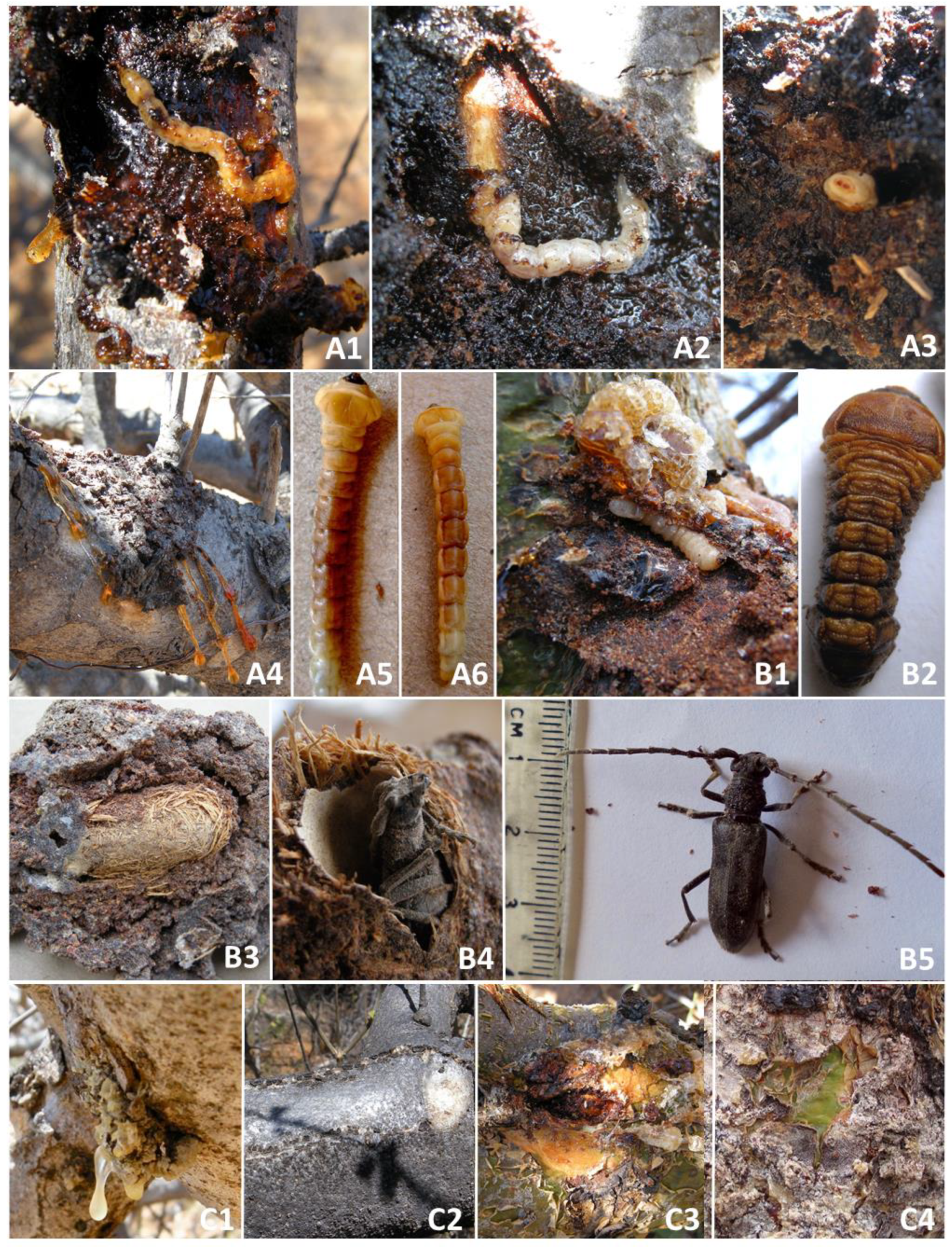
| Boswellia neglecta | Oldonyo Mara hill, South Horr. | May 2015 | Sphenoptera sp. immature larvae | 4 | Fresh black resin was seen dripping from several mature trees. When the fresh resin was peeled back, in all resin samples, immature larvae were found within the resin mass, eating the inner bark, which was thin (ca. 4 mm thick). The chewed indentations were shallow (ca. 4 mm deep) and did not penetrate the heartwood (Figure 1(A1)). Four larvae were lifted out of the resin with twigs, and stored in 2 mL spirit vials. |
| B. neglecta | Mathews Range. | Aug 2017 | Sphenoptera sp. mature larvae | 1 | Fresh resin collected by Samburu collectors, from the foothills of the Mathews range, was delivered to the first author. During resin sorting, several mature larvae were noted, feeding inside the fresh resin. One larva was lifted out of the resin with a twig and stored in a 2 mL spirit vial. |
| B. neglecta | Summit of Lemogor hill, Milgis. | Feb 2021 | Sphenoptera sp. - | - | Aproximately 15 mature trees were examined in a dense woodland of B. neglecta trees. All trees had had insect infestations, indicated by healed over indentations. Examined trees showed complete recovery from larval chewings under resin (Figure 1(C1,C2). Excessive damage or tree mortality was not noted from insect invasions. |
| B. neglecta | Summit of Laikawa hill, Milgis. | Aug 2021 | Sphenoptera sp. mature larvae | 4 | There was a woodland of almost pure stands of B. neglecta, with a mixed population of adult and young trees. We examined aproximately 12 adult trees and for each adult tree, there appeared to be up to 5 infestations, each with a lot of resin exudation. All revealed larvae under the resins. One larva was found in a hole under the resin (Figure 1(A3)) and another appeared to be making a hole under the resin (Figure 1(A2)). Often, we found the insects had burrowed under the intact bark of the tree, which concealed both the resin and the insects (Figure 1(A4)). The trees showed natural senescence with dead twigs and branches, and most of the exposed dead branches had insect holes and were occupied by a variety of insects. Excessive damage or tree mortality was not noted from insect invasions. Four mature larvae specimens were collected and stored in 2 mL spirit vials. |
| Commiphora confusa | Sera | Oct 2014 | Neoplocaederus benningseni - | - | We examined 240 C. confusa trees in 6 different locations, during a resource assessment conducted by the first author. Of this popuation, aproximately 45% were mature trees. Most of these trees had bark “scabs” showing recovery from shallow scrapings from goats and larval activity (Figure 1(C3,C4)). According to collector information, C. confusa has very regenerative properties, as any cuts or scrapings are sealed off and repaired within 4 months. Tree mortality was not noted from insect invasions. |
| C. confusa | Sera | May 2015 | N. benningseni immature larvae | 2 | Resin was noted on the bark of several trees. Resin was gently lifted on two trees, revealing larvae eating the inner bark (Figure 1(B1)). The chewed indentations (Figure 1(C3)) were shallow (ca. 3 mm deep). The two larvae were gently lifted out of the resin with twigs and put into 2 mL spirit vials. |
| C. confusa | Sera | May 2016 | N. benningseni immature larvae | 1 | Resin was collected from Sera and delivered to the first author. During resin sorting, several immature larvae were noted feeding in the resin. One immature larva was gently prised out of the resin with a twig, and stored in a 2 mL spirit vial. |
| C. confusa | Sera | Oct 2016 | N. benningseni mature larvae | 2 | Resin was collected from Sera and delivered to the first author. During resin sorting, several mature larvae were noted feeding in the resin. Two mature larvae were gently prised out of the resin with a twig, and stored in 2 mL spirit vials. |
| C. confusa | Sera | Oct 2016 | N. benningseni cocoon and cocoon fragments | 1 | Resin was collected from Sera and delivered to the first author. During resin sorting, a complete cocoon made of bark strips and a shell-like substance was found embedded in the resin (Figure 1(B3)). Numerous cocoon fragments were also found within the resin. |
| C. confusa | Sera | Nov 2016 | N. benningseni mature beetles | 3 | Resin was collected from Sera and delivered to the first author. During resin sorting, three beetles emerged from cocoons (Figure 1(B4,B5)). These were captured and stored in 8 mL spirit vials. |
Publisher’s Note: MDPI stays neutral with regard to jurisdictional claims in published maps and institutional affiliations. |
© 2022 by the authors. Licensee MDPI, Basel, Switzerland. This article is an open access article distributed under the terms and conditions of the Creative Commons Attribution (CC BY) license (https://creativecommons.org/licenses/by/4.0/).
Share and Cite
Sommerlatte, H.; Wyk, B.-E.V. Observations on the Association between Some Buprestid and Cerambycid Beetles and Black Frankincense Resin Inducement. Diversity 2022, 14, 58. https://doi.org/10.3390/d14010058
Sommerlatte H, Wyk B-EV. Observations on the Association between Some Buprestid and Cerambycid Beetles and Black Frankincense Resin Inducement. Diversity. 2022; 14(1):58. https://doi.org/10.3390/d14010058
Chicago/Turabian StyleSommerlatte, Hilary, and Ben-Erik Van Wyk. 2022. "Observations on the Association between Some Buprestid and Cerambycid Beetles and Black Frankincense Resin Inducement" Diversity 14, no. 1: 58. https://doi.org/10.3390/d14010058
APA StyleSommerlatte, H., & Wyk, B.-E. V. (2022). Observations on the Association between Some Buprestid and Cerambycid Beetles and Black Frankincense Resin Inducement. Diversity, 14(1), 58. https://doi.org/10.3390/d14010058

