This is an early access version, the complete PDF, HTML, and XML versions will be available soon.
Article

Neurotoxicity of Synthetic Cannabinoid Receptor Agonist Cumyl-PINACA: An In Vitro Study on Rat Cortical Neurons and Astrocytes

by
Damijana Mojca Jurič
1,
Klara Bulc Rozman
2,
Metoda Lipnik-Štangelj
1,
Dušan Šuput
2 and
Miran Brvar
3,4,*
1
Institute of Pharmacology and Experimental Toxicology, Faculty of Medicine, University of Ljubljana, Korytkova 2, 1000 Ljubljana, Slovenia
2
Institute of Pathophysiology, Faculty of Medicine, University of Ljubljana, Zaloška cesta 4, 1000 Ljubljana, Slovenia
3
Centre for Clinical Toxicology and Pharmacology, University Medical Centre Ljubljana, Zaloška cesta 7, 1000 Ljubljana, Slovenia
4
Centre for Clinical Physiology, Faculty of Medicine, University of Ljubljana, Zaloška cesta 4, 1000 Ljubljana, Slovenia
*
Author to whom correspondence should be addressed.
Pharmaceuticals 2026, 19(9), 1436; https://doi.org/10.3390/ph19091436
Submission received: 14 July 2026 / Revised: 4 September 2026 / Accepted: 7 September 2026 / Published: 10 September 2026

Abstract

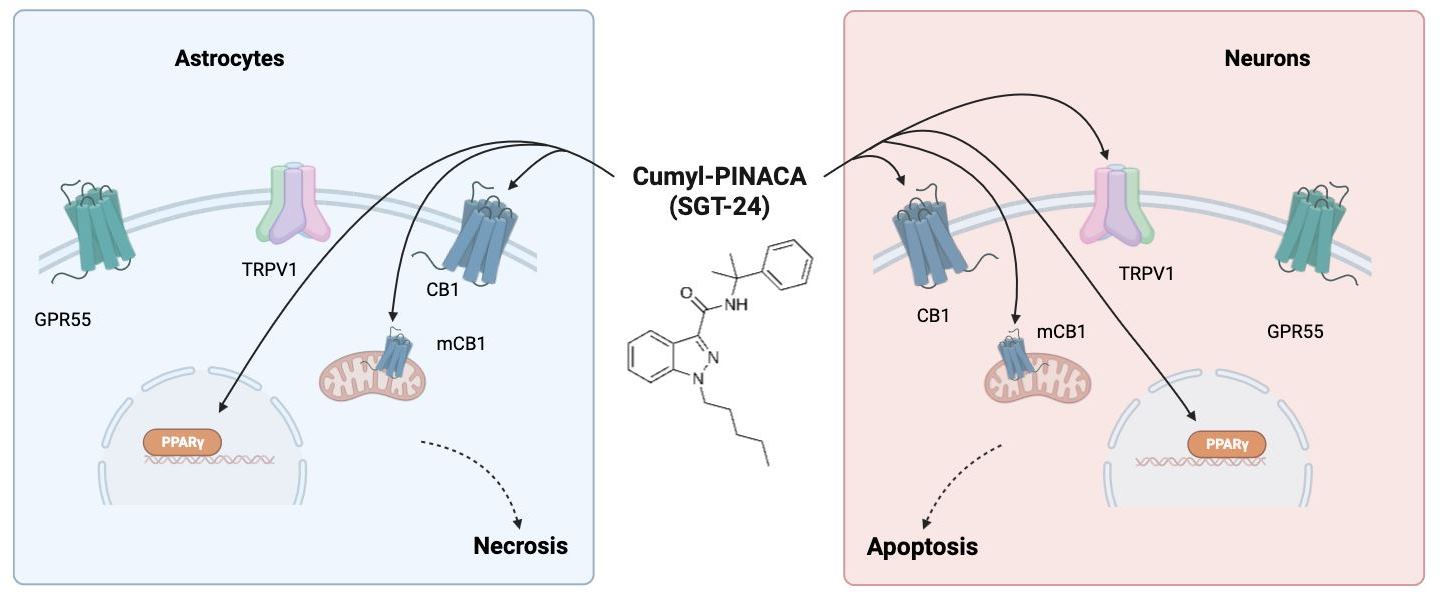
Background/Objectives: Synthetic cannabinoid receptor agonists (SCRAs) are associated with severe neurotoxicity, but the cellular mechanisms underlying their effects remain poorly defined. We investigated the effects of Cumyl-PINACA (SGT-24), a carboxamide-type SCRA derived from cumylamine, on rat cortical neurons and astrocytes. Methods: Primary rat cortical neurons and astrocytes were exposed to 1–10,000 nM SGT-24. Metabolic activity, mitochondrial function, morphology, and cell death were evaluated. Selective antagonists of cannabinoid receptor type 1 (CB1), G protein-coupled receptor 55 (GPR55), peroxisome proliferator-activated receptor gamma (PPARγ), and transient receptor potential cation channel subfamily V member 1 (TRPV1) were used to probe the involvement of these receptor pathways. Results: SGT-24 decreased metabolic activity in both cell types in a concentration- and time-dependent manner, with greater potency in neurons (IC50 = 13.2 nM) than in astrocytes (IC50 = 39.8 nM). After 24 h, maximal effects were observed at 100 nM in neurons and 500 nM in astrocytes, reducing metabolic activity by 45.2% and 36.2%, respectively. At these concentrations, mitochondrial membrane potential decreased to 57.6% and 54.1% of control, while cellular ATP levels fell to 51.6% and 52.5%, respectively. Neurons predominantly exhibited early apoptosis (21.9% of cells vs. 3.1% in controls), whereas astrocytes showed mainly 7-aminoactinomycin D (7-AAD)-positive cell death (19.3% vs. 8.2% in controls). Pharmacological inhibition of CB1, TRPV1, and PPARγ attenuated SGT-24-induced metabolic impairment, mitochondrial dysfunction, and apoptosis in neurons, whereas inhibition of CB1 and PPARγ reduced astrocytic toxicity. Conclusions: SGT-24 exerts potent, cell-type-dependent neuroglial toxicity associated with mitochondrial dysfunction and distinct cell death patterns, suggesting the involvement of cannabinoid receptor-dependent and non-cannabinoid signalling mechanisms. The nanomolar potency of SGT-24 underscores the toxicological risk posed by high-potency SCRAs.
Keywords: synthetic cannabinoid receptor agonists (SCRAs); cumyl-PINACA (SGT-24); neurons; astrocytes; neurotoxicity; receptors synthetic cannabinoid receptor agonists (SCRAs); cumyl-PINACA (SGT-24); neurons; astrocytes; neurotoxicity; receptors
Graphical Abstract